
On my ex and the moon
Recovering from his recent surgery is still extremely difficult for my ex-husband and very stressful. He has post-surgery pneumonia as his most serious problem at the moment, although not his only problem.
Yesterday I was at the hospital much of the afternoon and came home around 8:30 PM, but he called me again at around 11:00 PM and sounded awful. I simply couldn’t relax about it, and since I live just a few minutes from the hospital I went back there to check it out.
Fortunately, he was asleep. And also fortunately, I had a long talk with the nurse and she reassured me about various things. He’s certainly not out of the woods, but she seemed competent and on top of things.
And then, when I returned home and got out of my car, I happened to look up to the sky. The moon looked very unusual, and it occurred to me that this might be a lunar eclipse. So I got out my trusty cellphone and sure enough, it was! Plus, just by chance I happened to be stepping out of my car at the exact peak minute of the eclipse.
So that’s the silver lining, I guess.
Whatever the verdict, Lindsay Clancy is extremely unlikely to be getting out quickly
The jury is deliberating in the Clancy trial.
I am fairly certain she won’t be “getting off,” whatever the verdict. If she is found to have had diminished capacity due to psychosis, her stay in a mental hospital will be very long, IMHO. She brutally murdered her three young children. That is the reality, and they’re not just letting her out in a month. My guess is that she would be staying for many many years and perhaps even for life.
For example, Andrea Yates – who killed her 5 children in Texas in 2001, twenty-five years ago – and was found found guilty but ultimately found not guilty by reason of insanity (see this for the twistings and turnings of her legal situation), is still institutionalized in a mental hospital. Massachusetts is different than Texas of course, but here’s how it works in Massachusetts:
Massachusetts law says the court can order her hospitalized for up to 40 days for “observation and examination,” and prosecutors or hospital officials can then petition for involuntary commitment to a psychiatric facility.
If a judge determines Clancy is mentally ill and releasing her “would create a likelihood of serious harm,” she could be committed to a facility, the law states. The initial commitment is generally valid for six months and can be renewed in one-year periods.
“She’ll never be released unless there’s a finding by a judge that she doesn’t represent a danger to herself or others,” Rossman said.
She might never get out. Also, she’s probably still a suicide risk, although as a paraplegic she might have trouble accomplishing it.
If I had to guess, I’d predict the jury will be hung. But that’s 100% a guess.
Maybe it’s time to get a dashcam
This sort of scam has been going on in California for decades; I first heard of it a long time ago, when a friend was a victim.
Now, though, with the advent of dashcams, it’s easier to prove it and even to find the perps:
A crew of bozos targeted unsuspecting drivers in a series of staged crashes on busy Big Apple highways — scoring more than $80,000 in insurance payouts before a viral video brought the fraud ring down.
Jaime Huiracocha, 53, and Victor Murillo, 34, will respectively serve at least one year and two years in prison after pleading guilty to insurance fraud charges, Queens District Attorney Melinda Katz announced Thursday.
Katz credited the TikTok clip — of a Honda Civic brazenly backing into another vehicle on the Belt Parkway after a near-miss collision — shown to her by her 15-year-old son with jumpstarting the investigation that uncovered three crashes staged by Huiracocha and Murillo.
The guy on the right has a charming set of tattoos:
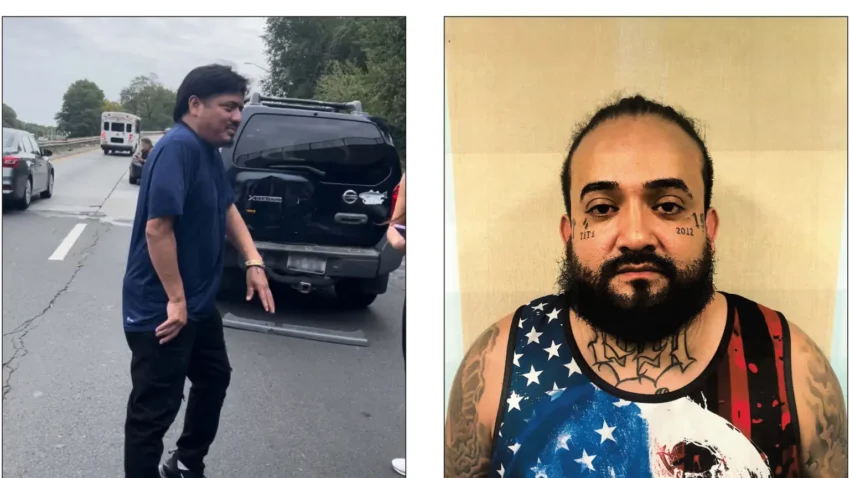
A commenter there points out that retrofitting a car with a dashcam isn’t all that expensive.
Do Dash Cams Work in Older Vehicles?
In most cases, the answer is yes.Modern dash cameras are designed to work independently of the vehicle’s factory electronics. They require only a few basic things to function properly:
a 12-volt power source
windshield mounting space
cable routing through the interior
Because nearly all vehicles include these components, dash cameras are compatible with the majority of cars manufactured since the early 2000s.In fact, older vehicles sometimes make installation easier because their electrical systems are less complex than those found in newer vehicles.
You can get a decent dashcam for under two hundred dollars, apparently. And installing it typically costs another $100 to $250 (depending on the type; see this, for example). Whether you might want one depends on where you live and usually drive.
Things that are no surprise
(1) The Massachusetts judge who blocked Trump’s mail-in voting rules has blocked them again, despite the recent SCOTUS ruling lifting her first injunction:
Remember, the Supreme Court did not decide the rule on Monday. The majority said the states and District of Columbia sued over the new rule too early because the USPS had not finalized it.
Well, the USPS finalized the new rules on how to handle mail-in and absentee ballots on Wednesday.
The defendants returned to [US District Judge Indira] Talwani with the rule, arguing the USPS exceeded its authority and inserted itself into federal elections.
Talwani determined the plaintiffs will likely succeed on the merits and face irreparable harm. She also said the balance of harms and the public interest warrants the temporary restraining order.
It probably will go back to SCOTUS again. One of the left’s tactics is to try to run out the clock as much as possible.
(2) Even in golf, “trans women” (biological men) are winning:
At least four women’s golf tournaments in Canada have been won by men this summer.
At least golf isn’t a contact sport in which men playing alongside women can physically harm women. But men can still have somewhat of an advantage:
We conducted a natural experiment, using publicly available data, comparing world class men and women golfers’ performances on their respective tours. Performance and course data were collected on all 50 PGA and 32 LPGA Tournaments in the 2021-2022 season and differences between the tours were identified. The lengths of the courses and holes on the LPGA Tour were approximately 90% of those on the PGA Tour. Overall, women had better driving accuracy than men but scored fewer eagles and rounds in the 60s. Anthropometric and physiological differences likely contribute to women’s adapted movement strategies during the swing and cause them to choose playing strategies that men do not, primarily in driving and approach shots. Altogether, our results suggest that women’s golf courses are likely not sufficiently scaled according to anthropometry or physiology. Thus, golf remains more demanding for women, which may, at least partly, explain their differences in performance compared with men.
(3) Chinese bot farms are campaigning against US AI centers.
You don’t say.
Roughly 200 accounts from a suspected Chinese bot farm have quietly tried to influence Americans to oppose AI data centers on social media, X said Thursday night.
Why it matters: The U.S. and China are racing to build the world’s most advanced AI systems — and it appears Chinese propaganda has infiltrated American circles with the hope of slowing the U.S. down.
Driving the news: The X Safety team probed suspected Chinese accounts involved in influence operations and identified 200,000 accounts, including 200 accounts “posting in a manner that could manipulate a legitimate debate about American AI and energy policy,” the team said in a tweet.
(4) Hand-washing is more effective against a wider range of pathogens than hand sanitizer. Duh.
(5) Mamdani seems to have more sympathy for the death of a killer than for the death of his victim:
Jose Miranda stopped by a laundromat in The Bronx to wash his clothes one hot August day two years ago, and was hacked to death, randomly, by a maniac with a meat cleaver.
He left behind two boys.
His convicted killer Clarence Woodward recently died at Riker’s; we don’t know how. Mamdani commented:
“I am deeply saddened by the death of a New Yorker in City custody at a jail on Rikers Island early this morning,” the mayor wrote.
“My thoughts are with his family and loved ones as they grieve this loss.”
But why would the mayor offer his solemn sympathies to the Woodwards while having nothing to say in support of the Mirandas?
The question answers itself. And it would have taken so little effort to have said something decent to the Mirandas as well.
Open thread 8/28/2026
Update on my ex-husband’s health
Well, it hasn’t been a barrel of laughs lately.
Without violating his privacy with Too Much Information, I’ll just say that eight days ago I took my ex-husband to the ER and he was diagnosed with two dangerous but not-likely-to-be-lethal conditions. At least one of them would absolutely be needing surgery, so they sent him home with instructions to call a surgeon and make an appointment. The ER was full with a long wait. And the surgeon couldn’t see him for almost two weeks.
Meanwhile, at home, he wasn’t feeling well. He didn’t want to go back to the ER and be sent home again, and it didn’t seem worthwhile to me either. But over the next five days he seemed to be deteriorating, and he wasn’t eating much at all. On Monday he was so ill that I called 911. They took him back to the ER, where they repeated the tests and decided this time to admit him, and that he had to have surgery – pronto. So instead of having a scheduled surgery with the preferred surgeon, it was pot-luck surgery at midnight the very day he came back to the hospital.
Fortunately, the team repaired the problem. But my ex developed a few complications and is still in the hospital. I’m the designated helper, and I’ve been going over there for quite a few hours every day. The staff has been pretty good, but they seem overworked because the place is very full.
However, there was one incident that really angered me – although it has nothing to do with the medical aspect of things. There was a middle-aged lady who came around to officially inform him of his Medicare rights – things like ye olde Patients’ Bill of Rights and the fact that if the hospital tries to kick you out prematurely, you can protest. That sort of thing. When she finished her spiel she said that we needed to vote in November, and not to vote for “that person” (she clearly meant Trump even though he’s not on the ballot) because he was going to end Medicare.
Extremely unprofessional and inappropriate, not to mention incorrect. I surprised her by snapping at her, and I’m contemplating reporting her but not while he’s still in the hospital.
Khalid Sheikh Mohammed: the wheels of justice grind slow
A military trial is planned – for 2028. Why so slow?:
A military judge ruled Wednesday that the man accused of being the mastermind behind the 9/11 attacks will stand trial starting in June 2028.
Khalid Sheikh Mohammed will be prosecuted alongside others suspected of conspiring in the attacks: Walid bin Attash, Ali Abdul Aziz Ali and Mustafa Ahmed al-Hawsawi. …
The trial date was announced after a split federal appeals court last summer threw out a potential agreement that would have allowed Mohammed to plead guilty in exchange for sparing him the risk of execution. …
The road to prosecute Mohammed and other conspirators has dragged on for years, with the Obama-era military commissions system being tested for the first time — at times leading to lengthy challenges to its rules.
Defense lawyers have also argued that the holdup comes from what they say are the government’s efforts to hide details of torture used against detainees at secret CIA prisons before they were transferred to Guantánamo Bay.
We’ve heard plenty about that, actually.
Mohammed should have been tried in military court long ago. It’s not at all certain he will be tried in 2028, either. He is now 61 years old, so he could end up living out his years on Guantanamo.
Also:
Past trial dates have come and gone several times, and Schrama is the fifth judge to oversee the case.
Victims’ families have been outraged that they’ve yet to see justice done, with some relatives telling The Post Wednesday they hope the latest trial date will stand.
“We have been asking for a trial date for 20 years. Hopefully, this time it is for real,” said retired NYPD officer Jim Smith, whose wife Moira Smith died responding to the attacks.
“It’s all going to depend on the judge. We’ve been through so many, some good, but mostly officers who wanted nothing to do with this case,” Smith said. “Someone has to man up and take charge.”
Agreed.
But in Canada at the CBC, don’t call Khalid Sheikh Mohammed a terrorist. Word has come down:
“This week, I received a memo — presumably confidential — addressed to CBC News staff. It is authored by one Basem Boshra, who is the “Senior Director of Journalistic Standards and Public Trust at CBC News.” In Boshra’s memo, reporters are editors are told this:
“Do not refer to the Sept. 11 attacks as terrorist attacks.”
Boshra states that all in bold letters, italicized, as if to emphasize the point. To make clear it is a directive, not a suggestion.
I can’t find much more about Basem Boshra, but the name is considered of Arab or North African Muslim descent. Oh, Canada!
News roundup
(1) What Gaza famine? UN data doesn’t support the famine story.
(2) The New Hampshire Senate race is described here as “flying under the radar.” It’s not flying under my radar, as a New Englander. It’s a close race and the probable Republican nominee and ex-senator John Sununu has a chance of victory, but the state of New Hampshire has gotten much bluer in recent years. If Sununu’s brother, the former NH governor, had been running, I think he’d win. I’m less sanguine about John’s chances, but I’m hoping.
(3) There’s a drive to name the Nashville airport after Dolly Parton. Hey, why not?
(4) Many UNRWA employees seem to have been assisting in the 10/7 massacre.
(5) El-Sayed of Michigan wants to know whether Fox’s Jesse Watters is circumcised. And no; despite being a medical school graduate, El-Sayed is not Watters’ doctor – or any kind of doctor at all. He also seems to be analogizing circumcision with orchiectomy and penectomy trans surgery. Watters seemed stunned by the question, but I think he might have asked El-Sayed how much a manicure resembles an arm amputation.
(6) There have been terribly lethal floods in Nepal, with many dead and missing. RIP.
Open thread 8/27/2026
SCOTUS ruling on mail-in voting
In a 6-3 ruling, the high court granted a request for emergency relief sought by the Trump administration late last month in a case involving 23 Democratic-led states. The Justice Department had asked the Supreme Court to lift a lower court’s injunction that stopped agencies from carrying out parts of Mr. Trump’s directive, which involves the Department of Homeland Security and U.S. Postal Service, in those states and the District of Columbia.
The high court said in its unsigned decision that the states filed their lawsuit too soon.
“The Court’s disposition of this application does not mean that any measure taken by the Government to implement the Order will necessarily be lawful,” the Supreme Court said in an unsigned decision. “On that score, time will tell. But the Order itself does not harm the States, so the District Court lacked jurisdiction to bar the Government from trying to implement it.”
The move from the high court clears the way for the Department of Homeland Security to move forward with a proposal to create lists of residents in each state who are eligible to vote.
But it’s getting awfully close to election time. For Democrats, that’s a feature and not a bug.
Yesterday’s primaries
Lindsey Graham’s sister Darlene won the South Carolina GOP primary and will be the nominee for Senate in that state. South Carolina is a red state, but she is an unknown quantity. Trump endorsed her – I’m not sure why; perhaps out of loyalty to his friend Lindsey Graham? I’m not at all sure she was the stronger candidate. But hopefully she’ll be strong enough.
In Oklahoma, the Democrat primary for the Senate was won by – you guessed it, another socialist. N’Kiyla Jasmine Thomas is the name, and if this story sounds familiar it’s because it is familiar:
Thomas, a 31-year-old member of the Chickasaw Nation, defeated attorney and minister Jim Priest, 70, in the contest, despite being drastically outspent. …
Thomas is “a self-proclaimed democratic socialist,” she told NBC News in an interview Tuesday morning, though she said she is “not yet” a member of the Democratic Socialists of America. She described democratic socialists as “the next generation” that is “looking to change the system.”
Oklahoma is a red state, and so the Democrat nominee is generally just going through the motions. But these DSA and DSA-adjacent wins remain shocking although not surprising.
The Republican primary winner in the Oklahoma governor’s race was Trump-backed Mike Massei, but the results were close.
I’m already weary of the 2026 elections. And I’m most definitely anxious about them.