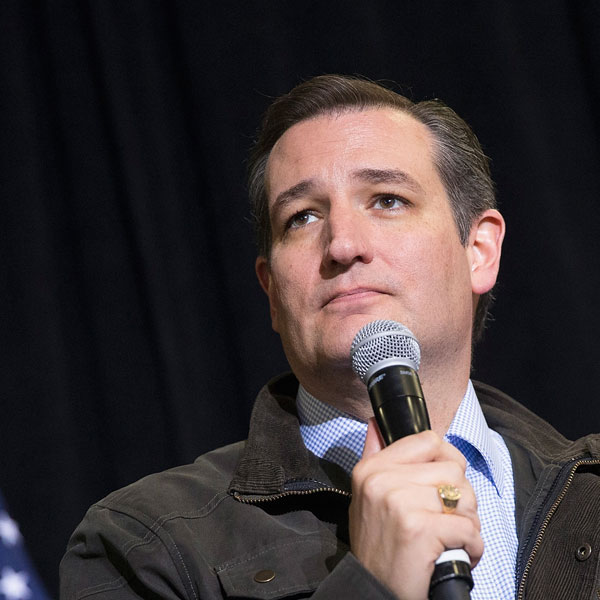
Here’s one plausible scenario. It’s worth reading the whole thing, but here’s an excerpt:
…[T]he assumption is that Cruz cannot improve his image among the broader electorate, but that’s hard to know for sure, because he’s never had to do it. While opinions on Clinton are deeply entrenched after her decades in the public spotlight, Cruz isn’t as universally known and has more of an opening to get a second look.
Cruz would enter the general election campaign with a reputation as an extremist, which the Clinton campaign would do everything to play up. But the risk of such a strategy comes if Cruz is able to defy such a caricature during the election among voters getting to know him for the first time.
To quote Shakespeare’s Prince Hal: “By so much shall I falsify men’s hopes/And like bright metal on a sullen ground/My reformation, glittering o’er my fault/Shall show more goodly and attract more eyes/Than that which hath no foil to set it off.”
In other words, Cruz is less of a known commodity to most voters, and he is therefore more likely to be able to improve his image if he can just soften up just a bit.
First, of course, the nomination would have to happen.
Here’s a sample from Salon of the sort of thing you’ll see from the left if Cruz is the nominee. The left will attack any GOP nominee, of course, but there are different approaches for different people. One of the main approaches his opponents will take against Cruz will be that he’s hated by all as well as being way to the right of practically everyone on earth. But the author of that Salon article also seems worried that Cruz will somehow manage to sustain the pretense of being a normal human being, or some approximation of one, long enough to fool the public into voting for him. That fits in more or less with the quote I gave from the first (pro-Cruz) article, as well—the idea that all Cruz needs to do is to prove he’s more or less human and some of the attacks could be blunted.
I also noticed today that in this Powerline post by Paul Mirengoff a quote from a NY Times article on Cruz:
The Times says that some big donors are put off by Cruz’s personality. They complain that even in private, he comes of as sanctimonious and unable to present a persona that’s appreciably warmer than what one sees on television.
I’ve heard the latter point raised by in Washington who are no less conservative than Cruz. It may be a valid insight. But at this juncture, it’s not a good reason to withhold support from the man who stands between the abominable Donald Trump and the Republican nomination.
As Mica Mosbacher, a Cruz fund-raiser and wife of the late Robert Mosbacher, Secretary of Commerce under George H.W. Bush, puts it, “[Cruz] might not be the most fun to have a drink at the bar with, but America needs a designated driver.”
Putting aside the fact that it’s Trump who actually doesn’t drink, and that Cruz does, the metaphor is so apt that Cruz himself made it at a debate last October:
“If you want someone to grab a beer with, I may not be that guy,” he said, when asked to name a weakness. “But if you want someone to drive you home, I will get the job done and I will get you home.”
So, what does America need—a fun beer companion, or a designated driver? I’ve always been immune to this idea of electing someone based on “likeability,” but I concede that all else being equal it’s a wonderful and very appealing trait for a candidate to have, and it can make up for a multitude of sins. Personally, however, I find Cruz not only more likeable than Donald Trump but more likeable than Hillary Clinton and Bernie Sanders and Kasich as well (Rubio was the generally “likeable” one, but he’s gone). So we have a parade of unlikeables this year, which would seem to put whatever it is that people don’t like about Cruz in some perspective.
What is it that they don’t like? I think it’s that he never really seems spontaneous (not to mention the face). He’s always measured and studied and under strict control. I happen to think those are great traits in a president, but I may not be the least bit typical of most voters.
That Times article quoted by Mirengoff also mentions the word “sanctimonious” being applied to Cruz, and that may be a key as well. This is what the word actually means:
1 : hypocritically pious or devout…
2 obsolete : possessing sanctity
So the word “sanctimonious” has, over time, taken on a suggestion of insincerity and even hypocrisy, but originally it merely meant religious or holy. It’s actually not clear whether those being quoted in the Times article as having said it about Cruz meant that found him overly religious–or hypocritical about his religiosity (there’s no indication in the article of the latter; what it seems to be saying is that he won’t compromise his core beliefs, which is the opposite of hypocrisy). For many people, particularly on the left, either one—actual religiousness or religious hypocrisy—would be bad. But my guess is that sincere belief would be worse to them.
It’s of interest to me that criticisms of Cruz and his religiosity often take the form of contradictory pleadings: he’s way way too religions—and besides, he’s a hypocrite and doesn’t really believe all that stuff. Which is it? The attempts to smear Cruz with accusations of sexual affairs with multiple women was and is an effort to prove that he’s a hypocrite. But the charge that he’s not a hypocrite but is in fact sincerely very religious also works well for those predisposed to not like him. For me, the extent of his religiousness would only be an issue if he were not a small government conservative. But since he’s the latter and I don’t see him as trying to impose his religious beliefs on others through government compulsion, I see no problem whatsoever, and whether I share or don’t share his religious beliefs is irrelevant. Hypocrisy is another question; it could matter. But I have seen no evidence that he’s a hypocrite about his religion.
Would Cruz’s personality hold him back from working well with other people in government were he to win an election? I don’t know, but one thing I’ve noticed is that we haven’t heard about a lot of turmoil among those who are working for him in this campaign. That’s not just true lately, now that he’s doing better, but it seems to have been true even earlier in the game, when he was low in the polls. And the Times article says that he’s well-liked by people in Texas who know him:
He is regarded warmly among Republicans in his home state, Texas, where he has deeper personal relations with a wider portion of the donor class…
When Mr. Cruz appeared recently on “Jimmy Kimmel Live,” the late-night host took note of his patience in winning new friends.
“What you did is, you kind of held out until they found someone that they liked less than you,” Mr. Kimmel said.
“There you go,” Mr. Cruz replied. “Listen, it is a powerful strategy.”
I wish Cruz were a more instantly affable-seeming fellow. Having observed him in person, though, I will say that he came across as quite likeable (“likeable enough”) in a casual venue. Would he wear well over time in a general election? I don’t know, but he’s improved his standing over the course of the campaign so far.
Maybe it’s time for me to start a “Ted Cruz” category on this blog.
[NOTE: In that Salon piece, I found the following rather amusing:
Throughout the interview, this wily Ivy League educated lawyer presents himself as the champion of the working class, the guy whose only concerns lie with the single mom who works as a waitress and the dad who lost his job down to the plant and can’t get ahead.
With a change of pronouns, would that not be a good description of Hillary Clinton as well?]