
↓
 

The New Neo

A blog about political change, among other things

  • Home
  • Bio
  • Email
Home » Page 1070 << 1 2 … 1,068 1,069 1,070 1,071 1,072 … 1,916 1,917 >>

Post navigation

← Previous Post
Next Post→

The GOP primaries and the dropouts: what will happen now?

The New Neo Posted on February 10, 2016 by neoFebruary 10, 2016

Why pay attention to a primary in a tiny state like New Hampshire? Is it just that it’s the primary primary in terms of the calendar? Doesn’t that mean it has a disproportionate influence? And isn’t its population not only small, but non-representative?

The answers are pretty much “yes.” But still, along with Iowa (which is a caucus), it’s the only real-world evidence we have so far. And like it or not, New Hampshire creates a buzz and provides momentum. In that case, Trump supporters must be very very happy.

As someone who most definitely does not support Trump, I am hoping for dropouts, the sooner the better, and lots of them. The greater the number of people who think they’re still in the running, the greater the number of people who will hang on. Even though Kasich, for example, has hardly a chance long-term, why would he drop out now? And certainly Bush won’t. Ben Carson, who paid little attention to NH and has barely reached 2% there, appears to be headed for South Carolina, the next primary state, where he is polling better.

Fiorina was one of my early favorites, and though it makes me sad to say it, she didn’t catch on and she won’t catch on, and I was about to add that she needs to give up and give others a chance—something I happen to think Carson should also do. But I just learned that she has dropped out, which shows good judgment, although I actually think she should have done it before New Hampshire.

In a post I put up about two hours ago, I mentioned that Christie should drop out, and reiterated an earlier statement of mine that on Saturday night, “Christie was like a drowning man who reaches out to another person and tries to pull him under too.” Sure enough, Christie has just announced his departure from the race. Good riddance.

I predict that South Carolina will be a repeat of NH, except that Kasich’s number two spot will probably go to Ted Cruz, and the rest of the vote will be split among what I will now start to call the moderate candidates: Bush and Rubio in particular (Rubio being more conservative than Bush, but less conservative than Cruz), with Kasich doing very poorly there. Carson will do somewhat better (if he stays in, which I think he will do).

It all comes down, however, to who will drop out and when, and where will their votes go. If it comes down to three people, for example—Trump and two others, let’s say Cruz and Rubio, or it could be Cruz and Bush—what happens? Do the voters split into roughly even thirds, and do they then limp on like that in an uneasy troika, right up to the finish line and perhaps a brokered convention? Or does one non-Trump person pull ahead by drawing most of the votes of the dropouts? Has a controversial candidate such as Trump already attracted most of the people who might ever be persuaded to vote for him, or can he appeal to significantly more as the field winnows and get the nomination?

I have been disturbed but not surprised that the field hasn’t winnowed so very much yet. I fear that self-interest on the part of each candidate, and deep pockets for some, argue against its happening soon enough. Who would be the candidate[s] willing to take one for the team? As Matthew Yglesias points out:

The establishment’s consistent dream, ever since Trump rocketed into a national polling lead, has been that consolidation of the “establishment lane” candidates will lead eventually some someone from the Rubio/Bush/Christie/Kasich foursome taking a strong lead. The problem for the establishment is that New Hampshire is the only state where this would have actually worked. Had supporters of those four men all united behind a single candidate, he would have won.

But they didn’t…

So far, the establishment has been trying to beat Trump with wishful thinking. It keeps not working. Trump could self-destruct or drop out for no reason at all. He could be abducted by aliens. Who knows? But merely hoping for those things is not a plan. The plain reality is that right now he is on course to win the nomination unless some concerted effort is made to stop him. And so far, there’s no sign that any such effort is underway. Republican leaders not actively involved in the campaign simply seem baffled and stunned into indifference. And they’re running out of time.

.

If it’s any consolation (and to me it is not), the same muddled incompetence that the establishment GOP has shown in fighting the Democrats it now shows in fighting for its own survival. That argues in favor of “fools” in the “fools vs. knaves” controversy (some, of course, would say “both”).

Too many cooks spoil the pot. Too many candidates spoil the—GOP chances? If the all-powerful much-feared-and-hated “establishment” could coalesce around one candidate (the un-Trump, the anti-Trump), their candidate would have a decent chance of wining, perhaps a good chance. But at the moment, it seems most likely that by the time the South Carolina primary is over, the leading non-Trump candidate would be—if numbers are what you’re looking at—Ted Cruz. After all, he won Iowa, he came in third to Trump and the anomalous Kasich in NH, and he will probably come in second to Trump in South Carolina.

David French explains why his NH primary showing was even better for Cruz than it seems. It has to do with what he was up against, and how little effort he expended:

First, Cruz spent just 27 days in New Hampshire, about half the number of Bush and Fiorina. Kasich and Christie both spent more than 70 days, and even Rubio was in New Hampshire more than Cruz. Even more importantly, Cruz spent very few resources on New Hampshire: Less than $1 Million combined between the campaign and SuperPACs. Compare that to Bush, whose combined efforts spent $35 Million in New Hampshire, while Christie spent $18 Million, Rubio $15 Milllion and Kasich $12 Million. All of them were beaten by Cruz in a state that was supposed to be a bad fit for him. Cruz enters the South Carolina primary with by far the largest war chest of any GOP candidate in hard campaign dollars and has by far the most extensive grassroots fundraising network to add to that total. Furthermore, he’s best organized candidate in the coming states in the “SEC Primary” March 1, and is the only candidate in the field right now who definitely has the resources and organization to compete throughout the primary season. A Southern supporter of Trump’s recently lamented that “Cruz is actually running the perfect [expletive] campaign” and while there are still many roadblocks in his way Cruz’s pathway to the nomination has never looked clearer.

The dilemma for the establishment is that Ted Cruz is not their guy. If you ask who they dislike more, Trump or Cruz, the answer would almost certainly be Cruz.

That argues against their backing Cruz, but if they don’t it would play into Trump’s hands. Common wisdom would say that a two-person race is more likely than a three-person race to lead to the defeat of Trump, but if the two people are Trump and Cruz, then the establishment is likely to want a third. It almost doesn’t matter who it is, but Bush would be the obvious choice, or perhaps Kasich (despite the fact that he’s less popular than Bush). Rubio could be a sort of honorary establishment choice, because he’s a bit too conservative to be a natural for them, but they probably would take him in a pinch. His trajectory was halted by the drowning Chris Christie, though, and it’s unclear whether he can start the climb again.

[NOTE: Here’s a good piece on the prospects.]

[ADDENDUM: Here’s Carly’s farewell message, which is excellent. Hint: it’s not exactly farewell, although she is indeed dropping out of the running.]
Posted in Election 2016 | 58 Replies

Initial NH primary reflections

The New Neo Posted on February 10, 2016 by neoFebruary 10, 2016

Donald Trump did about as expected in NH: very well. About a third of the people who decided to vote in the GOP primary race went for him, and if you look at the NH polls over time, you’ll see that he’s hovered around the low 30s there ever since he first started catching on last summer.

So the polls were fairly accurate about Trump in NH. They were pretty accurate about the others, as well. The number two guy Kasich has been polling at about 17% recently. And by gum, he’s sitting fairly close to that at 15.8 as I write this, with 98% of precincts reporting. What’s more, he’s been doing well in NH for many months. Kasich, however, is not expected to do well elsewhere (he practically became a NH resident since last summer, he was there so often).

As for Bush, he did just about as polls predicted, too (11% right now). He’s stronger in NH than in most other states, for similar reasons to Kasich: he’s spent a lot of money there, and he’s got a lot more money than Kasich had to begin with, so he probably has a great deal more left. Also, as I wrote in this post, NH may be quirky but it has strongly tended to favor moderate Republicans, and that would make it especially good territory for both Bush and Kasich.

And indeed, moderate Christie did well there, too—that is, if you don’t look at “well” in the objective sense, and you just compare his standing in NH to his abysmal support numbers in other states. In NH he’s running at 7.4 right now, but he is doing so poorly elsewhere that rumors are that he may drop out of the race, and certainly suggestions that he should (and it can’t happen soon enough for me, I must say). As I wrote in this comment, during that fracas on Saturday night with Rubio, Christie was like a drowning man who reaches out to another person and tries to pull him under too. That appears to me, at least to a certain extent, pretty much what happened.

That brings us to Rubio (10.6 right now). You can see that Cruz, Bush, and Rubio all are clustered close together around third place, but Rubio is the last of the three. Rubio has not visited NH much, but in general he was polling somewhat better than his performance yesterday, and the evidence is not that his supporters left him so much as late-deciders (and there are a lot of those in NH) went to Kasich rather than Rubio (I heard this cited on TV as being evidenced by exit polls).

Then there’s Cruz, who campaigned very little in the state but did about as polls predicted at 11.7, which means he slightly edged out Bush for third. This is surprisingly good in a state like NH, which is more moderate than conservative and not particularly religious.

All in all, the pollsters should be proud—and especially proud because this was in notoriously-difficult-to-forecast NH. And Trump supporters are very happy, with Cruz supporters a little bit happy. Kasich is overjoyed, but unless he’s completely out of touch with reality, he shouldn’t be all that happy. Bush is probably satisfied, and Rubio apologized to his supporters and made a promise:

Christie is probably very angry about his NH results, especially since he spent a lot of his money and time there. Of course, Christie’s default emotion appears to be anger, but he can comfort himself with the idea that Democrats and Trump-supporters, as well as others who were already angry at Rubio, will love him forever.

As for the Democrats, Sanders’ victory there was also no surprise. I would hate to have been around Hillary last night, but I still don’t think she’s all that down and out in the long run. But NH had to have been a bitter bitter pill compared to what she expected when she was contemplating the prospects of a 2016 run, which must have seemed as though it would be a coronation. Now the race moves to the South, where the demographics would appear to favor her.

Posted in Election 2016 | 25 Replies

Ted Cruz and tone

The New Neo Posted on February 10, 2016 by neoFebruary 10, 2016

There’s been quite a bit of talk about a recent appearance of Ted Cruz’s at a New Hampshire church, where he tells the sad story of his half-sister and her addictions. A lot of people who’ve seen the video have said it shows a different side of Cruz, one that’s more human and warm, a side voters need to see.

On watching it, I agree. But obviously he can’t be working in sob stories every time he speaks; that would be both absurd and exploitative of the suffering involved. But as I listened to him, it occurred to me that his relative warmth here is not just conveyed by the subject matter. It’s signaled by a marked shift in his tone and manner from his usual declamatory style with many studied pauses for emphasis, a style he probably learned as a master debater when he was a student.

I wonder if there’s a way Cruz can drop at least some of that and just talk, as he does here, when he’s speaking of things that are less emotional, like policy? After all, all he’s doing here is adopting a more conversational tone, he’s not weeping and wailing and carrying on:

Posted in Election 2016, Language and grammar | 8 Replies

Fool or knave: on the interview in which Obama called ISIS the “jayvee”

The New Neo Posted on February 9, 2016 by neoJuly 1, 2016

[NOTE: Even though this is somewhat of an old topic, I’m taking it up because of the revival of the “Obama, fool or knave?” argument the other day.]

We all know that Obama called ISIS the “jayvee” back when it had already taken over quite a bit of territory and was slaughtering great numbers of innocent people. It was so transparent an error even back then that it’s become nearly legendary in its ignorant, arrogant, wrongheaded condescension.

The time was January, 2014. The interviewer was a friendly admirer, David Remnick of The New Yorker. The article describes Obama as doing a number of things that—had they been, for example, done by President George W. Bush—would have been spun and criticized for weeks. For example, Obama says he never watches any Sunday news shows, although on the day of the interview those shows were showing reactions to Iran’s agreement to freeze its nuclear program for six months. Instead, Obama played basketball. After that, he embarked on a three-day fundraising trip to hobnob with rich donors. The Remnick interview is a long one, and it took place on Air Force One at the outset of that trip.

When Remnick goes to the front of the plane to talk to Obama, the president is watching a football game on TV, and Remnick adds, without any emphasis:

As we talked, mainly about the Middle East, his eyes wandered to the game.

I repeat: imagine if George W. Bush has done all of this. Imagine.

The Remnick interview started with some small talk about the game, while Obama chewed some Nicorette. At this point in the article, Remnick digresses to mention the following:

When Obama leaves the White House, on January 20, 2017, he will write a memoir. “Now, that’s a slam dunk,” the former Obama adviser David Axelrod told me. Andrew Wylie, a leading literary agent, said he thought that publishers would pay between seventeen and twenty million dollars for the book””the most ever for a work of nonfiction””and around twelve million for Michelle Obama’s memoirs. (The First Lady has already started work on hers.) Obama’s best friend, Marty Nesbitt, a Chicago businessman, told me that, important as the memoir might be to Obama’s legacy and to his finances, “I don’t see him locked up in a room writing all the time. His capacity to crank stuff out is amazing. When he was writing his second book, he would say, ”˜I’m gonna get up at seven and write this chapter””and at nine we’ll play golf.’ I would think no, it’s going to be a lot later, but he would knock on my door at nine and say, ”˜Let’s go.’

“The most money ever for a work of nonfiction”—no wonder Obama thinks he’s the most amazing, competent, and smartest guy on the planet. And whether he writes his own books or not (and think how Marty Nesbitt’s story might reflect on that question), I have to say that the excerpts I’ve read from The Audacity of Hope certainly read as though someone (perhaps Obama himself) wrote the chapters in less than 2 hours.

Note again the emphasis on quick work and then off to play golf. And that was when Obama was a senator.

As I said, the Remnick article is long. Along the way there are a lot of the obligatory digs at Republicans and respect for Obama, but one passage that struck me as ironic (and which I doubt that subsequent events have ever caused Remnick to revisit) is this one:

Toward the end of Obama’s speech, Ju Hong, a Berkeley graduate, broke in, demanding that the President use his executive powers to stop deportations.

Obama wheeled around. “If, in fact, I could solve all these problems without passing laws in Congress, then I would do so, but we’re also a nation of laws,” he said, making his case to a wash of applause.

Later Obama is about to address another crowd, and this exchange occurs:

Obama turned to his aides and said, “How many we got out there?”

“Five hundred. Five-fifty.”

“Five-fifty?” Obama said, walking toward the wings of the stage. “What are we talking about? Politics? Can’t we talk about something else? Sports?”

Is it a joke? Hard to say; Remnick doesn’t indicate, but I’ll assume so, because Obama goes on to make an impromptu speech of some length that once again defends the rule of law and separation of powers, with passages like this:

A man in the balcony repeatedly shouted out, “Executive order!,” demanding that the President bypass Congress with more unilateral actions. Obama listened with odd indulgence. Finally, he said, “I’m going to actually pause on this issue, because a lot of people have been saying this lately on every problem, which is just, ”˜Sign an executive order and we can pretty much do anything and basically nullify Congress.’ ”

Many in the crowd applauded their approval. Yes! Nullify it! Although Obama has infuriated the right with relatively modest executive orders on gun control and some stronger ones on climate change, he has issued the fewest of any modern President, except George H. W. Bush.

“Wait, wait, wait,” Obama said. “Before everybody starts clapping, that’s not how it works. We’ve got this Constitution, we’ve got this whole thing about separation of powers. So there is no shortcut to politics, and there’s no shortcut to democracy.” The applause was hardly ecstatic. Everyone knew what he meant. The promises in the second inaugural could be a long time coming.

That’s a fascinating passage to me for two reasons. The first is that Remnick chooses to pretend (and a pretense it is) that the number of executive orders has some meaning, when of course it’s their content and seriousness that matters. The second is that Obama uses the rhetorical device of whipping the crowd up to demand he abuse his powers and then saying he can’t (at least, not yet, because we all know he later did, and I have little doubt it was already something he planned to do when the “politics” allowed it).

Remnick then goes off on a long riff in which he criticizes people who say Obama is cool and removed and then Remnick goes on to describe Obama in such a way that the reader can only conclude that he is very cool and very removed.

Later in the piece when the discussion of the situation in Syria begins, Obama sets up one of his favorite defenses, which is that any alternatives to what he did that were proposed by his critics were “magical thinking.” In other words, his way was the best possible way, even though it didn’t turn out quite as planned or desired. And then he adds this:

…[O]ur best chance of seeing a decent outcome at this point is to work [in Syria] the state actors who have invested so much in keeping Assad in power””mainly the Iranians and the Russians””as well as working with those who have been financing the opposition to make sure that they’re not creating the kind of extremist force that we saw emerge out of Afghanistan when we were financing the mujahideen.”

Well, he’s right; in Syria we didn’t create “the kind of extremist force that we saw emerge out of Afghanistan when we were financing the mujahideen.” We created one that’s far worse.

At this point in the interview, even the admiring Remnick challenges Obama with the obvious:

I pointed out that the flag of Al Qaeda is now flying in Falluja, in Iraq, and among various rebel factions in Syria; Al Qaeda has asserted a presence in parts of Africa, too.

And here it comes. You’ll notice in the following that the “jayvee” part alone is nothing compared to the profound misjudgment of the whole [emphasis mine]:

The analogy we use around here sometimes, and I think is accurate, is if a jayvee team puts on Lakers uniforms that doesn’t make them Kobe Bryant,” Obama said, resorting to an uncharacteristically flip analogy. “I think there is a distinction between the capacity and reach of a bin Laden and a network that is actively planning major terrorist plots against the homeland versus jihadists who are engaged in various local power struggles and disputes, often sectarian.

“Let’s just keep in mind, Falluja is a profoundly conservative Sunni city in a country that, independent of anything we do, is deeply divided along sectarian lines. And how we think about terrorism has to be defined and specific enough that it doesn’t lead us to think that any horrible actions that take place around the world that are motivated in part by an extremist Islamic ideology are a direct threat to us or something that we have to wade into.”

You have a schism between Sunni and Shia throughout the region that is profound. Some of it is directed or abetted by states who are in contests for power there. You have failed states that are just dysfunctional, and various warlords and thugs and criminals are trying to gain leverage or a foothold so that they can control resources, populations, territory. . . . And failed states, conflict, refugees, displacement””all that stuff has an impact on our long-term security. But how we approach those problems and the resources that we direct toward those problems is not going to be exactly the same as how we think about a transnational network of operatives who want to blow up the World Trade Center.”

Obama’s analysis of and predictions about the entire situation are about as wrong as they can be. He misreads not just the size and the strength of ISIS (which would be a bad enough error on his part) but he misreads ISIS’ intent towards the west, which is the more fatal error.

So, what did we actually know about ISIS at the time Obama made these remarks? The interview seems to have occurred in late November of 2013; here’s a paper written the September before that, and these are some excerpts of what we already knew:

…[On]ne can see a number of images from Syria circulated among pro-ISIS circles that openly affirm the goal of establishing a Caliphate, which should eventually encompass the entire world.

The paper shows an image from ISIS propaganda that shows a map of the entire world under the ISIS flag. On page 6, the article features a video it says was an official ISIS video series entitled “Those who believe, emigrate and wage jihad.” In it, the desire to take over the world is explicitly stated, and waging jihad in order to do that is that goal. This is noted to have been virtually identical with the message of al Qaeda before it.

The article differentiates between the behavior of ISIS in Syria, where it already had a great deal of power, and in Iraq, where it was still consolidating its power. In the former it was secure enough to be open about its worldwide ambitions; in the latter it was keeping them hidden and concentrating on a more local message for now.

Here’s an article written a few weeks before the Remnick interview. It makes it clear that ISIS is composed mainly of al Qaeda members and, far from being a jayvee, it has established its power in record time.

THis article written a few weeks before the interview, describes the route jihadis take to enter Syria for what they belive will be an end-of-the-world battle. One of them makes clear that:

Our fight is with the West now too, as their silence means they are complicit,” he says, listing the “international community” alongside Iran, Russia and the Assad regime as an enemy…ISIS is linked to al Qaeda; it seeks an Islamic caliphate, it blames the West for what is happening, and it is sitting on NATO’s border.

Shouldn’t have been hard to connect those dots. And it wasn’t; many, many people did. Here’s an article from October 2013, about a month before the interview:

A U.S. counterterrorism official said Syria poses a “two-pronged terrorist threat” to Western nations.

“There is continuing concern that some of the foreigners fighting in Syria with the Nusra Front and other extremist factions could leave the battlefield and mount attacks in their home countries,” the official said on the condition of anonymity to discuss security issues. “At the same time, we are watching for signs that the al Qaeda-affiliated groups present in Syria could shift some of their focus from toppling [President Bashar Assad] to launching external operations against the West.”

Significant parts of the country are controlled by jihadi groups, and the U.S. doesn’t have any strategy,” said Barak Mendelsohn, a researcher at the Foreign Policy Research Institute. “It’s weird to me that the U.S. went to take out the safe haven in Afghanistan, went to Iraq for the fear of a safe haven, and now you have a safe haven in Syria.”

According to some estimates, more than 1,000 opposition groups such as the Nusra Front and the Islamic State of Iraq and the Levant are fighting alongside ”” and sometimes with ”” Syrian rebels in a conflict in which more than 100,000 have been killed since March 2011. Groups affiliated with al Qaeda have provided the most effective fighters because of their superior organization, equipment and funding.

Mr. Rogers said more than 10,000 “committed” al Qaeda members are operating along Syria’s eastern border with Iraq ”” more than the number of jihadists in Iraq during the U.S.-led occupation or in Afghanistan during the Soviet invasion of the 1980s. Jihadists in Syria are “talking about conducting external operations, which is exactly what happened in Afghanistan, which led to 9/11,” Mr. Rogers said.

Oh, what’s the use? Even if Obama never read or heard a word of this, common sense should have suggested that it was the case. Since when are extremist Middle Eastern jihadi groups composed of al Qaeda members going to limit their ambitions to the locals?

By the way, this post does not answer the question of whether Obama is fool or knave, because for many years I have thought it to be a false choice in Obama’s case. He sometimes sounds like a fool (although never to his many supporters) or acts foolishly. But there is way too much pattern to his seeming foolishness, which is not the least bit random. So my verdict is: knave sometimes dressing in fool’s clothing.

Posted in Obama, Terrorism and terrorists | 46 Replies

Five myths about the New Hampshire primary

The New Neo Posted on February 9, 2016 by neoFebruary 9, 2016

Here are the five.

About that first one—the article neglects to mention that the main reason there are so many independent (“undeclared”) voters in New Hampshire is that not registering with a party means a person can vote in either party’s primary. That’s a pretty strong motivation to remain independent. I suppose there also might be the satisfaction of saying you’re not a party member when in fact you pretty much always vote one party or other, and only cross lines in order to wreak havoc with the other party’s results.

As I wrote earlier, this year since both parties’ races are contested I don’t think there will be quite as much of those particular crossover shenanigans as can happen when one party has an incumbent.

Here’s another post I wrote just a few days ago about forecasting the New Hampshire results. You won’t catch me doing it, nosiree.

But I will go on record as saying I think turnout will be large.

One more thing, about polls—I keep clicking on headlines that shout that this or that candidate has dropped or risen in the polls, and when I read the article I discover it’s talking about something on the order of a point or two shift in a poll that has at least a plus minus five point margin of error, with something like 40% undecided. A huge change might sort of mean something, but a point or two? Give me a break. Anything for a story.

Posted in Election 2016, New England | 5 Replies

Trump encourages audience participation

The New Neo Posted on February 9, 2016 by neoFebruary 9, 2016

Trump being oh-so-coy:

Trump was touting his hardline stance against terrorists from the Middle East when he mentioned Cruz’s response during the debate Saturday on the use of waterboarding.

“Honestly I thought he’d say, ‘absolutely’ ”“ and he didn’t,” Trump said, suggesting that Cruz was concerned about how some might take his answer on the subject.

“She just said a terrible thing,” Trump said, stopping his own remarks at the arena in Manchester and pointing out a woman in the audience, beckoning her to raise her voice.

“You know what she said? Shout it out, ’cause I don’t want to,” Trump continued. “OK, you’re not allowed to say ”“ and I never expect to hear that from you again ”“ she said … he’s a pussy.”

“That’s terrible, terrible,” Trump said as the audience erupted into a mix of laughs and cheers and he threw his hands into the air and moved away from the microphone.

I can’t imagine why half of America says it would be embarrassed if Trump were to become president.

Here’s Trump on Rubio:

Trump also went after Marco Rubio during the rally for “sweating like a dog” at the debate Saturday night…

Cats, dogs.

And lest you say to me “neo my dear, the word ‘pussy’ in that context has nothing whatsoever to do with cats, and everything to do with female private parts,” I actually looked it up, and the derivation for the term meaning “coward” (which is how the Trump-surrogate used it) is unclear. Could be both, could be either—could even, according to the more pedantic among us, be derived from “pusillanimous.”

As for dogs and sweating: they don’t. Even I knew that, although I didn’t know all the details:

A dog’s skin is quite different, which is why you have never seen a dog with sweaty underarms. Most of the dog’s sweat glands are located around its foot pads. That is why, when a dog is overheated, you will sometimes see a trail of wet footprints that he has left behind as he walked across the floor.

Rather than relying upon sweat, the principal mechanism that a dog uses to cool himself involves panting with his mouth open. This allows the moisture on his tongue to evaporate, and the heavy breathing also allows the moist lining of their lungs to serve as a surface from which moisture can evaporate. In this way the dog can manage a significant cooling of his body temperature.

Another mechanism that dogs use to try to cool off in involves dilating or expanding blood vessels in their face and ears. If it is not too hot outside, this helps to cool the dog’s blood by causing it to flow closer to the surface of the skin. This mechanism works best if the overheating is due to exercise, rather than a high outside temperature.

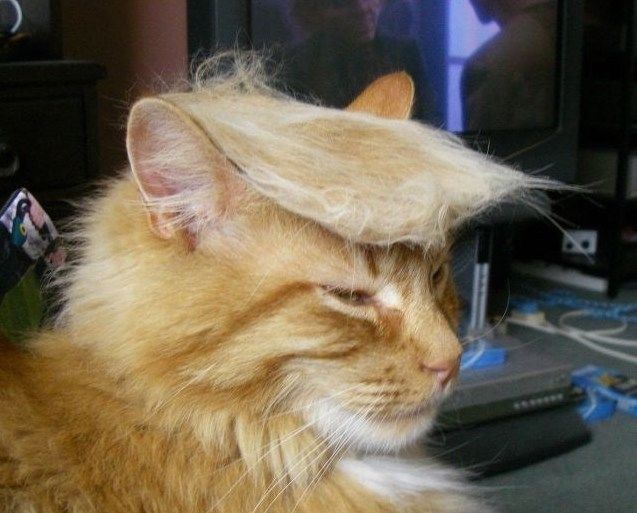
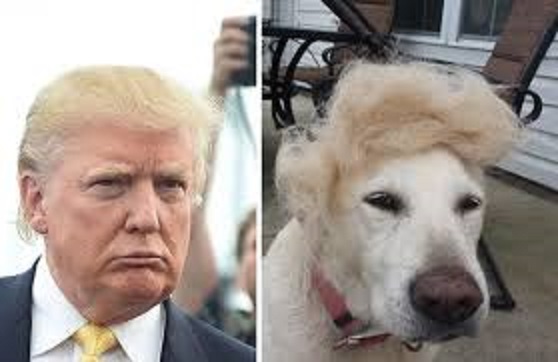
And speaking of pussies and Donald Trump, I had no idea until just now that there’s a vogue for making your cat’s hair into some sort of supposed facsimile of Trump’s and posting a photo of it at #trumpyourcat. For example:

trumpcat

And of course dogs, too:

trumpdog

Trump’s mention of Rubio sweating made me think of this:

America may have noticed Nixon sweating; pundits certainly did. But young neo, who was watching back then, didn’t notice a thing about it. Nor would I have thought a thing of it—didn’t everybody sweat?

Of one thing I am fairly sure: Kennedy wasn’t going to mention it. Candidates might sweat, but they were also expected to maintain a certain verbal decorum, at least in public. For example, in private LBJ may have been the possessor of an extraordinarily foul-mouthed wit, but in public he would never have displayed it, even against an opponent. Voters expected more of their leaders back then.

Posted in Uncategorized | 20 Replies

Bet you didn’t know this about Ted Cruz

The New Neo Posted on February 8, 2016 by neoFebruary 8, 2016

I didn’t know it either. Take a look.

I was talking to a liberal (but not at all doctrinaire) friend the other day, and she brought up the Republican candidates and asked my opinion on them. She’s not keen on Hillary or Sanders, and is taking a look at the Republicans. As I spoke, it became clear that all she knew about Cruz so far was the MSM hype (and the Trump hype, I might add) about him: “everybody hates him.” When I explained some of his experience, and some of the laudable traits I see in him, she was both impressed and surprised.

Cruz has been demonized by the MSM for several years now, and it’s sunk in. I don’t think it’s insurmountable, and I don’t think he’s “unelectable.” But there’s quite a bit that would need to be overcome.

Posted in Election 2016 | 43 Replies

About that Christie-Rubio flap last Saturday

The New Neo Posted on February 8, 2016 by neoMarch 7, 2026

I mentioned the other day that I was going to write more on the Christie-Rubio exchange during the last debate, the one that has everyone abuzz. I’ve been working on an article that I might ship out (if it doesn’t get published elsewhere, it will appear on this blog soon), but I thought in the meantime I’d just summarize what I discovered.

Strangely enough, when I actually went back to the transcript of the debate (something very few people seem to have done), I was very surprised to find that Christie was startlingly wrong. What’s more, Christie was repeatedly ignoring Rubio’s main point and repeating his own flawed premise. Rubio was repeating himself in response because Christie kept restating the error.

When people (and that most definitely included me) listened to the debate, they didn’t catch it. It happens fast, and you have to be tracking the back-and-forth very very carefully. But going back to the transcript and reading closely, I found it fairly clear.

Unfortunately, because of Christie’s emphasis on Rubio’s repetition (as though that has any deep meaning), Rubio’s point got lost. Rubio would have done well to have specifically said something like “You keep repeating your error and that’s why I’m repeating my answer,” but that was his biggest failure, and it was rhetorical.

Those who believe that it was Christie who had a good night must believe it’s true that Obama is a bad president because of inexperience, because that was Christie’s position. In other words, Christie’s answer to the “knave or fool?” question for Obama is: fool.

That, IMHO, makes Christie a fool about the biggest question of Obama’s presidency, and in addition a fool about the danger the left presents. Rubio was trying to say that. Too bad Christie’s belittling of Rubio’s method of saying it fooled so many listeners.

I wonder: would people have liked it better if Rubio had just let the analogy of his inexperience with Obama’s inexperience—and the idea that that’s the source of Obama’s “errors”—stand? Or would it have been better if, instead of saying “Obama knows exactly what he’s doing” several times, Rubio had said “Obama is aware of the meaning and consequences of his own actions, and is therefore culpable rather than incompetent?” Yes, Rubio repeated himself for emphasis, but he also said plenty of other things that evening (and elsewhere) that weren’t in his stump speech. And of course Christie, and the others, repeat themselves all the time.

Rubio is not necessarily my frontrunner. I’m most simpatico with Cruz’s stances on most things, although I worry about his “electability” (I’m growing to hate that word). And in the past I’ve been somewhat positive towards Christie, as well as of Rubio. My defense of Rubio here is because of what I found when I went to the transcript—and not just what I found about Rubio, but what I found about Christie.

[NOTE: And by the way, although I don’t happen to think repetition is a crime when you’re making an important point, here’s a piece on how Christie repeated himself during the same debate.]

[ADDENDUM: I plan to be more specific in my longer piece. But in response to a commenter request, here’s a really quick listing of what Christie got wrong in terms of content:

(1) the idea that Obama’s flaws stem from inexperience rather than intent, a serious and dangerous underestimation of the man’s agenda, and the left’s agenda. That was why Rubio was hammering that point home. Not only did Christie have no effective answer, he didn’t even attempt to answer at any point, just kept repeating his error.
(2) Christie had no answer to Rubio’s charge about his snow removal faux pas (and it was Christie who cited snow removal as some sort of experience relevant to the presidency, which it is not)
(3) Christie had no answer to Rubio’s charge about Christie’s budget failings.

Actually, of Rubio’s three points, Christie only even attempted to answer one—the snow removal charge. And he did so ineffectively.]

Posted in Election 2016 | 52 Replies

Post-debate thoughts on the debate I mostly didn’t watch

The New Neo Posted on February 6, 2016 by neoFebruary 6, 2016

I watched about one-third of this evening’s debate. After that I turned it on intermittently, but what I saw convinced me to finally call it quits, and to eat my (very late) dinner in blessed silence.

Maybe this really wasn’t one of the worst debates ever, but it sure felt that way. But maybe it felt that way because my disgust is cumulative. So I suppose that what I’m about to write refers to the entire debate process as it’s evolved (or devolved) over the years.

I could say that there are now too many debates, and that they’re too long. And there are, and they are.

I could say there were too many people up there, and that each GOP debate should instead have consisted of two groups of roughly equal size, randomly selected each time and both appearing in prime time, and running two hours each maximum.

I could say that the candidates should each have to answer the same question, until all on the stage have answered, and each should get the same amount of time to answer.

I think these things would go a long way towards improving the situation. But I also think those things will never happen, so they are probably irrelevant.

Right now it’s become a multi-candidate press conference conducted by a small number of “gotcha” journalists who are far more interested in “winning” the debate themselves than in helping the viewers get an idea of what the candidates would do about certain substantive issues. Yes, there are a small number of the latter type of questions, but way too few, and the rest are either attempts to trip up whatever candidate[s] they’ve decided needs tripping up, or to get one of them to trip up another, on and on in succession.

Because the candidates are, after all, in competition with each other, many are only too happy to oblige. And then it becomes a verbal duel to see which of the two who are warring at any particular moment can come up with the best sound bite put-down of the other. But there’s really no time for a takedown that’s meaningful and substantive, and someone can get away with a very bad answer in terms of the facts if it just sounds aggressive enough.

It’s an Attention Deficit Disorder debate with a World Wide Wrestling format. This is not just a frivolous objection about tone. I believe that the debates have become at least part of the reason we have come to choose presidents on a more and more superficial basis in recent years. This format not only lends itself to superficial, it pretty much requires superficial, plus a huge and growing emphasis on looks.

I can’t speak on who “won” tonight’s debate. I didn’t watch enough of it. I know that I’m usually very impressed with Cruz, because he manages to stay calm and focused, and because his mind is stupendously organized he probably gets in more statements of substance that anyone else there. I know that Donald Trump has never said anything in a debate that shows an understanding of issues, and that he shies away from detail and just want us to believe his bluster and boundless self-confidence is enough. It’s not. I know that Rubio looked shaky tonight during the time I watched, and Christie like the New Jersey prosecutor that he is. Carson said he wouldn’t attack Cruz and then seemed to go on to sort of attack Cruz. Kasich and Bush were there, I think, as they always are. Fiorina wasn’t.

Posted in Election 2016, Theater and TV | 46 Replies

GOP debate thread

The New Neo Posted on February 6, 2016 by neoFebruary 6, 2016

Ah, here we go again. And on a Saturday night, too!

Here’s what Carly has to say: “You’ll just have to find out, won’t you?”

If any of Carly’s advisers are listening, I have an idea: I think they should wheel in a big cake, and she should jump out of it.

And if anyone says she’s too old for that sort of thing, she’s not even close. See this:

I’ll be watching the debate this evening as long as I can stand it.

8:35 PM: I already can’t stand it. Seriously.

I don’t know whether any of you are watching, but this is just a stupid bunch of fighting on a personal level. Christie getting tough, Rubio getting tough back, none of it having anything to do with anything of substance. To me (and I’ve always been okay with Christie), it makes Christie look bad. I have no idea how other people react, though.

Everything I hate about so-called “debates” is on display. Well, not everything, but one big thing.

8:49 PM: I have a feeling this debate will get the lowest ratings of all.

9:11 PM: As far back as I can remember I have always hated debates.

Not actual debates with a regular debate format, but these things that they call debates, which are all about attacking each other in ways that seem stupid and petty to me, and then seeing how the other person manages to parry the attack. I suppose that measures a useful skill of some kind or other, but I don’t see it as part of being president. But apparently it’s become a mandatory part of how you get to be nominated to run for president.

It doesn’t entertain me, it makes me almost ill in addition to boring me. It’s an odd combination, stress and boredom, and not a pleasant one.

I do think Ted Cruz is doing well. Nothing rattles him, and I think that’s because (a) he’s really smart, and (b) he’s participated in so many real debates over his lifetime that mounting arguments in an organized way is second nature to him. But it gives him that controlled quality that a lot of people find offputting.

Hmmm, Jeb Bush finally mentions what Trump did to Vera Coking in Atlantic City, and Trump no like.

Posted in Election 2016 | 37 Replies

Dance teachers I have known: Stanley Holden, revisited

The New Neo Posted on February 6, 2016 by neoApril 7, 2025

A while back I wrote a tribute to a ballet teacher of mine, Stanley Holden. A little recap is in order:

One doesn’t ordinarily think of comedy in connection with ballet dancers, but Holden was a master of it, best known for originating the en travesti character Widow Simone, choreographed on him by Frederic Ashton in 1960 as part of the ballet “La Fille Mal Gardee” with the Royal Ballet.

Holden is said to have performed the role””and its most famous number, the clog dance””with far more humor than anyone has ever managed to bring to it since. But alas, there is no video of him that I can find online…

Since I wrote that in 2010, guess what? A video has appeared on YouTube of Holden in the role.

Before I present it to you, here’s a bit more from my post, to refresh your memory:

Holden didn’t look like a ballet dancer at all; more like a jockey. He exuded a tremendous amount of energy and an unforced cheeriness that was both unusual and infectious. He never yelled or was even cross, unlike so many temperamental dance teachers.

…Holden excelled at giving the class what are called “combinations,” those little pieces of choreography that make a dance class interesting rather than a mere repetition of the same steps every day.

…He kept them coming at us rapid-fire. Whether he planned these combinations ahead of time or made them up on the spot, or whether he had a secret book with lists of them that he’d memorized, I have no idea. But I do know that””especially towards the end of class, when the combinations featured large jumps and other big movements across the diagonal of his huge studio (a space that, unlike most dance classrooms, was constructed without any obstructive pillars or columns)””the feeling most of us had, along with exhaustion, was sheer joy.

“I want to die teaching” Holden said in an interview in 1997. “That’s my life. I love it.” He managed to convey that love not in any conventionally schmaltzy (or balletic) way, but through his own exuberance.

So, here’s the video. I hope you can see what I mean about Holden’s exceptional personality. Although he could certainly do classical ballet, here you’d never know he had ever danced in anything but the British Music Hall tradition, and you can see how very much he is enjoying himself. So now you can enjoy it, too:

Here’s a video I included in my earlier post. It’s of a more recent dancer doing the same variation. He’s very good, but to me he can’t compare. This dancer’s training as a ballet dancer comes across too strongly, which is at variance with the character. In the same role, Holden hid his ballet background and seems very natural, and that included his facial expressions.

Holden also added a lot of funny bits you don’t see in the later video. Note in particular Holden’s slide (at around 1:34 on the first video) vs. this one (at about 1:44). This guy slides a lot longer and more dramatically. But it doesn’t seem like an integral part of the dance, it seems like a forced thing to show off the fact that he can do it. But, more importantly, you may have noticed that right at the end of Holden’s slide he does a subtle little bit where he looks back and down at the floor as though wondering what on earth he just slipped on (just like a regular person might really do), whereas the modern guy just sliiiides, then turns around and runs back. No rhyme or reason to it. And the omission of those sorts of telling details, those little touches, are part of what makes the difference between Holden and the others.

RIP, Stanley Holden (1928-2007).

Posted in Dance, Me, myself, and I | 9 Replies

Over There: Bush predictions back in 2007

The New Neo Posted on February 6, 2016 by neoFebruary 6, 2016

This certainly seems prescient. It’s a 2007 interview with President Bush. He uses the phrase “failure in Iraq,” but we didn’t actually fail; we (Obama, that is) abandoned it very prematurely. I don’t think that, at the time of this 2007 interview, Bush could conceive that his successor would voluntarily do that, although the Democrats in Congress had certainly been trying for a while. Bush also uses the term “Al-Qaida,” because ISIS did not yet exist. But what he’s doing here is predicting something like ISIS:

Failure in Iraq will cause generations to suffer, in my judgment. Al-Qaida will be emboldened. They will say, “Yes, once again, we’ve driven the great soft America out of a part of the region.” It will cause them to be able to recruit more; it will give them safe haven. They are a direct threat to the United States.

And I’m going to keep talking about it. That’s my job as the president, is to tell people the threats we face and what we’re doing about it. They’re dangerous, and I can’t put it any more plainly to the American people, and to them, we will stay on the offense. It’s better to fight them there than here.

And this concept about, well, maybe, you know, let’s just kind of just leave them alone and maybe they’ll be all right is naive. These people attacked us before we were in Iraq. They viciously attacked us before we were in Iraq, and they’ve been attacking ever since.

They are a threat to your children, David. And whoever is in that Oval Office better understand it and take measures necessary to protect the American people.

This is a later interview with Danielle Pletka, who was “the president for foreign and defense policy studies at the American Enterprise Institute” and “a former Republican staff member at the Senate Foreign Relations Committee”:

If we retreat, if we surrender in Iraq, then I think we should have no doubt that there will be places from which they can plan and operate. That doesn’t take away from their ability to plan and operate elsewhere. That’s why we need to be fighting them in Iraq and elsewhere.

But the second part of this is, it reminds me of the discussions that we had with the Clinton administration about Afghanistan in the 1990s. There was a huge amount of frustration that the rise of the Taliban, at the fact that the Taliban was giving al-Qaida a safe haven, and that the administration wasn’t doing enough about it. Now, to be fair, the Congress wasn’t doing enough about it, either.

But, again, you heard the same sort of complacency about where they would be doing their planning. No, they’re not going to operate and plan against us in the United States. They’re focusing on Africa. Or they’re focusing on the Israeli-Palestinian conflict.

I think that they are focusing on us. And where we give them room to breathe, they will operate, and they will plan, and they will strike us, and they will be encouraged and emboldened if we retreat and allow them that headquarters in Iraq.

Obama gave them plenty of room to breathe, and now they have that headquarters in Iraq and Syria, and they’ve already been striking at the west after wreaking tremendous havoc in the Middle East.

Posted in Iraq, Terrorism and terrorists | 29 Replies

Post navigation

← Previous Post
Next Post→

Your support is appreciated through a one-time or monthly Paypal donation

Please click the link recommended books and search bar for Amazon purchases through neo. I receive a commission from all such purchases.

Archives

Recent Comments

  • huxley on Open thread 9/2/2026
  • Karmi on Open thread 9/2/2026
  • Ben David on Tucker Carlson is to J. D. Vance as Hasan Piker is to Abdul El-Sayed
  • Marlene on Some leftists are celebrating the murder of a young woman in New York because she’s a bank executive
  • Selfy on Tucker Carlson is to J. D. Vance as Hasan Piker is to Abdul El-Sayed

Recent Posts

  • The Strait of Hormuz
  • Some leftists are celebrating the murder of a young woman in New York because she’s a bank executive
  • Tucker Carlson is to J. D. Vance as Hasan Piker is to Abdul El-Sayed
  • Open thread 9/2/2026
  • Update on my ex [plus further updates]

Categories

  • A mind is a difficult thing to change: my change story (17)
  • Academia (328)
  • Afghanistan (98)
  • Amazon orders (6)
  • Arts (8)
  • Baseball and sports (164)
  • Best of neo-neocon (91)
  • Biden (536)
  • Blogging and bloggers (593)
  • Dance (292)
  • Disaster (244)
  • Education (323)
  • Election 2012 (360)
  • Election 2016 (566)
  • Election 2018 (33)
  • Election 2020 (513)
  • Election 2022 (114)
  • Election 2024 (403)
  • Election 2026 (90)
  • Election 2028 (13)
  • Evil (129)
  • Fashion and beauty (324)
  • Finance and economics (1,042)
  • Food (317)
  • Friendship (48)
  • Gardening (18)
  • General information about neo (4)
  • Getting philosophical: life, love, the universe (734)
  • Health (1,160)
  • Health care reform (545)
  • Hillary Clinton (184)
  • Historical figures (337)
  • History (716)
  • Immigration (448)
  • Iran (464)
  • Iraq (227)
  • IRS scandal (71)
  • Israel/Palestine (820)
  • Jews (437)
  • Language and grammar (365)
  • Latin America (212)
  • Law (2,972)
  • Leaving the circle: political apostasy (124)
  • Liberals and conservatives; left and right (1,320)
  • Liberty (1,117)
  • Literary leftists (14)
  • Literature and writing (393)
  • Me, myself, and I (1,496)
  • Men and women; marriage and divorce and sex (929)
  • Middle East (384)
  • Military (324)
  • Movies (353)
  • Music (533)
  • Nature (261)
  • Neocons (32)
  • New England (183)
  • Obama (1,738)
  • Pacifism (16)
  • Painting, sculpture, photography (131)
  • Palin (93)
  • Paris and France2 trial (25)
  • People of interest (1,043)
  • Poetry (258)
  • Political changers (178)
  • Politics (2,793)
  • Pop culture (397)
  • Press (1,634)
  • Race and racism (881)
  • Religion (428)
  • Romney (164)
  • Ryan (16)
  • Science (639)
  • Terrorism and terrorists (971)
  • Theater and TV (266)
  • Therapy (71)
  • Trump (1,630)
  • Uncategorized (4,549)
  • Vietnam (109)
  • Violence (1,443)
  • War and Peace (1,027)

Blogroll

Ace (bold)
AmericanDigest (writer’s digest)
AmericanThinker (thought full)
Anchoress (first things first)
AnnAlthouse (more than law)
AugeanStables (historian’s task)
BelmontClub (deep thoughts)
Betsy’sPage (teach)
Bookworm (writingReader)
ChicagoBoyz (boyz will be)
DanielInVenezuela (liberty)
Dr.Helen (rights of man)
Dr.Sanity (shrink archives)
DreamsToLightening (Asher)
EdDriscoll (market liberal)
Fausta’sBlog (opinionated)
GayPatriot (self-explanatory)
HadEnoughTherapy? (yep)
HotAir (a roomful)
InstaPundit (the hub)
JawaReport (the doctor’s Rusty)
LegalInsurrection (law prof)
Maggie’sFarm (togetherness)
MelaniePhillips (formidable)
MerylYourish (centrist)
MichaelTotten (globetrotter)
MichaelYon (War Zones)
Michelle Malkin (clarion pen)
MichelleObama’sMirror (reflect)
NoPasaran! (bluntFrench)
NormanGeras (archives)
OneCosmos (Gagdad Bob)
Pamela Geller (Atlas Shrugs)
PJMedia (comprehensive)
PointOfNoReturn (exodus)
Powerline (foursight)
QandO (neolibertarian)
RedState (conservative)
RogerL.Simon (PJ guy)
SisterToldjah (she said)
Sisu (commentary plus cats)
Spengler (Goldman)
VictorDavisHanson (prof)
Vodkapundit (drinker-thinker)
Volokh (lawblog)
Zombie (alive)

Meta

  • Log in
  • Entries feed
  • Comments feed
  • WordPress.org
©2026 - The New Neo - Weaver Xtreme Theme Email
Web Analytics
↑