
I’m so glad I’m a native speaker. I doubt I’d be able to master English as a second language. So tricky!
You Stepped Into My Life
I think we could all use a dose of joy, right?
Of course, those of you who hate the Bee Gees and especially the Bee Gees’ falsetto singing mode may find listening to this the opposite of joyful. It’s a fairly obscure song by the Bee Gees I recently discovered, and I just love it. You may say “oh, neo, you are tiresomely indiscriminate about the Bee Gees; you love all their stuff.” But no, I merely like some of it – and even among the many songs I love, there are degrees of love.
This particular song may not have caught on when it was released on their 1976 album “Children of the World,” but it’s so upbeat, so expressive of the bubbly happiness a person can feel when in the grip of the first blush of love, that it never fails to put a smile on my face. That smile becomes especially broad when I hear the keyboard (synth?) that begins at around 0:16, and then Barry’s musical yelp at 0:18-0:23. And I especially like the passage from 1:33 to 1:53. Is the song disco? Is it funk? Who cares? Enjoy:
It was a somewhat bigger hit in 1978 for Melba Moore, who turned it into what I hear as a more strictly disco version with more instrumental parts, a faster tempo, and the same relentlessly happy vibe. I like this one very much, too, although the Bee Gees edge it out slightly for me, in part because that synth bit is lacking here. They each have their substantial charms, though. Do we really have to choose? Let’s just dance:
I can’t think of another song that so perfectly captures the experience of sudden love, meeting someone out of the blue and feeling that energizing rush where all’s right with the world when a minute before things seemed so wrong. I fell in love almost instantaneously with my ex-husband. I was twenty-one years old, and although I’d had quite a few serious relationships up to that time, I knew instantly this was The Real Thing. The course of my very lengthy marriage didn’t run at all smooth, and ultimately we divorced, but both of us knew and know that what we felt was very very real despite its suddenness.
I find the phrase “stepped into my life” so interesting. The unusual thing about it is that word “stepped” – the lyric doesn’t say the more conventional “came in my life.” “Stepped” gives that feeling of “suddenly, suddenly” – at one moment the stage is empty, and then the main actor comes on to applause and happy relief. And the way Barry sings “suddenly, suddenly” is just effervescent.
A lot of people think the Bee Gees’ lyrics are ho-hum, but although I think I understand why they say that, I don’t agree. They’re not deep poets like Leonard Cohen, whom I also love. They’re not Bob Dylan, whose lyrics are more obscure and complex, whom I don’t especially love. I like the Beatles but I don’t love them, and many of their early lyrics are just bubblegum stuff and many of their later ones are rather nonsensical to me. The Bee Gees’ lyrics often seem simple and mundane till you think about them more; sometimes a word such as “stepped” is very telling. “You Stepped Into My Life” is one of their more simple lyrics, except that in a way it’s brilliant. And the music isn’t simple at all, although it’s catchy as all get-out.
VDH on why the “masses” detest the “elites”
…[T]here was a third catalyst that explained the mutual animosity in the pre-Trump years. The masses increasingly could not see any reason for elite status other than expertise in navigating the system for lucrative compensation.
In short, money and education certification were no longer synonymous with any sense of competency or expertise. Just the opposite often became true. Those who thought up some of the most destructive, crackpot, and dangerous policies in American history were precisely those who were degreed and well-off and careful to ensure they were never subject to the destructive consequences of their own pernicious ideologies.
Thomas Sowell wrote an entire book related to that topic quite some time ago, entitled Intellectuals and Society.
The pending Iran deal and the Biden administration’s “weakness”
There’s more on the new Iran Deal here, in particular what the Iranian leaders are saying about their plans for Israel. The article mentions the Biden administration’s weakness several times as one of the factors leading to all of this:
As the Biden administration seems to be moving closer to reaching a new nuclear deal with Iran, the mullahs in Tehran are encouraging their Lebanese and Palestinian terrorist proxies to prepare for waging war on Israel…
The mullahs are not oblivious to the growing voices in the Arab world that complain about the weakness of the US and how the Biden administration’s policy of appeasement towards Iran is undermining the Americans’ credibility and jeopardizing the security and stability of Arab and Islamic countries.
Iran’s mullahs appear to be so confident that the Biden administration has turned its back on its Arab allies in the Middle East that they are issuing direct threats not only against Israel, but also against any Arab country that dares to cooperate with the Israelis.
It may be a minor quibble, but although the article says the Biden administration is weak, that’s not the way I’d describe it. This particular deal is what the administration intends to do, and I’m puzzled by the somewhat constant assertion that this administration is weak, a statement hardly limited to that article. Yes, it’s weak in the traditional sense of not opposing a tyrannical regime such as Iran’s, and failing to project the strength, resolve, and ability to do so successfully. But that presupposes that the Biden administration has that goal and is trying to do those things. I see no indication that is the case.
Nor do I think that the Arab nations who oppose Iran are suffering from the delusion that they can count on the US to help them. That is one of the reasons they have allied somewhat with Israel in the first place – to try to stop Iran, realizing that the US is no longer a reliable player.
Please see also this.
Oh, and Lapid of Israel seems to be changing his tune, at least somewhat:
Bennett, Lapid and Defense Minister Benny Gantz often spoke of the weaknesses of the Iran nuclear deal, which has been negotiated mostly in Vienna over the past 16 months. They repeatedly said Israel would not be obligated to it, but they made sure not to openly criticize US President Joe Biden.
On Thursday, however, Lapid came very close to crossing that line.
“In our eyes, [the Iran deal] does not meet the standards set by President Biden himself: preventing Iran from becoming a nuclear state,” he said in a briefing to the foreign press.
In other words, if Biden agrees to rejoin the Iran deal as it stands, which all indications point to him doing, then he will be breaking a promise.
No doubt Biden and company are shaking in their shoes at that accusation from the extremely weak Lapid. The change in Lapid probably comes from two factors. The first is that he may actually realize this deal is on course to bring great peril to Israel in the truly – not just metaphorically – “existential” sense. The second is that he can feel Netanyahu’s hot breath on his neck.
The corporate retreat from wokeness?
I’ve seen a number of articles indicating that some companies are trying to leave extreme wokeness behind. For example, there’s this one about recent developments at Warner’s in that direction.
That doesn’t surprise me much – after all, cutting off so much of your potential audience wouldn’t seem like a good business move, and so a return to a more representative message would seem to make sense. What surprised me was the tremendous swing to wokeness in the first place. One would think it glaringly obvious that this would affect the bottom line negatively, and yet it was commonplace. My question is: why did they do it? It might have been an okay or even a good idea for some sort of niche company, but not for those whose business model was built on broad appeal.
My questions, in no particular order:
(1) Was it a case of competitive virtue signaling gone mad?
(2) Were the people making the decisions untethered from the reality of the need to make money?
(3) Did they think they were so creative and so clever that people would flock to their products anyway?
(4) Did they figure it was worth a little dropoff in business to demonstrate such virtue, but the dropoff was a lot more than they had bargained for?
(5) Was it merely a reflection of the fact that the personnel at such companies had become a woke echo chamber themselves and couldn’t even judge the extremity of what they were doing?
(6) Is this return to the center going to catch on and be real, or is it just a weak and sporadic thing?
Open thread 8/27/22
Cellphone wrangling
I spent hours today – literally hours – on the phone, attempting to cancel a certain cellphone service I have been paying for and wasn’t using. I’m not going to spend hours writing about it, only to bore myself and you silly with the details. I merely have a question: why do they purposely make it so hard to reach a human being?
It’s a rhetorical question, though, because I believe I know the answer. It’s both cost-saving to have everything automated, and an effort to discourage you and make you give up trying to drop something. The prompts made it relatively easy to add something, but dropping something was simply not an option.
I finally accomplished the task, however.
I think. We’ll see when the next bill either comes or doesn’t come.
The MAL search affidavit adds essentially nothing
As expected.
Prior to its release, I couldn’t imagine why anyone would think that it would actually change anything, given that it was the DOJ doing the redactions and the very same magistrate approving them. However, it will be used in the ongoing political propaganda war.
You can find links to the documents here.
From Jonathan “not a Trump fan” Turley:
Having read the redacted affidavit, it leaves most questions unanswered. It also raises further doubt over the Court's acceptance that the DOJ found the Goldilocks point of getting this "just right." The DOJ released what was largely already leaked or known.
— Jonathan Turley (@JonathanTurley) August 26, 2022
…Yet, the affidavit confirms a couple points that appeared in leaks. The affidavit does not establish that the Trump people were wholly uncooperative or non-communicative while noting that they were asked to turn over material and did not do so.
— Jonathan Turley (@JonathanTurley) August 26, 2022
And from Joel Pollak of Breitbart News:
If I were a Democrat who hoped the affidavit would have enough to condemn Trump I would be deeply disappointed. Their only hope would have to be that there is something in the redacted bits to justify raiding a former POTUS. Don't be fooled by whatever BS they post; they're upset
— Joel Pollak (@joelpollak) August 26, 2022
I doubt they’re upset about the content of the warrant, deeply or otherwise. They have a plan and they will stick to it, and they think it will help them politically. Even the redactions serve a purpose, and that purpose is to indicate Trump-doings so nefarious that even to mention them would risk US security.
ADDENDUM: Interesting takes can be found here, as well as here and here.
Biden the uniter president speaks
Sounds like he’s been reading the comments in the WaPo.
Or perhaps commenting there himself.
Speaking in Maryland to supporters, Biden said [emphasis mine in all the quotes from his speech]:
“It’s not hyperbole – now you need to vote to literally save democracy again,” Biden told an above-capacity crowd of several thousand at a Democratic National Committee event at Richard Montgomery High School in a Maryland suburb of Washington…
“Trump and the extreme MAGA Republicans have made their choice – to go backwards full of anger, violence, hate and division,” he said, warning they “refuse to accept the will of the people.”…
“We’re seeing now either the beginning or the death knell of an extreme MAGA agenda,” Biden said, referring to former President Donald Trump’s “Make America Great Again” slogan. “It’s not just Trump. … It’s almost semi-fascism,” he said.
Why, those divisive, hateful, almost semi-facist extremist Trump voters – not just Trump himself, but his voters and supporters – hatefully burning down our cities , causing all those January 6th deaths! Why prove it when you have rhetoric supported by the mendacious MSM to fall back on?
Save our democracy, “fortify” our elections – like, just to take one small example, the FBI did when they suppressed all investigation of the Hunter Biden laptop in 2020 in order to help Joe Biden…
You get the drill.
Then there’s also this:
“I respect conservative Republicans,” Biden said later. “I don’t respect these MAGA Republicans.”
MAGA Repulicans are just not conservative Republicans, it seems. And who are those conservative Republicans? I assume Biden means Liz Cheney and Mitt Romney, as well as Adam Kinzinger.
It’s not only a hateful speech by Biden, it’s by nature an Orwellian speech in which he accuses the right of doing what the left actually does.
In 2020, you and 81 million Americans voted to save our democracy…
…[W]e’ve chosen a different path forward. The future. Unity, hope, and optimism…
…while giving the most hateful, angry, divisive speech I can recall from a president in my lifetime.
More (and more “our democracy” – who is this “our,” kimosabe?):
The MAGA Republicans don’t just threaten our personal rights and economic security. They’re a threat to our very democracy.They refused to accept the will of the people, they embrace political violence. They don’t believe in democracy. This is why in this moment, those of you who love this country, Democrats, Independents, mainstream Republicans, we must be stronger, more committed, and more determined to saving America than the MAGA Republicans are to destroying America.
As I said, Orwellian. And this is the kind of speech I predict we will be hearing over and over – with the demonization of not just Trump but of all Trump-supporting voters, complete with Orwellian mischaracterizations while Democrats and Biden don the mantle of a false “unity.” The sad thing is that half of America will buy it, having been primed by the press and the Democrats ever since Trump entered the political fray – and even before that, although the trend has picked up considerably since Trump became a political force.
I find it mindboggling that Biden was ever considered a nice guy.
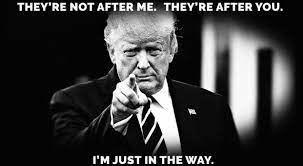
I find it interesting also that so many things Trump predicted have come true, for example something he claimed after his 2019 impeachment [emphasis mine]:
With a likeness to the Uncle Sam “I want you” poster, the disrupter-in-chief reaffirms in 14 words the belief of Trump Nation that the political establishment, the media, the permanent bureaucracy and yes, the deep state are trying to crush him and them.
Of course, because Twitter not only suspended his account but seems to have erased all his old tweets a la Nineteen Eighty-Four, you can no longer find it there. But here’s the image:
Open thread 8/26/22
Protect the Biden diary, suppress the Biden laptop
…[T]wo people allegedly found Ashley Biden’s diary at a rehab facility. They took it and then attempted to sell it to various entities. The Trump campaign did the smart thing, given the corruption at the DOJ, and said no to their offer. Ultimately Project Veritas got involved, and for many months, the FBI has been pursuing them, including executing search raids of the organization’s journalists. According to these latest reports, the two people who originally came in possession of the diary have now pleaded guilty to federal crimes…
Ultimately, they got these two people by charging them with trafficking in “stolen goods” across state lines. That sounds like quite the stretch given what we know. And since when does the FBI get involved with “stolen” diaries?…
So what’s in the diary? Allegedly, there are entries in it accusing Biden of taking inappropriate showers with his daughter. Whether those allegations are true, only Joe and Ashley Biden know, and I’m not making a judgment here. But the mere existence of a documented claim like that would be a non-stop story for the press if it involved any Republican, much less someone like Donald Trump. Instead, the press has ignored this story, first claiming it was Russian disinformation before now just flatly pretending it doesn’t exist.
It’s nice to know the DOJ has its priorities straight.
I keep being reminded of the old expression, “Hey, don’t make a federal case out of it.” The following was written in 2004:
A federal criminal code that covers everything essentially delegates to prosecutors and police the power to pick targets they think they should get rather than offenses that need to be prosecuted — leaving everyone at risk. That is unacceptable in a country that still considers itself a government of laws and not of men.
And in other news, we have more whistleblowers coming forward to describe how the FBI protected Hunter Biden’s laptop and therefore Joe Biden. They’re still doing it, actually.
When is a student loan not a student loan?
When the federal government turns it into a moral hazard.
Biden and company say, Hey, we’ve got an idea! Let’s make people who scrimped and saved and sacrificed and paid off their student loans pay off the loans of others! Or better yet, people who never went to college at all should pay off the loans of those who did! And let’s just do it by executive order.
My, what a novel and nifty idea. What could possibly go wrong?
Also, the COVID emergency is invoked as a reason Biden can do this under a 2003 law involving emergency powers. That’s a classic move when a leader wants to expand powers. Not long ago people like Nancy Pelosi and DOJ lawyers were saying that such a thing couldn’t be done through executive action. Well, guess what? Now it can:
For the past year and a half, the Office of General Counsel (“OGC”), in consultation with our colleagues at the Department of Justice Office of Legal Counsel, has conducted a review of the Secretary’s legal authority to cancel student debt on a categorical basis. This review has included assessing the analysis outlined in a publicly disseminated January 2021 memorandum signed by a former Principal Deputy General Counsel. As detailed below, we have determined that the Higher Education Relief Opportunities for Students (“HEROES”) Act of 2003 grants the Secretary authority that could be used to effectuate a program of targeted loan cancellation directed at addressing the financial harms of the COVID-19 pandemic. We have thus determined that the January 2021 memorandum was substantively incorrect in its conclusions.
Fancy that. How convenient.
And since Biden’s specialty seems to be the odd and condescendingly racist comment, we have this from Joe, too:
The burden is especially heavy on Black and Hispanic borrowers, who on average have less family wealth to pay for it. They don’t own their homes to borrow against to be able to pay for college.
But that’s okay. It’s only Biden and one of his endearing gaffes again.
The Babylon Bee has this to say.
NOTE: I think “moral hazard” is the right term, but those of you who are more conversant with economics that I might be able to say whether it’s actually apropos or not.
ADDENDUM: I see that the WSJ agrees that it’s a moral hazard: “Worse than the cost is the moral hazard and awful precedent this sets.”