
↓
 

The New Neo

A blog about political change, among other things

  • Home
  • Bio
  • Email
Home » Page 1735 << 1 2 … 1,733 1,734 1,735 1,736 1,737 … 1,917 1,918 >>

Post navigation

← Previous Post
Next Post→

Date of infamy: forgetting Pearl Harbor

The New Neo Posted on December 7, 2008 by neoDecember 7, 2008

Sixty-seven years ago today Pearl Harbor was attacked.

That’s long enough ago that only the elderly remember the day and its aftermath with any clarity. Several generations—including my own tiresome one, the baby boomers—have come up since then, and the world has indeed changed.

Prior to 9/11, the Pearl Harbor attack of December 7, 1941 was the closest thing America had to 9/11. The differences between the two are profound, however: at Pearl Harbor we knew the culprit. It was clearly and unequivocally an act of war by the nation of Japan, which was already at war in the Pacific.

But it was, like 9/11, a sneak attack that killed roughly the same number of Americans—in the case of Pearl Harbor mostly (although not exclusively) those in the armed forces. And the Pearl Harbor attack, in the reported (but disputed) words of Japanese Admiral Yamamoto, awakened the “sleeping giant” of the US and filled it with a “terrible resolve.”

In the case of Pearl Harbor, that resolve lasted the duration of the war, an all-out conflagration that required far more sacrifice of the US (and the world) in money, comfort, and the all-important cost of human lives. The scale of such a loss is not even remotely comparable to that of our present conflict. In addition, the first years of World War II featured many losses and much peril. It was a different world, however, and failure was not an option.

Yes, mistakes were made in both wars—and always will be. But it is impossible to remain politically correct and successfully wage an asymmetrical war against an enemy that uses terrorist tactics. If you’re going to try to do that, you may as well not try, because every single life sacrificed to that cause will have been as though it were wasted.

The tactics and even the strategies of World War II don’t fit today’s wars. But tactics and strategies aren’t the issue—although they are extremely important, as the surge reminds us. The overarching issue is will. And, in that respect as in many others, current generations don’t compare to the one known as “The Greatest Generation.”

For some contrast, go back to FDR’s “Day of Infamy” speech (a misquote, it turns out: he actually said “date which will live in infamy”). If you follow the link and scroll down to the first selection under “Media,” you can listen to an audio of it, as well.

Here are some of the less famous quotes from the speech; I have selected them because they speak to the question of will. FDR was assisted in mustering that will by the relative clarity of the enemy and its intent in World War II. But it still seems to me, on reading these words, that such unequivocal determination could not be summoned today, even if given the exact circumstances of the infamous attack of December 7, 1941:

…No matter how long it may take us to overcome this premeditated invasion, the American people in their righteous might will win through to absolute victory.

I believe that I interpret the will of the Congress and of the people when I assert that we will not only defend ourselves to the uttermost but will make it very certain that this form of treachery shall never again endanger us.

Hostilities exist. There is no blinking at the fact that our people, our territory and our interests are in grave danger.

With confidence in our armed forces””with the unbounding determination of our people””we will gain the inevitable triumph””so help us God.

[NOTE: This is a revised and expanded edition of a post first published in 2006.]
Posted in War and Peace | 44 Replies

Iraq: suppose they gave a victory and nobody noticed

The New Neo Posted on December 6, 2008 by neoDecember 6, 2008

The title of this post was inspired by the saying, “Suppose they gave a war and nobody came?”—one of the stupidist slogans of the peace movement of the 60s.

The news that Iraq has ratified a formal US/Iraq military and strategic alliance has fallen under most people’s radar screens. Ho-hum. The economy is (rightly) on people’s minds these days. But let’s pause to realize how successful the Iraq venture has been, and to cheer on the Iraqi people so far.

Yes, there are always caveats with Iraq, yada-yada-yada. But this news should be celebrated as much as the war was previously excoriated.

One way to do so (celebrate, not excoriate) is to take a look at this photo essay about normalcy returning to Iraq . The very first shot, of some Iraqi policemen, caused me to remember the dark days when recruits were mowed down as they waited in line to volunteer for the force. The times they have certainly a’changed.

Posted in Iraq | 90 Replies

The inadequacy of Indian police

The New Neo Posted on December 6, 2008 by neoDecember 6, 2008

Here’s more on the Indian police who couldn’t shoot straight—or at all.

Once you read it, you will no longer be surprised that the police were ineffective during the Mumbai attacks. But you might be even more enraged about it than before.

Here’s a sample:

Obviously [India] has needed a much better-educated, better-paid, better-trained national anti-terrorist police unit for years, but none has been established. Thus the forces available to fight the terrorists in Mumbai were pathetically inadequate in quantity, quality or both.

That was clearly true of Maharashtra’s state anti-terrorism squad, which is headquartered less than 10 minutes from the sites of the attacks but which had a total of 35 officers — and fewer than 15 on duty. This, to protect a state population of 96 million, 18 million in Mumbai alone. The squad’s commander, Hemant Karkare — who was killed early in the attacks — was a 54-year-old investigator, not a fighter even at the level of an ordinary infantryman.

By contrast, India’s National Security Guards, formed in 1985, are well trained. But the guards are a military-style commando assault force, with no real experience in civilian hostage rescue, even though that is one of their official missions. With 7,500 trained men, they could have responded adequately in a military way, if only someone had managed to call enough of them in quickly.

It’s not that India was taken by surprise by terrorism. Unlike the US pre-9/11, they’ve had many fatal terrorist attacks on their soil. The methods at Mumbai were somewhat different, it’s true. But there’s really no excuse for not having anticipated something of the sort and having some rudimentary preparation and training to deal with it.

The author of the piece, Edward N. Luttwak, ends by saying that India will now remedy the situation. I sincerely hope he’s correct.

Posted in Uncategorized | 5 Replies

Damien Hirst: signs that the recession can’t be as bad as all that

The New Neo Posted on December 5, 2008 by neoDecember 5, 2008

Or perhaps it’s just a sign that people have gone stark raving mad.

What am I talking about? Back in mid-September, when the economy was already rather iffy, the “artist” (I use that word advisedly) Damien Hurst had a monster of an auction, netting $200 million dollars for about two hundred lots of his work.

That’s an average of a million a lot. And a lot of those lots fetched a lot more than a million dollars a pop—some as much as eighteen million.

Who’s Damien Hirst, you might ask? And rightly so. I wrote about him here, although I didn’t name him. He’s the artist who specializes in “art” that consists of animals—or sections of animals—preserved in formaldehyde.

The following is an excerpt from my earlier post. You be the judge of how much you would pay for this sort of art:

I seem to recall an entire room consisting of cow segments. Memory could be playing tricks on me, but the image I retain is of a large creature that had been cut into four or five sections, each of which was placed in a huge vat of greenish or bluish preservative behind plexiglass: one for the head, one for the forequarters, one for the midsection, and so on, crossing the entire room.

I suppose it was some sort of political statement. It also smelled, as I recall…At some point I just wanted out, and I voted with my feet: I left.

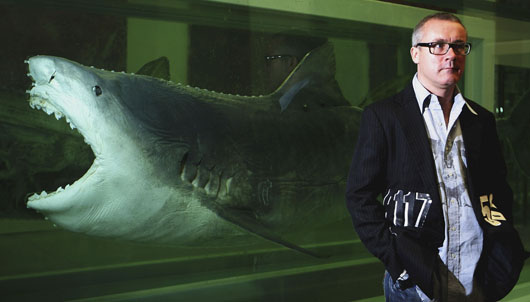
One of the pieces that recently sold for about seventeen million dollars at the auction was a shark in formaldehyde. I wish I had known this back in college when we dissected a shark in biology lab; I would have tried to save mine and market it.

Then again, maybe not. Some things are beyond imagining. And perhaps that is Hirst’s greatest gift—because I certainly don’t see that he has any others—to have imagined that people would buy this garbage, and pay very good money for it.

Sorry to have to do this, but one photo is worth a thousand words, and all that. I call this one “Two Sharks.” It’s Hirst with his seventeen-million-dollar work “The Kingdom.” Worth every penny, don’t you think?

twosharks.jpg

Posted in Finance and economics, Painting, sculpture, photography | 30 Replies

We’re not getting older, we’re getting better

The New Neo Posted on December 5, 2008 by neoDecember 5, 2008

Just as in Lake Woebegone, where all the children are above average, it seems that most “older” people (defined as over seventy) are convinced they look younger than they actually are. About ten years younger on average, in fact.

They also say they feel about thirteen years younger—at least in Berlin, where the study was done. And preliminary results in the US are consistent with its findings.

Women are less sanguine about the difference between their looks and their actual age. They estimate themselves to be younger-looking than their age, but not by as much of a gap as their male counterparts.

The article has a few thoughts about why people tend to say they look younger than average, but I have some theories to add. The first is that the study doesn’t seem to have taken into account the fact that quite a few people, even in that age group, have now had cosmetic surgery. So they may indeed look younger than their chronological age (although the less fortunate of them end up looking as though their eyebrows and hairline are about to merge).

Another idea—and the one I think is operating most strongly in the group as a whole—is that we are not sure how people get their notion of what a certain age normally looks like. My guess is that most of us base it on how we perceived our parents and grandparents when we were growing up.

Aside from the fuzziness of memory, which can cloud the issue, I believe there is a very real difference between then and now. Back then people allowed themselves—or maybe even forced themselves—to dress and act older, befitting their age and dignity. And, at least in urban settings, they didn’t exercise as much into their later years. In rural ones, life tended to be harder than it is today, and it wore people out faster.

I find I can’t tell how old people are at all just by looking at them. Most of the time, of course, I don’t check, and people don’t wear their ages on their sleeves. But among my friends, we all tend to look—well, at least ten years younger than we are. Which must make us just about average.

Posted in Health | 15 Replies

RIP Odetta

The New Neo Posted on December 4, 2008 by neoDecember 4, 2008

I just learned via American Digest that the folksinger Odetta has died at the age of seventy-seven.

In my youth, I saw her perform at The Bitter End in Greenwich Village. Since that was quite some time ago, I suppose it was also (relatively speaking) in Odetta’s youth. I also saw her perform just a few years ago, and she was still a powerhouse.

When she was young, she was one of the first African-Americans (Negroes, at that time) to sport short, natural, unstraightened hair. It was part of her proud presentation as a black woman of force and stature.

And stature Odetta had, in abundance: she was a big woman. I’m not sure how tall she actually was, but on stage she seemed a giant. In later life she had lost a great deal of weight, and I was surprised that she appeared rather diminutive the last time I saw her perform.

But she was never diminutive as a stage presence, even then. That voice! The Times obituary doesn’t really describe it, so I will. I first heard Odetta on a record, and for a moment I thought she was a man because of the extraordinary power and depth of her voice. But then it rose high and wailing, and it was clear her feminine name was not a fluke: she was a woman, after all.

But it was in her booming, resonant, vibrating lower (how low can you go?) registers that she shone. And rumbled. She could crack that voice like a whip, too, when necessary. Here are two short videos of Odetta in her prime—and what a prime it was:

The next one is very recent, within the last year and a half. In it you’ll see a demonstration of soul clapping its hands and louder singing for every tatter in its mortal dress.

RIP, Odetta.

Posted in Music | 10 Replies

Two million and counting

The New Neo Posted on December 4, 2008 by neoDecember 4, 2008

At some unspecified, unknown moment last night, my sitemeter reached the two million hit mark.

It’s not a milestone I ever expected to reach when I began blogging—I would have been surprised to get a total of one thousand hits back then, and I didn’t even have a sitemeter. But here I am at the two million point, thanks to you all.

Posted in Blogging and bloggers | 29 Replies

What do McCain voters know?

The New Neo Posted on December 3, 2008 by neoDecember 3, 2008

Remember that sobering poll of Obama voters? Several people (myself included) were interested in a similar poll of McCain voters. A reader alerted me to the fact that such a poll is now available, here.

Posted in Uncategorized | 108 Replies

Schiff: Cassandra or stopped clock? You decide

The New Neo Posted on December 3, 2008 by neoDecember 3, 2008

Peter Schiff is an interesting case of prognostication. Take a look at this video (or any number of others), and you will find him describing the financial crisis-to-be with a fair amount of detail and specificity before it happened:

So, was Schiff a genuis? And were all the others fools?

The latter question is easier to answer than the former: yes. They were as wrong as they could be, and most were arrogant about it as well. A losing combination. And if you followed their advice you lost too, big-time.

But as the old saying goes, even a stopped clock is right twice a day. I haven’t followed Schiff’s career up to this point, but apparently he’s been a bear for a long time. Perhaps his being on the money about the current crisis (can’t resist those puns) simply illustrates the fact that sooner or later he was bound to get lucky, as the rest of us got unlucky. A bull market can’t last forever.

So the real question is, was Schiff’s uncanny ability to predict this one a fluke, or was it evidence that the guy’s a guru with excellent advice for the future? Consider that his predictions about gold and the dollar do not seem to have come true—and least, not yet.

This article from the Globe and Mail, written last July before the big meltdown, calls Schiff “Dr. Doom,” and describes him thusly:

To say Peter Schiff is bearish is like saying Tiger Woods is an okay golfer, or China has a small problem with air quality. The president of Connecticut-based Euro Pacific Capital Inc. is so pessimistic about the U.S. economy that he lives in a rented house and keeps the vast majority of his and his clients’ money outside the country, a healthy chunk of it in gold and energy stocks.

“America is finished. We are going to destroy this country. Our economy is just going to unravel,” he told me yesterday. “The question is how much money is the world going to lose before it writes us off?”

The article also points out that certain other predictions of Schiff’s have “proved uncannily accurate.” They cite his foreseeing the dot.com crisis, and the problems with Fannie and Freddie that had already surfaced by the time the piece was written. He also appears to have predicted the rise in oil prices a while back, although I haven’t read any evidence that he foresaw their current fall. And from the quote above, it seems he didn’t understand the effect the US problems would have on foreign stocks; they have not been immune, to say the least.

Let’s give Schiff credit for his remarkable foresight on this one. But I’d like to hear from you all—especially those who have followed him closely over the years—about his predictions in general. Has he made as many errors as correct forecasts? And what do you think of what he’s saying now?

Be forewarned: it’s not encouraging;. Let them fail, says Schiff. The government needs to stop bailing companies out, and no artificial economic stimulus will help. Americans need to start saving more and producing more:

Posted in Finance and economics | 30 Replies

What good is intelligence if you can’t/won’t use it?

The New Neo Posted on December 2, 2008 by neoDecember 3, 2008

The US says it warned Indian authorities that terrorists from Pakistan would be arriving by water and targeting Mumbai. This sounds like a “good news/bad news” story: it’s reassuring the US knew that much, distressing that India chose to ignore it.

But did they? Since US officials are refusing to say when the information was conveyed and how much detail it involved, it’s difficult to evaluate what really happened.

As with all such warnings, it is only possible ex-post-facto to know which were important ones. But decisions most be made without the benefit of such hindsight.

In this case, the area to be guarded was large. How much care was India already taking to protect its coast? Was the effort stepped up, and did the terrorists succeed despite such measures? How many warnings from Washington does India get on a regular basis? Was this one just in the nature of the hum of the background noise, or was there something that made it stand out? To know whether India was negligent or not, and to what extent, we must know the answers to these questions.

This is one of the major problems with modern-day intelligence. It is not always that we have too little of it—it’s that we have too little of the exceptionally detailed variety, and too much of the very general type. How do we sort out the wheat from the chaff?

Logic indicates that the best information would come from infiltration of terror groups. I am certain this occurs—but how much, and to what effect, we do not know. As President Bush said long ago:

Americans should not expect one battle, but a lengthy campaign, unlike any other we have ever seen. It may include dramatic strikes, visible on TV, and covert operations, secret even in success.

The failures, on the other hand, are not secret. That is the nature of this war.

Posted in Terrorism and terrorists | 57 Replies

About blessings and enemies

The New Neo Posted on December 2, 2008 by neoDecember 2, 2008

Blogger Yaacov Ben Moshe is an essayist whose thoughts are well worth reading. In this post, he ruminates on Mumbai and its significance, as well as his rage at the following bumper sticker, which he saw recently on a car in Newton Massachusetts:

sticker.jpg

I share his disgust with those who would display such a banner with the intent of annoying the “God Bless America” folks. I have no patience with those who ignore our strengths, and whose reflexive position is to revile most of America’s actions while employing a double standard for the rest of the world.

I most strongly share his rage at the Islamic terrorists, who cold-bloodedly murdered so many innocents in Mumbai to no purpose but their own nihilistic yearnings and their desire to punish infidels and strike fear into the hearts of anyone associated with the West. I especially deplore and despise their sadistic torture of many of their victims (evidence is that they saved the worst torture for the Jews).

Ben Moshe wonders about other aspects of the sentiment expressed in the bumper sticker:

What does that mean? Does it mean they would call down God’s blessing on the stinking swine who apparently did their reconnaissance in the Chabad House by posing as travelers and accepting the food, hospitality and blessings of the Rabbi and his family while they plotted their torture and death?

Does it mean that they can see no moral or spiritual difference between the Rabbi who welcomed and served them with an open heart and the filthy, lying murderers who rewarded his kindness by killing his wife before him and letting him suffer her death, tenderly wrapping her body in his prayer shawl, before murdering him?

I know enough about the Left and its moral relativism towards the excesses of third world countries and peoples, and especially about those who adopt terrorist causes as their own pet projects, to know that Ben Moshe is correct about some of the people who would place this bumper sticker on their cars. But I hereby offer another (and yes, a kindler, gentler) explanation for at least some the rest.

The word “bless” can be interpreted in other ways than simply equating the worthiness of murderers with that of innocents. It is possible to ask for a blessing for one’s enemies (and if the word “enemy” has any meaning at all—and I most definitely believe it does—these people are our enemies) without such moral equivalence. For example, it would be a blessing if the terrorists’ hearts were opened to the light of respect for the religion of others. It would be a blessing if terrorists realized that the wanton murder of innocents and torture of same are wrong. Such a change would be an enormous blessing not just for the rest of us, but for the terrorists themselves.

It is a matter of personal belief whether one thinks such a basic change in a human being can be accomplished by prayer. I submit, however, that many religious people do indeed think so, and that this is a possible (and far more benign) interpretation of the bumper sticker Ben Moshe found so offensive.

But even for those who believe in the power of prayer, it is clear that we cannot wait around for such a profound transformation to take effect through prayer alone. Fortunately, prayer and action are not mutually exclusive. We must take multiple and varied actions in the world to seek out terrorists and prevent them from being able to cause new horrors such as those in Mumbai.

Posted in Religion, Terrorism and terrorists | 52 Replies

Walmart stampede dynamics

The New Neo Posted on December 1, 2008 by neoDecember 1, 2008

No doubt you are aware that the title of this post is not a metaphor for a buying frenzy, but a description of something quite literal. At the Valley Stream, NY, Walmart, on the day after Thanksgiving, an employee was trampled to death by an early-bird crowd that had waited all night for the bargains, giving new and tragic meaning to the phrase “Black Friday.”

Two thousand people are said to have stormed in, overwhelming the staff and trampling 34-year-old Jdimytai Damour to death, as well as injuring several other people. Descriptions of the scene paint a horrific picture of a crowd without pity or sense:

“They took the doors off the hinges. He was trampled and killed in front of me.

“They took me down, too … I didn’t know if I was going to live through it. I literally had to fight people off my back,” Overby said.

“They pushed him down and walked all over him,” Damour’s sobbing sister, Danielle, 41, said. “How could these people do that?”

How, indeed? I’m not certain, of course. But, having done some research a while back for a post on how stampede deaths occur, I can venture a guess.

A stampede does not ordinarlly involve the heartless, out-of-control, murderous mob scene that such reports might indicate. The important elements necessary for a stampede are the following: (1) a large crowd moving forward with impatience; (2) the sudden funneling of that crowd from a wider into a narrower space (such as a bridge or entrance doorway); and (3) the rear of the crowd is unable to see what the front can, and pushes on largely unaware of the violence taking place ahead.

The people in front, who can see, are inexorably propelled forward by the eager crowd behind them who cannot. Even if the people in front want to stop moving, they are physically unable to do so. The horror occurs against their will.

A person at the Walmart that day managed to take these photos on her cellphone as the scene unfolded. If you study them, you will see that the crowd was indeed spread out horizontally at the outset, with no ropes or barriers guiding them into more orderly (and lengthy) lines the width of the doors (this report also mentions the shameful lack of police presence or basic crowd control).

The report from employees inside the store, who could only see the front of the line, is that the shoppers tore the doors off their hinges in order to get in. Another article mentions the doors “bowing with the weight of the assault” and then “shattering.” That sounds more involuntary—and more correct. A large crowd pushing from behind can exert an astounding amount of strength.

The forceful opening of the doors—whether purposeful or accidental—would have created a wider opening to ease some of the pressure of the huge crowd surging forward, allowing a quicker flow of people into the store. This may have actually saved some of the people in the front, who might otherwise have been crushed against the doors. But it was not enough to save Mr. Damour.

Reports are that some people in the crowd wanted to continue shopping even after learning of the death. If true, this is evidence of a profound and chilling level of callousness. But the stampede itself is probably not. More likely, it is evidence of a lack of proper crowd control.

[NOTE: For more information, see my previous post on stampede dynamics, as well as this website.]

Posted in Disaster, Violence | 38 Replies

Post navigation

← Previous Post
Next Post→

Your support is appreciated through a one-time or monthly Paypal donation

Please click the link recommended books and search bar for Amazon purchases through neo. I receive a commission from all such purchases.

Archives

Recent Comments

  • Art Deco on The AfD does very well in the recent German elections in Saxony-Anhalt
  • neo on The AfD does very well in the recent German elections in Saxony-Anhalt
  • neo on The AfD does very well in the recent German elections in Saxony-Anhalt
  • BJ on Happy Labor Day
  • BJ on The Clancy jury apparently will end in a mistrial

Recent Posts

  • The AfD does very well in the recent German elections in Saxony-Anhalt
  • Happy Labor Day
  • Open thread 9/7/2026
  • A restrained AI spam comment
  • A lost skill

Categories

  • A mind is a difficult thing to change: my change story (17)
  • Academia (328)
  • Afghanistan (98)
  • Amazon orders (6)
  • Arts (8)
  • Baseball and sports (164)
  • Best of neo-neocon (91)
  • Biden (536)
  • Blogging and bloggers (595)
  • Dance (292)
  • Disaster (244)
  • Education (323)
  • Election 2012 (360)
  • Election 2016 (566)
  • Election 2018 (33)
  • Election 2020 (513)
  • Election 2022 (114)
  • Election 2024 (403)
  • Election 2026 (93)
  • Election 2028 (13)
  • Evil (129)
  • Fashion and beauty (324)
  • Finance and economics (1,042)
  • Food (317)
  • Friendship (48)
  • Gardening (18)
  • General information about neo (4)
  • Getting philosophical: life, love, the universe (734)
  • Health (1,161)
  • Health care reform (545)
  • Hillary Clinton (184)
  • Historical figures (337)
  • History (716)
  • Immigration (448)
  • Iran (464)
  • Iraq (227)
  • IRS scandal (71)
  • Israel/Palestine (821)
  • Jews (437)
  • Language and grammar (365)
  • Latin America (212)
  • Law (2,975)
  • Leaving the circle: political apostasy (124)
  • Liberals and conservatives; left and right (1,321)
  • Liberty (1,117)
  • Literary leftists (14)
  • Literature and writing (394)
  • Me, myself, and I (1,498)
  • Men and women; marriage and divorce and sex (929)
  • Middle East (384)
  • Military (324)
  • Movies (353)
  • Music (533)
  • Nature (261)
  • Neocons (32)
  • New England (183)
  • Obama (1,738)
  • Pacifism (16)
  • Painting, sculpture, photography (131)
  • Palin (93)
  • Paris and France2 trial (25)
  • People of interest (1,043)
  • Poetry (258)
  • Political changers (178)
  • Politics (2,793)
  • Pop culture (397)
  • Press (1,635)
  • Race and racism (882)
  • Religion (428)
  • Romney (164)
  • Ryan (16)
  • Science (641)
  • Terrorism and terrorists (971)
  • Theater and TV (266)
  • Therapy (71)
  • Trump (1,630)
  • Uncategorized (4,555)
  • Vietnam (109)
  • Violence (1,445)
  • War and Peace (1,027)

Blogroll

Ace (bold)
AmericanDigest (writer’s digest)
AmericanThinker (thought full)
Anchoress (first things first)
AnnAlthouse (more than law)
AugeanStables (historian’s task)
BelmontClub (deep thoughts)
Betsy’sPage (teach)
Bookworm (writingReader)
ChicagoBoyz (boyz will be)
DanielInVenezuela (liberty)
Dr.Helen (rights of man)
Dr.Sanity (shrink archives)
DreamsToLightening (Asher)
EdDriscoll (market liberal)
Fausta’sBlog (opinionated)
GayPatriot (self-explanatory)
HadEnoughTherapy? (yep)
HotAir (a roomful)
InstaPundit (the hub)
JawaReport (the doctor’s Rusty)
LegalInsurrection (law prof)
Maggie’sFarm (togetherness)
MelaniePhillips (formidable)
MerylYourish (centrist)
MichaelTotten (globetrotter)
MichaelYon (War Zones)
Michelle Malkin (clarion pen)
MichelleObama’sMirror (reflect)
NoPasaran! (bluntFrench)
NormanGeras (archives)
OneCosmos (Gagdad Bob)
Pamela Geller (Atlas Shrugs)
PJMedia (comprehensive)
PointOfNoReturn (exodus)
Powerline (foursight)
QandO (neolibertarian)
RedState (conservative)
RogerL.Simon (PJ guy)
SisterToldjah (she said)
Sisu (commentary plus cats)
Spengler (Goldman)
VictorDavisHanson (prof)
Vodkapundit (drinker-thinker)
Volokh (lawblog)
Zombie (alive)

Meta

  • Log in
  • Entries feed
  • Comments feed
  • WordPress.org
©2026 - The New Neo - Weaver Xtreme Theme Email
Web Analytics
↑