↓
 

The New Neo

A blog about political change, among other things

  • Home
  • Bio
  • Email
Home » Page 1736 << 1 2 … 1,734 1,735 1,736 1,737 1,738 … 1,917 1,918 >>

Post navigation

← Previous Post
Next Post→

The curve of an Instalanche

The New Neo Posted on December 1, 2008 by neoDecember 1, 2008

An Instalanche—that’s a link from blogger Glenn Reynolds, who’s otherwise known as Instapundit—can drive a huge amount of traffic to a blog. Glenn’s own blog traffic hovers somewhere in the vicinity of 300,000 hits a day (let me spell that out for you: that’s three hundred thousand). Depending on the time of day, the day of the week, the way Glenn phrases the link, the general interest in the topic, and other variables that remain mysterious, an Instalanche can vary from a modest spike in traffic to a tsunami of visitors.

But I’ve noticed there’s one thing about an Instalanche (or any high-traffic link) that is quite predictable: the graph of the visits always seems to follow a rather strict pattern. There’s a sudden soar the first hour. Then the second hour there’s a fractional step down that represents, very roughly, maybe twenty percent of the whole. Then another similar step down in the third hour, and so on. As the traffic diminishes, the size of the step-downs grows smaller and smaller, and the previously steep imaginary line connecting the steps becomes flatter.

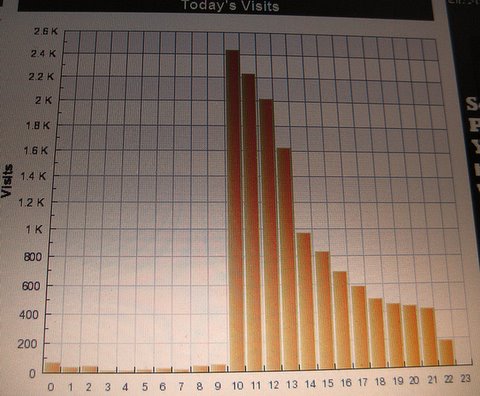
I’m sure there’s a simple equation that expresses the relationship. Here’s a picture of it:

sitemeter11-30-082.jpg

As you can see, this graph charts the number of visitors to my blog yesterday. It is a snapshot taken towards the middle of hour twenty-two. It begins in the wee small hours of the morning, the Sunday after Thanksgiving, ordinarily a very slow time on a very slow day. My traffic was just getting to around the 70 hits-per-hour point when suddenly, at approximately 10 AM, in came the Instalanche and BOOM! went the sitemeter.

There were over 2,400 hits in the first hour after that, about 2,200 in the second, 2,000 in the third, and so on, down to those smaller steps with the smaller decreases between them. This particular Instalanche was good for about 12,500 extra hits that first day—and it’s still going on, albeit at a much reduced rate.

Fun with sitemeters.

Posted in Blogging and bloggers | 25 Replies

Mumbai timeline

The New Neo Posted on December 1, 2008 by neoDecember 1, 2008

For those who requested a timeline of the Mumbai attack, this is the best I’ve been able to find so far.

Posted in Terrorism and terrorists | 2 Replies

The Mumbai policemen who refused to shoot

The New Neo Posted on November 30, 2008 by neoNovember 30, 2008

Photographer Sebastian D’Souza, who was able to take a photo of one of the armed terrorists in the train station in Mumbai, also described the events he witnessed there. One puzzling—not to mention profoundly troubling—aspect of his report was the following [emphasis mine]:

But what angered Mr D’Souza almost as much [as the terrorists’ rampage] were the masses of armed police hiding in the area who simply refused to shoot back. “There were armed policemen hiding all around the station but none of them did anything,” he said. “At one point, I ran up to them and told them to use their weapons. I said, ‘Shoot them, they’re sitting ducks!’ but they just didn’t shoot back.”

…The militants returned inside the station and headed towards a rear exit…Mr D’Souza added: “I told some policemen the gunmen had moved towards the rear of the station but they refused to follow them. What is the point if having policemen with guns if they refuse to use them? I only wish I had a gun rather than a camera.”

Unless these policemen were disciples of Gandhi or abject cowards, it’s hard to explain what might have stayed their hands. But I’ll give it a try.

Lack of readiness. There’s a difference between ordinary police training and the skills one learns in preparation for being a member of a SWAT or counter-terrorism team. Still, one would strongly hope—and expect—that any armed policemen would have the proper instincts and reflexes to take the terrorists out, even minus specialized training.

The problem in the Mumbai station could have been the presence of the crowd of innocents. The police may have been waiting for an opportunity to get off a clear and unobstructed shot, one with little likelihood of striking an unarmed traveler instead of a terrorist. Of course, when the terrorist in question is engaged in calmly murdering scores of people in the crowded station, it seems obvious that the policemen should have taken that chance. Even if a police bullet killed an innocent bystander, the action would end up saving far more people than it killed.

This much seems clear. But fear of doing the wrong thing may have paralyzed some of the policemen. I found a clue in an article about an incident from a month ago that indicates this might have been the case:

The Central and Bihar governments have reacted sharply against the Mumbai police killing a young man who allegedly fired shots and shouted slogans against Navnirman Seva (MNS) leader Raj Thackeray in a bus in Mumbai on Monday.

Police claim 23-year-old Rahul Raj, a resident of Patna who was visiting Mumbai, was mentally unstable and was gunned down when he refused to surrender or throw away his gun.

Bihar Chief Minister Nitish Kumar, who is visiting Delhi, condemned the Mumbai police for killing Raj… Bihar Deputy Chief Minister Sushil Kumar Modi and Shyam Rajak, general secretary of the state opposition Rashtriya Janta Dal party, also condemned the police.

A single man on a bus shouting slogans and firing shots that hit no one is not the same as a group of armed men coolly gunning down people in a crowded railway station. But it’s not really that big a stretch from one to the other. And if the killing of the first man was widely condemned, and the Mumbai police warned against another similar incident, that might have accounted for at least some of the tragic hesitation of the policemen in the train station.

I wrote the preceding part of this post late last night, planning to publish it today. Then this morning I read an article in the NY Times, which quoted police and/or military forces at the Taj Hotel, giving new support to my theory:

On Saturday afternoon, a sharpshooter who had spent over 60 hours perched outside the Taj Hotel said neither he nor his partner had fired a shot because they were not sure how to distinguish the gunmen from ordinary civilians trapped inside the hotel.

Similarly, a commando told a private Indian television station, CNN-IBN, that the gunmen seemed to be firing from so many different parts of the hotel that security forces did not quite know where to strike without inflicting civilian casualties. “There were so many people, and we wanted to avoid any civilian casualties,” he said.

It seems that in India, even “commandos” (which indicates at least some sort of specialized preparation) are not trained to face the chance that they might possibly inflict civilian casualties themselves in a situation like this. But such a risk is an inevitable part of dealing with terrorists willing and eager to fire into crowds. The police must be willing to do the same. The big difference is that the terrorists are aiming for the civilians, whereas the security forces are aiming for the terrorists.

[ADDENDUM: Quite a few interesting topics have come up in the comments section of this post. For more on one of them—Gandhi and pacifism—see this. For more on another—how to train troops to kill—see this.]

Posted in Terrorism and terrorists | 152 Replies

Whatever happened to respecting your elders?

The New Neo Posted on November 29, 2008 by neoNovember 29, 2008

And here I thought the Japanese were supposed to be one of those peoples who revered the elderly, with a culture that featured exquisite politeness.

I guess that’s all changed now, at least if we consider the evidence offered by Japan’s relentlessly non-PC Prime Minister Taro Aso, who decided it was verbal open season on the aged.

The rather aptly named Aso attacked old people for their lack of exercise, calling them “hobbling malingerers” who are “always tottering off to the doctor.” Maybe something was lost in translation, but Aso’s remarks don’t seem inclined to garner him a great deal of support in a nation in which one-fifth of the population is over seventy.

Aso is sixty-eight himself, by the way, and a former Olympic clay pigeon shooter.

Posted in Uncategorized | 7 Replies

Terrorism: the “I’s” have it

The New Neo Posted on November 29, 2008 by neoNovember 29, 2008

Rule of thumb in fighting terrorist attacks: if the Israelis offer advice, take it.

Israeli spokesmen say that in Mumbai, Indian troops stormed the hotels too soon, without gathering enough intelligence first. There is no country on earth with the expertise of the Israelis in this regard, and it’s surprising that (if the article is correct) India may have refused Israel’s assistance when it was initially offered in dealing with the Mumbai attacks.

This is not just because the Israelis wrote the book on this sort of thing. It’s also because India and Israel are countries that have more in common than their initial letter “I.” Although exceedingly different in size and population, they share a fact of history: both were partitioned and separated from their predominantly Muslim segments around the same time (late 1940s), when each ceased being part of the British Empire. In both cases bloodshed followed, and continues to this very day.

But that special history is not all they share. The two countries are increasingly cooperative economically and defensively as well. India is also the most prosperous country in its area, the one most closely allied with the West. And that’s even more true of Israel than it is of India. Islamic terrorists want both of them to pay the price, in blood.

And that’s not all. Both Judaism and Hinduism are the oldest of the world’s major religions still being practiced today. They are not only similar in their antiquity, but are also especially tolerant of the existence of other religions (see this about Judaism). Both have become targets of later, less tolerant religions—in recent years, Islam.

The news today is that the terrorist seige has ended in Mumbai. We can all be grateful for that, most especially the people of Mumbai and of India as a whole. But, as in Israel, it is clear that this is just a momentary lull in a storm that will be disrupting the country for a very long time.

Posted in Terrorism and terrorists | 46 Replies

I’ve got…

The New Neo Posted on November 28, 2008 by neoNovember 28, 2008

…an idea for a new source of income for myself. I’m gonna sue em both.

And lest you think the linked article was a mere Onion fantasy, there’s a real-life precedent.

Posted in Uncategorized | 3 Replies

Mumbai terror

The New Neo Posted on November 28, 2008 by neoNovember 28, 2008

The terror in Mumbai angers me, but it doesn’t surprise. Any shock that this sort of thing can be planned and executed with such vicious intent went away long ago, on 9/11. Perhaps even before that.

We don’t have many details on exactly who is doing this and/or why, but it seems to involve Islamic terrorists. That’s always a good bet, of course. There’s also a long history of attacks in India from such groups, including a newer outfit that appears to be homegrown. Here’s a timeline.

In addition to the targeting of Americans, British, and Jews (one would imagine the latter are not so easy to find in India, but the terrorists have a will and so there’s a way), another difference between this attack and previous ones is the scope and scale of the present one. It is well-coordinated and involves multiple sites, and includes hostage-taking in addition to outright killings.

This underscores the tendency of terrorists to feel the need and the desire to escalate in order to get more and more attention. My guess is that these increasingly outrageous and deadly attacks also feed the terrorists in a personal and emotional way, making them feel bigger and badder and giving them a certain nihilistic glow.

If the aim was to capture the attention of the world, the Mumbai attack has already succeeded. It also promises the added potential benefit for the terrorists of striking a psychological and symbolic blow against India’s strong economy, seeking to discourage the boom in investment from overseas. The specificity of the targets indicate this goal, a resemblance to the apparent motivation for the attacks on the World Trade Center.

The Mumbai carnage also contains an extra message for President-elect Obama: don’t think there’s anything special about you or your election. For us, it’s business as usual—which is to disrupt your business, and that of your allies such as India.

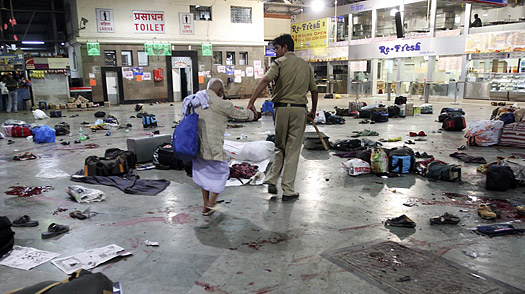
The following photo seemed particularly touching to me, even though there is nothing overtly violent in it. The carnage is implied rather than shown:

mumbaistation.jpg

There’s something about those bags just lying around, abandoned by the people they belonged to, whose ordinary day was disrupted by a nihilim that seems to love violence for its own sake as well as whatever strategic aims were in mind. But in the middle of the photo, there is the image of kindness and the hoped-for restoration of civic law and order: the elderly man (slightly reminiscent of Gandhi) being helped to safety by a soldier.

Posted in Terrorism and terrorists | 64 Replies

Thanks for the burger, but no thanks

The New Neo Posted on November 27, 2008 by neoNovember 27, 2008

A few days ago I noticed a sign outside the local Burger King that said “Open on Thanksgiving.” It made me wonder just what a Thanksgiving Day gathering there might be like. But then I realized that I actually had some personal experience in this regard, many moons ago.

That was when I was in college, before fast food had taken over the world. My family lived about a thousand miles away. My freshman year I’d gone home for Thanksgiving, but it seemed I’d hardly said hello to them before I had to say turn around and say goodbye again.

So my sophomore year I decided to make life easy and stay at school for the holiday (as I recall, one of the things that sweetened the deal was that I had some sort of date planned for Saturday night. But I digress.) I was going home for Christmas in a few weeks anyway, so I figured that would be soon enough to see my parents. After all, I was hardly a baby anymore; I’d reached the outrageously autonomous and sophisticated age of eighteen.

The dorm remained open, and there were three other girls staying there for the duration, all of them from foreign countries. But on Thanksgiving Day I discovered to my surprise that the dorm kitchen was closed, and all the other girls had somewhere else to go for the big feast.

I did not. I sat in my room pondering the dilemma. I had no car. There were very few restaurants in town, and the only nearby one that was open was a greasy spoon across the street that served sandwiches and fries and burgers. To top it all off it was raining in torrents.

I waited till the evening when hunger got the better of me, and then I scooted across the street in shame to the restaurant that was empty of any other customers, ordered a double cheeseburger to go with extra ketchup and a large fries (it was, after all, Thanksgiving, time for a feast), brought it all back to my room, and ate it slowly at my desk. “Slowly” in this case might have been all of fifteen minutes.

I never again made the error of being alone on Thanksgiving. Or having a burger. Despite all sorts of menu and venue variations, the classic turkey-with-stuffing theme has always been scrupulously followed.

This year I want to express the hope that all of you had a wonderful meal with wonderful company—whatever the menu, wherever you may be.

beforeturkey.jpg

Posted in Food, Me, myself, and I | 23 Replies

The lost art of browsing; the power of the book inscription

The New Neo Posted on November 26, 2008 by neoNovember 26, 2008

Theodore Dalyrmple mourns the decline of the practice of browsing in secondhand bookstores. Now that the internet allows us to zero in on exactly and precisely the used book we might be looking for, it is no longer necessary—nor do people seem to have the patience and the time—to while away an hour or two (or more) looking at musty volumes in cramped quarters in the low-rent section of town.

I still sometimes go to used bookstores and browse, although I understand why many people don’t. But they miss the serendipitous discoveries that can be made, and the fun of glimpsing the strange, unexpected, and obscure.

Browsing is a somewhat lost art not just in used bookstores, but in general. First cause was the catalogue and now the internet. One can browse online of course, but somehow it’s different. The process doesn’t have the same dimensions, nor does it engage all the senses. A person is limited by the way the website search is set up. Sometimes it’s impossible to find an item because the proper category isn’t known, for example.

It’s the same with hard copies of news media versus reading news online. I can read an online copy of a certain magazine—or think I’ve read it—yet when I hold an actual physical copy of the same in my hand, it has a heft and solidity that’s almost surprising. Glancing at it and turning the pages, I notice items I hadn’t seen before, including things that might interest me. Smaller articles. Advertisements. The shape the words make on the page. The quality of the paper. So something is lost in translation that is gained in convenience.

Dalyrmple also writes about book inscriptions in his essay. They are small bids for immortality on the part of the person who pens them, just as Dalyrmple indicates. For the recipient they are also a reminder, usually of the love and care of someone who is gone.

As a child I tended to request books as presents. I asked for some very strange ones indeed, most often gleaned from other readings, perhaps of library books (I was, and still am, a frequent patron). My parents also used to receive in the mail the Marlboro Books catalogue (an operation that seems to be defunct; I can no longer find it online), and I ordered a few items from it all by myself as a youngster, with money saved from gifts and allowances.

Just to show you what a strange child I was (as though you needed a demonstration), when I was about ten years old I sent away for a copy of Extraordinary Popular Delusions and the Madness of Crowds (hardcover, natch), as well as a great little cheerer-upper called The Rape of the Mind. The latter was about brainwashing. Good training for a future blogger specializing in the mental gymnastics involved in political decisions and mass movements. It seems my course was already set back then, although I certainly didn’t know it.

One of the few books with inscriptions I ever received was a gift from my grandmother. It was a Time-Life coffee-table extravaganza entitled The Wonders of Life on Earth (science was another early love of mine).

I still have the book, although it long ago lost its glossy dust cover. The text and the beautiful pictures and drawings were very satisfying at the time I received it. But after all these years the best part is the spidery old-fashioned handwriting on the flyleaf that says, quite simply, “From Grandma,” and the date; she died seven years later. It was the first gift I ever got that I had requested; the first time anyone had ever asked me, and actually listened to my answer.

A poignant example of the treasures (sometimes bittersweet) to be found in used bookstores appears in Vladimir Nabokov’s sublime and haunting memoir Speak, Memory. Nabokov was raised in luxury in pre-Soviet Russia, a condition that ended abruptly with the Revolution and lifelong banishment. In Chapter Nine of the book he describes the library in his childhood home, a room in which Nabokov’s beloved father not only read, but also took daily boxing and fencing lessons from a teacher who visited expressly for that purpose:

The place combined pleasantly the scholarly and the athletic, the leather of books and the leather of boxing gloves. Fat armchairs stood along the book-lined walls. An elaborate “punching ball” affair purchased in England—four steel posts supporting the board from which the pear-shaped striking bag hung—gleamed at the end of the spacious room. The purpose of this apparatus, especially in connection with the machine-gunlike ra-ta-ta of its bag, was questioned and the butler’s explanation of it reluctantly accepted as true, by some heavily armed street fighters who came in through the window in 1917. When the Soviet Revolution made it imperative for us to leave St. Petersburg, that library disintegrated, but queer little remnants of it kept cropping up abroad. Some twelve years later in Berlin [after Nabokov’s father had been assassinated in that same city], I picked up from a bookstall one such waif, bearing my father’s ex libris. Very fittingly, it turned out to be The War of the Worlds by Wells. And after another decade had elapsed, I discovered one day in the New York Public Library, indexed under my father’s name, a copy of the neat catalogue he had had privately printed when the phantom books listed therein still stood, ruddy and sleek, on his shelves.

Inscriptions survive their authors; it is one of their most magical and touching qualities. So do old books. This fact is no small part of their allure and their mystery.

[ADDENDUM: For my own strange experience—also involving a parent, in this case my mother—in the New York Public Library, please see this.]

[ADDENDUM II: And if you’re hungry for more Dalyrmple today, here’s another good one, although this time of the political variety.]

Posted in Literature and writing, Me, myself, and I | 22 Replies

This just might be…

The New Neo Posted on November 25, 2008 by neoNovember 25, 2008

…too much information.

On the other hand, it’s evidence that astronauts are made of sterner stuff than most of us. But then again, we already knew that.

[NOTE: The matter I’m referring to begins in paragraph four of the article.]

Posted in Uncategorized | 13 Replies

Predicting the financial crisis: a few who saw it coming, and why

The New Neo Posted on November 25, 2008 by neoNovember 25, 2008

Here’s an exceedingly sobering article by Michael Lewis on the roots of the financial crisis, and a few of the prognosticators who saw it coming. These people had a couple of characteristics in common: a finely-honed BS detector; a willingness to face unpleasant truths, ask unwelcome questions, and make depressing predictions; and an immunity to the desire to move with the pack.

In retrospect, the truths in the article seem self-evident. But at the time they were being formulated they most certainly were not. There’s apparently a very powerful desire to believe in a pleasant fable in which home prices continue to rise forever, and where heads of huge companies and the people they employ actually know—and care—what they are doing, and what the larger consequences of their actions might be.

A while back I called the subprime mortgage market and its derivatives and tranchings an attempt at alchemy, that futile quest to turn base metals into gold. Unlike actual alchemy, this effort seemed to work—for a while. But now it’s turned to dross.

I was surprised to see something akin to my alchemy metaphor appear in the Lewis article in the following quote from a man named Steve Eisman, the abrasive yet prescient Wall Street analyst featured in the piece, “I didn’t understand how they were turning all this garbage into gold.” Some years ago, Eisman set about to find out, researching the situation by observing and talking to those in the subprime debt business.

What he discovered makes chilling reading. At the end of this long but edifying article, you may find yourself very angry, if you weren’t already.

Here’s a sample; Eisman is explaining to the author how the “creative” instruments called collateralized debt obligations (C.D.O.s) operated:

“You have to understand this,” [Eisman] says. “This was the engine of doom.” Then he draws a picture of several towers of debt. The first tower is made of the original subprime loans that had been piled together. At the top of this tower is the AAA tranche, just below it the AA tranche, and so on down to the riskiest, the BBB tranche””the bonds Eisman had shorted. But Wall Street had used these BBB tranches””the worst of the worst””to build yet another tower of bonds: a “particularly egregious” C.D.O. The reason they did this was that the rating agencies, presented with the pile of bonds backed by dubious loans, would pronounce most of them AAA. These bonds could then be sold to investors””pension funds, insurance companies””who were allowed to invest only in highly rated securities. “I cannot fucking believe this is allowed””I must have said that a thousand times in the past two years,” Eisman says.

His dinner companion in Las Vegas ran a fund of about $15 billion and managed C.D.O.’s backed by the BBB tranche of a mortgage bond, or as Eisman puts it, “the equivalent of three levels of dog shit lower than the original bonds.”

FrontPoint had spent a lot of time digging around in the dog shit and knew that the default rates were already sufficient to wipe out this guy’s entire portfolio. “God, you must be having a hard time,” Eisman told his dinner companion.

“No,” the guy said, “I’ve sold everything out.”

After taking a fee, he passed them on to other investors. His job was to be the C.D.O. “expert,” but he actually didn’t spend any time at all thinking about what was in the C.D.O.’s. “He managed the C.D.O.’s,” says Eisman, “but managed what? I was just appalled. People would pay up to have someone manage their C.D.O.’s””as if this moron was helping you. I thought, You prick, you don’t give a fuck about the investors in this thing.”

Whatever rising anger Eisman felt was offset by the man’s genial disposition. Not only did he not mind that Eisman took a dim view of his C.D.O.’s; he saw it as a basis for friendship. “Then he said something that blew my mind,” Eisman tells me. “He says, ”˜I love guys like you who short my market. Without you, I don’t have anything to buy.’”‰”

That’s when Eisman finally got it. Here he’d been making these side bets with Goldman Sachs and Deutsche Bank on the fate of the BBB tranche without fully understanding why those firms were so eager to make the bets. Now he saw. There weren’t enough Americans with shitty credit taking out loans to satisfy investors’ appetite for the end product. The firms used Eisman’s bet to synthesize more of them. Here, then, was the difference between fantasy finance and fantasy football: When a fantasy player drafts Peyton Manning, he doesn’t create a second Peyton Manning to inflate the league’s stats. But when Eisman bought a credit-default swap, he enabled Deutsche Bank to create another bond identical in every respect but one to the original. The only difference was that there was no actual homebuyer or borrower. The only assets backing the bonds were the side bets Eisman and others made with firms like Goldman Sachs. Eisman, in effect, was paying to Goldman the interest on a subprime mortgage. In fact, there was no mortgage at all. “They weren’t satisfied getting lots of unqualified borrowers to borrow money to buy a house they couldn’t afford,” Eisman says. “They were creating them out of whole cloth. One hundred times over! That’s why the losses are so much greater than the loans. But that’s when I realized they needed us to keep the machine running. I was like, This is allowed?”

Yes, we can blame Barney Frank and the Democrats and Fannie and Freddie for their part in the subprime mortgage debacle. But they only acted as a starter engine, and failed (along with so many) to see where the runaway bus was heading. The point is that few people did see; it took someone with the clearsighted cynicism (I don’t think that’s an oxymoron) and the drive of Eisman to put it all together and try to sound the (largely unheeded) warning.

I agree with those who criticized John McCain for failing to point out the Democrats’ large role in pushing subprime mortgages at the start, and failing to check them later on. However, he was also excoriated by many people for blaming the crisis on “Wall Street greed” instead. There’s no “either-or,” of course. But if anyone has any doubt at this point how right McCain was about the greed part, all they have to do is read this article.

I know I’ve already quoted the piece at some length, but here’s just a bit more. It describes the beginning of the end, when a man named John Gutfreund, the ex-CEO of Salomon Brothers, turned it from a private partnership into Wall Street’s first public corporation in the 80s:

From that moment, though, the Wall Street firm became a black box. The shareholders who financed the risks had no real understanding of what the risk takers were doing, and as the risk-taking grew ever more complex, their understanding diminished….No investment bank owned by its employees would have levered itself 35 to 1 or bought and held $50 billion in mezzanine C.D.O.’s. I doubt any partnership would have sought to game the rating agencies or leap into bed with loan sharks or even allow mezzanine C.D.O.’s to be sold to its customers. The hoped-for short-term gain would not have justified the long-term hit…

“When things go wrong, it’s their problem,” [Gutfreund] said””and obviously not theirs alone. When a Wall Street investment bank screwed up badly enough, its risks became the problem of the U.S. government. “It’s laissez-faire until you get in deep shit,” he said, with a half chuckle. He was out of the game.

Actually, Gutfreund got out of the game quite some time ago, forced to resign in disgrace from Salomon in 1991. Later, he advised students to do something better with their lives than follow in his footsteps. But he knows more than most what went down and how it worked—and how it is that we are all now forced to assume risks we would never have thought of taking.

[NOTE: Hat tip on the article, commenter “logern.”]

Posted in Finance and economics | 58 Replies

Unforeseen consequences

The New Neo Posted on November 25, 2008 by neoNovember 25, 2008

I found the following tangential nugget about the long-term consequences of one of Bill Clinton’s Presidential moves buried in an article on the surprising amount of cooperation that seems to be developing between the outgoing Bush Administration and the incoming Obama one:

After 18 U.S. Army Rangers were killed and soldiers were dragged through the streets of Mogadishu , Clinton began a troop pullout; all U.S. forces were out by 1995. Osama bin Laden later said that the U.S. withdrawal encouraged his al Qaida forces to plan new attacks.

Premature withdrawals are seen by terrorists as acts of cowardice committed by weak horses. Obama, take note.

Posted in Terrorism and terrorists | 19 Replies

Post navigation

← Previous Post
Next Post→

Your support is appreciated through a one-time or monthly Paypal donation

Please click the link recommended books and search bar for Amazon purchases through neo. I receive a commission from all such purchases.

Archives

Recent Comments

  • Art Deco on The AfD does very well in the recent German elections in Saxony-Anhalt
  • neo on The AfD does very well in the recent German elections in Saxony-Anhalt
  • neo on The AfD does very well in the recent German elections in Saxony-Anhalt
  • BJ on Happy Labor Day
  • BJ on The Clancy jury apparently will end in a mistrial

Recent Posts

  • The AfD does very well in the recent German elections in Saxony-Anhalt
  • Happy Labor Day
  • Open thread 9/7/2026
  • A restrained AI spam comment
  • A lost skill

Categories

  • A mind is a difficult thing to change: my change story (17)
  • Academia (328)
  • Afghanistan (98)
  • Amazon orders (6)
  • Arts (8)
  • Baseball and sports (164)
  • Best of neo-neocon (91)
  • Biden (536)
  • Blogging and bloggers (595)
  • Dance (292)
  • Disaster (244)
  • Education (323)
  • Election 2012 (360)
  • Election 2016 (566)
  • Election 2018 (33)
  • Election 2020 (513)
  • Election 2022 (114)
  • Election 2024 (403)
  • Election 2026 (93)
  • Election 2028 (13)
  • Evil (129)
  • Fashion and beauty (324)
  • Finance and economics (1,042)
  • Food (317)
  • Friendship (48)
  • Gardening (18)
  • General information about neo (4)
  • Getting philosophical: life, love, the universe (734)
  • Health (1,161)
  • Health care reform (545)
  • Hillary Clinton (184)
  • Historical figures (337)
  • History (716)
  • Immigration (448)
  • Iran (464)
  • Iraq (227)
  • IRS scandal (71)
  • Israel/Palestine (821)
  • Jews (437)
  • Language and grammar (365)
  • Latin America (212)
  • Law (2,975)
  • Leaving the circle: political apostasy (124)
  • Liberals and conservatives; left and right (1,321)
  • Liberty (1,117)
  • Literary leftists (14)
  • Literature and writing (394)
  • Me, myself, and I (1,498)
  • Men and women; marriage and divorce and sex (929)
  • Middle East (384)
  • Military (324)
  • Movies (353)
  • Music (533)
  • Nature (261)
  • Neocons (32)
  • New England (183)
  • Obama (1,738)
  • Pacifism (16)
  • Painting, sculpture, photography (131)
  • Palin (93)
  • Paris and France2 trial (25)
  • People of interest (1,043)
  • Poetry (258)
  • Political changers (178)
  • Politics (2,793)
  • Pop culture (397)
  • Press (1,635)
  • Race and racism (882)
  • Religion (428)
  • Romney (164)
  • Ryan (16)
  • Science (641)
  • Terrorism and terrorists (971)
  • Theater and TV (266)
  • Therapy (71)
  • Trump (1,630)
  • Uncategorized (4,555)
  • Vietnam (109)
  • Violence (1,445)
  • War and Peace (1,027)

Blogroll

Ace (bold)
AmericanDigest (writer’s digest)
AmericanThinker (thought full)
Anchoress (first things first)
AnnAlthouse (more than law)
AugeanStables (historian’s task)
BelmontClub (deep thoughts)
Betsy’sPage (teach)
Bookworm (writingReader)
ChicagoBoyz (boyz will be)
DanielInVenezuela (liberty)
Dr.Helen (rights of man)
Dr.Sanity (shrink archives)
DreamsToLightening (Asher)
EdDriscoll (market liberal)
Fausta’sBlog (opinionated)
GayPatriot (self-explanatory)
HadEnoughTherapy? (yep)
HotAir (a roomful)
InstaPundit (the hub)
JawaReport (the doctor’s Rusty)
LegalInsurrection (law prof)
Maggie’sFarm (togetherness)
MelaniePhillips (formidable)
MerylYourish (centrist)
MichaelTotten (globetrotter)
MichaelYon (War Zones)
Michelle Malkin (clarion pen)
MichelleObama’sMirror (reflect)
NoPasaran! (bluntFrench)
NormanGeras (archives)
OneCosmos (Gagdad Bob)
Pamela Geller (Atlas Shrugs)
PJMedia (comprehensive)
PointOfNoReturn (exodus)
Powerline (foursight)
QandO (neolibertarian)
RedState (conservative)
RogerL.Simon (PJ guy)
SisterToldjah (she said)
Sisu (commentary plus cats)
Spengler (Goldman)
VictorDavisHanson (prof)
Vodkapundit (drinker-thinker)
Volokh (lawblog)
Zombie (alive)

Meta

  • Log in
  • Entries feed
  • Comments feed
  • WordPress.org
©2026 - The New Neo - Weaver Xtreme Theme Email
Web Analytics
↑