↓
 

The New Neo

A blog about political change, among other things

  • Home
  • Bio
  • Email
Home » Page 1737 << 1 2 … 1,735 1,736 1,737 1,738 1,739 … 1,917 1,918 >>

Post navigation

← Previous Post
Next Post→

Gail Collins vies for honor of worst NY Times column ever

The New Neo Posted on November 24, 2008 by neoNovember 24, 2008

There’s a lot of competition for that honor, but this column by Gail Collins just might get top (bottom?) prize. Unwilling to wait the last two months of the end-of-Bush-Presidency countdown, or to let the Constitution take its course, Collins calls for the immediate resignation of President Bush. Apparently she just can’t tolerate another moment of the man, now that the end is in sight.

Where does the Times get these people, and why are their thoughts considered fit to print? It’s not as though Collins is a newby, either. On looking up her bio, I discovered that she was the first female editor of the Times‘ editorial page, serving in that capacity from 2001 to 2007. Before and after that she had/has been a columnist. Nor should she be ignorant of the topic on which she speaks; her degree was not only in journalism, but she earned a Master’s in government as well.

This proves two things: not only is it possible to rise to a high position at the Times and still be foolish as well as ignorant, but it’s also possible to get a degree in government and not have any practical understanding of it. I suppose neither thing should surprise me in the least at this point. But I still consider them remarkable.

Collins isn’t just calling for Bush to resign, either—“obviously,” she says, Cheney’s got to go too. Obviously. As a result we would then get the interim presidency of none other than Nancy Pelosi, a development certain to reassure just about nobody—with the possible exceptions of Ms. Pelosi herself, her immediate family, and Gail Collins.

Collins writes:

House Speaker Nancy Pelosi would become president until Jan. 20. Obviously, she’d defer to her party’s incoming chief executive, and Barack Obama could begin governing.

I’m not sure Pelosi would defer to anything or anybody, especially after she got a taste of the highest position in the land without benefit of having had to earn it. The damage she might do in even two short months could be formidable. And how this turn of events would ultimately help Obama’s Presidency is exceedingly unclear.

Ms. Collins does manage to make a historical comparison, and the one she offers is telling:

In the past, presidents have not taken well to suggestions that they hand over the reins before the last possible minute. Senator J. William Fulbright suggested a plan along those lines when Harry Truman was coming to the end of a term in a state of deep unpopularity, and Truman called him “Halfbright” for the rest of his life.

Truman was deeply unpopular, it’s true. And yet now he is usually ranked among the top ten Presidents in history, most often around number seven. Funny how that can happen.

Collins’ column has a juvenile, snarky tone that shows about as much respect for Bush—and, even more importantly, for the office of the Presidency and the rule of law—as her suggestion does. In fact, what she mostly expresses is contempt, and the now-familiar attitude of the sore winner.

Not only does Collins fail to understand that it is hugely important to adhere to the Constitutional rules set up for the peaceful transition of power, a widely-admired process that makes the US an example to the world, but in the extremity of her shortsighted anti-Bush partisanship she fails to understand that we cannot automatically assume that it’s the Bush Presidency that’s causing the markets to tank. Another perspective is that it may be the prospect of change in a time of crisis, and fear of the unknown policies of an untested Obama, causing at least some of the increased panic.

Markets tend in general to dislike instability. So Collins’ bright idea of adding even more instability to the present toxic mix is an exceedingly poor one.

If Ms. Collins is joking, it’s a lousy joke at a very poor time. If she’s serious, it’s just further evidence—not that we needed it—that the NY Times long ago dropped all semblance of objective reporting. At least it’s not pretending any more.
Posted in Press | 57 Replies

Defending Richard Thompson

The New Neo Posted on November 24, 2008 by neoAugust 30, 2011

Okay, I tolerate a lot of dissent here. But some statements are simply unconscionable.

Case in point, “Tom” on Richard Thompson:

Why is it so many skilled musicians are considered “songwriters” when their lyrics are simply so stupid? I’d prefer the unadorned instrumentals to crap lyrics as here…

Richard Thompson is a fabulous guitar player and indefatigable performer. His voice has a smoky intensity and emotional complexity that is nearly unsurpassed. But he’s also a lyricist of rare narrative and poetic skill, as well as intelligence.

“Mingus Eyes,” the song featured in yesterday’s post, isn’t one of the finest examples, to be sure, although it’s not bad. I put it up there because I like the guitar (and the bass; I agree with all the commenters who remarked on that), and because it featured Thompson’s quirky little kick.

But Thompson is master of the bitingly witty (although often darkly bitter) lyric, as well as the song that tells a poignant story. As exhibits A through F, I suggest “Beeswing”, for starters. Then try “Vincent Black Lightning,” “Down Where the Drunkards Roll,” “Wall of Death,” “Walking On a Wire,” and, for a touch of lightness, “Hots for the Smarts.”

Or look at the lyrics of just about anything else the man has written. But your research won’t be complete without a visit to You Tube to see his performances of all these favorites, and more.

So there.

Posted in Literature and writing, Music | 10 Replies

Can’t get enough Richard Thompson?

The New Neo Posted on November 23, 2008 by neoNovember 23, 2008

So here’s some more, for your viewing and listening pleasure.

For those of you who play guitar, you might want to study how it is that he makes the difficult seem so easy. Nice closeups of Thompson’s hands and face. He often sings with closed eyes; his concentration is very deep.

When I wrote about Thompson here, I noted:

In person, he emanates a deceptive stillness that contains within it a coiled tension. He moves hardly at all when he plays and sings; all that energy is focused on his hands, face, and mouth. Every now and then a leg kicks out in a small karate-like action, potential energy transformed to kinetic.

You can see some fine examples of that irrepressible kick from about minute 2:00 to 2:15:

Lyrics here.

Posted in Music | 12 Replies

The heat is on

The New Neo Posted on November 22, 2008 by neoNovember 22, 2008

This fall I’ve been engaging in the popular annual New England sport of thermostat avoidance. The idea is to see who can be last to turn on the central heating in house or apartment. Last one to do so wins.

Wins what? Nothing but bragging rights, and a slightly reduced heating bill.

I’m not sure why I play this game, except I always do. For a while it’s perfectly fine. All I need is an extra sweater; no problem. Later on, maybe another layer underneath, perhaps an extra T-shirt. And then some thicker, more comfy socks.

And then one day, suddenly (and this year that day came about five days ago) I realize I’m keeping my down jacket on when I come in from the outside. Keeping it on not just for a few minutes, but indefinitely.

That’s the moment of truth. I surrender, flipp that switch from “off” to “heat,” set the temperature level, hear the low and reassuring rumble of the blower, and feel the cozy warmth return. Ah!!

Oh, why not:

Posted in Me, myself, and I, New England | 25 Replies

Today is VI Day

The New Neo Posted on November 22, 2008 by neoNovember 22, 2008

It’s pretty much “mission accomplished” in Iraq. But it’s a victory we’re not willing to openly claim.

In another world and time, this war would have been lauded as one of the least brutal in history, although it was fought against some of the most brutal of opponents—Saddam Hussein, the insurgents, and al Qaeda. But thanks to our strange reluctance to credit that there is any good that can come from the horror of a war—or to realistically analyze what victory there might look like—this particular success is being noted not with a bang but a whimper.

I have written at length previously, in a two-part series that begins here, about how and why we have failed to define success in Iraq, and the importance of that omission for the public’s perception of this war.

I am not really suggesting a major celebration. Nor am I saying things couldn’t still turn in a worse direction for Iraq, especially as more of our forces withdraw. “Victory” is never permanent or static. But there is no question that things there are going about as well as any realistic person could have expected, and much better than most did expect.

Ace comments on the victory that has gone nearly unnoticed. And Zombietime has decided to declare today, November 22, VI Day:

Although our governments have chosen to not name any official day marking the end of this war, we the people have taken it upon ourselves to commemorate November 22, 2008 as the day of victory over the forces of tyranny, oppression and terror in Iraq.

Join fellow bloggers and other members of the public in this virtual ticker-tape parade for our brave troops…

VE Day and VJ Day were altogether different from VI Day, of course, and not just because the former were enthusiastically celebrated. One obvious difference between then and now is that World War II was a war against countries that had fought all out for many years and then surrendered—spent and exhausted. These surrenders marked an obvious end to the violence, even though we retained troops in those countries for a long time thereafter in what was a successful rebuilding occupation (in fact, we continue to have a significant number of troops there: see this and this). The people in those countries knew the difference between victory and defeat and they had a deep awareness, after many years of all-out conflict, and death tolls that dwarfed anything in the Iraq War, that they were beaten.

And speaking of all-out conflict, Americans knew that’s what they had been involved in as well, for close to four long years. There was no doubt about it; everyone was on a war footing, civilian and military alike. Almost every family in the US had someone serving overseas because in addition to hordes of volunteers, the draft reached into so many homes.

And it wasn’t just the fact of the draft, it was the huge number of men mobilized. The Vietnam era draft threatened many young men but a far smaller proportion actually served in that theater of war compared to WWII (in Vietnam, about 2.7 million served and about 58 thousand died from a total US population of about 203 million people; in WWII about 16 million served and 418 thousand died out of a total US population of about 130 million people). And in Iraq, not only has there been no US draft, but the actual numbers of those who have served in Iraq are far smaller (this site is somewhat out of date, but it still serves for purposes of comparison).

We have two other elements that have made this war in Iraq different from WWII: negative press coverage during much of its course, and antiwar fervor on the part of one major party for much of its course (the best comparison is to Vietnam, but that opposition got started later in the history of the conflict).

And now that President Bush has become an especially lame duck, and the economy has taken such a terrible turn, the Iraq war is virtually forgotten as it winds to a relatively successful close, although such a development would have been considered almost miraculous less than two short years ago. There will be no parades today, no crowds celebrating, and no exuberant sailors bending pretty girls backwards in a joyous embrace. But still, attention should be paid, and credit given.

Posted in Iraq, War and Peace | 91 Replies

As time goes by

The New Neo Posted on November 22, 2008 by neoNovember 22, 2008

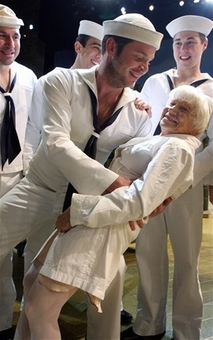
Here’s a re-creation—sort of—of a famous photographic kiss:

wwiinurse.jpg

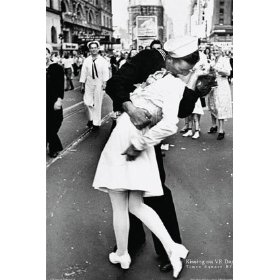
Here’s the iconic original from VJ Day in Times Square:

wwiinurse2.jpg

The claim is that it’s the same woman. I’ve always loved that black and white Eisenstaedt photo, especially the little twist in the nurse’s posture. Here’s an article on the many claimants for the honor of being the originals.

Posted in Pop culture | 3 Replies

Voting reform: ain’t gonna happen

The New Neo Posted on November 21, 2008 by neoNovember 21, 2008

After 2000, there were many calls for voting reform. Same in 2004, and now again. Voting fraud—or even the perception of it—can’t help but undermine trust in the legitimacy of the government, and that’s not good. So one would think that fixing the problems would have bipartisan approval.

One of the main arguments, and the focus for at least some of the rage, against George Bush was the voting turmoil in 2000. Bush was not responsible for Florida and the butterfly ballot, but he was the beneficiary and it served to channel anger against him and to amplify it, right at the outset. The same is true of Acorn shenanigans in the election of 2008 as they relate to Obama, and his previous connections to Acorn only make the perception worse.

This sort of doubt directed at a President-elect does not bode well for the institution of the Presidency itself, nor for the country. So why wouldn’t both parties do all they could to change it?

“Dream on, neo” you say. And you would be correct. Each party wishes to maximize the number and/or proportion of its own voters, for obvious reasons. For Republicans, this means making rules tougher (or at least keeping them traditionally tough) about who is allowed to vote. No motor voter. Definitely no aliens being able to present a utility bill on voting day. Forget about felons. I happen to agree with these rules, even in the abstract. I think that voting should be restricted to citizens, for example—I’m funny that way. And I am fairly certain I felt that way even back in my liberal Democrat days.

However, Democrats have a strong interest in allowing such people to vote, because they tend to vote Democratic. It’s really not rocket science. As the party encourages expansion of voting rights and winks at fraud that aims to include these voters, and solidifies its power as a result, why would that party ever vote to restrict the practice? And if you think Republicans are needlessly or even nastily or fraudulently restrictive, you would know the same is true of their policies.

It is sad but true that few politicians who are favored by certain voting policies would slit their own throats and vote against them, merely for reasons of justice or fairness or ethics. This is why, once this begins, it is unlikely to end—at least, as long as that party continues to be in power. And that party is more likely to stay in power as long as the voting policies that favor it are in place. It is a vicious cycle, or a wonderful cycle—depending on your point of view, and your party.

[ADDENDUM: Here, by the way, is how India handles potential problems. Sounds like a great system. But I doubt it will happen here, not only because of special interests, but because it is too centralized.]

Posted in Politics | 9 Replies

It’s Neo Day at Google

The New Neo Posted on November 21, 2008 by neoNovember 21, 2008

This must be my day. Not only has Obama turned into a neo-neocon, but Google has decided to honor me. And it’s about time.

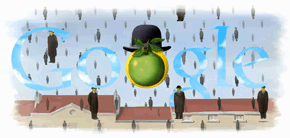
Here’s the graphic you get when you do a Google search today:

googlesearch.gif

You say that perhaps Google is actually honoring Magritte? Well, I beg to differ.

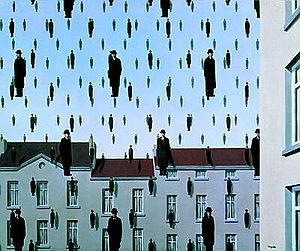
Although I must say the Google image is rather reminiscent of Magritte’s “Golconda:”

golconde.jpg

Just a coincidence, I’m sure.

Posted in Painting, sculpture, photography | 5 Replies

Obama is a neo-neocon

The New Neo Posted on November 21, 2008 by neoNovember 21, 2008

Not really, or course. But more than his followers expected.

His antiwar supporters don’t understand it, nor do they like it. But they can’t say he didn’t warn them:

I am new enough on the national political scene that I serve as a blank screen on which people of vastly different political stripes project their own views. As such, I am bound to disappoint some, if not all, of them.

Let the disappointment begin!

Posted in Obama | 18 Replies

Back to the future: choosing the Obama team

The New Neo Posted on November 20, 2008 by neoNovember 20, 2008

So far Obama’s choices for Cabinet and other advisers seem to be shaping up as Clinton redux.

This is somewhat ironic, considering that Obama ran on a “change” platform and his closest rival was Hillary (Clinton, in case there’s anyone who needs reminding). So even before he’s been officially inaugurated, he’s faced a lot of criticism about this, from both friends and opponents.

Well folks, hold onto your hats, because I’m about to defend Obama. Sorta, anyway.

A new president has a limited number of ways to go in making appointments. He/she (and I will henceforth dispense with this awkward PC pronoun arrangement and just go with the masculine) can either: (a) hark back to earlier administrations’ picks and choose people with federal government experience; (b) select those with no role in previous governments but who (we can hope) are qualified because of jobs they have held in other sectors; or (c) deal in cronyism (this does not necessarily rule out being qualified, but it is more likely to do so).

So far, Obama is trending mostly towards (a). Because of his own rather extreme inexperience, it’s not a bad way to go if he wants to reassure people that he’s not a wild-eyed radical who will appoint other radicals and/or neophytes. His appointments have a grounding effect, at least potentially. However, they also appear to be an early disappointment to those who believed he would somehow wave a magic wand and Change Everything.

The Clinton administration was the most recent Democrat presidency. To go back and try to find non-Clinton Democrats with experience in a previous administration, Obama would had to have reached back to the 70s and Carter. I for one am highly relieved that he has not done so—not only because many of those people would be ancient (or dead), but because I think that for the most part Carter’s policies were more disastrous than Clinton’s. But these two administrations—Clinton’s and Carter’s—are pretty much the only games in town for Obama if he wants Democrats with previous experience at that level.

What of (b), however? When one looks back at history, it’s an approach practiced to a large extent by FDR and JFK. The former had his “brain trust,” a shifting group of academicians who advised him through the long years of the New Deal. According to Wiki, “Many newspaper editorials and editorial cartoons ridiculed them as impractical idealists.” And this may indeed have been true, if the current view of Roosevelt as adopting policies that prolonged the Depression is correct.

An earlier manifestation of the same idea was Woodrow Wilson’s “The Inquiry,” a group of academics who advised him on matters pertaining to negotiations at the end of WWI. Of course, Wilson himself was an academic prior to becoming President, so it’s hardly surprising that he turned to them for advice. But if the Treaty of Versailles and its aftermath are any guide, they didn’t do a very good job.

JFK’s administration was a mixture of all three approaches. Dean Rusk, Kennedy’s Secretary of State, was an example of (a). He had been in the State Department since the Truman Administration, so this was a fairly conventional pick. Johnson kept him on as well (as he did for most of JFK’s appointees).

But Kennedy was famous for his own version of the brain trust, otherwise known as the Best and the Brightest. In fact, fifteen Rhodes Scholars were in high Kennedy administration posts:

“From Eisenhower to Kennedy,” observed a Harvard professor, “is a shift from the “gentleman C’s’ boys to the Phi Beta Kappas.”

The most well-known of Kennedy’s picks without previous government experience were Robert McNamara and McGeorge Bundy. Their policies in Vietnam are not much of a recommendation for method (b), either.

McNamara was appointed by Kennedy and kept on by Johnson as Secretary of Defense. A Harvard MBA and professor who later fought in WWII, he was President of Ford when he was tapped for the government job of Defense. Kennedy had initially offered the post to Lovett, who had been Truman’s Secretary of Defense. This appointment would have been an example of (a). But Lovett turned it down for health reasons and recommended McNamara, who was given the choice of Treasury as a cabinet post, one to which he may have been far better suited. But he turned it down and settled for Defense. On such small pivots does history turn.

McGeorge Bundy was prominent as JFK’s national security adviser. He was an academic who went into government for the first time during Kennedy’s administration, and stayed on through part of Johnson’s term:

Bundy was one of Kennedy’s “wise men,” a noted professor of government””although not a PhD””at Harvard University. He was later appointed Dean of the Faculty at Harvard, the youngest in the school’s history. He moved into public life in 1961, becoming national security adviser in the Kennedy administration. He played a crucial role in all of the major foreign policy and defense decisions of the Kennedy and part of the Johnson administration. These included the Bay of Pigs Invasion, the Cuban Missile Crisis, and, most controversially, the Vietnam War.

Not a very impressive resume, in the end. This is not to say that choice (b) is always a bad one. But I’ve offered the prominent examples that happened to come to mind for me, and they certainly indicate that (b) is not necessarily a better way to go than (a).

And then of course there is choice (c). I’m especially glad Obama does not seem to be going that route so far, since so many of his allies and confederates during his rise to power have been either shady, Leftist, corrupt, hatemongers, or several or all of the above.

One of the best examples of nepotism in a previous administration was Kennedy’s appointment of his brother Bobby as Attorney General. Widely criticized even at the time, it resulted in the passage (in 1967) of the so-called “Bobby Kennedy Law” prohibiting such nepotism in the future. There is evidence that JFK was initially wary of appointing Bobby as AG, but that his father (speaking of nepotism) insisted on it.

Obama is a fatherless only child, so we don’t have to worry about the undue influence of a Joseph Kennedy or a brother Bobby. As for Obama’s erstwhile “spiritual father,” Reverend Wright, we can assume that Obama will not touch that particular third rail during his administration, at least publicly. But one of the reasons Obama’s associations were examined so closely (at least by the Right; the MSM didn’t much care) was the understandable concern that people such as Wright, Ayers, and Frank Marshall Davis might have input (or, in the case of the deceased Davis, have had input), not in an Obama administration, but as simpatico influences on the formation of his thoughts and policies.

It is still very early, and Obama has made few decisions yet. This is also not surprising; he seems to be a guy who takes his time and then some.

Obama’s delay in choosing a Treasury Secretary has not been reassuring to the financial markets, as they keep plunging in a kind of “how low can you go?” limbo dance. And I think very little of his Attorney General pick Holder, a man with a history of promoting policies that are too liberal for me (read “progressive”) such as the strict DC ban on handguns, as well as many of the very questionable pardons Clinton issued in the last days of his administration.

But I don’t think this automatically means that the appointment of former Clintonites is a bad idea per se for Obama. Consider the alternatives.

Posted in Obama, Politics | 28 Replies

I get it now: those Wall Street whiz kids were practicing alchemy

The New Neo Posted on November 19, 2008 by neoNovember 19, 2008

When I started learning about the underpinnings of the present financial debacle, I kept wondering how they could they have been so stupid.

There was a lot of stupidity to go around, but the “they” in this case were not the consumers who thought house prices would always go up, or who maxed out their credit to get the latest consumer trinkets. Although that is indeed stupid, I could understand how people could do it and fail to understand or appreciate the consequences, although I never participated in either practice. I’m one of those people who pays off my entire credit card every month—at least, so far.

No, the people who puzzled me were the financial “experts” who made bad loans (only some of which were at the behest of the government) and especially the wizards who bundled them and derivatived them and tranched them and turned them inside out and upside down in such a way that the lousy investments now somehow managed to earn great ratings from other wizards at financial institutions such as Moody’s who should have known better.

This was the stupidity that astonished me. On reflection, though, I realize that one reason they may have been not all that stupid was if they were in it just for the short-term gain. Perhaps a great many of these people got out while the going was good and pocketed the profit, a tidy sum.

But it still seemed awfully odd to me that anyone could believe that it would last indefinitely, if they understood the history of the markets—which I expected them to know—or the math of these things.

Early on, when I asked a relative of mine (someone who had spent most of his working life in the banking industry but had retired in 2001) to explain what had happened with these people, he said that during the last ten years or so the “math guys” came in with a bunch of computer-generated proofs that demonstrated all would be well. It didn’t make sense to him, or to many others in the older generation. But the math seemed irrefutable, and the computer number crunchers were supposed to be the experts on that.

And so the previously conservative bankers were persuaded that this was the wave of the future. And it was. Except they forgot the crest-and-trough nature of the wave. Now we’re in the trough.

The whole thing is explained quite nicely, I think, in this article by Niall Ferguson (my relative’s “math guys” are referred to as the “quants”—quantitative analysts—by Ferguson).

This is how Ferguson describes what happened. After presenting a formula that was used by these folks to calculate the value of options, he writes:

Feeling a bit baffled? Can’t follow the algebra? That was just fine by the quants. To make money from this magic formula, they needed markets to be full of people who didn’t have a clue about how to price options but relied instead on their (seldom accurate) gut instincts. They also needed a great deal of computing power, a force which had been transforming the financial markets since the early 1980s.

Math is math, but it can also a case of garbage in garbage out. And just what did the quants forget to factor in? A little thing called common sense, with a generous helping of history. They relied on the idea that diversification would protect them:

Diversification was all about having a multitude of uncorrelated positions. One might go wrong, or even two. But thousands just could not go wrong simultaneously.

Oh, no? Where people and psychology are concerned, they sure can. And financial markets are rife with people and psychology, not just numbers.

The quants were instrumental in the formation of a highly successful hedge fund of the 90s called Long-Term Capital Management. For four years it worked amazingly well. Then in 1998 it all came tumbling down. Ferguson reports:

The problem lay with the assumptions that underlie so much of mathematical finance. In order to construct their models, the quants had to postulate a planet where the inhabitants were omniscient and perfectly rational; where they instantly absorbed all new information and used it to maximize profits; where they never stopped trading; where markets were continuous, frictionless, and completely liquid…When things began to go wrong, there was a truly bovine stampede for the exits. The result was a massive, synchronized downturn in virtually all asset markets. Diversification was no defense in such a crisis.

How could the quants not know this was the way people behave in crises? After all, it’s not as though it was the first time. The answer is not a reassuring one:

The quants’ Value at Risk models had implied that the loss the firm suffered in August 1998 was so unlikely that it ought never to have happened in the entire life of the universe. But that was because the models were working with just five years of data. If they had gone back even 11 years, they would have captured the 1987 stock-market crash. If they had gone back 80 years they would have captured the last great Russian default, after the 1917 revolution. Meriwether himself, born in 1947, ruefully observed, “If I had lived through the Depression, I would have been in a better position to understand events.” To put it bluntly, the Nobel Prize winners knew plenty of mathematics but not enough history.

Not only did they not know history, it seems that no one even understood what was happening in 1998. After this debacle you might think their sort of reasoning would be discredited (pun intended). Instead, hedge funds and derivatives using the same calculus (love these puns!) skyrocketed. Until they fell.

As I was reading all of this it begin to remind me of alchemy. Alchemists were attempting to do many magical things with their pseudo-scientific machinations, but one of the main dreams they had was to find a way to turn base metals into gold. Ah, the riches and the glory that would ensue!

The alchemists had other aims; they were looking for the secret of eternal life, as well. And they can be forgiven their ignorance about basic chemical processes, because such functions hadn’t yet been discovered and studied. In fact, alchemists invented many techniques that were ultimately used in true science, so you might say alchemy was a sort of proto-science.

The quants, on the other hand, were just looking for money. And they found it, for a while. Until people started behaving like people instead of numbers. And there’s no alchemy that can change that.

Posted in Finance and economics | 73 Replies

Invasion of the body snatcher

The New Neo Posted on November 19, 2008 by neoNovember 19, 2008

Judy extols the joys of dieting via Acai Berry and Colon Remedy.

Doesn’t sound like much fun, but who am I to judge? She’s got a fake blog that I’m not going to link to. It’s an advertising ploy that features the following intriguing before and after photos, meant to illustrate the weight she lost in eight glorious weeks of treatment:

dontthinkso.jpg

Weight’s not all Judy lost. There’s her identity, for starters.

Is there anyone on earth who believes this tripe? I guess the same folks who send money in response to emails from perfect strangers in Nigeria that begin “Dearest One.”

Posted in Uncategorized | 8 Replies

Post navigation

← Previous Post
Next Post→

Your support is appreciated through a one-time or monthly Paypal donation

Please click the link recommended books and search bar for Amazon purchases through neo. I receive a commission from all such purchases.

Archives

Recent Comments

  • Art Deco on The AfD does very well in the recent German elections in Saxony-Anhalt
  • neo on The AfD does very well in the recent German elections in Saxony-Anhalt
  • neo on The AfD does very well in the recent German elections in Saxony-Anhalt
  • BJ on Happy Labor Day
  • BJ on The Clancy jury apparently will end in a mistrial

Recent Posts

  • The AfD does very well in the recent German elections in Saxony-Anhalt
  • Happy Labor Day
  • Open thread 9/7/2026
  • A restrained AI spam comment
  • A lost skill

Categories

  • A mind is a difficult thing to change: my change story (17)
  • Academia (328)
  • Afghanistan (98)
  • Amazon orders (6)
  • Arts (8)
  • Baseball and sports (164)
  • Best of neo-neocon (91)
  • Biden (536)
  • Blogging and bloggers (595)
  • Dance (292)
  • Disaster (244)
  • Education (323)
  • Election 2012 (360)
  • Election 2016 (566)
  • Election 2018 (33)
  • Election 2020 (513)
  • Election 2022 (114)
  • Election 2024 (403)
  • Election 2026 (93)
  • Election 2028 (13)
  • Evil (129)
  • Fashion and beauty (324)
  • Finance and economics (1,042)
  • Food (317)
  • Friendship (48)
  • Gardening (18)
  • General information about neo (4)
  • Getting philosophical: life, love, the universe (734)
  • Health (1,161)
  • Health care reform (545)
  • Hillary Clinton (184)
  • Historical figures (337)
  • History (716)
  • Immigration (448)
  • Iran (464)
  • Iraq (227)
  • IRS scandal (71)
  • Israel/Palestine (821)
  • Jews (437)
  • Language and grammar (365)
  • Latin America (212)
  • Law (2,975)
  • Leaving the circle: political apostasy (124)
  • Liberals and conservatives; left and right (1,321)
  • Liberty (1,117)
  • Literary leftists (14)
  • Literature and writing (394)
  • Me, myself, and I (1,498)
  • Men and women; marriage and divorce and sex (929)
  • Middle East (384)
  • Military (324)
  • Movies (353)
  • Music (533)
  • Nature (261)
  • Neocons (32)
  • New England (183)
  • Obama (1,738)
  • Pacifism (16)
  • Painting, sculpture, photography (131)
  • Palin (93)
  • Paris and France2 trial (25)
  • People of interest (1,043)
  • Poetry (258)
  • Political changers (178)
  • Politics (2,793)
  • Pop culture (397)
  • Press (1,635)
  • Race and racism (882)
  • Religion (428)
  • Romney (164)
  • Ryan (16)
  • Science (641)
  • Terrorism and terrorists (971)
  • Theater and TV (266)
  • Therapy (71)
  • Trump (1,630)
  • Uncategorized (4,555)
  • Vietnam (109)
  • Violence (1,445)
  • War and Peace (1,027)

Blogroll

Ace (bold)
AmericanDigest (writer’s digest)
AmericanThinker (thought full)
Anchoress (first things first)
AnnAlthouse (more than law)
AugeanStables (historian’s task)
BelmontClub (deep thoughts)
Betsy’sPage (teach)
Bookworm (writingReader)
ChicagoBoyz (boyz will be)
DanielInVenezuela (liberty)
Dr.Helen (rights of man)
Dr.Sanity (shrink archives)
DreamsToLightening (Asher)
EdDriscoll (market liberal)
Fausta’sBlog (opinionated)
GayPatriot (self-explanatory)
HadEnoughTherapy? (yep)
HotAir (a roomful)
InstaPundit (the hub)
JawaReport (the doctor’s Rusty)
LegalInsurrection (law prof)
Maggie’sFarm (togetherness)
MelaniePhillips (formidable)
MerylYourish (centrist)
MichaelTotten (globetrotter)
MichaelYon (War Zones)
Michelle Malkin (clarion pen)
MichelleObama’sMirror (reflect)
NoPasaran! (bluntFrench)
NormanGeras (archives)
OneCosmos (Gagdad Bob)
Pamela Geller (Atlas Shrugs)
PJMedia (comprehensive)
PointOfNoReturn (exodus)
Powerline (foursight)
QandO (neolibertarian)
RedState (conservative)
RogerL.Simon (PJ guy)
SisterToldjah (she said)
Sisu (commentary plus cats)
Spengler (Goldman)
VictorDavisHanson (prof)
Vodkapundit (drinker-thinker)
Volokh (lawblog)
Zombie (alive)

Meta

  • Log in
  • Entries feed
  • Comments feed
  • WordPress.org
©2026 - The New Neo - Weaver Xtreme Theme Email
Web Analytics
↑