↓
 

The New Neo

A blog about political change, among other things

  • Home
  • Bio
  • Email
Home » Page 1068 << 1 2 … 1,066 1,067 1,068 1,069 1,070 … 1,934 1,935 >>

Post navigation

← Previous Post
Next Post→

It bears repeating: Trump is neither Dole, nor McCain, nor Romney

The New Neo Posted on April 26, 2016 by neoJune 10, 2016

Commenter “K-E” wrote this today:

I know many of you on here cannot stand Trump, but I’ve felt that way about Dole, McCain, and Romney, yet I was willing to let go of my dislike and get behind these guys anyway.

K-E is not alone. I’ve read this sentiment over and over and over, on many blogs and in many comments. It makes a certain tit-for-tat sense—or at least it seems to.

But it doesn’t actually make sense to me. I pointed out why in this previous post, but it occurs to me that it might be time to reiterate the points I made there:

Many Trump supporters also write things like, “You forced me to vote for Dole, Bush, McCain, and Romney, because they were the nominees. So now you’d better vote for Trump if he’s the nominee unless you want to be called out for the hypocrite you are.” Leaving aside the fact that it’s not possible to force someone to vote for a particular candidate (short of holding a gun to the person’s head and going into the voting both with him), are there parallels here?

I don’t think so. Trump is not just a candidate with whom people differ on policy items, or think is too conservative or not conservative enough or whatever it was that people didn’t like about the aforementioned Gang of Four, he represents a hostile takeover of the Republican Party. This is no ordinary disagreement between the more moderate and more conservative wings of the party; this a difference more profound.

Here are a few reasons why Trump’s candidacy isn’t business as usual:

(1) Never having held any public office at any level, Trump has no record to look to and no experience in office-holding or governing.
(2) Trump has a history of supporting Democrats and has called himself a liberal on most issues, and if he’s a bona fide political changer he’s certainly never explained his change (unlike, for example, Reagan, who worked for conservative causes for decades after his political change, and then held office for many years at the governor level).
(3) There are multiple character issues with Trump that are well-known and dramatic and go to the heart of whether he has anything like the temperament required to be president.
(4) Trump often shows little grasp of policy issues when speaking, and is inconsistent on a host of subjects, putting out proposals and almost immediately walking them back or modifying them considerably.
(5) Trump has leveled an extremely serious charge against the previous Republican president (Bush lied!!), one that heretofore was only offered by the far left.
(6) Trump has shown a marked tendency towards strongman rule, with him as the strongman.
(7) Trump is not supported by the majority of Republican voters; he has a plurality only, and a lot of his votes seem to come in the primaries from Democrats (who may or may not actually support him in the general).

These are qualitatively different objections than the objections to previous candidates and nominees. In fact, a good argument can be made that someone as far outside a particular party as Trump is would ordinarily run Independent or third-party, and that his Republican candidacy can be likened to a hostile takeover. Whether people who think that way are alarmists is unknown, but what is certainly true is that Trump is a very, very different candidate.

I will add that Trump is the first candidate in memory who is pretty open about his disdain and dislike for the party within which he’s running, and for which he wishes to become leader and standard bearer.

Or maybe I missed the part where Dole, Romney, and McCain were trying to destroy the GOP. That stated goal is the main motivation for many of Trump’s supporters, who are often quite open about it. So some sort of equation with the candidacies of Dole, Romney, or McCain seems absurd.

Now, this doesn’t mean that if Trump is nominated, no one on the right should vote for him. I haven’t made my mind up yet what I would do, because it depends on weighing one possible/probable evil (Clinton) against another possible/probable evil (Trump), and to determine which would be worse, as well as figuring out how far you’re willing to go to compromise your own principles in the deal.

There’s nothing easy about it, at least not for me. Many days I’m at least partly with Matt Walsh on this:

We should also note the staggering hypocrisy of Trump fans insisting we vote for Trump, should he win the primary, “because you have to support the nominee.” These are the same people who’ve spent months telling us the GOP needs to be “burned down.” So the Republican Party ought to be demolished, but if Trump is its nominee, we should cancel the demolition plans and obsequiously bow to the party again? No, you can’t have it both ways, friend. You want the Republican Party reduced to rubble? Well, if Trump gets the nod, you’ll get your wish. And the rest of us will remember that it was your wish, not ours, and the next decade of Democrat rule will be on your shoulders.

I say “at least partly” because I don’t think all Trump supporters are of the “burn it down” variety. But a lot are, an awful lot. And I repeat that there’s no analogy with Dole or McCain or Romney, who may have been too moderate and “establishment” for your tastes but who were not trying to destroy their own party. The GOP is not a suicide pact, when I last checked, even though it sometimes acts like one.
Posted in Election 2016, Politics, Trump | 44 Replies

Reality and the record of the GOP

The New Neo Posted on April 26, 2016 by neoApril 26, 2016

[Hat tip: commenter “expat.”]

David Harsanyi makes some points I’ve also been harping on for years now, about the actual record of the GOP recently versus the perception of the terrible awfulness of its record.

Here’s an excerpt from Harsanyi, but I strongly suggest you read the whole thing:

Republicans have been dreadful on plenty of fronts””the quality of their advocacy, the spine they show making arguments, and the lack of innovation and malleability in the focus of their policies, to name a very few””but resistance to Obama’s legislative agenda was definitely not one of them. If Republicans had capitulated in the way the average angry populist claims, Obama would not have needed to enact some of the most consequential abuses of executive power since World War II.

Some of this anger is propelled by false expectations and wishful thinking about how government works””which is to say, when voters don’t get what they want they assume the system has failed. On one hand, voters are under the impression that presidents should be able to craft law and policy and make everything great again; and, on the other, they are angered about the ineffectiveness of the legislative branch. It all depends on which of these corresponds with their own political affiliation.

As far expectations go, Republicans deserve blame for making promises they couldn’t possibly fulfill””including the notion that they could repeal Obamacare. Then again, overpromising is not exactly a new political trend. And it’s not as if voters flock to candidates who tell them unvarnished facts about this cruel world of ours.

Harsanyi goes on to flesh out the details. As I said, read the whole thing. He succinctly and with great clarity goes into a great many points I’ve been laboriously laying out over and over, but you know what? It probably won’t convince a single angry person, or certainly not more than a few. Because anger is an emotion and usually not subject to reason.

Unfortunately. Very unfortunately.

But I wish Harsanyi and his explanation luck. As I said, it’s lucid and thorough, and I agree with just about every word of it. It’s a finger in the dike, trying to stem the tide of an onrushing tsunami. What that tsunami would/will do to our republic if/when it breaches the dike is something I don’t have a good feeling about (an understatement, to say the least). But I plan to continue holding my own finger in that very same dike.

Posted in History, Politics | 11 Replies

Cruz and Kasich: let’s get together

The New Neo Posted on April 25, 2016 by neoApril 25, 2016

Political parties are organizations designed to get together as a group to further a certain point of view. They are not democracies, nor are they even republics. They are not governmental agencies or branches of government at all. They nominate people to run for office, and they make the nomination rules and can also break them—although when they do either, they take the consequences from the voters, who can either support the candidate the party selects or reject him/her.

I have no idea—none, and never have understood a single rationale for it—why there are any open primaries at all. I believe it’s done on a state-by-state basis, but why any party would allow it at any time is completely mysterious to me. If political parties decide to be more democratic and let the voters help them choose a nominee by having a say in primaries (something that seldom or never happens in Europe, as far as I know, and mostly didn’t happen here till the 1960s) why on earth would they open the process up to members of the other party, who constitute their opponents or even their enemies?

It makes no sense. It never made any sense. It allows a hostile takeover of a party.

That what is going on with Trump—it is a hostile takeover that may work. The reason Trump is close to being the nominee of the GOP and may be the nominee of the GOP is not just crossover voters in open primaries, of course; not by a longshot. But that practice certainly helped—and it will be operating in Indiana, the state that this long and grueling primary seems to be coming down to, and which features an open primary.

A party is allowed to protect itself. To protect itself, there should not be open primaries. Period. But the GOP apparently has not seen the danger, and has allowed itself to be vulnerable, and that’s its decision.

Which brings us to the wheeling and dealing that Cruz and Kasich are doing to co-operate in the various remaining states with the idea of stopping Trump. You can read about it just about anywhere, but here are some typical links. Is it smart? Will it backfire? Will it work? Has Kasich already reneged? I refuse to speculate on any of it, because I haven’t a clue and no one else does, either.

I’m writing about whether it’s okay to do this, and my answer is of course it is. And it’s smart if it works. I only wish the candidates had done it much, much earlier, but the tragedy of the commons prevented them. The GOP, conservatism, and the right are all facing an existential crisis. Yes, populists and Trump voters will probably resent the move and Trump will declare it unfair and an act of desperation, but I thought part of all of this was being clever enough to game the rules and make deals.

[NOTE: I have to say I’m very very weary of this primary season, and don’t see much hope at the moment. I hate to say that, but that’s the way it is. Talk me out of it if you can; I’d love to be convinced otherwise.

This, by the way, was the inspiration for the title of this post:

Simpler times, no?]

Posted in Election 2016 | 61 Replies

The suicide of nations, Venezuela, and the US

The New Neo Posted on April 25, 2016 by neoApril 10, 2021

Joel Hirst offers a description of what happened to Venezuela:

I have watched the suicide of a nation; and I know now how it happens. Venezuela is slowly, and very publically, dying; an act that has spanned more than fifteen years. To watch a country kill itself is not something that happens often. In ignorance, one presumes it would be fast and brutal and striking – like the Rwandan genocide or Vesuvius covering Pompeii…

No, national suicide is a much longer process – not product of any one moment. But instead one bad idea, upon another, upon another and another and another and another and the wheels that move the country began to grind slower and slower; rust covering their once shiny facades. Revolution – cold and angry. Hate, as a political strategy. Law, used to divide and conquer. Regulation used to punish. Elections used to cement dictatorship. Corruption bleeding out the lifeblood in drips, filling the buckets of a successive line of bureaucrats before they are destroyed, only to be replaced time and again. This is what is remarkable for me about Venezuela. In my defense – weak though it may be – I tried to fight the suicide the whole time; in one way or another. I suppose I still do, my writing as a last line of resistance. But like Dagny Taggert I found there was nothing to push against – it was all a gooey mess of resentment and excuses. “You shouldn’t do that.” I have said. And again, “That law will not work,” and “this election will bring no freedom,” while also, “what you plan will not bring prosperity – and the only equality you will find will be in the bread line.” And I was not alone; an army of people smarter than me pointed out publically in journals and discussion forums and on the televisions screens and community meetings and in political campaigns that the result would only be collective national suicide. Nobody was listening.

Gives me the willies, because although we’re not nearly there yet, we’re already way too close for comfort.

Posted in Latin America | 32 Replies

The princely robe

The New Neo Posted on April 25, 2016 by neoApril 25, 2016

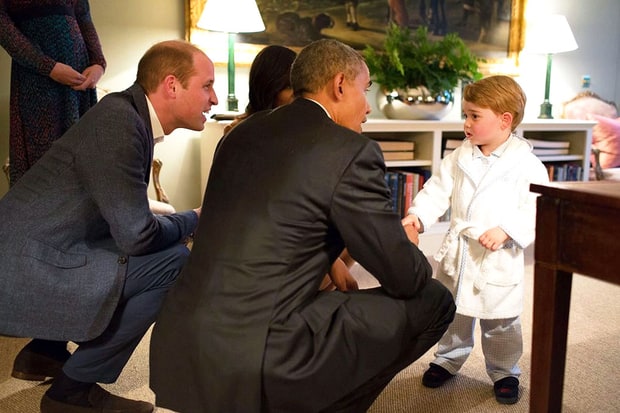
So, Prince George wore this white robe for his audience with President Obama:

robe

Cute kid, cute photo.

The robe—like almost everything else in Prince George’s much-photographed wardrobe (or that of his fashionable mother, for that matter)—sold out in minutes.

Talk about product placement! It’s a robe, folks, a white robe. In addition, it’s the sort of thing that most kids don’t wear anymore. When was the last time you saw a child in a robe?

I’ve noticed that most of Prince George’s clothes have a wonderful timeless quality. I’d call them “preppy” but that’s not quite right, either. They’re almost exactly sort of thing I remember from my long-ago childhood that were featured in the Best & Co. catalogue, conservative clothing that conveyed the possession of understated old money. The Queen has the same style-less (one might instead call it “timeless”) style that ignores style and says, “We stand for the old truths and the old ways.”

Of course, Prince George so far has little say in the matter. Come to think of it, though, he seems to tolerate his clothes quite nicely and wear them with a solemn dignity that’s also quite adorable. How many kids could pull it off as well?

[NOTE: Speaking of “pull it off,” I believe that, had I tried to put such a robe on my son when he was little, he would have pulled it off (literally). He didn’t like restraints or extra clothing, and one of the first phrases he ever used was “Too tight! Too tight!” He had particular difficulty with footed pajamas and turtlenecks, and after a short while I stopped buying either for him.]

Posted in Fashion and beauty | 21 Replies

Van Gogh on his life’s mission

The New Neo Posted on April 23, 2016 by neoApril 23, 2016

From one of Van Gogh’s letters to his beloved brother Theo:

What am I in the eyes of most people – a nonentity, an eccentric or an unpleasant person – somebody who has no position in society and never will have, in short, the lowest of the low.

All right, then – even if that were absolutely true, then I should one day like to show by my work what such an eccentric, such a nobody, has in his heart.

That is my ambition, based less on resentment than on love malgré tout [in spite of everything], based more on a feeling of serenity than on passion.

Though I am often in the depths of misery, there is still calmness, pure harmony and music inside me. I see paintings or drawings in the poorest cottages, in the dirtiest comers. And my mind is driven towards these things with an irresistible momentum.

Posted in Painting, sculpture, photography, People of interest | 7 Replies

On Kasich: a lot of people have been asking…

The New Neo Posted on April 23, 2016 by neoApril 23, 2016

…why is Kasich still running?

The question isn’t all that interesting or mysterious to me, because I figure it’s ego, and/or he aims to help or hurt Trump or Cruz (take your pick), and/or he somehow sees this as leading to a vice-presidency for himself.

The question that interests me more is: why are so many people still voting for Kasich in the primaries? Do they like him so very very much (that’s hard for me to believe)? Do they merely see him as the only moderate left standing (that makes more sense to me)? Do they think he really has a chance of winning (highly unlikely)? Are they just not paying attention to the dynamics of the race at this point?

Posted in Election 2016 | 39 Replies

“That 2016 moment”: politics and culture

The New Neo Posted on April 23, 2016 by neoApril 23, 2016

Peggy Noonan writes:

Have you had your 2016 Moment? I think you probably have, or will.

The Moment is that sliver of time in which you fully realize something epochal is happening in politics, that there has never been a presidential year like 2016, and suddenly you are aware of it in a new, true and personal way. It tends to involve a poignant sense of dislocation, a knowledge that our politics have changed and won’t be going back.

I had my 2016 moment in November of 2012, right after the election. Actually, I had it a week before that, when after talking to a series of friends I realized in my gut that the election was almost certainly going to end with an Obama victory. But you get the idea.

However, that doesn’t mean I haven’t had further refinements on the moment this year. I most definitely have. Ever since last summer, I keep losing hope, and then getting hope revived—that somehow the forces of reason will pull this one out. But each time that hope has been short-lived. I’m with Noonan on this one:

We’ve had a lot to absorb””the breaking of a party, the rise of an outlandish outsider; a lurch to the left in the other party, the popular rise of a socialist. Alongside that, the enduring power of a candidate even her most ardent supporters accept as corrupt. Add the lowering of standards, the feeling of no options, the coarsening, and all the new estrangements.

The Moment is when it got to you, or when it fully came through.

But I don’t fully agree with this, at least not exactly:

As she stood watching a video of Reagan speaking, he thought of Reagan and FDR, of JFK and Martin Luther King. His daughter, he realized, would probably never see political leaders of such stature and grace, though she deserved to. Her first, indelible political memories were of lower, grubbier folk. “Leaders with Reaganesque potential no longer go into politics””and why would they, with all the posturing and plasticity that it requires?”

I still see some leaders with “Reaganesque potential” and “stature and grace” in politics. I even have seen people I might describe that way during this election cycle. For example, I saw those things in Carly Fiorina, particularly when I saw her in person. Cruz likewise, when he gives speeches and interacts with crowds. They are not the only ones. Are they Reagan, or up there with Reagan? No. But they have those qualities and that potential, and there is no reason other aspiring politicians of the future couldn’t sometimes exhibit those qualities and have that potential.

The real difference between Reagan’s times and now, as I see it? It’s the American people who have coarsened, who respond to posturing and plasticity positively rather than rejecting it, and who are less likely to elect politicians with those qualities of “stature and grace.” This is true not just in the political world, but in our cultural life across the spectrum. I don’t blame politics or politicians. The problem and the trend goes much much deeper.

Noonan also writes:

Lately conservative thinkers and journalists had taken to making clear their disdain for the white working class.

Well, maybe I don’t read those particular thinkers and journalists. Noonan doesn’t name them or quote them, so I’m not sure who she’s talking about, or what she considers evidence of this disdain—certainly it can’t just be criticism of Trump’s supporters, because criticism is not the same thing as disdain, and besides “Trump supporter” is not even remotely synonymous with “white working class,” because Trump supporters come from many different classes and educational levels (although most, like most Republicans, are white).

Earlier in this post when I wrote, “It’s the American people who have coarsened, who respond to posturing and plasticity positively rather than rejecting it. This is true not just in politics, but in our cultural life across the spectrum,” I was not referring to class at all. In fact, I don’t see the “white working class” as necessarily exhibiting more of these traits than anyone else. It’s not about money. It’s not about race or class. It’s more common across the board, part of public and private life, and it’s been worsening for decades.

I don’t even blame it on the left, although I believe the left has long encouraged and celebrated it. At this point it is bipartisan and pervasive.

Towards the end of her column Noonan writes of her grief that “the great choice in a nation of 320 million may come down to Crazy Man versus Criminal” this year. Well, I feel grief, too, but have felt it for many years. And I find “Crazy Man versus Criminal”—cute, snappy, and memorable—inaccurate. Trump is not a crazy man, not at all. And although Hillary may be guilty of some crimes, “criminal” is not her most salient characteristic, nor her source of appeal. I realize that cute and snappy makes a column that people will quote and remember, but if I had to think of a way to put it I’d say (trying to be a bit cute and snappy myself) something like “Cunning Con Man versus Cunning Con Woman, the first from the world of business and the second from the world of politics.”

It does no good to disrespect working class people, and I don’t think I’ve ever done it (I don’t even like the term “working class,” although I can’t think of a better one to designate a certain group of people). I grew up in a mainly working class community, and although my father was a professional, my parents had a number of working class friends because the community in which they grew up and lived was a tight one where people had mostly known each other since childhood. I’ve lived ever since in mainly working class communities, and I see stupidity of mind and coarseness of thought and culture as equal opportunity qualities, cutting across classes and educational levels. Some of the dumbest people I know are well-educated professionals, some of the smartest are not, and vice versa.

I think something else is going on. I was in a Trader Joe’s the other day, pushing my cart and happily loading up on supplies (including this favorite), when I saw a youngish man in a T-shirt with the F-word on it. He was accompanied by his daughter of about six years old, and as they were talking I stared in realization that years ago—and not all that many years, either—such a thing would be highly unlikely, but now it’s just a matter of course. Years ago, it would be highly unusual for a father to wear such a T-shirt in public at all, much less in the presence of his young daughter, but these days it’s a sort of ho-hum experience for most people. That’s how coarsened our lives are, in small but meaningful ways.

As Andrew Breitbart (not the blog, the man) so memorably said, politics is downstream from culture. Politics can’t be some sort of highfalutin oasis, isolated from the culture and above it all—au contraire—and it never was. What we’re seeing today in politics is not primarily about politics, politics is just one of its manifestations, albeit an important and powerful one.

I’ve been writing about this phenomenon, both in politics and elsewhere, almost since the beginning of my blogging (see this for an early example, and this for a recent one). If Noonan’s “Reaganesque” politician of “stature and grace” came on the scene (particularly on the right), I submit that these days he or she would be considered a big boring yawn, and/or would be attacked by tabloid accusations that needn’t contain a particle of truth to be disseminated widely even by those who don’t write for tabloids. Such a politician would not be a winner—because way too many Americans neither demand nor appreciate such qualities in their leaders or their public figures, nor do they demonstrate them in their own public or private lives.

Posted in Election 2016, Politics, Pop culture | 65 Replies

For Passover: celebrate freedom

The New Neo Posted on April 22, 2016 by neoApril 23, 2016

[NOTE: This is a slightly edited repeat of a previous post.]

This evening is the beginning of the Jewish holiday Passover.

In recent years whenever I’ve attended a Seder, I’ve been impressed by the fact that Passover is a religious holiday dedicated to an idea that’s not really primarily religious: freedom. Yes, it’s about a particular historical (or perhaps legendary) event: the liberation of the Israelites from slavery in Egypt. But the Seder ceremony makes clear that, important though that specific event may be, freedom itself is also being celebrated.

Offhand, I can’t think of another religious holiday that takes the trouble to celebrate freedom. Nations certainly do: there’s our own Fourth of July, France’s Bastille Day, and various other independence days around the world. But these are secular holidays rather than religious ones.

For those who’ve never been to a Seder ceremony, I suggest attending one (and these days it’s easier, since they are usually a lot shorter and more varied than in the past). A Seder is an amazing experience, a sort of dramatic acting out complete with symbols and lots of audience participation. Part of its power is that events aren’t placed totally in the past tense and regarded as ancient and distant occurrences; rather, the participants are specifically instructed to act as though it is they themselves who were slaves in Egypt, and they themselves who were given the gift of freedom, saying:

“This year we are slaves; next year we will be free people…”

Passover acknowledges that freedom (and liberty, not exactly the same thing but related) is an exceedingly important human desire and need. That same idea is present in the Declaration of Independence (which, interestingly enough, also cites the Creator):

We hold these truths to be self-evident, that all men are created equal, that they are endowed by their Creator with certain inalienable Rights, that among these are Life, Liberty, and the pursuit of Happiness.

It is ironic, of course, that when that Declaration was written, slavery was allowed in the United States. That was rectified, but only after great struggle, which goes to show how wide the gap often is between rhetoric and reality, and how difficult freedom is to achieve. And it comes as no surprise, either, that the Passover story appealed to slaves in America when they heard about it; witness the lyrics of “Let My People Go.”

Yes, the path to freedom is far from easy, and there are always those who would like to take it away. Sometimes an election merely means “one person, one vote, one time,” if human and civil rights are not protected by a constitution that guarantees them, and by a populace dedicated to defending them at almost all costs. Wars of liberation only give an opportunity for liberty, they do not guarantee it, and what we’ve observed in recent years has been the difficult and sometimes failed task of attempting to secure it in a place with no such tradition, and with neighbors dedicated to its obliteration.

We’ve also seen threats to liberty in our own country, despite its long tradition of liberty and the importance Americans used to place on it. I fear those days may be over.

Sometimes those who are against liberty are religious, like the mullahs. Sometimes they are secular, like the Communists. Sometimes they are cynical and power-mad; sometimes they are idealists who don’t realize that human beings were not made to conform to their rigid notions of the perfect world, and that attempts to force them to do so seem to inevitably end in horrific tyranny, and that this is no coincidence.

As one of my favorite authors Kundera wrote, in his Book of Laughter and Forgetting:

…human beings have always aspired to an idyll, a garden where nightingales sing, a realm of har­mony where the world does not rise up as a stranger against man nor man against other men, where the world and all its people are molded from a single stock and the fire lighting up the heavens is the fire burning in the hearts of men, where every man is a note in a magnificent Bach fugue and anyone who refuses his note is a mere black dot, useless and meaningless, easily caught and squashed between the fingers like an insect.”

Note the seamless progression from lyricism to violence: no matter if it begins in idealistic dreams of an idyll, the relinquishment of freedom to further that dream will end with humans being crushed like insects.

History has borne that out, I’m afraid. That’s one of the reasons the people of Eastern Europe have been more inclined to ally themselves recently with the US than those of Western Europe have—the former have only recently come out from under the Soviet yoke of being regarded as those small black and meaningless dots in the huge Communist “idyll.”

Dostoevsky did a great deal of thinking about freedom as well. In his cryptic and mysterious Grand Inquisitor, a lengthy chapter from The Brothers Karamazov, he imagined a Second Coming. But this is a Second Coming in which the Grand Inquisitor rejects what Dostoevsky sees as Jesus’s message of freedom:

Oh, never, never can [people] feed themselves without us [the Inquisitors and controllers]! No science will give them bread so long as they remain free. In the end they will lay their freedom at our feet, and say to us, “Make us your slaves, but feed us.” They will understand themselves, at last, that freedom and bread enough for all are inconceivable together, for never, never will they be able to share between them! They will be convinced, too, that they can never be free, for they are weak, vicious, worthless, and rebellious. Thou didst promise them the bread of Heaven, but, I repeat again, can it compare with earthly bread in the eyes of the weak, ever sinful and ignoble race of man?

Freedom vs. bread is a false dichotomy. Dostoevsky was writing before the Soviets came to power, but now we have learned that lack of freedom, and a “planned” economy, is certainly no guarantee of bread (just ask the Ukrainians).

Is freedom a “basic need, then? Ask, also, the Vietnamese “boat people.” And then ask them what they think of John Kerry’s assertion, during his 1971 Senate testimony, that they didn’t care what sort of government they had as long as their other “basic needs” were met:

We found most people didn’t even know the difference between communism and democracy. They only wanted to work in rice paddies without helicopters strafing them and bombs with napalm burning their villages and tearing their country apart…

So that when we in fact state, let us say, that we will have a ceasefire or have a coalition government, most of the 2 million men you often hear quoted under arms, most of whom are regional popular reconnaissance forces, which is to say militia, and a very poor militia at that, will simply lay down their arms, if they haven’t done so already, and not fight. And I think you will find they will respond to whatever government evolves which answers their needs, and those needs quite simply are to be fed, to bury their dead in plots where their ancestors lived, to be allowed to extend their culture, to try and exist as human beings. And I think that is what will happen…

I think that politically, historically, the one thing that people try to do, that society is structured on as a whole, is an attempt to satisfy their felt needs, and you can satisfy those needs with almost any kind of political structure, giving it one name or the other. In this name it is democratic; in others it is communism; in others it is benevolent dictatorship. As long as those needs are satisfied, that structure will exist.

I beg to differ. I think there’s another very basic need, one that perhaps can only really be appreciated when it is lost: liberty.

Happy Passover!

Posted in Liberty, Religion | 20 Replies

US suicide rates continue to rise

The New Neo Posted on April 22, 2016 by neoApril 22, 2016

This is depressing news:

Suicide in the United States has surged to the highest levels in nearly 30 years, a federal data analysis has found, with increases in every age group except older adults. The rise was particularly steep for women. It was also substantial among middle-aged Americans, sending a signal of deep anguish from a group whose suicide rates had been stable or falling since the 1950s.

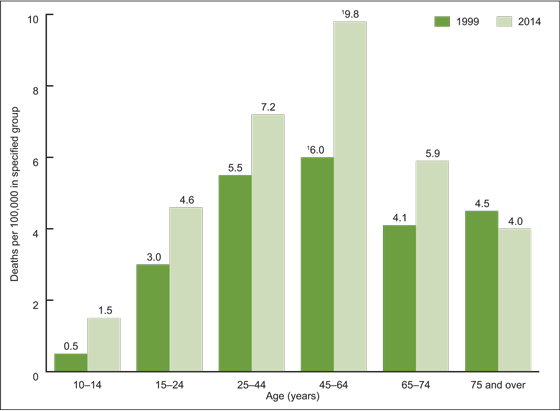
The suicide rate for middle-aged women, ages 45 to 64, jumped by 63 percent over the period of the study, while it rose by 43 percent for men in that age range, the sharpest increase for males of any age. The overall suicide rate rose by 24 percent from 1999 to 2014, according to the National Center for Health Statistics, which released the study on Friday

Rates increased sharply for girls 10-14 as well, and the ethnic group with the highest increase was American Indians, followed by white middle-aged women. Black men were the only ethnic group with a decrease.

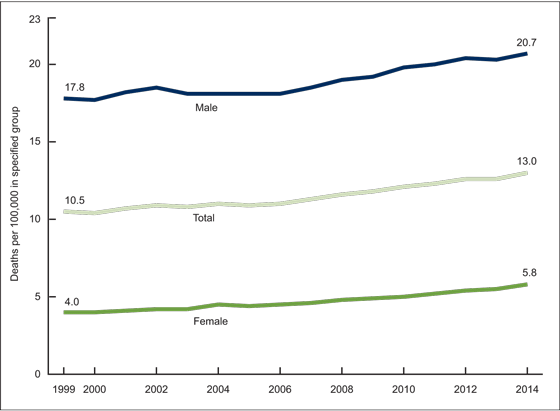
Those statistics are all about increase vs. decrease rather than absolute numbers, however. A caveat is that 1999, the start year, was a low year for suicides. But the rates have been steadily increasing since then, so it seems to be a real effect. The other thing I need to point out is that even though the rates among women increased more than among men, men have a much higher suicide rate than women:

suiciderates

There are theories about why this general increase is happening, although no one knows for sure:

The data analysis provided fresh evidence of suffering among white Americans. Recent research has highlighted the plight of less educated whites, showing surges in deaths from drug overdoses, suicides, liver disease and alcohol poisoning, particularly among those with a high school education or less. The new report did not break down suicide rates by education, but researchers who reviewed the analysis said the patterns in age and race were consistent with that recent research and painted a picture of desperation for many in American society.

“This is part of the larger emerging pattern of evidence of the links between poverty, hopelessness and health,” said Robert D. Putnam, a professor of public policy at Harvard…

This is sobering, as well:

Though suicide rates for older adults fell over the period of the study, men over 75 still have the highest suicide rate of any age group ”” 38.8 per 100,000 in 2014, compared with just four per 100,000 for their female counterparts.

When you look at the charts, you might notice something interesting about that:

womensuicide

mensuicide

You can easily see that spike for middle-aged women and for older men. But notice that both women and men over 75 had suicide rates even higher in 1999 than recently, the only category with that pattern. Has growing old become less depressing in the 21st Century for both sexes, while being middle-aged has become more so (especially for women)? Or are the differences generational?

Posted in Health | 31 Replies

RIP Prince

The New Neo Posted on April 22, 2016 by neoApril 22, 2016

I can’t say I know much about Prince’s music except that he was mega-famous and a tremendous number of people loved his work. I know the song “Purple Rain” and very little else. However, the reports about his cause of death (the flu) made me wonder whether he wasn’t another victim of sepsis, an illness that recently killed a very good friend of mine.

I’ve also noticed that Prince and his first wife had a series of tragedies—the death of a baby born with a genetic illness, and then a later miscarriage. His ex-wife says the couple never really recovered from those events, and that such things either make a couple stronger or break them. That has the ring of truth to me.

RIP.

Posted in Music, People of interest | 20 Replies

Politicians, deception, and Trump

The New Neo Posted on April 22, 2016 by neoApril 22, 2016

From a commenter at Ace’s, saying he preferred Hillary Clinton to Donald Trump for the following reason:

I prefer a wolf to a wolf in sheep’s clothing.

I’m not sure which I’d prefer—wolves are wolves, after all—but I understand the principle that the wolf you know a lot about might be easier to deal with than the wolf who masquerades as something else.

But don’t all politicians masquerade, and don’t they all lie?

Indeed, politicians often lie, or seem to have lied. Sometimes they lie about a single issue, sometimes more issues. But sometimes they just make promises they can’t keep, and their enemies call them liars. Barack Obama, however, was the first politician I can recall in my lifetime who was purposely deceptive about his basic political orientation when he was running for office.

I believe that Trump would be the second.

I wrote the above words last night as notes for a post to finish writing today. Between then and now I saw this story, which seems highly relevant:

Trump’s newly hired senior aide, Paul Manafort, made the case to Republican National Committee members that Trump has two personalities: one in private and one onstage.

“When he’s out on the stage, when he’s talking about the kinds of things he’s talking about on the stump, he’s projecting an image that’s for that purpose,” Manafort said in a private briefing.

“You’ll start to see more depth of the person, the real person. You’ll see a real different guy,” he said.

The Associated Press obtained a recording of the closed-door exchange.

“He gets it,” Manafort said of Trump’s need to moderate his personality. “The part that he’s been playing is evolving into the part that now you’ve been expecting, but he wasn’t ready for, because he had first to complete the first phase. The negatives will come down. The image is going to change.”

I find this fascinating, and also fascinating are the responses to it. Many of Trump’s vocal supporters think it’s just great, as we’ve come to expect—a clever pivot showing his wonderful flexibility. His opponents think it’s remarkably duplicitous, beyond what is customary for a politician.

And of course, Trump is fond of touting his NON-politician status, and his supporters his “authenticity.” I guess he’s an authentic chameleon, not just about policy (we already know that) but in personality as well.

It’s not the least bit reassuring. Nor is this “politics as usual” (from the supposed non-politician, yet). Everyone has a public face (sometimes somewhat different in different public roles) and a private face (sometimes different with different people). But for people of integrity and character, there is a basic sameness and a basic thread that runs through all their encounters, both public and private. In other words, there’s a reason the description “two-faced” is ordinarily considered pejorative.

Manafort (see *NOTE below) assured the group that the Trump version 2.0 they are about to see is the “real” Trump. But having done a lot of research on Trump—seeing countless articles, profiles, and interviews; a biography, and videos—I have to say that if the “real” Trump is the one we haven’t seen yet, then Trump’s been acting a role for his entire public life, because the Trump persona we’ve seen in this campaign so far is highly consistent with the persona he’s been projecting towards the world for close to four decades—that is, most of his adult life, which has been spent in the spotlight.

What’s more, when a politician adopts a public persona, usually that presentation is of a person who is more sober, more serious and well-informed, than he or she might be in private. The private persona is usually the looser one. With Trump, according to Manafort, it’s the other way around. If Trump has been deceptive with the American public and what we’ve seen is not the real Trump, then he must think the American public consists of stupid, crass fools.

And of course, he may be right about a lot of people.

I happen to think that Trump is running a con. Now, politicians often have a lot of overlap with con artists, but it’s a matter of degree. But Trump’s overlap seems greater to me, the con bigger. Take a look at this description of con artists, for example [comments in brackets are mine]:

In order to be a con artist you have to take advantage of other people’s belief in you, and psychopaths don’t really have a conscience, so it’s much easier for them to take that step. Narcissism, you have to have an overinflated sense of self in order to rationalize conning other people, especially if you’re not a psychopath. If you’re someone who feels emotion normally, narcissism will protect you, because you say, “Well, I deserve it.” And finally, Machiavellianism is a textbook definition of a con artist, because it’s someone who is like Machiavelli’s “ideal prince,” someone who uses the tools of persuasion and deception and connivance to get what he wants. The ends justify the means…

Dale Carnegie’s How to Win Friends & Influence People [a book that happens to have been an influential book during Trump’s formative years] is kind of the unofficial con artist’s bible, because a lot of those tactics [Carnegie] talks about, in terms of building relationships and being successful in business, are ideal for getting people to trust you. One of the really easy things is creating a feeling of familiarity. You’re more likely to trust someone who feels more familiar to you. It’s even enough to exploit something called the “mere exposure effect,” where, say, you just go to the same coffee shop as someone every single day, and they may not consciously note you, but all of a sudden you feel more familiar. [Americans have become very familiar with Donald Trump though his constant celebrity, and particularly through his popular show “The Apprentice,” which makes many of them think they know him and therefore can trust him.]

In summary, at this point I cannot imagine why anyone would trust anything Donald Trump says in any of his personae.

[*NOTE: Paul Manafort, the man who reassured the RNC that they’d see the “real” Trump soon, has an interesting history of presenting the public with candidates who’ve gotten a personality makeover. His most recent client in that regard prior to Trump was Viktor Yanukovych of Ukraine, although Yanukovych was not favored by the US due to his alliance with Putin. This was Manafort’s role [emphasis mine]:

In 2010, under Manafort’s tutelage, the opposition leader [Yanukovych] put the Orange Revolution [that had previously overthrown him in 2004] on trial, campaigning against its leaders’ management of a weak economy. Returns from the presidential election gave Yanukovych a narrow win over Prime Minister Yulia Tymoshenko, a leader of the 2004 demonstrations. Yanukovych owes his comeback in Ukraine’s presidential election to a drastic makeover of his political persona and, people in his party say, that makeover was engineered in part by his American consultant, Manafort.

Sound familiar?

It didn’t end well for Ukraine, as you can see by Yanukovych’s subsequent history.]

Posted in Politics, Trump | 62 Replies

Post navigation

← Previous Post
Next Post→

Your support is appreciated through a one-time or monthly Paypal donation

Please click the link recommended books and search bar for Amazon purchases through neo. I receive a commission from all such purchases.

Archives

Recent Comments

  • om on Veterans Day; Armistice Day
  • om on News roundup
  • Richard Illyes on Veterans Day; Armistice Day
  • huxley on Veterans Day; Armistice Day
  • Ray Van Dune on Veterans Day; Armistice Day

Recent Posts

  • News roundup
  • Veterans Day; Armistice Day
  • Open thread 11/11/2026
  • The refinery issue
  • This type of ed is special, all right

Categories

  • A mind is a difficult thing to change: my change story (17)
  • Academia (330)
  • Afghanistan (98)
  • Amazon orders (6)
  • Arts (8)
  • Baseball and sports (164)
  • Best of neo-neocon (91)
  • Biden (536)
  • Blogging and bloggers (599)
  • Dance (292)
  • Disaster (244)
  • Education (329)
  • Election 2012 (360)
  • Election 2016 (566)
  • Election 2018 (33)
  • Election 2020 (514)
  • Election 2022 (114)
  • Election 2024 (403)
  • Election 2026 (125)
  • Election 2028 (14)
  • Evil (130)
  • Fashion and beauty (324)
  • Finance and economics (1,054)
  • Food (319)
  • Friendship (48)
  • Gardening (18)
  • General information about neo (4)
  • Getting philosophical: life, love, the universe (737)
  • Health (1,169)
  • Health care reform (546)
  • Hillary Clinton (184)
  • Historical figures (338)
  • History (720)
  • Immigration (452)
  • Iran (467)
  • Iraq (227)
  • IRS scandal (71)
  • Israel/Palestine (836)
  • Jews (445)
  • Language and grammar (365)
  • Latin America (216)
  • Law (2,997)
  • Leaving the circle: political apostasy (125)
  • Liberals and conservatives; left and right (1,335)
  • Liberty (1,119)
  • Literary leftists (14)
  • Literature and writing (394)
  • Me, myself, and I (1,524)
  • Men and women; marriage and divorce and sex (935)
  • Middle East (385)
  • Military (327)
  • Movies (355)
  • Music (534)
  • Nature (262)
  • Neocons (32)
  • New England (185)
  • Obama (1,740)
  • Pacifism (16)
  • Painting, sculpture, photography (132)
  • Palin (93)
  • Paris and France2 trial (25)
  • People of interest (1,051)
  • Poetry (259)
  • Political changers (179)
  • Politics (2,797)
  • Pop culture (397)
  • Press (1,636)
  • Race and racism (885)
  • Religion (431)
  • Romney (164)
  • Ryan (16)
  • Science (642)
  • Terrorism and terrorists (983)
  • Theater and TV (266)
  • Therapy (71)
  • Trump (1,638)
  • Uncategorized (4,636)
  • Vietnam (109)
  • Violence (1,465)
  • War and Peace (1,036)

Blogroll

Ace (bold)
AmericanDigest (writer’s digest)
AmericanThinker (thought full)
Anchoress (first things first)
AnnAlthouse (more than law)
AugeanStables (historian’s task)
BelmontClub (deep thoughts)
Betsy’sPage (teach)
Bookworm (writingReader)
ChicagoBoyz (boyz will be)
DanielInVenezuela (liberty)
Dr.Helen (rights of man)
Dr.Sanity (shrink archives)
DreamsToLightening (Asher)
EdDriscoll (market liberal)
Fausta’sBlog (opinionated)
GayPatriot (self-explanatory)
HadEnoughTherapy? (yep)
HotAir (a roomful)
InstaPundit (the hub)
JawaReport (the doctor’s Rusty)
LegalInsurrection (law prof)
Maggie’sFarm (togetherness)
MelaniePhillips (formidable)
MerylYourish (centrist)
MichaelTotten (globetrotter)
MichaelYon (War Zones)
Michelle Malkin (clarion pen)
MichelleObama’sMirror (reflect)
NoPasaran! (bluntFrench)
NormanGeras (archives)
OneCosmos (Gagdad Bob)
Pamela Geller (Atlas Shrugs)
PJMedia (comprehensive)
PointOfNoReturn (exodus)
Powerline (foursight)
QandO (neolibertarian)
RedState (conservative)
RogerL.Simon (PJ guy)
SisterToldjah (she said)
Sisu (commentary plus cats)
Spengler (Goldman)
VictorDavisHanson (prof)
Vodkapundit (drinker-thinker)
Volokh (lawblog)
Zombie (alive)

Meta

  • Log in
  • Entries feed
  • Comments feed
  • WordPress.org
©2026 - The New Neo - Weaver Xtreme Theme Email
Web Analytics
↑