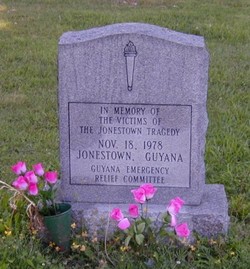
The other evening I turned on the TV and came across this CNN documentary entitled “Escape from Jonestown.” I watched for the next two hours, because to my surprise it turned out to be riveting.
Even though I recall Jonestown well and thought I remembered most of the salient facts about it, there was still much more to learn. The story contains facts of tragic relevance even today, November 18, 2008, which is the thirtieth anniversary of that terrible mass suicide.
We call it a mass suicide because the evidence (and there is plenty of it, including an audiotape of the horrendous proceedings) indicates that many of Jones’ followers cooperated in their own deaths. In fact, the term “drink the Kool Aid” derives from that fact.
But what most people don’t know is the extent of the psychological and physical pressure that was placed on these people from the moment they entered the cult, as well as the fact that fully one-third of the nearly one thousand who died there were children who could hardly be said to have freely cooperated. There is also forensic evidence that those adults who did protest or try to escape were forcibly injected with cyanide as they attempted to flee.
So I prefer to call it a suicide/massacre. That places most of the blame where it belongs, on Jim Jones himself.
The first relevant lesson to be learned is the danger of blindly following a charismatic leader. Jones became more deranged later on, but as his congregation grew in the 60s and 70s, he was a respected member of the San Francisco community, with connections to Democratic politicians (I’m not sure there’s any other kind in San Francisco) and a strong reputation for racial equality.
The second lesson is to beware of the trust that gullible and trusting human beings can place in that charismatic leader. Jones required that people give over their lives and their assets when they became followers—a danger sign. Members had varied reasons for joining, but it can probably be safely said that most of them were exceedingly idealistic. According to the testimony of many of the survivors (a small group, but an articulate one), once they realized the true character of the man in whom they’d placed such hope and faith, it was too late. They were in a prison, subject to various forms of physical and psychological torture in Jones’ attempt to control the inmates. And in the final year before the terrible end, the prison we know as Jonestown was at least as isolated as Alcatraz, because it was located in the heart of the Guyanese jungle.
Two forms the psychological torture/indoctrination took are especially instructive. The first is that as Jones became increasingly paranoid, he regularly harangued his followers that they would be under attack soon, either from the CIA or the Guyanese authorities, and that mass suicide would be the only way out. In fact, he had many rehearsals for the killings, which had the effect of getting people used to what would be happening and more ready to accept it, as well as more doubtful when the real thing began to happen that it actually was the real thing; maybe it was another rehearsal?
The second was a particular type of psychological coercion described in Deborah Layton’s very fine and highly recommended book Seductive Poison. I am describing this from memory (I read the book many years ago), but my recollection is that they were encouraged to inform on each other if they heard anyone complain about or criticize Jones or Jonestown. The tattler was then publicly praised, while the complainer was subject to public harangues, physical punishment, withdrawal of privileges, and ostracism. In a totally controlled environment, this was especially difficult to take, even for those with strong personalities.
What was even more terrible—and diabolical—was the fact that Jones made some of his close confederates pretend to be be discontented, confiding their criticism of Jones and Jonestown to others. The listeners had no idea that these were false “confessions.” If they listened sympathetically and perhaps shared their own discontent, they were reported and punished. But worse, if they failed to report the confidences of their “friends”—who were actually, unbeknownst to them, Jim Jones plants—then they were punished as well.
The entire system encouraged extreme distrust of sharing any complaints with or confiding in anyone. Therefore no mass rebellion or escape plans could be hatched. A resident never knew who was telling the truth, or who would go straight to Jones with the news. Even those who hated Jones and Jonestown had to wrestle with their consciences about whether to report on a friend; the consequences for failure to do so could be dire.
I doubt that even the KGB or the Stasi were quite as able to control all aspects of their subjects’ personal lives as Jones was. I mention the latter two organizations because it is not insignificant that Jim Jones was a Socialist/Communist, who greatly admired Cuba and the USSR. This little fact had escaped my memory as well, but it takes on a greater significance in retrospect. It is, quite simply, no accident.
One of the things Jones had been planning and contemplating in his last year was a possible mass exodus to the Soviet Union. He also instructed the Temple’s money to be left to the Soviet Union. Some of the dead left handwritten notes to that effect as well.
Watching the CNN documentary and hearing the survivors’ tell their fascinating stories, it became clear that they (like Deborah Layton) are hardly lacking in brainpower. This is the next lesson: intelligence has nothing to do with it. If these people were susceptible (and they were), it was not because they were not smart. It was because they were insufficiently skeptical of a charismatic demagogue, and of the limits of idealism.
Another lesson is how connected many on the Left were to Jones’ movement. Angela Davis and Huey Newton were involved, for example, in the rehearsals for suicide:
[Jones] set up a false sniper attack upon himself and begin his first series of White Nights, called the “Six Day Siege”, where Jones spoke to Temple members about attacks from outsiders and had them surround Jonestown with guns and machetes. The fiery rallies took an almost surreal tone as Angela Davis and Huey Newton communicated via radio-telephone to the Jonestown crowd, urging them to hold strong against the “conspiracy.”
Mark Lane, the Kennedy assassination conspiricist, was also quite influential as Jones’ lawyer, which I also hadn’t before realized. He helped fan the flames of paranoia:
In 1978, Lane began to represent the Peoples Temple. Temple leader Jim Jones hired Lane and Donald Freed to help make the case of what it alleged to be a “grand conspiracy” by intelligence agencies against the Peoples Temple…
In September of 1978, Lane visited Jonestown, spoke to Jonestown residents, provided support for the theory that intelligence agencies conspired against Jonestown and drew parallels between Martin Luther King and Jim Jones. Lane then held press conferences stating that “none of the charges” against the Temple “are accurate or true” and that there was a “massive conspiracy” against the Temple by “intelligence organizations,” naming the CIA, FBI, FCC and the U.S. Post Office. Though Lane represented himself as disinterested, the Temple paid Lane $6,000 per month to help generate such theories….Lane later wrote a book about Jonestown that repeated his paranoia about CIA involvement, parroting the Jones party line.
Another important lesson that’s also forgotten is that Ryan and his entourage, including the reporters, seem to have been fooled by Jones and Jonestown. This has happened time and again in history, when people go to investigate a controlled environment. Although Ryan, his aides, and the reporters who went with them (almost all of whom were killed by Jones) are to be commended for their heroism and are deeply mourned, they also showed naivete in failing to understand the total control Jones had over his flock, and the depths of his evil. The extent of true evil, and the techniques it can use to coerce and silence, can be difficult for the good to understand:
Before leaving Jonestown for the airstrip, Congressman Ryan had told Temple attorney Charles Garry that he would issue a report that would describe Jonestown “in basically good terms.” Ryan stated that none of the sixty relatives Ryan had targeted for interviews wanted to leave, the 14 defectors constituted a very small portion of Jonestown’s residents, that any sense of imprisonment the defectors had was likely because of peer pressure and a lack of physical transportation, and even if 200 of the 900+ wanted to leave “I’d still say you have a beautiful place here.” Similarly, Washington Post reporter Charles Krause stated that, on the way back to the airstrip, he was unconvinced that Jonestown was as bad as defectors had claimed because there were no signs of malnutrition or physical abuse, while many members appeared to enjoy Jonestown and only a small number of the over 900 residents elected to leave.
It is tempting to think “it couldn’t happen to me.” We all like to think of ourselves as strong, both psychologically and physically. I have very little doubt, for example, that I would never join such a group in the first place. But I can see how anyone would be vulnerable once placed in that environment, with no way out.
I hope and trust I could resist, even then. But extreme isolation, brainwashing to stir up paranoia, constant rehearsal for death, and the sort of coercion and control Layton describes to isolate each person and make him/her think there is no escape, could take an enormous toll. In the case of the Jonestown inhabitants, they were extreme idealists who had ceded a great deal of autonomy to a leader and a group at the outset. Very few of them had a chance.
The survivors are suffused with guilt, and continue to mourn every day of their lives. Time has not healed these wounds. Some of them still live in the San Francisco area, and those who do sometimes visit the site of the mass grave in Oakland, the final resting place of those who died at Jonestown whose bodies were never identified. Many of these were children.
This is a moment to remember them and all who died there, as well as the suffering survivors. We can honor them by attempting to learn the lessons of their lives and deaths: