
You may be watching the proceedings on TV right now, as I am. Amazing visuals, astounding story, with what appears to be an against-all-odds happy ending.
What did Mrs. Madoff know and when did she know it?
You might ask: who cares about Mrs. Madoff? After all, it’s her husband who’s the culprit.
There’s little doubt that this is true. But a rather intriguing article appeared in today’s NY Times on the subject of the involvement (or lack thereof) of Madoff’s wife Ruth in the whole scheme. It touches on a subject relevant to other spouses engaging in other acts of crime or major wrongdoing: is it possible to fool a wife or husband about so basic a character trait?
There are people quoted in the article who say Ruth Madoff must have known; a wife would know and a wife should know. There are people who say the same thing about child molesters, serial killers, adulterers, and most of the other varieties of human wrongdoing. But it is my observation that, although it is sometimes true that wrongdoers leave a clear trail and that any spouse who doesn’t intuit what’s going on is in a state of denial, sometimes the culprits are so slick and so clever, so good at dissembling, that no one would ever know.
To think otherwise is a self-protective lie we tell ourselves to reassure ourselves that we could not be taken in this way; oh no, surely not! But the evidence points to the fact that Bernard Madoff was a master at taking people in, gaining their trust, and then politely screwing them. He fooled people who would otherwise have been wary. His reputation was spotless, stellar, and lengthy.
And his wife, apparently, was part of his game, if only unwittingly. He used her charm and friendliness to woo new investors without seeming to be in need of them. The feeling people got was that they were lucky that Madoff deigned to take their money; he was doing them a favor, not the other way around.
Here’s the Times on the subject:
Was Mrs. Madoff really blindsided? In the social circles where the couple once traveled, both possibilities are unnerving ”” that Ruth Madoff was in on this, or that she wasn’t…Either way, wittingly or not, she was an essential asset to her husband, humanizing him and drawing people into his orbit.
I’m not saying that Mrs. Madoff absolutely did not know what was what with her husband and his deals. But the article points out that she would have almost had to be a skilled accountant, devoted to studying his books, to have learned the truth of what was going on. Assuming she did not do that—and why would she have, even if she had the training?—the only other clue to the existence of the Ponzi scheme would have been her husband’s suspicious demeanor. And my guess is that, until shortly before that fateful December 10, 2008, when he claims he first spilled the beans to his wife and sons, he managed to exude the same gravitas, confidence, and reliability as ever.
It’s tempting for us all to think that we would not have been fooled had we been in Ruth Madoff’s position. But I say, isn’t it pretty to think so?
Here’s one historian…
…who thinks history will look kindly on President Bush.
I’m for the Labradoodle
The Obamas are trying to decide what sort of dog to get, and seem to have narrowed it down to the Labradoodle versus the Portuguese water dog. America votes again, and this time the mutt wins it by a hair. And this time, unlike the last election, I’m with the majority.
As the former owner of a (now-deceased) cockerpoo, a mix very similar to the Labradoodle only a bit smaller, I can say that this sort of dog tends to be one of the best around: friendly, trainable, calm, adorable, non-shedding (the latter is the trait that sold me, if truth be told). The need for regular grooming was a very small price to pay for the benefit of a dog that was relatively allergy-free, and for a home that wasn’t carpeted with dog detritus.
I happen to know a Portuguese water dog, and this particular animal is a pill. Unruly, too energetic for people not dedicated to walking it for miles every day, difficult to train—and the one I know even hates water. It does share the wonderful poodle-mix characteristic of having curly non-shedding hair rather than fur, but that’s about all it shares except genus and species.
Of course, the Obamas will now have a staff to take care of these pesky tasks. But they should be wary of the Portuguese water dog. Even the usually enthusiastic American Kennel Club has an entry on the breed that is a mite sobering, if you read between the lines:
An athletic, active breed, the Portuguese Water Dog requires daily vigorous exercise. He is very intelligent and responds well to obedience training…An animal of spirited disposition, self-willed, brave, and very resistant to fatigue.
There it is: “requires daily vigorous exercise;” “spirited disposition;” “self-willed.” These are codes for “really restless and even destructive if not walked to exhaustion, difficult to train, and stubborn.”
The key, as with any breed, is effective obedience training. Again, I doubt the Obamas will be doing this themselves, but if they plan to, it will be a time-consuming and demanding task.
So, even if it might work out in the end, why ask for trouble? Go with the Labradoodle. Your girls will thank you. America will thank you. I will thank you.
Obama’s choice on Israel
As with so many things about Obama, we just don’t know what his policy on Israel will be. But his dilemma is clear: will he appease the left wing of his party and go the Jimmy Carter route? Or will he face the facts and realize that such a course would be not only a waste of time and effort, but a means of empowering the terrorist powers-that-be in Palestine who have brainwashed and impoverished its people and helped them to embrace murder and mayhem?
I was going to write a longer piece on the subject, but Irwin Seltzer seems to have more or less done it for me. My additional question is whether Obama’s more fundamental sympathies are with those who think Hamas is a force to be moderated and reasoned with, or whether he understands the group’s implacable and non-negotiable agenda.
I don’t know the answer; I’m not sure anyone except Obama’s closest advisors—and perhaps not even them—knows. Does Obama himself know? If he doesn’t, that’s okay for now—he’s got about a week to decide.
Meanwhile, here’s the face of Hamas. See whether you think this describes a mindset amenable to diplomatic niceties, or even conventional pressure:
Like Hezbollah, Hamas believes that God is opposed to a Jewish state in Palestine… I [author Jeffrey Goldberg] asked [a Hamas leader] the question I always ask of Hamas leaders: Could you agree to anything more than a tactical cease-fire with Israel? I felt slightly ridiculous asking: A man who believes that God every now and again transforms Jews into pigs and apes might not be the most obvious candidate for peace talks at Camp David. Mr. Rayyan answered the question as I thought he would, saying that a long-term cease-fire would be unnecessary, because it will not take long for the forces of Islam to eradicate Israel.
Goldberg goes on to say that the only hope for any successful action against Hamas is to activate the help of the “moderate” Arab states to strengthen Fatah:
The moderate Arab states, Europe, the United States and, mainly, Israel, must help Hamas’s enemy, Fatah, prepare the West Bank for real freedom, and then hope that the people of Gaza, vast numbers of whom are unsympathetic to Hamas, see the West Bank as an alternative to the squalid vision of [Hamas].
Good luck on that. Talk about nation-building for democracy and tolerance in a climate and culture hostile to it! Iraq was indeed a “cakewalk” compared to the task of changing a people that has been macerated in the deepest and most irrational of religiously-driven hatreds for many decades.
Making predictions about the economy—or much of anything else
Are these guys correct, and is the worst of the recession behind us?
I certainly don’t know—but neither does anyone else. It would, however, be a wonderful thing to have the answer, because we are being asked to act in drastic ways to forestall a cataclysmic event that may or may not occur without such intervention. And, unfortunately, since the proposed cures could be worse than the disease, it would be awfully good to know that the diagnosis is correct before we start the treatment.
But isn’t this always the way? For example, it’s the situation with global warming (or climate change, or whatever is the proper term de jour). The state of our analytic and predictive powers is poor, but the voices of doom cry out for immediate and sometimes drastic remedies.
It also was what faced the Bush administration in the buildup to the Iraq war—that is, unless you think the evil CheneyBushHitler manufactured everything for their/his own nefarious purposes. There was evidence that pointed in the direction of a situation that could easily go on to become a conflagration if not nipped in the bud. And yet the nipping process was painful, uncertain, and potentially dangerous in and of itself, as we have seen.
But we must always make decisions based on incomplete information, both in our lives and in politics —and even in areas of science that seem far more straightforward than climate change or economics. For example, at the end of WWII, when it came time to test the atomic weaponry developed by the Manhattan Project, there was still some uncertainty about the outcome. Despite the fact that physics is one of the more rigorous and predictable sciences, and although the men who designed the bomb were exceptionally brilliant, there remained some question about what would actually happen when an attempt was made to detonate one:
The observers [of the first atomic test] set up betting pools on the results of the test. Predictions ranged from zero (a complete dud) to 18 kilotons of TNT (predicted by physicist I. I. Rabi, who won the bet, to destruction of the state of New Mexico, to ignition of the atmosphere and incineration of the entire planet. This last result had been calculated to be almost impossible, although for a while it caused some of the scientists some anxiety.
I bet it did.
We all must live with the anxiety of not knowing the consequences of our actions, or what the alternatives would have wrought. Those of you who read this blog regularly know that one of my favorite authors, expatriate Czech author Milan Kundera, has written quite a bit about this topic—and I’ve quoted him quite a bit, too. But his words seem so apropos that I’m going to quote him again (the following is from his masterpiece The Unbearable Lightness of Being):
Several days later, [Tomas] was struck by another thought, which I record here as an addendum to the preceding chapter: Somewhere out in space there was a planet where all people would be born again. They would be fully aware of the the life they had spent on earth and of all the experience they had amassed here.
And perhaps there was still another planet, where we would all be born a third time with the experience of our first two lives,
And perhaps there were yet more and more planets, where mankind would be born one degree (one life) more mature.
That was Tomas’s version of eternal return.
Of course we are here on earth (planet number one, the planet of inexperience) can only fabricate vague fantasies of what will happen to man on those other planets. Will he be wiser? Is maturity within man’s power? Can he attain it through repitition?
Only from the perspective of such a utopia is it possible to use the concepts of pessimism and optimism with full justification: an optimist is someone who thinks that on planet number five the history of mankind will be less bloody. A pessimist is one who thinks otherwise.
….There is only one history of the Czechs. One day it will come to an end, as surely as Tomas’s life, never to be repeated.
In 1618, the Czech estates took courage and vented their ire on the emperor reigning in Vienna by pitching two of his high officials out of a window in the Prague Castle. Their defiance led to the Thirty Years War, which in turn led to the almost complete destruction of the Czech nation. Should the Czechs have shown more caution than courage? The answer may seem simple; it is not.
Three hundred and twenty years later, after the Munich Conference of 1938, the entire world decided to sacrifice the Czech’s country to Hitler. Should the Czechs have tried to stand up to a power eight times their size? In countrast to 1618, they opted for caution. Their capitulation led to the Second World War, which in turn led to the forfeit of their nation’s freedom for many decades or even centuries. What should they have done?
If Czech history could be repeated, we should of course find it desirable to check the other possibility each time and compare the results. Without such an experiment, all considerations of this kind remain a game of hypotheses”¦
The history of the Czechs will not be repeated, nor will the history of all of Europe. The history of the Czechs and of Europe are a pair of sketches from the pen of mankind’s fateful inexperience.
Does humanity grow in experience, and therefore wisdom? Perhaps. I’m not at all sure, however—or, to extend Kundera’s thought, I’m not at all certain that the history of planet number five would go any better than that of planet number one (or to use another example, does “Groundhog Day” trump “Peggy Sue Got Married?”)
No matter how much history and knowledge we amass, we are still going forward into an unknown future, in which situations that appear to resemble each other (such as, for example, the present economic crisis and the Great Depression of the 30s) have so many differences that to try to apply the lessons learned from the errors of the first to the facts of the second is not necessarily going to lead to a better result. We also labor under the difficulty that, even if those lessons might be applicable and we would like to apply them, public opinion and/or politics may at times make it impossible to do so.
The only solution is to attempt to study history and/or science, find the course of action that seems most suitable to address the new situation, and do our best, remaining philosophical about the prospects of success. Another caveat might be to use the least drastic measures possible. But unfortunately, sometimes drastic situations require drastic interventions.
Good marks for Freud?
Long-term psychotherapy, especially of the Freudian type, has gone out of style. Perhaps that’s because we’ve become more impatient these days. Or perhaps it’s due to the fact that psychotherapy seems more an art than a science, and an expensive one at that.
But here’s an article claiming that in many cases Freudian therapy achieves longer-lasting positive results than shorter therapies do. The patients in the two studies cited had been diagnosed with “complex mental disorders” and/or borderline personality disorder (the latter is a problem that is notoriously difficult to treat). Such findings are encouraging for the talking cure, pointing to the fact that shorter and simpler is not always better in the therapy biz.
Of course, this may not matter to the insurers who reimburse for therapy; they’ve been cutting back on coverage for quite some time, for obvious cost-saving reasons. The type of treatment tested in these particular studies—in the second one, eighteen months of individual therapy followed by eighteen months of group—would rack up quite a hefty bill indeed.
However, although the article claims to be about Freudian therapy, it really seems to concern long-term psychotherapy, which is a somewhat different animal. Although Freud’s work is the historic foundation for long-term psychotherapy, it is hardly identical to it, but is instead a small and very specific subset of the genre, practiced by very few therapists today. In fact, I doubt very much that the research cited here investigated classic Freudian therapy at all, although I’d have to go to the studies themselves itself to determine whether that is true.
Freudian therapy had/has a number of very specific techniques with which it is associated, among them the familiar lying-on-the-couch routine. Others are word association and dream analysis. Freud used these tools as the primary ways he tried to get at the underpinnings of patients’ psyches, believing them to be the royal roads to unlocking the ways in which patients were held in thrall to the workings of their unconscious minds and drives.
Let’s take the Freudian couch. It’s been celebrated in popular culture, especially cartoons. Here’s one classic from Gary Larson:

Cute. Except that Freud suggested the couch be positioned so that the patient could not see the psychiatrist’s face, the better to foster transference, and to relax the patient and make free-association more free.
Here’s a cartoon than shows the proper placement of both parties:
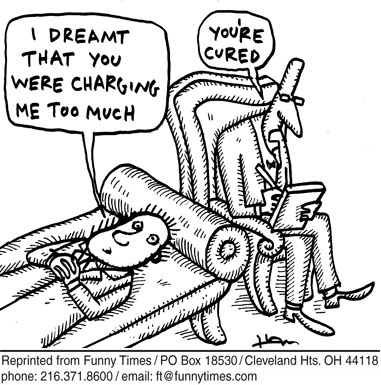
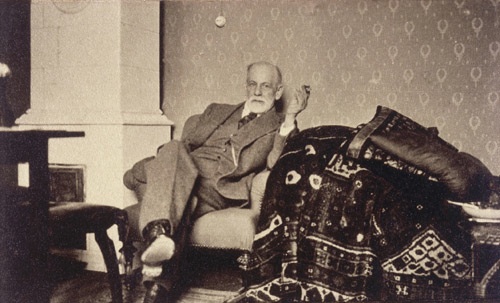
The couches in both cartoons are rather spare. But the couch the historical Freud used for patients in his office was surprisingly and charmingly ornate:

Note the position of the chair, placed where the patient cannot see the doctor’s face. And here’s one of Freud himself demonstrating, complete with cigar (or is it cigarette?):
Hans Brinker skates again: global warming, anyone?
Most of the canals in the Netherlands have frozen solid this winter.
It’s a big surprise to some:

Skates are sold out in stores after many who thought that ice would never return to the Netherlands threw their rusty blades away or simply lost them.
A crustacean reprieve…
Although I’m not so sure he wouldn’t be safer, and happier, if he stayed in the NY eatery as a protected pet, rather than be returned to the ocean, even the protected waters of the toney resort of Kennebunkport.
Of course, who knows what makes for lobster happiness? They have such inscrutable faces.
Less news is good news—for now
Have you noticed a certain flatness in the news lately?
The election is over. Bush-bashing is no longer so much fun—nor so necessary—because he’s on the way out. Very very soon, they won’t have him to kick around anymore— although I’m pretty sure they’ll keep on trying.
Iraq is relatively stable, and thus off the media radar screen. Israel and Palestine are—Israel and Palestine. The economy is bad, but that’s not news, and now the initial shock is over. Obama is waiting in the wings, but hasn’t really done much except make appointments and speeches, and bare his torso in Hawaii.
Will the lull last a while? Or is this the calm before the storm?:
And all the news just repeats itself
Like some forgotten dream that we’ve both seen.
Someday I’ll go and call up Rudy,
We worked together at the factory.
But what could I say if he asks “What’s new?”
“Nothing, what’s with you? Nothing much to do.”
Well, even though the news seems to be repeating itself lately, that most assuredly won’t last long. Remember the pre-9/11 summer of 2001, when the biggest stories were about shark attacks?
Real news of import is always a surprise, always unexpected. That’s why it’s called news.
The recession: don’t worry, be happy
Depressed about the recession? If you are, research indicates that, unless you are directly affected by losing your job or some other dramatic loss, the downturn in your mood won’t last long. And even if you have been directly affected in a fairly dramatic way, you probably won’t remain depressed for long unless that’s your natural tendency anyway.
It turns out that, just as money can’t buy you love, it can’t buy you happiness—at least, not much, and not permanently. But even if there are a few depressed people around, they’re not as likely to have a depressive effect on others:
The reason: sorrow does not spread nearly as readily as joy. Nicholas Christakis, one of the study’s authors, says happy people form groups and socialize. Unhappy people spend more time alone, not always by choice. “Do you want to hang out with an unhappy person?” says Christakis, who teaches sociology at Harvard. “My feeling is that happiness declines during recessions, but I am not sure how much.”
[ADDENDUM: Here’s a piece on what makes for happiness—at least, according to psychology research. Turns out that some of it is genetic—about 50%, as with so many things. And other important factors are the somewhat corny and cliched, but nevertheless important, acts of counting one’s blessings, finding meaning in one’s life, and altruistic endeavors. ]
More…
…on possible (probable?) CNN Pallywood.