↓
 

The New Neo

A blog about political change, among other things

  • Home
  • Bio
  • Email
Home » Page 1544 << 1 2 … 1,542 1,543 1,544 1,545 1,546 … 1,865 1,866 >>

Post navigation

← Previous Post
Next Post→

Coming soon to a country near you: decoy Jews?

The New Neo Posted on August 7, 2010 by neoAugust 7, 2010

Decoy Jews are now being used by police departments in the Netherlands—that is, cops disguised as Jews—a response to increasing reports that Jews wearing skullcaps cannot travel the streets of some European cities such as Amsterdam without being harassed:

Since 1999, Jewish organizations in the Netherlands have been complaining that Jews who walk the Dutch streets wearing skullcaps risk verbal and physical attacks by young Muslims. Being insulted, spat at or attacked are some of the risks associated with being recognizable as a Jew in contemporary Western Europe.

Last week, a television broadcast showed how three Jews with skullcaps, two adolescents and an adult, were harassed within thirty minutes of being out in the streets of Amsterdam. Young Muslims spat at them, mocked them, shouted insults and made Nazi salutes. “Dirty Jew, go back to your own country,” a group of Moroccan youths shouted at a young indigenous Dutch Jew. “It is rather ironic,” the young man commented, adding that if one goes out in a burka one encounters less hostility than if one wears a skullcap.

Rather ironic, indeed. Ironic, also, that in Amsterdam, the city where Anne Frank’s family took refuge, this sort of behavior is still happening—mainly at the hands of other newcomers and their children, not the Germans this time but the Muslims from various countries.

And ironic, also, that the left is up in arms about police entrapment of those same Muslims:

The deployment of “decoy Jews”, however, is being criticized by leftist parties such as the Dutch Greens. Evelien van Roemburg, an Amsterdam counselor of the Green Left Party, says that using a decoy by the police amounts to provoking a crime, which is itself a criminal offence under Dutch law.

If the laws about provoking a crime are at all similar to the entrapment laws here, the Greens have no case at all. But if merely walking about while looking Jewish is considered a provocation to violence, then Europe (and the world) is in even worse trouble than I thought.

Posted in Jews, Law | 43 Replies

Kurtz on same sex marriage

The New Neo Posted on August 7, 2010 by neoAugust 7, 2010

Some years ago, Stanley Kurtz wrote a series of articles on the subject of what effect the legalization of same-sex marriage might have on the institution of marriage itself. They make for sobering reading, although (like almost all other social science data) they only show correlation rather than causation. But one wonders why Judge Walker was apparently (as far as I can tell, anyway) not even presented with this data by the attorneys for the state in Perry v. Schwarzenegger: see this and this.

And also see this one is about hidden agendas.

Posted in Law, Men and women; marriage and divorce and sex | 25 Replies

Hair: the long and the short and the aging

The New Neo Posted on August 7, 2010 by neoAugust 7, 2010

To take up a topic suggested by a number of comments to my earlier post today (and to avoid talking about Obama just a little bit longer): why do older women, or even middle-aged women, so seldom wear their hair long? And should they perhaps do so more often?

Since we discussed Mia Farrow in that previous post, and since she’s a woman of a certain age (65, to be exact), let’s see what she looks like today:

farrowlong.jpg

I’ll spare Ms. Farrow the side-by-side comparisons with her own youthful self. She’s had enough grief at Woody Allen’s hands; I don’t need to add to it. But if you want to see a photo, just look here.

The point is not that she looks older now—she does—or that she appears to have had a soupcon of cosmetic surgery enhancement (she does). It’s what’s going on with her hair, and whether she would look better with something a bit shorter, although not necessarily something as short as her trademark androgynous do in her heyday.

My answer is yes. The main reason is the same reason that really long hair is often a not-great look for many other older women: hair gets thinner and duller as one ages.

Yes folks, men may get bald, but women’s crowning glory is likewise not untouched by time. I have been fortunate enough to have (so far, knock wood) a certain heredity that involves a lot of hair, and even my 96-year old mother still has a fair amount of it, but age is not kind to hair in general, and really long hair tends to look lifeless and droopy on an older women unless she is in that very tiny percentage of the population whose locks somehow retain the shine and gloss of youth, and/or whose gray or white hair is astoundingly thick and especially flattering. Coloring helps the whole project for most, but it can’t restore the bounce and vigor of yesteryear’s tresses, and the older face itself has enough drag that more drag does not do it any favors.

I’ve had longish hair most of my life. But really really really long hair was only possible when I was a teenager and in my early twenties. One reason was that the thickness of my hair made it take forever to dry, and the longer it was, the longer that process took, till it seemed to consume an entire day. Another was that, once I was out of school and about in the world, very long hair just stopped looking good and looking stylish. But I kept it medium-long, never short.

Later on, when I hurt my arms, I could not have it long because I couldn’t fuss with it any more. But those relatively short-haired years were not my finest and most flattering, hairwise (or otherwise, if truth be told), and as soon as I was well enough to be able to deal with longer hair, I started growing it out, and got lots of compliments.

But I noticed a funny thing. There was a point beyond which it started getting draggy again. So over the years I’ve kept it more or less the length in my little apple photo in the upper right. It seems to work for me, and I guess you’d call it long, and I guess you’d call me older, so I guess I’m a sort of older woman with sort of long hair.

It’s an idiosyncratic thing; I’ve got quite a few friends on whom short hair is best. But in general, all else being equal (which it never is), I agree with those who say a little length is good for a women, even an older one, if her hair can handle it. Here, for example, is a generally good length for a woman of what we might call mature years (it helps, of course, to be Helen Mirren):

mirren.jpg

[NOTE: Oh, and by the way, about those younger women—here’s a shot of Seberg, she of the chic pixie haircut, in a long do for the movie “Lilith.” IMHO, ultra-short was much better on Ms. Seberg in her prime. It gave her a distinctive artsy look that she lacks here:

seberglong.jpg

Your mileage, of course, may vary.]

Posted in Fashion and beauty, Me, myself, and I | 35 Replies

Call it pixie, call it gamine, call it…

The New Neo Posted on August 7, 2010 by neoAugust 7, 2010

…difficult to wear.

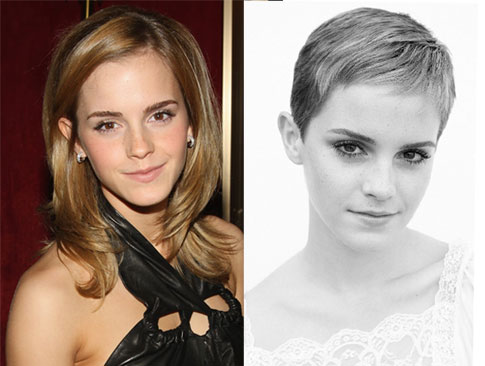
It takes a very special woman with a very special face to make the pixie haircut work (confession: I am not now, nor have I ever been, that woman). But Emma Watson of “Harry Potter” fame has garnered some publicity for cutting off her flowing locks and going all early Mia Farrow (hat tip: Althouse):

emmahair.jpg

I think she looks pretty darn pretty. As did Mia in her prime, although not quite as good:

miahair.jpg

What are the elements necessary to pull this off? Very feminine, delicate features, with a wide heart-shaped rather than long face. Wide fawnlike eyes, tiny pert nose. Straightish and fine hair (mine sticks up in wild cowlicks when short; it’s way too wavy/curly to stay put). Ears that don’t stick out too much. And most of all, a beautifully-shaped head.

All these attributes were possessed to the nth degree by the actress who popularized the look (as Louise Brooks did the straight bob with bangs) but is largely forgotten by the youth of today, Jean Seberg. She was plucked from Iowan obscurity to play Joan of Arc as a teen, got bad reviews, and went on to fame, fortune, and a tragic end in France. The Godard movie that made her (and a very skinny Jean Paul Belmondo) a film icon was “Breathless,” a film I happen to have watched last night after renting it from Netflix to fill in a gap in my movie-going career.

It’s one of those classics that’s not all that good, although it’s fascinating as a portrait of the sort of empty, trendy, improvised new wave style of Godard at the time, with the hand-held camera filming in black and white, and the two tough, cool, beauties (Seberg and Belmondo) chain-smoking furiously, wearing little white socks, and talking your ear off about nothing, pretending to be in love but demonstrating not one whit of it. Seberg is gorgeous in various sorts of Gallic stripes that only the very thin can pull off:

sebergbreathless.jpg

Godard’s camera is absolutely in love with her. Closeup after closeup explores every aspect of her face, and there’s a longish scene in a car that focuses mainly on the back of her closely cropped and perfectly shaped head, which seems to especially fascinate the director.

And here—thanks to the magic of You Tube—it is:

[ADDENDUM: Halle Berry’s another one who’s got the requisite features to pull off a version (or several versions) of the hairstyle. Granted, her hair is wavier, but even her cowlicks look good.]

Posted in Fashion and beauty, Movies | 48 Replies

Hiroshima, 65 years later

The New Neo Posted on August 6, 2010 by neoAugust 6, 2010

[NOTE: The following is a reposting of a piece that appeared here on a previous Hiroshima anniversary. If you follow the links in the second paragraph, you’ll find three other pieces I’ve written about the decision to drop the bomb on Hiroshima.]

Once again it’s the anniversary of the dropping of the atomic bomb on Hiroshima. Nagasaki followed three days later, and Japan surrendered on August 15, 1945.

To date these two bombs remain—astoundingly enough, considering the nature of our oft-troubled and troubling species—the only nuclear warheads ever detonated over populated areas. (I’ve written at length on the subject of those bombs: see this, this, and this.)

Oliver Kamm wrote a while back:

Our side did terrible things to avoid a more terrible outcome. The bomb was a deliverance for American troops, for prisoners and slave labourers, for those dying of hunger and maltreatment throughout the Japanese empire – and for Japan itself. One of Japan’s highest wartime officials, Kido Koichi, later testified that in his view the August surrender prevented 20 million Japanese casualties.

This context always needs to be kept in mind when evaluating any “terrible thing”—and there is no question that the dropping of these bombs was a terrible thing.

But critics who are bound and determined to portray the West as evil, marauding, bloodthirsty— whatever the dreadful adjective du jour might be—are bound and determined to either avoid all context, or to change the true context and replace it with fanciful myth. As Kamm writes, those who want to portray Hiroshima and Nagasaki as American crimes cite evidence of an imminent Japanese surrender that would have happened anyway.

Trouble is, there’s no such evidence; available information points strongly to the contrary. It’s difficult to know whether those who argue that the bombs were unnecessary and the deaths that ensued gratuitous are guilty of poor scholarship, wishful thinking, or willful lying—or perhaps some combination of these elements.

Truth in history is not easy to determine (see this), although it helps greatly if conventions of scholarship (sources, citations) are properly followed. Oh, the main events themselves are often not disputed—except for fringe groups such as those who think we didn’t go to the moon—although the details are often the subject of disagreement. But it’s the motivations behind the acts, the hearts and minds of the movers and shakers, the “what-might-have-been’s” and the “but-fors” that are so open to both partisan interpretation and willful distortion, and so deeply meaningful.

It’s hard enough to determine what happened. How many died in Dresden, for example? Do we believe Goebbels’s propaganda as promulgated by David Irving, or do we believe this work of recent exhaustive scholarship? The former “facts” have reigned now in popular opinion for quite a while, and although the latter mounts a far more convincing case, how many have read it or are familiar with the facts in it, compared to those who have been heavily exposed to the former?

There’s what happened, and then there’s why it happened—the meaning and intent behind the policy. A combination of the two is what propaganda is all about. It takes a lot of time and effort to wade through facts, make judgments about the veracity of sources, and be willing to keep an open mind.

Much easier to stand in a public square (as a bunch of nodding, smiling, waving, middle-aged peace-love Boomers regularly do in the town where I live) holding huge banners declaring “9/11 WAS AN INSIDE JOB.” Repeat it often enough, and the hope is it will become Truth in people’s eyes.

Especially in the eyes of the young, and of future generations, who don’t have their own memories to go on. It’s much harder to convince a WWII vet that Hiroshima was an unnecessary war crime than it is to convince a young person of same; the former not only has the context, he has own personal memories of the context. But propagandists are not just interested in changing opinions in the present, they’re interested in history and the future.

Posted in History | 45 Replies

China takes aim at US aircraft carriers

The New Neo Posted on August 6, 2010 by neoAugust 6, 2010

I guess it’s not enough that we’re deeply indebted to China, and getting more so each day. Now comes the news that China has nearly perfected a missile aimed at our supercarriers:

…an unprecedented carrier-killing missile called the Dong Feng 21D that could be launched from land with enough accuracy to penetrate the defenses of even the most advanced moving aircraft carrier at a distance of more than 1,500 kilometers (900 miles)…

The weapon, a version of which was displayed last year in a Chinese military parade, could revolutionize China’s role in the Pacific balance of power, seriously weakening Washington’s ability to intervene in any potential conflict over Taiwan or North Korea. It could also deny U.S. ships safe access to international waters near China’s 11,200-mile (18,000-kilometer) -long coastline.

Great news, no? Nor should it come as a surprise. China has been working on this for a long time, its navy having been “funded by annual double-digit increases in the defense budget for almost every year of the past two decades.”

Meanwhile…

Posted in Military | 24 Replies

Michelle Obama’s austerity vacation…

The New Neo Posted on August 5, 2010 by neoAugust 7, 2010

…at taxpayer expense.

[ADDENDUM: Even Obama apologist extraordinaire Ruth Marcus can’t seem to muster up much enthusiasm for the defense of this one, although she tries.]

Posted in Obama | 35 Replies

The judge, the people of California, and Prop 8

The New Neo Posted on August 5, 2010 by neoMarch 26, 2013

Federal Judge Vaughn Walker has ruled in the case of Perry v. Schwarzenegger that Proposition 8, approved by the people of California and restricting marriage in that state to being between a man and a women, violates the Equal Protection Clause (14th Amendment) of the US Constitution.

This raises the question: how best to balance the stated desire of the people of California—to adhere to a long-held tradition about marriage—against the decision of a single federal judge in California that the traditional man/woman restriction of marriage can be safely jettisoned, and in fact must be jettisoned, in order to preserve gay rights? Is this a case of judicial activism run amok, or is it a desirable and timely extension of basic rights to a group that has been deprived of them for too long?

I don’t write much about gay marriage, because I am not clear in my mind on what is the best thing to do about it. Both sides have a great deal of merit, IMHO. So it helps me to look at this case in a more narrow legal sense, as an issue of whether the judge was correct under the law to extend the Equal Protection Clause to cover gay marriages as follows:

“The Equal Protection Clause renders Proposition 8 unconstitutional under any standard of review”¦”¦.excluding same-sex couples from marriage is simply not rationally related to a legitimate state interest,” Walker wrote in his 136-page decision. He suggested that opponents of same-sex marriage had few arguments to bolster their position beyond the claim that marriage is traditionally between men and women, and there are few historical precedents for allowing homosexual unions.

Let’s take a look at the relevant words in the Equal Protection Clause, passed shortly after the Civil War to invalidate the so-called Black Codes, which were attempts by some of the defeated southern states to deprive the newly-freed black slaves of their rights and make of them second-class citizens:

No State shall make or enforce any law which shall abridge the privileges or immunities of citizens of the United States; nor shall any State deprive any person of life, liberty, or property, without due process of law; nor deny to any person within its jurisdiction the equal protection of the laws.

Slowly but surely, in a series of cases that were brought before the Supreme Court over many decades, the Clause was used to expand the rights of blacks, first to have juries that were not totally white, then to be allowed into public places like theaters, modes of transportation, inns, and the like. The expansion of the Clause was dealt a temporary blow by Plessy v. Ferguson, which established “separate but equal,” but was overruled in 1954 by Brown v. Brown of Education.

Later rulings beyond Brown expanded the Clause still further to encompass the prohibition of discrimination on the basis of sex, which was determined to dictate what was called intermediate scrutiny: that is, such a law was to be considered unconstitutional unless it is “substantially related” to an “important government interest.” Laws that involve possible discrimination on some basis other than race or sex are subject to a different standard: the rational-basis test, which means that such a law is presumed to be constitutional as long as it is “reasonably related” to a “legitimate government interest.” Here at last we recognize a version of the language used by Judge Walker in the Prop 8 case; when he said the prohibition on same sex marriage is “not rationally related to a legitimate state interest,” he is using the rational-basis test.

And that is where we stand. Judge Walker thinks Prop 8 fails the rational basis test. But excellent arguments can be made to the contrary (although from what I read, the arguments made in the present case by the side defending Prop 8 were poorly presented). The Supreme Court (or five out of nine of the Justices, which is all it takes to render a decision) may buy those arguments, unlike Judge Walker.

The way some of those arguments might go would be that the right to marry is not absolute and that there are still several allowable restrictions (such as the laws against incest, for example), that the state has long had an interest in regulating marriage, that it is (and always has been) an essential quality of marriage that it be between a man and a woman, and that a state also has a compelling interest in allowing its citizens to vote to determine the rules about marriage as long as they do not obviously violate the Equal Protection Clause, and that there should be a very high standard of proof necessary to prove discrimination to the degree that it would invalidate such a law passed by its citizens on a matter that is not as clearly protected by the 14th Amendment (not race and not sex, but sexual orientation, as in this case).

In some ways, the very strangest statement Judge Walker made was this one:

Race and gender restrictions shaped marriage during eras of race and gender inequality, but such restrictions were never part of the historical core of the institution of marriage.

Judge Walker may not like it or approve of Proposition 8. He may even think it clearly violates the Equal Protection Clause, and he may want to overturn it. But the fact is that such gender restrictions were a tremendously central part of the historical core of the institution of marriage. They go back thousands of years, to Genesis (and even earlier). Although the following quote is religious, it is also a huge and central part of the historical and cultural core of the institution of marriage in our culture:

The man said,

“This is now bone of my bones
and flesh of my flesh;
she shall be called ”˜woman,’
for she was taken out of man.”

24 For this reason a man will leave his father and mother and be united to his wife, and they will become one flesh.

The judge relies on social science testimony presented during the trial to justify his ruling that throwing out this idea doesn’t really matter, and won’t matter in the future. But social science research and its vagaries are a very shaky foundation on which to rest such a striking and basic change in an institution central to our lives.

[NOTE: Some interesting and related questions are discussed here, here, and here.]

Posted in Law | 74 Replies

Obama’s approval rating and race

The New Neo Posted on August 5, 2010 by neoAugust 5, 2010

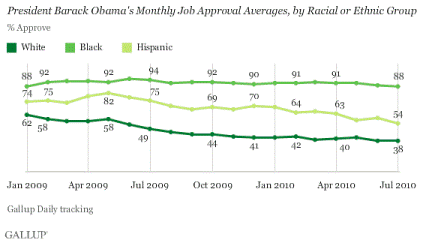
The latest Gallup poll on Obama’s job approval rating among whites, blacks, and Hispanics highlights the continuing huge differential in opinion between whites and blacks: 38% of whites presently approve of the job Obama is doing while 88% of blacks approve. Hispanics hover in-between, and are closer to the approval figure for whites than for blacks.

Here’s the chart:

obamaapprovalrace.gif

At the beginning of the Obama administration, the three groups started out not all that far apart from each other: 88% job approval from blacks, 74% from Hispanics, and 66% from whites. But a fall-off in approval from the highs of the earlier months of Obama’s term of office is clear for all three groups. For blacks, the slope of the drop is very small—from consistent highs in the low 90s to 88%—but it nevertheless exists. For Hispanics, the drop is steeper—from a starting point of 74% and a high shortly thereafter of 84%, the figure has gone more or less steadily downward to the present 54%, a rather startlingly low number considering how assiduously Obama has courted and catered to Hispanics lately (could it possibly be that many of our Hispanic citizens aren’t so all-fired happy about Obama’s championing of their illegal brethren?).

The slope for whites is the steepest of all. It is the only group that has experienced a continual drop, with only a single minor 1-point uptick along the way. Down, down, down, it’s dropped, at a steady pace that can be graphed almost as a straight line pointing southward, a sort of long ramp.

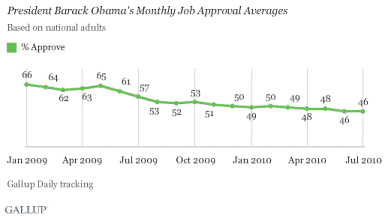
Did I say “straight line pointing southward?” That’s the shape of Obama’s overall job approval rating, as well:

obamaapprovaloverall.gif

What does it all mean? It seems significant to me that Obama’s job approval ratings don’t seem to have the up and down fluctuations that might reflect approval or disapproval of the policy du jour. Does the steady downward slope in all groups represent a far more basic and global disillusionment with this particular president?

Posted in Obama | 27 Replies

Robert Gibbs and Obama—they feel your pain…

The New Neo Posted on August 4, 2010 by neoAugust 4, 2010

…not.

Asked what it means that voters in Missouri would vote against the federal mandate, Gibbs said: “Nothing.”

As I wrote last Saturday:

…[Obama] ignores the wishes of the American people, something neither FDR nor Clinton would ever do…Obama sees the public as his enemy, a stumbling block that he needs to get around if he is ever to reach his goals. For Obama, the public is an entity to deceive and manipulate if possible, and he regards it contemptuously rather than respectfully. He no longer needs to inspire people. He just needs to exercise power over them.

And the despicable Gibbs is the perfect mouthpiece for that sentiment.

Posted in Health care reform, Obama | 33 Replies

Missouri says no to individual mandate

The New Neo Posted on August 4, 2010 by neoAugust 4, 2010

Proposition C was roundly defeated in Missouri yesterday, with 71% of voters saying they don’t need no steenking Obamacare individual mandate.

The results may be a bit less overwhelming than one might think, however, because (a) it’s unclear whether this will have any legal effect at all; (b) turnout was relatively light; and (c) more voters seem to have been drawn to the ballot on the Republican side because the Missouri Republican primary was more competitive than the Democratic one.

Since Missouri has an open primary in which voters are not restricted to voting for their own party, it’s hard to say what the breakdown of Republicans, Democrats, and Independents was among the voters yesterday. What we do know is that about 65% of the participants voted on the Republican ballot. The 71% overall pro-Prop C figure means that a significant number of those voting on the Democrat side must have approved of the measure, as well.

We also can assume that the vote for Proposition C yesterday was evidence that there are a lot of disgruntled ex-Obama voters right now in Missouri. In the 2008 election, McCain won Missouri, but only by a hair: 49.4% to 49.3%. Missouri’s nickname is the “show-me” state; it seems Obama has shown them quite a bit in the last year and a half, and they’re not liking what they see.

[NOTE: Other states are planning similar votes on the individual mandate. Legal scholars seem to be saying such states’ rights protest votes are unenforceable and merely symbolic. Although I’ve seen many articles that mention this, I’ve seen no actual discussions on the merits, nor links to such discussions. If more states go the Missouri route, I would imagine we’ll see more debate on the subject.]

Posted in Health care reform, Law, Politics | 11 Replies

Obama the great bamboozler

The New Neo Posted on August 4, 2010 by neoAugust 4, 2010

One of the most perverse things about Obama is that, when he’s trying to get tough with the opposition, what he says about them is often the best clue to what he’s actually doing, or planning to do.

Case in point—his latest declaration about the Republicans (video here):

…[T]hey’re betting on amnesia. That’s what they’re counting on. They’re counting on that you all forgot. They think that they can run the okey-doke on you. Bamboozle you.

Like many of Obama’s most revealing remarks, these were made at a Democratic fundraiser, this time in Atlanta. And the word “bamboozle” is an especially nice touch, harking back to a famous scene in Spike Lee’s film “Malcolm X,” a reference that would most likely be recognized by a great many people in his Atlanta audience.

I said the speech appears in the film; Malcolm X never actually said the words in real life. But since movies about history have largely become a substitute for history, these cinematic words may be more famous than any the historical figure of Malcolm X actually uttered. The movie context was a speech made by Malcolm in Harlem, on the subject of the white man. Rest assured that Obama (who has used these phrases quite a few times to describe his enemies) is aware of the racial code he’s employing, and what it means to many of the black people in his audience.

Here’s Spike Lee’s version of Malcolm X:

So I have to stand here today as what I was when I was born: A black man.

Before there was any such thing as a Republican or a Democrat, we were black.

Before there was any such thing as a Mason or an Elk, we were black.

Before there was any such thing as a Jew or a Christian, we were black people!

In fact, before there was any such place as America, we were black!

And after America has long passed from the scene, there will still be black people.

I’m gonna tell you like it really is. Every election year these politicians are sent up here to pacify us! They’re sent here and setup here by the White Man!

This is what they do!

They send drugs in Harlem down here to pacify us!

They send alcohol down here to pacify us!

They send prostitution down here to pacify us!

Why you can’t even get drugs in Harlem without the White Man’s permission!

You can’t get prostitution in Harlem without the White Man’s permission!

You can’t get gambling in Harlem without the White Man’s permission!

Every time you break the seal on that liquor bottle, that’s a Government seal you’re breaking!

Oh, I say and I say it again, ya been had!

Ya been took!

Ya been hoodwinked!

Bamboozled!

Led astray!

Run amok!

This is what He does….

And this is what Obama does—sows the seeds of racial hatred while maintaining a facade of plausible deniability (the following footage of Obama is from 2008).

[NOTE: Obama has been called on this before, during the 2008 campaign, when he used “bamboozled” and “hoodwinked” repeatedly to describe the actions of opponents (see also this).]

Posted in Language and grammar, Obama, Race and racism | 65 Replies

Post navigation

← Previous Post
Next Post→

Your support is appreciated through a one-time or monthly Paypal donation

Please click the link recommended books and search bar for Amazon purchases through neo. I receive a commission from all such purchases.

Archives

Recent Comments

  • om on Joe Kent casts his lot with the Carlson/Owens wing of …
  • FOAF on Somaliland corroborates the charges against Ilhan Omar
  • Selfy on Open thread 3/20/2026
  • Nonapod on Joe Kent casts his lot with the Carlson/Owens wing of …
  • Bauxite on Joe Kent casts his lot with the Carlson/Owens wing of …

Recent Posts

  • Open thread 3/20/2026
  • Joe Kent casts his lot with the Carlson/Owens wing of …
  • Somaliland corroborates the charges against Ilhan Omar
  • Governor Hochul pleads with the former “captives” to return to NY so they can have their assets confiscated
  • Open thread 3/19/2026

Categories

  • A mind is a difficult thing to change: my change story (17)
  • Academia (318)
  • Afghanistan (97)
  • Amazon orders (6)
  • Arts (8)
  • Baseball and sports (161)
  • Best of neo-neocon (88)
  • Biden (536)
  • Blogging and bloggers (581)
  • Dance (286)
  • Disaster (238)
  • Education (319)
  • Election 2012 (360)
  • Election 2016 (565)
  • Election 2018 (32)
  • Election 2020 (510)
  • Election 2022 (114)
  • Election 2024 (403)
  • Election 2026 (13)
  • Election 2028 (4)
  • Evil (126)
  • Fashion and beauty (323)
  • Finance and economics (1,002)
  • Food (316)
  • Friendship (47)
  • Gardening (18)
  • General information about neo (4)
  • Getting philosophical: life, love, the universe (724)
  • Health (1,132)
  • Health care reform (545)
  • Hillary Clinton (184)
  • Historical figures (329)
  • History (699)
  • Immigration (427)
  • Iran (405)
  • Iraq (224)
  • IRS scandal (71)
  • Israel/Palestine (787)
  • Jews (415)
  • Language and grammar (357)
  • Latin America (202)
  • Law (2,883)
  • Leaving the circle: political apostasy (124)
  • Liberals and conservatives; left and right (1,272)
  • Liberty (1,097)
  • Literary leftists (14)
  • Literature and writing (386)
  • Me, myself, and I (1,465)
  • Men and women; marriage and divorce and sex (902)
  • Middle East (380)
  • Military (308)
  • Movies (344)
  • Music (524)
  • Nature (254)
  • Neocons (32)
  • New England (176)
  • Obama (1,735)
  • Pacifism (16)
  • Painting, sculpture, photography (126)
  • Palin (93)
  • Paris and France2 trial (25)
  • People of interest (1,016)
  • Poetry (255)
  • Political changers (176)
  • Politics (2,765)
  • Pop culture (392)
  • Press (1,611)
  • Race and racism (857)
  • Religion (411)
  • Romney (164)
  • Ryan (16)
  • Science (621)
  • Terrorism and terrorists (967)
  • Theater and TV (263)
  • Therapy (67)
  • Trump (1,575)
  • Uncategorized (4,338)
  • Vietnam (108)
  • Violence (1,395)
  • War and Peace (964)

Blogroll

Ace (bold)
AmericanDigest (writer’s digest)
AmericanThinker (thought full)
Anchoress (first things first)
AnnAlthouse (more than law)
AugeanStables (historian’s task)
BelmontClub (deep thoughts)
Betsy’sPage (teach)
Bookworm (writingReader)
ChicagoBoyz (boyz will be)
DanielInVenezuela (liberty)
Dr.Helen (rights of man)
Dr.Sanity (shrink archives)
DreamsToLightening (Asher)
EdDriscoll (market liberal)
Fausta’sBlog (opinionated)
GayPatriot (self-explanatory)
HadEnoughTherapy? (yep)
HotAir (a roomful)
InstaPundit (the hub)
JawaReport (the doctor’s Rusty)
LegalInsurrection (law prof)
Maggie’sFarm (togetherness)
MelaniePhillips (formidable)
MerylYourish (centrist)
MichaelTotten (globetrotter)
MichaelYon (War Zones)
Michelle Malkin (clarion pen)
MichelleObama’sMirror (reflect)
NoPasaran! (bluntFrench)
NormanGeras (archives)
OneCosmos (Gagdad Bob)
Pamela Geller (Atlas Shrugs)
PJMedia (comprehensive)
PointOfNoReturn (exodus)
Powerline (foursight)
QandO (neolibertarian)
RedState (conservative)
RogerL.Simon (PJ guy)
SisterToldjah (she said)
Sisu (commentary plus cats)
Spengler (Goldman)
VictorDavisHanson (prof)
Vodkapundit (drinker-thinker)
Volokh (lawblog)
Zombie (alive)

Meta

  • Log in
  • Entries feed
  • Comments feed
  • WordPress.org
©2026 - The New Neo - Weaver Xtreme Theme Email
Web Analytics
↑