
Good for her.
Perkinsnacht
Remember Tom Perkins? The guy who compared the war on the 1%, not to Kristallnacht, but to the beginning of a pattern that could lead to something like Kristallnacht?
Well, his letter to the WSJ may be “the most-read letter to the editor in the history of The Wall Street Journal.” He’s been forced to eat a little crow:
Amid the ongoing media furor and an ungallant rebuke from Kleiner Perkins, Mr. Perkins has apologized for the comparison, without rebuking the larger argument.
It’s no surprise that Perkins was made to walk back his comparison—a fact that doesn’t take away from his analogy. We discussed the issues he raised in the original thread on the subject on this blog, and I’ll just add that the last sentence of the WSJ‘s editorial defending Perkins is somewhat naive:
The liberals aren’t encouraging violence, but they are promoting personal vilification and the abuse of government power to punish political opponents.
There are many ways to encourage violence, and not all of them take the form of saying, “Go out and kill the [fill in the blank]!” To encourage hatred and envy, rather than mere disagreement and rational argument, is to help to encourage violence, at least potentially, and that’s what Perkins was talking about.
Of course, sometimes violence isn’t necessary. Sometimes the re-education camps will do. Sometimes it is enough to silence people or discourage them from speaking up in a way judged to be insufficiently PC.
No, the Romney film would not have made a particle of difference in the election
I keep reading about how wonderful the Netflix documentary “Mitt” is, what a nice guy it shows Romney to be, and how if only the film had been released before the 2012 election it would have made a difference.
Well, however fine a film it is, and however nice a guy it reveals Romney to be, I have to say that “they” (the media, the pundits, the left, the liberals) would have destroyed it before the election. They don’t need to do so anymore, and therefore they can afford to be magnanimous. They can even let little bleats of wistful praise escape: gee whiz, we didn’t know what a nice guy he was!
Of course they (the MSM, for example) did. They tried to make sure we didn’t know. And the Republican Convention had plenty of information available, too. But not many people watched it, and the networks didn’t even cover the parts about Romney’s bio and good deeds. That was no accident at all.
I’m not sure whether I’ll watch the Netflix film, because I’m not really a glutton for punishment.
Whoever is the Republican nominee in 2016, get ready for the full-court-press-press. Anyone who thought that what happened to George W. Bush or Sarah Palin had something to do with some special characteristics of stupidity, accent, word choice, does not understand politics and the press today, nor do they understand the opposition in general.
The opposition (and that most definitely includes the propaganda wing, the MSM) will find whatever vulnerability exists, and if it doesn’t exist they will make it up. They will do the opposite for their candidates, the Democratic candidates. People may say they don’t trust the MSM or don’t listen to them. But most do, and even if they think they don’t the message still seeps in.
It’s as though the Republican (and/or conservative) candidate starts a footrace carrying a 100-pound sack. What’s inside the sack may differ for one candidate versus another. But everybody on that team has got to carry the sack all the way to the finish line, and then for the rest of his/her life, and that person had better be very very strong.
Dirty dogs
Some dogs really really really don’t want to take a bath.
And some dogs really do.
I think the anti-bath growlers and teeth-bearers are kind of scary; seems to me they could bite. But some of the rest are pretty funny (hint: click on the “x”s in the black circles to get rid of those annoying ads):
Churchill and speechmaking
Last night when I was engaged in not watching Obama’s SOTU speech, I was thinking of the antidote: Churchill. I even wrote a couple of notes for this post.
And funny thing, today I see that commenter “Beverly” had the same notion (see also this).
I have long cringed when anyone refers to Obama as a great orator. I just don’t get it. He’s a terrible orator: flat, repetitive delivery; contentless (that is, when he’s not engaged in flagrant lying, or errors); and cliche upon cliche.
But why single Obama out? The US hasn’t had a president who’s a great orator in a long, long time. Kennedy had some good moments, Reagan was quite good, but I can’t think of anyone of Churchillian quality since Lincoln. But “Churchillian quality” is a tall, tall order, because Churchill was a great orator.
It helped that Churchill was a writer who wrote his own speeches. Actually, if you read the Manchester biographies of Churchill (one volume of which appears in my blog header photo), you’ll learn that Churchill actually dictated most of his speeches in the early morning (as in, “late night”) hours to a bevy of night-owl secretaries.
Churchill carefully plotted out his delivery, too, and he was a master at it:
At the Morgan Library are several drafts of a single speech from February 1941, when England stood alone against the Nazi onslaught and Churchill appealed to President Roosevelt for aid. The first draft looks like a normal typescript; the final draft, says Kiely, “looks like a draft of a poem.”
Churchill made those markings, Kiely explains, to indicate how the speech should be delivered. He inserted white space to remind himself to pause.
Churchill asked: “What is the answer that I shall give, in your name, to this great man, the thrice-chosen head of a nation of a hundred and thirty millions?”
Here, lots of white space is inserted into the final draft.
“Here is the answer which I will give to President Roosevelt.”
Another long pause, and then he said:
“Put your confidence in us. Give us your faith and your blessing, and under Providence, all will be well. We shall not fail or falter. We shall not weaken or tire. Neither the sudden shock of battle, nor the long”drawn trials of vigilance and exertion will wear us down. Give us the tools, and we will finish the job.”
Historian Andrew Roberts says the impact of Churchill’s speeches cannot be underestimated. “An awful lot of people thought that it was impossible to beat the Nazis,” Roberts says. “Yet what Winston Churchill did, by constantly putting Britain’s peril in the greater historical context of other times that Britain had nearly been invaded, but had been ultimately successful, he managed to tell the British people that this could happen again.
I recall reading in the Manchester books that Churchill had the final drafts of his speeches written out in a sort of blank verse form, and had not only the pauses written in but sometimes instructed himself to stutter slightly for emotional emphasis. A master of wit, word, and the delivery of both, he had a general rule about speech-writing and speech in general:
Short words are best and the old words when short are best of all.
You will note that most of Churchill’s speeches – and virtually all of his most memorable quotes – feature short, “old” (Anglo-Saxon root) words. They also tend to have the cadence of the best poetry.
Which means we’ll have to hear a bit of Churchill now, won’t we? How about the speech described in this post? The pauses aren’t quite as long as I expected from the description, but it’s a great, great speech (note the way he says “nay,” “give us,” and “finish the job,” as well as the way he reads the Longfellow verse, and how Biblical the tone becomes towards the end of the clip):
Defending Debbie Wasserman Schultz
Don’t worry folks, I’m not defending her politics. I’m just defending her hair, on behalf of curly-haired women everywhere.
First let me establish my bona fides (if my photo on this blog hasn’t done so already): yes, I am a curly-haired woman. I’ve written about it, and I’ve been through every conceivable way of dealing with it. I don’t look good in straight hair (tried to iron it long ago, and blow dry it more recently). Straightening it is just not complimentary to my face or my hair, and it’s a royal pain in the butt, so I don’t do it.
But most curly-haired people can’t just let the hair go completely au naturale, or they get a huge frizzball. It needs to be coaxed—ideally, gently and without too much fuss—into showing off its natural curl in the best way possible. That usually involves a good haircut, a few products, and air-drying or drying with a diffuser. Not that terrible a process, really, although the drying can take time, and if the hair is especially curly the taming can be more difficult to accomplish. For all of us our sworn enemies are humidity, the brush, and too-frequent washing.
That said, Wasserman Schultz was dealt a particularly bad hand in that she’s got hair that’s both curly and thinnish, and she resides either in Florida or Washington DC, two of the frizz capitals of the world. She’s also Of A Certain Age (although it’s an age that sounds youngish to me), which means her hair isn’t getting any thicker with time.
Now at this point you might say, “Neo, I thought you said you were going to come to Wasserman Schultz’s defense.” But bear with me; all in good time.
Today I was reading Ann Althouse’s entertaining list of 10 things she might have live-blogged from last night’s SOTU speech, had she been live-blogging it (my hat is off to anyone who could watch that thing, much less watch it and make amusing comments about it), and I saw this:
“Shirley Temple is there,” I said, spotting Debbie Wasserman Schultz, and being unfair to Shirley Temple, whose ringlets ”” as I do an image search this morning ”” look artlessly subtle and not at all like Debbie’s headful of boing-y springs. Incredible what women can do to themselves and still be taken seriously…

Ah, but I’d wager that Wasserman Schultz hasn’t “done” very much to herself at all to get that headful of boing-y springs. She’s probably desperate for an “artlessly subtle” look, but that’s probably beyond her powers, or would take so much “doing” for her as to be all-consuming. She’s lucky if her hair doesn’t frizz up into a big puffball or frizz down into a limp and wan collection of wires.
As for Shirley Temple, who was indeed a cutie-pie, it was her hair that was the product of a great deal of work (in addition to having the glow of youth). Her “look” was – as Althouse suggests – “artlessly subtle,” but there was actually a great deal of art behind it:
Temple was undoubtedly a great actor for such a young child, but it didn’t hurt that she usually had a head full of perfect curls when she stepped in front of the camera. As you might expect, giving a preteen such a meticulous hairdo was no small task. Before she turned in for bed each night, her mother had to set her hair in 56 carefully planned curls.
Temple reportedly didn’t love the hairstyle; she preferred the shorter, tousled locks that her hero Amelia Earhart sported. Temple did, however, understand the value of her trademark look. In 1938 she visited the Roosevelts at their Hyde Park estate. First Lady Eleanor Roosevelt asked the star to go swimming with her, but Temple declined “because of my hair.”
Indeed.
Here’s Temple in her heyday:

You all probably know what Wasserman Schultz looks like on a bad hair day, so I’ll spare you. I couldn’t find a still photo of her at the SOTU speech last night, but here’s a video clip. She’s in black at the right of the video, and then later towards the center and slightly in back, and I think her hair looks darn good, and although not “artlessly subtle” it’s actually going the way curly hair goes when you get a decent haircut, put just a couple of taming products on it, and dry it naturally:
And that’s probably the last nice thing I’ll ever say about Debbie Wasserman Schultz.
[ADDENDUM: And if you still want to read something about the actual SOTU speech rather than the travails of curly-haired women, here’s a reflection on the reactions to the speech, more about the speech, and the Tea Party rebuttal by Utah Senator Mike Lee (sounds interesting).]
Well, to be charitable…
…when Andrea Mitchell says “more or less” at around minute 1:00 of this clip from last night, maybe she actually means “less.”
A lot less.
Because otherwise, we’d have to come to the conclusion that she’s just making stuff up and hoping the American people are incredibly ignorant/stupid. Or else it’s Mitchell who’s just that stupid.
And what’s Chris Cillizza’s excuse?
[Hat tip: Ace.]
State of the Union
[UPDATE (9:25 PM): Give Stephen Green a big round of applause. And a drink; the man needs a drink. Why? He’s liveblogging the SOTU speech. For the umpteenth time.]
“Union?” What union? Obama’s speech is reported to be planned to be a broadside against Republicans:
Democrats consider President Obama’s State of the Union address on Tuesday a launching point for a year of sustained assault on Republicans over a populist economic agenda, part of an effort to focus more on bread-and-butter issues and less on income inequality.
Actually, Obama’s entire presidency has been a “sustained assault.”
But I predict this speech won’t do a thing one way or the other. I am probably typical of many on the right when I say I won’t be listening to it. I will read it, and read about it, and probably write about it. But even among independents and liberals, there aren’t many people left who trust Obama and have faith in his abilities to turn things around, or who want to listen to him talk any more.
That doesn’t mean he won’t get some of what he wants, by hook or by crook (and at times with Republican help). It just means his speech tonight won’t be triumphant.
I’m providing this thread for you to discuss it—including those hardy souls who will actually watch it.
To Republicans on illegal immigration: don’t do it!
The National Review lays out the reasons why passing a bill right now legitimizing illegal immigrants would be a bad, bad idea.
I wouldn’t have thought this needed to be spelled out at this point. But apparently it does, because according to all reports I’ve read so far, the Republicans are poised to pass such a law.
This is exactly the sort of thing that gets conservatives shrieking against the sellout “establishment” Republicans on the Hill, and in this case I join them. If this bill is passed it will be a deep betrayal of both the Republicans’ constituency and the best interests of the nation.
So, why are they so close to doing it? Well, this is one reason:
In this it reflects the obsession of the business establishment, for which the answer to the dire employment crisis among low-skilled workers is always to import more low-skilled workers.
Money talks, nobody walks, as the old ad used to say.
But there’s another reason, and it’s an even stupider one, IMHO: the idea that this will somehow bring the Republicans more votes. Memo to Republicans: au contraire. Hispanics aren’t going to thank you for it. The people (Hispanic and otherwise) who like the idea of amnesty want real amnesty, and know that it’s far more likely to come at the hands of the Democrats. And the entire Republican Party is likely to turn on you for it.
As Bill Kristol wrote recently in the Weekly Standard:
Speaker Boehner…should announce that he will not bring any immigration legislation to the floor this session. If there’s one thing that could blow up GOP chances for a good 2014, it would be an explosive debate over immigration in the House. The only sure way to avoid such a debate is not to let anything onto the floor in the first place. Once even an innocuous-sounding measure gets passed, then the pressure to go to conference with the loathed Senate bill will be great. And whatever ultimately were to happen, activists would spend months worrying about and agitating against a betrayal by the leadership, business interests would spend months urging such a betrayal, and Republicans would be consumed by infighting and recriminations on an issue that does them no short-term political good. Bringing immigration to the floor insures a circular GOP firing squad, instead of a nicely lined-up one shooting together and in unison at Obamacare and other horrors of big government liberalism. Since there really is no need to act this year on immigration, don’t. Don’t even try.
Yes, yes, a thousand times yes. This would be a huge, self-inflicted wound. Why Boehner et al might consider it a winner can only come down to money in the end: their own financial support must depend on it. And yet, if they do this, I don’t see how the voters can ever trust them again, even the remaining few who still trusted them up to this point. It seems to me they’ll be signing their own political death warrant. Can money save them from that?
Pete Seeger: dead at 94
Ah, I see that Pete Seeger, troubadour of my youth, has died.
My feelings about Seeger are mixed, to say the least. First, the bad: he was an activist Communist, and even a Stalinist back in the day. Let’s not whitewash that, like the Chicago Trib article I just linked to did [emphasis mine]:
Seeger also was known for his liberal politics, working as an environmentalist, protesting against wars from Vietnam to Iraq and being sentenced to prison for refusing to testify to Congress about his time in the Communist Party. The case was dismissed years later…
Seeger’s life of music and political activism could be summed up in “The Hammer Song,” the enduring anthem he wrote more than 60 years ago with his good friend Lee Hays to support the progressive political movement in the U.S.
Popularized by Peter, Paul and Mary in the 1960s, the song embodied the heart of Seeger: his musicality, his activism, his optimism and his lifelong belief that songs could and should be used to build a sense of community to make the world a better place.
Liberal? Progressive? Supporting Communism to make the world a better place? Those are euphemisms, I’m afraid. And although his “time in the Communist Party” did end some time in the 50s, his time of sympathy with the Communist Party went on.
Contrast the Trib article with this piece from 2009 (hat tip: Instapundit):
Seeger was a member of the Communist Party from the 1930s through the 1950s. He left the party but never gave up the faith. He told the Washington Post in 1995 “I am still a communist.” Like his comrades and fellow travelers Seeger twisted and turned with every pronouncement from Moscow…Seeger’s sycophancy for murderous communist tyrants didn’t end with Stalin. During the Cold War he praised Ho Chi Minh and provided a hearty jacket endorsement for Tomas Borges’ the brutal Sandinista thug’s book…To be fair Seeger did eventually get around to realizing the horrors of Stalinism, albeit 50 years too late…[but]the moral equivalencies Seeger used to water down his apology for supporting a regime that murdered more people than 20 million people [were unimpressive].
Those of you who follow this blog closely may recall that I know that genre well; quite a few of my more distant relatives (not my immediate family, however) shared Seeger’s politics. What I mostly remember of get-togethers in my youth with that side of the family were the shouting matches about politics (if you don’t believe that liberals and Communists can fight very bitterly with each other about politics, you should have come to those family parties). Quite a few of the most rabid relatives never, at least to the best of my knowledge, denounced Stalin at all. So Seeger was ahead of them.
That probably colors my ability to acknowledge Seeger’s huge political flaws but to also look at his singing and music separately from his politics. Not that he always separated them, but for the most part his music can stand alone. I’ve written about Seeger before, and for me it was the energy of his voice that was the draw:
We had a shaky old record player on which I’d play the scratchy Weavers records that featured Seeger’s unique voice and vibrant banjo. I loved those old songs, but I especially loved Seeger’s voice.
Why? It wasn’t pretty, nor was it exceptionally musical. There are many ordinary people who can make far more beautiful sounds, although I’m most definitely not one of them. But Seeger had what I’ve noticed is a prerequisite for great voices: a unique and utterly identifying timbre, much like a fingerprint, and instantly recognizable as that person and no one else.
Seeger’s voice had an uplifting quality mixed with something indefinable, something between a lilt and a sob. Although the lilt always dominated, the sob was always present as well, much like the complexity of a fine wine with a hint of many flavors to give it a special richness and depth.
Seeger played a mean banjo, too. Here’s a video of the Weavers in their prime, singing a typical number (the vast majority of which were traditional and non-political, except in the most subtle sense), a medley of songs from around the world that supposedly illustrate our oneness (I tried to find one of my very favorites, “Follow the Drinking Gourd,” but no dice). Note, also, the pride of place given to an Israeli song, back when Israel was still beloved by Leftists:
When I think about it, virtually every pop, folk, or rock singing voice that interests me has that same quality of distinctiveness of sound.
Seeger was not a simple figure. But for the joy he gave me and so many others, I loved him. RIP.
Michelle Obama’s Mirror thinks that Madonna…
…is beginning to resemble Marlene Dietrich in her later years.

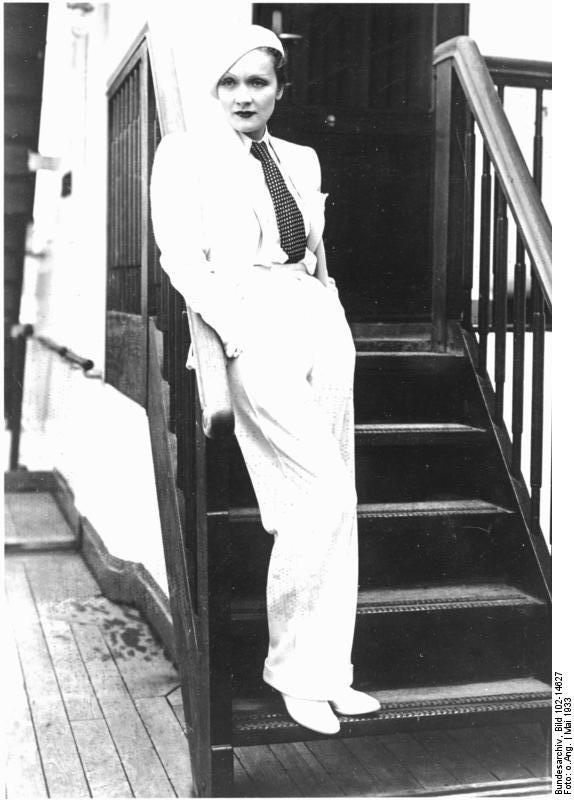
Well, Dietrich did wear suits, including white ones:
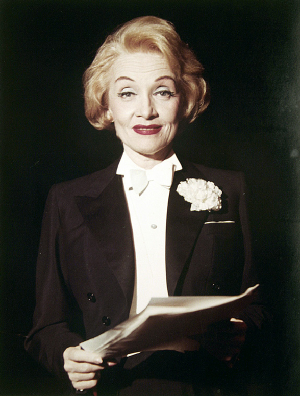
Here Dietrich (who was apparently bisexual) is again in a suit, older this time:
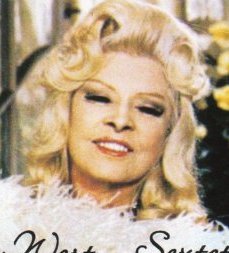
But for the Madonna comparison, I’m thinking that, except for the suit, she looks more like an anorexic Mae West (is that an oxymoron?):


Robert Frost: a living voice
The following passage is from the book Robert Frost: A Living Voice, edited by Reginald L. Cook. It’s from a talk Frost gave at Bread Loaf in July 27, 1960, when he was in his 80s. He starts by describing a conversation he had with Julian Huxley about evolution:
…I said, “We’ve come up?” He said: “Yes, up! up!” He thought “up.” He thought we’d come up, not down. I just wanted to know. And I said: “What do you suppose steered us up?” He was very vague about that. Then, in that kind of corner, just sort of out of indignation, patient indignation, I just said: “Wouldn’t it have been possible to say that it was passionate preference—preference—passionate preference?” This didn’t seem to make a hit with him particularly. He seemed to think it was some sort of an upward uplifting, I guess, that was accidentally upward. No God in it at all. Nothing but spirit. I would think it would be something like that—that everything has a tendency to prefer—even teachers. That’s one of the things we’ve tried to throw away in teaching and give everybody the same mark. But we’ve decided we’ve got to do something about that.
My anger at that made me say that we were going to so homogenize society that the cream would never rise again. And that’s the way some people are talking about education—so homogenized it that now they’re looking for cream again. Beat the Russians. They’re creaming, why shouldn’t we cream? That’s where a good deal comes from—that kind of pressure that you’re cornered and you’re bothered. There’s a certain debate in your life that you don’t ever feel you’ve got the best of, that there’s still something unsettled. If He’s a God of mercy, is He also a God of justice? Naturally there’s a constant natural conflict between justice and mercy. The big joke is that somebody on earth ought to balance them up. Probably God does. It could be assumed. That is the most Godlike thing: to balance them—mercy for justice or a just mercy. But there’s something there that’s almost too hard for a mortal man to get.
The Democratic Party and the Republican Party are having quite a time about it right now. They both want to sound merciful enough, and they both want to sound just enough. They’re going to outdo each other in getting that right. The nice way is to choose the Democrats for being too merciful. Somebody calculated that the mercies that they promised the world were going to cost us about fifty billion dollars a year—if they did all they had in their program. The Republicans have got to sort of match that somewhere if they don’t get broke.
So, Frost seems to have been an amalgam of Cassandra, Will Rogers, and Thomas Sowell, in the guise of a rumpled old New England poet. Of course, he didn’t foresee the actual numbers; they’ve become too large for most people to have imagined. Even in the 30s, Frost was a strong opponent of the New Deal, by the way; not because he was unmerciful, but because he knew where the trend was headed.