↓
 

The New Neo

A blog about political change, among other things

  • Home
  • Bio
  • Email
Home » Page 1884 << 1 2 … 1,882 1,883 1,884 1,885 1,886 … 1,918 1,919 >>

Post navigation

← Previous Post
Next Post→

A new press hero: Saddam, defendant

The New Neo Posted on October 19, 2005 by neoAugust 28, 2009

I’ve been looking forward to the sight, and here it is: Saddam on trial.

I watched a bit of coverage, enough to assure me that Saddam was playing his outraged defiant role, as expected, and that the judges are among the bravest men on the face of the earth to let their faces be shown and their names be known.

The sight brought back memories of the joy I felt the morning I learned Saddam had been captured alive, and of the photos of the Iraqi press corps whooping it up on hearing the news. But the danger always was that a living Saddam standing in the docks would try to turn his trial into a showcase for himself, a la the interminable Milosevic trial, and in the process turn himself into that most unlikely of things: a victim.

Makes a person wonder what would have happened had Hitler not killed himself. We’ll never know, but times and attitudes were certainly different then.

As for Saddam, it seems that some media outlets are already taking up his case–the case for the defense, that is. Well, if not the defense exactly, then certainly the case of criticizing the prosecution and the court, and of a sort of sneaking admiration for Saddam’s moxie and “defiance,” a word I’m already heartily sick of.

To paraphrase Sylvia Plath (of all people), in her poem “Daddy”:

Every [left-leaning journalist] adores a Fascist,
The boot in the face, the brute
Brute heart of a brute like you.

Well, it doesn’t scan well as poetry, and yes, it’s hyperbole, but it comes to mind these days when I read things like the NY Times editorial highlighted and discussed today by Captain’s Quarters.

The Times is criticizing the Iraqi court for–oh, well, for just about everything. Being American puppets, for starters; not having a big international tribune trying the case; being bloodthirsty for wanting the death penalty to be a possibility for Saddam; not having a comprehensive trial for all his crimes but taking the easiest charge first (as, by the way, good prosecutors always do: earth to NY Times), saying it looks like a show trial, and so on and so forth.

Can the Times spare a word in the editorial for any sort of satisfaction that the day of reckoning has come for one of the worst murderous tyrants of recent memory? No. On this momentous day of the trial’s beginning, it seems our Blue-Gray Lady’s editorial board can’t manage to muster up even a smidgen of happiness, only a tongue-scolding for the all-too-imperfect prosecution.

And what of the news wing of the Times? The ordinarily relatively fair John Burns and Edward Wong write the story today. It’s an interesting document, which describes Hussein and the court proceedings and then segues into a recounting of objections much like the ones outlined in the editorial–criticisms from Human Rights Watch and the like, as well as opponents of capital punishment; allegations that the US was too involved (for example, the US provided the money for the especially-secure courthouse and has aided the investigation process–horrors!). The article ends with a quote from a group purporting to be spokesmen for the pesky insurgents, condemning the trial.

But to me what was most telling was the article’s failure to give much space to the reaction of the Iraqi people on this momentous day. The following constitutes the sum total of what this lengthy lead article has to say on that subject (keep in mind as you read it that Dujail is the town where the murders for which Saddam is currently being tried took place):

This morning, images on one Iraqi television network showed residents of Dujail calling for Mr. Hussein’s execution. Meanwhile, in Mr. Hussein’s home town of Tikrit crowds gathered to show support for their former leader, chanting slogans such as: “You are still the son of Iraq.” They appeared to be in a frenzy, waving Iraqi flags and photos of Mr. Hussein. Iraqi police, wearing blue uniforms and carrying Kalashnikovs, walked through the crowds but did not appear anxious to break up the demonstration.

So, one TV station showed some anti-Saddam demonstrations–and only from the very town where the massacre occurred. But the Times must balance that tiny little piece of news with a bulletin from Saddam’s homies demonstrating for him.

I’ll not go on too much longer about all of this; the wonder is that it still has the power to surprise me.

I haven’t gone back to read the Times coverage of the trial of these guys, but I imagine it might have been a bit different:

But back to today. As soon as one turns to the far-less-renowned but also less liberal New York Post, one notices the change in coverage. In the following excerpt, the Post doesn’t neglect to balance the happy responses of some Iraqis with the reactions from an area of Saddam sympathizers. But at least it gives due weight to the anti-Saddam feeling of what must be the majority of Iraq’s people:

Many Iraqis gathered around TV sets to watch the proceedings.

“Since the fall of the regime, we have been waiting for this trial,” said Aqeel al-Ubaidi, a Dujail resident. “The trial won’t bring back those who died, but at least it will help put out the fire and anger inside us.”

In Baghdad, Shiite construction worker Salman Zaboun Shanan sat with his family at home in the Shiite neighborhood of Kazimiyah, having taken the day off from work to watch the trial.

When Saddam appeared on television, his wife Sabiha Hassan spit at the screen.

“I hope he is executed, and that anyone who suffered can take a piece of his flesh,” said Shanan, who was imprisoned during Saddam’s rule, as was Hassan and several of their sons.

But across the Tigris River in the mainly Sunni Arab district of Azamiyah, some were embittered by the trial of Saddam, whose regime was dominated by Sunni Arabs who have now lost their power.

“Saddam is the lesser of evils,” said engineer Sahab Awad Maaruf, comparing Saddam to the current Shiite-Kurdish led government. “He’s the only legitimate leader for Iraqis.”

In particular, the Shiite Muslim majority and the Kurdish minority – the two communities most oppressed by Saddam’s regime – have eagerly awaited the chance to see the man who ruled Iraq with unquestioned and total power held to justice.

“I’m very happy today. We’ve prayed for this day for years,” said Iraqi Deputy Prime Minister Ahmad Chalabi, an anti-Saddam opposition leader in exile for years and now one of the fiercest proponents of the purge of Baathists from the new government.

In closing, I’ll return to that Plath poem “Daddy.” It contains another image, one I think captures the understandable sentiment of so many Iraqis who had come to hate Saddam and all he stood for:

There’s a stake in your fat black heart
And the villagers never liked you.
They are dancing and stamping on you.
They always knew it was you.

This is the very human desire for revenge, a desire that is transmuted from its primal savagery into the desire for the accounting and punishment that comes with justice–the justice of a trial. It would be good if our MSM could find it in their hearts to applaud the fact that the Iraqis are on their way to the latter satisfaction rather than the former.

[ADDENDUM: I just came across this NY Times article on their webpage. It deals specifically with the reaction of ordinary Iraqis to the trial and its images. Those of you who are registered with the Times can read the article and see for yourself how, despite paying lip service to the fact that some Iraqis despise him, the thrust of the article is that a) many, many Iraqis still adore him; and b) even those who dislike Saddam have little faith in the trial, but many criticisms of it–almost as many as the Times itself. How very extraordinary.]

[ADDENDUM II: Michelle Malkin has a roundup of coverage and commentary. Michelle highlights the following quote from an article in the Boston Globe, which I thought particularly relevant in light of my final words on the Plath poem and the understandable human desire to take personal revenge:

“We want to eat [Saddam] alive,” said Salimah Majeed Al-Haidari, 60, who spent more than four years in detention, then waited 17 more to learn that her husband and two sons, hauled off by security officers, had been executed. “We wish they would cut him to pieces and hand them out to us and families like us.”]

Posted in Iraq, Press | 27 Replies

Vietnamization vs. Iraqization

The New Neo Posted on October 18, 2005 by neoAugust 28, 2009

Even though Vietnam and Iraq are far from the same, there are certainly similarities–although they’re not necessarily the ones the “quagmire” crowd would cite. We are now engaged in a very intense part of the “Iraqization” phase of the current war, very roughly similar to the “Vietnamization” phase of the Vietnam War (I’ve written about the latter here).

Seekerblog has an edifying post on the trajectory of the process of Iraqization, and why there’s every reason to believe it’s building geometrically, and will continue to do so.

Coincidentally, in the newly-released issue of Foreign Affairs, none other than Melvin Laird, Nixon’s Secretary of Defense, discusses the topic of Vietnamization, and compares it to the current situation in Iraq. Of course Laird, as the architect of Vietnamization, is defending his own record when he writes that Vietnamization (contrary to MSM spin) was actually going rather well until Congress pulled the funding plug in 1975. But I’ve read other pieces on much the same theme, (such as this one), and I find their arguments quite persuasive.

Laird notes an important ideological and tactical difference between Vietnamization and Iraqization, and thus has saved me the trouble of writing my own post on the subject, because–astonished though I may be to find myself agreeing with Nixon’s Secretary of Defense at this late date–it’s a distinction I’d been thinking of pointing out myself:

Those who call the new Iraqi government Washington’s “puppet” don’t know what a real puppet government is. The Iraqis are as eager to be on their own as we are to have them succeed. In Vietnam, an American, Ambassador Philip Habib, wrote the constitution in 1967. Elections were choreographed by the United States to empower corrupt, selfish men who were no more than dictators in the garb of statesmen.

Little wonder that the passionate nationalists in the North came off as the group with something to offer. I do not personally believe the Saigon government was fated to fall apart someday through lack of integrity, and apparently the Soviet Union didn’t think so either or it would not have pursued the war. But it is true that the U.S. administrations at the time severely underestimated the need for a legitimate government in South Vietnam and instead assumed that a shadow government and military force could win the day. In Iraq, a legitimate government, not window-dressing, must be the primary goal. The factious process of writing the Iraqi constitution has been painful to watch, and the varying factions must be kept on track. But the process is healthy and, more important, homegrown.

Funny how the old man has gotten so much smarter over the years. I suggest you read the whole thing.

Posted in Iraq, Vietnam | 25 Replies

I said no more Miers, but I just couldn’t resist this

The New Neo Posted on October 18, 2005 by neoOctober 18, 2005

Here’s a song to brighten your day. Pretty clever, I think.

(And here’s the original for comparison).

And, since the author has solicited new stanzas, here are my offerings (the last one is based on the final stanza of the original):

Pundits, oh! they think I’m dumb,
They wish they could carry me home,
Next I’ll nominate my mum,
Coming for to carry me home.

The brightest day that I can say,
In front of the Capitol dome,
’09 Inauguration Day,
Then I’m gonna carry me home.

Posted in Uncategorized | 2 Replies

I bet you’ll never see this in Reuters

The New Neo Posted on October 17, 2005 by neoOctober 17, 2005

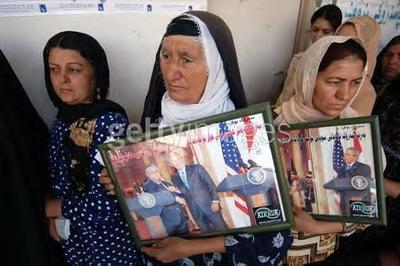
Via Dr. Sanity, here’s a photo of some participants in the Iraqi referendum that you’re unlikely to see in that Axis of Negativity (Reuters, the BBC, the AP):

The “ayes” seem to have it.

[ADDENDUM: It turns out there’s a tradition of Bush photos in Iraq, apparently. See the Hitchens quote here.]

Posted in Uncategorized | 21 Replies

On the couch with Sigmund, Carl, and Alfred

The New Neo Posted on October 17, 2005 by neoAugust 28, 2009

Today I had a heavy session on the couch with Sigmund (Freud), Carl (Jung), and Alfred (Adler). Funny, but none of these three great luminaries of analytic thought were interested in my sex life or my toilet training. All they seemed to want to talk about was politics (and pizza). Go figure.

Posted in Me, myself, and I | 7 Replies

Reuters gets dizzy over the Iraqi vote

The New Neo Posted on October 16, 2005 by neoOctober 16, 2005

Reuters is spinning so much here, I’m surprised it doesn’t get vertigo.

This is the entire text of the article, which originally caught my eye because of its positive headline, “Iraq voters seen approving constitution”:

BAGHDAD (Reuters) – Iraqi voters have probably approved a new U.S.-backed constitution, overcoming fierce Sunni Arab opposition in a vote Washington hopes will boost its beleaguered strategy in Iraq, results showed on Sunday. Early counts from Saturday’s referendum indicated the vote split as expected along largely communal lines, reflecting the bitter ethnic and religious tensions that have cost thousands of Iraqi lives since the U.S.-led invasion in 2003.

These two sentences show an economy of expression that is truly impressive, a remarkable ability to compress a large number of negative thoughts into a relatively small number of words. Check it out:

“U.S.-backed constitution”–Nothing about how hard the Iraqis worked to hammer out a compromise, or how this vote was widely seen even by Sunnis as a way for Iraqis to participate in the formation of their own government. No; just “U.S.-backed,” as in “U.S. tools and puppets.”

“fierce Sunni Arab opposition”–it will be interesting to see what the actual statistics are. Opposition has indeed been fierce by many Sunnis, to be sure, but when last I checked, the majority Sunni party was backing the constitutional compromise and telling its followers to vote “yes.”

“Washington hopes will boost its beleaguered strategy in Iraq”–need I even bother to tackle this one?

“bitter ethnic and religious tensions that have cost thousands of Iraqi lives since the U.S.-led invasion in 2003.”–All the Iraqi postwar deaths are chalked up to ethnic and religious differences rather than terrorist attempts to sabotage the Iraqi people’s efforts at democracy. Yes, there’s ethnic strife, to be sure. But Reuters hasn’t a clue how much of the mayhem in Iraq is due to that factor, and how much to terrorists hoping to thwart the US and the Iraqi people as a whole. And of course, Saddam and the deaths he caused (and the ones he would have continued to cause which have now been prevented by that “U.S.-led invasion”) are nowhere to be seen. As far as Reuters is concerned, the U.S.seems to have invaded Michael Moore’s happy kite-flying land, and caused all the subsequent strife and destruction.

One would think that this referendum news would be cause for celebration. I, for one, plan to savor and enjoy it if the constitution is indeed passed. Would that Reuters could spare a moment to do the same. Or are they suffering from the same sort of depression as the NY Times?

Posted in Uncategorized | 54 Replies

Pulchritude on the right–and left (PC alert: non-PC discussion ensues)

The New Neo Posted on October 15, 2005 by neoAugust 28, 2009

Blogger Pamela of Atlas Shrugs has been profiled at Pajamas Media, to an unusual amount of–err–highly cerebral commentary (well, commentary, anyway).

Some of the comments have featured an observation I’ve heard before, to wit:

Pamela is one hot gal. Nice to confirm that politicallly conservative women are better looking and smarter then liberal hags!

Much heated discussion of this weighty issue ensues.

I’d like to proffer, in defense of liberal women everywhere (after all, I used to be one!–liberal that is–and no wisecracks, please, about the function of the strategically-placed apple), the observation that there are most definitely some very attractive liberal women–quite a few, in fact.

Take, for example, 99.9% of Hollywood. Are they not attractive? And are they not liberal?

Also, as much as I cannot abide her columns, no one can say that MoDo is not an attractive woman (well, someone can say it–but it would be wrong!). Exhibit A:

And, despite her abominable views, Ms. Fonda, especially in her youth (my extreme youth, that is), was no slouch in that department, either. Exhibit B:

It’s true, of course, that the protean Jane had many faces–perhaps not a thousand, but close, as you’ll see from the photos of her that come up if you Google her name in “Images.” But in nearly all of those images she is attractive, including this (somewhat Photoshopped, I believe) one from her Hanoi Jane phase:

And now, I have a question for those who agree with the original assertion: do you think that becoming more conservative is the equivalent of getting some free plastic surgery? If so, the neocon movement might gain quite a few adherants.

Posted in Fashion and beauty, Liberals and conservatives; left and right | 28 Replies

Voting day in Iraq: so far, so good

The New Neo Posted on October 15, 2005 by neoAugust 28, 2009

Fortunately, things have been peaceful. Whether the high turnout in Sunni areas will bode poorly for the fledgling constitution remains to be seen.

Iraq the Model has an interesting reminiscence on elections past:

I am so excited but a flashback from Saddam’s referendum three years ago still hurts; he wanted a 100% as the 99.96% of the previous one shocked the dictator. I was depressed that way and I decided not to go to the voting office and so did the rest of the family but my father was afraid that not going could be dangerous. He said that maybe one member of the family could go alone and cast votes for the rest of us. We looked at each other thinking who’s going to volunteer to do this ugly job to protect the family. At that moment my father said “it was my generation that caused the misery we’re living in so I’m the one who should do this”.

I couldn’t stop him and I couldn’t utter a word but I felt sad for him; his sacrifice was big and I had teary eyes when I watched him taking our papers and heading out.

It is different this time father, no more 100% and a ”˜no’ would make me happy just like a ’yes’ would do and no one ever will force us to do something against our will anymore…

God bless you my people and all the freedom lovers who keep sacrificing to make this world a better place.

Posted in Iraq, Liberty | 6 Replies

Well, so, why can’t they?

The New Neo Posted on October 15, 2005 by neoOctober 15, 2005

This little teaser at the NY Times tempted me for a moment to become a subscriber to TimesSelect, their pay-for-view columnist service:

Why Righties Can’t Teach
By JOHN TIERNEY
Published: October 15, 2005

Liberals on campus have become so used to hearing their opinions reinforced that they have a hard time imagining there are intelligent people with different views.

Sounds intriguing, especially for the NY Times. But I managed to resist.

Then again, it’s a sentence that actually does quite well standing alone, a succinct explanation for a common phenomenon.

Posted in Uncategorized | 14 Replies

Next year I suppose he’ll get the Peace Prize: Pinter wins Nobel for literature

The New Neo Posted on October 14, 2005 by neoAugust 4, 2007

First off, I must confess that I like his early plays–or at least I did when I saw them, many moons ago. “The Birthday Party” was especially fine, as I recall, and I enjoyed the original Broadway production of “The Homecoming” as a teenager.

So, even though Pinter has turned into a raving leftist political hater of formidable intensity and moonbattery, his Nobel prize for literature doesn’t seem beyond the pale, although I suspect he wouldn’t have gotten it if his politics hadn’t dovetailed so very nicely with the Nobel committee’s mission of sticking it to Bush, Blair, and Company.

I’m not the only one who suspects that this is the case; Pinter, to his credit, admits as much:

In an interview with Reuters Television yesterday, Pinter wondered whether his increased visibility on the political front may have played a part in the choice: ”I’ve been writing plays for about 50 years. But I am also very politically engaged and I am not at all sure to what extent that factor had anything to do with this award.”

I encountered his politics about a year ago through one of those ubiquitous forwards a relative had approvingly sent. The content was hateful and mindless; I have no interest in reproducing it here or linking to it, but Pinter has a website that’s easy enough to locate, if you care to browse there.

Pinter says he’s now given up writing plays (quit while you’re ahead?):

”I think the world has had enough of my plays.” He plans, instead, to concentrate on poetry.

Curious, I took a look at his poetry and found that it is mindbogglingly and stupendously bad; only a moment of reading it and I’d had more than enough of his poetry. Since his unique poetry cannot be adequately described and can only be experienced, I’ve changed my mind and this time I will provide a link, just to let you see what this Literature Nobel prizewinner and winner of the Wilfred Owen prize for poetry (a sad reflection of the current state of poetry in the world) is up to these days.

But back, mercifully, to his plays. If Pinter can be said to have had a mastery, it certainly was not of plot, but of language and dialogue of a peculiar and haunting kind, with its own strange and mysterious humor. Pinter elevated the pause to a fine art:

I think we all learned the power of the pause from Harold,” said Tina Packer, artistic director of Shakespeare & Company in Lenox. ”They’re almost more important than the words because they focus your attention that you’re in a theatrical space.”

In ”The Life and Work of Harold Pinter,” drama critic Michael Billington relates a story in which he asked Pinter when he first became aware of the power of the pause. ”He told me, with a slight twinkle, that it was from seeing Jack Benny . . . at the London Palladium in 1952.”

Ah, Jack Benny! I wish I’d known that when I was attending Pinter’s plays all those years ago; I don’t think they’ll ever seem the same again.

The one bright spot on the Nobel horizon, for me, is contained in the following Nobelian homage to geographic literary diversity. Can you locate it?

Nine of the last dozen winners of the literature prize have been from Europe, and a writer from the Arab or Asian world was expected to win this year. Along with Pamuk and Oz, writers rumored to be under consideration were the Syrian poet Adonis, Algerian writer Assia Djebar, and South Korean poet Ko Un. Albanian novelist Ismail Kadare, Swedish poet Tomhas Transtromer, American novelists Philip Roth, Joyce Carol Oates, and Don DeLillo, Czech novelist Milan Kundera, and Belgian writer Hugh Claus have also been mentioned as possible Nobelists.

Milan Kundera. Now, there would be a Nobelist worthy of the honor. Well, a neocon can dream, can’t she?

Posted in Literature and writing | 21 Replies

The varieties of pacifism: (Part IIB)–responses to 9/11

The New Neo Posted on October 13, 2005 by neoAugust 25, 2015

[See previous posts in the series: Part I (Gandhi); and Part IIA (Quaker history).]

For some reason, this post was much harder to write—and far longer!—than I ever expected it to be. So I apologize, especially for the length. I hope I haven’t bitten off more than I could comfortably chew, or expect readers to chew. In it, I’ve tried to summarize the belief system of pacifists as a whole, and then to describe the varied Quaker responses to 9/11 in terms of that belief system.

BACKGROUND

Pacifism sometimes seems illogical and naive to those who don’t espouse it. But the key to the logic of pacifism—and it definitely has its own logic—is that it is a belief system. As such, it’s based on certain premises which are accepted as articles of faith and that, to pacifists, can stand outside the realm of proof.

Certain broad Quaker pacifist beliefs underlie their responses to 9/11. These beliefs are by no means limited to Quakers, so this essay should be relevant to the reactions of many other types of pacifists as well.

There are two main strains of modern-day Quaker belief about how pacifism would actually work in practice. The first approach (which I’ll call the “love” approach) is both individual and transcendent: the pacifist refuses to fight, but understands that others will. The pacifist sees him/herself as serving as an example of another way of being in the world, an alternative and spiritual way. This is the sort of pacifist who might refuse to bear arms but would volunteer to serve as an ambulance driver in the theater of war. This first strain of pacifism also contains the hope that, by meeting hatred with love, and also acting as an example, the pacifist will effect a spiritual and emotional change in the hard heart of the violent person, a turning towards peace (this is also the Gandhian view). Often, as with Gandhi, this pacifist approach assumes that if a large group of individuals could make the decision to meet hatred with love in this manner, the whole enterprise would take on a different aspect and effect a very real change in the conduct of a war, including the possibility of ending that war.

Pacifists of this first variety fervently hope (and believe) that meeting violence with love will cause the tyrannical to have a change of heart. But what if it’s tried, and the approach fails to work as planned? Then those who are nonviolent could easily end up being slaughtered by the violent. Most pacifists don’t look on that prospect with anything like Gandhi’s chilling equanimity.

So, if fighting in a war isn’t allowed, what’s to prevent a slaughter of the innocents? How can the problem of defending against tyranny be solved? What does the pacifist propose as a replacement for a muscular and violent defense to prevent this slaughter from happening?

As we found in Part IIA, many Quakers would answer that at that point, in a clearly defensive situation, it may be time to fight, even for Quakers. They would say that each person needs to make an individual decision about this after some intensive soul-searching.

But many pacifists have trouble with that approach. Absolute pacifists would say instead, as we saw with Gandhi in Part I, that it would be better to allow oneself to be slaughtered and meet death with exemplary courage than to fight and live another day.

Both alternatives can be problematic for pacifists, of course: the choice is between a bang or a whimper. So there is a second pacifist approach (which I’ll call the “law” approach), one that emphasizes prevention and/or alternative resolution of conflict, and can either exist independently of the first approach or complement it. This second approach is both institutional and legalistic: the belief in the structures and rules of international law as the alternative to war. It constitutes a sort of safety net for pacifists: if it works, the pacifist doesn’t need to make the hard decisions to either fight or be slaughtered, because the situation for that choice won’t arise.

EXAMPLES

If you’ve read my history of Quaker pacifism in Part IIA, you may recall that the first approach has its roots in the views of Fox and Penington, the second in those of William Penn.

Here’s an excellent and representative example of the Quaker “love” approach, a document entitled “Speak Truth to Power,” published by the American Friends Service Committee in 1955. It fully captures the flavor of this approach—individual, idealistic, faith-based:

Our truth is an ancient one; that love endures and overcomes; that hatred destroys; that what is obtained by love is retained, but what is obtained by hatred proves a burden. This truth, fundamental to the position which rejects reliance on the method of war, is ultimately a religious perception, a belief that stands outside of history.

As “a belief that stands outside of history,” the faith that love conquers all cannot be challenged or disproven by facts. That’s what makes it a religious—or quasi-religious—belief rather than a proven approach, although I don’t think pacifists would be adverse to proof if it were offered. But such proof is not required.

Here is more in the same vein, in which “reason” is explicitly rejected:

If ever truth reaches power, if ever it speaks to the individual citizen, it will not be the argument that convinces. Rather it will be his own inner sense of integrity that impels him to say, “Here I stand. Regardless of relevance or consequence, I can do no other.” This is not “reasonable”: the politics of eternity is not ruled by reason alone, but by reason ennobled by right…

The early Friends realized only too clearly that the Kingdom of God had not come, but they had an inward sense that it would never come until somebody believed in its principles enough to try them in actual operation. They resolved to go forward then, and make the experimental trial, and take the consequences. So we believe and so we advise.

So the “love” approach is a leap of faith into the unknown, an experiment based on a belief system. This message is considered to be a timeless one. Although the document was written in 1955 and intended in the fight against Communism, the website on which it appears specifically recommends it as still being relevant and timely in the post-9/11 fight against terrorism.

As for the “law” approach, here’s a good post-9/11 example. It was issued by several Quaker groups around the time of the invasion of Afghanistan:

We regret the decision by our nation’s leaders to launch military strikes against Afghanistan, and we call upon them to halt the bombing and other military attacks.

We recognize the responsibility of the international community to apprehend and try, under international law, those responsible for the recent terrorist attacks… History teaches us that violence leads to more violence. We expect that these massive military strikes by missiles and bombers against this already devastated, starving country will almost certainly make it easier for the leaders of this terrorist struggle to recruit more people to their cause. We must break the cycle of escalating violence.

The struggle against terrorism will indeed be long. To succeed, it will have to undermine the ability of those who would use terrorism to recruit new people to carry out such attacks. This requires ending, or greatly diminishing, the tremendous anger and hatred toward the United States and its allies felt, in particular, by many in the Muslim and Arab world. This can only be done with prolonged, nonviolent efforts for reconciliation, justice, and long-term economic development. It cannot be done through massive bombing and military attacks.

Here’s another Quaker post-9/11 “law” response; this one quite divorced from reality, I’m afraid, since it calls for the UN to settle things in Iraq:

…the troop presence in Iraq has lost the support of the Iraqi people and, by most accounts, the U.S. public. All of these events confirm our long-held belief that violence can only beget further violence. The U.S. must give way, so that the UN and other agencies, working with the Iraqi interim government, can bring peace and stability. The AFSC believes that the United States has lost the moral standing to achieve the necessary healing, but remains responsible to support financially those institutions and agencies which can do so.

Here we have another example of the legalistic point of view, written by a Quaker named Mary Lord after 9/11. It calls for international tribunals, special courts, weapons trade limitations, stopping the financing of terrorists, and a host of other peaceful international cooperative approaches (curiously, Ms. Lord maintains that most of these things have not been done, although in fact many have been performed in tandem with the military approaches).

Here is Ms. Lord explaining the pacifist belief system:

Pacifism has been called naé¯ve and unpatriotic. But I ask you, which is the greater naiveté””to believe that the frustrating but productive path of using and strengthening international law is the path of safety, or to believe that a never-ending worldwide war against loosely defined terrorism fought with weapons of mass destruction will make us safe and secure in our gated communities?

The path of war is always, as history proves, the more naé¯ve. War almost never works. Even when it seems to, for a short time, or after a long struggle, it is with a horrific cost of life, and property, and treasure, and the fouling of the earth, and the killing if its creatures. Almost always, similar ends could have been achieved through negotiation or international law and peacekeeping, with far less cost.

This last sentence, which I’ve taken the liberty of highlighting in bold, I find extraordinary in its assertion of facts without any even an attempt to marshall evidence. But, as with the “love” approach, facts are not the issue here; belief is, including the oft-stated belief that war “doesn’t work.”

What is meant by this statement that war doesn’t work—or, as sometimes put, that it never solves anything? On reflection, I’ve come to the conclusion that what is really meant is that war doesn’t solve everything. In other words, no war eliminates all problems, or even eliminates every aspect of a single problem. For example, the Civil War eliminated slavery, but was followed by the anguish of Reconstruction and inequality. But the fact that a war hasn’t solved all problems, or hasn’t even solved a single problem (discrimination against blacks, for example) in its entirety, does not mean that the war didn’t solve some problems, at least partially or in whole. Slavery is no longer with us. The concentration camps are gone. The pacifist belief that war doesn’t solve things not only ignores evidence that it sometimes does (at least partially), but it also fails to take into account how much worse things might be if appeasement had been the order of the day.

As I’ve said, though, pacifism is a belief system, not requiring proof in the eyes of its adherents. But not all Quakers are uninterested in facts or proof. Some pursue them, no matter how upsetting the results. For example, Swarthmore Quaker historian J. William Frost undertook a lengthy study a few years ago:

…aimed at finding an answer to the question, “has religion ever prevented or stopped a war?” Or as he put it more pointedly, “is there historical evidence that religious leaders have stopped wars from beginning or shortened their duration?” His sobering answer, in sum, is: No. There is very little such evidence.

The record of western history, as Frost reviewed it, shows that a church “cannot prevent war, because it has neither theology, mission, nor the leverage in society to do so.” Even the largest, most “established” denominations have lacked real leverage, he found….

I could find no similar studies of whether international law had ever stopped a war. Perhaps the answer would be too depressing for pacifists to even contemplate. The results of Frost’s study certainly must have been.

But pacifism has other benefits beyond the practical, at least to its believers. There is the wonderful feeling that comes from a sense of oneself as being spiritual, moral, kind, and loving; and of being part of a group of like-minded individuals engaged in working for a worthy and noble cause (see this previous post for a further explanation of this feeling of “circle dancing,” especially the Milan Kundera quote on the subject.)

Here’s a good example of this genre, in which the feelings of the pacifist about him/herself within the small group of loving Quakers, and the exaltation of the mission, give the author (who became a Quaker post-9/11) hope that such peacefulness is a possibility for all humankind:

I don’t know how it happened. It could have been the anthrax that closed the Princeton Post Office that fall that made each mail day seem like our last. Or maybe it was simply that I liked the architecture of the Meetinghouse. It could have been how Irene, the woman who led the Young Friends Meeting, spoke in a quiet voice and the children listened. Whatever it was, I took to this place. I liked meditating in the creaky-benched silence of the meetinghouse, and how the people I met seemed to have light in their faces, despite the building’s lack of wattage.

By spring, I felt that I’d found a spiritual home. I was so moved by a feeling of at-oneness, that on Easter Sunday, I peeled myself off my bench to stand up and thank everyone for being there…”Let there be peace on earth, and let it begin with me,” is a song I probably sang too much as a child. I feel it happening, though, as I participate in Meeting. This spring, as with the Gulf War, I am writing letters to the government and joining protests. But it’s different. This time around, it’s not just my voice and that of a few friends. It’s a whole community I’ve chosen to be part of. This time around, I actually feel the peace I want for the world, and because I feel it, I actually believe it can be possible for others.

Of course, the world is not composed of a circle of peaceful Quakers, a fact of which many Quakers are well aware. And of course, as we’ve learned, not even all Quakers are dancing in the same circle; Quaker belief and tradition allows for an individual response.

So I close with the words of another post-9/11 Quaker statement, this one by a Quaker who challenges pacifism and casts his lot on the other side of it for this conflict. NPR broadcaster Scott Simon says:

One of the unforeseen effects of being in journalism is that your first-hand exposure to the issues of the world sometimes has the consequence of shaking your deepest personal convictions. I happen to be a Quaker; this is known, I have written about this…I covered conflicts in Central America and the Caribbean, the Middle East and Africa. None of them shook my belief that pacifism offers the world a way to foment change without the violence that has pained and poisoned our history…

And then, in the 1990’s, I covered the Balkans. And I had to confront, in flesh and blood, the real life flaw””I am inclined to say literally fatal flaw””of pacifism: all the best people could be killed by all the worst ones…

So I speak as a Quaker of not particularly good standing. I am still willing to give first consideration to peaceful alternatives. But I am not willing to lose lives for the sake of ideological consistency. As Mahatma Gandhi himself once said””and, like Lincoln, the Mahatma is wonderful for providing quotations that permit you to prove almost any point you choose”””I would rather be inconsistent than wrong.” It seems to me that in confronting the forces that attacked the World Trade Center and the Pentagon, the United States has no sane alternative but to wage war; and wage it with unflinching resolution…

We are living in a time when we must remind ourselves of the imperfections of analogies. But let me press ahead with one that has recently been on my mind.

In 1933, the Oxford Student Union conducted a famous debate over whether it was moral for Britons to fight for king and country. The leading objective minds of that university reviewed the many ways in which British colonialism exploited and oppressed the world. They cited the ways in which vengeful demands made of Germany in the wake of the end of World War I had helped encourage the kind of nationalism that may have kindled the rise of fascism. They saw no moral difference between western colonialism and world fascism. The Oxford Union ended that debate with this famous proclamation: “Resolved, that we will in no circumstances fight for king and country.”

Von Ribbentrop sent back the good news to Germany’s new chancellor, Adolph Hitler: the West will not fight for its own survival. Its finest minds will justify a silent surrender.

The most intelligent young people of their time could not tell the difference between the deficiencies of their own nation, in which liberty and democracy occupied cornerstones, and dictatorship founded on racism, tyranny, and fear…

When George Orwell returned to England after fighting against Fascism in the Spanish civil war, he felt uneasy over finding his country so comfortable””so close to Fascism. His country, he said, with its fat Sunday newspapers and thick orange jam.

“”¦All sleeping the deep, deep sleep,” he wrote, “from which I sometimes fear that we shall never wake till we are jerked out of it by the roar of bombs.”

“The deep, deep sleep.” Sometimes, in sleep, we dream beautiful dreams of peace. And then we wake.

Posted in Pacifism, War and Peace | 54 Replies

Gray Lady sings the blues

The New Neo Posted on October 13, 2005 by neoAugust 28, 2009

It occurred to me today that the folks at the NY Times may in fact be suffering from depression, and I mean that in the clinical sense.

Why the sudden diagnosis? Well, Captain’s Quarters alerted me to this editorial about the Iraqi constitutional compromise in today’s NY Times (for contrast, compare the Times’s take on the matter with the elation of Iraqi blogger Mohammed at Iraq the Model).

As Captain Ed points out, with only a little hyperbole:

Each paragraph [of the editorial] starts out with some gloomy statement on what the Times sees as reality. Each statement relates back to American efforts to create this democratic environment, either directly or indirectly…

The torturous process of actually saying something meaningful about the Iraqi agreement on a new constitution in the days ahead of the vote grinds on through eight paragraphs written in this stultifying prose, as like a bad pop song with an unrelenting, unchanging bass line. It takes that long for the Times to admit that the developments this week give greater hope for unity after the plebescite and for greater Sunni participation in democracy thereafter. The editorial approaches masterpiece status for sour grapes and for burying the lede. Even its title, “A Flicker Of Hope In Iraq”, makes this major step forward seem little more than a mere footnote in an encyclopedia of misery.

“A footnote in an encyclopedia of misery.” Reading this, I had one of those sudden insights that seem to make what was formerly murky as clear as day: the entire editorial staff of the Times is clinically depressed. For here is exactly the sort of behavior one would expect from a depressed person: the inability to take pleasure in even good news, the constant “yes-butting” that negates anything positive before it can sink in or be savored. One can almost see the sad, heavy eyes of the writer, and hear the droning voice with its flat affect.

And now I also see the Times’s constant ignoring of the good news from Iraq in a different light. It’s another symptom of depression.

Oh, I know what those of you who still like the Gray Lady will say: they’re just being judicious and cautious, and rightly so. And indeed caution is in order. But I think the Times has a track record of going way beyond caution, into a gloom that can hardly be dispelled by facts.

It seems that lately I’ve been prescribing meds without a license. But I have yet another suggestion along those lines for those at the Times: perhaps a trial of SSRIs might be in order.

It could make that hope become a tad more than a flicker. Just a thought.

Posted in Iraq, Press | 62 Replies

Post navigation

← Previous Post
Next Post→

Your support is appreciated through a one-time or monthly Paypal donation

Please click the link recommended books and search bar for Amazon purchases through neo. I receive a commission from all such purchases.

Archives

Recent Comments

  • charles on An update on my ex
  • Sharon W on An update on my ex
  • om on News roundup
  • huxley on Open thread 9/9/2026
  • Niketas Choniates on Postpartum psychosis is not postpartum depression

Recent Posts

  • An update on my ex
  • News roundup
  • The New Hampshire primary and the continuing saga of Jeanne Shaheen
  • Open thread 9/9/2026
  • Another day, another fraud

Categories

  • A mind is a difficult thing to change: my change story (17)
  • Academia (328)
  • Afghanistan (98)
  • Amazon orders (6)
  • Arts (8)
  • Baseball and sports (164)
  • Best of neo-neocon (91)
  • Biden (536)
  • Blogging and bloggers (595)
  • Dance (292)
  • Disaster (244)
  • Education (323)
  • Election 2012 (360)
  • Election 2016 (566)
  • Election 2018 (33)
  • Election 2020 (513)
  • Election 2022 (114)
  • Election 2024 (403)
  • Election 2026 (94)
  • Election 2028 (13)
  • Evil (129)
  • Fashion and beauty (324)
  • Finance and economics (1,043)
  • Food (317)
  • Friendship (48)
  • Gardening (18)
  • General information about neo (4)
  • Getting philosophical: life, love, the universe (734)
  • Health (1,162)
  • Health care reform (545)
  • Hillary Clinton (184)
  • Historical figures (337)
  • History (716)
  • Immigration (449)
  • Iran (465)
  • Iraq (227)
  • IRS scandal (71)
  • Israel/Palestine (821)
  • Jews (437)
  • Language and grammar (365)
  • Latin America (212)
  • Law (2,977)
  • Leaving the circle: political apostasy (124)
  • Liberals and conservatives; left and right (1,322)
  • Liberty (1,117)
  • Literary leftists (14)
  • Literature and writing (394)
  • Me, myself, and I (1,499)
  • Men and women; marriage and divorce and sex (930)
  • Middle East (384)
  • Military (324)
  • Movies (353)
  • Music (533)
  • Nature (261)
  • Neocons (32)
  • New England (184)
  • Obama (1,738)
  • Pacifism (16)
  • Painting, sculpture, photography (131)
  • Palin (93)
  • Paris and France2 trial (25)
  • People of interest (1,043)
  • Poetry (258)
  • Political changers (178)
  • Politics (2,793)
  • Pop culture (397)
  • Press (1,635)
  • Race and racism (882)
  • Religion (428)
  • Romney (164)
  • Ryan (16)
  • Science (641)
  • Terrorism and terrorists (971)
  • Theater and TV (266)
  • Therapy (71)
  • Trump (1,630)
  • Uncategorized (4,558)
  • Vietnam (109)
  • Violence (1,446)
  • War and Peace (1,028)

Blogroll

Ace (bold)
AmericanDigest (writer’s digest)
AmericanThinker (thought full)
Anchoress (first things first)
AnnAlthouse (more than law)
AugeanStables (historian’s task)
BelmontClub (deep thoughts)
Betsy’sPage (teach)
Bookworm (writingReader)
ChicagoBoyz (boyz will be)
DanielInVenezuela (liberty)
Dr.Helen (rights of man)
Dr.Sanity (shrink archives)
DreamsToLightening (Asher)
EdDriscoll (market liberal)
Fausta’sBlog (opinionated)
GayPatriot (self-explanatory)
HadEnoughTherapy? (yep)
HotAir (a roomful)
InstaPundit (the hub)
JawaReport (the doctor’s Rusty)
LegalInsurrection (law prof)
Maggie’sFarm (togetherness)
MelaniePhillips (formidable)
MerylYourish (centrist)
MichaelTotten (globetrotter)
MichaelYon (War Zones)
Michelle Malkin (clarion pen)
MichelleObama’sMirror (reflect)
NoPasaran! (bluntFrench)
NormanGeras (archives)
OneCosmos (Gagdad Bob)
Pamela Geller (Atlas Shrugs)
PJMedia (comprehensive)
PointOfNoReturn (exodus)
Powerline (foursight)
QandO (neolibertarian)
RedState (conservative)
RogerL.Simon (PJ guy)
SisterToldjah (she said)
Sisu (commentary plus cats)
Spengler (Goldman)
VictorDavisHanson (prof)
Vodkapundit (drinker-thinker)
Volokh (lawblog)
Zombie (alive)

Meta

  • Log in
  • Entries feed
  • Comments feed
  • WordPress.org
©2026 - The New Neo - Weaver Xtreme Theme Email
Web Analytics
↑