
Squirming, moaning, leaping:
On Picketty
Here’s an article on Piketty’s book that seems less political than most, and more about analyzing the nitty gritty of what he says.
Student loan forgiveness: liberal win-win
Sometimes there’s so much out there it’s hard to keep up.
For instance, although I’d heard of the Pay As You Earn program, the details had previously passed under my radar screen. But my oh my, the set-up’s clever:
But the immediate taxpayer S.O.S. concerns Mr. Obama’s Pay As You Earn program. We’ve warned for years about the risks of this program as Mr. Obama has worked to expand the number of eligible borrowers and sweeten its terms.
Pay As You Earn allows students under certain circumstances to borrow an unlimited amount and then cap monthly payments at 10% of their discretionary income. If they choose productive work in the private economy, the loans are forgiven after 20 years. But if they choose to work in government or for a nonprofit, Uncle Sugar forgives their loans after 10 years.
For aspiring community organizers who go to college and then grad school before moving into a job that the government defines as public service, the forgiven debt can be $150,000 or more, courtesy of the taxpayer. And unlike with some other federal programs, when the government forgives the debt of one of the exalted class of nonprofit or government workers, the do-gooder doesn’t have to report it as income to the IRS. Who wouldn’t want to pick up $150,000 tax-free?
What’s so clever about it for Obama and the Democrats? It’s probably pretty obvious, but I’ll state it anyway: it simultaneously fills the coffers of the left’s cadre of propagandists known as the universities and assures a ready supply of recruits for the left’s foot soldiers out in the working world, those employed by government and nonprofits.
And the taxpayer finances what basically amounts to a forced contribution to the Democratic Party. Sweet.
Bundy’s remarks on race, welfare, and slavery
Cliven Bundy’s remarks about race, welfare, and slavery have drawn a lot of fire, and the right is attempting to back away from them.
First, take a look at what he said:
“I want to tell you one more thing I know about the Negro,” he said. Mr. Bundy recalled driving past a public-housing project in North Las Vegas, “and in front of that government house the door was usually open and the older people and the kids ”” and there is always at least a half a dozen people sitting on the porch ”” they didn’t have nothing to do. They didn’t have nothing for their kids to do. They didn’t have nothing for their young girls to do.
“And because they were basically on government subsidy, so now what do they do?” he asked. “They abort their young children, they put their young men in jail, because they never learned how to pick cotton. And I’ve often wondered, are they better off as slaves, picking cotton and having a family life and doing things, or are they better off under government subsidy? They didn’t get no more freedom. They got less freedom.”
There’s a kernel of truth there—that the welfare system has been a goodly part of the reason that people who receive welfare can sometimes end up being harmed by it in terms of killing initiative, undermining the family, and in general fostering dependence. The racist part of what Bundy said is not that outdated word “Negro” (although I’m sure some take offense at that), but the idea that this an especially black phenomenon. In fact, it’s something that happens with welfare as a whole, and although more blacks are on welfare proportionate to their incidence in the population, the culture of welfare is hardly limited to or special to blacks.
The last portion of Bundy’s statement is especially offensive not just to blacks but to the cause of the liberty he professes to support. Even though he couches it as a question (“I’ve often wondered”), the idea that slavery may have been better for black people (or anyone else) than welfare demonstrates an odd lack of appreciation on his part for one of the main—and probably the biggest—reason that slavery was a repulsive institution: the ownership of one human being by another is an especially profound violation of the liberty inherent in each human being, far deeper than anything engendered by welfare.
None of this has anything to do with the merits of Bundy’s legal case, the pros and cons of which were discussed here. Nor does Bundy speak generally for conservatives, libertarians, the Republican Party, or ranchers. However, you can be sure the left will try to impute his remarks to the right no matter how hard and fast the right tries to run away from them. They fit the false stereotypes the left has long tried to push about the Tea Party and the right as a whole.
All those objective moderates who love Piketty’s book…
…are revealing themselves to be the leftists that they actually are.
I said as much in my Piketty post when I wrote:
In case you’re wondering, Piketty’s book has been hailed almost universally on the left””and by “left” I mean almost everyone except the right.
If that was a little too subtle, I want to emphasize a similar thought as expressed here by David Harsanyi:
…[H]ow does a book that evokes Marx and talks about tweaking the Soviet experiment find so much love from people who consider themselves rational, evidence-driven moderates?
Put it this way: It’s unlikely that Democrats would have praised a book like this 20 years ago ”“ or even 10. Nowadays, Jack Lew ”“ better known as the Treasury Secretary of the United States of America – takes time to chit chat with the author…
Like many progressives, Piketty doesn’t really believe most people deserve their wealth anyway, so confiscating it presents no real moral dilemma. He also argues that we can measure a person’s productivity and the value of a worker (namely, low-skilled laborers), while at the same time he argues that other groups of workers (namely, the kind of people he doesn’t admire) are bequeathed undeserved “arbitrary” salaries. What tangible benefit does a stockbroker or a Kulak or an explanatory journalist offer society, after all?…
The thing is, some of us still believe that capitalism fosters meritocratic values. Or I should say, we believe that free markets are the best game in town. Not that long ago, this was a nearly universal position. A lot of people used to believe that even the disruptions of capitalism ”” the “caprices of technology” as Piketty dismisses them”” that rattle “social order” also happen to generate mobility, dynamism and growth. Today this probably qualifies as Ayn Rand-style extremism.
Then again, I haven’t read Ayn Rand since college (or maybe it was high school) but if I still believed she was the most prophetic writer of her generation, I might feel compelled to defend her ideas. But Piketty’s utopian notions and authoritarian inclinations ”” ones that I’m pretty sure most Americans (and probably most Democrats) would still find off-putting ”” do not seem to rattle the left-wing press one bit. While Piketty’s economic data might be worth studying and debating, his political ideas are unworthy of discussion.
Despite the extremism of his positions, Piketty has already become a folk hero to inequality alarmists everywhere. So if his popularity tells us anything, it’s that many liberal “thought leaders” have taken a far more radical position on economic policy than we’re giving them credit for.
I’d like to add a caution to one thing Harsanyi says, though. He writes that he’s pretty sure that “most Americans (and probably most Democrats) would still find” Piketty’s “utopian notions and authoritarian inclinations” “off-putting.” Maybe so, but that’s certainly less true than it used to be, which is part of the reason that these liberal pundits don’t seem to have much problem coming out with their praise of Piketty.
I can’t find any polls asking people whether the rich should be taxed at a rate of 80%; my guess is that Harsanyi is right that most people would not support it. But the majority favors higher taxes on the rich, and it’s not hard to imagine that the definition of “higher” could increase significantly over time.
Will Piketty’s views ever become mainstream? Not sure, but they will if the press has anything to say about it.
Is eating fruits and vegetables good for you?
I’d like to say at the outset that I like fruits and vegetables. Even if they weren’t supposed to be good for you I would eat them. I might even eat them if I heard they were a little bit bad for you; that’s how much I like them.
And if I had to cut them almost totally out of my diet—which I did when, in my young adulthood, I went on the very-low-carb Stillman diet for a while—I would not only miss them terribly but I would dream about them.
Yes, I used to dream about fruit.
So it always astounds me when people talk about low-carb diets as being so great. “I can eat eggs and bacon every day! And then a big steak and some gooey cheese for dessert!” Although I like to eat all those things too, the thought of eating them or their equivalent every day, for nearly every meal, fills me with dread.
That said, I realize other people have vastly different desires. But I’ve long thought that the long-standing food wars about what’s good for you and what’s not rest at least partly on people’s idiosyncratic food preferences.
That brings us to today’s article in the NY Times by George Johnson, which is being hailed as knocking the common wisdom that fruits and vegetables are so very good for you.
The article limits itself to criticizing the viewpoint that fruits and vegetables confer some particular benefit in protecting against cancer. But it’s interesting that many commenters seem to generalize it to mean or to imply or to insinuate that there’s no health benefit of eating fruits and vegetables, period (see some of the commentary on this thread for examples of what I’m talking about).
I offer the caveat that attempts to link nutrition and food intake to diseases or health are fraught with peril, whatever the truth about foods and health might actually be. They tend to rely on self-reports about diet, which are certainly suspect, and tend to be about correlations, which can hint at causation but certainly do not prove it. So all diet suggestions for the general public should be taken with (forgive the pun) a grain of salt.
That said, Johnson is talking about something that science (as opposed to popular lore) had been backing off from: the idea that diet has a lot to do with whether one gets cancer or not. If you don’t believe me, see this, from the Harvard School of Public Health:
Numerous early studies revealed what appeared to be a strong link between eating fruits and vegetables and protection against cancer. Unlike case-control studies, cohort studies, which follow large groups of initially healthy individuals for years, generally provide more reliable information than case-control studies because they don’t rely on information from the past. And, in general, data from cohort studies have not consistently shown that a diet rich in fruits and vegetables prevents cancer.
For example, in the Nurses’ Health Study and the Health Professionals Follow-up Study, over a 14-year period, men and women with the highest intake of fruits and vegetables (8+ servings a day) were just as likely to have developed cancer as those who ate the fewest daily servings (under 1.5).
A more likely possibility is that some types of fruits and vegetables may protect against certain cancers.
A more nuanced claim, to be sure.
And although Johnson is very careful to limit his article to whether fruits and vegetables protect against cancer, the Harvard publication is pretty clear that whatever the case for cancer protection (and it’s weak at best), the evidence that fruits and vegetables can help protect a person’s cardiovascular health is much stronger:
There is compelling evidence that a diet rich in fruits and vegetables can lower the risk of heart disease and stroke. The largest and longest study to date, done as part of the Harvard-based Nurses’ Health Study and Health Professionals Follow-up Study, included almost 110,000 men and women whose health and dietary habits were followed for 14 years.
The higher the average daily intake of fruits and vegetables, the lower the chances of developing cardiovascular disease. Compared with those in the lowest category of fruit and vegetable intake (less than 1.5 servings a day), those who averaged 8 or more servings a day were 30 percent less likely to have had a heart attack or stroke.
Although all fruits and vegetables likely contribute to this benefit, green leafy vegetables such as lettuce, spinach, Swiss chard, and mustard greens; cruciferous vegetables such as broccoli, cauliflower, cabbage, Brussels sprouts, bok choy, and kale; and citrus fruits such as oranges, lemons, limes, and grapefruit (and their juices) make important contributions.
When researchers combined findings from the Harvard studies with several other long-term studies in the U.S. and Europe, and looked at coronary heart disease and stroke separately, they found a similar protective effect: Individuals who ate more than 5 servings of fruits and vegetables per had roughly a 20 percent lower risk of coronary heart disease and stroke, compared with individuals who ate less than 3 servings per day.
There is little question that, as with most health/diet studies of this design, there is the complication that there might be a lot of other things that are different about people who eat so many fruits and vegetables compared to people who don’t. Most studies attempt to control for confounding variables of this nature (such as exercise, for example), but let’s just acknowledge that it’s very hard to effectively do so.
All such studies are handicapped by this built-in flaw, and probably always will be. But that doesn’t mean we should toss them out, although you’re free to reject them if you want, and to eat whatever you want—life is for living, after all.
Income inequality: hey, let’s take away most of the money of the rich
Yes indeed, that’ll fix it, according to French economist Thomas Piketty:
Piketty’s terror at rising inequality is an important data point for the reader. It has perhaps influenced his judgment and his tendentious reading of his own evidence. It could also explain why the book has been greeted with such erotic intensity….
It’s no surprise that the idea of levying enormously high taxes on rich people’s money has had rising support in this era of proudly unearned self-esteem and entitlement, as well as decline in the power of religious prohibitions such as the commandment against covetousness.
More at the WSJ:
While America’s corporate executives are his special béªte noire, Mr. Piketty is also deeply troubled by the tens of millions of working people – a group he disparagingly calls “petits rentiers – whose income puts them nowhere near the “one percent” but who still have savings, retirement accounts and other assets. That this very large demographic group will get larger, grow wealthier and pass on assets via inheritance is “a fairly disturbing form of inequality.” He laments that it is difficult to “correct” because it involves a broad segment of the population, not a small elite that is easily demonized.
Oh, but it can be done. Where there’s a will, there’s a way. Piketty need only take lessons from Stalin re the kulaks, and from Pol Pot re—well, re just about everybody.
This is what Piketty proposes as a remedy for the terrible problem of income inequality [emphasis mine]:
Mr. Piketty urges an 80% tax rate on incomes starting at “$500,000 or $1 million.” This is not to raise money for education or to increase unemployment benefits. Quite the contrary, he does not expect such a tax to bring in much revenue, because its purpose is simply “to put an end to such incomes.” It will also be necessary to impose a 50%-60% tax rate on incomes as low as $200,000 to develop “the meager US social state.”
In case you’re wondering, Piketty’s book has been hailed almost universally on the left—and by “left” I mean almost everyone except the right.
They have turned to “income inequality” as the big bad issue because the actual plight of the poor in objective terms can’t be the point any more, since the poor are doing a lot better than they used to be in terms of their standard of living in most first world countries. In fact:
…[T]he last few centuries have seen us banish starvation and famine from a large part of the Earth. In the most successful countries, the average citizen now enjoys a material standard of living that would have made the greatest king of two hundred years ago turn green with envy…
To see how much more an American worker can buy today, compare the number of hours he would have had to work to obtain various items in 1895 versus 2000 (Table 1). Whereas a one-hundred-piece china set would have taken 44 hours of labor income in 1895, a twenty-first-century American would need to work 3.6 hours or less for it. The numbers are 28 versus 6 hours, respectively, for a gold locket; and 260 versus 7.2 hours for a one-speed bicycle (taken from De Long 2000, based on prices in the 1895 Montgomery Ward catalog). Comparing the prices charged in the Montgomery Ward catalog with prices today””both expressed as a multiple of the average hourly wage””provides an index of how much our productivity in making the goods consumed back in 1895 has multiplied…
As all this was going on, expectations and demands have risen, and so income inequality has been the new buzzword. Stamp it out, because it somehow “offends democracy.” The fact that the remedy Piketty and many others propose offends liberty, and the strong possibility that it could end up killing the goose that laid the golden egg, are both ignored and/or minimized in the rush to social and economic “justice”—that is, equality of outcome rather than opportunity.
I’ll let the inimitable Margaret Thatcher have the last word here (the following clip is from 1990):
[NOTE: For more on income inequality, see this, this, as well as this on the question of how big a problem income inequality really is in the first place.].]
Spambot of the day
Can’t wait to hear the rest:
In my opinion, a more sound approach to the problem of pigs
But does the bot mean the problem faced by pigs, or the problem caused by pigs?
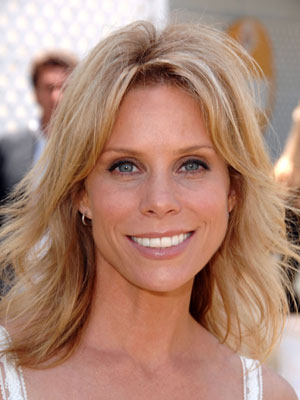
Separated at birth?
I know, I know; the actress in the first photo is a bit older than the actress in the second.
But still…

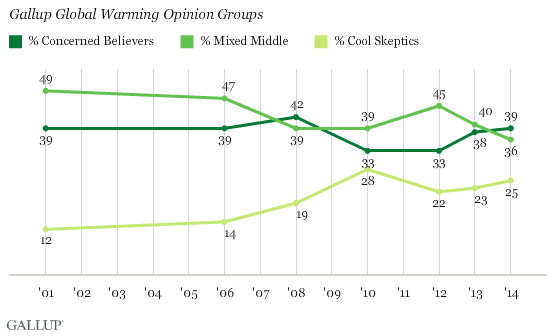
Poll: AGW global warming, belief vs. skepticism
Here’s an interesting poll on the subject:
Over the past decade, Americans have clustered into three broad groups on global warming. The largest, currently describing 39% of U.S. adults, are what can be termed “Concerned Believers” — those who attribute global warming to human actions and are worried about it. This is followed by the “Mixed Middle,” at 36%. And one in four Americans — the “Cool Skeptics” — are not worried about global warming much or at all.
The “interesting” part is that, except for that “mixed middle” group (which has less education than the others), the groups don’t differ in their amount of education. Also, men are much more likely to be in that “cool skeptic” group (as are Republicans, which is no surprise at all—and men are more likely to be Republicans anyway).
Also interesting is the following chart, which tracks changes over time. You can see how the “cool skeptics” group has grown and the “mixed middle” shrunk. The “concerned believers” segment has had a few ups and downs, but has ended up pretty much where it began:
At war: the two meanings of “liberal”
According to Peter Burrows at Business Week, Stanford law professor Joseph Grundfest remarked, when Brenan Eich was forced to resign as CEO of Mozilla, “This is a particularly fascinating situation, because it involves an illiberal reaction from a very liberal community.”
The “very liberal community” of which Grundfest was speaking was either the Silicon Valley computer industry or the gay activist movement, or possibly both. But his use of the word “liberal” in this context betrays a misunderstanding of the double meaning of the term. Yes, these communities call themselves “liberal” or even “progressive.” But their liberalism breaks down into two opposing groups: one that espouses PC thought and considers conformity to it necessary for right liberal thinking, and one that values individual liberty above those concerns.
The first group was in the forefront of the anti-Eich forces. The second includes those who embraced and promoted the legalization of gay marriage and yet were made uneasy by the Eich witchhunt and its success. They do exist; I saw them on discussion boards back when the Eich controversy was at its height. However, modern liberalism, sadly, seems to contain far more of the former group than the latter, and there is hardly anything so illiberal as a “liberal” bent on stomping out opposing thought.
How could Grundfest have made such as error (and perhaps he didn’t; I’ve not been able to locate his quote in fuller context)? After all, he’s a member of the American Enterprise Institute and the Hoover Institution, and ought to understand full well what what so many “liberals” are about.
Curiously, this short article from 1989 identifies Grundfest as a “conservative Democrat.” That phrase alone should tell us how profoundly times have changed since then; the appellation “conservative Democrat” would be oxymoronic today.
Michigan’s anti-affirmative action law stands
SCOTUS has ruled 6-2 (Kagan abstaining) that Michigan’s law against race-based affirmative action is constitutional.
In other words, it’s not racial discrimination to ban the sort of racial discrimination that is supposedly designed for the purpose of redressing racial discrimination.
Mind-boggling that the question even comes up. As Justice Scalia, joined by Thomas, wrote:
It has come to this. Called upon to explore the jurisprudential twilight zone between two errant lines of precedent, we confront a frighteningly bizarre question: Does the Equal Protection Clause of the Fourteenth Amendment forbid what its text plainly requires? Needless to say (except that this case obliges us to say it), the question answers itself. “The Constitution proscribes government discrimination on the basis of race, and state-provided education is no exception.” Grutter v. Bollinger, 539 U. S. 306, 349 (2003) (SCALIA, J., concurring in part and dissenting in part). It is precisely this understanding””the correct understanding””of the federal Equal Protection Clause that the people of the State of Michigan have adopted for their own fundamental law.
Justices Ginsburg and Sotomayor strongly disagree. Professor Jacobson writes at Legal Insurrection:
Here’s how Justice Sotomayor framed the issue: Taking away racially sensitive admissions uniquely harms those who benefit from that sensitivity…This is, as Kurt Schlichter calls it, essentially a ratchet theory, that no preference ever can be rolled back otherwise the rollback is discrimination.
I would add that Justices Sotomayor, Thomas, and Ginsburg all have personal experience with affirmative action, or lack thereof in Ginsburg’s case. Sotomayor and Thomas have acknowledged benefiting from affirmative action, although Thomas has indicated he felt it meant that people doubted his credentials for getting into law school. As for Ginsburg, who is older and went to law school before affirmative action existed, although her academic record was stellar she was discriminated against when she tried to get a job in law.
Thomas’ statements about his experience with affirmative action have been especially powerful:
When Thomas applied to Yale Law School, his race was taken into consideration. He wrote in his book, “I asked Yale to take that fact into account when I applied, not thinking that there might be anything wrong with doing so.”
But Thomas says that after he graduated from Yale, he went on several job interviews with “one high-priced lawyer” after another and the attorneys treated him dismissively. “Many asked pointed questions, unsubtly suggesting that they doubted I was as smart as my grades indicated.”
The fact that he couldn’t get a job would shape his thoughts on affirmative action programs for years to come. Thomas wrote, “Now I knew what a law degree from Yale was worth when it bore the taint of racial preference. I was humiliated””and desperate.”
In his interview with ABC News, Thomas said he was unable, even when he was nominated to the Supreme Court, to erase the stigmatizing effects of racial preference. “Once it is assumed that everything you do achieve is because of your race, there is no way out.” he said. “”¦it is irrebuttable and it is proved to be true. In everything now that someone like me does, there’s a backwash into your whole life is because of race.”
I am certainly not suggesting a one-on-one relationship between any of these justices’ positions on affirmative action and their own experiences with it; their viewpoints are in line with their general liberal/conservative orientation. But I do find their experiences interesting. My own personal reaction to affirmative action, back when I was a liberal Democrat and it first came into play, was antipathy on the order of “two wrongs cannot make a right.”
[NOTE: In reading the article about Ruth Bader Ginsburg’s life, this caught my eye:
She credits another professor at Cornell, Vladimir Nabokov, with influencing her reading habits and writing style. “He loved words ”¦ the sound of words. ”¦ Even when I write an opinion, I will often read a sentence aloud and [ask,] ”˜Can I say this in fewer words””can I write it so the meaning will come across with greater clarity?’”.
I can’t say I ever saw a connection between Ginsburg’s prose and Nabokov’s. Nabokov was a wonderful stylist, but he was certainly not known for saying things in “fewer words.”
Having read Nabokov’s beautifully controlled and atmospheric memoir Speak, Memory, I recall that his father, whom he highly respected and loved, was a well-known law expert in Russia before the revolution (and I see looking here that his grandfather was involved with law as well, as Justice Minister during the reign of Alexander II).
I don’t have Vladimir Nabokov’s memoir in front of me right now so I can’t quote it. But I remember that, in the wonderful chapter devoted to his father, he praised his father’s ability to write clearly and succinctly in first draft and compared it favorably to his own meanders and convoluted crossings-out while in the act of composition.]