I know that rhinos are tough and powerful beasts, and nothing to cozy up to.
But baby ones are—surprisingly cute:

I know that rhinos are tough and powerful beasts, and nothing to cozy up to.
But baby ones are—surprisingly cute:
David Horowitz has devoted his entire adult life to the left.
First, working for it. And then for the last three or so decades, fighting against it.
One of the many ways to fight it is to inform people about it, and Horowitz certainly knows whereof he speaks, having looked at politics and history from both sides now.
Horowitz is 75 years old, and had a major health scare a few years ago. So it makes sense that he would be looking back over his life’s work, which in the case of Horowitz consists of a ton of writing. So what better way to look back—and forward—than to issue a multi-volume compendium of his output that constitutes one long warning about the left’s strategy and duplicity, and its plans for the future.
I’ll let Horowitz tell the rest:
…[T]hese are not articles written on random subjects that happened to catch my fancy. Nor were they written as intellectual exercises that set out to explore various aspects of current issues. They are dispatches from a war zone, written to identify the nature, agendas, and long-term goals of a political movement of historic proportions that is also global in scope…
The nature of these conflicts as part of an ongoing war was, in my view, scarcely recognized by conservatives at the time, and has still not fully sunk in. Conservatives have rarely approached the individual conflicts with the seriousness they deserve, describing their adversaries as “liberals” ”” as if they subscribed to the principles of Lockean individualism, tolerance, and political compromise. Only with the advent of the Obama administration have some conservatives begun to connect the dots of origins and outcomes and to grasp the real nature of the national transformation that their adversaries intend.
It is for this conservative audience ”” a constituency on whom the American future depends ”” that I undertook to put together The Black Book of the American Left. It is first of all a narrative map of the battles fought over the last 40 years and ”” it must be said ”“ lost, almost every one. The Black Book contains a record as complete as any likely to be written of the struggle to resist a Communist-inspired Left that was not defeated in the Cold War but took advantage of the Soviet defeat to enter the American mainstream and conquer it, until today its members occupy the White House…
…[T]he movement now in motion to dismantle the American system, and bring this country to its knees, is no overnight phenomenon and is not the result of misguided idealisms or misunderstandings that can be easily repaired. The adversary cannot be dissuaded, because what drives him is a religious mission on which his identity and quest for a meaningful life depend. He can be stopped only by a political counterforce that is determined and organized, and ”” most importantly ”” that understands the gravity of the threat it faces…
…[My work] draws aside the veil of “good intentions” to reveal the malice underneath. That is its utility, and the main reason I am putting these volumes together…
…While I hope this book may be useful to those fighting to defend individual freedom and free markets, I do not deceive myself into believing that I have finally set the harpoon into the leviathan, a feat that is ultimately not possible. Progressivism is fundamentally a religious faith, which meets the same eternal human needs as traditional faiths, and for that reason will be with us always. In the last analysis, the progressive faith is a Gnosticism that can only be held at bay but never finally beaten back to earth.
No, her name’s not a joke.
And yes, this quote of Ball’s would be funny if it weren’t so sad and so scary that this women hosts a show at MSNBC:
For his trouble, Piketty has predictably gotten the full Cold War treatment. The National Review calls his book “soft Marxism” and Lord only knows what they’re saying over at less responsible outlets or the comments section. Even the august and ostensibly economically literate Wall Street Journal tells him to read “Animal Farm.”
Animal Farm,” hmmm — isn’t that Orwell’s political parable of farm animals where a bunch of pigs hog up all the economic resources, tell the other animals they need all the food because they’re the makers and then scare up the prospect of a phony bogeyman every time their greed is challenged? Sounds familiar. Hey conservatives — it’s time to stop the childish Cold War name calling and deal with facts. Either that or be relegated to the kids’ and the crazy uncle table at holiday dinners.
Well actually, Krystal, it’s Orwell’s parable of the evils of Communism, which was no phony bogeyman. But hey, the Cold War is so 20th century, isn’t it? As was Orwell.
Is Ball a knave or a fool? I don’t think you can go wrong with the answer “both.”
She also reminds me of the following passage from “Fiddler On the Roof.” In the play it’s played for comedy, and it really is a funny scene. But what it’s mocking isn’t so very funny at all, because the character “Perchik” is a young leftist revolutionary who has ingratiated himself into Tevye’s household and is employed by Tevye to teach his daughters their Bible lessons. In this little speech Perchik manages to re-interpret the story of Jacob in the light of his political slant and thereby give Tevye’s youngest girls a little leftist indoctrination:
After Jacob had worked for Laban for seven years, do you know what happened? Laban fooled him and gave him his ugly daughter Leah. So to marry Rachel, Jacob was forced to work another seven years.
So, you see, children, the Bible clearly teaches us: you can never trust an employer.
One of Tevye’s oldest daughters, Hodel, overhears Perchik. Hodel’s got his number—although she of course ends up falling in love with him—and asks him sarcastically, “And that is what the Bible teaches us?”
Perchik’s reply: “That is the lesson of the story of Jacob… if you interpret it correctly.”
Indeed. It’s all in the interpretation.
As time goes on and the mendacity piles up, it’s getting harder to sort out and remember the entire hierarchy of lies this administration has told about Benghazi. And this, no doubt, is part of the plan—to get the opposition to dizzy itself playing a long-running game of whac-a-mole.
So let’s just say the whole thing is pretty much a house of lies, and that the latest Jay Carney statement—that the Rhodes email, the one instructing Rice to spin the protests as being motivated by the video, was not actually about Benghazi—is only the latest and perhaps most ridiculous of them all.
Andrew McCarthy points out the additional fact, usually ignored, that even if you look only at the Cairo protests rather than the Benghazi ones, the ones in Cairo were not motivated by the video either. The video as motivation was always a spin and a lie, from the very outset, designed to protect the administration:
The State Department knew there was going to be trouble at the embassy on September 11, the eleventh anniversary of al-Qaeda’s mass-murder of nearly 3,000 Americans. It was well known that things could get very ugly. When they did, it would become very obvious to Americans that President Obama had not “decimated” al-Qaeda as he was claiming on the campaign trail. Even worse, it would be painfully evident that his pro”“Muslim Brotherhood policies had actually enhanced al-Qaeda’s capacity to attack the United States in Egypt.
The State Department also knew about the obscure anti-Muslim video. Few Egyptians, if any, had seen or heard about it, but it had been denounced by the Grand Mufti in Cairo on September 9. Still, the stir it caused was minor, at best. As Tom Joscelyn has elaborated, the Cairo rioting was driven by the jihadists who were agitating for the Blind Sheikh’s release and who had been threatening for weeks to raid and torch our embassy. And indeed, they did storm it, replace the American flag with the jihadist black flag, and set fires around the embassy complex.
Nevertheless, before the rioting began but when they knew there was going to be trouble, State Department officials at the embassy began tweeting out condemnations of the video while ignoring the real sources of the threat: the resurgence of jihadists in Muslim Brotherhood”“governed Egypt, the continuing demand for the Blind Sheikh’s release (which underscored the jihadists’ influence), and the very real danger that jihadists would attack the embassy (which demonstrated that al-Qaeda was anything but “decimated”).
The transparent purpose of the State Department’s shrieking over the video was to create the illusion that any security problems at the embassy (violent rioting minimized as mere “protests”) were attributable to the anti-Muslim video, not to President Obama’s policies and patent failure to quell al-Qaeda.
Because there was a kernel of truth to the video story, and because the American media have abdicated their responsibility to report the predominant causes of anti-Americanism in Egypt, journalists and the public have uncritically accepted the notion ”” a false notion ”” that the video caused the Cairo rioting. That acceptance is key to the administration’s “Blame the Video” farce in connection with the lethal attack in Benghazi.
McCarthy’s article is (as usual) so good that it’s well worth reading the whole thing to get an idea of the depth and breadth of the administration’s lies, and how early in the game they were being promulgated.
I would like to point out another episode connected with Benghazi that’s gotten lost over time in the pile of other lies: I’d love to know what really was happening with Candy Crowley in the second debate. I continue to believe that was pre-orchestrated between some person (or persons) connected with the White House and Crowley herself. If you’re interested in refreshing your memory on what happened and my analysis of it, take a look here, here, and especially here.
The left certainly hopes so.
My new article is up at PJ.
[NOTE: This is a repeat of a previous post.]
[UPDATE: I see that Russia has revived its Mayday parade, first time since 1991. Why am I unsurprised?]
Today is Mayday.
As a child I was confused by the wildly differing associations the word conjures up. It’s a distress signal, for example, apparently derived from the French for “come to my aid.”
That was the first meaning of the word I ever learned, from watching the World War II movies that were so ubiquitous on TV when I was a tiny child. The pilot would yell it into the radio as the fiery plane spiraled down after being hit, or as the stalling engine coughed and sputtered. On the ship the guy in uniform would tap it out in code and repeat it (always three times in a row, as is the convention) when the torpedo hit and the ship filled with water.
But on a far more personal level, it was the time of the May Féªte (boy, does that sound archaic) in my elementary school, when each class had to learn a dance and perform it in the gymnasium in front of the entire student body’s proud/bored parents. The afternoon was capped by the eighth-graders, who were assigned the only activity of the day that seemed like fun—weaving multicolored ribbons around the maypole.
Ah, the maypole. Who knew it was a phallic symbol? Or that maypoles were once considered so risque that they were banned in parts of England by certain Protestant groups bent on discouraging the mixed-gender dancing and drunkenness that seemed to go along with them (not in my elementary school, however; only girls were allowed to wind the maypole ribbons, and the mixed-gender dancing the rest of us had to do was decidedly devoid of frivolity)?
The other meaning of Mayday was/is the Communist festival of labor, or International Workers Day. In my youth the big bad Soviets used to have huge parades that featured their frightening weaponry. Back in the 20s and 30s the Mayday parades in New York City were fairly large. I know this because I own a curious artifact of those times—a home movie of a Mayday parade from the mid-1920s. I’m not sure who in my family had such an early and prescient interest in movies, but the film features my paternal grandparents on their way to such a celebration.
They’d come to this country from pre-revolutionary Russia in the early years of the century. Like many such immigrants, my grandfather became a Soviet supporter who thought the Communists had a chance of making things better than they’d been in the Russia he’d left behind. Since he died rather young, only a few years after the film was made, I don’t know whether time and further revelations of the mess the Soviet Union became would have changed his point of view. In the film, however, the family goes to view the Manhattan Mayday parade, which looks to be a very well-attended event with hopeful Communist banners held high and nary a maypole nor a Morris dancer in sight.
The footage of the parade seemed archaic even back when I saw it as a young girl, although it was fascinating to see the grandfather and grandmother I’d never known (not to mention my father as a handsome seventeen-year old). But the most puzzling sight of all was the attention paid to the Woolworth building. Whoever took the movie was fascinated by it; there were two slow pans up and down its length.
Why the Woolworth Building? Opened in 1913, it was a cool fifty-seven stories high, the tallest building in the world until 1930. It had an elaborate Gothic facade and was considered a monument to capitalism—the “Cathedral of Commerce,” although the Communist-sympathizing photographer of my Mayday movie didn’t seem to let those two offending words (cathedral, commerce) get in the way of his awe for the building.
I never noticed the Woolworth building myself until the day I visited the site of the World Trade Center a few months after 9/11. There were still huge crowds coming to pay homage, and so we had to wait in a long line that snaked around the nearby blocks.
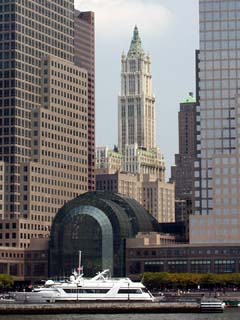
That’s how I found myself in front of a familiar sight, the Woolworth Building, still Gothic after all these years, and still standing (although it had lost electricity and telephone service for a few weeks after 9/11, the building itself sustained no damage). No longer dwarfed by the enormous towers of its successor—that new Cathedral of Commerce, the World Trade Center—the Woolworth Building even commanded a bit of its former dominance.
Although it’s still dwarfed from this angle:
And to bring this hodgepodge of a post round full circle, there exists a book of photos of 9/11 with the title Mayday, Mayday, Mayday!: The Day the Towers Fell, a reference to the myriad distress calls phoned in by firefighters on that terrible day.
Quoting Winston Churchill can get you into hot water. Mark Steyn writes :
On Saturday, Paul Weston of Liberty GB, a candidate in next month’s European elections, was speaking on the steps of Winchester Guildhall and quoting Winston Churchill on the matter of Muslims (from The River War, young Winston’s book on the Sudanese campaign). He was, in short order, arrested by half-a-dozen police officers, shoved in the back of a van and taken away to be charged under a “Section 27 Dispersal Notice”. I had charitably assumed this was a more severe equivalent of the parade licensing that American municipalities use to discourage public participation by disfavored groups – ie, Mr Weston was arrested because he did not have his paperwork in order. I dislike such laws, but in America their use testifies at least to a certain squeamishness about directly punishing someone for the content of his speech.
Not so in Britain. The coppers dropped the Section 27 Dispersal business, and instead charged Mr Weston with a “Racially Aggravated Crime” – in other words, he’s being charged explicitly for the content of that Churchill passage, and the penalty could be two years in jail. This is remarkable, and not just because Islam is not a race, as its ever more numerous pasty Anglo-Saxon “reverts” will gladly tell you. For one thing, the police have effectively just criminalized Liberty GB’s political platform.
Where to begin? First, with the offending passage from Churchill’s The River War that Weston had read:
How dreadful are the curses which Mohammedanism lays on its votaries! Besides the fanatical frenzy, which is as dangerous in a man as hydrophobia in a dog, there is this fearful fatalistic apathy. The effects are apparent in many countries. Improvident habits, slovenly systems of agriculture, sluggish methods of commerce, and insecurity of property exist wherever the followers of the Prophet rule or live. A degraded sensualism deprives this life of its grace and refinement; the next of its dignity and sanctity.
The fact that in Mohammedan law every woman must belong to some man as his absolute property, either as a child, a wife, or a concubine, must delay the final extinction of slavery until the faith of Islam has ceased to be a great power among men. Individual Moslems may show splendid qualities ”“ but the influence of the religion paralyses the social development of those who follow it. No stronger retrograde force exists in the world. Far from being moribund, Mohammedanism is a militant and proselytizing faith. It has already spread throughout Central Africa, raising fearless warriors at every step; and were it not that Christianity is sheltered in the strong arms of science, the science against which it had vainly struggled, the civilisation of modern Europe might fall, as fell the civilisation of ancient Rome.
Churchill posits “science” as saving western civilization against the militancy of Islam—meaning, if my interpretation is correct, the science that allowed the West to make superior weapons and to fight effectively with them against Muslim invasions of Europe and later Muslim rebellions around the world (the latter included the war his book was describing). But did Churchill foresee that Islam would take root in Britain itself, and—along with the left—wage a campaign to insidiously undermine the freedom of speech that is one of the bulwarks of western civilization? Not to mention the left’s also working to dumb down the teaching of the science, too?
I don’t think so. Although I’ve hardly read everything Churchill ever wrote, I doubt that even he had the vision to see those possibilities.
And yet here we are—and I use the word “we” because, although the US isn’t quite as far gone as Britain, it’s not far behind. That’s one of the reasons why many people (I include myself among them) are against a special criminal designation known as “hate crimes.” I think that old-fashioned “crimes” would suffice to cover all bases, and that the dangers of adding “hate” as a special intensifier to the mix is potentially too high a price to pay.
Steyn correctly describes the source of the point of view that ended up stifling Weston’s speech and which has weakened the defense of freedom of speech in the US as well:
Two generations of Americans have been raised in an educational milieu that thinks, to pluck a current example at random, that using the phrase “Man up!” ought to be banned. If you’ve been marinated in this world from kindergarten, why would you emerge into the adult world with any attachment to the value of freedom of speech?
As I say, in Britain, Australia and America, free peoples are losing the habits of free speech, and thereby will lose their freedom.
Exactly and precisely. These attitudes became entrenched in academia decades ago, as I discovered on my own when I returned to get my Master’s degree in the early 90s. Although I was still a liberal Democrat at the time, the academic world had passed me by while I’d been out in the other world minding my business and tending my family. In the meantime, someone had taught a whole new generation or two that they had the right to stop speech (and discipline the speaker) if said speech hurt their feelings.
I was shocked; how could this be? Back then I hadn’t the political framework to place it all in a left/right or statist/libertarian context, but I knew I was greatly disturbed by what I saw. When I spoke up to protest it in a class composed mostly of younger undergraduates, I was looked on by both class and professor (a woman of roughly my generation, I might add) as a kind of doddering old fossil with ideas too antiquated to bother much about.
I duly noted back then—although again, I hadn’t much political context to understand it at the time—that at the university I attended a great many of the students working to ban and punish speech they didn’t like called themselves feminists. Note that in the Churchill quote that got Weston into hot water, part of Churchill’s criticism of Islam was that it oppresses women. And so it does, to this day. But it’s the rare “feminist” who cares about that issue and its continuing truth, because somehow the need to soothe the ruffled feathers of Muslims takes precedence. Note what happened to Hirsi Ali at Brandeis, where the protection of Muslim feelings trumped championing women’s rights as well as the airing of ideas in the academic marketplace.
Ask not for whom the bell tolls. It tolls for us all.
Ace writes about Common Core math pedagogy:
Common Core needlessly complicates the simple. They complicate the simple, supposedly, to impart “number sense” to kids, to get them to understand not just that 9 +3 = 12, but why 9 + 3 =12.
That’s a very ambitious goal.
I suppose we should ask this question, however: Given that teachers are currently failing in the less-ambitious goal of simply teaching that 9+3= 12, why do we believe they’ll be better at the more-ambitious goal of teaching why 9+3 =12…
Pedagogues have been doing this sort of thing for ages. In fact, Tom Lehrer got their number back in the early 60s when he lampooned what was then called “New Math.” Enjoy this; it’s timeless:
Speaking of timeless, I was lucky enough to be educated prior to such abominations, although even in my day there were tiny hints of what was to come. For example, my grandmother used to tell a favorite story about something I did as a child. I have no memory of the incident, but it sounds about right. When I was in grades one and two there was a big push to get us to see that the simple math tables we were learning had practical real-world applications. This bored me no end, but I knew that if I failed to label my math problems properly (one apple plus five apples equals six apples), I would be marked down even if I got the right mathematical answer.
I hated it, but I complied. And according to my grandmother (who’d been a teacher back at the turn of the century—that’s the turn of the 19th century into the 20th century, by the way) I applied it. When I was around six or so I was playing with some toys in her apartment while she was talking to a friend (also a former schoolteacher) about teaching children their math tables by drilling them with flash cards and the like. They didn’t think I was paying attention—why would I be?—until I suddenly cried out, “No, no, no!”, leapt up, and imperiously and impatiently said, “That’s not how you do it!”
They were sitting in front of a dish of cookies, and I took four out of the plate, lined them up in two rows of two, and pointed. “You have to say two of these and two of these!” I insisted, having learned my lesson.
…will be happy to hear that UCLA has rejected a three million dollar donation from Donald Sterling for kidney research.
People are falling all over themselves to show how righteous they are by shunning Sterling and everything he ever touched. Apparently they’re afraid his racist cooties will rub off on them.
The latest developments in the Sterling case—this action by UCLA, and of course the lifetime ban and huge fine levied by the NBA, are legal and well within the rights of both institutions. But it’s possible to feel alarmed at what’s been happening without mounting any sort of defense of Sterling himself. What alarms me is the chilling effect this has on private conversations, and the encouragement it gives to blackmailers and those out for revenge.
It’s been reported by “a source” that Sterling knew he was being recorded when the conversations were taped. If that is correct (and at this point we have no way of ascertaining whether it is or isn’t), then the man’s a fool (well, we already knew that) as well as a racist. But at least it would also take the case out of the realm of being in violation of the California wiretapping statute that requires the consent of both parties to any recording of a confidential conversation, a law whose violation would very very much concern me.
I had never heard of Sterling before this story broke. I don’t follow basketball and haven’t for decades. So I knew nothing about previous allegations of Sterling’s racist behavior, including this 2009 Department of Justice lawsuit that was settled out of court. But the NAACP no doubt knew about all of it, and somehow the organization managed to tolerate his behavior and even to reward it till now. What changed?
I’m in agreement with Andrew McCarthy on this:
In what he foolishly thought was a safe place to let his hair down, Kerry merely gave voice to what the Obama administration thinks. “Apartheid” trips easily off his tongue because it is part of the Islamist narrative that the administration has internalized.
Forget Kerry. This was made explicit in Obama’s 2009 Cairo speech””for anyone who didn’t infer it already from Obama’s friendships with notorious Israel bashers like Rashid Khalidi and Bill Ayers (see P. David Hornik’s FPM report on Ayers joining his fellow tenured radicals in a 2010 petition accusing Israel of ”” all together now ”” apartheid policies). As I recounted in The Grand Jihad, Obama’s speech “combined fictional accounts of Islamic history and doctrine, a woefully ignorant explanation of Israel’s claim to its sovereign territory, and an execrable moral equivalence drawn between Southern slave owners in early America and modern Israelis besieged by Palestinian terror.”
I would take small issue with a couple of things McCarthy said. The first is “That the current secretary of state is a clownish figure has been well known for decades.” It’s the word “clownish” that troubles me. Yes, Kerry’s been made fun of (why the long face, John?) for his patrician windsurfing ways and overwhelming arrogance (do you know who I am?). But those who remember him from his Vietnam testimony days find him anything but clownish. The man has done a great deal of damage.
McCarthy also says that Kerry’s use of the word “apartheid” was “not a gaffe.” I maintain, however, that it was somewhat of a slip, but only in the sense that he didn’t mean his real point of view to come out. It was therefore more of a “tell” than he’d planned. But he probably has run way too long in circles where the only thing that would happen if he were to talk about Israel as a potentially (or actually) apartheid state would be for his listeners to nod sagely in agreement. So I think that not only did he suppose that the text of his remarks wouldn’t surface, but he failed to realize how inflammatory his words would seem if they ever were publicized.
Please forgive my cynicism, but I don’t think America cares about Benghazi.
It’s a yawn because it’s been officially declared a yawn by the administration and far more importantly the MSM. And so I’m not at all confident that this new revelation will matter (see also this):
Emails sent by senior White House adviser Ben Rhodes to other top administration officials reveal an effort to insulate President Barack Obama from the attacks that killed four Americans.
Rhodes sent this email to top White House officials such as David Plouffe and Jay Carney just a day before National Security Adviser Susan Rice made her infamous Sunday news show appearances to discuss the attack.
The “goal,” according to these emails, was “to underscore that these protests are rooted in an Internet video, and not a broader failure or policy.”
Did I write “revelations”? The emails may be proof of the orchestration of the lies, but that’s probably no revelation since they merely underline what almost everyone paying attention already knew, which is that the administration’s blaming the video was a purely and utterly political act with purely and utterly political motivations.
In fact, a great deal of what this administration does is purely and utterly political, to a degree that is unusual even compared to previous presidencies. This is no accident, either, since Obama has more political and PR advisors in policy positions than previous presidents have had.
I’ve written about the situation before, in a post about Ben Rhodes’ background and his then-merely-suspected involvement in the Benghazi mess, and a more general one about the huge policy footprint of Obama’s political advisors. That phenomenon has been one of the hallmarks of Obama’s administration, which is one of the reasons it was so easy to see and to believe that the Benghazi-was-about-a-video meme was promulgated by the administration for political reasons and political ends.
Rhodes is probably merely the tip of the iceberg. We still haven’t had the most basic questions about Benghazi answered, such as where was Obama that night? But if Obama responds to the news about Rhodes’ emails at all, it will probably be to do one or all of these things: deny he knew a thing about it, say Rhodes was merely instructing people to say what the administration actually thought was the truth, and/or ask what difference does it make now, anyway?
Roger Simon (and others) call for a full investigation and possible impeachment, and in a just country the administration would be forced to answer for what it did and didn’t do regarding Benghazi. However, I regretfully have to say I believe that those who think this call of Roger’s will be answered: “American ‘liberals’ and their media consorts should search their souls” are living in a dreamworld.
Simon adds, “We will now see if there is even a figment of honesty in our mainstream media and if our elected representatives are to be trusted in any way.” Again, I think we know the answer. But I hope I’m wrong.
The foibles of Donald Sterling and his mistress have somehow managed to remind me of these guys, another pair with a rather large age gap, and who represented what in those days (1974) passed for an ethnically diverse couple:
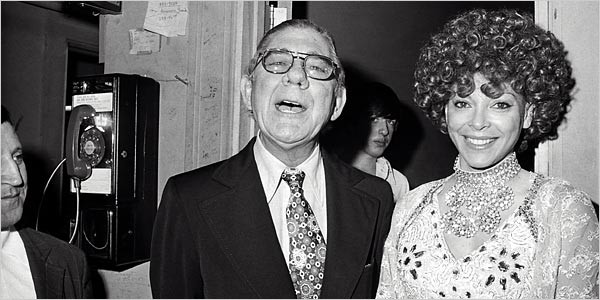
For Wilbur Mills, Democratic congressman from Arkansas who held the chairmanship of the Ways and Means Committee for 17 years, longer than anyone in history, being caught drunk and in a dalliance with Argentine stripper Fanne Foxe precipitated the end of his political career, although it actually was a second similar incident that administered the coup de grace.
Compared to Sterling and his lady friend, Mills was positively youthful when all this happened (65), and Foxe comparatively geriatric at 38.
In an aside, I noticed on Foxe’s Wiki page that she earned a spot on Time magazine’s 2009 list of history’s top 10 mistresses (although, strangely enough, she appears to be number eleven). My, my my! Who even knew Time had compiled such a list?
Here’s the roster, in case you’re wondering. Quite a few of the women have names that no longer ring a bell, having passed to obscurity in the five years since the list was compiled, showing how fleeting fame can be. And one of them wasn’t even a mistress: Anne Boleyn, who got a bum rap not only from Henry but from history, it seems.
Do most people even know that one of the reasons Henry VIII was so keen to divorce Catherine of Aragon and marry Boleyn was that Anne held out on him sexually and insisted on marriage as the prerequisite? She had watched what had happened to her sister Mary, who’d been Henry’s previous mistress, had gotten pregnant by him, and been effectively abandoned by him, and Anne had no intention of going the same route.
So it’s ironic that Anne’s on a list of mistresses when she was bound and determined not to be one. Also ironic that, in order to behead her, Henry falsely accused her of infidelity. Anne was ambitious, but she was sexually faithful to both Henry and her marriage vows. She was also very smart, although that didn’t help her much when arrayed against the formidable forces of a king who wanted to be rid of her. But her daughter, Elizabeth I, probably inherited her brilliance from both her parents.
[NOTE: It would be nicely symmetrical if I could list Henry and Anne as still another May/December romance gone wrong. But it wouldn’t really be true because, at the time of their marriage, Henry was 42 and Anne (whose birthdate has been disputed) was somewhere between 26 and 32. That’s an age gap, all right, but not such a big one, and Henry was still a relatively young man.]
[NOTE II: Here’s an interesting tidbit on Mills:
His accomplishments in Congress included playing a large role in the creation of the Medicare program. Mills initially had reservations about the program because he was worried about the eventual cost, but eventually shepherded it through Congress and had a large hand in shaping its program.]