I haven’t gotten around to writing about this story yet, and I probably won’t get to it today. Most likely tomorrow.
But I thought you might want to talk about it here.
Or about anything else that interests you.

I haven’t gotten around to writing about this story yet, and I probably won’t get to it today. Most likely tomorrow.
But I thought you might want to talk about it here.
Or about anything else that interests you.
Remember Lisa Page? Her testimony has been made public [emphasis mine]:
Newly released transcripts from Page’s private testimony in front of a joint task force of the House Judiciary and Oversight committees in July 2018 sheds new light on the internal discussions about an investigation into Clinton’s emails…
Comey cleared Clinton of all charges in a press conference on July 5, 2016.
Page told the committee that the FBI “did not blow over gross negligence.” Responding to a question from Rep. John Ratcliffe, R-Texas, Page testified the FBI, including Comey, believed Clinton may have committed gross negligence. “We, in fact — and, in fact, the Director — because, on its face, it did seem like, well, maybe there’s a potential here for this to be the charge. And we had multiple conversations, multiple conversations with the Justice Department about charging gross negligence,” she said.
Page further testified the DOJ put a stop to that: “The Justice Department’s assessment was that it was both constitutionally vague, so that they did not actually feel that they could permissibly bring that charge.” The specific statute being referenced, 18 U.S. Code § 793, deals in part with “gross negligence” in the handling of national defense information, which Clinton came under scrutiny for possibly violating.
Page said Comey and the FBI spoke with DOJ about a gross negligence charge for Clinton multiple times, but that the DOJ consistently pushed back on it. “We had multiple conversations with the Justice Department about bringing a gross negligence charge. And that’s, as I said, the advice that we got from the Department was that they did not think — that it was constitutionally vague and not sustainable,” she said.
Ratcliffe asked if the decision not to charge Clinton with gross negligence was a direct order from the DOJ. “When you say advice you got from the Department, you’re making it sound like it was the Department that told you: ‘You’re not going to charge gross negligence because we’re the prosecutors and we’re telling you we’re not going to,’” he said.
Page responded: “That’s correct.”…
When asked if she knew why DOJ believed that, Page replied: “I really don’t know… I am confident that it was based on their own research in consultation with others, but I don’t have personal knowledge about what the Department did in order to come to that conclusion.”
When Comey made his announcement back in July of 2016, listeners on the right (including me) immediately noted the strangeness—in the legal sense—of what he was saying (see also this as well as this and this). It just didn’t make sense. It was as though they had come to the conclusion that they would not charge Clinton, and had to come up with an excuse after the fact. The excuse was absurd, but it was all they could conjure up, and they went with it.
What Page said supports that idea.
More:
At the time, the National Review’s Andy McCarthy wrote, “According to Director James Comey, Hillary Clinton checked every box required for a felony violation of Section 793(f) of the federal penal code … and, in essence, in order to give Mrs. Clinton a pass, the FBI rewrote the statute.”
It was speculated at the time that the DOJ was behind the FBI’s action, and that part of the impetus was that tarmac meeting between Loretta Lynch and Bill Clinton, after which Lynch refused to recuse herself but said that she would abide by the FBI’s decision.
And then, apparently, the DOJ told the FBI what to do.
Unfortunately, it seems that the only people who care about all of this are on the right.
I’m often struck by how artificial most politicians are when they speak. So little of what they say seems unguarded, natural, spontaneous, or sincere. Everything is strategic.
That doesn’t mean that everything a politician says is effective as a tactic. What it does mean, for so many of them, is that it is a tactic rather than the utterance of what appears to be a normal human being speaking his or her mind.
I was thinking this while I was analyzing one of Nancy Pelosi’s statements for my previous post today. I found myself in a sort of awe at how much she packed into a couple of seemingly simple sentences: so much hypocrisy, so much unctuous fake nobility, so much artificiality, a little hidden dagger, so many hidden messages. You might say I was reading too much into her statement, but I don’t think so.
It’s not just Pelosi’s statements one can parse that way (I tend to see it more on the left, but it certainly exists on the right). Obama was a master at it. One difference, though, is that when Pelosi speaks I can almost see the wheels in her head turning, but when Obama did it, it was more smooth. Perhaps that’s one of the reasons he was able to succeed in his run for national elected office, and why Pelosi always kept her election bids to re-election in her safe district and made her power moves for advancement within Congress itself. Perhaps she’s too obviously contrived to have won national office.
Perhaps that was Hillary’s problem, too. Maybe she should have kept her power moves within the government structure itself, too, and not sought national elective office from voters. She was just so artificial—among other things—whereas her equally strategic husband had perfected the art of seeming natural.
So, where does Trump fall on this spectrum? The first time I ever watched him give a political speech—and this was back when I thought he’d be a disaster for the right—I was impressed by a number of things and wrote:
Anyone who reads this blog knows that I’m not a Trump supporter, but that I also get his appeal. Watching him speak at length, I “got” it even more. He makes all other politicians look boring and stilted (hey, many of them are boring and stilted). He makes it all sound so simple—just as Obama did, but in a completely different direction and with a completely, and I mean completely, different style. Populist appeal is a neat trick in a man who’s a multi-billionaire and who grew up in enormous wealth and graduated from Wharton. But he’s got it, and although I’m sure he carefully nurtures it he manages to make it look natural.
When I started writing this post, I hadn’t looked back at that quote yet. I had planned to say a certain thing today, but as I read what I wrote in that post of three and a half years ago, I find it’s the same thing. All this time has passed and that aspect of Trump hasn’t faltered: he makes all other politicians look boring and he looks natural doing whatever it is that he does.
That’s an art, and in addition to any art of the deal, it’s one of the arts that got him elected. It’s also something that lends itself to misinterpretation. Some people think he’s stupid, but I’ve never (even when I was very much against him during the primaries) said or thought that he was stupid. He also has unusually keen intuition, which can be more precious than intelligence, and certainly doesn’t always go hand-in-hand with it.
Trump’s enemies on left and right (and he certainly has them on both sides) tend not just to dislike what he does. In fact I’m not at all sure that his enemies on the right hate him because of what he does; I think they hate him in spite of it. But those who really really really dislike Trump seem to dislike him in very visceral and personal terms. One thing the ones on the right don’t like is his lack of intellectualism. Another thing his enemies on both sides don’t like is that they interpret the seeming naturalism of his speech as meaning that he is someone who says whatever pops into his head, with no filter and little thought. I think nothing could be further from the truth.
I think what’s happening is that Trump is every bit as strategic/tactical as any politician, perhaps even more so. But he also seems to be authentic when he speaks; he seems to be himself, whatever that means. He projects a naturalness and spontaneity. I think this combination of strategy and everyman-type naturalness is utterly unique to Trump. I’m not sure where it comes from. Perhaps it’s because he is a man who is strategic to his core: it comes naturally to him. Perhaps he just has a populist gift. Perhaps he is sincerely strategic, if that makes any sense.
But whatever it is about, I think that, without that trait, Trump would not have been elected president.
There’s been a lot of discussion about what Pelosi meant when she said this about impeaching Trump:
But since you asked, and I’ve been thinking about this: Impeachment is so divisive to the country that unless there’s something so compelling and overwhelming and bipartisan, I don’t think we should go down that path, because it divides the country. And he’s just not worth it.
Here’s my take:
(1) She’s just “been thinking” about it. She can always do some more thinking and change her mind.
(2) She’s on record as being against dividing the country. Pretty funny, that. Nancy Pelosi, the Great Uniter.
(3) She’s setting yourself up as a “good cop” to AOC et al’s “bad cop.”
(4) She’s belittling Trump as of no import. Note she says he’s not worth it, not that it’s not worth it to impeach him.
(5) Despite the extra diss of “he’s not worth it,” a la #4 above, the impeachment process itself probably isn’t worth it unless the impeachment forces can convict Trump in the Senate, and they don’t have the votes for that. It’s been my opinion for a long long time that they won’t impeach for that reason, and although I could be wrong, I haven’t changed my opinion. Impeachment without conviction can be seen as a divisive waste of time and backfire on the impeachers, and a vindictive move rather than a valid response to “high crimes and misdemeanors” that don’t seem to be there.
(6) The Mueller report probably isn’t going to provide the Democrats with the longed-for evidence of said “high crimes and misdemeanors.” It was always the idea that it might, and that enough Republicans might get on board to convict Trump in the Senate.
(7) Impeachment also is not worth it because it would put in place a President Pence. Pence may be many things, but he’s much less of a lightning rod for campaign hate, which is what the Democrats plan to go on in 2020. They feel they can defeat Trump, so why remove him and elevate Pence and have to come up with a whole new strategy to defeat him—or, if he chose not to run in 2020, some other Republican? They’ve been demonizing Trump for two years, and they believe they’ve paved the way for a resounding defeat no matter who they run.
I really knew next to nothing about hula as an art form. But here’s a video that taught me a bit. Enjoy!:
Basically, our youth has suffered from a form of child abuse by their teachers and the media. They have been told, implicitly and explicitly, from earliest childhood that socialism is the preferable system because of “fairness.”
The next election is likely to be some form of socialism versus capitalism, no matter who the Democrats nominate. If Bernie Sanders, it will be front and center, but it won’t be far away with other candidates. Every election is said to be the most consequential. This one really is. It’s about a lot more than the individuals running.
So as Lenin himself would have put it, what is to be done?
Trump has to be prepared as never before to be the spokesperson for the free market system and its attendant freedoms…
Rather than relying on obvious sloganeering, even if it’s accurate, or pointing to his own business success or even a booming economy, he has to be mindful of his audience. It is not, in this instance, the “deplorables,” who already understand the situation. It is the youth of America — our future — who must be educated from the ground up, actually re-educated.
This takes patience and it takes clarity, but is also an opportunity to make this election even more important. Our youth must be walked through basic economics and have history explained to them. (As an example, merely pointing out Bernie’s love affair with the Soviet Union is not enough, since our young don’t have a clue what the USSR really was…)
To do this educating, Trump will have to rely on speech-writers and prepared remarks more than he likes. But, as I have said, this election is about far more than Donald, no matter what you think of him.
Trump may or may not be up to the task. But I’m not sure who would be, if anyone, because the task is nothing less than a deprogramming from an inculcated worldview that is built not just on a couple of facts that are incorrect, but a deeply-held, emotionally-satisfying, lifelong (since first attending school, anyway, for these young people) belief system, one that’s been rewarded in school, applauded by peers, and constantly reinforced.
I hate to be pessimistic. But we all know that a mind can be a difficult thing to change. The shortest and most powerful way to change a mind is if a belief-system is contradicted by a person’s lived experience. But since those who promote socialism here for the most part have lived under a relatively socialism-free and relatively capitalistic system, and reaped the benefits thereof without necessarily even noticing the source of those benefits (but have been repeatedly told the drawbacks), it’s not even clear that living under the yoke of socialism would drive home the lesson.
Certainly, they’re not likely to listen to Trump. For him to be an effective educator it would require that young people who already hate him actually listen to him with some sort of open mind. I just don’t see that happening, although I hope I’m wrong.
What is needed is a long-term overhaul of the educational system. Since at the moment the left has a tight grip on it, I’m not sure how that could happen in the foreseeable future.
What I hope is that somehow there are enough voters around to see through the left’s promises. I hope that somehow no leftist Democratic leader emerges who energizes the base.
I’ll close with this cartoon, which I found in the comments section to Simon’s post:
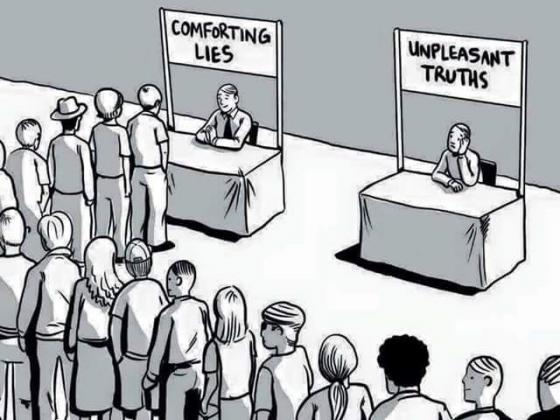
In her interview with Tim Alberta for “The Democrats’ dilemma,” Omar disparaged the sainted Barack Obama by asserting that in critical respects he was as bad as Trump is. She then denied the accuracy of the quote on Twitter while posting the audio clip that proved the accuracy of Alberta’s quote. Is she stupid? If so, it would be one of her more attractive traits.
When Alberta pushed back, Omar deleted the tweet without expression of regret or apology. She just sought to avoid further self-embarrassment while availing herself of the Orwellian memory hole.
Recently, it’s been Ilhan Omar’s anti-Semitism and boldness vis a vis Nancy Pelosi that have been the special foci of commentary about her. The audio tweet has taken somewhat of a back seat, although it’s gotten attention, too. But I want to explore the audio issue a little bit more.
When something like this happens, I wonder “why?”. Why did Omar post the audio clip in the first place if it didn’t prove what she said it proved? I’m assuming that most people believe she posted it in error, and it’s certainly highly possible that’s the case—that is, that Omar posted it with careless disregard for truth, perhaps without even listening to the relevant part. Perhaps she actually thought it proved what she said it did. Perhaps her memory was as faulty as her attention to detail.
And then, when she was criticized, Omar merely removed the proof of her initial statements in what Johnson aptly calls “avoid[ing] further self-embarrassment while availing herself of the Orwellian memory hole.”
But I wonder if that’s quite the whole story. I will hypothesize another possibility for Omar’s actions—one that is far worse, although I don’t know whether what I’m about to propose is correct.
It may be that the “Orwellian” nature of what Omar did goes much deeper. She may simply have not cared whether the audio proved her point or not. It was offered as “proof,” she stated that it constituted proof, and perhaps she was expecting its truth to be taken for granted by those on her side without their checking it by listening in an objective fashion.
In fact, does objectivity even exist as a principle to be followed on the left? Isn’t truth what the Party says it is? And isn’t that the deeper Orwellian nature of the left?
I’ve noticed this quite a bit: the left’s lie can be quite flagrant, and yet the person making it is confident that he or she won’t be called on it by anyone who matters. The person isn’t addressing the skeptical; the person is addressing followers, admirers, and/or true believers on the left.
Omar may have been operating in this way. She may have gotten away with it most of the time in the past. She’s used to those who support her and would-be supporters not bothering to follow through and check her out. She’s used to people (Nancy Pelosi being the latest) making excuses for everything wrong that Omar may do or say.
She’s used to people forgetting. She’s used to not facing any consequences for bold lies. She’s used to being admired nevertheless, and to going from strength to strength.
This is “Orwellian” in the sense of “Two plus two equals five, if I say so. And if you ever believed otherwise, then forget it and move on.”
Suing CNN is a good idea:
“CNN was probably more vicious in its direct attacks on Nicholas than The Washington Post. And CNN goes into millions of individuals’ homes,” attorney L. Lin Wood said this weekend on Fox News.
“They really went after Nicholas with the idea that he was part of a mob that was attacking the Black Hebrew Israelites, yelling racist slurs at the Black Hebrew Israelites. Totally false,” he added. “Now you say you’ve seen the tape; if you took the time to look at the full context of what happened that day, Nicholas Sandmann did absolutely nothing wrong. He was, as I’ve said to others, he was the only adult in the room. But you have a situation where CNN couldn’t resist the idea that here’s a guy with a young boy, that Make America Great Again cap on. So they go after him.”
As far as I can tell, CNN and so many others didn’t just fail to follow accepted journalism standards. They followed no standards at all, except for those of the mob. But the MSM has in many cases become indistinguishable from the mob. The full video of the incident was available quite early in the game, and they ignored it. Nicholas Sandmann was not only a private citizen, he was an underage person. A lawsuit is highly appropriate.
I hope Sandmann wins this suit. I tend to doubt he will, but I hope to be pleasantly surprised.
Sunday’s crash of an Ethiopian airliner is a terrible tragedy in which 157 people lost their lives. The scenes of anguish and destruction are horrific and heartbreaking.
Air travel’s safety record has improved tremendously, but any crash feels intolerable and everyone would like to completely eliminate such occurrences. This particular crash raises exceedingly disturbing safety questions because it appears to echo the circumstances of another recent crash that may have had something to do with the design and operation of the plane model involved, the Boeing 737 MAX, which is a relatively new design although substantially similar to an older one:
The accident drew immediate parallels to the Oct. 29 crash of a Lion Air plane that plunged from the skies in Indonesia and into the Java Sea, killing all 189 passengers and crew members.
A new MAX 8, an upgraded, more fuel-efficient aircraft from Boeing’s popular 737 line, also was involved in that calamity. In both instances, the pilots tried to return to the airport a few minutes after takeoff but were not able to make it back. And both flights experienced drastic speed fluctuations during ascent.
But experts warn that doesn’t mean the reasons they plummeted were the same.
But it’s hard to believe there wasn’t a connection, until proven otherwise. Air crashes have become less common than ever, but it’s my impression that crashes are particularly unusual with new planes and clear weather unless some sort of design flaw or error-encouraging design glitch is involved.
More:
The cause of the Lion Air disaster is still being examined 4½ months later, but investigators are looking into whether an incorrect reading from a sensor activated an automatic command to lower the plane’s nose. The pilots had tried to reverse the command.
Boeing did not take the costly step of retraining pilots on that new feature of the flight control system when it introduced the MAX 8 in 2017, based on the argument that the new models flew essentially the same way as the familiar 737s. Pilots complained that neither the company, the airlines nor the Federal Aviation Administration informed them of the change.
After the crash, Boeing sent out an advisory telling pilots how to override the software upgrade that created the problem.
American and Southwest currently fly the plane, but it’s a very small part of their fleets, 24 out of 1000 for American and 31 out of 750 for Southwest.
RIP all those who have perished, and condolences to all their their relatives and friends.
There were some comments recently that were so insightful I thought I’d repost them here, to draw attention to them. The first was in the knitting post. In case you haven’t read that post, it was about a big dust-up in the online knitting community—a community I never even knew existed till now, since I’m definitely not part of it—in which a knitting blogger was chided nastily for some innocuous remarks about India that were deemed insufficiently culturally-sensitive by the mobbish powers-that-be, and she ended up offering an abject apology.
The first comment was from “Henry”:
The interesting thing about this set-to is that it shows how the old laws about blasphemy – which everyone (who counts) had so disdained – have been resurrected in the form of “Political Correctness”. The penalties are no longer physical flogging, imprisonment, and torture with an Auto da Fe, but a more extended and public Inquisition. As of old, it ends with a confession of sin, unaccepted repentance, excommunication, and banishment from the fellowship.
It is as much of an abomination today as it ever was.
And of course, a more recent type of pseudo-religious belief system that comes to mind is Communism, which reproduced intolerance for the expression of anything that deviated from the Party line in even the smallest of ways, and which featured the public humiliation of and confession from, and in many many cases imprisoned and/or murdered, the offenders. The point was not in order to purge their souls as in medieval times, although perhaps that was the pretense even under Communism, but to cleanse the group and set a stern example for others not to transgress. Come to think of it, those last two were probably operative during the Inquisition as well.
It’s been said many times that leftism is a religion, or rather a substitute for the religious impulse when religion has weakened or fled. Nietzsche wrote in 1882:
God is dead. God remains dead. And we have killed him. How shall we comfort ourselves, the murderers of all murderers? What was holiest and mightiest of all that the world has yet owned has bled to death under our knives: who will wipe this blood off us? What water is there for us to clean ourselves? What festivals of atonement, what sacred games shall we have to invent? Is not the greatness of this deed too great for us? Must we ourselves not become gods simply to appear worthy of it?
That’s a famous passage and reams have been written about it. But in the context of this discussion and that Nietszche quote, it seems that we’ve invented a great many rituals to replace the old ones, and that one way to look at Communism and all central planning schemes that purport to transform human society into utopia—and fail utterly and completely, accomplishing something quite different—is that they are attempts to “become gods” in Nietszche’s sense.
The second blog comment I want to highlight was at the recycling post, and it was by “RC”:
I really believe that Leftism is the religion* that replaced mainstream Protestantism in America as it drifted away from its faith and became de-supernaturalized.
As “theological liberals” took over the Protestant seminaries in the early 1900’s, the people who still believed in God reacted as conservatives always seem to: Instead of reconquering their own existing institutions through bareknuckle political infighting, they abandoned them, splitting off to form their own new parallel institutions in which they could reassert “the fundamentals of the faith” (like the literal existence of God). They thus became known as “Fundamentalists.”
This meant that the mainline Protestant churches (most especially the Episcopalians, but also the then-differently-named ancestors of PCUSA and ELCA) gradually bled out all their genuine believers, losing them to the newly-launched Evangelical churches and para-church organisations. Two generations later, the mainline leadership consisted almost entirely of persons who didn’t believe but felt that a church was a perfectly fine place to act out their personal inclination for moralizing and social meddling, governed less by Holy Writ than by emotionalism and left-wing politics.
In the last three decades, these churches have seen a profound collapse in membership. The reason is this: Half their remaining members said, “If these leaders don’t believe, why should I?” and started sleeping in on Sundays. The other half said, “If these leaders don’t believe, I’ll go find some others who do,” and departed for other churches…
…[W]what about the folk who started sleeping in on Sundays?
They, too, retained a latent religious instinct. They felt unsettled if they didn’t have:
– a cosmology and metaphysics
– an ethical crusade to participate in
– an apocalyptic eschatology
– a set of rituals to practice
– a way to cheaply buy indulgences to alleviate their feelings of moral guilt
– a sense of community
– a diabolical enemy to struggle against
– a set of sermons to attendSo, their own functional religion evolved, in which those needs were met as follows:
– cosmology/metaphysics: reductive materialism coupled to a purely emotional “spirituality”
– ethical crusade: Save the Planet!
– apocalyptic eschatology: Global Warming Will Kill Us All In Ten Years!
– ritual system: Recycling, Buying Priuses
– buying indulgences: By promoting leftist political policies, I prove that I Am One Of The Enlightened White People, and get a pass on the sin of being white
– sense of community: Left-wing political activism and Following All The People On Twitter Who Exhibit My Same Tribal Markers
– enemy to struggle against: Republicans are demons, and Trump is the devil himself
– a set of sermons to attend: TED Talks and attending lectures during Sex Week on campusI defy anyone to offer a better explanation of the above behaviors than as a surrogate for the religious instinct they inherited from their grandparents, but for which they had no other outlet.
An excellent summary, and not the least bit limited to recycling and global warming and the like as the quasi-religious causes. It’s also correct as a summary whether or not the threat of global warming is real, because it’s the behavior around it that is quasi-religious, although in the case of AGW that religiosity is wrapped in the cloak of science.
In this recent thread, there was an interesting discussion regarding popular music about finding your soulmate (or thinking you’ve found your soulmate).
But no one mentioned the song that immediately came to my mind: “I’ll Know” from “Guys and Dolls.” That was a song I loved as a child. It’s sung by mission girl Sarah and smooth gambler Sky, who are meeting “cute”—that is, they can’t stand each other at the outset, and yet the audience knows, or at least strongly suspects, that before the musical is over, they will be singing another tune.
The funny thing about this song is that Sarah is saying that she absolutely knows with 100% certainty the kind of guy she’s looking for and with whom she’ll fall in love and live happily ever after. And she has imagined every detail about him, and will recognize him immediately the minute she meets him.
Sarah is most definitely not describing the charming Sky. He, in return, says he’s just going to react to things as they happen and doesn’t have a firm picture of the woman he’ll love, but he is just as sure as Sarah was that he’ll recognize that woman the moment he meets her.
And yet, of course (SPOLER ALERT for anyone unfamiliar with “Guys and Dolls”), after all the play’s entertaining twistings and turnings they end up together.
I tried to find a YouTube video of a good modern rendition of the song in a revival performance, and gave up. I’ve always detested the movie. Marlon Brando tries but he’s not a good singer (Hollywood decided not to dub him, however). And I just don’t care for movie musicals in general compared to the stage versions.
So here’s the stage version that I heard over and over as a child; just the audio. I thought it was beautiful then, and I still think so now. It’s very simple. Isabel Bigley, who played Sarah, has a clear high soprano (the part of Sarah is not an easy one to sing) that has just the right touch of primness. And Robert Alda, father of Alan, who plays Sky, has a voice with a wonderful mellow but slightly brassy timbre, instantly recognizable as unique. The contrast between their personalities isn’t just in the book and the lyrics, it’s right there in their voices.
And yet at the very end, how well they blend:
Here’s the markedly inferior movie version: