↓
 

The New Neo

A blog about political change, among other things

  • Home
  • Bio
  • Email
Home » Page 1831 << 1 2 … 1,829 1,830 1,831 1,832 1,833 … 1,862 1,863 >>

Post navigation

← Previous Post
Next Post→

The Gandhi nobody knows

The New Neo Posted on October 2, 2005 by neoMay 22, 2011

In response to my post about Gandhi’s pacifism, a number of people (Ed Driscoll publicly, others in private e-mails) have called my attention to Richard Grenier’s essay on Gandhi that appeared in a 1983 issue of Commentary.

Driscoll calls it “undoubtedly one of the most incredible film reviews ever written,” and I second the motion.

Driscoll’s reference is quite the wry understatement. The essay is far more than a film review, although its take-off point is indeed a critique of the Oscar-winning movie of 1982. Whether the movie “Gandhi” could truly be termed a film biography is doubtful; it probably is so only in the Oliver Stone-ish sense.

Grenier writes what could more rightly be called a fisking of the Gandhi movie–in the course of which he pretty effectively demolishes the Gandhi myth as well. He makes a very good case that the actual historical figure is a far more complex and flawed person than the Gandhi most of us think we know.

Here’s an excerpt which is especially relevant to the pacifism discussion on the earlier thread:

“Gandhi”, then, is a large, pious, historical morality tale centered on a saintly, sanitized Mahatma Gandhi cleansed of anything too embarrassingly Hindu (the word “caste” is not mentioned from one end of the film to the other) and, indeed, of most of the rest of Gandhi’s life, much of which would drastically diminish his saintliness in Western eyes…

[I]t is not widely realized (nor will this film tell you) how much violence was associated with Gandhi’s so-called “nonviolent” movement from the very beginning. India’s Nobel Prize-winning poet, Rabindranath Tagore, had sensed a strong current of nihilism in Gandhi almost from his first days, and as early as 1920 wrote of Gandhi’s “fierce joy of annihilation,” which Tagore feared would lead India into hideous orgies of devastation–which ultimately proved to be the case. Robert Payne has said that there was unquestionably an “unhealthy atmosphere” among many of Gandhi’s fanatic followers, and that Gandhi’s habit of going to the edge of violence and then suddenly retreating was fraught with danger. “In matters of conscience I am uncompromising,” proclaimed Gandhi proudly. “Nobody can make me yield.” The judgment of Tagore was categorical. Much as he might revere Gandhi as a holy man, he quite detested him as a politician and considered that his campaigns were almost always so close to violence that it was utterly disingenuous to call them nonviolent.

For every satyagraha true believer, moreover, sworn not to harm the adversary or even to lift a finger in his own defense, there were sometimes thousands of incensed freebooters and skirmishers bound by no such vow. Gandhi, to be fair, was aware of this, and nominally deplored it–but with nothing like the consistency shown in the movie. The film leads the audience to believe that Gandhi’s first “fast unto death,” for example, was in protest against an act of barbarous violence, the slaughter by an Indian crowd of a detachment of police constables. But in actual fact Gandhi reserved this “ultimate weapon” of his to interdict a 1931 British proposal to grant Untouchables a “separate electorate” in the Indian national legislature–in effect a kind of affirmative-action program for Untouchables. For reasons I have not been able to decrypt, Gandhi was dead set against the project, but I confess it is another scene I would like to have seen in the movie: Gandhi almost starving himself to death to block affirmative action for Untouchables.

…Meanwhile, on the passionate subject of swaraj Gandhi was crying, “I would not flinch from sacrificing a million lives for India’s liberty!” The million Indian lives were indeed sacrificed, and in full. They fell, however, not to the bullets of British soldiers but to the knives and clubs of their fellow lndians in savage butcheries when the British finally withdrew.

I came across Grenier’s piece about a year ago and found it extraordinary, and extraordinarily shocking. I’ve done a fairly extensive online search to see whether anyone has effectively countered any of the facts in it, and have found nothing save ad hominem attacks on Grenier himself. Makes me think he may have gotten his facts right. (Here, by the way, is a short bio on Grenier himself.)

Read Grenier’s piece and judge for yourself.

Posted in Historical figures, Pacifism, People of interest | 34 Replies

It’s official: I’m a centrist

The New Neo Posted on October 2, 2005 by neoOctober 2, 2005

You are a

Social Moderate
(55% permissive)

and an…

Economic Liberal
(38% permissive)

You are best described as a:

Centrist

You exhibit a very well-developed sense of Right and Wrong and believe in economic fairness.

The test didn’t pick up on the fact that it would be more accurate to describe me as an economic illiterate than an economic liberal. But at least it got the “centrist” part right.

Posted in Uncategorized | 12 Replies

How Tuvia Grossman got to be a “Palestinian”

The New Neo Posted on October 1, 2005 by neoAugust 28, 2009

In case you missed the story the first time round, Richard Landes of Second Draft has a post at Solomonia on the misidentification of Tuvia Grossman by the press.

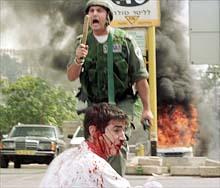
Grossman, an American Jew studying in Israel, was beaten by a mob in the Arab section of Jerusalem and rescued by an Israeli policemen. When the photo of the bloodied Grossman appeared, a club-wielding and shouting policeman standing over him,

it was released by the AP and flashed all over the world–including the NY Times–with the laconic caption, “An Israeli policeman and a Palestinian on the Temple Mount.” The reader was led to the inescapable conclusion that the Israeli had beaten the defenseless Palestinian youth.

To this day, that misapprehension continues among many, despite attempts at correction. The photo was originally used as propaganda for the Palestinian intifada; it is still used for propaganda purposes by the Palestinians. After all, what are facts when there’s a larger truth to consider?

Landes makes the important point that the misidentification most likely had to do with the expectations of the press that any photo featuring “bloodied youth and Israeli policeman with club” would just have to be of a Palestinian who had been beaten by said policeman. Psychologists have long known that human beings function in the world by setting up such templates as shortcuts to ordering observations.

I became curious to know more of the details of the chain of events involved in this error. Who actually had been responsible for the mistaken caption? Who had taken the photo, for example; had he/she originally identified the people in it, and if so, how? Was the error the photographer’s, or had someone else along the way goofed–or even lied?

It took some digging to find any answers, and at first I found only a fragment. It appeared in this recent article from the Jerusalem Post on the subject of the Grossman photo (Tuvia himself, by the way, has emigrated permanently to Israel, according to the article).

Here’s the passage relevant to the caption’s genesis and evolution:

…a freelance photographer took a shot of one of the soldiers, his club in the air, standing over a bloody Grossman. The Associated Press, in giving a caption for the photo, identified the gas station, outside the Old City, as the Temple Mount and the victim as a Palestinian.

From this we learn that a freelance photographer took the shot, and someone at the AP gave it the caption (we also learn that the policeman in question may have actually been a soldier, although the words “soldier” and “policeman” seem to be used interchangeably at times in articles about the incident, including even this one by Grossman himself. An unimportant distinction, perhaps, but it illustrates what an elusive quarry accuracy can be–as does this whole affair).

So, we still haven’t a clue as to how the AP managed to get the information so very wrong. Even CAMERA, which has a good summary of the development of the story and the differing retractions and corrections along the way (including the AP’s first correction, which again misidentifies Tuvia, this time as an Israeli medic) fails to shed light on the question.

Here is the most complete set of facts describing how the caption came to be written that I’ve been able to find. It’s not perfect, but it will have to do. The link is to a reprint of an article that originally appeared in the NY Times about a week after the story broke. Here’s the relevant quote (note that the soldier [?] has turned back into a police officer):

A picture of Tuvia Grossman, his head bloodied and sitting in front of the approaching police officer, was taken by an Israeli photographer for Zoom 77, an Israeli agency, and sent that Friday, Sept. 29, to The A.P. in Jerusalem with a garbled Hebrew caption that misidentified Mr. Grossman as an Israeli ambulance medic.

The A.P., which had received many pictures of injured Palestinians that day, did not clarify the garbled caption but sent the picture to subscribers with a caption based on the erroneous assumption that Mr. Grossman was a Palestinian. It also misidentified the site, first as the Temple Mount and later as another site in the Old City.

Many newspapers published the picture and erroneous captions based on The A.P.’s information. The New York Times misidentified Mr. Grossman in last Saturday’s issue as a Palestinian and in some copies misidentified the site as the Temple Mount. In a correction on Wednesday, The Times noted that the wounded man was Tuvia Grossman, a student from Chicago, but–using erroneous information from The A.P.–mistakenly said the site of the attack was in the Old City.

So: we’ve learned that the photographer was an Israeli who originally made an error about Grossman’s identification–a different and much smaller error than the one later made by the AP. At least the photographer got the fact that Grossman was a Jew and not a Palestinian correct–and that the policeman/soldier was protecting him rather than beating him. (At the same time we’ve learned why it was that the AP’s first correction of the caption had misidentified Grossman still again, this time as an Israeli medic–the AP was simply using the information supplied by the photographer’s original caption to make its correction. One almost begins to have some sympathy for the AP at this point–almost.)

The incident began with the fact that the photographer’s original caption had somehow become garbled (unintelligible? illegible?). But the AP, instead of asking for clarification from the photographer–as it should have if it had any interest in accuracy–seems to have filled in the blanks (just as Landes has suggested it did) with its own expectations and assumptions that the bloodied man had to have been a Palestinian victim of Israeli aggression. All the other papers followed the lead of the AP, not having any reason to suspect a mistake. The Times, when informed of the error (by Tuvia’s father, by the way), continued to err in the first of its several corrections by relying on the already-discredited AP for the location shown in the photo.

A story of astounding carelessness, expectations, assumptions, and multiple misidentifications on the part of the press, particularly the AP–although one that does not seem to include deliberate lying, except on the part of the Palestinian organizations still using the photo even today.

The whole thing would be relatively trivial if the subject matter weren’t so important, and hadn’t been so inflammatory. The photo and caption have already done their dirty work, and I doubt that many of the people who saw the original caption have ever caught the correction, or ever will.

Posted in Israel/Palestine, Press | 13 Replies

Our need to know–the ACLU and Abu Ghraib

The New Neo Posted on September 30, 2005 by neoAugust 28, 2009

Let’s see if I’ve got this straight: US District Court Judge Alvin K. Hellerstein has ordered the release of more Abu Ghraib photos to help the ACLU prove that prisoners have been abused, and it’s OK because the terrorists don’t need those photos in order to hate us, they can do it very well for no reason at all.

And to think I used to give money to the ACLU.

This article from about a month ago makes the situation even more puzzling. Apparently, back then, Judge Hellerstein seemed to be very hesitent to release the photos because of the national interest involved. Why the change in one short month?

I haven’t found an answer, but the article explains why the ACLU is so hot to have these photos splashed all over the cable news networks and the newspapers: they’re only thinking of us:

ACLU lawyer Amrit Singh argued that release of the pictures was necessary for the public to assess the scope of the abuse and whether it could have been carried out without the knowledge of military leaders.

Thanks a lot, ACLU. I really, really appreciate it. I’m sure that once I look at those photos I’ll instantly know how high up the responsibility goes–no doubt, one of them features Rumsfeld holding a naked prisoner on a leash.

The underlying basis of Judge Hellerstein’s decision appears to be compliance with the Freedom of Information Act. Apparently, the present rule is that information should be released under the act unless “disclosure would be harmful.”

Our legal system ordinarily requires that a rape victim’s name not be released because it might be harmful to her. A juvenile’s court records are sealed because it might be harmful to the minor in question. The potential harm in both situations trumps the public’s right to know.

In the present case, the public has seen photos of Abu Ghraib ad nauseum, so seeing a few more is hardly likely to give the us needed and vital information. The only effect such release is likely to have is to harm us, our soldiers, and our country still further.

Whether or not the terrorists need such information to hate us is hardly relevant; they could certainly use it.

I’m with Dickens–the law is an ass (not to mention the ACLU).

[ADDENDUM: I didn’t see this when I wrote the post, but in the NY Times article on the subject, it mentions that, when the photos are to be released, the rights of the detainees to privacy will be protected:

Judge Hellerstein ordered that the images be edited to hide the faces of the Iraqi prisoners, to avoid violations of their privacy under the Geneva Conventions. He concluded that one videotape sought by the A.C.L.U. could not be adequately edited, and that it not be released.

So, to recap: a certain videotape will be surpressed because the right of the detainee to privacy overrides our need to see still more and more and more photos of abuse that has already been more than adequately covered in the press. But the rights of our servicemen and women to be protected from further inflammatory publicity on the matter, and our own right to be protected against increased rage in the Islamicist world, are both less powerful than that detainee’s right to privacy. I’m in awe.

It’s certainly possible that this decision makes perfect sense, if I were to read the entire transcript of the judge’s ruling. Sometimes learning the details of a case makes all the difference in the world. But from what I’ve read in the press so far, this one seems misguided.

It’s being appealed; it will be interesting to see what ultimately happens. But I think cases like this are an excellent example of why the public has become more dissatisfied with the judicial system in general.]

Posted in Iraq, Law, War and Peace | 26 Replies

Martha Gellhorn on press censorship during WWII

The New Neo Posted on September 29, 2005 by neoAugust 28, 2009

After reading Martha Gellhorn’s remarkably prescient
1961 Atlantic Monthly article
about the Palestinians, I wanted to read more of her work. I recently and serendipitously happened upon a copy of her Travels with Myself and Another (the “other” being short-term husband Ernest Hemingway), and have been slowly savoring it.

Gellhorn had a mordantly witty and idiosyncratic approach to travel in some very out-of-the-way places–in fact, the book is devoted to what she calls “horror journeys.” She throws herself into adventure with the reckless abandon worthy of a Hemingway heroine, although she herself was angry that her biographers tended to focus on her brief marriage to him. Despite the fact that this is a travel book–although it’s a travel book like no other–it was as a war correspondent that she made her name.

Gellhorn began her war reporting with the Spanish Civil War and ended it in the 80s with the fighting in Panama, and spent a long time arguing passionately against the Vietnam War (and those of you who have read my Vietnam essays here know that I now have some disagreements with that point of view).

In the following passage, Gellhorn is looking back on the outset of WWII. Though a seasoned war correspondent, she accepts the necessity for press censorship at the time:

During that terrible year 1942, I lived in the sun, safe and comfortable and hating it. News reached us at regular hours on the radio and none of it was good. But we didn’t understand how bad it was; piecemeal and (I now see) wisely censored, the news gave us no whole view. The only war I understood or could imagine was war on land and that was enough to shake the heart with the Germans moving like a tidal wave into Russia and Rommel rampaging in the desert. I think my ignorance was typical; the general public, which is most of us, did not realize that the fatal danger was on the sea. We would have lost the war if we went on losing ships at the appalling rate of 1942.

To Gellhorn, and to other Americans, censorship was a question of survival. Her words remind me of Sandlin’s essay on the chaos of WWII as it was actually lived through in real time, discussed here. That Gellhorn, a woman dedicated to getting the truth out during war, came to realize that it was necessary to block the terrible news of the first year of WWII in order to sustain morale on the home front, was an admission of the extreme importance attached to winning that particular war, the “good war.”

I’m not suggesting we go back to generalized censorship of war news. I’m not even so sure it could be accomplished any more, global communications being what they are. But it sometimes seems nowadays as though we’ve gone to the opposite extreme, and that the news is skewed to the worst rather than the best. It’s almost as though the goal were to demoralize those at home.

Posted in Press, War and Peace | 15 Replies

Will someone please inform this woman how time zones work?

The New Neo Posted on September 29, 2005 by neoAugust 28, 2009

Rand Simberg has a wonderful fisking of unrependent CBS producer Mary Mapes’ self-serving new book. Mapes’ head is bloody, but unbowed.

Simberg’s post is very very funny. Mapes herself, on the other hand, makes me very very sad, and very very angry. Her statements are so illogical that she makes me wonder whether any sort of critical thinking at all is required for a job as a producer with CBS. Perhaps not.

Mapes writes, among other things:

I was told that the first posting claiming the documents were fakes had gone up on Free Republic before our broadcast was even off the air!

Anyone who has followed the story knows that the theory of the early posting has been totally discredited by the fact that it involves a confusion between time zones. So Mary either doesn’t grasp the time zone concept, or she is disingenuous in using the covering phrase “I was told.” Either way, not good.

Mapes also writes:

There was no analysis of what the documents actually said, no work done to look at the content, no comparison with the official record, no phone calls made to check the facts of the story, nothing beyond a cursory and politically motivated examination of the typeface. That was all they had to attack, but that was enough.

Yes, Mary, let me try to explain it to you: ordinarily, when a document is proven fake, that fact automatically discredits its contents (some of the comments on the Simberg thread are hilarious along this vein). Mapes seems unable to grasp that simple concept–or perhaps she hopes that we will be unable to grasp it.

Is Mapes stupid, or is she ignorant–or is she banking on the fact that we are stupid and ignorant?

Posted in Press | 15 Replies

The varieties of pacifism: (Part I)–Gandhi’s absolutism

The New Neo Posted on September 28, 2005 by neoSeptember 27, 2009

While researching this post on the phrase “speaking truth to power,” I discovered that it originated among Quakers, and I promised that I’d write something soon about Quaker pacifism. I had planned that this post would be that “something.”

But my Quaker post will have to wait a little longer, because I got sidetracked when doing my research–one of the perils of Google. There are many varieties of pacifism, and although the Quaker version is an interesting, complex, and multifaceted one, today I’m going to write about a more absolute and extreme form of pacifism, that of Gandhi.

I had grown up hating and fearing war. As a woman, I knew I’d never be forced to fight one. But at the same time I certainly knew that I would and could (and, during the Vietnam War, did) have loved ones who would probably eventually fight in one.

The dilemmas inherent in deciding whether a war was just or not became familiar to me, both in the abstract and personally. How did I resolve them? You might say that, originally, when quite young, I had a sort of pacifist ideal; I just wanted us to “all get along.”

But even back then I realized there was a flaw; I hadn’t a clue as to how that might actually happen. The United Nations of my early youth was an early hope, but I soon began to realize that it was at best impotent (and later, at worst, counterproductive). It could not prevent conflict after conflict from happening. I was a post-WWII child, and it seemed clear to me that Hitler could not have been deterred by any human forces known to me–whether it be the power of love or that of the international courts–and those who thought otherwise seemed hopelessly, naively, and dangerously foolish.

Absolute pacifism–the most extreme form–eschews war in any guise. And what would absolute pacifism have suggested as a response to the Holocaust? Many years later I came across Gandhi’s answer, in an essay he wrote in 1938 advising the Jews on the subject of what to do about Hitler. In it, he sets out the case in unequivocal terms; and clearly, he understands that the Jews face grave dangers:

…the German persecution of the Jews seems to have no parallel in history. The tyrants of old never went so mad as Hitler seems to have gone. And he is doing it with religious zeal. For he is propounding a new religion of exclusive and militant nationalism in the name of which any inhumanity becomes an act of humanity to be rewarded here and hereafter. The crime of an obviously mad but intrepid youth is being visited upon his whole race with unbelievable ferocity. If there ever could be a justifiable war in the name of and for humanity, a war against Germany, to prevent the wanton persecution of a whole race, would be completely justified.

So, Gandhi recognizes that, if ever a war would be justified, this is the war. And here is the Gandhian pacifist answer, that of the absolute pacifist–a non-negotiable and rigid faith that makes such justification impossible:

But I do not believe in any war. A discussion of the pros and cons of such a war is therefore outside my horizon or province.

So for Gandhi, whatever the question, “war is not the answer.”

And what is? He wrote:

Germany is showing to the world how efficiently violence can be worked when it is not hampered by any hypocrisy or weakness masquerading as humanitarianism. It is also showing how hideous, terrible and terrifying it looks in its nakedness.

Can the Jews resist this organized and shameless persecution? Is there a way to preserve their self-respect, and not to feel helpless, neglected and forlorn? I submit there is…If I were a Jew and were born in Germany and earned my livelihood there, I would claim Germany as my home even as the tallest gentile German may, and challenge him to shoot me or cast me in the dungeon; I would refuse to be expelled or to submit to discriminating treatment. And for doing this, I should not wait for the fellow Jews to join me in civil resistance but would have confidence that in the end the rest are bound to follow my example. If one Jew or all the Jews were to accept the prescription here offered, he or they cannot be worse off than now. And suffering voluntarily undergone will bring them an inner strength and joy which no number of resolutions of sympathy passed in the world outside Germany can. Indeed, even if Britain, France and America were to declare hostilities against Germany, they can bring no inner joy, no inner strength. The calculated violence of Hitler may even result in a general massacre of the Jews by way of his first answer to the declaration of such hostilities. But if the Jewish mind could be prepared for voluntary suffering, even the massacre I have imagined could be turned into a day of thanksgiving and joy that Jehovah had wrought deliverance of the race even at the hands of the tyrant. For to the godfearing death has no terror. It is a joyful sleep to be followed by a waking that would be all the more refreshing for the long sleep.

When I read this passage of Gandhi’s, I experience a profound weariness. I have long felt that religions focusing on the transient nature of life on earth and emphasizing instead the glory of the world to come, although giving much comfort and joy to their adherents, run the risk of exhibiting just this sort of thing: a callous disregard of suffering in the here and now (not that they inevitably fall into that trap, of course).

Here Gandhi, with what I believe were the best intentions, does just that. He is casually suggesting the Jews use his method of satyagraha (which he developed and honed against the far milder British) against the Nazis, an example of an attitude that can at best be called naive, and at worst, fatally flawed. The transformative power of nonviolent non-cooperation was something Gandhi had, quite literally, staked his life on, and it was an article of faith to him that it could (and should!) be applied universally. If it could save the Jews, fine. But if not, then at least they would be massacred while doing the right thing. It almost sounds as though, to Gandhi, one result would be nearly as good as the other,and that makes me shudder.

A belief that powerful can’t be argued with; it simply is. This is the case with absolute pacifism; it lies beyond the realm of logic and argument, and is an article of faith. But if one tries to imagine that somehow, all six million Jews–men, women, and children–had somehow complied with what Gandhi suggested, what would have been the result? He says their action would either have wakened the respect of the Germans and they would have been spared, or it would have stirred up German anger and they would have been killed on the spot. My guess is that German reaction would have resembled the latter far more than the former, although there is no way to know for certain.

However, it’s a moot question, and not just because the Holocaust is over and done with. It’s a moot question because no people on the face of the earth could be expected to sustain that sort of response in the face of such danger. So Gandhi’s premise would be impossible to test. His suggestion shows a profound lack of understanding of human nature, and is an example of where idealism can take us–to what appears to be an absurdity, and a dangerous one at that, well-meaning though it may be.

All great visionaries are extremists, and Gandhi was no exception. By the sheer force of his personality he managed to hold together a movement against the British that ended up with a measure of success in terms of winning Indian independence. But that initial success was followed by the unleashing of internal forces of violence of such an extreme nature that they dwarfed any outrages the British had committed in India. When partition (which Gandhi had opposed) occurred, the country was already on the brink of a turmoil that erupted into a series of massacres which killed at least a million or more, although the true figures will never be known. Gandhi’s methods were utterly powerless against the violence between Moslem and Hindu, as opposed to his relative success against the British colonial authorities.

Gandhi was not only extremist, he was utterly consistent as well. I was shocked to learn that what he had earlier recommended for the Jews in the face of Hitler, he also applied to his own people on partition: that they surrender themselves to death. In this article by Dr. Koenraad Elst, a Belgian scholar on India, the author discusses a number of mistakes he feels Gandhi made. Elst writes:

Gandhi refused to see the realities of human nature; of Islamic doctrine with its ambition of domination; of the modern mentality with its resentment of autocratic impositions; of people’s daily needs making them willing to collaborate with the rulers in exchange for career and business opportunities; of the nationalism of the Hindus who would oppose the partition of their Motherland tooth and nail; of the nature of the Pakistani state as intrinsically anti-India and anti-Hindu.

In most of these cases, Gandhi’s mistake was not his pacifism per se…The Khilafat pogroms revealed one of the real problems with his pacifism: all while riding a high horse and imposing strict conformity with the pacifist principle, he indirectly provoked far more violence than was in his power to control. Other leaders of the freedom movement, such as Annie Besant and Lala Lajpat Rai, had warned him that he was playing with fire, but he preferred to obey his suprarational “inner voice”.

The fundamental problem with Gandhi’s pacifism, not in the initial stages but when he had become the world-famous leader of India’s freedom movement (1920-47), was his increasing extremism. All sense of proportion had vanished when he advocated non-violence not as a technique of moral pressure by a weaker on a stronger party, but as a form of masochistic surrender…

During his prayer meeting on 1 May 1947, he prepared the Hindus and Sikhs for the anticipated massacres of their kind in the upcoming state of Pakistan with these words: “I would tell the Hindus to face death cheerfully if the Muslims are out to kill them. I would be a real sinner if after being stabbed I wished in my last moment that my son should seek revenge. I must die without rancour. You may turn round and ask whether all Hindus and all Sikhs should die. Yes, I would say. Such martyrdom will not be in vain.” (Collected Works of Mahatma Gandhi, vol.LXXXVII, p.394-5) It is left unexplained what purpose would be served by this senseless and avoidable surrender to murder.

Even when the killing had started, Gandhi refused to take pity on the Hindu victims, much less to point fingers at the Pakistani aggressors. More importantly for the principle of non-violence, he failed to offer them a non-violent technique of countering and dissuading the murderers. Instead, he told the Hindu refugees from Pakistan to go back and die. On 6 August 1947, Gandhiji commented to Congress workers on the incipient communal conflagration in Lahore thus: “I am grieved to learn that people are running away from the West Punjab and I am told that Lahore is being evacuated by the non-Muslims. I must say that this is what it should not be. If you think Lahore is dead or is dying, do not run away from it, but die with what you think is the dying Lahore…”

This is absolute pacifism run amok; as Elst writes, “a form of masochistic surrender.” There is an ancient Talmudic saying: “He who is kind to the cruel ends up being cruel to the kind.” The fact that in Gandhi’s efforts to stop violence “he indirectly provoked far more violence than was in his power to control” is a good example of that principle in action.

Gandhi is venerated by peace activists worldwide. I wonder whether they have studied his actual words, or the real-world consequences of his actions. If they did, would they still emulate and revere him?

[ADDENDUM: I decided to move this passage of mine up from the comments section. I wrote it in response to a commenter who asked what would have happened had the Jews resisted the Nazi roundups:

If you study the history of what the Nazis actually did, they practiced all sorts of clever deceptions to make sure the people they were rounding up did not know what was happening. There were told they were being relocated, and to pack bags, and many believed them. The entire roundup apparatus was geared to maintaining the deception to the bitter end, including the false showers at the death camps, in order to forestall any chance of rebellion. In additon, as many have pointed out, there were many women, children, and old people involved, and the populace, unlike that of the US, was not armed. Furthermore–and this is also of the utmost importance to remember–where would they have gone, even if they had been successful? Remember that Jews who managed to flee were turned back in droves, into the arms of the Nazis. Most of Europe would not accept them, nor would the US, and they were not even able to go to Israel (see the film “Exodus,” which contains a fictionalized version of some real incidents of this nature where ships were turned back to certain death). This fact is one of the main reasons the world later allowed the founding of Israel.

One likes to think there was a way out. It would have required 20/20 hindsight, perfect organization, knowledge, arms, and a safe haven–none of which were possible. As for awakening the German conscience–another nice dream, I’m afraid. Although the Germans (like the Jews) were not especially aware of death camps at the time, they witnessed and participated in terrible persecutions of Jews on a daily basis, mostly with no pangs of conscience whatsoever. It is hard and painful to look back and see how truly evil the behavior was, even without the death camps, but it was.]

[ADDENDUM II] Go here for the next post in the series, Part IIA, about the Quakers.]

Posted in Pacifism, People of interest, War and Peace | 63 Replies

Al Qaeda as media source

The New Neo Posted on September 27, 2005 by neoAugust 28, 2009

Captain’s Quarters reports, (via this Washington Post article) that al Qaeda is now skipping the media middle man, and debuting its own internet video news site. I guess even al Jazeera isn’t good enough for al Qaeda–everyone seems to be dissatisfied with the media these days.

I’m not sure why al Qaeda isn’t more pleased with its coverage, though. Here, for example, is today’s Reuters report on the killing of Abu Azzam, said to be Al Qaeda’s second in command in Iraq, by combined US and Iraqi forces (and how that combination would have seemed an unbelievable pipe dream just three short years ago!).

In the Reuters article, writer Luke Baker is very careful not to crow too much about Azzam’s capture. A goodly portion of the article is devoted to “balancing” the good news: coalition statements are couched in the language of “US and Iraqi forces said” rather than of established fact. And al Qaeda statements on the killing are treated almost as respectfully, although Reuter’s does at least mention that the Al Qaeda’s sources’ authenticity could not be verified–that is, Reuters isn’t sure the speakers are actually from Al Qaeda.

Baker is quick to bring more “balance” to the story, which cannot be allowed to be limited to what seems to be an unequivocal US and Iraqi forces victory. Much of the article is devoted to downplaying the possible effects of the capture, and of course the obligatory “but things are still awful” appears fairly early on:

But attacks continued unabated.

In the latest act of violence, a suicide bomber…

I’ve often wondered why two stories such as this can’t be separated into–well, into two stories. But they almost never are.

Posted in Press, Terrorism and terrorists | 10 Replies

Not the media’s finest hour–reporting urban legends as fact

The New Neo Posted on September 27, 2005 by neoAugust 28, 2009

When I first heard the stories of widespread rape, murder, and other carnage at the New Orleans Superdome and Convention Center after Katrina, I was horrified.

Horrified, but skeptical. The last couple of years have taught me, as never before, that many newspapers are not especially keen on fact-checking or substantiating the veracity of their sources. What they do seem to be keen on, in this hotly competitive 24-hour news cycle, is getting the story out quickly–the more sensational, the better.

So I took those stories with some hefty grains of salt, since they sounded for all the world like urban legends. And now, with the passage of time, as the fog of Katrina has lifted, it turns out that most, if not all, of those stories appear to have been rumors (via Clive Davis):

Orleans Parish District Attorney Eddie Jordan said authorities had confirmed only four murders in New Orleans in the aftermath of Katrina – making it a typical week in a city that anticipated more than 200 homicides this year. Jordan expressed outrage at reports from many national media outlets that suffering flood victims had turned into mobs of unchecked savages.

“I had the impression that at least 40 or 50 murders had occurred at the two sites,” he said. “It’s unfortunate we saw these kinds of stories saying crime had taken place on a massive scale when that wasn’t the case. And they (national media outlets) have done nothing to follow up on any of these cases, they just accepted what people (on the street) told them. … It’s not consistent with the highest standards of journalism.”

No, it’s not consistent with the highest standards. But it’s consistent with the usual standards.

And, in fact, if you read the entire article, it’s hard even for a media-basher such as myself to blame the media entirely. The rumors were so rampant and so global that even the Mayor and the Police Superintendent were fooled. Authorities who recently came into both venues searching for bodies were prepared to find scores or more, based on these reports.

There is no doubt that conditions were abominable; everyone agrees on that. But civility seems to have reigned for the most part. The number of rapes may be impossible to ascertain, but the evidence indicates that the reports of rapes were probably greatly exaggerated as well. The situation was rife for rumors of horror to spread: huge numbers of people under extreme conditions of fear and privation.

Reporter Gary Younge of the Guardian (another surprise–the Guardian?) has been skeptical of the reports for quite some time. In an article he wrote back on September 6, Younge was already questioning the veracity of the reports. An excerpt:

New Orleans police have been unable to confirm the tale of the raped child, or indeed any of the reports of rapes, in the Superdome and convention centre…New Orleans police chief Eddie Compass said last night: “We don’t have any substantiated rapes. We will investigate if the individuals come forward.” And while many claim they happened, no witnesses, survivors or survivors’ relatives have come forward.
Nor has the source for the story of the murdered babies, or indeed their bodies, been found. And while the floor of the convention centre toilets were indeed covered in excrement, the Guardian found no corpses….

“Katrina’s winds have left behind an information vacuum. And that vacuum has been filled by rumour.

“There is nothing to correct wild reports that armed gangs have taken over the convention centre,” wrote Associated Press writer, Allen Breed.

“You can report them but you at least have to say they are unsubstantiated and not pass them off as fact,” said one Baltimore-based journalist.

“But nobody is doing that.”

The best thing one can say about these stories is that some journalists themselves seem abashed that they were taken in. The remedy, as the unnamed “Balimore-based journalist” states, would have been to have stated that the stories were unsubstantiated rumors.

But that doesn’t sell newspapers, does it? (Not that too much else does, these days.)

Posted in Disaster, Press | 11 Replies

An ode to baseball–and invalids

The New Neo Posted on September 26, 2005 by neoOctober 9, 2013

As an inveterate Red Sox fan, last year was really the pinnacle—it just couldn’t get any better than that.

So I have to confess that, although the Red Sox are doing fine this year, I haven’t paid all that much attention. After all, they don’t need me any more to sweat it out, to leave the room and pace and wring my hands when things get tight, to turn off the TV for a few minutes when things get really tight. Fellow Red Sox fans will understand what I mean; others might think I’m quite loony, but this is standard operating procedure in Red Sox Nation.

I said after last season that if the Sox didn’t win for the rest of my lifetime it wouldn’t bother me, because the curse was lifted in such dramatic and overwhelming fashion—first, by the record-setting and historic reversal against the dread detested Yankees, of all people; next, by the cakewalk in the Series itself. Wins are no longer necessary for many years to come, although they still would be nice.

Those of you who are not baseball fans (and I used to count myself among you) can’t understand what the fuss is about. It’s such a slow, boring, game, after all, isn’t it? I used to think that, too, until two things happened. The first was that my son played Little League (now, there’s a slow, boring game). The second was that I sustained a back and arm injury about fifteen years ago and was very limited for quite a while in what I could do.

The Little League games taught me the rules of baseball, in a venue in which I couldn’t help but care—watching my son’s rise and fall on the field. I came to appreciate the beauty and grace of the game, the extreme tension produced by slowness punctuated by moments of great drama, the sequential spotlighting of each individual within a team.

Then when I became injured, baseball was there for me—as, I learned, it is for many people facing health problems. Baseball’s season is long, and a game occurs virtually every day. Someone cooped up and housebound can have a daily appointment with something outside of him/herself, an activity that lasts a number of hours and becomes engrossing, when there are precious few other activities that fit that bill.

Baseball features players who look relatively “ordinary,” despite the fact that they are highly honed athletes. They are neither freakishly tall, as in basketball, nor hulking behemoths, as many are in football, but men who look deceptively like anyone you might meet on the street, although a bit more fit. Their faces and bodies are exposed, unlike in ice hockey or football, games in which helmets and equipment cover and distort to a certain extent.

Watching the same baseball team day after day (or evening after day), the viewer gets to know each player very well—how he moves, his facial expressions, his nervous tics (Nomar Garciaparra was famous for them; for instance, he had a ritual with the hands and the gloves that had to be seen to be believed, but it wasn’t magical enough to keep him with the Sox for the World Series win). And it’s not totally incidental—at least for women fans—that baseball players tend to be young, good-looking men.

When one is in chronic pain, the mind finds it hard to focus. Things that formerly were fascinating, like books, can sometimes require too much concentration and effort. Baseball’s pace seems just right. It kept me sane while I recuperated, which took a long time. But baseball’s got the time—one of the few things in this high-paced world that still does.

Posted in Baseball and sports, Best of neo-neocon, Health, Me, myself, and I | 11 Replies

Kerry: stick a fork in him, I’m afraid he’s done

The New Neo Posted on September 26, 2005 by neoSeptember 26, 2005

John Kerry just can’t get no respect these days. Even Michael Crowley of the New Republic tells him–and none-too-gently, either, that his time is up.

Not surprisingly, the peculiar offness, narcissism, and tone-deafness that Kerry exhibited during his Presidential campaign have followed him into his post-campaign campaign. He doesn’t seem to understand that, according to polls quoted in the Crowley article, his popularity has dived precipitously.

As Crowley writes:

…while the political world hangs on every word from Hillary Clinton’s mouth, and Joe Biden seems to be getting more airtime than Anderson Cooper, no one appears terribly interested in what John Kerry has to say anymore.

Anymore? Who ever was terribly interested in what John Kerry had to say? Yes, in the 2004 election campaign people were paying attention to his words in order to see whether he would succeed in countering their arch-enemy, Bush. But, listening to him for its own sake? I don’t think so.

If, at the time, Kerry hadn’t been the only game in town in a position to defeat Bush, he would have stirred up about as much interest as he has for most of his political life since the its high point, the 1971 Senate hearings on Vietnam–which is to say, none to speak of.

Posted in Uncategorized | 15 Replies

Sunday

The New Neo Posted on September 25, 2005 by neoSeptember 25, 2005

Took the day off today–back tomorrow!

Posted in Uncategorized | 1 Reply

Post navigation

← Previous Post
Next Post→

Your support is appreciated through a one-time or monthly Paypal donation

Please click the link recommended books and search bar for Amazon purchases through neo. I receive a commission from all such purchases.

Archives

Recent Comments

  • Marlene on We are so sorry, says “leader” (for the moment) of Iran to Gulf States
  • James Sisco on We are so sorry, says “leader” (for the moment) of Iran to Gulf States
  • Marlene on Tucker’s demon goes after Chabad – and Trump finally disowns him
  • mkent on We are so sorry, says “leader” (for the moment) of Iran to Gulf States
  • Jimmy on Tucker’s demon goes after Chabad – and Trump finally disowns him

Recent Posts

  • Solitaire
  • We are so sorry, says “leader” (for the moment) of Iran to Gulf States
  • Meet the new Conservative Party of Iran
  • Tucker’s demon goes after Chabad – and Trump finally disowns him
  • Open thread 3/7/2026

Categories

  • A mind is a difficult thing to change: my change story (17)
  • Academia (318)
  • Afghanistan (97)
  • Amazon orders (6)
  • Arts (8)
  • Baseball and sports (161)
  • Best of neo-neocon (88)
  • Biden (536)
  • Blogging and bloggers (580)
  • Dance (286)
  • Disaster (238)
  • Education (319)
  • Election 2012 (360)
  • Election 2016 (564)
  • Election 2018 (32)
  • Election 2020 (510)
  • Election 2022 (114)
  • Election 2024 (403)
  • Election 2026 (11)
  • Election 2028 (3)
  • Evil (126)
  • Fashion and beauty (323)
  • Finance and economics (998)
  • Food (316)
  • Friendship (47)
  • Gardening (18)
  • General information about neo (4)
  • Getting philosophical: life, love, the universe (724)
  • Health (1,132)
  • Health care reform (545)
  • Hillary Clinton (184)
  • Historical figures (329)
  • History (699)
  • Immigration (425)
  • Iran (396)
  • Iraq (223)
  • IRS scandal (71)
  • Israel/Palestine (784)
  • Jews (412)
  • Language and grammar (357)
  • Latin America (200)
  • Law (2,880)
  • Leaving the circle: political apostasy (124)
  • Liberals and conservatives; left and right (1,269)
  • Liberty (1,097)
  • Literary leftists (14)
  • Literature and writing (386)
  • Me, myself, and I (1,463)
  • Men and women; marriage and divorce and sex (902)
  • Middle East (380)
  • Military (306)
  • Movies (342)
  • Music (523)
  • Nature (253)
  • Neocons (32)
  • New England (176)
  • Obama (1,735)
  • Pacifism (16)
  • Painting, sculpture, photography (126)
  • Palin (93)
  • Paris and France2 trial (25)
  • People of interest (1,015)
  • Poetry (255)
  • Political changers (176)
  • Politics (2,764)
  • Pop culture (392)
  • Press (1,608)
  • Race and racism (857)
  • Religion (409)
  • Romney (164)
  • Ryan (16)
  • Science (621)
  • Terrorism and terrorists (964)
  • Theater and TV (263)
  • Therapy (67)
  • Trump (1,573)
  • Uncategorized (4,323)
  • Vietnam (108)
  • Violence (1,390)
  • War and Peace (955)

Blogroll

Ace (bold)
AmericanDigest (writer’s digest)
AmericanThinker (thought full)
Anchoress (first things first)
AnnAlthouse (more than law)
AugeanStables (historian’s task)
BelmontClub (deep thoughts)
Betsy’sPage (teach)
Bookworm (writingReader)
ChicagoBoyz (boyz will be)
DanielInVenezuela (liberty)
Dr.Helen (rights of man)
Dr.Sanity (shrink archives)
DreamsToLightening (Asher)
EdDriscoll (market liberal)
Fausta’sBlog (opinionated)
GayPatriot (self-explanatory)
HadEnoughTherapy? (yep)
HotAir (a roomful)
InstaPundit (the hub)
JawaReport (the doctor’s Rusty)
LegalInsurrection (law prof)
Maggie’sFarm (togetherness)
MelaniePhillips (formidable)
MerylYourish (centrist)
MichaelTotten (globetrotter)
MichaelYon (War Zones)
Michelle Malkin (clarion pen)
MichelleObama’sMirror (reflect)
NoPasaran! (bluntFrench)
NormanGeras (archives)
OneCosmos (Gagdad Bob)
Pamela Geller (Atlas Shrugs)
PJMedia (comprehensive)
PointOfNoReturn (exodus)
Powerline (foursight)
QandO (neolibertarian)
RedState (conservative)
RogerL.Simon (PJ guy)
SisterToldjah (she said)
Sisu (commentary plus cats)
Spengler (Goldman)
VictorDavisHanson (prof)
Vodkapundit (drinker-thinker)
Volokh (lawblog)
Zombie (alive)

Meta

  • Log in
  • Entries feed
  • Comments feed
  • WordPress.org
©2026 - The New Neo - Weaver Xtreme Theme Email
Web Analytics
↑