↓
 

The New Neo

A blog about political change, among other things

  • Home
  • Bio
  • Email
Home » Page 1863 << 1 2 … 1,861 1,862 1,863 1,864 1,865 … 1,918 1,919 >>

Post navigation

← Previous Post
Next Post→

Your toothbrush is your friend

The New Neo Posted on April 5, 2006 by neoAugust 16, 2007

I was watching TV the other night right before bed. I usually do a bunch of stretching exercises then, and I often turn on a cable news station to accompany the action (although, come to think of it, that may not be the most relaxing thing to have on in the background while trying to unwind).

While I was changing channels to try to find the best station, my attention was grabbed by an ad for this product, called “Violight,” a little gizmo that purports to sterilize your family’s toothbrushes through the wonders of UV light.

The commercial (actually, I think it must have been an infomercial–it was long!) featured the usual smiling hosts and satisfied customers, as well as “scientific” proof of how many germs ordinarily live on one’s toothbrush, lying in wait like muggers ready to pounce on the unsuspecting users of old, unsterilized, non-Violighted toothbrushes–that is, most of us. Quelle horreur!

We were told just how many bacteria dwell on our innocuous-seeming toothbrushes–nine million? sixteen billion? I forget; the mind boggles. The customers on the infomercial looked properly stunned at the news, and who wouldn’t be? They were grateful to have been told about the Violight, and will be sure to use one in the future to safeguard the health of their families.

I’d read about this toothbrush contamination business before. But it always seemed rather bogus to me. Not that I doubt there are plenty of bacteria–and viruses, let’s not forget the viruses–on our toothbrushes. But ordinarily, these things come from—our mouths!

Yes, I know it’s hard to accept, but our bodies are breeding grounds for bacteria, most of them innocuous, some even beneficial (that’s why taking antibiotics can sometimes cause people to come up with yeast infections, or intestinal troubles: the good beasties have been killed off by the drugs, as well as the bad).

There’s a book on the subject of bacteria and people that made the deepest of impressions on me back when I first read it in 1969, when it came out: Life on Man by Theodor Rosebury. Despite its so very un-PC title, I never forgot its message (caveat for the squeamish on the following passage):

The figures that [Rosebury] grapples with are quite mind-boggling. For example, he counted 80 distinguishable species living in the mouth alone and estimated that the total number of bacteria excreted each day by an adult to ranges from 100 billion to 100 trillion…From this figure it can be estimated that the microbial density on a square centimeter of human bowel is around 10 billion organisms (1010/cm2) [==> 1.5 x10¹³ or yielding a total of 15 trillion microbes, based on 2 m2 surface/person].

Microbes inhabit every surface of a healthy adult human that is exposed to the outside, such as the skin, or that is accessible from the outside — the alimentary canal, from mouth to anus, plus eyes, ears, and the airways.

Rosebury estimates that 50 million individual bacteria live on the average square centimeter (5×10⁷/cm2) of human skin [5×10⁷/cm2 x 20,000 cm2/person = 1011 bacteria], describing the skin surface of our bodies as akin to a “teeming population of people going Christmas shopping.”

I’m not sure why Christmas shopping would come to mind, but you get the point: Houston, we’ve got a lot of bacteria here. And then there are the parasites–but at this point, I’ll draw a veil over further discussion of this delicate issue. Sometimes it’s best not to look too closely, believe me (for example, I just did a Google search for images of the hair follicle mite that hitches a ride on us all, and concluded that I could not in all good conscience assault my readers with those pictures).

But one thing it is good to know is that most baceria do not harm us, and some actually help us. Not only that, but there’s even evidence that exposure to bacteria in early life toughens the system in various ways, such as the reduction in the incidence of asthma.

It seems that people–and even children–were not meant to be free of all bacteria. It’s true that advances in hygiene have saved lives, particularly from such contaminated-water-borne diseases as cholera and typhoid. But we have over-corrected when we are afraid of our own toothbrushes; the bacteria that live there, in general, originate within our mouths. As long as we don’t share toothbrushes with each other (and even the grungiest of us usually knows better than to do that), I think we’re quite safe.

After all, the Violight people have an interest in drumming up fear of contaminated toothbrushes: to make money for themselves. And they’re not the only ones; recent decades have seen the rise of two other similarly over-the-top anti-bacterial products: soap and sponges.

Ah, remember those days when a sponge was just a sponge and soap was just soap and a kiss was still a kiss? The fundamental things don’t seem to apply as time has gone by: it’s actually become somewhat difficult to find non-antibacterial soap or sponges.

There is no need to disinfect ourselves as though we were in an operating theater. But that seems to be the aim of companies who make these products and advertise them, who would dearly love to see us all turned into a bunch of obsessive-compulsives, the perfect consumers.

In pursuit of this goal, the Violight people have mastered the art of the out-of-context quote. Their website features the following, which sounds nicely convincing:

Even after being rinsed visibly clean, toothbrushes can remain contaminated with potentially pathogenic organisms.”
”” The Centers for Disease Control, January 2002 report

If one Googles the sentence and finds the original report, it’s true that Violight has quoted it correctly. However, let’s take a look at the rest of the story [emphasis mine]:

To date, the Centers for Disease Control and Prevention is unaware of any adverse health effects directly related to toothbrush use, although people with bleeding disorders and those severely immuno-depressed may suffer trauma from tooth brushing and may need to seek alternate means of oral hygiene. The mouth is home to millions of microorganisms (germs). In removing plaque and other soft debris from the teeth, toothbrushes become contaminated with bacteria, blood, saliva, oral debris, and toothpaste. Because of this contamination, a common recommendation is to rinse one’s toothbrush thoroughly with tap water following brushing. Limited research has suggested that even after being rinsed visibly clean, toothbrushes can remain contaminated with potentially pathogenic organisms. In response to this, various means of cleaning, disinfecting or sterilizing toothbrushes between uses have been developed. To date, however, no published research data documents that brushing with a contaminated toothbrush has led to recontamination of a user’s mouth, oral infections, or other adverse health effects.

So, as long as you keep your toothbrush to yourself, don’t worry, be happy: brush, rinse, and go forth into the world and meet the day, secure in the knowledge that your toothbrush is not out to get you.
Posted in Health | 19 Replies

Women and the perpetuation of female genital mutilation

The New Neo Posted on April 4, 2006 by neoJuly 30, 2010

Dean Esmay has flung out a challenge to the female blogosphere, and I thought I’d take him up on it.

In this post, he points out that the practice of female genital mutilation (known also as “female circumcision”) is neither Islamic nor the sole province of men. In fact, it occurs in a cultural band in northern Africa and predates Islam there, and women themselves are generally the agents of its transmission: they perform the majority of these “surgeries.”

I am in agreement with Dean that the custom is not primarily an Islamic one, but rather, a cultural practice. However, it tends to follow a geographic distribution that intersects in many places with Islam, so the two are sometimes linked together in actuality, if not in origins. And some Moslems have used a passage in the Koran to justify the practice, although most think that’s an ex-post-facto stretch.

Dean has titled his post “Understanding things: a first step towards fixing them.” I agree with this notion as well: understanding something can help us in knowing how best to intervene to change it, and why it may be very difficult to do so.

Dean writes (and I believe this is the part of his post that he considers a challenge to the female blogosphere):

Historically, and even today, in most places where female circumcision is practiced, it is primarily done to women by other women…You aren’t going to change this horrific, barbaric practice until you get all those aunts, mothers, and grandmothers in places like Egypt to agree that it needs to be changed. And I doubt you’re going to get much mileage by blaming their brothers, fathers, and husbands for a tradition that goes back to long before any of them was born.

So, how can we best understand the practice, and is there any way to intervene to change it? There’s a vast amount of literature on the topic, both online and off, and this post of mine will hardly scratch the surface–the problem has great complexity.

When one looks at a cultural practice of any sort, especially an ancient one, there are a host of interrelated issues involved, and it can be very difficult to tease out what influences what.

For the ancient practice euphemistically known as “female circumcision” (see this), the milder forms may be roughly analogous to male circumcision, but the more extreme (and more common) forms are most certainly not. They represent a horror of major proportions.

Dean is quite correct in pointing out that women have traditionally perpetuated the practice. This, by the way (at least as far as I know) tends to be true of other similar cultural practices that subjugate women physically (such as, for example, foot-binding, now fortunately eradicated).

In cultures where such mutilating customs are practiced, one reason that women tend to be in charge of performing them on other women (on little girls, actually) is that, in such cultures, men have been traditionally discouraged from touching women’s bodies intimately–except sexually, that is, in the proper sanctioned relationships. But the more important reason that women are the agents of their own mutilation is that, of course, women are part of the culture, too. The custom is all of a piece, as is the culture, and women are not separate from it.

In the case of areas in which female circumcision is the custom, it is usually a cultural norm for men to only want to marry a circumcised woman. Of course, women want the girls in their own family to be marriageable; an uncircumcised girl would be a terrible liability. Still another goal of female circumcision is to enforce chastity by reducing female sexual desire, which is felt to be threatening and dangerous. Older woman, therefore, are also trying to control the tendency of younger women to run around and be sexually wild, and thus to reflect badly on the family (sleep around, get pregnant, etc.–all of which is absolutely forbidden in shame/honor cultures).

If you think of each girl who is born as a commodity that only gains worth when married, and if sexual activity prior to marriage (and intact genitalia) would make her unmarriageable, then the entire family–men and women both–will do everything in their power to stop that.

Who comes first, women or men, in perpetuating this endeavor? I don’t think there can possibly be an answer; the two are intertwined. But there is no question that it is the cultural demand (expressed as a male demand) for a chaste and sexually tractable wife that’s driving it, and the perception that female circumcision is an excellent way to accomplish this.

How could it be changed? Men or women–or both together–could take steps to do so–but, realistically speaking, to make this widespread would require a fairly massive cultural change in the entire way of looking at female sexuality, marriage, and the position of women in society. Although every journey begins with a single step, how do women or men get the courage to buck such a deeply ingrained system?

In the areas where female circumcision is common, it is a fact that women tend to have less political power than men, just as it is a fact that they are usually the actual agents by which the genital mutilation is performed. Most of their power is within the home, as Dean points out. And if female circumcision is the price they feel they must pay to be married and even to have a home and a family, then one can hardly expect them to cast off these chains all by themselves. It is a conundrum.

There are movements in that direction, however. And intervention can occur either through changing male or female attitudes, or both. This rather outdated article (from 1989)–which admittedly comes from a feminist and male-blaming perspective–details some suggestions for efforts in this direction, stressing the importance of education, including education of the women traditionally responsible for performing the procedure:

* Adoption of clear national policies for the abolishment of female circumcision;

* Establishment of national commissions to coordinate and follow up the activities of other bodies involved including, where appropriate, the enactment of legislation prohibiting female circumcision;

* Intensification of general education of the public, including health education at all levels, with special emphasis on the dangers and the undesirability of female circumcision;

* Intensification of education programs for traditional birth attendants, midwives, healers and other practitioners of traditional medicine, to demonstrate the harmful effects of female circumcision, with a view to enlisting their support along with general efforts to abolish this practice.

And here is a very recent article on the topic, which outlines some of the areas in which the UN is actually performing a positive service; general public education seems to be the way to go:

UNICEF is supporting programmes to end FGM/C in 18 countries and conducting initial activities in four. They use a variety of approaches:

In Senegal, largely thanks to the work of TOSTAN, a non-governmental organization that focuses on educating communities about human rights and human dignity, tens of thousands of people have declared their abandonment of the practice.

In Egypt, the FGM-Free Village Model project brings together government and UN partners to encourage villages in the southern region to make public declarations against FGM/C. UNICEF works with individuals who have renounced FGM/C and are willing to speak out and persuade others in the community to do the same.

In Sudan, religious leaders are using their authority to affirm that FGM/C is a violation of spiritual and theological principles. On Monday, government officials, the National Council for Child Welfare and UN agencies will hold a commemorative event that will include an exhibition, religious and secular songs on abandonment of FGM/C and children’s performances. The exhibition will include images of girls who died of FGM/C.

…The Maputo Protocol, a regional legal instrument which explicitly prohibits and condemns FGM/C, was ratified by 15 African countries and entered into force in November 2005. A month later, 100 African parliamentarians adopted the groundbreaking “Dakar Declaration,”
which underscores the importance of community involvement as well as legislative change in ending FGM/C…

As I’ve said before, a mind (or, in this case, minds) can be a difficult thing to change. But not an impossible one. The same goes for that aggregate of minds known as a culture, and the practices that make up that culture.

Posted in Health, Men and women; marriage and divorce and sex | 35 Replies

Kidnapping, coercion, and mind control: Jill Carroll, and the strange case of Patty Hearst (Part II)

The New Neo Posted on April 4, 2006 by neoApril 16, 2014

[Part I can be found here.]

About a month after being photographed with a gun at the Hibernia bank robbery and then coming out as the chic revolutionary “Tania,” Patty Hearst participated in still another crime. This time she covered for shoplifting SLA members Bill and Emily Harris at a sporting goods store, spraying gunfire from a car outside, allowing them to escape as Patty screamed obscenities. Witnesses said her cooperation was full and she did not seem to be coerced—and, in fact, there were indeed moments when the Harrises were in the store committing the robbery that Patty was alone in the car and had an opportunity to escape, an opportunity she did not take. It seemed that her conversion was for real.

The next day, the majority of the members of the SLA died in a shootout and fire in Los Angeles. It was thought at the time that Patty was among them. But forensic evidence proved otherwise; she had not been there, and was now on the lam.

Another tape—which I believe proved to be her last—was issued, in which she said:

I died in the fire on 54th Street, but out of the ashes I was reborn. I know what I have to do.

A little over a year later an emaciated Patty Hearst was taken into custody, and a few months after that she was put on trial and found guilty despite—or perhaps because of?—her defense by celebrity attorney F. Lee Bailey:

What really hurt her case, in Patty’s estimation, was Bailey’s closing argument. As he grabbed his notes, she could see that his hands were shaking and his face was flushed. She had the impression that he’d been drinking. His comments to the jury were rambling and irrelevant. Then he knocked a glass of water off the podium and the water hit his crotch. For the rest of his closing, it appeared that he’d wet his pants. Later Patty was to write about how jury members giggled: “It was, to say the least, distracting.” To make matters worse, he had flown each evening to Las Vegas to conduct a seminar, and had then flown back for the trial. It was the feeling of many that Bailey’s inability to make a forceful statement, whether he was exhausted or inebriated, decided Patty’s fate.

There were other irregularities in the trial, in which Patty was sentenced to twenty-five years (later shortened to seven). The brainwashing defense was poorly presented and poorly understood, and most of America didn’t buy it.

But brainwashing is by far the best explanation of Patty’s behavior, despite the verdict. Here are some of the many ways in which Patty’s treatment by the SLA greatly resembled brainwashing (from a Saturday Evening Post article around the time of the trial; the events in parentheses represent what actually happened to Patty):

1. Confinement under inhuman conditions to lower resistance (such as being kept blindfolded in a closet for 57 days).
2. The insistence on confession of past misdeeds (such as being raised in a privileged family).
3. Manipulating confessions into the context of the ideology (Patty had it all while many people are starving). The confession becomes self-criticism.
4. Telling the person that his former society had turned against him (Patty was told that her parents would not meet the ransom demands).
5. “Undeserved” liberties are granted commensurate with the person’s conversion, which makes the person grateful to his captors. (She denounced her family on tape.)
6. The person’s weakened physical state and feeling of shame and inferiority merge into a bond with the captor. (Patty joined the SLA in their criminal activities.)
7. Captors prove their sincerity by using the same tactics on their fellow prisoners. (Patty took part in a bank robbery and helped two members elude arrest.)
8. Even upon returning to society, the person will experience confusion and doubt. (She exhibited this behavior.)}

…In addition, Patty had some clear disadvantages. She had no training in these tactics, she was young and vulnerable, she’d been protected most of her life, and she lived among college students who articulated anti-establishment values. There’s no reason to doubt that she had been under duress sufficiently traumatic and manipulative to produce the shocking behavior for which she was on trial.

The list leaves out another important method of humiliation and manipulation used on Patty after her kidnapping: she was repeatedly sexually abused by her captors.

Patty’s sentence was commuted by President Carter after she had served twenty-one months (and President Clinton later pardoned her). Shortly after leaving prison, she married her bodyguard and went on to live a rather conservative—and security-conscious—life as wife and mother in Connecticut, as well performing as sometime actress in a few small movie roles.

Patty—now Patricia—also authored a book about her case. Those who believed her to be guilty thought it a self-serving apologia, but those more inclined to believe the brainwashing theory (such as me) found it mostly convincing and coherent. Among other interesting points I recall from her book was the fact that, early on, she knew she was guilty of bank robbery from the initial Hibernia heist, which was documented by camera. So had she tried to turn herself in at any later time, she was convinced that her innocence would not have been believed, but that she would have been convicted of the crime. Still later, when the fatal fireshoot and fire occurred, she realized that the police in fact had not been interested in protecting her, since they had assumed she had been in the house that had burned. She was not only fully brainwashed by then, but she felt that there was no turning back even if she had wanted to; if she did, she would most likely be found guilty and imprisoned. And later events certainly supported that perception.

There are some similarities and also huge differences between the Hearst case and that of Jill Carroll. Carroll is a young woman, but she’s a good deal older than Hearst was at the time. But, more importantly, Carroll’s situation seems to represent a case of simple coercion by political kidnappers who threatened her in order to make a political point, and to create a set of videos that could be successfully used as propaganda. Hearst’s kidnappers were far more ambitious in their aims: theirs was a purposeful, systematic, and remarkably successful program to brainwash Patty Hearst and to use her both as propaganda and as an actual accomplice in their cause.

These days Patricia Hearst Shaw seems both straightforward and insightful in interviews that describe both her particular state of mind long ago and the general attitudes and experiences of victims of brainwashing. As such, she still has important things to tell us.

Here is Patricia describing her mental and emotional changes during that first tumultuous year after the kidnapping (from a 2002 Larry King interview):

KING: A brain-washed person doesn’t know from time element when they’re being brainwashed, do they? They don’t wake up one day and say, I have been brainwashed?

HEARST: No. No, they don’t. They — I know for me, I thought that I was kind of fooling them for awhile, and the point when I knew that I was completely gone, I’m quite convinced, was at the Mel Sporting Goods Store when I reflectively did exactly what I had been trained to do that day instead of what any sensible person would have done or person still in control of their senses and their responses, which would be the minute the Harrises had left the van to have just run off and called the police.

At that point, you know, looking back, I can say that I was gone. I was so far gone I had no clue how bad it was.

Patty is well aware that many still think she’s guilty, and that her brainwashing claim is a transparent excuse. And she thinks she understands why they might feel that way:

CALLER: Hey, Ms. Hearst, I would like to know, have you ever felt guilty being a part of the SLA and how do you handle the fact that so many others think you are just as guilty?

HEARST: You know, when I first was arrested and first going through the therapy with the psychiatrist because I did feel really horrible. And I — it was the kind of guilt that was — a lot of it stemmed from feeling so horrible that my mind could be controlled by anybody, that I was so fragile that this could happen to me.

And because really we all think we’re pretty strong and that nobody can make us do something if we don’t want to do it. That’s true until somebody locks you up in a closet and tortures you and finally makes you so weak that you completely break and will do anything they say. And there was the feeling of guilt and self- loathing and despair and pain that was just overwhelming.

And in terms of people still thinking that I’m guilty, you know, the government spent an awful lot of time trying to convince people of that. So how can I blame them?…

Jill Carroll’s case is not the only recent one that has brought Patty Hearst to some people’s minds. In the same interview with Larry King, Patricia Hearst Shaw was asked to compare her case to that of the American Taliban, John Walker, who some saw as resembling her. She herself saw a different resemblance:

KING: Do you have some sympathy for John Walker?

HEARST: I had to think for a second. The…

KING: The American Taliban.

HEARST: OK, well, frankly, I mean, I think you have another case of someone who went looking for trouble, who politicized themselves, wasn’t finding enough trouble where they were and went looking for it. I have heard people say it reminds me of the Patty Hearst case and I think it reminds me of my kidnappers. That’s what it reminds me of.

And here is a portion of the interview that has some relevance to Jill Carroll’s (coerced) remarks about how she had been treated while a captive:

KING: Were any of these people [the SLA], to you, likable?

HEARST: You know, yes, sure. It gets to degrees of who’s likable when you’re with people who are causing mayhem and placing bombs and doing robberies. There are always some people that are more likable than others. It’s hard to say. You know how when people have been held hostage, one of the first questions they get asked is, how were you treated? And the answer is almost always I was treated, you know, pretty well. And by that, they usually mean they weren’t killed.

Patricia Hearst Shaw seems remarkably stable today, and exhibits rare insight and perspective into the state of mind of the brainwashed kidnap victim, although some reject that explanation of her acts even to this day. I think it’s quite clear, however, that she didn’t choose that unconventional and horrific period of her life; it was thrust upon her, and she appears to have ultimately adapted rather well to her re-entry to “normal” existence—although her life would never again be really normal.

My guess is that her husband (and former bodyguard) represents a figure of great stability and support to her, a person who bridges her former trauma and her present calm. It’s no accident she married her bodyguard, I would guess; he may have represented the one person able to protect her.

Because, when one actually thinks about it, no one else who should have protected her was able to do so: not her parents, not her boyfriend at the time, not the police, not the court system, not the expert witnesses, and not her lawyer (the best money could buy). In the end, she had to learn the hard lessons herself—and one of those lessons was that many will never forgive her for what she did. But I think she’s at peace even with that.

Posted in People of interest, Terrorism and terrorists | 22 Replies

Kidnapping, coercion, and mind control: Jill Carroll, and the strange case of Patty Hearst (Part I)

The New Neo Posted on April 3, 2006 by neoApril 16, 2014

[Part II can be found here.]

The Jill Carroll kidnapping was dreadful from the very beginning: watching videos of the young woman, pleading and crying; imagining the emotional state of her family and friends, and most especially her parents; trying to keep out of one’s mind the sad and horrific ending of so many hostages, including another journalist, Daniel Pearl.

No, it was almost unbearable to think about, and the only good thing seemed to be that, as time went on, there was at least a tiny bit of reason to believe that if her kidnappers hadn’t yet killed her, perhaps she might be released or even rescued.

And then came the good—no, the wonderful!—news: Carroll had been released. Along with that news was another video, this one of the Christian Science Monitor reporter criticizing US actions in Iraq and praising her captors. The video seemed to trigger a great deal of skepticism and anger: speculation that Carroll had staged her own kidnapping, that she’d actually been an Islamist sympathizer to begin with, or that she’d succumbed to Stockholm syndrome and gone over to the dark side.

Dr. Sanity writes with great clarity about Carroll and the criticism of her, here, as does Cori Dauber, here. According to Dr. Sanity:

I am of the opinion that people who are kidnapped and held prisoner have to survive. It should be understood that they are permitted by all rational people to say whatever they need to say in order to stay alive. We should assume that anything such captives say is said under duress and they should be confident that we will understand that. Jill Carroll was under duress. Thus, I think we must not judge Jill Carroll for anything she may have said to her captors in any videotape she made with them before her release.

The same is true, I might add, about her hedginess in a video made immediately after her release, for Iraqi TV, when she had not yet been debriefed and did not feel safe.

The harsh criticism that some have leveled towards Carroll reflects two things. The first is the fact that there have been a number of kidnappings in which the hostages (mostly NGO workers from other countries) seem to have been complicit in their own abductions, as well as the fact that some journalists are sympathetic to the terrorist (or “insurgent”) cause and bitterly opposed to the US actions in Iraq. So an attitude of skepticism, a sort of “co-conspirator until proven otherwise” attitude, has spring up on the part of many observers who have become cynical about these things.

The second is an older notion: people would often rather believe that they themselves would hold firm under any conditions–that they would never crack, nor would they make a video that would compromise their true beliefs.

For most people (unless they happen to be Navy Seals) this is balderdash, a form of grandiosity, and a denial of major proportions. But we all like to think we are (or would be, if given the opportunity) heroes, of the mind, spirit, and body.

The truth is that, short of undergoing special training or being an extraordinarily special person, we are all susceptible to coercion of the type Jill Carroll no doubt faced. And even if she had been treated well by her captors—as she stated in her video and the later Iraqi television interview (both of which Carroll now disavows)—the mere fact of having been kidnapped and held at the mercy of a shadowy bunch of unpredictable and violent people (after all, they had murdered her translator during the kidnapping, someone with whom she probably was fairly close) would be enough in and of itself to cause extreme psychological trauma in the average person.

This trauma can cause a host of reactions, which depend on details of the situation, the psyche of the hostage, and the techniques and goals of the kidnappers. Stockholm syndrome, for example, is a bonding with a kidnapper that at times happens naturally as a result of the hostage situation itself, and the almost childlike state of dependency it can engender in the hostage, who becomes grateful at not having been treated even worse. Then there is simple coercion: kidnappers who force the hostage to do or say certain things with the threat of physical punishment (or even death) for failure to cooperate.

By far the most comprehensive process is brainwashing, in which there is a systematic attempt by the kidnapper (or jailer, in a prisoner of war camp) to restructure the belief system of the captive and spark a political and social conversion towards the mindset of the enemy.

From the information we have so far, according to Carroll’s own statements, it seems that it was the second process, that of coercion, most likely to have been operating in her case:

The night before journalist Jill Carroll’s release, her captors said they had one final demand as the price of her freedom: She would have to make a video praising her captors and attacking the United States, according to Jim Carroll.

In a long phone conversation with his daughter on Friday, Mr. Carroll says that Jill was “under her captor’s control.”

Ms. Carroll had been their captive for three months and even the smallest details of her life – what she ate and when, what she wore, when she could speak – were at her captors’ whim. They had murdered her friend and colleague Allan Enwiya, “she had been taught to fear them,” he says. And before making one last video the day before her release, she was told that they had already killed another American hostage.

That video appeared Thursday on a jihadist website that carries videos of beheadings and attacks on American forces. In it, Carroll told her father she felt compelled to make statements strongly critical of President Bush and his policy in Iraq.

Of course, we may never know Carroll’s true feelings in the matter, but I see no reason not to give her the benefit of the doubt and accept her words at face value, since they were recanted relatively quickly. And the truth is that, although we may not like to admit it, the vast majority of people would probably have done the same, knowing that once they were freed they could tell the truth.

A personal note: these issues have always been of great interest to me. Even as a child—through old World War II films, rumors of things that had happened during the Korean War, learning about concentration camps at a young age—I had a fascination with people’s ability to withstand psychological and physical duress and even torture.

In fact, as a very young child, perhaps ten years old or so, I actually purchased a book called The Rape of the Mind: the psychology of thought control, menticide, and brainwashing (yes indeed, I was a strange child; what can I say?). Aside from serving as fodder for many of my Cold War nightmares, it didn’t give me what I was searching for: a foolproof method for resistance if I happened to end up in a prisoner of war camp. But in its detailed descriptions of the sort of pressure that could be brought to bear to make even the strongest of men crack, it gave me a lifelong appreciation of the power of coercion.

That same appreciation was operating in my reaction to what was arguably the most famous political kidnapping/coercion case of the twentieth century. I refer, of course, to the saga of Patty Hearst.

To those of you were weren’t alive then, and who perhaps have only a glancing familiarity with the case, it’s hard to convey just how very famous Patty Hearst became, and what a deep effect her story had on the American psyche of the time. OJ was nothing compared to Patty; her story became a lightning rod for much of the anger, confusion, and cross-generational enmity that was roiling around in those years.

The basic facts are these: Patty Hearst was a 19-year-old Berkeley student and heiress to the Hearst fortune when gunmen broke into her apartment, beat her boyfriend severely, and kidnapped her in February of 1974. Sympathy was high for the fragile-looking and pretty young woman, and for her suffering parents, who distributed six million dollars of food to the poor at the request of her kidnappers in a vain attempt to gain her release.

There were no 24-hour cable news networks at the time, but coverage was heavy and the story saturated the airways and the press. A special feature that drew much attention was the release of many audiotapes featuring Patty repeating the terrorists’ demands; we all grew familiar with her eerily calm and relatively affectless voice.

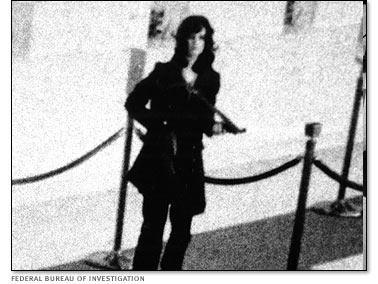
But the nation was stunned, and sympathy for Patty quickly evaporated (although sympathy for her parents increased, if anything) when she was photographed during a bank robbery, holding a gun and looking tough:

The shocks kept coming. A further tape featured Patty saying:

…that she and her “comrades” had robbed the bank. “My gun was loaded,” she claimed, “and at no time did any of my comrades intentionally point their guns at me.” Their actions were justified to finance “the revolution.” She called her parents “pigs,” dismissed her fiancé, and then said, “As for being brainwashed, the idea is ridiculous to the point of being beyond belief.” She ended by declaring that “I am a soldier of the people’s army.”

I wish I could offer a link to an actual recording of her voice, because I’m convinced that something about it—a certain snotty casualness, a cadence of disdain, an almost Valley Girl emptiness—caused people’s blood to boil on hearing it. And then, later, still another tape was released, in which Hearst declared:

I’ve been given the choice of one, being released in a safe area, or two, joining forces with the Symbionese Liberation Army and fighting for my freedom and the freedom of all oppressed people. I have chosen to stay and fight.

The rhetoric was perfect, and it was utterly convincing. Patty took the revolutionary name “Tania,” (after a female associate of Che Guevara’s—good old Che, he’s always in the picture) and posed wearing a fetching beret, looking very thin. It was one of the first examples of radical chic I ever saw:

The reaction to the robbery, the photos, and Patty’s declaration was electric. Hatred for her grew, even among those who’d been predisposed to sympathize before. As for me, I didn’t know what to believe about her sincerity. But—perhaps because of my background in reading about brainwashing and thought control—I thought the most likely explanation was that some sort of process of coercion had gone on. After all, she’d been an impressionable young girl, not even out of her teens, subjected to a horrific experience and under the total control of people who were both extraordinarily violent and politically inclined. Why would they not have made every effort to brainwash her, and what possible strength could she have drawn on that would have enabled her to successfully resist?

But when I tried to argue that these things were even a possibility I was shouted down. I seemed to be in an extreme minority. I vividly recall attending a dinner with my parents and about four other couples who were their friends—liberal Democrats all, people with children roughly around the age of Patty Hearst. I’d known all these people my entire life and had never had a political argument or even a disagreement with them, and they’d always seemed to be relatively mild-mannered. Several of them were in the field of social work, a profession that one might think would predispose them towards sympathy for Patty’s plight.

But no. In fact, the topic of Patty brought out a surprising rage in them. If Patty were ever to be captured, she should be prosecuted to the fullest extent of the law. There was absolutely no possibility, they screamed at me, that she hadn’t done all of this of her own free will, and there should be no excuses made. I was a gullible fool.

It seemed to me that all the frustrations of parents of the 60s and early 70s towards the excesses of their offspring—the long hair and the pot-smoking and the open sexuality and the music and the refusal to follow in those parents’ footsteps and become doctors and lawyers and upstanding community members; the turning on and the dropping out and the living on the hippie communes, as one of my cousins had done (although her parents didn’t even know it was actually a naked hippie commune)—everything these parents had been swallowing, all the rage and confusion and hurt they hadn’t fully expressed towards their ungrateful children, was coming out in one great big rush at Patty Hearst, who symbolized it all.

I decided to wait and reserve judgment. As it turned out, I had a long time to wait.

[To be continued in Part II, tomorrow….]

Posted in People of interest, Terrorism and terrorists | 24 Replies

Weaving the tangled web of deception: confessions of an April fool

The New Neo Posted on April 2, 2006 by neoNovember 23, 2024

Well, it’s the morning after (or, rather, the afternoon after). And in the sober light of a non-April Fool’s Day, as I reflect back on my little prank of yesterday, I’m chastened. Chastened, but still a neo-neocon.

I had no idea so many people might think, even for a moment, that yesterday’s post was true. I feel a tiny tiny bit like Orson Welles after his “War of the Worlds” radio show stunt.

When I was quite young, my mother had told me all about Welles’s hoax, which she vividly remembered. Welles asserted he had never meant to fool anyone into thinking the Martians had actually landed. And in fact there were disclaimers at the beginning of the show and at an intermission, but (at least according to my mother) most people missed the beginning because they were listening to the end of another very popular radio program (if memory serves me, Edgar Bergen and Charlie McCarthy). And later, people were too panicked to hear:

Welles had no idea of the consequences of this seemingly innocuous choice of entertainment. The play used the names of actual places well known to most, especially those on the east cost, and was set in current time with its use of apparent live and remote announcers in the field,; tales of fiery meteors falling to the earth… of strange metallic cylinders embedded in the ground emitting unearthly noises and the subsequent uprising of monstrous, mechanized Martian war machines bent on world conquest. The play became all too real for hundreds of thousands of Americans who were apparently glued to their radios aghast. Whether they missed the introduction and the intermission, both of which stated plainly that what was being broadcast was merely a radio-play, or whether holiday spirits enhanced the naturally alarming elements of something dreadful and terrifying coming from another world… we’ll never really know. But it became known as the night that panicked America.

As I said, I only feel a little bit like Welles. And, speaking of which–at the time of the Halloween hoax, Welles was only a little bit like the Welles he later became. Take a look:


Definitely–most definitely!–hotter than John Dean of Watergate times.

I had another “interesting” April Fool’s experience yesterday. I was at the customer service counter ( a somewhat Orwellian designation, in this case) of a major chain store that will remain nameless. I was having one of those experiences I often have there, in which something that was supposed to have been put on hold was nowhere to be found. While I waited, and waited, another employee was dealing with the somewhat easier business of a youngish man next to me. The customer seemed a trifle spacey; he seemed to think it was Friday, not Saturday. The clerk told him what day it actually was, and added–with a great big smile–“And don’t forget to set your clocks forward tonight!”

Now, I’d somehow missed the fact that it was time to reset the clocks again (how, I don’t know; perhaps I‘m the space shot). But because of the clerk’s huge smile (I even imagined I’d seen him wink conspiratorially), I was sure it was an April Fool’s joke.

This placed me in an uncomfortable ethical dilemma. Should I remain silent, let the prank stand, and allow this poor young man to go home, set his clock ahead, and bear the consequences? Or was it my duty to be a party pooper and to warn him that his leg was being pulled?

Ah, the stresses of trying to live the moral life. I mulled the quandary over a while, deciding to remain silent, but after a few minutes more of guilt (that poor man! He’d wake up tomorrow and he’d miss church, or brunch with his mother, or whatever, and it would be my fault, all my fault!) I could take it no more. I blurted out that it was April Fool’s Day, and added that it was not the day to change the clocks; that that had been a joke. This time the clerk looked at me with a big, broad smile (no doubt thinking that I had decided to make a rather clever and convoluted April Fool’s joke). Transaction over.

I went home that evening feeling the warm glow of self-righteousness. Duty had called, and I had not shirked it. I had saved that young man from the dire consequences of the cruel hoax the clerk had been trying to play on him. And I basked in that warm glow of the doer of the good deed, right up until late that night when I turned on the TV and discovered that it was in fact time to set the clocks forward–and felt myself to be quite the April fool, indeed.

Glad it’s the 2nd.

Posted in Best of neo-neocon, Me, myself, and I | 18 Replies

Exclusive: neo-neocon rerats

The New Neo Posted on April 1, 2006 by neoAugust 17, 2007

[HINT: note the date]

If you’re a regular reader here, you probably already know that Winston Churchill is my idol– well, one of my idols, anyway, along with all the contestants on “American Idol.”

One of Churchill’s many famous quotes is “Anyone can rat, but it takes a certain ingenuity to rerat.” Now, for those of you who don’t speak English English, the term “rat” refers to a change of political affiliation. Churchill started out as a Conservative, became a Liberal a few years later, and about twenty years afterwards returned to the Conservative Party.

Well, even though he’s someone I look up to, I really can’t follow in his footsteps. For one thing, I’m sure his feet were a lot bigger than mine. For another, I’m not British, and I’ve never smoked a cigar. And it’s too late to follow his political trajectory, because I didn’t start out as a Conservative (although I certainly would have if I’d known that he had; that’s how much I admire the man).

But there is one way in which I’m already like him: I’ve ratted. Big time. And today I’m announcing another way I intend to be like Churchill: I’m going to rerat.

Yes, it’s official: neo-neocon is returning to her roots and becoming a liberal Democrat once more. I’m not sure what to rename the blog: perhaps “neo-exneocon?”

But I’m not going to worry about nomenclature at this point. In fact, I’m not going to worry about anything. I’m going to stick my head in the sand and put my fingers in my ears (although that might be difficult to do simultaneously) and I will Whistle a Happy Tune, as long as I don’t get sand in my mouth.

Because I am tired. Bone tired. And I can see it now: the prodigal daughter will return, and I’ll be welcomed with open arms. They’ll kill a fatted calf, and we’ll have a barbecue and some brewskis. I’ll lay down my weary load. And I can take that silly apple away from my face before the computer company or the Beatles or Magritte’s estate ends up suing me.

“Why, neo-neocon, why?” you might ask (except, don’t call me that any more!). The turning point might seem rather odd. In fact, it is rather odd. But please try to understand, and to forgive–it comes from a love long suppressed.

“Love?” you ask. “What’s love got to do with it?” The answer: John Dean.

Yes, John Dean, Watergate whistleblower. I had a tremendous crush on him back in 1973. Don’t laugh, he was hot; and he didn’t have any holes in his soles:

Although I liked him better with the glasses on–but I digress.

All these long intervening years I’ve been wondering where he’s been–and if his wife Mo (she of the slick-backed every-hair-in-place blond bun)

is still there with him, (turns out she is).

And then, lo and behold, when I’d almost given up hope, yesterday he ups and testifies in front of the Senate Judiciary Committee, asking that Bush be censured for eavesdropping on calls to terrorists without getting warrants.

Dean said that Bush’s offenses are even more serious than Nixon’s during Watergate. I’m not so sure I follow exactly why that might be, but Dean ought to know–after all, he wrote the book on Watergate (or rather, he had the book on Watergate partly ghostwritten by Taylor Branch. Whatever.)

And, not only did he write the book on Watergate, but he wrote the one on Bush, too, the one that said Bush’s offenses were worse than Watergate (that’s the title, Worse Than Watergate), although it was written before the wiretappings were revealed.

When I heard that Dean was testifying again, the years fell away and I saw the error of my recent ways. I know it’s sudden, and may not seem very well-thought-out, but that’s the way I am: impulsive, emotional, madcap, throwing caution to the winds.

And so it’s over for me, this crazy neocon venture. It was a good trip while it lasted, but I’m returning to my roots.

At least, that is, till April Fool’s Day is over.

[NOTE: In the interests of clarity, and to any readers out there who may not be aware of this fact, I am hereby stating that today, April 1st (otherwise known as April Fool’s Day) is a day in which hoaxes and practical jokes are traditional in the English-speaking world, as well as in France.

So, there’s been no reratting; all of this was merely an attempt (and probably a feeble one, at that) at a joke. Neo-neocon will remain neo-neocon for the foreseeable future.

But I actually did have a tiny little crush on John Dean back in ’73. Loved those glasses.]

Posted in Me, myself, and I | 37 Replies

The guilt of Europe survives

The New Neo Posted on March 31, 2006 by neoJuly 25, 2009

Shrinkwrapped has written a series of thought-provoking posts on the survivor guilt of post-WWII Europeans, and how they might be dealing with it. Well worth reading. Three parts have been already written, and a fourth is planned.

He writes of an ex-patient of his (“Gudrun”) who seemed to take on the burden of guilt for what her parents–who were not high-level Nazi functionaries but ordinary Germans–did (or didn’t do) during World War II. Her extreme sense of shame about her mother’s family’s failure to protect and save Jewish neighbors caused Gudrun to sabotage her own life in many ways, and to decide never to have children.

In Part III of the series, Shrinkwrapped connects the present-day pacifism and passivity of many Europeans with their failure to face their own guilt about their (or their parents’) behavior during World War II.

There is no question that Europeans were deeply traumatized by both World War I and World War II in a way that we Americans–who fought in both wars but did not experience destruction on our own soil, nor were we faced with the sort of “Sophie’s Choice” decisions that many Europeans faced–may find it hard to fathom. Part of the European experience was their own relative guilt in the Holocaust, and this was not just true of Germans. The example of the maternal family of Shrinkwrapped’s patient “Gudrun” is an excellent one: they were faced with the choice of trying to save their Jewish friends and neighbors at the risk of danger to themselves, and they chose their own safety over heroism. They were not evil people, but they were passive when they might have been active against evil. Every European who was not an active member of the resistance during the war, and their children and children’s children, must on some level deal with the issue of guilt.

Some, of course, deal with it through denial or even identification with the aggressor. Some just aren’t troubled by such concerns and consider the past the past. Some, such as Shrinkwrapped’s patient, are tortured by guilt even though they, as individuals, bear none (Gudrun wasn’t even alive during the war). We don’t know enough about the human heart and mind to explain such differences; we merely note them.

Shrinkwrapped writes that the source of current European attitudes towards the Jews may also be found in their WWII experience and the need to deny feelings of guilt that, if accepted, might threaten to overwhelm them, as they did Shrinkwrapped’s patient:

The European elites show a great deal of pathology in their culture. They attempt to deal with their shame by attacking what they see as the source of their shame. If the Jews would only disappear, the memory of the Holocaust could be consigned to the distant past and never thought of again.

I would phrase it somewhat differently. I don’t think the desire is for the Jews to disappear, exactly. But I think the desire is to prove the Jews to be as guilty as the Europeans were, and thus to absolve the Europeans of guilt for participating in and cooperating with the Holocaust in such great numbers. And if the Jews and/or Israelis should happen to disappear as a side-effect of the present-day attitude of the Europeans, then so be it.

This can be seen in the eagerness with which explicit and frequent comparisons are made between Jews–especially Israelis–and Nazis. And, in a separate but related phenomenon, I think it’s at least partly behind the comparison of Bush to Hitler. If the Israelis/Jews (and American Presidents) are as bad as the Nazis and their European collaborators, this serves a double function: first, it norms Europe’s behavior during WWII (“see, there’s nothing special about the guilt of Europeans, move along now”); and second, it can even be seen as justifying the Holocaust, as well (“Jews are evil, so it was okay for us to cooperate in attempting to destroy them”).

Anti-Semitism and anti-Americanism not only both have a long history in Europe (the first phenomenon is an ancient one; the second has existed for centuries), but they both have a more recent function, and that it is to deflect and sooth European guilt. As the case of Shrinkwrapped’s patient indicates, guilt can be an extremely unpleasant and sometimes even unbearable emotion. It’s not so surprising that people will do what they can to avoid feeling its ravages.

One other thing about guilt and Europe. There is some connection between guilt and religion. No, it’s not at all necessary to believe in religion to feel guilt. But guilt is an emotion specifically addressed by religion: when it is appropriate for a person to feel it, and the various ways for which it can be atoned. It’s beyond the scope of this particular post to go into the manner in which different religions answer these questions; but suffice to say it’s one of the major tasks of religion to try to give people a way to assess guilt, and then to expiate it.

Europe has become far less religious in recent decades, and perhaps the loss of this mechanism for dealing with guilt is another reason the emotion has to be so strongly deflected there. What remains as a tool for dealing with guilt is the somewhat secular religion of psychiatry and psychology, and Shrinkwrapped’s tale of his patient’s treatment reveals some of the limitations of that approach to the problem.

Would Gudrun–and other European survivors and their children–be helped by mechanisms such as the Catholic confessional, or Yom Kippur and other Jewish mechanisms for expiation (please see this fascinating discussion of the Jewish attitude toward repentance and forgiveness)? Perhaps.

In any event, Europe’s unshrived and denied guilt can go on to produce monsters:

Posted in Religion, War and Peace | 27 Replies

History reasserts itself, in rhyme

The New Neo Posted on March 30, 2006 by neoAugust 4, 2007

Gerard Van der Leun has written a rumination on the return of history, post-9/11.

I offer a few excerpts here, although they don’t really capture the full flavor of the thing (to do that, it needs to be read as a whole):

The History of Me was huge in the 90s and rolled right through the millennium. It even had a Customized President to preside over those years; the Most Me President ever…It was better when we lived in The History of Me…The meaning of this history was not deep but was to be found in the world “fun.”…

Now we find ourselves back in history as it has always been and it is not fun. Not fun at all. The history of history has little to do with fun, almost nothing at all.

Should the nation choose to continue in the elections of this year to move forward, to stay the course and continue the offensive, our encounter with history will move forward at much the same pace as it has these past four years, perhaps a bit accelerated. Should the nation choose to step back, to retreat, it will simply retard the process that grips it a bit more than otherwise might be the case. Neither result wil place us back in the History of Me no matter how many yearn for it.

History, having returned, will continue to happen, not to Me, but to Us.

We will have war whether we wish it or not…

Personally, I wasn’t too much a part of the 90’s “Me” movement, although I remember noticing it. I was too busy raising a child and going to graduate school, and listening to the personal histories of my clients.

But during that decade I definitely relaxed my grip on the notion of being part of a larger history that was frightening; with the end of the Cold War I thought history had turned out to be a paper tiger, a pussycat compared to what we had expected during the 50s and 60s. This perception was a big relief to me (which I’ve written about here).

Call me naive–and you would be correct to do so–but those were the years in which pears loomed much larger than tanks, in Milan Kundera’s image, and I was happy to see those pears. Who wouldn’t have been? Yes, there were rumblings that not all was well–many rumblings, if I look back and see with different eyes–but somehow the haze of optimism continued to obscure where this was all heading.

I think a good analogy to those years was the era shortly before WWI, when people thought mankind was progressing almost inevitably to a better and better future. There had been a long time of relative peace, and then “poof!”, it all blew up in their faces in a way they hadn’t ever imagined, barbaric and bloody and seemingly endless. As the British poet Philip Larkin, quoted in Paul Fussell’s wonderful book The Great War and Modern Memory, wrote: “never such innocence again.”

Well, I guess one should never say “never”–since it turns out that many (although not all) of us were so innocent once again. And many still remain so, despite 9/11.

That is, almost so innocent; the innocence of those pre-WWI Europeans seems to have been even more profound, as Fussell describes it:

Out of the world of summer, 1914, marched a unique generation. It believed in Progress and Art and in no way doubted even the benignity of technology. The word machine was not yet invariably coupled with the word gun.

As Henry James, spokesman for the disillusionment of the era, wrote to a friend on the day afer the British entered the war:

The plunge of civilization into this abyss of blood and darkness…is a thing that so gives away the whole long age during which we have supposed the world to be, with whatever abatement, gradually bettering, that to have to take it all now for what the treacherous years were all the while really making for and meaning is too tragic for any words.

I’ve written at some length here about my own 90s version of the glorious prewar summer of 1914, in which I’d imagined that we’d somehow escaped the horrific apocalypse envisioned in the ’50s–in other words, that we’d escaped history. I, much like James, had lacked a sense of what those years were “making for and meaning.”

But on 9/11 I had an almost instantaneous perception that this threat was more serious than anything that had come before, at least in my lifetime, because this opponent had revealed itself to be unusually implacable, determined, and vicious; and was quite unconcerned with such mundane affairs as living. The latter represented the unique thing about this particular enemy; the Dark Ages had somehow merged with the Quantum Age, and it was not a good combination.

But one thing I never envisioned on 9/11 was the fact that, despite my sense that we could be successful in beating back these destructive forces if we ourselves had some unity of purpose and resolve, many people would be only too eager to go right back to their sweet dreamy repose (what Gerard Van der Leun calls “fun”) and to think that it was Bush who was the real bogeyman–that he’s the one spoiling all the fun, for his own nefarious purposes.

So history is indeed–to paraphrase another writer, James Joyce–a nightmare from which many of us try to awake. But try as we may, it reasserts itself into our lives, not with a whimper but with a bang.

This page of history quotations contains quite a few gems, such as one from the much-maligned Machiavelli:

Whoever wishes to foresee the future must consult the past; for human events ever resemble those of preceding times. This arises from the fact that they are produced by men who ever have been, and ever shall be, animated by the same passions, and thus they necessarily have the same results.

And one of my favorites, from Mark Twain:

The past does not repeat itself, but it rhymes.

And how about this, by Anonymous (not the same “anonymous” who posts here, I’m afraid):

We cannot escape history and neither can we escape a desire to understand it.

And I didn’t realize Harry Truman was this much of a philosopher:

The only thing new in the world is the history you don’t know.

And then there’s an observation by Cicero that seems apropos:

To be ignorant of the past is to remain a child.

I will close with a simple statement by Lincoln, from his message to Congress of Dec. 1, 1862,

We cannot escape history.

But that sure doesn’t stop us from trying, does it?

Posted in History | 29 Replies

Spring: moving right along

The New Neo Posted on March 30, 2006 by neoMarch 30, 2006


What a difference a week makes.

Posted in Uncategorized | 2 Replies

The Rahman case and the Inquisition

The New Neo Posted on March 29, 2006 by neoJuly 25, 2009

Now that the case against Abdul Rahman has been dropped, Italy’s Silvio Berlusconi has offered him sanctuary:

“I say that we are very glad to be able to welcome someone who has been so courageous,” Premier Silvio Berlusconi said.

Berlusconi himself is no slouch in the courage department. And of course who could forget another incredibly brave Italian, Fabrizio Quattrocchi.

The Afghan clerics, however, haven’t given up:

Muslim clerics condemned Rahman’s release, saying it was a “betrayal of Islam,” and threatened to incite violent protests.

Some 500 Muslim leaders, students and others gathered Wednesday in a mosque in southern Qalat town and criticized the government for releasing Rahman, said Abdulrahman Jan, the top cleric in Zabul province.

He said the government should either force Rahman to convert back to Islam or kill him.

“This is a terrible thing and a major shame for Afghanistan,” he said.

Note the word “shame” here, and the notion that killing this man for his change of religious faith would somehow restore a sense of honor! Of course, in the eyes of most of us, it would only have increased Afghanistan’s shame. But Abdulrahman Jan and others don’t seem to agree.

On reading Abdulrahman’s chilling words, The Spanish Inquisition was the first thing that came to my mind. But, on further reflection, I decided that the comparison was not all that apt, despite certain similarities.

The Inquisition, although it featured the same sort of violent religious absolutism with death as the Draconian punishment, was actually dedicated to the opposite goal of Islamic clerics such as Abdulrahman Jan. Inquisitors–including, of course, the famous Torquemada–were interested (or professed to be interested; their motives were probably far more complex than that) in rooting out false converts to Catholicism. They were involved in preventing people from insincerely professing to be Catholics, whereas the Moslem clerics are interested in preventing people from leaving Islam, no matter what their consciences might dictate.

It’s an interesting difference of emphasis, is it not? The Moslem clerics are only looking at the outward appearance of things, whereas the Inquisitors took individual beliefs into consideration, or at least said they did. But both involve imposing the ultimate punishment for what we would consider to be no crime at all: a change of religious conscience. That’s a process our post-Enlightenment minds would regard as the domain of the individual, and solely between him/her and the deity.

The present-day Moslem clerics don’t seem to regard the actual viewpoint of the individual involved to be of any importance; obedience to the faith is the goal, whatever the internal belief system. Of course, in a way, that’s better than the Inquisitors: at least one can get around the Moslem system by a public lie and a profession of adherence to the Moslem faith. That was exactly what the Inquisitors were interested in eliminating.

So, you pays your money and you takes your choice. Suffice to say they are both abominable ways of dealing with a matter of individual belief.

In researching the Spanish Inquisition briefly for this post, however, I came across a fact I hadn’t previously known (that is, if one can believe the Wikipedia article in this respect), which is that the Pope of the time was initially against its excesses, but later bowed to political pressure from Ferdinand and gave the Spanish Inquisition his approval. And note the role of the war with Islam in the entire story of how this pressure was brought to bear:

The Pope did not want the Inquisition established in Spain at all, but Ferdinand insisted. He prevailed upon Rodrigo Borgia, then Bishop of Valencia and the Papal Vice-Chancellor as well as a cardinal, to lobby Rome on his behalf. Borgia was partially successful, as Pope Sixtus IV sanctioned the Inquisition only in the state of Castile…

Sixtus IV was Pope when the Spanish Inquisition was instituted in Seville. He worked against it, but bowed to pressure from Ferdinand, who threatened to withhold military support from his kingdom of Sicily. Sixtus issued a papal Bull establishing the order in 1478. Nevertheless, Sixtus was unhappy with the excesses of the Inquisition and took measures to suppress their abuses.

The Pope disapproved of the extreme measures being taken by Ferdinand, and categorically disallowed their spread to the kingdom of Aragon. He alleged that the Inquisition was a cynical ploy by Ferdinand and Isabella to confiscate the Jews’ property…

Ferdinand had some important levers he could use to bend the Pope to his will. Venice, traditionally the defender against the Turks in the East, was greatly weakened after a protracted war which lasted from 1463 to 1479. The Turks had taken possession of Greece and the Greek islands. France, as always, was looking for signs of weakness which it could use to its advantage. And in the midst of all these threats, in August of 1480 the Sultan of Turkey had attacked Italy itself, at the port of Otranto, with several thousand janissaries who pillaged the countryside for three days, largely unopposed.

Under these conditions, Ferdinand’s position in Sicily ”” he was king of Sicily as well as Aragon and several other kingdoms ”” gave him the leverage he needed. He threatened to withhold military support for the Holy See, and the Pope relented.

Sixtus then blessed the royal institution of the Spanish Inquisition. Ferdinand had won everything he sought: the Inquisition was under his sole control, but had the blessing of the Pope.

So the Inquisition received the Pope’s blessing in order to counter the threat of the Moslems battering at the gates of Italy.

Another interesting point is that, although converted Jews were definitely a major target of the Spanish Inquisition, Moslem converts to Catholicism were definitely very much at risk as well:

There were many motivations for Ferdinand to create the Inquisition. Spain, historically an area with disparate religious traditions and ethnic groups, needed a common religion – Catholicism – if it was to have a sense of unity. Ferdinand was particularly concerned with false converts to Catholicism who often remained loyal to the rule of Islam during the final years of Reconquista, and the Inquisition, which had no jurisdiction over non-Catholics, was his method of identifying them.

I mention all of this as a matter of historical interest only. What I’m most definitely not saying is that, because Christianity (or any other religion, for that matter) has had its wretched and horrific (and yes, shameful) excesses, that this fact would in any way justify or excuse what’s happening today with Islam.

The important thing is that today there is no longer any Inquisition in Christianity, nor does there appear to be any on the horizon. In fact, all the great world religions of today seem to have adopted religious tolerance as a whole, as well as respect for the individual religious decisions of adherents, into their worldviews–except for one.

Yes, there are Christian sects who believe nonbelievers are doomed to eternal punishment. Yes, there are members of certain religions who shun and ostracize those who leave the fold. But that’s a far, far cry from calling for their deaths. No, there is only one religion today that does this, and that is Islam.

And yes, I’m sure not all adherants of Islam subscribe to the idea that apostates and converts must die. But it seems to be an extremely common position. It puzzles me that a religion that believes in itself wouldn’t have more faith in its own ability to draw people to the fold–and to keep them there without the rather persuasive compulsion of the threat of death.

[NOTE: And this guy reminds me a bit of the Taliban. Bonfire of the Vanities, anyone?]

[ADDENDUM: Here are some figures on the official Moslem legal position on the crime of apostasy, including how often it is prosecuted in the Moslem world:

A broad consensus exists through much of the Islamic world that apostates from the faith deserve to be killed. This consensus could be glimpsed in Abdul Rahman’s case, where the judge, Ansarullah Mawlavezada, said, “In this country we have the perfect constitution. It is Islamic law and it is illegal to be a Christian and it should be punished.” Even the Afghanistan Independent Human Rights Commission, expected to take a more moderate stance, called for Abdul Rahman’s punishment, claiming that he clearly violated Islamic law.

But apostasy laws stretch far beyond Afghanistan. At least 14 Islamic countries make conversion out of Islam illegal. The crime is punishable by death in at least eight of these states, either through explicit anti-apostasy laws or the broader offense of blasphemy.

Official proceedings against those who convert out of Islam are rare, at least in part because most of those who leave Islam choose to keep it secret. More often the government looks the other way while irate citizens mete out their own punishment. In July Paul Marshall, a senior fellow at Freedom House’s Center for Religious Freedom, estimated that dozens of apostates from Islam had been killed throughout the world in the previous year. Bolstering Marshall’s estimate, the Compass Direct News Agency was able to identify 23 expatriate Christian workers who were killed in the Muslim world between 2002 and July 2005.

So, although the law is on the books in many countries, prosecution is usually left to the mob, and is not all that common even then. This, at least, is better than if these prosecutions and/or killings were an everyday event. But still, not very encouraging.

The article concludes with the assertion–and I agree–that it is necessary not only to encourage the growth of democracy in countries such as Afghanistan, but the concomitant protection of human rights. Freedom of religion is one of the most basic human rights–one we hold to be “self-evident,” under the rubric of “liberty”–and it must go hand in hand with any democracy.

This idea, of course, is on a collision course with the principles of Islam. The Rahman case is important because it confronted this inherent contradiction, which must be resolved if this sort of thing is not to go on. And since it strikes to the heart of Islam, the resolution is not going to be easy, I’m afraid.]

Posted in Afghanistan, History, Religion | 33 Replies

I guess I need to be careful about that apple logo

The New Neo Posted on March 29, 2006 by neoAugust 28, 2009


I better not start using this site to sell any music, or the Beatles will be breathing down my neck (of course, at an earlier time in my life, that would have been the fulfillment of a dream):

Two legendary companies in the music industry faced off in court Wednesday in a trademark battle over a piece of fruit.

Apple Corps Ltd., the Beatles’ record company and guardian of the band’s musical heritage and business interests, is suing Apple Computer Inc., claiming the company violated a 1991 agreement by entering the music business with its iTunes online store…

The computer company’s logo is a cartoonish apple with a neat bite out of the side; the record company is represented by a perfect, shiny green Granny Smith apple…

The 15-year-old agreement between the two Apples had ended a long-running trademark fight in which each agreed not to tread on the other’s toes by entering into a ”field of use” agreement.

Of course, it’s a good deal more lucrative to sue Apple; their pockets are just a mite deeper than mine. But still, one can’t be too careful.

Posted in Blogging and bloggers | 13 Replies

The cavalry never came: Moussaoui’s confession

The New Neo Posted on March 28, 2006 by neoFebruary 16, 2008

The ongoing carnival of the Moussaoui trial has introduced still another act: the main character turning the tables on his defense team (and himself) by a spectacular in-court confession during the sentencing stage of his trial.

This gesture of Moussaoui’s may guarantee that he gets the death penalty, which is probably exactly and precisely what he wants.

The Moussaoui trial has become–among other things–an exercise in the negatives involved in treating terrorists as ordinary criminals, including allowing them a bully pulpit for spewing forth propaganda–not that anyone who wasn’t already a jihadi would have been convinced of much of anything by the rantings of Moussaoui. His testimony is also painful for the 9/11 families, who now are confronted with the idea that if this man had spilled the beans earlier, the attacks might have been thwarted (the basis of the death penalty charge for Moussaoui):

The sister of a pilot whose hijacked plane struck the Pentagon on Sept. 11 says watching Zacarias Moussaoui’s chilling testimony on Monday provided new information for families desperate for answers, yet only worsened their emotional wounds. From a federal courthouse, Debra Burlingame watched the al-Qaida conspirator on a special video monitor set up for families of the victims of the attacks….

Burlingame shook her fists as she described testimony that the hijackers would have taken the planes into the ground if they had seen fighter planes in the air around them.

“My brother was a fighter pilot,” she said.

Her voice cracked as she dwelled on a truth too painful to bear: “The cavalry never came. The cavalry never came.”

So, is Moussaoui telling the truth now? He’s given out so many conflicting stories it’s hard to tell. But this one has some legs to it:

Gerald Leone, a former first assistant US attorney in Boston who was the lead prosecutor in the shoe-bombing case against Reid, said yesterday that it is impossible to know whether Moussaoui is telling the truth. Moussaoui may finally be coming clean, he said, or instead is now embellishing his role. But Leone said Moussaoui’s story is consistent with what is known about Reid.

Investigators know that Reid and Moussaoui knew each other, went to the same London mosque and the same training camps in Afghanistan, and had at least one Al Qaeda handler in common, he said. ….

Leone said that Reid told his interrogators that he had been ”disappointed” that he didn’t participate in the 9/11 attacks and that he had had a dream in which he missed a van carrying the 9/11 hijackers and thus could not join the plot….

“It’s just so difficult to tell with a guy like Moussaoui where his motivations and intentions lie,” Leone said. ”I don’t think anyone is even clear whether he considers the death penalty to be a badge of honor or not. He’s clearly said he wants to die a martyr, but not at the hands of the government. So it’s a mixed bag.”

Ah, the sorrow of missing out on all the glory! Failed suicidal jihadis such as Reid (and probably Moussaoui) seem to be plagued by their own version of the student anxiety dream. Bummer.

It is probable that, once a person makes up his/her mind to be a suicide mass murderer, a line is crossed. The person has accepted the necessity and reality of his/her death (I’m tired of this PC gender stuff; from here on in this essay I am just using the masculine, since the vast majority of these people are men); visualized it and gloried in it, as well as expecting that this martyrdom will lead to lasting glory. It must be a cruel cheat to be deprived of such a “consummation devoutly to be wished.”

So, if a man is prepared to die, and considers himself a “dead man walking” already, it’s only the manner of his death that remains at issue. Unable to effect the death of his choice–taking thousands of people with him–he goes for the next best thing, now that his task is done. He has already made the legal system look bad (not so difficult, as it turns out), cost us plenty of money (likewise, not too hard), taken full advantage of the stage he was given, and increased the grief of the 9/11 survivors. Not too bad for a man on trial for his life.

Another motive I think may be driving Moussaoui in particular: from the very start, he has shown great contempt for his own lawyers. Yesterday’s courtroom scene must have been quite the show, his defense attorneys trying desperately to shut him up, and then scrambling to negate what he’d said. So another perk of his confession would be to stick it to the hated lawyers.

It stands to reason that Moussaoui despises their attempts to save him as unworthy of a jihadi, not to mention being stupid (and inexplicable) activities against the US’s own interest, since Moussaoui doesn’t seem to appreciate the US legal system–in fact, he’s made it clear he despises it, also.

All in all, a good day for Moussaoui, by his lights.

[NOTE: A while back I wrote this post discussing the bizarre Moussaoui family and its history. It’s well worth reading, I think–and I think you’ll be surprised by what some of his siblings are up to.

The story of this family is a sad and terrible tale, though a fascinating one (at least to me). I do not, however, offer it as an excuse for Moussaoui, who must bear the responsibility for his own actions.]

Posted in Law, Terrorism and terrorists | 24 Replies

Post navigation

← Previous Post
Next Post→

Your support is appreciated through a one-time or monthly Paypal donation

Please click the link recommended books and search bar for Amazon purchases through neo. I receive a commission from all such purchases.

Archives

Recent Comments

  • charles on An update on my ex
  • Sharon W on An update on my ex
  • om on News roundup
  • huxley on Open thread 9/9/2026
  • Niketas Choniates on Postpartum psychosis is not postpartum depression

Recent Posts

  • An update on my ex
  • News roundup
  • The New Hampshire primary and the continuing saga of Jeanne Shaheen
  • Open thread 9/9/2026
  • Another day, another fraud

Categories

  • A mind is a difficult thing to change: my change story (17)
  • Academia (328)
  • Afghanistan (98)
  • Amazon orders (6)
  • Arts (8)
  • Baseball and sports (164)
  • Best of neo-neocon (91)
  • Biden (536)
  • Blogging and bloggers (595)
  • Dance (292)
  • Disaster (244)
  • Education (323)
  • Election 2012 (360)
  • Election 2016 (566)
  • Election 2018 (33)
  • Election 2020 (513)
  • Election 2022 (114)
  • Election 2024 (403)
  • Election 2026 (94)
  • Election 2028 (13)
  • Evil (129)
  • Fashion and beauty (324)
  • Finance and economics (1,043)
  • Food (317)
  • Friendship (48)
  • Gardening (18)
  • General information about neo (4)
  • Getting philosophical: life, love, the universe (734)
  • Health (1,162)
  • Health care reform (545)
  • Hillary Clinton (184)
  • Historical figures (337)
  • History (716)
  • Immigration (449)
  • Iran (465)
  • Iraq (227)
  • IRS scandal (71)
  • Israel/Palestine (821)
  • Jews (437)
  • Language and grammar (365)
  • Latin America (212)
  • Law (2,977)
  • Leaving the circle: political apostasy (124)
  • Liberals and conservatives; left and right (1,322)
  • Liberty (1,117)
  • Literary leftists (14)
  • Literature and writing (394)
  • Me, myself, and I (1,499)
  • Men and women; marriage and divorce and sex (930)
  • Middle East (384)
  • Military (324)
  • Movies (353)
  • Music (533)
  • Nature (261)
  • Neocons (32)
  • New England (184)
  • Obama (1,738)
  • Pacifism (16)
  • Painting, sculpture, photography (131)
  • Palin (93)
  • Paris and France2 trial (25)
  • People of interest (1,043)
  • Poetry (258)
  • Political changers (178)
  • Politics (2,793)
  • Pop culture (397)
  • Press (1,635)
  • Race and racism (882)
  • Religion (428)
  • Romney (164)
  • Ryan (16)
  • Science (641)
  • Terrorism and terrorists (971)
  • Theater and TV (266)
  • Therapy (71)
  • Trump (1,630)
  • Uncategorized (4,558)
  • Vietnam (109)
  • Violence (1,446)
  • War and Peace (1,028)

Blogroll

Ace (bold)
AmericanDigest (writer’s digest)
AmericanThinker (thought full)
Anchoress (first things first)
AnnAlthouse (more than law)
AugeanStables (historian’s task)
BelmontClub (deep thoughts)
Betsy’sPage (teach)
Bookworm (writingReader)
ChicagoBoyz (boyz will be)
DanielInVenezuela (liberty)
Dr.Helen (rights of man)
Dr.Sanity (shrink archives)
DreamsToLightening (Asher)
EdDriscoll (market liberal)
Fausta’sBlog (opinionated)
GayPatriot (self-explanatory)
HadEnoughTherapy? (yep)
HotAir (a roomful)
InstaPundit (the hub)
JawaReport (the doctor’s Rusty)
LegalInsurrection (law prof)
Maggie’sFarm (togetherness)
MelaniePhillips (formidable)
MerylYourish (centrist)
MichaelTotten (globetrotter)
MichaelYon (War Zones)
Michelle Malkin (clarion pen)
MichelleObama’sMirror (reflect)
NoPasaran! (bluntFrench)
NormanGeras (archives)
OneCosmos (Gagdad Bob)
Pamela Geller (Atlas Shrugs)
PJMedia (comprehensive)
PointOfNoReturn (exodus)
Powerline (foursight)
QandO (neolibertarian)
RedState (conservative)
RogerL.Simon (PJ guy)
SisterToldjah (she said)
Sisu (commentary plus cats)
Spengler (Goldman)
VictorDavisHanson (prof)
Vodkapundit (drinker-thinker)
Volokh (lawblog)
Zombie (alive)

Meta

  • Log in
  • Entries feed
  • Comments feed
  • WordPress.org
©2026 - The New Neo - Weaver Xtreme Theme Email
Web Analytics
↑