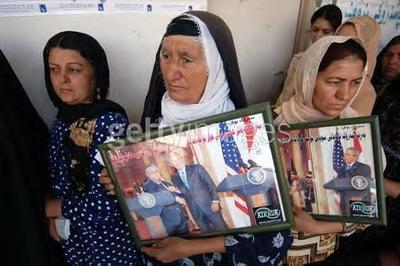
I’ve been looking forward to the sight, and here it is: Saddam on trial.

I watched a bit of coverage, enough to assure me that Saddam was playing his outraged defiant role, as expected, and that the judges are among the bravest men on the face of the earth to let their faces be shown and their names be known.
The sight brought back memories of the joy I felt the morning I learned Saddam had been captured alive, and of the photos of the Iraqi press corps whooping it up on hearing the news. But the danger always was that a living Saddam standing in the docks would try to turn his trial into a showcase for himself, a la the interminable Milosevic trial, and in the process turn himself into that most unlikely of things: a victim.
Makes a person wonder what would have happened had Hitler not killed himself. We’ll never know, but times and attitudes were certainly different then.
As for Saddam, it seems that some media outlets are already taking up his case–the case for the defense, that is. Well, if not the defense exactly, then certainly the case of criticizing the prosecution and the court, and of a sort of sneaking admiration for Saddam’s moxie and “defiance,” a word I’m already heartily sick of.
To paraphrase Sylvia Plath (of all people), in her poem “Daddy”:
Every [left-leaning journalist] adores a Fascist,
The boot in the face, the brute
Brute heart of a brute like you.
Well, it doesn’t scan well as poetry, and yes, it’s hyperbole, but it comes to mind these days when I read things like the NY Times editorial highlighted and discussed today by Captain’s Quarters.
The Times is criticizing the Iraqi court for–oh, well, for just about everything. Being American puppets, for starters; not having a big international tribune trying the case; being bloodthirsty for wanting the death penalty to be a possibility for Saddam; not having a comprehensive trial for all his crimes but taking the easiest charge first (as, by the way, good prosecutors always do: earth to NY Times), saying it looks like a show trial, and so on and so forth.
Can the Times spare a word in the editorial for any sort of satisfaction that the day of reckoning has come for one of the worst murderous tyrants of recent memory? No. On this momentous day of the trial’s beginning, it seems our Blue-Gray Lady’s editorial board can’t manage to muster up even a smidgen of happiness, only a tongue-scolding for the all-too-imperfect prosecution.
And what of the news wing of the Times? The ordinarily relatively fair John Burns and Edward Wong write the story today. It’s an interesting document, which describes Hussein and the court proceedings and then segues into a recounting of objections much like the ones outlined in the editorial–criticisms from Human Rights Watch and the like, as well as opponents of capital punishment; allegations that the US was too involved (for example, the US provided the money for the especially-secure courthouse and has aided the investigation process–horrors!). The article ends with a quote from a group purporting to be spokesmen for the pesky insurgents, condemning the trial.
But to me what was most telling was the article’s failure to give much space to the reaction of the Iraqi people on this momentous day. The following constitutes the sum total of what this lengthy lead article has to say on that subject (keep in mind as you read it that Dujail is the town where the murders for which Saddam is currently being tried took place):
This morning, images on one Iraqi television network showed residents of Dujail calling for Mr. Hussein’s execution. Meanwhile, in Mr. Hussein’s home town of Tikrit crowds gathered to show support for their former leader, chanting slogans such as: “You are still the son of Iraq.” They appeared to be in a frenzy, waving Iraqi flags and photos of Mr. Hussein. Iraqi police, wearing blue uniforms and carrying Kalashnikovs, walked through the crowds but did not appear anxious to break up the demonstration.
So, one TV station showed some anti-Saddam demonstrations–and only from the very town where the massacre occurred. But the Times must balance that tiny little piece of news with a bulletin from Saddam’s homies demonstrating for him.
I’ll not go on too much longer about all of this; the wonder is that it still has the power to surprise me.
I haven’t gone back to read the Times coverage of the trial of these guys, but I imagine it might have been a bit different:

But back to today. As soon as one turns to the far-less-renowned but also less liberal New York Post, one notices the change in coverage. In the following excerpt, the Post doesn’t neglect to balance the happy responses of some Iraqis with the reactions from an area of Saddam sympathizers. But at least it gives due weight to the anti-Saddam feeling of what must be the majority of Iraq’s people:
Many Iraqis gathered around TV sets to watch the proceedings.
“Since the fall of the regime, we have been waiting for this trial,” said Aqeel al-Ubaidi, a Dujail resident. “The trial won’t bring back those who died, but at least it will help put out the fire and anger inside us.”
In Baghdad, Shiite construction worker Salman Zaboun Shanan sat with his family at home in the Shiite neighborhood of Kazimiyah, having taken the day off from work to watch the trial.
When Saddam appeared on television, his wife Sabiha Hassan spit at the screen.
“I hope he is executed, and that anyone who suffered can take a piece of his flesh,” said Shanan, who was imprisoned during Saddam’s rule, as was Hassan and several of their sons.
But across the Tigris River in the mainly Sunni Arab district of Azamiyah, some were embittered by the trial of Saddam, whose regime was dominated by Sunni Arabs who have now lost their power.
“Saddam is the lesser of evils,” said engineer Sahab Awad Maaruf, comparing Saddam to the current Shiite-Kurdish led government. “He’s the only legitimate leader for Iraqis.”
In particular, the Shiite Muslim majority and the Kurdish minority – the two communities most oppressed by Saddam’s regime – have eagerly awaited the chance to see the man who ruled Iraq with unquestioned and total power held to justice.
“I’m very happy today. We’ve prayed for this day for years,” said Iraqi Deputy Prime Minister Ahmad Chalabi, an anti-Saddam opposition leader in exile for years and now one of the fiercest proponents of the purge of Baathists from the new government.
In closing, I’ll return to that Plath poem “Daddy.” It contains another image, one I think captures the understandable sentiment of so many Iraqis who had come to hate Saddam and all he stood for:
There’s a stake in your fat black heart
And the villagers never liked you.
They are dancing and stamping on you.
They always knew it was you.
This is the very human desire for revenge, a desire that is transmuted from its primal savagery into the desire for the accounting and punishment that comes with justice–the justice of a trial. It would be good if our MSM could find it in their hearts to applaud the fact that the Iraqis are on their way to the latter satisfaction rather than the former.
[ADDENDUM: I just came across this NY Times article on their webpage. It deals specifically with the reaction of ordinary Iraqis to the trial and its images. Those of you who are registered with the Times can read the article and see for yourself how, despite paying lip service to the fact that some Iraqis despise him, the thrust of the article is that a) many, many Iraqis still adore him; and b) even those who dislike Saddam have little faith in the trial, but many criticisms of it–almost as many as the Times itself. How very extraordinary.]
[ADDENDUM II: Michelle Malkin has a roundup of coverage and commentary. Michelle highlights the following quote from an article in the Boston Globe, which I thought particularly relevant in light of my final words on the Plath poem and the understandable human desire to take personal revenge:
“We want to eat [Saddam] alive,” said Salimah Majeed Al-Haidari, 60, who spent more than four years in detention, then waited 17 more to learn that her husband and two sons, hauled off by security officers, had been executed. “We wish they would cut him to pieces and hand them out to us and families like us.”]