↓
 

The New Neo

A blog about political change, among other things

  • Home
  • Bio
  • Email
Home » Page 1816 << 1 2 … 1,814 1,815 1,816 1,817 1,818 … 1,863 1,864 >>

Post navigation

← Previous Post
Next Post→

More thoughts on the Hamas victory: liberal and illiberal democracy

The New Neo Posted on January 27, 2006 by neoJuly 25, 2009

Via Austin Bay, I came across this article from the Telegraph, on the Hamas victory:

It was not supposed to be like this. For the past two years, America has pursued the idea that democracy is the answer to Islamist terrorism. Now the Palestinian people have spoken clearly – and they have voted for the terrorists.

It’s true that the US has encouraged the spread of democracy in the Middle East and elsewhere. But it’s a major oversimplification to imagine that America–or, for that matter, those dread neocons–think democracy by itself is any sort of answer to anything at all, except a way to give Jimmy Carter some more business in his old age.

To anyone who may have misunderstood, I declare here and now that democracy, by itself, is not “the answer.” It is, however, part of the answer.

A more complete “answer” would go something like this: it’s democracy, coupled with protection of human and civil rights (including those of minorities and woman), and widespread education that avoids indoctrination in mindless hatred. The goal is liberal democracy. The spread of what might be called “illiberal democracy” (see this lengthy article by Fareed Zakaria) is not the same as the spread of liberal democracy.

We all know that illiberal democracy is possible in the Middle East. The question is how to implement liberal democracy, whether it is realistic to think it can happen, and which elements have to be in place before a democracy can be considered to be liberal.

This is a complex subject for a longer post, to be sure. I don’t have time to tackle it properly today. Suffice to say that democracy cannot mean only “one person, one vote, one time.” That is why we have spent so much effort working with the Iraqis on a constitution that protects human rights and the democratic process itself, even before the popular elections of representatives to a legislative body. Because without these guarantees, it all is close to meaningless.

The PLO has worked hard ever since Oslo to prevent anything that might be considered civil or human rights, or liberty, from taking root in the territory under its sway. In addition to corruption and terror (both internal and external), the PLO dedicated the Palestinian educational system to the preaching of a hatred so deep that it has tainted and warped an entire generation, perhaps beyond repair. Now, Hamas has reaped the benefits of the PLO’s hard work.

So, what has democracy wrought for the Palestinians? Time will tell.

But it is difficult to be the least bit optimistic. The terrible reality is that, for quite a while, there have been no good alternatives in the region. A tyrant such as Arafat put in place a system in which people of good will tended to be murdered or silenced, and corruption was rampant and fanned the fires of rage–which were also carefully stoked by the educational system and the media. A benevolent despot was not going to take power; and the alternative, democracy, was destined to be of the very illiberal sort.

Democracy by itself is not the solution. But it is a beginning, even for the Palestinians, because they now have the responsibility for their own fate. If there are ever to be solutions in the Middle East (and for a long time now I have despaired that there will be any that are not destructive), the path must start with an end to the idea that the Palestinians are passive victims of others. As the Telegraph article states:

If Islamists want to take part in democratic life, then they must learn to live by its rules. The question is not whether Muslim radicals should be elected to power, but what they do in office and whether they can be voted out.

Political Islam has thrived as a protest movement of the disgruntled and dispossessed, attracted by the simple message that “Islam is the answer”. In power, however, Islamists have to find real answers to real problems of jobs, poverty, health and illiteracy….

With Arafat, or even his successor, Mahmoud Abbas, there has always been a debate over whether the Palestinian Authority was unable, or merely unwilling, to stop the violence. Palestinian leaders have turned weakness into a diplomatic art-form, telling Israel and the West they needed more concessions in order to have the authority to take on Hamas. With the terrorists in office, there should be no such ambiguity. When the suicide bombs go off, the address for protests will be obvious: the office of the Palestinian prime minister.

In theory, an agreement with Hamas should be more durable. But can Hamas, like Fatah before it, give up the idea of destroying Israel?

I make a prediction here, and I hope I am wrong: the answer is “no.”

We do live in “interesting” times indeed, and this election has been more “interesting” than most.

Posted in Israel/Palestine, Liberty | 50 Replies

Hamas wins–and now we get to see if they can make anything run on time

The New Neo Posted on January 26, 2006 by neoJanuary 26, 2006

I need a rest, so I’m not planning to write today on the Hamas victory. But fortunately, there’s no need at all for me to do so; the newspapers and the blogosphere have covered the territory.

If you’re looking for places to go for information and discussion, here are a few suggestions for posts and roundups:

Atlas Shrugs

Vital Perspective (many posts)

Kesher Talk

All Things Beautiful

Below the Beltway

Captain’s Quarters

Michelle Malkin

Pajamas Media

National Review

Belmont Club (including comments)

Patrick Belton of Oxblog is on the scene, and has some especially pertinent things to say:

It’s not clear anyone wanted this, least of all Hamas, who in assuming the administration of the Palestinian national authority’s creaking and often corrupt bureaucracy single-handed in a moment when its sole lifeline of European and other international support appears threatened, may just have stumbled into the biggest molasses patch the Harakat al-Muqawamah al-Islamiyyah has ever faced. Unlike the Lib Dems of 1985, Hamas did not go to its constituencies to prepare for government. It had prepared for a coalition, or possibly pristine opposition, but not this….

The mood here, so recently jubilant, suddenly is somber. In Ramallah we are promised a press conference at 7, with final results, and Hamas has said it will declare its intentions after. Does Hamas continue to moderate in its now desperate need to keep foreign aid flowing? It may still yet form a coalition, to provide internationally palatable, unbearded, faces for Europeans and Americans to talk to.

I was wondering what Europe’s reaction will be. It’s difficult for me to imagine that they will be able to continue to believe that Palestine is a partner for peace if Hamas is in charge. And yet, stranger mental gymnastics have occurred. Because Europe has so much invested (literally) in that notion, my guess is that European acknowledgement that the Palestinians have now taken the masks–and the gloves–off will be exceedingly difficult.

Several bloggers have pointed out a parallel with the rise of the Nazis in pre-WWII Germany, saying “Hitler was democratically elected.” I beg to differ, at least slightly.

Yes, Hitler was selected by a Democratic process. But he did not come to power by winning the popular vote. He won neither a majority (difficult to do in a Parliamentary election, anyway), nor a plurality. In fact, he lost, and the Nazi Party’s fortunes were sinking.

That story is told here. An excerpt:

Between 1931 and 1933, vicious power struggles would break out between rival political parties. The power brokers in these struggles were Hindenburg and Schleicher. The problem during this period was that no party even came close to achieving the majority required to elect its leader Chancellor. Coalitions were either impossible to build, or were so transient that they dissolved as quickly as they formed. Ambitious leaders from every party began maneuvering for power, striking deals, double-crossing each other, and trying to find the most advantageous alliances. Hitler himself would ally the Nazis to the Nationalist Party. “The chess game for power begins,” Joseph Goebbels wrote in his diary. “The chief thing is that we remain strong and make no compromises.”

In 1932, hoping to establish a clear government by majority rule, Hindenburg held two presidential elections. Hitler, among others, ran against him. A vote for Hindenburg was a vote to continue the German Republic, while a vote for Hitler was a vote against it. The Nazi party made the most clever use of propaganda, as well as the most extensive use of violence. Bloody street battles erupted between Communists and Nazis thugs, and many political figures were murdered.

In the first election, held on March 13, 1932, Hitler received 30 percent of the vote, losing badly to Hindenburg’s 49.6 percent. But because Hindenburg had just missed an absolute majority, a run-off election was scheduled a month later. On April 10, 1932, Hitler increased his share of the vote to 37 percent, but Hindenburg again won, this time with a decisive 53 percent. A clear majority of the voters had thus declared their preference for a democratic republic.

However, the balance of power in the Reichstag was still unstable, lacking a majority party or coalition to rule the government. All too frequently, Hindenburg had to evoke the dictatorial powers available to him under Article 48 of the constitution to break up the political stalemate. In an attempt to resolve this crisis, he called for more elections. On July 31, 1932, the Nazis won 230 out of 608 seats in the Reichstag, making them its largest party. Still, they did not command the majority needed to elect Hitler Chancellor.

In another election on November 6, 1932, the Nazis lost 34 seats in the Reichstag, reducing their total to 196. And for the first time it looked as if the Nazi threat would fade. This was for several reasons. First, the Nazis’ violence and rhetoric had hardened opposition against Hitler, and it was becoming obvious that he would never achieve power democratically. Even worse, the Nazi party was running very low on money, and it could no longer afford to operate its expensive propaganda machine. Furthermore, the party was beginning to splinter and rebel under the stress of so many elections. Hitler discovered that Gregor Strasser, one of the Nazis’ highest officials, had been disloyal, attempting to negotiate power for himself behind Hitler’s back. The shock was so great that Hitler threatened to shoot himself.

But at the lowest ebb of the Nazis’ fortunes, the backroom deal presented itself as the solution to all their problems. Deal-making, intrigues and double-crosses had been going on for years now. Schleicher, who had managed to make himself the last German Chancellor before Hitler, would eventually say: “I stayed in power only 57 days, and on each of those days I was betrayed 57 times.” It’s not worth tracking the ins and outs of all these schemes, but the one that got Hitler into power is worth noting.

Hitler’s unexpected savior was Franz von Papen, one of the former Chancellors, a remarkably incompetent man who owed his political career to a personal friendship with Hindenburg. He had been thrown out of power by the much more capable Schleicher, who personally replaced him. To get even, Papen approached Hitler and offered to become “co-chancellors,” if only Hitler would join him in a coalition to overthrow Schleicher. Hitler responded that only he could be the head of government, while Papen’s supporters could be given important cabinet positions. The two reached a tentative agreement to pursue such an alliance, even though secretly they were planning to double-cross each other.

Meanwhile Schleicher was failing spectacularly in his attempts to form a coalition government, so Hindenburg forced his resignation. But by now, Hindenburg was exhausted by all the intrigue and crisis, and the prospect of civil war had moved the steely field marshal to tears. As much as he hated to do so, he seemed resigned to offering Hitler a high government position. Many people were urging him to do so: the industrialists who were financing Hitler, the military whose connections Hitler had cultivated, even Hindenburg’s son, whom some historians believe the Nazis had blackmailed. The last straw came when an unfounded rumor swept through Berlin that Schleicher was about to attempt a military coup, arrest Hindenburg, and establish a military dictatorship. Alarmed, Hindenburg wasted no time offering Hitler the Chancellorship, thinking it was a last resort to save the Republic.

On January 30, 1933, Hitler was sworn in as Chancellor.

Posted in Uncategorized | 23 Replies

A mind is a difficult thing to change–Part 6 B (After 9/11: war is interested in you)

The New Neo Posted on January 26, 2006 by neoMarch 1, 2009

[Please note that this is the most recent entry in an as-yet-unfinished series entitled “A mind is a difficult thing to change,” in which I describe the process of my political change and discuss political change in general. The posts in the series are listed in reverse historical order. To find earlier entries, please scroll down to the bottom and then work up. I have started with general discussions of the formation of a political identity, then detailed the formation of my personal political identity and that of many liberals of my generation, with particular emphasis on the Vietnam years. Later posts describe my process of slow post-9-11 change.]

You may not be interested in war, but war is interested in you.
—-Leon Trotsky

INTRODUCTION

This segment of the story begins with a shock to the system: 9/11.

For me, that shock was just the beginning–the catalyst, as it were–of a slow process of change that took several years to complete and probably isn’t over yet. It unfolded in a manner that was mostly solitary and internal; involving watching, listening, reading, and thinking.

Looking back, I realize that two elements were absolutely necessary for this to occur: a powerful motivation, and access to information.

The motivation was provided by 9/11 itself, as I wrote towards the end of my last “change” post:

It now seemed to be no less than a matter of life and death to learn, as best I could, what was going on. I knew it wasn’t up to me to solve this; I had no power and no influence in the world. But still something drove me, with a force that was almost relentless, to pursue knowledge and understanding about this event. The pursuit of this knowledge no longer seemed discretionary or abstract, it seemed both necessary and deeply, newly personal.

The access was provided by the internet. The worldwide media was newly at my fingertips. Without it, I would never have encountered the varied sources that led me down the path of change, but would instead have stuck with the old tried and true–the Times, the Globe, the New Yorker, Nightline, and NPR–and I am certain I would not be sitting here today, writing this blog.

Prior to this, I’d been neither a news junkie nor a history buff. My consumption of such things seems to have been about average: the usual cursory high school history courses plus one or two in college; the quick reading of a daily newspaper and a weekly periodical; and the viewing of the nightly news on TV, background noise while I concentrated on cooking dinner or tending to the family.

In the immediate aftermath of 9/11, I didn’t have a clue that my online reading and increased interest in news, history, and politics would lead to any sort of mind- or life-changing experience. It would be interesting now to be able to look at a list of what I read post-9/11, and in what order I read it (well, maybe not all that interesting, since, for one thing, it would be insufferably long). But since I wasn’t prescient enough to know what was going to happen to me as a result of my reading, I have no such list. So I’ll just have to try to recreate the general course of events as best I can, understanding that it will only be an approximation.

THE DAYS AFTER

Like so many people, I was in a state of heightened emotion and awareness after 9/11. I, who had rarely watched cable news on television, was now viewing it many hours each day, and also reading my usual newspapers and periodicals with greater intensity and focus.

For the first few days after 9/11, I watched President Bush very carefully. He seemed worried and squinty-eyed, brow furrowed in tense puzzlement, speaking words that were meant to be reassuring but sounded hesitant and uncertain. This didn’t surprise me; I’d never expected much of him to begin with.

It’s not that I’d thought Bush was stupid. Not exactly, anyway. I had disabused myself of the “stupid” notion way back during the 2000 Presidential debates. Watching them, I’d disagreed with much of what Bush had said, and I couldn’t stand his cocky manner–it grated on me. But I was grudgingly forced to admit to myself that he was at least passably able to think on his feet.

I’d heard he was dumb so many times that I fully expected him to amply demonstrate it in the debates. He was uninspiring and certainly far from eloquent, and I didn’t agree with most of his ideas, but he stated them with relative clarity. Nothing indicated brilliance, for sure, but nothing he said sounded even remotely stupid.

Some time shortly after those 2000 debates, I’d watched a TV interview with Laura Bush. Most of what I’d seen of her till then had consisted of smiling and waving; I’d heard her say only a few words here and there. She’d seemed to me to be a sort of plastic Stepford wife, controlled and bland. But during this interview there was something–some charm and sweetness, some flashes of humor and wit–and, over all of it, a warmth and ease and graciousness I could not deny.

I didn’t want to like her. But like her I did. And I had to–just had to–further admit that it was unlikely (although not impossible!) that a simpleton or a fool or a creep could have attracted and held on to a woman like that.

But that was a far cry from actually liking Bush or supporting him in any way. I did not. And when the election results had stalled in the seemingly endless vote-counting and court actions, putting everyone through tension and misery, I’d been rooting for Gore all the way–if not with enthusiasm for the man himself, then with fear of the alternative. I hadn’t really been thinking much, if at all, about world affairs during the election–they hadn’t seemed especially important for some years, since the fall of the Soviet Union. No, it was the probability of Bush’s appointing conservative Supreme Court justices, cutting stem cell research, and a host of other conservative domestic policies I was worried about.

Throughout the long back-and-forth of the election and the vote counts, the court rulings and the overrulings, I was on tenterhooks. But when it ended up going Bush’s way, I never felt cheated. Nor did I feel that he’d cheated, although I was bitterly disappointed with the results.

What did I think? I thought the election had been a virtual tie. And I thought that, in the end, the tougher man had won.

Not the better, not the smarter or the kinder, nor the most likely to be a good President–just the more hard-nosed. He hadn’t done anything illegal, in my opinion; he’d merely pushed it for all it was worth, and milked the legal system until he got the result he wanted. And Gore? He’d failed to show the sort of intestinal fortitude required to win this particular battle.

When I thought about it, I didn’t like it, nor did I like Bush. Not at all. But it occurred to me that hard-as-nails toughness might not necessarily be the worst trait to have in a President–that this had been some sort of Darwinian struggle for existence in which the winner was, if not the best man, then the fittest man for the toughest job in the world.

Now, looking back, I see that these three combined notions of mine–that Bush was not a stupid man, that he had to be at least somewhat nice to have a wife like Laura, and that the toughness he showed in the fight to win might not be a bad attribute for a President–must have been somewhat odd in a liberal Democrat. They might, in fact, have been signs of a sort, signs that I was the type of person who, like it or not, couldn’t deny certain evidence if I felt it was right in front of me, who might be ripe for a change of heart and mind if enough evidence ever happened to present itself.

But at the time, I didn’t think in those terms at all. I just figured that, after the disappointing results of the election, I’d settle in for four years of turning off the TV whenever Bush appeared. After all, I’d done that before–especially with Nixon, and often with Reagan. In fact, I was quite a pro at getting through Republican administrations, since the only Presidents I’d ever voted for had been Carter and Clinton.

So when 9/11 occurred, one of the things that had upset me was that Bush was President. I didn’t for a moment think he’d be up to the task–although, to be fair, I also couldn’t imagine that Gore would have been a whole lot better.

During the previous year, to save paper and money, I’d already begun reading my two favorite newspapers online rather than in the dead tree versions. After 9/11 I found the Times‘s series of short biographies on the lives of the WTC victims to be especially moving. I sat at my computer almost every night, weeping as I read it. The dead seemed so young, so promising, so much-loved–and such ghastly, wrenchingly violent ends, such tragic bereaved survivors left behind. Timelines of 9/11, and particularly the story of Flight 93, were riveting, and the latter inspiring, as was the heroism of the firefighters and police.

But this was just the story of the day itself. It was compelling and emotional, but it wasn’t the “why” I so craved to understand.

About a week after 9/11, I happened to turn on my car radio as a man was being interviewed. I didn’t catch his name, but he was talking about Arabs, Islam, and the 9/11 attacks, and relating the whole thing to the history, philosophy, culture, and religion of the region. After a few sentences I knew I needed to learn more about him, and to read some of his books, because here was a person who seemed to have thought long and hard about the very questions that were haunting me.

The man turned out to be Bernard Lewis. I learned that he was elderly, and that he was a leading scholar of Moslem and Arab history, culture, and literature who’d been writing on the subject for decades, unbeknownst to me. Here was someone attempting to explain the terrorists (see this, for example), embedding the whole thing in history and context.

I didn’t know whether Lewis was correct or not–how could I? But what he said sounded plausible, and had as foundation his long lifetime of scholarship. And what was most impressive to me was that his forthcoming book What Went Wrong, on which this interview was based, had already been written–although not yet published–before the 9/11 attacks occurred.

Talk about topical! You may recall, if you’ve read my previous essay in this “change” series, that I’d been puzzled and disappointed by the failure of the media and most experts in the field to have accurately predicted the collapse of the Soviet Union. So one of the things that gave Lewis credibility with me was the fact that he had seemed to “get” 9/11 before it had even happened, and to be wrestling with the “why” of it before many of us were even perceiving the extreme seriousness of the threat.

BUSH ADDRESSES CONGRESS POST-9/11

After 9/11, President Bush was to address a joint session of Congress. Only ten days earlier the building had been evacuated in panic, and by now it was strongly suspected that it had been the real target of Flight 93. The situation felt very dramatic as I turned on the TV and awaited his speech.

I knew security was tight, but that fact didn’t totally reassure me. It seemed far-fetched, but if a plane had swooped down just as Bush had begun his speech, crashed into the center of the assemblage, and brought the whole edifice down in a fiery furnace, I would not have been especially surprised.

So I was keyed up and apprehensive as Bush strode into the room and onto the TV screen. I expected nothing stirring from him, and nothing even particularly admirable. My goal was a simple one: that everyone assembled live through the speech, and that Bush not stumble and falter so badly that he’d make everyone feel even more uneasy about him.

But Bush looked resolute and seemed focused. His speech was crisp and well-delivered. Both these things were surprises to me; I found them difficult to believe. What’s more, every now and then I thought I could discern in his words the influence of that man I’d heard so recently in the radio interview, Bernard Lewis. Could it be that Bush had heard of him? Or, at least, that Bush’s speechwriters had heard of him?

The broad outlines of the fight ahead were drawn. Bush (or was it his speechwriters and/or advisors? I couldn’t decide) saw this as a global struggle that would last many years and be fought on many fronts. The first one was to be Afghanistan; no surprise there. Bush gave a list of demands to the Taliban and indicated that if those demands were not met, we would bring the war to them.

It’s not that this speech caused me to suddenly develop faith in Bush–far from it. But it went a small way towards indicating that he might have some sort of minimal competence–or rather, a possibility of minimal competence. That was all.

But I absolutely hated–detested–Bush’s message. War! My memories of the Vietnam War were of an endless and bloody struggle that had led to failure and a shameful retreat. The Gulf War hardly seemed relevant here–it had been short, relatively simple, and straightforward; the repelling of an invasion. This promised to be a very different war against a very different enemy, and much more like Vietnam.

As we geared up to go to war in the next few weeks, I found my apprehension increasing. At no point did I consider that this war was avoidable, because it was clear the Taliban would never accede to our demands and turn Bin Laden and the other Al Qaeda members over. It was just as clear that we could not back off. The articles I read in the Times and the Globe during the buildup to the war were exceedingly ominous, and the talking heads on CNN agreed: the predictions were of hundreds of thousands or even millions of people dead in indiscriminate bombing, millions more starving and/or freezing or dying of disease, and a war that echoed both our Vietnam experience and the ten-year Soviet nightmare in Afghanistan itself. A double whammy.

I’d been aware of the latter war, particularly as it had related to the fall of the Soviet Union. The Afghan War was considered to have bled the USSR dry economically and in terms of its will to fight. The almost impenetrable Afghan terrain and weather were factors, and the ferocity and tenacity of the Afghans themselves were legendary. I’d read that this war had been the USSR’s Vietnam, and that it had helped destroy the Soviet Union. Now, repeatedly, I read how these same elements would inevitably trap us there for long and bitter death-dealing years. Over and over, I read that the people of Afghanistan hated us, and had no interest in their own “liberation.” This was going to be a long, vicious, and costly struggle against an utterly implacable foe.

But, unlike Vietnam, it didn’t feel as though there was any other choice now. We had to destroy the Al Qaeda havens in Afghanistan. Unlike Vietnam, once we began this war there could be no turning back and no pulling out. It felt more like I would imagine the start of World War II had felt to my parents’ generation. In this, my then-87-year-old mother was a guide; she said it felt even worse than the beginning of World War II.

As the ultimatums were issued to the Taliban and the deadlines passed, it became clear that the war would begin in a day or two. I remembered old war movies from WWII in which families in England huddled around their radios, listening to the BBC for news of the war, hanging on every word. I felt that way now. Only this time I wasn’t huddled around the radio; it was the computer.

REPORTING THE AFGHAN WAR

Almost from the moment the war began, it seemed to be going very badly. First, there was the killing of Abdul Haq in late October, a man who’d been touted as the most likely person to lead Afghanistan after the war since Massoud, leader of the Northern Alliance, had been killed by suicide bombers shortly before 9/11.

Haq’s death seemed a strange and terrible and confusing thing, with details from a movie. Ambushed, and calling for help with a satellite phone? An unmanned drone appearing in response, but too late to help?

Shortly thereafter, in early November, there was an article by Seymour Hersh that appeared in the New Yorker (see this Slate article discussing it to refresh your memory; the original Hersh article has been impossible for me to locate online so far). The name didn’t ring a bell at the time, although I later did a search and discovered he was the journalist who’d broken the My Lai story so long ago. His Afghanistan article presented our operation there as a disorganized, incompetent tragedy of errors.

It focused on a covert operation that had occurred towards the beginning of the war a month earlier:

…a two-pronged “special operations” (that is, commando) attack last month on a Taliban airbase and on a complex of buildings sometimes used by Taliban leader Mullah Omar. Although the Pentagon presented the operation as successful (intelligence was collected at both sites), the sizzle of the Hersh piece [was] his conclusion that it was a “near-disaster” that left the U.S. military “rethinking” the future of such special operations inside Afghanistan.

I read the entire piece with mounting concern. The Vietnam comparison (although I don’t recall it as being overt) was not lost on me. If this piece could be believed, we didn’t seem to know what we were doing in Afghanistan.

But could it be believed? I trusted my beloved New Yorker, of course. But I could not escape the perception that there was something very odd about this particular article. Not only was it rather poorly written (something unusual for the magazine, as best I could remember)–disjointed and disconnected–but it read like a gossip column. It relied completely on unnamed and unidentified sources, which made a certain amount of sense for a piece about a covert operation during a war in progress. But that meant that the entire incident, and Hersh’s interpretation of it, was something that could not be checked–we had to rely totally on his credibility and reliability, and on that of the New Yorker‘s editors.

And that wasn’t all. I wondered about the point of publishing this piece in the first place. Why did we need to know this so very badly? After all, it wasn’t as though Hersh was alleging that terrible war crimes had been committed, as at My Lai. This was just a single mission ostensibly gone bad, occurring very early in a war against a terrible enemy (surely everyone agreed the Taliban were terrible?)–a war we desperately needed to win, not a discretionary one. I didn’t see that there was any overriding public purpose in exposing this mission as failed; certainly not enough to justify the breach of security and the possibility of harming our morale and enhancing that of the enemy.

So, who was Seymour Hersh, anyway? It may seem hard to believe, but in years past I had never paid particular attention to who had written a story as long as it appeared in a major media source that I trusted. The Times, the Globe, the New Yorker–I trusted that their editors would only publish reliable writers, and that all articles would be scrupulously fact-checked. Yes, I knew that all newspapers and magazines had a political slant (be they liberal or conservative), but that was only in the editorials, right? Even though I knew there might be some underlying agenda, the news pages–the facts–were sacred.

As I write this, a phrase from Paul Fusell’s book about World War I, The Great War and Modern Memory, comes to mind: “never such innocence again.” How can I explain my previous naivete? How had it escaped me that bias was not confined to the editorial pages?

I can’t totally explain it. But I know that part of the answer is that I had not read many publications on the other side in order to compare. Nor had I read many original sources such as speeches on which the articles were based; I relied on the newspapers to summarize for me. To do otherwise would have taken some effort in those pre-internet days–I would have had to have gone to a library, or to have bought a great many newspapers and magazines at a newsstand, and also to have had an interest in investing a great deal of time in the endeavor.

But without any special motivation to do so–for example, everyone I knew read the Times, and I’d been taught since childhood that it was the paper of record–it simply did not occur to me that there was any compelling need to compare or to check sources. I guess that’s what’s meant by the phrase “living in a bubble.”

But the Hersh article piqued my curiosity as well as raising red flags. And now, with the internet, it was so easy to do a bit of research. When I looked Hersh up online, I discovered some odd things. Yes, he’d been the highly respected and honored journalist who’d broken the My Lai story. But I also found other facts that were profoundly disturbing. (Unfortunately, I haven’t been able to locate the exact articles about Hersh that I read at the time, but they were more or less similar to this one and this, which are more recent.)

It turned out that, after his My Lai fame, Hersh had gone on to write for the NY Times during the 70s. He was instrumental in breaking stories about the CIA’s domestic spying, reports that led to the formation of the Church Commission and, ultimately the “firewall” with which we’re familiar today. He also clearly had a leftist political agenda which he was not shy about stating.

But what was far more interesting to me was that he’d departed from the Times under a cloud of allegations that he had browbeaten sources and played fast and loose with the facts. Later, he wrote a series of suspect books (see this one and this), and was taken in by an obvious hoax and forgery during the writing of one of them, a biography of JFK entitled The Dark Side of Camelot.

Many in journalism (some of them even liberals!) had come to regard Hersh as generally untrustworthy; quotes such as the following (from a more recent article) were not uncommon:

“I don’t read him anymore because I don’t trust him,” says Holland. “I find Hersh a perplexing character,” says Newsweek’s Evan Thomas, who has written extensively about the Kennedys. “He’s done great work, but he wildly overreached with the Kennedy book.” These days, Thomas reads Hersh differently. “I read what he writes with some skepticism or doubt or uncertainty.”

The fact that Hersh wasn’t being kept on a tighter leash by the New Yorker editors made me wonder. It caused a flicker–perhaps even more than a flicker–of doubt. But at the time I wrote it off as an isolated incident.

As the war continued through November, I checked the news online several times a day. Because Afghanistan was halfway around the world, I could hardly wait to learn what had happened. In my eagerness to get the latest news as quickly as possible, I started to branch out, searching for English language newspapers in Europe and Asia. I was impatient to hear the latest news of troop movements, bombing reports, battle results, territory gained–and above all, analyses of what it all might mean and predictions of what was going to happen next. Earlier, without the internet, I hadn’t had access to all those widely-flung papers, nor felt the driving need to read the news as soon as it occurred. But now all these sources were just a mouse click away.

I still read my old standbys. But when I started reading many other papers as well, I discovered a surprising thing. The Times and the Globe and most of my previous reading sources (the New Yorker, Newsweek) had pretty much agreed with each other. But now some of the papers predicted widely different outcomes, and analyzed the meaning of events differently. As I got to know the different papers and magazines, however (news ones such as the Telegraph, the Guardian, National Review, and many more), I noticed that each paper was internally consistent, whether optimistic or pessimistic about the war’s progress, or somewhere in-between.

As time went on, the pessimistic ones–the newspapers and periodicals that had predicted a Soviet-style long-drawn-out battle–were being proven wrong. In fact, the Afghan War was over a little more than two months after it had begun (and the Special Forces-type operations that Hersh had trashed had apparently been instrumental in the victory).

The war had lasted only two months and about ten days; it hardly seemed possible. And the casualties? Although there was some variation in the estimates of the civilian casualties of the war, the most reputable ones all seemed to be somewhere between one and two thousand people, nothing like the numbers that had been predicted. Where were the refugees, the plagues, the famines, the dread winter? In addition, our casualties were very low (I can’t find an exact figure, but the total of all US combat deaths in Afghanistan seems to have been similar to that of the Gulf War, between one and two hundred).

It was extraordinary–so different from the prewar predictions as to be nearly miraculous. And to top it all off there were scenes of intense celebration by the Afghan people at what could only be described as their liberation (now, without the scare quotes). It was moving, it was a relief–it was a puzzlement.

THE AFTERMATH

What had happened? How had the media–my media (I hadn’t yet encountered the phrase “the MSM”)–gotten it so wrong? I waited for the explanation.

Where were those prognosticators now that things had gone so much better than expected? When territory had been won in such short order, and with such relatively little loss of life? When the military proved not to have been mired down in quag, but to have been exceptionally flexible and reactive in its tactics? .

Where were they? On to the next gloomy prognostication, that’s where. I never could find the declarations of “we were so wrong; things are much better than they looked just a month ago.” Here was an entire host of Emily Litellas saying, “Never mind.” And now it was on to the next thing: “the Taliban are about to return.”

This had been the first time I had ever followed a war so closely–day by day, almost hour by hour. It was the first time I’d eagerly devoured so many stories as events unfolded. And, most importantly, it was the first time I’d read a variety of newspapers, both geographically and politically. It was the first time I had been made frightened and deeply apprehensive, over and over again, by negative predictions in my favorite papers–and then discovered, to my growing puzzlement and even annoyance, that these predictions bore no more relation to subsequent reality than if they’d emanated from the I Ching. It was the first time I noticed that the more reliable papers had seemed to be the more conservative ones.

But these were only a string of incidents. They were puzzling and disconcerting, but I had no framework to make sense of them. Yes, during the Afghan war the more conservative papers seemed to have been more reliable in their predictions and their facts than the liberal papers. But this had no particular meaning to me. Surely, this was some artifact of the peculiar situation of this war; it was a meaningless anomaly.

Later, some time during the spring of 2002 I was doing a Google search. By chance it led me to my first blog, a now-defunct site the name of which I can’t even remember. The immediacy and vibrancy of the voice, talking about politics as though having a conversation with me in my living room, caught my fancy, and I started clicking on the blogroll. In short order I was hooked on blogs, a fascinating Greek chorus (or set of competing Greek choruses trying to shout each other out) commenting–sometimes brilliantly–on the action.

I was still regularly reading my old liberal sources (NY Times and Boston Globe, the New Yorker and even some new regulars such as the LA Times, the Guardian, and the New Republic). But now I was also reading the Telegraph and National Review, the Wall Street Journal and the Jerusalem Post, MEMRI and English versions of Arab papers, Canadian and Australian and Scottish ones, and the blogs–a vast cacophony of voices. And it was becoming clearer and clearer–at least to me–that the arguments in the media from the middle or the right were making more sense–and had more predictive value–than those emanating from the left.

It was as though I were sitting in a court of law as a member of the jury and being asked to decide a case. Before, I had heard only the presentation from one side. Now I heard both sides, and was trying to give both a fair hearing, and to approach my task without prejudice or preconceived notions. I was reluctantly coming to a certain distressing conclusion: more often than not, the voices on the left were less credible than those on the right.

I still had no notion of changing my point of view about politics in general. But then more events took place, and new reportage on those events. There were several turning points (which I plan to tackle in later installments of this series) in particular: Jenin and the “massacre” that wasn’t; the buildup to the war in Iraq and the reportage afterwards; and my first forays into voicing my thoughts to others, and their reactions to me .

Along the way I encountered constant comparisons to Vietnam, especially in connection with the war in Iraq. This led me to revisit the history of that war. What I found shocked and surprised me, changing my point of view about that war, a view I had thought was etched in stone as hard and enduring as the granite of the Vietnam Veterans Memorial .

Another metaphor: the process was like doing a jigsaw puzzle. At first I only had a few pieces in my hands, and no real way to tell what the picture was going to turn out to look like. But bit by bit I started assembling it, and began to discern the outline of a new form as it was slowly being revealed. In the end, events that were happening in the present merged with a reassessment of the past, enabling the picture to emerge ever more clearly, piece by piece.

Two of the missing pieces to that puzzle ended up fitting quite snugly: new information about those photographs, the ones that had caused such a sensation during Vietnam: the field execution by General Loan, and the little napalmed girl running naked down that dirt road so very long ago.

[Go to Part 7A]

[ADDENDUM: Links to previous posts in this series can be found by scrolling down on the right sidebar and looking under the heading “A mind is a difficult thing to change.”]

[FURTHER ADDENDUM: Norm Geras explains that there is some doubt about whether Trotsky was in fact the originator of the opening quote. Sorry, Trotsky fans.]

Posted in A mind is a difficult thing to change: my change story | 128 Replies

New “change” post

The New Neo Posted on January 25, 2006 by neoJanuary 25, 2006

It’s official: my next “change” post will appear here, either late tonight or by about noon tomorrow.

[disclaimer on]

Warning: it’s long. I may have undergone a lot of changes, but I can’t seem to change that aspect of myself.

Whenever I’m writing one of these things, I feel a bit like a boa constrictor who’s swallowed a rather large and unwieldy elephant (or donkey). It seems all but indigestible; impossible to assimilate. But then it’s done and I feel so much better, although I can’t really evaluate the worth of the project. I can only place it up here and hope for the best.

But one thing kept striking me again and again as I struggled with this particular portion of the story. It wasn’t easy to look back and admit my own previous (pre-9/11) lack of interest in things that were so important, my tendency to skim the surface of the events of our time, and my seemingly blind trust in just a few media sources. My interests lay elsewhere, as they do for so many of us.

And that’s probably not such a bad thing. After all, relationships and people, art and music and theater, fiction and movies, food and nature and work and play, all call to us with insistent voices that should not be denied. Who wants to spend so much time reading the fine print of newspapers, or trying to ferret out the elusive truth, when all those other important and life-affirming things beckon?

In that respect I was (and, to some extent, still am) typical of most people. I don’t want to spend my life in front of a computer screen, and I still don’t do so–although I spend a good deal more time there than I used to, and sometimes more than I want to. But only fanatics (on both sides) or experts become utterly obsessed with these things. I think I’ve managed to avoid becoming either, although some of my friends might disagree and rank me among the former.

It would be wonderful (perhaps) if we could all simply sit down with some sort of Krell learning machine and be able to instantaneously absorb reams of information. But we can’t.

My introspective nature combined with my training as a therapist might enable me to describe the process of political change better than some, it’s true. But if you find yourself reading my next “change” post and wondering at my previous (or present!) naivete and/or lack of expertise, just remember that I consider my story valuable for its relative ordinariness, not because I’m some sort of seer or savant.

[/disclaimer off]

But I stand by what I write. It’s a story I’ve been wanting to tell. And if you feel like the wedding guest stopped by Coleridge’s ancient mariner, I apologize.

But please understand that I feel at least partly responsible for the slaying of the albatross. Do you?

Since then, at an uncertain hour,
That agony returns :
And till my ghastly tale is told,
This heart within me burns.

I pass, like night, from land to land ;
I have strange power of speech ;
That moment that his face I see,
I know the man that must hear me :
To him my tale I teach.

Posted in Uncategorized | 22 Replies

Joan Baez: Michael Moore groupie

The New Neo Posted on January 24, 2006 by neoOctober 22, 2009

You may think them an odd couple. But Joan Baez seems quite taken with Michael Moore.

Clive Davis led me to this recent Guardian interview with Baez, in which she mentions how the existence of Moore somehow keeps her from losing faith (I have to say it doesn’t quite do the same for me):

People say, ‘Oh, Miss Baez, how do you keep up your optimism?’ And I say, ‘I never had any. I was way too smart. I’m a realist.’ And they look shocked and hurt, because they’re depending on me to say something that’ll make them feel better.” She giggles again. “I have hope in people, in individuals. Because you don’t know what’s going to rise from the ruins. I mean, Michael Moore – where did he come from? This big, floppy, fat, strange man, who makes these unbelievable films saying exactly how it is. You think when you see that, how can anyone possibly vote for Bush? After seeing what a hypocritical, lying bastard he is?”

It seems odd to me (no doubt that’s my optimism and naivete showing) that so many are still taken in by Moore’s lies. And I’m a bit puzzled as to why Baez thinks Moore’s emergence such a mystery. It’s relatively easy to know where Moore comes from—just read up on him at the many websites devoted to the pursuit of Moore lore. If Baez did, maybe even she would come to the conclusion that Moore is less.

But I sometimes underestimate the force of propaganda, of which Moore is a master. It leads to the quoted Orwellian utterance by Ms. Baez, who does not see that “hypocritical, lying bastard” would be an excellent descriptor of her “big, floppy, fat, strange” (her words, not mine) hero.

To be kind to Ms. Baez, I was impressed by the photo accompanying the Guardian article. Unless it’s been airbrushed to the hilt, I have to say the lady looks good, especially considering her stated age: 65.

Baez, sixty-five. It’s sobering–to her, too, apparently. The article quotes Baez during a recent Somerville, Massachusetts performance:

“When did we get so old?” she cried, to huge cheers.

Well, speak for yourself, Joan, I’m nowhere near as old as you. So there!

But on a more serious note, my answer to Joan might be: when we stopped changing and learning. When we got stuck in a 60s mentality that didn’t take into account new information. When we placed on our cars bumper stickers such as yours, reading (according to the Guardian article): Iraq is the Arabic for Vietnam

Ah, Vietnam! Those were the days, my friend, we are determined that they’ll never end. Here’s Joan again:

If they’re honest with themselves, says Baez, veterans of the peace movement, of the war itself or of any great struggle for social change must admit that for all the woes they suffered, there is a terrible anticlimax when it ends. “Afterwards looking back, it is inevitably the high point of your life. You know that from soldiers, who tell their story over and over. I’ve heard that even the Vietnamese were depressed.”

Even the Vietnamese were depressed. But maybe, just maybe, they—unlike you, Joan—were/are depressed not because the glory days are over, but because the Communists won.

Posted in Movies, Vietnam | 39 Replies

Canada: Tories win, but it’s not a conservative country

The New Neo Posted on January 24, 2006 by neoJanuary 24, 2006

The Canadian election results are in, and the conservatives have won.

Sorta. Kinda.

Or at least we can say that the liberals have lost.

Kinda. Sorta.

The conservatives garnered the largest share, about 36% of the total vote. But in interpreting the results, we have to remember that Canada’s system is different than ours, both in its majority voting (no electoral college), its parliamentary nature, and its party structure. The latter resulted in a split of the liberal vote and opened the door for the conservative victory.

As Vodkapundit Stephen Green points out:

The countries two lefty parties, the Liberals and the NDP, together garnered about 48%. If you think that sounds like a victory for the righty parties, think again. Ten percent of the vote went to Bloc Québécois – a party that doesn’t stand for much other than getting privileges and tax dollars for Quebec. In that, the BQ is a lot like the Mother Country.

So, yeah, Harper will probably be the next PM. But so what? He’ll preside over a shaky coalition or an even-shakier minority government. If Harper steps into the Liberals shoes by allying with BQ, he’ll foster more resentment in the Canadian West. A Conservative-NDP coalition might very well clean up some of the Liberals’ corruption – but wouldn’t change much else. And a Grand Coalition with the Liberals, ala Germany, would mean that only the names had changed.

Publius Pundit has more to say:

Canada remains an ultimately liberal nation in that regard and many certainly take pride in that. This victory was handed to them in large degree because of corruption in the ruling party, so the Conservatives should definitely take the hint and clean up the government and implement other system reforms. Pushing a social agenda that very likely the majority of the country opposes will result in an election loss that will lead to promised reforms being lost.

Publius does see some plusses that are likely to result from this election:

# No more America-hating Prime Minister
# Democratic reform (elected senate?)
# Lower taxes (slightly)
# Not enough Conservative MPs to crack down on gay marriage, dope, etc.
# Funding the military again
# No more gun bans? No more CBC? (never mind”¦)
# No capital gains tax when re-investing sale proceeds

And also the following minuses:

#Health care still on a par with Cuba and North Korea
#Weird concessions to retain power”¦
o Continue the Kyoto madness?
o Stay soft on Iran?
#Another election in a few months (or does this belong in the last grouping?)

Canada has joined the list of nations with post-Iraq-war elections that have ended up favoring the parties who sided with (or probably would have sided with, had they been in power) the US position: Britain, Germany, and Australia (it can be argued that Spain would have been on that list had it not been for its pre-election terrorist attack and the fallout from it).

However, it’s difficult to interpret these Canadian results in terms of US policy, because they seem mostly driven by internal Canadian politics and especially the corruption of the current liberal administration there. The most we can say is that the election may end up resulting in improved US-Canadian relations. Whether or not that was a goal of the Canadian electorate, it may be an unexpected and unintended consequence–a positive one, IMHO.

Posted in Uncategorized | 14 Replies

The “changer” path: looking at political life from both sides now

The New Neo Posted on January 23, 2006 by neoJuly 10, 2009

Having studied the stories of so many political “changers” (most recently, Kanan Makiya), it strikes me how similar the paths to such change often seem to be.

Oh, the details vary, of course–different countries of birth, different turning points. But otherwise there is a marked resemblance.

It seems to go like this: an idealistic and intelligent person, who reads a lot and thinks a lot, falls in with leftist beliefs, usually as a university student. But this person never abandons his/her ability to think critically. At some later point the evidence starts challenging his/her worldview.

Because that worldview is so deeply held, the first challenges are successfully resisted. Then, growing experiences add to the doubt, and the pressure builds to the point where it just can’t be denied. The person then makes tentative statements to that effect: initially, perhaps, just among friends; ultimately, in public.

The angry and dismissive reaction on the part of former colleagues and friends is always–always–a surprise; one might even say, a shock. And this experience takes on a life of its own by underlining all the previous doubts. If those colleagues can’t even listen to the questions and doubts of a former friend and fellow-traveler, how open-minded can they be? The essentially closed nature of such a belief system–the heretofore discussed “circle dance”–becomes clear to the changer-in-the-making. And, once that line has been crossed, there does not appear to be any turning back.

As Makiya states, in a tale typical of the genre:

A tension was building up between the way the Middle Eastern world was, to my eyes, and the way our categories described it. The two didn’t match.

I’m very familiar with that disturbing and unsettling sensation of something not matching. That’s the beginning. Usually, it sparks a drive towards further reading, especially of texts from a different (or even opposite) point of view, texts that had been previously untouched and considered unworthy of perusal. Reading such texts–and seeing value in them–are usually crucial to the further development of the change.

Sometimes I think that we changers are a little bit like Tiresias (metaphorically, that is!) He was the character in Greek mythology who had been both a man and a woman, and was therefore able to understand what it was like to be on either side:

Tiresias was the son of Everes and the nymph Chariclo; he was a blind prophet, the most famous soothsayer of ancient Greece.

The most famous account of the origin of his blindness and his prophetic talent is as follows. When Tiresias was walking in the woods one day, he came upon two great serpents copulating; he struck them with his staff, and was thereupon transformed into a woman. Seven years later, she/he passed by the same place and came upon the same two serpents copulating; she/he struck them again with the staff and was turned back into a man. Some time later, Zeus and Hera were arguing over who had more pleasure in sex, the man or the woman: Zeus said it was the woman, while Hera claimed men got more pleasure from the act. To settle the argument, they consulted Tiresias, since he had experienced life as both sexes, and Tiresias sided with Zeus. In her anger, Hera struck Tiresias blind. Since Zeus could not undo the act of another deity, he gave Tiresias the gift of prophecy in compensation.

Well, maybe it’s a bit of a stretch to make that analogy. But I’ve always liked the story of Tiresias, and this seemed as good a time as any to work it in.

Posted in Leaving the circle: political apostasy, Liberals and conservatives; left and right, Political changers | 35 Replies

In case you didn’t know….

The New Neo Posted on January 23, 2006 by neoJanuary 23, 2006

…there’s an election going on today in Canada.

It hasn’t gotten a ton of attention. This AP article, for example, didn’t make the front page of the Times, nor have I heard the subject discussed during my (admittedly rather brief) forays into cable news watching.

Austin Bay offers a roundup, with his own perspective on the decline of the Canadian military and how that change has weakened Canada’s position as a world player. Michelle Malkin also takes a comprehensive look at the election.

From the AP article:

The Conservatives are pinning most of their hopes on Ontario, Canada’s most populous province and traditionally a bedrock of Liberal support. They also have a chance to make inroads in Quebec, where they were shut out in June 2004 elections.

The youngest candidate at 46, Harper has toned down the rightist rhetoric that cost him the last election and painted the Liberals as a party of corruption.

Postal worker Tim Armstrong said he is among the many Canadians tired of Liberal scandals.

”I think they lack credibility and integrity,” he said. ”Every time you turn around, there’s another scandal. It just goes on and on and on.”

If the Liberals are finally voted out of power, will it be because of backlash against the scandals? Or would it represent any sort of more basic ideological shift? I can’t answer the question, but I think it’s an important one in assessing what’s going on with our erstwhile ally (and that former military power), Canada.

It also makes me wonder about the possible effects of the Abramoff scandal on the next elections here at home, particularly the fortunes of the heavily-implicated Republican Party.

Posted in Uncategorized | 9 Replies

Another changed mind: Kanan Makiya

The New Neo Posted on January 21, 2006 by neoAugust 3, 2007

I had read some of Kanan Makiya’s writings before. But I’d never realized that he was another “changer.” This interview with Makiya, appearing in a recent Democratiya, makes that clear. For anyone interested in “changers,” it’s a fascinating read.

Born in Iraq, Makiya grew up with somewhat of an outsider perspective, realizing at an early age that the Iraqi people were being fed lies by their own media. This was brought home to him for the first time during the Arab-Israeli War of 1967, when, as a young man, Makiya heard the Arab media claiming victory right up to the point of defeat.

Shortly thereafter, Makiya went to MIT in the US, to study architecture. So he was actually, in some ways, a child of the sixties, like so many of us boomers. He describes what he experienced there:

Soon I had these two lives. I became very active in the [Vietnam] anti-war movement, which was burgeoning in the United States. And I was very active in supporting the emerging Palestinian Resistance Movement. I passed through the Nationalist Palestinian groups and I ended up in the Marxist one. All of this happened very rapidly. Within a span of a year I became a Marxist and was attracted to Trotskyist politics. The great influence on me was Emmanuel Farjoun, a member of the Israeli Socialist Organisation, Matzpen. He was also a student at MIT, much older than I. He had enjoyed a socialist training from day dot having grown up in a left socialist kibbutz. It was a revelation for me to meet an Israeli who was critical of his own society. He explained a) basic socialist principles which, of course, were completely new to me, and b) the nature of Israeli society, which was also a revelation for me. We became very, very close friends, almost brothers, for the next twenty-five years. (We fell out over the Iraq war but that’s another story. That’s sad, very sad.)

(Readers of this blog can no doubt empathize with the “story” encapsulated in that last sentence.)

This was an unusual set of influences, indeed, for an Iraqi–although perhaps not so very unusual for an Iraqi exile. Makiya later lived in England and became a Trotskyite political activist. The war in the 70s in Lebanon gave him pause, and led him to experience a troubling cognitive dissonance, which he “solved” by using a pseudonym to write:

The left insisted [the civil war in Lebanon] was not a sectarian war. That was troubling to me but I had no other set of categories. In fact, the Palestinians were now behaving very badly, like little Mafia’s inside Lebanon. I used to write in the journal called Khamsin, which was a journal of Middle Eastern socialist revolutionaries, edited by Moshe Machover in those days…I used to write articles critical of the Palestinians, even though I was basically working with them. I wrote under a pseudonym, Muhammad Ja’far, in those days. A tension was building up between the way the Middle Eastern world was, to my eyes, and the way our categories described it. The two didn’t match.

Another turning point for Makiya was the Iranian revolution, in which he saw the left’s aims betrayed and shattered as the mullahs took power (this part of his story somewhat resembles that of Azar Nafisi). The Iran-Iraq war was another blow; Makiya saw it as a senseless exercise in slaughter.

By this point his change was almost complete:

I was now totally alienated from my previous world view. I thought it didn’t describe the world I was now in.

Makiya had made political activism the core of his life. So this sort of dislocation was especially profound for him. He threw himself into the writing of a book about the troubles in Iraq under Saddam. As background, he started to read more, and discovered there was a whole world of knowledge out there that had somewhere been neglected during his lengthy education in some of the finest educational institutions of the world:

The writing of what became The Republic of Fear took six years. I had returned to England. It was probably the 6 most wonderful years of my life, in some senses. Nobody knew I was writing this book, except 4 or 5 friends. My parents didn’t know until they discovered by accident, but that’s a long story. I discovered writers I’d never read before, above all Hannah Arendt. Also Isaiah Berlin, John Stuart Mill, Hobbes: very basic texts that I’d never read. I had spent weeks and months studying Capital and Theories of Surplus Value but I had never read John Stuart Mill! This was the lopsided education that we all had. These basic texts I discovered, as I was writing Republic of Fear, became very important to me. They changed my whole way of thinking about politics, though they didn’t change certain underlying values. I discovered liberal politics. Hannah Arendt’s Origins of Totalitarianism, in particular, gave me a model of how to understand, for instance, the Ba’ath front organisations.

Makiya’s book, when published, languished in obscurity. Only Iraqi exiles were interested it, and it would have died rather quickly had not Saddam invaded Kuwait.

Suddenly, Makiya was discovered as an expert. He achieved some noteriety by suggesting, in the New York Review of Books, no less (brave man!) that the allies should march all the way to Baghdad and overthrow Saddam. A predictable firestorm ensued among his leftist friends as Makiya stepped out of the circle dance. You probably already know the story:

The previous good wishes that had been passed in my direction from the left ended. I was viewed as a complete traitor. I was called a ‘quisling’. But my position [that the uprisings should be supported and Saddam should be deposed] was a logical continuation of the changes that had taken place in my thinking during the course of the writing of The Republic of Fear. The be-all-and-end-all of politics was removing this dictatorship in Iraq. Abstract considerations””such as the categories ‘imperialism’ and ‘Zionism’””became totally secondary in importance to the removal of dictatorship.

Makiya then settled down to write another book about Saddam’s Iraq and the extreme cruelty of his reign. Entitled Cruelty and Silence, it didn’t quite meet with the reception he expected:

In writing that book, I was naé¯ve. I had thought that I would simulate a debate in the circles I had come from. There was no debate or dialogue. I thought that the weight of the words of the victims would make the case. All you had to do was read the first half of the book. As it turned out, most of these intellectuals only read the second part of the book and the references to themselves. I was naming names, you see. I couldn’t just write general abstractions. I was pitting words against words. Two sets of words had to clash with one another. So I named names. That upset people no end, and there was a huge backlash. The book was blasted by the very people I thought I was opening a dialogue with. I realise now how naive that whole approach was.

This particular passage, describing Makiya’s surprise at the unpersuasiveness of the facts and arguments he offered–including his former friends’ and colleagues’ unwillingness to even listen or hear him out, and the viciousness of the responses of some of them–is of great interest to me. I shared that experience, at least in a very small way, when I first tried to speak to my friends after my “change.” No doubt some of you have shared it, too. But to Makiya it was a central part of his life and work, and the fallout was severe.

Alan Johnson [interviewer]: And there was character assassination. You were personally attacked.

Kanan Makiya: Oh, it was the beginning of a terrible period. After that book came out in 1993 I was actually depressed for a couple of years. I couldn’t write anything. But this hostile reaction was not an Iraqi reaction. I was buoyed up by that fact.

Obviously, Makiya was ultimately able to recover and to write and work again.

I’ve concentrated here on Makiya’s personal story of political change. But the entire interview is well worth reading, although it’s a long one. Here, for example, is Makiya on the topic of whether Islam is capable of reform (a topic discussed recently on this blog, here):

Missing, at the moment, are the clerics who will fight from within and make their argument not in the way I make my argument (from western texts, general texts of human rights or from someone like Hannah Arendt), but from within the religion itself…That this can be done in Islam I have not the slightest shadow of a doubt. The nature of scriptural texts is that they are infinitely malleable.

I sincerely hope Makiya is correct on this point.

Lastly, Makiya has the following to say about the attitude of Europeans in the lead-up to the Iraq War:

…much of the strength of the hostility of the Jihadi movement, and of the forces that have made life so horrible in Iraq, came from the silence of Europe. Europe has a lot to answer for. It’s not even that it was half-hearted. They fell in completely with the language of the non-democratic Arab regimes. They bought their line and they seemed to stand for the same things. They undermined entirely the values of the operation. Europeans knew that the United States was not going to permanently occupy Iraq. Deep down the smarter Europeans must have known it wasn’t just about oil. It was – rightly or wrongly – a way of changing the traditional western attitude towards the Arab Muslim world. It was an end to the support for autocratic and repressive governments….Europe was justifying and supporting the foundations on which these repressive regimes stood.

I’m very much looking forward to Part 2 of the Makiya interview, due to appear in the March/April edition of Democratiya.

Posted in Political changers | 29 Replies

Magda Goebbels: heart of darkness (Part II)

The New Neo Posted on January 20, 2006 by neoMarch 10, 2013

[This is the second of two parts. Part I can be found here.]

Goebbels was an extraordinarily intelligent and even learned man who had earned a doctorate in literature and philosophy from the University of Heidelberg. Here is a description of Josef from Meissner’s biography of Magda:

Goebbels was one of those responsible for the gruesome final solution….His guilt is all the greater in that he did not himself accept the doctrines of anti-Semitism. Even during the war he would read to his family and friends from Naumann’s book In Borrowed Plumes, which he almost knew by heart. He openly admitted that he owed much to the encouragement and stimulation of Jewish literature and science. Nevertheless, a few years later he allowed his own writings in praise of Jewish authors to be burnt in public.

Everything I have ever read about Goebbels agrees about his profound and complete cynicism, his utter lack of belief in anything except the drive for power. He is quoted as having said, towards the end of his life, “We shall go down in history as the greatest statesmen of all time, or as the greatest criminals.” We can only conclude that Goebbels didn’t care all that much which one of the two it happened to be; it was the adjective “greatest” he was aiming for.

Goebbels was able to be charming when he wanted to. He charmed Magda long enough to marry her, and for some time afterwards. Magda was not the only one susceptible to his charms; he was an unrestrained womanizer, and conducted a string of affairs during their marriage. In fact, even before they were married, he had extracted Magda’s permission to stray. It’s a mark of how spellbound she was that she agreed to the deal he offered:

…he should have the right to indulge in extra-marital affairs, undertaking at the same time to love no one but her, always to return to his beloved wife and frankly admit to his misdemeanors. In his cunning way Joseph succeeded in convincing her that such behavior was necessary for a man of his virility now and again, and could not in any way impair his close relationship with his wife.

Nevertheless—quite unsurprisingly—it did impair that relationship, especially as time passed, and as he had some actual love affairs in addition to his more casual liasons. Magda slowly came to realize the depth of the horrors (not just the infidelity) of the man she had married and the regime she had supported—that is, if we are to believe biographer Meissner’s chief informant, Magda’s best friend from early adulthood till the day she died, Ello Quandt.

Ello claims that Magda had confided that Goebbels was telling her details of many horrific and gruesome acts, both personal and state. The suspicion is that Magda was referring to having heard some of the specifics of the Holocaust. By the time the war was drawing to a close, she clearly knew that Germany had been defeated.

Ello quotes her as making the following extraordinary statements as time was running out on the Reich. The two are discussing the fact that the Russians will be coming soon; Magda has just stated that she and Goebbels intend to commit suicide and to kill their six children rather than to have them fall into Russian hands:

We have demanded monstrous things from the German people, treated other nations with pitiless cruelty. For this the victors will exact their full revenge…we can’t let them think we are cowards. Everybody else has the right to live. We haven’t got this right—we have forfeited it.

Ello protests, saying that Magda herself has been guilty of nothing. Magda’s reply:

I make myself responsible. I belonged. I believed in Hitler and for long enough in Joseph Goebbels…Suppose I remain alive, I should immediately be arrested and interrogated about Joseph. If I tell the truth I must reveal what sort of man he was—must describe all that happened behind the scenes. Then any respectable person would turn from me in disgust…

It would be equally impossible to do the opposite—that is to defend what he has done, to justify him to his enemies, to speak up for him out of true conviction…That would go against my conscience. So you see, Ello, it would be quite impossible for me to go on living.

When asked about the reason the children had to die, too, Magda is reported to have answered:

We will take them with us, they are too good, too lovely for the world which lies ahead. In the days to come Joseph will be regarded as one of the greatest criminals that Germany has ever produced. His children would hear that said daily, people would torment them, despise and humiliate them….You know how I told you at the time quite frankly what the Fuhrer said in the Cafe Anast in Munich when he saw the little Jewish boy, you remember? That he would like to squash him flat like a a bug on the wall…I couldn’t believe it and thought it was just provocative talk. But he really did it later. It was all so unspeakably gruesome…

There is much evidence that the Goebbels children could have been saved and sent to a safe place. And, in fact, Magda was the only Nazi wife (other than the newlywed Eva Braun) to die in the bunker with her husband, and the Goebbels children were the only children so murdered by their parents. There is very little question that this was a choice of Magda’s, an act of monstrosity that seems to have come, strangely enough, at least partly from her sense of guilt.

It also appears to have stemmed from her little-known but lifelong faith in—of all things—Buddhism. This faith had been introduced to her during World War I by her biological father. She was a firm believer in reincarnation, and was convinced that her children, if killed while still innocent and pure, would go on to better lives.

Despite having read so much about Magda, I still can’t say that I understand her, although I think I can see how she ended up—step by step—taking a twisted and terrible road from innocent convent student to Nazi to loving mother to murderer. That journey led into her very own heart of darkness. The fact that she fell under the influence of another does not absolve her of guilt–and it appears that, in the end, she herself understood that.

Magda was apparently unable to distinguish her children’s fate from her own, or to psychologically separate from them enough to give them a chance to live. Her own pathology, at least prior to meeting Goebbels, was of a mild variety. But her blankness and weakness made her fatally susceptible to his much greater pathology, and strangely unable to judge the cause he served. In the end, even her Buddhist religious beliefs only served to lead her down the nightmarish path to this horrific act.

It can be difficult, from the perspective of years, to understand the draw of men such as Goebbels and Hitler. To us, they seem mad; their speeches so much barking and raving. But for too many Germans they wove a spell which didn’t seem diabolical at the time, although it undoubtedly was, and should have been clearly seen as such.

In a way, what happened to Magda happened to the German nation as a whole. World War II and the Third Reich are subjects of endless fascination and commentary, but we are far from understanding them. Perhaps the most profound and appropriate thing we can say, in the words of Mr. Kurtz in Conrad’s Heart of Darkness, is this: The horror! The horror!

[ADDENDUM: Last March, Ed Driscoll wrote this review of the movie “Downfall,” and described its portrayal of Magda and the final bunker scenes.]

Posted in Evil, Historical figures, People of interest | 38 Replies

Magda Goebbels: heart of darkness (Part I)

The New Neo Posted on January 19, 2006 by neoMarch 10, 2013

[This is the first of a two-part series. Part II will appear tomorrow.]

Every now and then I read about a person whose life seems so strangely compelling that I can’t help but write about it. In telling such a story, I’m trying (often vainly) to somehow make sense of the puzzle that particular life presents.

Such is the case with the astounding (and I mean that in many senses of the word) Magda Goebbels. I came across a photo of her recently while doing a quick bit of research on her abominable husband, Josef. The photo looked vaguely familiar; I’d seen it before, somewhere, but never paid much attention.

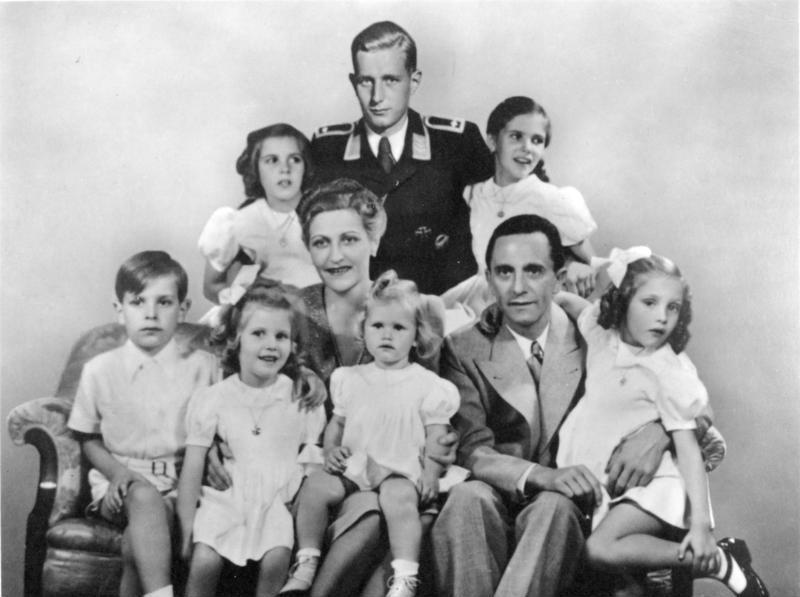
Perhaps you’ve seen it, too. It’s a family group.

A lovely young mother sits with her brood of six beautiful children, her somewhat blank and vaguely sinister-appearing husband, and a grown stepson standing in the back row in uniform. The family photo conveys a sense of brittleness and sharp edges, and there is a hint of desperation in the mother’s smile. But the impeccably-dressed and well-groomed offspring resemble illustrations in a picture book of ideal children, a Dick and Jane reader come to life.

Here is the photo:

Bild 146-1978-086-03

The caption under it tells the reader that, in the final days of the defeated Reich, Magda was instrumental in poisoning all six of her small children before she and her husband committed suicide. A dreadful woman, a dreadful story.

But something about her face—as well as her fate—intrigued me. Something ambiguous and human and vulnerable, something that was not present in her husband’s barren eyes. And then, of course, there were those beautiful children, innocent pawns in a vicious and monstrous game.
–
Reading about Magda’s eventful life, I found that the truth—as it so often is—was actually stranger than any fiction. In fact, if it had been fiction, no one would have believed it.

There was nothing in Magda’s early life that presaged her end. Quite the contrary. (Most of the information in this post is taken from the Hans-Otto Meissner biography, and from this. That last link will take you to a website of the reprehensible David Irving, unfortunately. But it leads to an informative article from the Jerusalem Post that I can’t seem to find elsewhere online.)

Magda’s early life was characterized to an unusual degree by instability and change, making for a shaky and shifting identity. Her ill-matched biological parents briefly married, only to divorce. Her mother then married again, to a Jewish man named Max Friedlander, who became Magda’s stepfather, and whose openly Jewish surname she adopted. All three parents and Magda ended up moving to Belgium, where Magda lived from the ages of five to eighteen, the last eight years spent at a strict Catholic convent for her schooling, despite her Protestant mother and Jewish stepfather. By all accounts she was an extraordinarily beautiful and yet modest and intelligent girl who impressed all who met her.

The entire family, including her biological father, were expelled from Belgium at the beginning of World War I, when the country sent its German nationals away, and spent time in a refugee camp before returning to Germany. During this time, the Friedlanders became friendly with a Jewish family named Arlosoroff, and Magda later had a love affair with the son, Vitaly:

Vitaly became Victor in Germany and under the spell of Zionism emerged as Haim. He was a fiery and passionate orator — as at home with the poetry of Heine and the works of Goethe, as the socialist theories of Syrkin and Borochov. Magda sported a Magen David which he had given her and she attended meetings of Tikvat Zion. She was attracted to Arlosoroff because of his personality and sense of purpose rather than an independent commitment to Zion.

Arlosoroff emigrated to Israel in the 20s after the two had broken up, and became a well-known Zionist figure there. He was murdered mysteriously in 1933 on a Tel Aviv beach, only a few weeks after traveling back to Germany and communicating with Magda, who warned him to get out of the country. By this time, she had married and divorced a German businessman (converting to Protestantism for the purpose of the marriage), and then married Josef Goebbels, another fiery orator of a far different variety in a far different cause. Some speculate that Arlosoroff was killed at Goebbels’s behest.

How does a person go from being closely connected to, raised by, and even in love with, Jews, and wearing a Star of David around her neck; to marrying one of the architects of the Holocaust and becoming known as “The First Lady of the Third Reich?”

There is absolutely no evidence that Magda herself was an anti-Semite at any point in her life, or even an especially political person. She seems to have been drawn to political figures through a deep need to be allied with a powerful man with a cause. Any cause would do, it seems, as long as it was connected with such a man. The beliefs themselves were secondary at best.

In this latter quality, that of the ideas themselves being unimportant to her, Magda was—strangely enough—quite a bit like her final husband, Goebbels. Perhaps it’s part of what drew them together; who knows? In Magda this characteristic appeared as a sort of spacey ignorance and a need, through her own weakness, to follow a strong leader. In Goebbels, it seems to have been a purely sociopathic nihilism, compounded by enormous narcissist drives (the following is taken from the Meissner book):

As far as one could tell, Goebbels had no beliefs at all. People still living [the book was written in 1980], who were part of his immediate circle or his household, agree absolutely about this. To him all human existence was nothing but chaos. He considered himself one of the very few intellects capable of surveying it and mastering it.

In fact, it may be that Goebbels didn’t even particularly hate Jews, at least no more than he hated the entire human race. His interest was in power, self-promotion, and persuasion, and he was a rare genius at all three, willing to do literally anything to further those causes. A short and unattractive man with a crippled leg, he—like Hitler—was a mesmerizing speaker. All evidence is that, though Magda initially went to hear him on a lark, his speech had a life-transforming effect on her. Apolitical before, she joined the Nazi party. From the moment she heard Goebbels, she seemed to come under a kind of evil spell.

When I read this material, I suddenly saw her as resembling one of Charles Manson’s followers. A certain sort of weak, blank, and lost young woman of relative privilege, a searcher trying to fill a void in her life, can find herself transformed by coming under the influence of an unattractive, evil, and yet extremely powerful figure, as though a large gravitational object has trapped her in its orbit. Sadly, she can end up spiraling straight into its surface, crashing in death and destruction, and taking others with her. This, I believe, is what happened to Magda, who nevertheless still bears the responsibility for her own terrible trajectory.

[Part II]

Posted in Evil, Historical figures, People of interest | 20 Replies

Mama said (and so did Momma)

The New Neo Posted on January 18, 2006 by neoJuly 28, 2007

Mama said there’d be days like this.

And, you know what? Mama didn’t lie.

Oh, actually, today wasn’t so bad. It’s just that when I was about to start working on today’s post at my computer, the power went out.

I live in a certain amount of fear about the power going out–that is, I would if I ever stopped to think about it, which I don’t but should. Because the truth is I live in a community with an inordinate number of large trees, which seem to come down at the merest whisper of wind and storm, and always onto a power line. And today was truly windy and stormy, so it could easily have been predicted that those lights would flicker and then die.

The moment that happens is always an interesting one, wherein one confronts one’s utter dependence on electricity, and the fact that one usually takes it way too much for granted. What, a power outage? To moi? Can’t be; I’ve got work to do.

The moment of hubris passes, and then comes the taking of the inventory. Oh, right, the toilet will only have one flush in it–I forget why, but something to do with a pump. And in the winter, the cold starts seeping in within minutes, reminding me that lingering around the house would not be a good thing. The computer, the post? Fagettabout it. Time to leave and go about the other business of the day.

Ah yes, time to leave. Leave. And then I remember: that wonderfully convenient electric garage door opener has to be disabled. Now, how do I do that, again? Each time it happens, I have to learn anew–get out the manual and the flashlight (even though the day was young, it was so dark a flashlight was needed to read the diagrams).

Then, out to the garage. Piece of cake. Just pull that red lever dangling from a rope on the ceiling, and then lift the garage door manually, the old-fashioned way. But the red lever is just an inch out of my reach, even when I stand on tiptoe. I can unlock the door to the house, go back to the closet and get out the stepstool. But really, is it necessary? And by now I’m late. So I decide to jump and grab the lever at the top of my jump. I used to be quite the leaper, having been a ballet dancer/teacher not so very long ago (those of you who are new to my blog may be surprised at that little bit of history, but please see this).

Well, I guess it’s been longer than I thought between leaps. Or maybe I’m not used to leaping on a concrete floor. Because somewhere between up and down (it didn’t seem to be on the landing; it seemed to happen in the air) I got a sudden sharpish pain in the ankle that went down the foot.

Expletives undeleted, I hobbled around the garage, and found that I could at least walk, although with pain. So I set off.

The rest of the day I’ll skip, except to say it involved, among other things: getting lost; an umbrella turning inside-out; and being knocked off the treadmill three times when the power at my workout place failed and then started, failed and then started, failed and then started.

So the post I was going to write turned into this one. I may write the other one and post it tonight, or I may wait till tomorrow.

And this may be as good a time as any to say to those who’ve been waiting for my next “change” post that it’s about two-thirds written, and my prediction is that I’ll be posting it some time early next week.

What did I learn today? A lesson I already knew: not only am I not in control of the big things, I’m not even in control of the little things. And in the great vastness of the universe, these are all indeed little things.

And I also learned, to my stupendous surprise (and after some heavy Googling), that in those song lyrics I linked to at the beginning of this piece, it’s not “Momma said” and “Momma didn’t lie,” it’s “Mama said” and “Mama didn’t lie.” After all these years, it’s nice to know.

Posted in Me, myself, and I | 14 Replies

Post navigation

← Previous Post
Next Post→

Your support is appreciated through a one-time or monthly Paypal donation

Please click the link recommended books and search bar for Amazon purchases through neo. I receive a commission from all such purchases.

Archives

Recent Comments

  • Richard Cook on Those plucky ISIS kids
  • Jimmy on Those plucky ISIS kids
  • Tom Grey on Those plucky ISIS kids
  • Grandpagrumble on Those plucky ISIS kids
  • Kate on Those plucky ISIS kids

Recent Posts

  • Open thread 3/11/2026
  • Those plucky ISIS kids
  • Roundup
  • Open thread 3/10/2026
  • Khamenei Junior …

Categories

  • A mind is a difficult thing to change: my change story (17)
  • Academia (318)
  • Afghanistan (97)
  • Amazon orders (6)
  • Arts (8)
  • Baseball and sports (161)
  • Best of neo-neocon (88)
  • Biden (536)
  • Blogging and bloggers (580)
  • Dance (286)
  • Disaster (238)
  • Education (319)
  • Election 2012 (360)
  • Election 2016 (565)
  • Election 2018 (32)
  • Election 2020 (510)
  • Election 2022 (114)
  • Election 2024 (403)
  • Election 2026 (11)
  • Election 2028 (3)
  • Evil (126)
  • Fashion and beauty (323)
  • Finance and economics (998)
  • Food (316)
  • Friendship (47)
  • Gardening (18)
  • General information about neo (4)
  • Getting philosophical: life, love, the universe (724)
  • Health (1,132)
  • Health care reform (545)
  • Hillary Clinton (184)
  • Historical figures (329)
  • History (699)
  • Immigration (426)
  • Iran (398)
  • Iraq (223)
  • IRS scandal (71)
  • Israel/Palestine (785)
  • Jews (412)
  • Language and grammar (357)
  • Latin America (201)
  • Law (2,880)
  • Leaving the circle: political apostasy (124)
  • Liberals and conservatives; left and right (1,269)
  • Liberty (1,097)
  • Literary leftists (14)
  • Literature and writing (386)
  • Me, myself, and I (1,463)
  • Men and women; marriage and divorce and sex (902)
  • Middle East (380)
  • Military (306)
  • Movies (342)
  • Music (523)
  • Nature (253)
  • Neocons (32)
  • New England (176)
  • Obama (1,735)
  • Pacifism (16)
  • Painting, sculpture, photography (126)
  • Palin (93)
  • Paris and France2 trial (25)
  • People of interest (1,015)
  • Poetry (255)
  • Political changers (176)
  • Politics (2,764)
  • Pop culture (392)
  • Press (1,608)
  • Race and racism (857)
  • Religion (411)
  • Romney (164)
  • Ryan (16)
  • Science (621)
  • Terrorism and terrorists (965)
  • Theater and TV (263)
  • Therapy (67)
  • Trump (1,573)
  • Uncategorized (4,327)
  • Vietnam (108)
  • Violence (1,392)
  • War and Peace (956)

Blogroll

Ace (bold)
AmericanDigest (writer’s digest)
AmericanThinker (thought full)
Anchoress (first things first)
AnnAlthouse (more than law)
AugeanStables (historian’s task)
BelmontClub (deep thoughts)
Betsy’sPage (teach)
Bookworm (writingReader)
ChicagoBoyz (boyz will be)
DanielInVenezuela (liberty)
Dr.Helen (rights of man)
Dr.Sanity (shrink archives)
DreamsToLightening (Asher)
EdDriscoll (market liberal)
Fausta’sBlog (opinionated)
GayPatriot (self-explanatory)
HadEnoughTherapy? (yep)
HotAir (a roomful)
InstaPundit (the hub)
JawaReport (the doctor’s Rusty)
LegalInsurrection (law prof)
Maggie’sFarm (togetherness)
MelaniePhillips (formidable)
MerylYourish (centrist)
MichaelTotten (globetrotter)
MichaelYon (War Zones)
Michelle Malkin (clarion pen)
MichelleObama’sMirror (reflect)
NoPasaran! (bluntFrench)
NormanGeras (archives)
OneCosmos (Gagdad Bob)
Pamela Geller (Atlas Shrugs)
PJMedia (comprehensive)
PointOfNoReturn (exodus)
Powerline (foursight)
QandO (neolibertarian)
RedState (conservative)
RogerL.Simon (PJ guy)
SisterToldjah (she said)
Sisu (commentary plus cats)
Spengler (Goldman)
VictorDavisHanson (prof)
Vodkapundit (drinker-thinker)
Volokh (lawblog)
Zombie (alive)

Meta

  • Log in
  • Entries feed
  • Comments feed
  • WordPress.org
©2026 - The New Neo - Weaver Xtreme Theme Email
Web Analytics
↑