
Sure, throw Israel under the bus. It’s getting a bit crowded there.
Jonathan Alter on Obama—American’s shrink? FDR?
Jonathan Alter of Newsweek feels the Obamalove.
In Alter’s cover story about Obama entitled “America’s New Shrink,” Alter tells us don’t worry, be happy, even though Obama has utterly failed to perform what even Alter insists is the first job of a president in a peacetime crisis, instilling confidence.
Despite the fact that Alter spends the first page and a half of his article describing the myriad ways in which Obama has failed to do just that for the economy, he still thinks it will happen:
So why do I still think Barack Obama has a good chance of restoring confidence and pulling us back from the brink?…Because my take on Obama, based on conversations with him and his team stretching back more than four years and extending into the White House, is that he has a firm grasp of the psychological and substantive challenges of the presidency.
So Obama’s buddy Alter is willing to ignore the evidence of Obama’s actions as president in favor of Alter’s personal experience of what a smart guy Obama appears to be when schmoozing with the press—and that’s even though the stock market has been falling precipitously since Obama has become president, and particularly every time he proposes a new policy (today, the first day the market has been open since the announcement of the “tax the rich and businesses” plan, is no exception; at the moment we’re down 140 points to the 7220s).
But that’s okay; it’s just not the right time yet for confident optimistic talk, according to Alter:
[Obama] knows that now is not the moment to cheerlead, not when the financial players are lying dazed on the field. There will be time for that, when the banks have been “restructured” (see, that sounds better than “nationalized”) and the credit starts flowing again.
As a “shrink” of sorts myself, I will interject that both leaders—and shrinks—must convey optimism about the long-term picture, and this must be done from the beginning of a crisis.
What’s more, condescension isn’t very helpful. But Alter seems to disagree:
Obama has the chops to sell [his] approach, starting with his already-proven ability to be the nation’s teacher in chief. This was FDR’s secret weapon on the radio, and it can be Obama’s on TV and the Web. He’s the smart, cool instructor, trusted by the class to explain something important even if a little complicated. All that’s lacking is a bit more humor and a few catchphrases to simplify the message.
FDR’s “secret weapon” was not being a teacher. Rather, (although it wasn’t really very secret) it was his buoyant optimism, an attitude that was neither an empty pose nor a strategic ploy but a fundamental part of his personality—perhaps the most fundamental part. FDR’s optimism was both a natural tendency of the man and an attitude accentuated by his hard and personal struggle with polio, and his successful conquering of the despondency that would naturally be faced by most men of action struck down by such a disease in their prime, as FDR was.
The nation understood that Roosevelt was not consdescending to them as “smart, cool, instructor.” Nor was he playing a clever game of timing with his pep talks, being negative at the beginning and positive only when things were already looking up. He was imbuing them with some of the hard-won confidence he’d earned through his own triumphs over adversity.
Oh, and good luck with that humor thing, Jonathan. Obama has never shown a particle of it, and is not likely to do so now.
FDR was a naturally ebullient man; Obama is most decidedly not. Take it from another great, Winston Churchill, who ought to know:
Meeting Franklin Roosevelt was like opening your first bottle of champagne; knowing him was like drinking it.
I can’t quite imagine anyone saying that about Obama; meeting Obama is more like taking some cod liver oil.
Speaking of Churchill—now there was a man who knew who to balance optimism with realism. But he could never be compared to champagne; more like a fine port. Churchill’s optimism, like that of FDR’s was no pose—it was his natural tendency, and his eloquence and delivery guaranteed that he could deliver the message to perfection.
The main thrust of what Churchill told the British people and the world—and he said it right from the start, at the darkest hour; he did not wait for things to get better!—was that even though the way would be incredibly difficult, the Allies would prevail. Intrepid perseverance was his forte, and he was able to transmit his own endurance to the British people, and in the process amplify theirs.
In his very first broadcast after taking office, in May of 1940, Churchill doesn’t mince words about the darkness of the situation facing the Allies. But every passage in which he describes the depth of the peril is followed by a firm affirmation that victory is never in doubt:
We must expect that as soon as stability is reached on the Western Front, the bulk of that hideous apparatus of [German] aggression which gashed Holland into ruin and slavery in a few days will be turned upon us. I am sure I speak for all when I say we are ready to face it; to endure it; and to retaliate against it…
Our task is not only to win the battle—but to win the war. After this battle in France abates its force, there will come the battle for our Island—for all that Britain is, and all the Britain means. That will be the struggle. In that supreme emergency we shall not hesitate to take every step, even the most drastic, to call forth from our people the last ounce and the last inch of effort of which they are capable.
Here is my favorite—and the most famous—part of Churchill’s speech. It occurs towards the end, and is an almost perfect example of Churchill’s ability to convey the depth of the horror facing Europe while at the same time transmitting to his listeners a near-guarantee—by the sheer force of his own will and determination—of their ultimate victory:
[N]ow one bond unites us all—to wage war until victory is won, and never to surrender ourselves to servitude and shame, whatever the cost and the agony may be. This is one of the most awe-striking periods in the long history of France and Britain. It is also beyond doubt the most sublime. Side by side, unaided except by their kith and kin in the great Dominions and by the wide empires which rest beneath their shield—side by side, the British and French peoples have advanced to rescue not only Europe but mankind from the foulest and most soul-destroying tyranny which has ever darkened and stained the pages of history. Behind them—behind us—behind the Armies and Fleets of Britain and France—gather a group of shattered States and bludgeoned races: the Czechs, the Poles, the Norwegians, the Danes, the Dutch, the Belgians—upon all of whom the long night of barbarism will descend, unbroken even by a star of hope, unless we conquer, as conquer we must; as conquer we shall.
[NOTE: I couldn’t find an audio of the above speech of Churchill’s, so I offer the following substitute.]
[ADDENDUM: Commenter AuH2O has kindly led me to the correct You Tube video (the quoted part begins around 1:35):]
[ADDENDUM II: My colleague and friend Shrinkwrapped has a shrink’s take on it all.]
I know you all would be very disappointed…
…if I didn’t liveblog the Oscars.
Whaaaa?? you say. But I think we need some lightness for a change. And there’s hardly anything lighter than the Oscars. They nearly levitate with their lack of gravitas—not to mention the hot air of the stars’ pomposity.
Yes, even though I hardly ever watch movies these days, and could hardly care less about the lives of film celebrities, I almost always try to watch the Oscars for one thing: the fashions.
I have no idea who host Hugh Jackman is. But trusty Wikipedia tells me that he’s an Australian star of screen and the musical stage. Jackman played the lead role of Billy Bigelow in a recent production of the Rodgers and Hammerstein musical “Carousel.” So tell me why his singing sounded so ghastly during the opening number that I had to mute the sound?
The usual unctuous, self-congratulatory garbage goes on. Yada yada yada. But as I said, it’s the fashions that interest me.
The following monstrosity made Tinda Winton (who???) look as though she’d been exhumed for the occasion, proving that beige is one of the most difficult colors to wear—especially for those who are somewhat beige and washed-out to begin with:

For a contrast, see Kate Winslet in a classy shade of blue that looks a bit like a moonlit night sky:

Sophia, Sophia, Sophia. Ah, Sophia girl, we’ve got to talk. When I wrote this heartfelt tribute to you a while back, I never could have guessed that you’d betray my trust by turning up as the main character in “Hello Dolly.” But that sad day has come (and the dress is beige, yet):
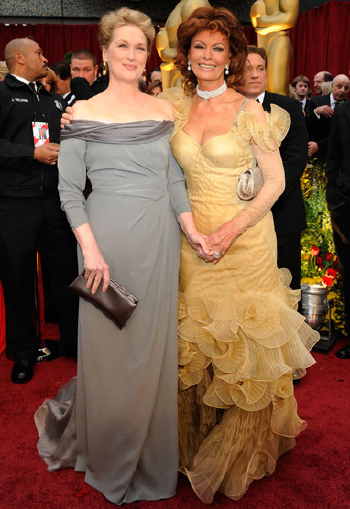
Beyonce has turned herself into a cross between a divan and a mermaid:

I deserve some sort of special award myself for just attempting to watch this swill. It is far more boring than usual, and that’s saying an awful lot. So far, no video montages of old films either, one of the few things other than the fashions that I usually look forward to.
To top the evening off, Sean Penn just said he’s proud to live in a country that has the (I think the next word was “courage;” not sure though) to elect an elegant man president. Wow.
And now, just when I’d given up—a montage of old films! But unfortunately, the featured film clips are mostly about politics. And some of them aren’t even old. Given those parameters, how did a moment of “The Graduate” sneak in there?
Why is the market tanking?
Let me count the reasons.
Holder: equality is not enough
Our new Attorney General, Eric Holder, says we are still a bunch of cowards about race despite all these years of affirmative action, and our brand new African-American president and Attorney General (that would be Mr. Holder himself).
Why? Because we don’t talk enough about race, and because although we might work together, we don’t play together well on weekends.
Holder was speaking at the Justice Department in honor of black history month, February (here is the full text of his speech). He made it clear that, despite all the advances of the last fifty years, there is much more work to be done.
Holder’s attitude is a good example of what I was talking about the other day, that some time ago equality of opportunity ceased to be enough to satisfy liberals and special interest groups, and was replaced by equality of outcome. Now it seems that equality of outcome is not enough either, at least not to Holder—there must be a sort of merging. But at the same time he requires that African-Americans retain a favored status in terms of what is taught in school.
The teaching of history was a big focus of Holder’s speech, one that has been neglected in the attention given the sound bite of his “cowards” remark. This balancing act—merging the races while somehow retaining for blacks a favored status—is a bit tricky, to say the least. Here’s what Holder said about how black studies should be taught:
As a former American history major I am struck by the fact that such a major part of our national story [black history] has been divorced from the whole…For too long we have been too willing to segregate the study of black history. There is clearly a need at present for a device that focuses the attention of the country on the study of the history of its black citizens. But we must endeavor to integrate black history into our culture and into our curriculums in ways in which it has never occurred before so that the study of black history, and a recognition of the contributions of black Americans, become commonplace. But we have to recognize that until black history is included in the standard curriculum in our schools and becomes a regular part of all our lives, it will be viewed as a novelty, relatively unimportant and not as weighty as so called “real” American history.
This is a fascinating point of view that represents a change in ideas about racial justice. I was recently browsing through an old favorite of mine, Allan Bloom’s The Closing of the American Mind (1987), and I found a passage that explains the early years of this process so much better than anything I could write that I will just quote him on the subject:
…[A]lmost all the significant leaders [of the early civil rights movement]…relied on the Declaration of Independence and the Constitution. They could charge whites not only with the most monstrous injustices but also with contradicting their own most sacred principles. The blacks were the true Americans in demanding the equality that belongs to them as human beings by natural and political right…They therefore worked through Congress, the Presidency, and, above all, the Judiciary. By contrast, the Black Power movement that supplanted the older civil rights movement…had at its core the view that the Constitutional tradition was always corrupt and was constructed as a defense of slavery. Its demand was for black identity, not universal rights…It insisted on respect for blacks as blacks, not as human beings simply….
The upshot of all this for the education of young Americans is that they know much less about American history and those who were held to be its heroes. This was one of the few things they used to come to college with that had something to do with their lives. Nothing has taken its place except a smattering of facts learned about other nations or cultures and a few social science formulas.
I would add that the teaching of black history has also taken the place of education about the founding fathers as heroes. As part of the mea culpa approach to history that has become even more prevalent in the years since Bloom wrote his book, the clay feet of American heroes are emphasized (in particular, their hypocrisy on racial issues), and the mistreatment of certain groups (native Americans, blacks, Japanese during WWII) is hammered home, as well as their achievements. Witness the fact that one might at times think Harriet Tubman superior in importance and influence to Thomas Jefferson, if amount of coverage in the school curricula were to be your only guide. I’m not asking that the US be treated by history teachers as though it were perfect. But the emphasis has gone too far in the other direction.
But back to Attorney General Holder, who appears to be asking for two contradictory things. If a race-blind society is the ultimate goal—and I think it is for Holder, since he is critiquing even the casual social separation of the races in their weekend activities—then it’s not likely that this could be arrived at by singling out a particular race for special consideration in the study of American history or through the continuance of affirmative action.
This contradictory approach is a thread that ran through President Obama’s campaign as well—the desire to have it both ways. Obama was the post-racial candidate, and his election has proven just how far we have come in this regard. But he also played on his racial identity by mentioning it many times (“I don’t look like the others;” “I have a funny name”), and his followers and associates made it clear that any criticism of Obama was by its very nature racially motivated.
In this piece, Gary Graham gives a good rendering of the problem from a personal point of view. Of course, he’s just a white guy, but let’s listen to him for a moment:
Apparently, I’m a racist coward because I want to be color blind. This great national offense of racism doesn’t want to die – even though we just elected our first black president. Just when you thought it was okay to climb out of the past, to put racial injustice and animosity behind us”¦the Attorney General in the national media yesterday drags it back out…
I don’t believe in Black History Month any more than I believe in White History Month. To me, Black History Month is a complete insult to Blacks. We must prop up an entire race of people, give them special awards, honors, and recognitions, underscoring their accomplishments and achievements and contributions to society, based on their color”¦ as if it’s so truly remarkable that they did it in the first place”¦and are African American to boot? Stop the presses! A black person accomplished something great! As if they couldn’t have done it on their own, without help. As if they are somehow inferior to whites. That they somehow overcame their blackness”¦and did all these wonderful things despite the obvious disadvantage, encumbrance, disability”¦of being a person of color.
Am I the only one in America”¦who finds this the least bit patronizing and insulting”¦and downright, well, racist?
No Gary, you’re not. But I don’t think we’ve reached the point where it’s OK to say so.
Welfare for homeowners
Here are some of the details of the mortgage bailout plan. Not good.
Yes, I understand that a huge flood of foreclosures isn’t a good thing either. But this program will probably do little to forestall foreclosures because many homeowners will probably walk away from their obligations anyway and forfeit their homes.
As for those who renegotiate their mortgages under the proposal, its terms almost guarantee that everyone who doesn’t come under its aegis—homeowners and renters alike—will be spitting mad at those who do.
We’re liberals and we run the show: we don’t need your steenking history
Leon Wieseltier of The New Republic is happy about recent political developments. Very happy.
After decades of wandering in the Republican desert (and he includes the Clinton years as a craven accommodation to Republicans), the good guys (liberals) are finally in the driver’s seat where they belong.
But he would be even happier if Barack Obama would declare himself as a proud, big-government liberal—in contrast to those selfish, lying, hypocritical Republicans.
If your health can take it, you should read Wieseltier’s piece because of the light it sheds on the triumphant liberal mindset of today. He is drunk with his Aquarian vision of government on a white horse riding to the rescue.
If this picture requires ignoring or distorting history, so be it. History is messy; belief is beautiful.
How shall I fisk thee, Mr. Wieseltier? Let me count the ways [I will put the Wieseltier quotes in bold; my responses will follow in regular type].
The public has not yet broken the grip of the conservative discourse that has dominated America for a generation.
Just how has the conservative discourse dominated America for a generation? When last I checked, liberals were quite talkative (not to say loud)—on TV, in academia, churches, newspapers, periodicals, blogs, You Tube, and in fact most of the current sources of information except for talk radio. But despite the overwhelming representation of liberals in media and academia, the fact that conservatives have sometimes been in power during the last twenty years is interpreted by Mr. Wieseltier as “dominating” the discourse.
Consider the insane headline on Newsweek’s cover, “We Are All Socialists Now”: an exclamation of its inner Hannity, as if the president is preparing to abolish private property or expropriate the means of production.
Wieseltier is either ignorant of what socialism is, or purposely deceptive about it. But just for the record, socialists have never agreed that private property should be abolished or that the state should control the means of production. That’s Communism, which is an extreme subset of socialism.
Here’s a summary of socialism’s rather big tent:
Some socialists advocate complete nationalization of the means of production, distribution, and exchange; others advocate state control of capital within the framework of a market economy. Socialists inspired by the Soviet model of economic development have advocated the creation of centrally planned economies directed by a state that owns all the means of production. Others, including Yugoslavian, Hungarian, Polish and Chinese Communists in the 1970s and 1980s, instituted various forms of market socialism, combining co-operative and state ownership models with the free market exchange and free price system (but not prices for the means of production). Social democrats propose selective nationalization of key national industries in mixed economies and tax-funded welfare programs and the regulation of markets. Libertarian socialism (including social anarchism and libertarian Marxism) rejects state control and ownership of the economy altogether and advocates direct collective ownership of the means of production via co-operative workers’ councils and workplace democracy.
All that is happening, comrades, is that our democratically constituted central government is acting to protect the whole of our economy by taking over, for a period, a part of our economy.
Oh, is that all (see above definition of socialism)? I guess if you say it will be for our own protection, we’ll believe it, Mr. Wieseltier. And if you say it’s only temporary, we’ll believe that too. But if you look at the actual history of socialism (or even of FDR’s New Deal), I’d say the facts argue otherwise.
The Republicans are not only heartless, they are also hypocritical, since the cause of all this [financial] misery was the market abandon that they promoted so messianically.
Actually, there was another earlier cause, and you would find that cause in too much government regulation, regulation that ignored market realities.
Which side of this argument is correct can be debated, of course. But Mr. Wieseltier doesn’t feel the need to do this; he merely states his position as an established fact. That’s probably because he’s preaching to the choir.
The supposed “heartlessness” of Republicans is a popular meme on the Left. It’s the result of either a misunderstanding or a willful distortion about Republican beliefs. The truth is that most Republicans and Democrats aspire to helping people have good and prosperous lives. They disagree on the best means to go about doing that.
If one is to evaluate which group has the better ideas on the subject, it’s best to look at the evidence of results rather than focus on intentions. But Mr. Wieseltier elevates the latter over the former—and imputes evil motivations to Republicans, as well.
I want the president to tell the American people that, contrary to what they have been taught for many years, government is a jewel of human association and an heirloom of human reason…
Republicans venerate our Constitution, the founders, and their intent. It’s the practice of government they tend to distrust, and with good reason.
Does Mr. Wieseltier really believe his rosy words about government’s performance, as opposed to its ideals? Almost any personal encounter with government would tell him otherwise.
…that government, though it may do ill, does good; that a lot of the good that government does only it can do…
No disagreement here; and conservatives agree. The disagreement is about how much is too much.
…that the size of government must be fitted to the size of its tasks, and so, for a polity such as ours, big government is the only government…
Again, assertion of a philosophy with no backup history or evidence, and ignoring the many times and places where big government has led to even bigger problems.
…that a government based on rights cannot exclude from its concern the adversities of the people who confer upon it its legitimacy, or consign their remediation to the charitable moods of a preferred and decadent few…
Once again: Republicans are also concerned with adversity, and they want the best for people. However, they disagree with Democrats on which governmental policies are most likely to promote it. And Wieseltier ought to learn a bit more about how grassroots charity works in this country.
…that Ronald Reagan, when he proclaimed categorically, without exception or complication, that “government is not the solution to the problem, government is the problem,” was a fool…
Here again, Wieseltier is either ignorant (and, I might add, abysmally, unforgivably ignorant) or lying. Reagan, when last I checked, was not an anarchist.
Here’s the Reagan speech Wieseltier is referencing; notice the “exceptions” and “complications.” Reagan, appropriately enough, was speaking of the economic crisis he inherited from his liberal predecessor, Jimmy Carter. His words in their full context bear repeating—because, strangely enough, they fit today’s economic situation as well (fancy that):
You and I, as individuals, can, by borrowing, live beyond our means, but for only a limited period of time. Why, then, should we think that collectively, as a nation, we’re not bound by that same limitation? We must act today in order to preserve tomorrow. And let there be no misunderstanding: We are going to begin to act, beginning today.
The economic ills we suffer have come upon us over several decades. They will not go away in days, weeks, or months, but they will go away. They will go away because we as Americans have the capacity now, as we’ve had in the past, to do whatever needs to be done to preserve this last and greatest bastion of freedom.
In this present crisis, government is not the solution to our problem; government is the problem. From time to time we’ve been tempted to believe that society has become too complex to be managed by self-rule, that government by an elite group is superior to government for, by, and of the people. Well, if no one among us is capable of governing himself, then who among us has the capacity to govern someone else? All of us together, in and out of government, must bear the burden. The solutions we seek must be equitable, with no one group singled out to pay a higher price.
Did Wieseltier even bother to check the sentence he quoted to see when and where it had been said, and what Reagan might actually have meant by it? Since Reagan wasn’t in the habit of stepping up to the podium, stating a single sentence, and then withdrawing, wouldn’t it have been logical to assume that there was some sort of qualification and/or context to it? And it wouldn’t have taken too much time (it took me about ten seconds, max) to find out—because the context is embedded in the sentence itself: “in this present crisis.”
But no, that would be too factual, and too fair, for Wieseltier, who is more interested in glorying in the achievement of liberal hegemony than to bother with such pesky details as facts.
There’s more to fisk, but why bother? I think the point is clear enough. But I’ll close with one more quote from Wieseltier:
In an open society, therefore, it is the intellectual duty of the citizen to search for the warrant for his views, to raise opinions into beliefs by means of reasons, right reasons, reasons conceived in the bravery of arguments. This is the only way to resist the regimentations of demagogues and entertainers.
I agree with this, actually—except that I would add that those “reasons,” and that “bravery of arguments,” should be founded in facts and history rather than mere opinion and yearning.
Also, I have a sneaking suspicion that Mr. Wieseltier resembles one of those demagogues he is warning us about. Whether he is also an entertainer—well, I’ll leave that up to you.
[ADDENDUM: For a bit of pertinent history, here’s Reagan’s actual speech. Enjoy (the relevant portion begins around 5:05).]
Join the Chicago Tea Party…
…and end the moral hazard (hat tip: Drudge).
Our topsy-turvy economic world: legislating social and economic justice
Economic bubbles are a repetitive historical reality, as are their precipitous bursting and the resultant downturns. Here’s a history of some of the major ones that have occurred; there are others.
But there’s something about the current situation that is sui generis, as far as I can tell: it began with legislation designed to create a financial reality that would reflect our desire to end what was perceived as social and racial bigotry, and to achieve more economic parity. This does not appear to have been true of previous bubbles, which were not the result of deliberate social engineering.
In this piece, Thomas Sowell outlines how the real estate bubble began. Although it started during the Carter administration with the Community Reinvestment Act of 1977, that was just a general statement about banks needing to serve their communities. The Act didn’t really result in any major drive to change the way lenders made mortgage loans.
In fact, the language of the law was quite careful. The idea was to “encourage” lenders:
to help meet the credit needs of the local communities in which they are chartered consistent with the safe and sound operation of such institutions.
Of course, these twin goals are always in conflict, almost by definition. For example, I might have a “credit need,” but if I’m not a good financial risk those needs will just have to go unfulfilled if lenders are going to operate in a manner that is “safe and sound.”
This isn’t rocket science. It isn’t even arcane financial knowledge. It is one of the most basic premises of our financial system. And yet it was violated with impunity during the Clinton era (and this continued in the Bush administration) when the old adage “a chicken in every pot” was replaced with “a home for every citizen.”
How did this happen? It occurred under the guise of nondiscrimination. The notion was that, if banks were not lending in equal amounts to the poor—and especially African-Americans and Hispanics—the reason wasn’t that they were following “safe and sound” financial practices. It had to be about about racism.
Here’s how it worked in the 90s, according to Sowell:
What HUD wanted were numbers showing that mortgage loans were being made to low-income and moderate-income people on a scale that HUD expected, even if this required “innovative or flexible” mortgage eligibility standards.
In other words, quotas were imposed– and if some people didn’t meet the standards, then the standards need to be changed.
Both HUD and the Department of Justice began bringing lawsuits against mortgage bakers when a higher percentage of minority applicants than white applicants were turned down for mortgage loans.
Nowhere have I read any indication that the government cared whether those minority applicants who were turned down were in fact poorer loan risks than candidates who were approved for loans.
There is no doubt that this used to happen—just as there is no doubt that minority (read: African-American or Hispanic) students used to be discriminated against in the university admission process. But, just as affirmative action for the latter came to mean equality of outcome rather than equality of opportunity, so the percentages of minorities receiving mortgages became the standard by which discrimination was judged, rather than whether the denial of a particular mortgage was actually racially motivated rather than economically motivated. The unfairness was assumed by the unequal numbers.
Of course, the fact that loan standards ultimately had to be relaxed in order to accommodate low-income minority applicants is the clearest evidence of all that the earlier loan denials were likely to have been the result of sound economic practices rather than discrimination, at least in the vast majority of cases. But by that time the goal had changed from the prevention of intentional racial discrimination to the prevention of all racial inequality, even if it were based on sound economic reasoning rather than any purposeful racial discrimination.
It’s certainly possible that there was some small amount of intentional racial discrimination going on as well, somewhere in all those loan denials. But if so, the proper remedy would have been to find the cases in which minority applicants with the proper financial and credit history were being denied loans that white people with exactly the same finances would have been granted. Forcing banks to make bad loans to achieve racial parity—that is, equality of outcome—is bad business. But the need to achieve the appearance of racial equality was considered far more important than the preservation of the banking system.
As I wrote yesterday, these governmental regulations were not the whole problem. But they were the springboard for the whole problem, which was an enormous blossoming of bad loans as the housing bubble starting to grow. Then the risk was spread by derivatives and other instruments to nearly every corner of our financial system.
Some interesting questions: would banks and mortgage companies have come up on their own with “creative” financing, had they not first tasted the fruit of that forbidden tree by government order and found it to be sweet in an era of continually rising real estate prices (and indeed, would prices have risen so precipitously without the government jumpstart)? Would lenders still have forgotten the most basic rules of lending, and surrendered to the siren song of the “math guys,” who reassured the more staid banker types that all would be well, since their computer simulations decreed it?
I don’t know the answer; no one does. But there is little doubt that in the beginning there was the affirmative action loan by government decree, breaking time-honored rules of lending.
And presently we have something similar: the affirmative action real estate bailout. Now the impetus is not primarily to achieve racial equality, although that’s still in there somewhere. Now it’s about continuing home ownership for those who cannot afford it.
Bailout proponents point out that things are so bad now that to let these people lose their homes would cause a cascade of events that would harm us all financially. They also like to paint such people as the innocent prey of predatory lenders, although we have no idea how numerous or rare such cases may be.
The argument on the other side is that people should not be rewarded for bad financial decisions. Bailout naysayers also predict that the mortgage bailout (as well as all the other huge bailouts that preceded it) will only temporarily postpone the agony by taking money from those who were more financially prudent (and/or future generations) and giving it to those who were not. Better to let banks renegotiate mortgages with homeowners in order to forestall widespread foreclosures (which don’t benefit banks much either, when housing prices are low), using time-honored financial standards to determine which homeowners are good bets and which are not. Governmental intervention is only likely to blow the housing bubble up once again—and we all know what ultimately happens to bubbles.
One of the basic financial practices that was jettisoned in the 90s was the idea of the 20% down payment on a house. This not only reduced a homeowner’s mortgage payments, but it gave the bank a certain amount of non-refundable income from the transaction. In the event of a foreclosure due to the buyer’s failure to meet payments, the bank would only have had to recoup 80% of the purchase price in order to come out even.
This constituted a sort of insurance for banks even if the loan ended up going bad. The end of the practice meant trouble for banks, especially in a climate in which housing prices fall and foreclosures become commonplace—such as now.
The dream of equality of opportunity for all has become a kind of nightmare, escalated to the point where equality of opportunity is not enough. Equality of outcome, which has been the goal of liberals for some time, is a very slippery slope. Down it we all now slide.
[ADDENDUM: How many of the defaults are voluntary?]
The age of Aquarius revisited
I wrote the following back in January, 2008. I think it bears repeating.
* * * * *
Many liberals I know are enthralled with Obama.
As far as I could tell, this was based primarily on the feeling he gave his supporters: hope, trust, excitement. It was as though the optimistic part of the 60s had come back after a long absence and many dashed dreams.
A lot of people who went through the 60s keep yearning for that special feeling they’d gotten back then (when they weren’t stoned, that is, or maybe when they were stoned): a sense that wonderful things were possible and just around the corner, that all it would take was the right attitude and the casting off of the old and fusty, that charismatic leaders with inspiring words and good intentions would lead the way.
The way to where, and to what? The goals were fairly clear: liberty and justice—and equality of outcome, not just opportunity—for all. Oh, and the end of bigotry, war, and the economic exploitation by the nasty rich of the noble poor.
Not too much to ask.
Exactly how this was to be accomplished wasn’t as clear. Continue reading →
The economy, bubbles, and the tragedy of the commons
The current economic crisis exhibits characteristics that illustrate the tragedy of the commons:
“The Tragedy of the Commons” is an influential article written by Garrett Hardin and first published in the journal Science in 1968. The article describes a dilemma in which multiple individuals acting independently in their own self-interest can ultimately destroy a shared limited resource even where it is clear that it is not in anyone’s long term interest for this to happen.
Central to Hardin’s article is a metaphor of herders sharing a common parcel of land (the commons), on which they are all entitled to let their cows graze. In Hardin’s view, it is in each herder’s interest to put as many cows as possible onto the land, even if the commons is damaged as a result. The herder receives all of the benefits from the additional cows, while the damage to the commons is shared by the entire group.
Subprime mortgages began with Congressional acts that ordered banks to make bad loans in order to bring housing opportunities to the poor. But, although we can blame that for opening the door to the practice, the mortgages made under Congressional fiat were but a small percentage of the final total of bad real estate paper. Over time, mortgage companies and other lenders ran amok with the notion. Ultimately, the toxic paper was spread throughout our entire financial system.
Why? Why did so many people violate the most obvious standards of prudence, and endanger us all?
It’s the tragedy of the commons, stupid: there was money to be made from these loans in the era of ever-ascending housing prices that constituted the real estate bubble. The lenders and borrowers involved in such loans not only profited from the rising housing prices, but they also helped fuel them. And all homeowners liked seeing the value of their homes increase, especially those who took out second mortgages counting on that figure to remain the same or to continue to go up. Many people seemed to benefit.
In the short run, that is—although in this case, the “short run” lasted many years. Those involved in the deals were betting either that housing prices would never come down (a truly insane assumption, but it seems that many otherwise rational people convinced themselves it was true),—or that, when the decline did happen, they themselves would still have come out ahead.
What was ignored was that, despite individual benefit, such gains would be temporary for most. The fact that the risk was so thoroughly spread throughout the entire financial sector that it poisoned everything was either not understood, or ignored. In addition, even among those who did see a downturn coming in a general sense, most did not foresee that there would not necessarily be enough warning when the bubble burst to get out safely.
After all, that’s the nature of bubbles—they get larger and larger, and while that is happening, their outer surfaces become thinner and thinner, stretched finally to the breaking point.
Where exactly will that breaking point be? Hard to predict, but when it happens it happens suddenly and dramatically. Poof! The bubble is gone, and all that’s left behind is a tiny bit of slimy foam.
[NOTE: And don’t think government can rectify the situation. Not only does Congress lack the tools to foresee and correct the problems, but it is an excellent example of the tragedy of the commons in action.]
More things in heaven and earth
Evidence comes that the polar oceans, once thought to be relatively barren, are teeming with an “astonishing richness of marine life.” Many thousands of species found to be living in the water at each pole include many that have never been seen before.
Sound familiar? Remember when they first found those incredible life forms in hot vents, back in 1970? It seems that life, once begun, can adapt to extreme environments far better than we had previously thought possible. Its nature is to fill every available niche—and the definition of “available” is continually expanding.
One of the many puzzles the new data presents is that, at least on preliminary observation, many of the species near North and South Poles seem to be the same. So how did they get from one to the other? Ah, sweet mystery of life!
[NOTE: The title of this post comes from a line uttered by Hamlet: There are more things in heaven and earth, Horatio,
than are dreamt of in your philosophy.]