
↓
 

The New Neo

A blog about political change, among other things

  • Home
  • Bio
  • Email
Home » Page 1719 << 1 2 … 1,717 1,718 1,719 1,720 1,721 … 1,917 1,918 >>

Post navigation

← Previous Post
Next Post→

Obama’s energy proposals and your utility bills

The New Neo Posted on March 4, 2009 by neoMarch 4, 2009

If you ever had any doubt, it’s becoming more and more clear every day that Obama meant every single radical thing he ever said. Including that one about bankrupting the coal companies.

Don’t recall it? Well, let me refresh your memory:

Obama said [in a January 2007 interview] that the environmental policies he proposes would cause builders of new coal plants to go bankrupt. And he didn’t sound the least bit sad about the prospect…

Obama stated that;

…under my plan of a cap and trade system, electricity rates would necessarily skyrocket”¦whatever the plants were, whatever the industry was, they would have to retrofit their operations. That will cost money. They will pass that money on to consumers.

I added at the time I wrote my post on the subject, right before the 2008 election, that:

Rather than banning new coal plants de jure, [Obama] plans to drive them out of business de facto, because the environmental requirements of his policies would be so stringent that new plants would be unable to comply and the penalties for noncompliance would be catastrophic. In other words,, any new plants would have to pay penalties so Draconian that they would be bankrupted””and the listener is left to wonder whether even older plants might be required to retrofit in order to comply, and be forced out of business as well.

Obama’s plan is that market forces would dictate that, as new coal production would become impossible, people would be forced to quickly fill in for the lack of power by developing the wonderfully clean alternative sources of energy that he is so sure would be available if only the will were there. We have no way of knowing whether it would work out that way, of course. But in the meantime we could be sure that the economic costs would be very high, as Obama unapologetically states.

Well, you can’t say I—and Obama—didn’t warn you. Although one had to be paying close attention to hear it, and to understand what he actually meant—and still means.

Obama seems to think that green energy can be developed and made reasonable and efficient to use, if only the nasty old capitalists were given the right incentives to develop it. This argument was already suspect two years ago when he made it. But now, in a recession, his policies are a recipe for a deepening of the economic disaster, with no real evidence that such sources of energy are even scientifically possible at this juncture.

Note that Obama is not talking about developing the one alternative source that most definitely is available: nuclear power plants. Nor is he supporting tapping new domestic fossil fuel sources to reduce our dependence on foreign oil.

No, his goals are far more utopian, according to Barron’s:

The President has a worthy if somewhat utopian goal in mind: He is attempting to create a new industrial base that will produce solar panels, windmills, a smart electrical grid and other clean-energy sources and technologies, while simultaneously boosting the economy and reducing U.S. dependence on foreign oil. Leadership in green technologies theoretically would give the U.S. something to sell to the rest of the world that cheap-labor countries like China and India can’t produce readily…Because solar, wind and other forms of clean energy are now much more expensive to generate than energy supplied by coal, gas and oil, Congress would have to pass legislation that in effect forces Americans to use more of it.

Why are they more expensive? Because they are inefficient and are not being produced and used on a large scale. Unfortunately, there are reasons why this is so—and these are mostly physical rather than political, although liberals have great difficulty acknowledging this extremely inconvenient truth.

It’s not just lack of goodwill that stops us from heating our homes with the sun and the wind and the rain, as Steven den Beste pointed out back in 2002 in this post. It’s science:

Small sources of energy are easy. Big sources of energy aren’t, and the small sources of energy can’t be scaled, and there aren’t enough of them so that even when added up they would be enough to matter… Anything which, when fully deployed, generates less than ten gigawatts average (1010 joules per second) is useless for our purposes in terms of actually making a meaningful contribution to the total amount of energy we consume. For scale purposes:

Hoover Dam = 1.5 gigawatts.
Grand Coulee Dam = 6.5 gigawatts
Small coal or nuclear plant = 300 megawatts
Large coal or nuclear plant = 1 gigawatt

Average US electrical power consumption = 400 gigawatts

Peak US electrical power consumption is probably above 1 terawatt

Den Beste went on to describe four large enough sources of energy that might be practical some day, but none of them are even close to being realizable yet (the science is nowhere near there), and they certainly don’t include anything like wind or solar power. The latter have their uses, no doubt. But to drive out coal by making it unaffordable, in the hopes that good alternatives will just spring into action to take its place, is an absurdity.

And very, very expensive. The last thing we need in the current financial climate is added expense.

But Obama has an answer for that, as well—and it’s his answer to almost everything right now: pass the cost on to the rich and give the poor a break.

Ace discusses the way it will work:

Obama’s cap and trade scheme will impose a $700-$1400 additional tax on all families as energy producers (and users) pass-through their own higher costs to the public.

Obama plans to devote more taxpayer money to defray these costs for those making $75,000 per year or less.

So the added burden will be borne by those making over $75,000 a year—the bad “rich” guys, who will be footing the bill for almost everything in the Obama administration.

Note, by the way, that with cap and trade it’s not just those making more than $250,000—Obama’s old dividing line between the innocent poor and the guilty rich—who will be in trouble. But he is technically correct that those in the $75,000 to $250,000 bracket would not actually be paying a raised tax. Instead, they (and everyone else) would be paying higher utility bills as a result of the Obama penalties on coal plants. But they also would not be getting the federal monies that the under-75K crowd would be receiving to offset it.

Pretty clever, no? Let’s see: electric bills skyrocket as a result of Obama’s policies. Cheap and efficient wind and solar power cannot possibly fill the gap, as much as we all would wish it. Obama’s green supporters are ecstatic, however, and support him mightily. The rest of the public is unlikely—unless they are paying strict attention—to understand why their utility bills are rising. Obama will no doubt say it’s because of the nasty coal and electric companies trying to stiff the poor working American. This increases that enmity against greedy capitalists that so suits Obama’s electoral purposes.

And then, who comes to the rescue for those making under $75,000? Why, Obama and the Democrats, that’s who. As for the jobs lost in the process—well, who cares, as long as the government is ready with a helping hand?

[ADDENDUM: Read Hanson on Obama, “The Great Divider.” I can’t say I think the President will take his suggestions, though, since they run counter to his own purposes.]
Posted in Finance and economics, Science | 119 Replies

Profiles in courage?

The New Neo Posted on March 4, 2009 by neoMarch 4, 2009

It remains to be seen whether these folks will actually end up blocking some of the worst excesses of Obama’s spending proposals. But I hope so; we could certainly use a few profiles in courage right now.

Candidates for the title: these moderate Democrat Senators who are starting to realize that the Obama’s budget is way out of line. Do we have a new “gang of 14” on the Democrat side?:

Moderate and conservative Democrats in the Senate are starting to choke over the massive spending and tax increases in President Barack Obama’s budget plans and have begun plotting to increase their influence over the agenda of a president who is turning out to be much more liberal than they are.

A group of 14 Senate Democrats and one independent huddled behind closed doors on Tuesday, discussing how centrists in that chamber can assert more leverage on the major policy debates that will dominate this Congress.

Afterward, some in attendance made plain that they are getting jitters over the cost and expansive reach of Obama’s $3.6 trillion budget proposal.

Asked when he’d reach his breaking point, Nebraska Sen. Ben Nelson, one of the most conservative Democrats in the Senate, said: “Right now.

Good.

Posted in Politics | 8 Replies

The perfect bubble

The New Neo Posted on March 4, 2009 by neoMarch 4, 2009

Iceland. It makes tulipmania look sane.

Posted in Uncategorized | 11 Replies

Down and down the market goes, and where it stops…

The New Neo Posted on March 3, 2009 by neoMarch 3, 2009

…nobody knows.

I’ve been polling some of my liberal friends who voted for Obama, asking their opinion about what’s been happening lately in the financial sector and his effect on the economy. Every one of them has responded in much the same way, by saying quickly that nobody knows what lies ahead and nobody knows how to fix it.

They don’t seem ready to blame Obama for anything yet, and I don’t know whether they ever will. This “nobody has a clue” mantra may be the wave of the future for some time to come.

But they look and sound shaky and stunned, with a frightened tension in their eyes. They sure don’t sound happy about the bills that have been passed so far, or about the policies Obama has been recommending next, or the precipitous drop in the stock market.
.
In forging ahead with his liberal/radical economic spending agenda in the midst of a serious recession, President Obama seems to be blithely ignoring the fact that every time he speaks the stock market falls. His declaration of war on the rich hasn’t helped much, either, nor has his definition of “rich” as households or businesses earning 250 thousand dollars a year.

I can’t escape the conclusion that Obama doesn’t care if the stock market keeps on falling and people keep being spooked. In fact, it benefits him, up to a point. After all, Obama can blame market declines at the outset of his administration on his despised predecessor Bush. What’s more, the lower the market falls now, the more room it has to recover under his watch.

In addition (and perhaps most importantly), the lower the market falls the greater the panic it induces, and an increase of fear and desperation is exactly what Obama needs to sell change with “the fierce urgency of now.” As long as his supporters are willing to give him the benefit of the doubt and blame others—and, if my friends are at all typical, they are still doing just that—he can ignore the falling market and concentrate on the social welfare part of the change we’ve been waiting for.

[ADDENDUM: If this is correct, maybe today will begin the big stock market climb we’ve all been hoping for. But I wouldn’t sit on a hot stove.]

Posted in Finance and economics, Obama | 61 Replies

The rise of the dollar meal

The New Neo Posted on March 3, 2009 by neoMarch 3, 2009

It shouldn’t come as a big surprise that McDonald’s has been doing well lately. There’s no mystery as to why: it food is relatively cheap, and people are pinching pennies.

I’ve never been much of a McDonald’s fan myself. I used to go when my son was little, of course, to make him happy with a Happy Meal. But not very often (oh, the poor neglected child); I just don’t much care for the food.

But I found myself in a McDonald’s the other day and was stunned to learn that the clock has been rolled back, and they are pushing the dollar meal menu. A burger (albeit small) for a dollar! A cheeseburger, likewise. It’s all very tempting to a cheapskate like me. After all, you can barely buy a pack of gum these days for a dollar.

There’s something very satisfying about the whole state of affairs, the silver lining in the darkening cloud of the recession. These items are smaller than a Big Mac, to be sure, but they’re not all that small. And the dollar hamburger fields a modest and diet-friendly 250 calories, while the Big Mac checks in at 540.

How do I know that? McDonald’s has obliged us by providing nutritional information for all its products. Some of this stuff you may not want to know (for instance, if you’re a fan of the Double Quarter-Pounder with cheese, or the 21-oz Chocolate Triple Thick Shake, you may need to be sitting down when you take a look), so click on the link at your peril.

Posted in Food | 5 Replies

Marie Antoinette…

The New Neo Posted on March 3, 2009 by neoMarch 3, 2009

…got a bad rap, if history’s any guide.

Posted in Uncategorized | 5 Replies

Obama: “Don’t say I didn’t warn you!”

The New Neo Posted on March 2, 2009 by neoMarch 2, 2009

The war to divide Americans continues, with explicitly and purposely combative language from the no-longer-conciliatory Obama. The Obama who’s showing up now is the same guy who crowed “I won” when challenged by Congressional Republicans during a supposedly bipartisan closed-door meeting about the stimulus bill.

Obama has taken the gloves off—the kid ones, that is—and put on the boxing gloves. Now we know that when he said “change,” he really meant it:

…[Obama] will fight to change health care, energy and education in dramatic ways that will upset the status quo.

“The system we have now might work for the powerful and well-connected interests that have run Washington for far too long,” Obama said in his weekly radio and video address. “But I don’t. I work for the American people.”

The strain of populism that was always present in the Obama campaign is now coming to the fore. Flush with the victory of the nonpartisan stimulus bill, he is throwing down the gauntlet (more glove figures of sppech) and fighting for truth, justice, and the American way against the shadowy special interest groups that protect the wealthy and the status quo and hurt the common man/woman:

“I know these steps won’t sit well with the special interests and lobbyists who are invested in the old way of doing business, and I know they’re gearing up for a fight…My message to them is this: So am I.”

Forget the fact that Obama is rewarding powerful special interest groups and lobbyists as well—they just happen to be the ones he and his party define as the “good guys.” So if other interest groups and lobbyists are against his policies it must be because they are against change, you see, and everybody knows that change is good—especially if it’s the sort of change proposed by Obama.

There’s no room in Obama’s mind for the idea that many of those who oppose him might merely disagree about the best way to help the economy, or that some of their arguments might have merit, or that certain of their actions might benefit as all, although not in a direct welfare-state sort of way. He’d rather cast all of his opponents as the selfish enemy opposing the good, which is defined as his mantra of “change.”

And never mind that the change Obama is proposing is radical change. After all, he says he gave us fair warning, and if we voted for him we were giving him carte blanche to follow the most radical of all the many conflicting policies he outlined during his campaign (in the quote that follows, I’d omit the word “almost”):

Some analysts say Obama’s proposals are almost radical. But he said all of them were included in his campaign promises. “It is the change the American people voted for in November,” he said.

Obama must know, of course, that this is because almost everything was included in his campaign promises. That was part of his m.o.; to say many things at once, some of them contradictory. To seem centrist at one moment and radical at another. To change his mind. To deny what he’d said when he deemed it strategic to do so, and/or to “clarify” (read: reverse) his position.

And so I am virtually certain that most of what he is proposing now was indeed mentioned somewhere during his campaign. Back then, many of us bloggers on the right tried to highlight his more worrisome proposals and to mention his myriad radical associations. But Obama counted on the fact that a great many of the people who were about to vote for him weren’t paying attention to his more radical side, and would be lulled into a false sense of security by his centrist pose.

And if you retain doubt that it was a pose, then I fear you’re in deep denial. As Clive Crook (who is basically an Obama supporter) writes in this piece in Financial Times, Obama’s true nature has been revealed [emphasis mine]:

…I feel I owe Republicans an apology.

As you recall, in the debate over the fiscal stimulus, Republicans accused the president of presenting a measure they could not support, disguising this with an empty show of co-operation. Bipartisanship, they said, is more than inviting your opponents round for coffee and a chat. I did not buy it: I accused them, in effect, of brainless rejectionism and a refusal to compromise, and congratulated the president for trying to come to terms with the other side.

This budget says the Republicans had Mr Obama right all along. The draft contains no trace of compromise. It makes no gesture, however small, however costless to its larger agenda, of a bipartisan approach to the great questions it addresses. It is a liberal’s dream of a new New Deal…

Take this budget at face value, and when Mr Obama talks about “a new era of responsibility” he does not mean: “We are all in this together.” He means: “The rich are responsible for this mess and it is payback time.”

According to Obama, if you’re against the radical restructuring that he’s proposing, then you’re just a rich bloodsucker trying to get richer at the expense of the working stiff. Of course, this is the case for some of his opponents. But certainly far from all of them; much of the opposition is principled.

Obama continues:

Insurance companies will dislike having “to bid competitively to continue offering Medicare coverage, but that’s how we’ll help preserve and protect Medicare and lower health care costs,” the president said. “I know that banks and big student lenders won’t like the idea that we’re ending their huge taxpayer subsidies, but that’s how we’ll save taxpayers nearly $50 billion and make college more affordable. I know that oil and gas companies won’t like us ending nearly $30 billion in tax breaks, but that’s how we’ll help fund a renewable energy economy.”

Passing the budget, even with a Democratic-controlled Congress, “won’t be easy,” Obama said. “Because it represents real and dramatic change, it also represents a threat to the status quo in Washington.”

But there are reasons to object to his proposals other than defending business as usual in Washington. There’s the huge deficit they will run up. There’s the tax burden that is almost bound to worsen the recession and discourage investment in new business—and which might not even raise much revenue, certainly nowhere near as much as would be needed. There’s a reduction in the quality of health care for the elderly. There’s a rise in gas prices because the taxes will be passed along to all of us.

I don’t usually quote Andrew Sullivan, but something he wrote on the subject recently caught my eye. It appears that even Obamaphile Sullivan is wrestling with discomfort over the radical nature of Obama’s policy proposals. For example, here’s Sullivan writing on February 25th:

[The]…question about Obama is whether the crises we are all confronting require or demand a seismic shift, to keep the American ship afloat. I have felt a deep ambivalence about this since one of my first posts absorbing what Obama meant.

I would love to know when that “first post” was written. When did Sullilvan first begin to “absorb what Obama meant?” During the campaign? Or during the lead up to the stimulus bill? Or even more recently than that? Did the fact that Sullivan fell wholly under the spell of the charismatic orator originally blind him to what the man was actually saying he would do? Did Sulllivan only hear what he wanted to hear, as one often does when in the first flush of infatuation? And is he starting to come to? If so, how long will it take, and how many others might do the same?

Here’s more from the same Sullivan piece:

Do I worry that government will over-reach? You bet I do. Is my instinct and inclination to do less than Obama plans? You bet it is.

Now read what Sullivan has to say two days later, on February 27. After an intro that lauds Obama’s tactical genius, he writes:

[A]fter presenting such a centrist, bi-partisan, moderate and personally trustworthy front, he gets to unveil a radical long-term agenda that really will soak the very rich and invest in the poor. Given the crisis, he has seized this moment for more radicalism than might have seemed possible only a couple of months ago.

Sullivan goes on to discuss whether Obama’s proposals will be successful or not; he’s still agnostic on that. But it is deeply troubling to me how Sullivan can describe the bait and switch tactic by which Obama won the election and yet ignore the fundamental indecency of such deceptiveness. And how can Obama claim the American people knew about his far liberal plans all the time, when they were purposely obscured and muffled by his centrist rhetoric? And is this not at variance with “personal trustworthiness?”

In the February 25th piece, Sulllivan quotes Ross Douthat on Obama’s speech to Congress the evening before. Once again, see how the evaluation is of Obama’s style and strategy rather than his substance, and how the duplicity of the man is considered clever rather than problematic:

Obama was fantastic…He laid out the most ambitious and expensive domestic agenda of any Democratic President since LBJ, and did it so smoothly that you’d think he was just selling an incremental center-left pragmatism…It was the speech of a man seeking to turn a moment of crisis into a domestic-policy revolution, and oozing confidence from every pore along the way. Now all he has to do is find a way to pay for it …

Oh, is that all?

It’s a repellent picture, whether Douthat realizes it or not: Obama as smooth salesman, deceiving the American people about his revolution, and all for their own good. And as for that confidence that “oozes from every pore,” it’s disturbing in its arrogance. For all of Obama’s failure to project optimism about the economy, he has tremendous confidence in one thing: his ability to ram his program through Congress before the American people even know what hit them.

One of the most chilling quotes from Obama that I’ve ever read is this one, reported by Fred Barnes recently:

When Barack Obama met with TV anchors at a White House lunch last week, he assured them he likes being president. “And it turns out I’m very good at it,” he added.

Let that one sink in for a moment. President for only a little over a month and he’s “very good at it.” The stock market falling every day (as I write this, it’s in the 6800s) and he’s “very good at it.”

Confidence is one thing. Untrammeled, unashamed hubris is another. The worrisome signs have been there from the start with Obama.

Remember this McCain campaign ad? It seems like a long time ago, but it bears repeating (note especially the brief exchange at :29 in which the interviewer asks Obama “Do you ever have any doubts?” and he responds with a firm and chilling “Never”):

The American people—along with Andrew Sullivan and Clive Crook—should be having some doubts about Obama right about now. Let’s hope it’s not too late.

Posted in Obama | 73 Replies

Now, this guy…

The New Neo Posted on March 1, 2009 by neoMarch 1, 2009

…had a voice.

And the rest of the story. RIP.

Posted in Uncategorized | 8 Replies

AIG: for want of a shoe—and some common sense

The New Neo Posted on March 1, 2009 by neoMarch 1, 2009

I have no way to judge whether this NY Times piece about AIG is correct or not. I’ve grown so leery of the Times’ veracity that I automatically doubt it. Nevertheless, it seems to be a good description of how it was that this particular firm got into so much trouble, and why it has required three bailouts—so far.

The insurance company’s problems originated in a small London division that dealt with “financial practices” rather than conventional insurance. Ironically, the rest of the company was (and still is) doing well. But that’s merely a moot and academic point, because the “financial practices” of the so-called “go-go financial wizards” in charge of that small London group managed to seed their creative products (known as “credit-default swaps,” which essentially were uncapitalized insurance for bad mortgages) around the world.

This is how it was done:

How did banks get their risk measures low? It certainly wasn’t by owning less risky assets. Instead, they simply bought A.I.G.’s credit-default swaps. The swaps meant that the risk of loss was transferred to A.I.G., and the collateral triggers made the bank portfolios look absolutely risk-free [because of AIG’s triple-A rating]. Which meant minimal capital requirements, which the banks all wanted so they could increase their leverage and buy yet more “risk-free” assets. This practice became especially rampant in Europe. That lack of capital is one of the reasons the European banks have been in such trouble since the crisis began.

And how is it that people were so stupid as to buy (literally) into it? Once again (we’ve heard this many times before, but it never ceases to amaze me): they thought housing prices would always go up, so the bills would never come due.

There’s much more of interest in the article—you should read the whole thing. It reminds me, however, of the old proverb:

For want of a nail the shoe was lost.
For want of a shoe the horse was lost.
For want of a horse the rider was lost.
For want of a rider the battle was lost.
For want of a battle the kingdom was lost.
And all for the want of a horseshoe nail.

The original bad mortgages are the horseshoe nail.

Posted in Finance and economics | 7 Replies

Class war: welcome to dinner at the égalité cafe

The New Neo Posted on February 28, 2009 by neoFebruary 28, 2009

I’ve noticed a trend in comments by some Obama supporters on several other websites lately: Bring it on!, they say.

What are they seeking? Class warfare. The accusation from many conservatives and Republicans that Obama’s actions and rhetoric are fomenting more acrimonious division between the working classes and the wealthy isn’t being resisted by many of these commenters. Instead, it is embraced.

The tone is of seething resentment coupled with triumphant revenge—they screwed me, now I’ll screw them, cause it’s payback time.

This will give a flavor of the sort of thing we’re talking about:

I love the smell…of class warfare in the morning. It smells like victory!

And this is one of the most extreme statements of the impulse:

I don’t want anybody tending bar unless they or their parents own it. I want even rich people to have to cook for and clean up after themselves. I want a minimum wage large enough to make the service economy unmanagable. I want people busy creating real wealth and getting to share in it. I want a social safety net, including universal health care, good anough that employers can’t keep worker hostage in dead end jobs that they hate at low pay just so they can go to the doctor if they get sick. I want the American dream as Lincoln defined it, where a man can apprentice, learn a skill, buy his own tools and eventually compete with his master. And since they’ve been robbing us for lifetimes now I want the owning class robbed rigth back to pay for it.

How does Obama figure into this? After all, he isn’t responsible for the bile of a bunch of angry commenters on some websites. And who knows how widespread this phenomenon is, anyway? But if my perceptions are any guide, it appears to be on the increase.

Whatever led these people to this peak of pique has probably been a long time coming. The feeling has been fed by decades of maceration in the idea that life is supposed to be fair and that fairness equals equality; that people are entitled to do well financially; that it’s a zero-sum game in which, if your neighbor is doing better than you are, then he/she is taking something away from you; that economic downturns are always the fault of the rich doing something underhanded and crooked; and that taking it out on the rich will benefit the rest of us. And, of course, there are the very real abuses that have been committed by some of the captains of industry and finance.

Obama’s speeches and policies stoke the fires of that anger, a fact of which I believe he is absolutely aware. In his recent speech to Congress he made the division crystal clear. Here are some quotes that illustrate this (my interpolations and comments are in brackets and in bold):

A surplus became an excuse to transfer wealth to the wealthy instead of an opportunity to invest in our future [ forgetting the idea that the wealthy often invest that money in the future, in new businesses that employ people who are not rich and that help grow the economy for everyone)…People bought homes they knew they couldn’t afford from banks and lenders who pushed those bad loans anyway [ignoring the seminal role of liberals and Democrats in pushing these very loans on those banks and lenders]…

I will not send—I will not spend a single penny for the purpose of rewarding a single Wall Street executive, but I will do whatever it takes to help the small business that can’t pay its workers, or the family that has saved and still can’t get a mortgage [fostering that perception of a division between the bad and the good, the guilty rich and the innocent poor]…

In order to save our children from a future of debt [a substantial part of which is the result of the stimulus bill Obama has championed and Congress passed, loaded with non-stimulating goodies for Democratic constintuencies] we will also end the tax breaks for the wealthiest 2 percent of Americans. Now, let me be clear—let me be absolutely clear, because I know you’ll end up hearing some of the same claims that rolling back these tax breaks means a massive tax increase on the American people: If your family earns less than $250,000 a year—a quarter million dollars a year—you will not see your taxes increased a single dime. I repeat: Not one single dime. Not a dime. In fact, the recovery plan provides a tax cut—that’s right, a tax cut—for 95 percent of working families. And by the way, these checks are on the way. [There is great deal of emphasis on the division between the two groups here. The haves will finally be paying the have-nots and the have-lesses, and economic redistributive justice will be served.]…

I think of Leonard Abess, a bank president from Miami who reportedly cashed out of his company, took a $60 million bonus, and gave it out to all 399 people who worked for him, plus another 72 who used to work for him. He didn’t tell anyone, but when the local newspaper found out, he simply said, “I knew some of these people since I was seven years old. It didn’t feel right getting the money myself.” [The only good banker is a redistributive banker. Note that he gives the money to the people as a grant/largesse, rather than using it to start a new company or to employ them in jobs in some ongoing concern that will contribute more in the long run to growing the economy.]

These are not rabble-rousing sentiments. There’s no call to storm the Bastille, or to do away with royalty. But despite the lip service that Obama gives (towards the beginning of his speech) to pulling together, and to the importance of the entreprenurial imagination, it is clear that he is subtly equating the rich with an exploitative nobility whose actions do not benefit the nation, and who must be taken down a peg or two—or three or four or more. Those CEOs with their “fancy drapes” and private jets are the enemy, and Obama says their days of luxury are over. The idea that people work to get rich and enjoy the fruits of their labor, and that this is not a bad thing as long as they are not breaking laws and/or defrauding the stockholders, is nowhere to be heard.

Some of the angry commenters I quoted above sound a bit like the leaders of the French Revolution, whose slogan was “liberté, égalité, fraternité” (liberty, equality, brotherhood). Here’s some pertinent historic perspective on how the idea of equality changed over time for the French. Initially, it was defined in a way similar to the way our founding fathers looked on it: equality of opportunity. In the Declaration of the Rights of Man of 1789, it is described thusly:

[The law] must be the same for all, whether it protects or punishes. All citizens, being equal in its eyes, shall be equally eligible to all high offices, public positions and employments, according to their ability, and without other distinction than that of their virtues and talents.

But that changed in France rather soon:

This identification of liberty and equality became problematic during the Jacobin period, when equality was redefined (for instance by Babeuf) as equality of results, and not only judicial equality of rights. Thus, Baudot considered that French temperament inclined rather to equality than liberty, a theme which would be re-used by Roederer and Tocqueville, while Necker considered that an equal society could only be found on coercion.

And coercion there was, if you look at the Jacobin’s most dreadful project, the Reign of Terror. We’re not there yet, and I hope we never will be—our “temperament” seems (at least until now) to be inclined more to liberty, and to equality of opportunity rather than outcome. But there’s quite a bit of fulminating rage out there, and enough people who would probably applaud the public guillotining of a few CEOs.

Of course, anyone guilty of a crime should go to prison—I am as incensed as anyone at Bernard Madoff, for example, and hope that justice comes to him sooner rather than later. But making a lot of money is no crime, and no one should be hated for it—that would be the politics of envy rather than reason. Obama’s refusal to acknowledge the following—and to say it clearly and loudly when he is addressing the American people—is definitely part of the problem:

[W]ho are the people out there today with the cash—and confidence—to spend? Most often they are people and families with earnings ranked in the top echelons and who will be subject to the Obama tax hike.

If I were a rich man—or woman (Ya ha deedle deedle, bubba bubba deedle deedle dum)—I wouldn’t feel encouraged by Obama to invest in a new business or grow the one I already had. I would also feel unfairly characterised as an automatic exploiter of others rather than a hard-working American doing my bit to better myself and to add wealth to the economy as a whole.

That’s not a feeling that’s going to foster our financial recovery, or our “pulling together.” It’s more like this:

“It’s increasingly beginning to look like we’ve all been invited to the dinner, but some of us are showing up as the main course and others are the invited guests,” said Martin Regalia, the chief economist for the U.S. Chamber of Commerce, which has supported Obama’s economic recovery programs.

And cake is nowhere to be found on the menu.

[ADDENDUM: Larry Kudlow agrees that it’s war.]

Posted in Finance and economics, Obama | 81 Replies

Good question

The New Neo Posted on February 27, 2009 by neoFebruary 27, 2009

What’s your opinion?

Posted in Uncategorized | 19 Replies

Obama: the speech and the voice

The New Neo Posted on February 27, 2009 by neoFebruary 27, 2009

I’m obviously not a fan of Obama’s policies. But many people who are with me on that score still believe that he’s an excellent public speaker and a charismatic orator, and that these qualities were evident in his recent speech to Congress and the nation.

I watched that speech, and even liveblogged it. But I found it to be a boring, formulaic laundry list, with some attempts at inspiration that fell flat because they seemed grafted onto Obama’s naturally subdued personality rather than an integral part of it. I also found the speech curiously loaded with narcissistic-sounding self-referential statements about what “I” (Obama, that is) will do, or what “I” will not allow. Nearly all politicians are full of themselves, but Obama seems stuffed to the bursting point.

It continues to puzzle me that others see so much in Obama’s speeches while I see so little. Or is the proper word “hear?” I’m not an auditory processor and have never thought much of speeches in general; it takes a really great one to impress me. And when I hear political speeches, I am listening mainly for two things: content (and that includes misrepresentations and/or inconsistencies and logical flaws) and sincerity.

The latter is less important to me than the former. I almost always assume a degree of falseness and artifice on the part of politicians. Exceptions impress me mightily, for example the late Paul Tsongas.

But even sincerity, if in the cause of policies with which I disagree, isn’t going to persuade me of anything. Remember that old saw that sincerity is everything; if you can fake that, you’ve got it made.

Well, not with me you don’t. Is Obama sincere when he speaks? I’m not sure. But if he’s faking it, he’s doing an excellent job.

One thing about which Obama does seem sincere is his wish to remake the United States as a European-style welfare state, although I’m not impressed with either the goal or his plan on how to accomplish it. I’m with Holman Jenkins in the WSJ, who points out that Obama is driving up unrealistic expectations while offering policies that have failed in the past to do what he promises they will somehow accomplish now.

Jenkins believes that:

…[Obama] kids himself if he believes he will be allowed, like FDR, to preside over a depression without being politically blamed for it. The public is different now — the world is different — and he will own the “Obama depression” sooner than he thinks.

I don’t necessarily agree. If in fact things continue to be financially gloomy, I’m not so sure Obama will be held responsible at all by most people. And that is because I already see a huge disconnect between the adulation for him and what he is actually doing, and between the praise given to his speeches and what he is actually saying.

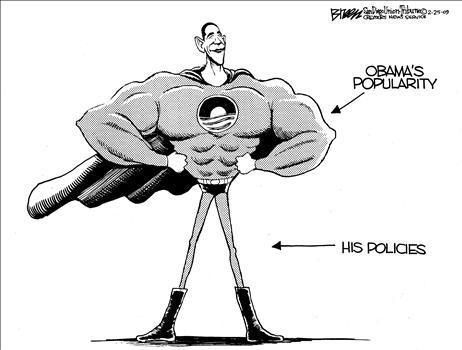
Dr. Sanity offers a wonderful cartoon by Steve Breen that expresses this rather nicely:

obamacartoon.jpg

When I search for answers as to why people might be so pleased with Obama’s words and the way he delivers them, I think it is impossible to ignore the underpinnings of his oratory: the quality of his voice itself. He happens to be gifted with a naturally mellifluous baritone of a type that resonates in the deep recesses of the human heart and brain as trustworthy and soothing.

It’s the sort of voice that is sought after for radio or TV work, the type that used to narrate those educational films we watched as children. Such speaking voices tend to naturally project qualities such as those listed in this advertisement for a baritone voiceover artist: “sonorous, knowledgeable, authoritative and trustworthy.”

The man being described is an actor, of course. But note that the adjectives are exactly the same ones Obama’s admirers (and even some of his detractors) would use to describe features his voice and persona seems to project. They also happen to describe Ronald Reagan’s voice, by the way—and for the record, I was largely immune to its effect as well.

Here’s a fascinating article on Obama’s speaking abilities, written during the campaign:

Says [opera coach] Lotfi, “The fact is that the basic timbre is a god-given sound. Through technique and vocal study and all that, you can learn to control it and develop it, but you cannot manufacture timbre artificially…It comes across at a very gut level more so than at an intellectual level.”

When it happens that something within us shivers or tingles at the words of a great and moving voice…it is because there is something that leaps forth from the very anatomy of the speaker, revealing the innate grain that vibrates with a receptive grain of our own. It is not about goodness or morality or truth-telling and is little affected by coaching or practice.

Maybe I just happen lack the requisite “receptive grain” for Obama’s voice. I can hear the melody of the pleasant baritone quality well enough, but it just doesn’t mean a thing to me. Unfortunately, I sense that it means a great deal to others.

[NOTE: Jules Crittenden seems immune, as well. He describes the general reaction to Obama’s speech as “a never-ending mass sycophancy of gaga-eyed fawning.”]

Posted in Obama | 32 Replies

Post navigation

← Previous Post
Next Post→

Your support is appreciated through a one-time or monthly Paypal donation

Please click the link recommended books and search bar for Amazon purchases through neo. I receive a commission from all such purchases.

Archives

Recent Comments

  • BJ on Happy Labor Day
  • BJ on The Clancy jury apparently will end in a mistrial
  • Charles R Harris on The AfD does very well in the recent German elections in Saxony-Anhalt
  • Charles R Harris on The AfD does very well in the recent German elections in Saxony-Anhalt
  • om on The AfD does very well in the recent German elections in Saxony-Anhalt

Recent Posts

  • The AfD does very well in the recent German elections in Saxony-Anhalt
  • Happy Labor Day
  • Open thread 9/7/2026
  • A restrained AI spam comment
  • A lost skill

Categories

  • A mind is a difficult thing to change: my change story (17)
  • Academia (328)
  • Afghanistan (98)
  • Amazon orders (6)
  • Arts (8)
  • Baseball and sports (164)
  • Best of neo-neocon (91)
  • Biden (536)
  • Blogging and bloggers (595)
  • Dance (292)
  • Disaster (244)
  • Education (323)
  • Election 2012 (360)
  • Election 2016 (566)
  • Election 2018 (33)
  • Election 2020 (513)
  • Election 2022 (114)
  • Election 2024 (403)
  • Election 2026 (93)
  • Election 2028 (13)
  • Evil (129)
  • Fashion and beauty (324)
  • Finance and economics (1,042)
  • Food (317)
  • Friendship (48)
  • Gardening (18)
  • General information about neo (4)
  • Getting philosophical: life, love, the universe (734)
  • Health (1,161)
  • Health care reform (545)
  • Hillary Clinton (184)
  • Historical figures (337)
  • History (716)
  • Immigration (448)
  • Iran (464)
  • Iraq (227)
  • IRS scandal (71)
  • Israel/Palestine (821)
  • Jews (437)
  • Language and grammar (365)
  • Latin America (212)
  • Law (2,975)
  • Leaving the circle: political apostasy (124)
  • Liberals and conservatives; left and right (1,321)
  • Liberty (1,117)
  • Literary leftists (14)
  • Literature and writing (394)
  • Me, myself, and I (1,498)
  • Men and women; marriage and divorce and sex (929)
  • Middle East (384)
  • Military (324)
  • Movies (353)
  • Music (533)
  • Nature (261)
  • Neocons (32)
  • New England (183)
  • Obama (1,738)
  • Pacifism (16)
  • Painting, sculpture, photography (131)
  • Palin (93)
  • Paris and France2 trial (25)
  • People of interest (1,043)
  • Poetry (258)
  • Political changers (178)
  • Politics (2,793)
  • Pop culture (397)
  • Press (1,635)
  • Race and racism (882)
  • Religion (428)
  • Romney (164)
  • Ryan (16)
  • Science (641)
  • Terrorism and terrorists (971)
  • Theater and TV (266)
  • Therapy (71)
  • Trump (1,630)
  • Uncategorized (4,555)
  • Vietnam (109)
  • Violence (1,445)
  • War and Peace (1,027)

Blogroll

Ace (bold)
AmericanDigest (writer’s digest)
AmericanThinker (thought full)
Anchoress (first things first)
AnnAlthouse (more than law)
AugeanStables (historian’s task)
BelmontClub (deep thoughts)
Betsy’sPage (teach)
Bookworm (writingReader)
ChicagoBoyz (boyz will be)
DanielInVenezuela (liberty)
Dr.Helen (rights of man)
Dr.Sanity (shrink archives)
DreamsToLightening (Asher)
EdDriscoll (market liberal)
Fausta’sBlog (opinionated)
GayPatriot (self-explanatory)
HadEnoughTherapy? (yep)
HotAir (a roomful)
InstaPundit (the hub)
JawaReport (the doctor’s Rusty)
LegalInsurrection (law prof)
Maggie’sFarm (togetherness)
MelaniePhillips (formidable)
MerylYourish (centrist)
MichaelTotten (globetrotter)
MichaelYon (War Zones)
Michelle Malkin (clarion pen)
MichelleObama’sMirror (reflect)
NoPasaran! (bluntFrench)
NormanGeras (archives)
OneCosmos (Gagdad Bob)
Pamela Geller (Atlas Shrugs)
PJMedia (comprehensive)
PointOfNoReturn (exodus)
Powerline (foursight)
QandO (neolibertarian)
RedState (conservative)
RogerL.Simon (PJ guy)
SisterToldjah (she said)
Sisu (commentary plus cats)
Spengler (Goldman)
VictorDavisHanson (prof)
Vodkapundit (drinker-thinker)
Volokh (lawblog)
Zombie (alive)

Meta

  • Log in
  • Entries feed
  • Comments feed
  • WordPress.org
©2026 - The New Neo - Weaver Xtreme Theme Email
Web Analytics
↑