Evan Bayh has another ally in opposing the budget bill: Senator Robert Menendez from New Jersey, who is protesting a little item that was slyly slipped into the bill while no one was looking. Menendez, the son of Cuban immigrants, was stunned to find a provision there that would relax rules on travel and imports to Cuba.
Senator Menendez seems to be pretty liberal, and he would have otherwise supported this bill. But he’s not just annoyed, he’s enraged—enough to offer this bit of stinging rhetoric to the supposedly “transparent” administration, as well as Congressional leaders Reid and Pelosi:
The process by which these changes have been forced upon this body is so deeply offensive to me, and so deeply undemocratic, that it puts the omnibus appropriations package in jeopardy, in spite of all the other tremendously important funding that this bill would provide.
“Deeply undemocratic”—I’m sure Menendez meant “undemocratic” with a small “d.”
I find it pretty offensive as well, but not because it’s undemocratic (small or large “d”). Slipping in provisions without debate on them is certainly not unheard of in Washington. But the especially offensive (“deeply offensive”) part is the hypocrisy of the promises on which Obama ran versus the reality of his actual presidency.
A few days ago a commenter here offered a link to this page of Lenin quotes. Some of them seem pretty apropos in light of recent developments, and so I offer them to you for your contemplation [I’ve emphasized some of the most “interesting” by highlighting them in bold]:
A lie told often enough becomes the truth.
Democracy is indispensable to socialism.
Give me four years to teach the children and the seed I have sown will never be uprooted.
It is true that liberty is precious; so precious that it must be carefully rationed.
One man with a gun can control 100 without one.
The best way to destroy the capitalist system is to debauch the currency.
The goal of socialism is communism.
The way to crush the bourgeoisie is to grind them between the millstones of taxation and inflation.
There are no morals in politics; there is only expedience.
No amount of political freedom will satisfy the hungry masses.
The final quote is of special interest because of the way it dovetails with the insights of the Russian writer Fyodor Dostoevsky. Although Lenin was a mere nipper of ten when Dostoevsky wrote “The Grand Inquisitor,” (a chapter from Dostoevsky’s masterpiece The Brothers Karamazov, written in 1880), Lenin seemed to steal a page (or several) out of his book.
Dostoevsky was no stranger to the revolutionary socialist zeal and terrorist nihilism that was already beginning to shake Russia in the second half of the nineteenth century, which terminated in the Russian Revolution and the ascent of Communism there. Although he died in 1881 and did not live to see the final flowering of the movement that had taken root decades earlier, he had been a revolutionary himself in his youth, and had actually faced a firing squad after being arrested for subversive activities.
It was a traumatic experience for Dostoevsky, already a highly emotional and even unstable youth. He and his companions were subject to a mock execution, their sentences commuted at the last moment to years of harsh labor in prison camp. That experience and others made Dostoevsky a “changer;” he later renounced both socialism and a host of other Western ideas, embraced Russian Orthodoxy and a mystical spirituality, and became one of the world’s greatest writers.
I came across Dostoevsky’s works in high school and then again in college, during the period of upheaval and unrest that started in the late 1960s. In high school we were assigned to read Crime and Punishment, as well as the “Grand Inquisitor” excerpt from Karamazov, and in college I read his chilling work The Demons (then titled The Possessed), about the spiritual and moral bankruptcy of the revolutionaries.
Did I understand these works then? Not as well as I think I understand them now. But of all the lessons I learned during my school days, and of all the books I was assigned to read, these made perhaps the deepest and most powerful impression on me.
Much of school felt like the memorization of dry and irrelevant facts. Many novels seemed obscure and and hardly applicable to my life, and one would have thought that would have been even more true of these startling and intense Russian works from a time that seemed so distant then (although it seems much closer now; odd how that happens).
But something in them rang a bell, especially as the political upheaval of the 60s progressed. That bell had a sound not only of strange and inexplicable familiarity, it was also an ominous toll of warning. The books seemed to speak to the troubled times in which I was living, and made me realize that there is hardly any new thought under the sun. Those headstrong revolutionaries of the far-off Russian past were not stilted figures in an old and faded photo; they too closely and uncomfortably resembled the rebels of my own generation, who thought they had invented protest and cast off the shackles of the past.
I’ve quoted the following excerpt before on this blog. I’m quoting it again now. And I wouldn’t be at all surprised if I have reason to quote it in the future.
In this excerpt Dostoevsky’s Grand Inquisitor is addressing Christ, who has returned to earth but is arrested and imprisoned again:
Oh, never, never can [people] feed themselves without us [the Inquisitors and controllers]! No science will give them bread so long as they remain free. In the end they will lay their freedom at our feet, and say to us, “Make us your slaves, but feed us.” They will understand themselves, at last, that freedom and bread enough for all are inconceivable together, for never, never will they be able to share between them! They will be convinced, too, that they can never be free, for they are weak, vicious, worthless, and rebellious. Thou didst promise them the bread of Heaven, but, I repeat again, can it compare with earthly bread in the eyes of the weak, ever sinful and ignoble race of man?
When Cramer said that the Obama administration is destroying wealth in this country, he thought his liberal bona fides would protect him. He also thought that the fact that he was, you know, speaking the truth might have some effect as well.
Cramer may have thought that liberals would defend speaking truth to power; after all, it’s one of their favorite phrases. But it depends what “truth” and it depends what “power.” If the powerful people being criticized just happen to be liberals or the Left, then it can’t really be “truth,” you see, whatever its obvious merits might be. And the person so bold as to utter that truth not only had better shut up, but he/she immediately becomes fair game for attack, ridicule, and/or distortions of what was said.
Now, as Cramer looks around from his perch under that crowded bus, he is surprised. He shouldn’t be. Welcome, Cramer, to the first step on the long road to change.
Not that Cramer will necessarily take any of the next steps. But it can be profoundly disturbing to discover (as Cramer now has) that those whom you thought were interested in actually solving a problem and listening to honest criticism are far more interested in silencing and marginalizing the opposition.
Finally, here’s a bit that has nothing whatsoever to do with Obama. At least, I can’t find a tie-in. Watch it and brighten your day/night/whatever (hat tip Rachel Lucas).
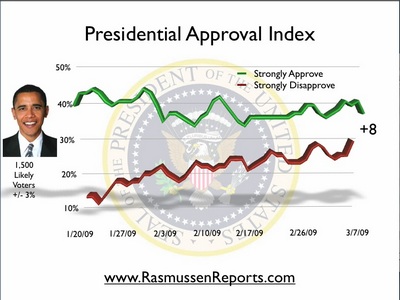
One of the more interesting aspects of this graph is that the convergence of the two lines is caused more by steeply growing “strongly disapprove” rates rather than sharply falling “strongly approve” ones.
That makes a good deal of sense. Those who were weakly for Obama—the ones who thought he’d be a nice moderate guy—are learning the hard way, while the Leftists who adored him before the election probably adore him even more now.
And for those moderates who are having second thoughts because they trusted him, Ace offers this comfort. Enjoy—and, in the immortal words of the great John Belushi, start drinking heavily (but shhh!, don’t say I told you to do that).
Sometimes a seemingly random word or two can be very instructive, if you want to know what a person really thinks. That is the reason I (and so many others) paid quite a bit of attention to a couple of revealing moments leading up to the election.
One was Obama’s “spread the wealth” comment to Joe the Plumber. While some might say it was just a single insignificant phrase uttered during an impromptu give-and-take, I would respond that no one would express such a thought unless it matched his/her internal concept of the world and how it should function.
In other words, it was a moment in which Obama’s carefully constructed mask slipped.
The same was true for the surfacing of a tape in which Obama calmly said that his energy policies were intended to bankrupt coal plants and cause the price of electricity to “skyrocket.” Prior to this, we all know he was an environmentalist. But the radical nature of his “solutions” had not been so nakedly revealed.
I wrote this post in the week before the election, entitled “Will the real Obama please stand up?” In it, I quoted Tony Blankley on the subject of Obama’s true intentions as opposed to his facade.
It made chilling reading then. But it makes prescient reading now:
But of course, throughout history when dangerous, radical men have offered themselves up for leadership, their moderate supporters have rationalized their early support by hoping that the dangerous man is really a sensible man like them and doesn’t believe some of those wild things he has said to his more fervent followers.
But as the campaign clock ticks down to its last days and hours, prudent people have to consider the possibility that beneath that easy manner and calming voice is the pulsating heart of a genuine man of the radical left.
That brings us to a telling remark Obama made during his February 24, 2009 speech to a joint session of Congress. It slipped right by me at the time. But Jacob Sullum, writing in Reason, has kindly underlined it.
In the sentence in question, Obama doesn’t mention Bush by name. But it appears fairly clear that he is speaking of the beginnings of the Bush administration, when Bush inherited a budget surplus from President Clinton (let’s leave aside for the moment the interesting question of whether it was technically a surplus or not; we can certainly agree it was at the very least a greatly reduced deficit). Obama said:
A surplus became an excuse to transfer wealth to the wealthy instead of an opportunity to invest in our future.
Sullum points out:
Whatever you think of the wisdom of Bush’s tax cuts, they amounted to taking less from people, not giving more to them. Obama makes it sound as if there is no meaningful difference between robbing Peter to pay Paul (which is what he has in mind when he talks about “rebalancing the tax code”) and leaving Peter alone (or, more accurately, robbing him less thoroughly)””except that the latter option is, in Obama’s view, morally inferior.
I believe that this, more than any other statement Obama has made, underlines the deeply radical Leftist underpinnings of Obama’s thoughts about wealth and capital. By labeling the act of allowing people to keep more of the money they have already earned as a “transfer of wealth to the wealthy,” he indicates that he actually doesn’t think that money belongs to them in the first place.
Now, you may think the tax code isn’t progressive enough. You may think that the rich should be paying an even bigger share than their already substantial portion of the tax burden. But the idea that a reduction in a still-high tax rate, that allows the rich to keep more of the money they have earned, represents an actual transfer of wealth to them is a very odd—and hugely telling—notion.
The second part of the quote is interesting, as well. Obama says the wealth transfer has been a substitute for “an opportunity to invest in our future.” But wait—do not the wealthy “invest in our future,” by starting businesses, growing the GNP, and employing people in a myriad of ways? Of course, not all of their money goes to this purpose. They keep quite a bit (are allowed to keep quite a bit?) to furnish their lavish homes, and to buy their yachts and other playthings. But some of that surplus owned by the wealthy (yes, they do own it) is put in the service of driving the engine of our economy for us all.
Does Obama not realize this? Perhaps—but I think he does actually know it. I just think that, when he says “our future,” he’s envisioning a different sort of future.
What is this “future” in which Obama would have us invest? It appears to be one in which government makes the decisions as to who should own wealth, because that wealth actually belongs to the people as a whole. One in which that wealth can be redistributed by the government according to its own ideas of fairness. A government which, under Obama, will come to resemble either a social welfare state of the type popular in Europe, or perhaps even a socialist state approximating Venezuela under the reprehensible Hugo Chavez.
New and expanded refundable tax credits would raise the fraction of taxpayers paying no income taxes to almost 50% from 38%. This is potentially the most pernicious feature of the president’s budget, because it would cement a permanent voting majority with no stake in controlling the cost of general government.
And that, in turn, reminds me of this thought, attributed (perhaps falsely) to Alexander Fraser Tytler:
A democracy cannot exist as a permanent form of government. It can only exist until the voters discover that they can vote themselves largesse from the public treasury. From that moment on, the majority always votes for the candidates promising the most benefits from the public treasury with the result that a democracy always collapses over loose fiscal policy, followed always by a dictatorship. The average age of the world’s greatest civilizations has been 200 years.
Now, I’m not sure about the word “always.” And it also seems there are democracies that have lasted more than 200 years. Also, of course, we can quibble with the word “democracy” because we are a republic.
But it seems true that it would take a very stalwart and unusual group of people to stop voting funds for themselves from the money machine our government has become. I’m not sure we are that people any more. And the quote dovetails nicely with another thought, this one attributed to Ben Franklin:
When the people find they can vote themselves money, that will herald the end of the republic.
Far from being naive about money and taxes and their effects on the general public, I see signs that the Democrats and Obama are very sophisticated indeed. It’s not that their goal is to destroy the republic. But I’m not sure that they care all that much if it happens. It may just be an unintended consequence of their drive for power.
…recants from his recent piece criticizing the President’s budget as way too liberal. Now he’s back in the Obama saddle again, and all it took was a little phone call from “four senior officials” of the Obama administration. And a dozen red roses, no doubt.
They mean well, they told Brooks. And they’re not really liberals, after all. And the deficit won’t be that bad. Promise.
On the other hand, is Whoopi Goldberg starting to have second thoughts about supporting The One? She’s been doing the tax math and doesn’t like the way it’s adding up.
I’ve been wanting to write about other things besides Obama. Truly, I have.
But I keep coming back to that topic because it seems vital to get it right—and now, before things slide out of control.
Speaking of sliding out of control, here’s a little musical interlude:
But I digress.
Now back to the main event: so, what’s up with Obama? (certainly not the stock market). Some middle-of-the-roaders who thought he was one of them seem shell-shocked. They need a support group, and maybe a twelve step program as well.
As for me, I’m disappointed but not surprised; I, along with many others, felt there were just too many signs that Obama would be taking a Leftist course despite his soothing centrist words and demeanor—although I’d still be happy if I turned out to be wrong.
I’ve found that it’s always good to believe that people mean what they say, even when they’re politicians. The problem with Obama is that, even more than most, his campaign was a combination of lofty but general rhetoric and contradictory specifics. He truly did try to be all things to all people, and succeeded with enough of them to get elected.
Sorting through all of that was difficult for most voters. What’s more, it required time and attention. But the signs that Obama would be one of the most liberal and even Leftist presidents in history were clear to those who were looking.
There was his voting record, for starters. In addition, his friends and close alliances, as well as many of his statements back when he wasn’t running for president (at least officially; I’m not sure there ever was a time he wasn’t running for president in some sense), indicated the same. Add to that his stint as a student of the Alinsky approach, as well as being a teacher of Alinsky’s methods, ample evidence of far Left leanings and a plan to put Alinsky techniques to work on the American public.
Seizing (and even deepening) a crisis and feelings of panic in the populace, and making use of those emotions to pass a liberal agenda, is pure Alinsky. The heart of that particular Alinsky suggestion is here:
[People] must feel so frustrated, so defeated, so lost, so futureless in the prevailing system that they are willing to let go of the past and change the future.
There’s that word ubiquitous word “change” again. What had seemed so amorphous and featureless an idea (purposely vague) during the campaign, but which had Obamaphiles chanting in spellbound wonder, was most likely a focused and targeted page out of the Alinsky playbook rather than an accident.
What else was a plan, and what accidental?
Powerline’s John Hinderaker doesn’t know, and neither do I. Perhaps no one except Obama and his close associates do. I have never been much of a conspiracy theorist and I’m not one now. But the evidence pointing in the direction of Leftist intent and awareness, and purposeful deception about that fact, is becoming more compelling every day.
Hinderaker quotes those who set out the case that Obama is “deliberately damaging the economy and gutting the stock market…[to] make more people dependent on the government and pave the way for a far-left regime.” But then he draws back from concluding that they are correct. This is his reasoning:
Obama can’t possibly want to be a one-term failure. That’s what happened to Jimmy Carter, and Obama must know that it will happen to him, too, if his policies are perceived as dragging down the economy.
More likely the explanation is that Obama is an economic illiterate, and subscribes to the idea–which I think is rather common among Democrats–that what the government does has little impact on the economy.
John, I hope you’re right. But I think you’re wrong. I’m not sure that his goal is to deliberately damage the economy, but I sense that Obama doesn’t much care if he breaks that particular egg in order to make his welfare state omelet—in fact, it tends to go with the territory, as he must know.
And, if Obama is a true Leftist, as I believe he is, he (a) doesn’t mind if he only serves one term, if he guides America closer to a socialist destination; and/or (b) thinks that his policies will placate enough Americans, who will be grateful for the help and the money and who buy his line that the rich are the enemy, that they will actually give him a second term.
I don’t think Obama is an “economic illiterate,” despite the fact that he lacks business experience. As many people have pointed out, he is a smart man, and the basics aren’t all that hard to master. Also, it’s difficult to believe that, with economic advisers such as Larry Summers (who used to actually be a centrist, a real rather than a rhetorical one), he’s not being told the probable negative consequences of his economic proposals. And anyway, what’s the rush? Why not concentrate on getting the stimulus going first, if he cares about the current economic crisis, rather than just using it as an opportunity to turn America Left before it knows what hit it?
I can only come to the conclusion that Obama doesn’t care about the fallout for entrepreneurship or for productivity. His goal is his version of “economic fairness”—that is, equality of outcome rather than opportunity.
Once again, he warned us—at least those who were listening to the details. I wrote the following back in August of 2008 [emphasis mine]:
Some of Obama’s slightly-less-publicized statements are the ones that concern me most.
Case in point: in this WSJ column by William McGurn, the author points out that for Obama, taxes are not just about collecting revenue. What are they for? Fairness.
Obama was being quizzed on his proposal to raise the capital gains tax. When Charlie Gibson of ABC noted that the empirical evidence indicates that increasing the capital gains tax tends to lead to a decrease in actual revenue collected, Obama’s answer was, “Well, Charlie, what I’ve said is that I would look at raising the capital gains tax for purposes of fairness.”…
Obama’s brand of liberalism seems most interested in the appearance of fairness, and appears to view the economy as a zero-sum game. To help some people, you must take money away from others. The idea of a rising tide floating all boats””or of a capital gains cut stimulating the economy in a way that yes indeed, does benefit the rich but also benefits the entire financial system in a way that ultimately helps the middle class and even the poor””is often considered a nefarious and duplicitous scheme hatched by (who else?) the Republicans. That it often (though not always) conforms to reality is a mere detail, because the rich are by definition bad and need to be taken down a peg.
Obama has hit the ground running with his plan to undo the policies of the most “nefarious” Republican of all: Ronald Reagan. This is no accident, either—not that it’s something he overtly campaigned on. But he took advantage of the crisis—and has amplified it, I believe—the better to make good on a promise he made to himself back in the early 80s, when he was a lowly Alinskyesque community organizer (quoted from his 1995 book “Dreams from My Father”; emphasis mine):
Obama said he got into community organizing in Chicago in 1983 to “pronounce on the need for change. Change in the White House, where Reagan and his minions were carrying on their dirty deeds.”
Note that Obama is not voicing a mere disagreement with Reagan’s policies. He is characterizing them as evil. I believe that his entire public career has been an attempt to undo Reagan and establish the “trickle-up” economics of socialism, whatever happens to our economy in general. The fact that this might be the worst of all possible times in economic terms to do this is something he is ignoring, as well, because he feels the American people are emotionally ready for it. He must strike while that iron is hot.
It’s probably no accident, either, that Obama sent that Churchill bust back to England almost as soon as he became president. He doesn’t want the old man’s visage around staring at him and reminding him of quotes such as this
Socialism is a philosophy of failure, the creed of ignorance, and the gospel of envy, its inherent virtue is the equal sharing of misery.
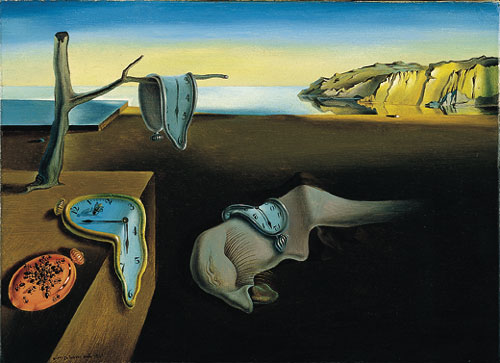
[NOTE: Why the weird painting? It’s surrealist Salvador Dali’s “The Persistence of Memory,” his most famous work.
Plus, what we’re going through is starting to seem surreal, don’t you think? And time’s getting short on blocking Obama’s attempt at a radical transformation of American society into a Euro-style welfare state.]
What important military defeats has America ever known? If you don’t count the South in the Civil War, we have a single one: Vietnam.
The consequences of that defeat, in a land so far away, were easy for Americans to ignore or whitewash, or to pin on our conduct during the war itself rather than our decision to abandon the South Vietnamese to their fate.
The Left, for example, has always blamed America’s actions during the Vietnam war—and especially the bombing of Cambodia—for the ascendance of the brutal Pol Pot regime and its later killing fields (see this article, especially pages 6-7, for an argument against that controversial theory, as well as an explanation of its journalistic origins). The Left has also consistently minimized the suffering of the people of South Vietnam when the North took over. To the Left, the Northern Vietnamese Communists weren’t so bad, and the Cambodian Communists (who even they have to admit were pretty nasty folk) would never have succeeded but for the actions of the US in fighting them and their North Vietnamese allies.
Not only does the Left whitewash the consequences of the American defeat in Vietnam. I’ll go even further and say that to the Left, the Vietnam pullout was actually a victory—for them. It’s something they had promoted for a long time, and they finally won. What’s more, except for the rare Vietnam revisionist historian, their version of history won; it has come to dominate the texts and the press. And so the Left neither wanted—nor needed—to look at the negative consequences of the defeat for others.
Vietnam has been the template for the Left in most of our subsequent wars. They tried to repeat the experience in Afghanistan, but it didn’t quite work because that country’s American casualties, and the length of time we were in active fighting there, were insufficient to generate enough revulsion on the part of the American public.
But Iraq was going very well for the Left for quite a while, much in the Vietnam mode. It went on for a long time and was more bloody. And, although casualties were nowhere near those sustained in the Vietnam conflict, American sensibilities had become more delicate in the ensuing years, and tolerance for death in wartime was much lower.
In Bush, as in Nixon, the Left was gifted with a president who was vulnerable to personal attack, and both men played into the Left’s hands in various ways (Bush through his tendency to strut and his relative inarticulateness, Nixon through his paranoia and ultimately Watergate). In both wars the press changed from initial (although somewhat wary) enthusiasm for the war to outright condemnation (see this and this for a discussion of Vietnam and the press).
Vietnam was not just the template for the Left’s approach to war, it was the template for defeat without consequences. But there were negative consequences; just not for the Left. Not only did our withdrawal from Vietnam negatively impact the people of South Vietnam and Cambodia, it offered encouragement to those who would challenge the US, by letting them know that the American people lacked the stamina for a long fight. Thereafter, enemies assumed they might have a good chance of wining against the larger and more powerful US through a three-pronged strategy: (a) wear us out while (b) simultaneously allying with the Left in this country to spread propaganda points, and (c) counting on the US press to ultimately join forces with the Left in that endeavor, either through ignorance or design.
The Iraqi insurgents and terrorists expected to win in a manner similar to North Vietnam. It was reasonable of them to assume that they would, and in fact they came perilously close. The Democrats, the Left, and the press played their parts to perfection. The 2006 Congress had become controlled by Democrats, and was eager to be part of the production.
The stumbling blocks turned out to be a few Democrats, most of the remaining Republicans, and especially the stubborn Bush. The former managed to block some of the legislation the majority of Democrats wished to pass, and Bush vetoed the rest. Bush remained committed to the surge, and appointed the brilliant General Petraeus to be in charge of its implementation.
And so there remained enough time left for the surge to succeed beyond the Left’s and the Democrats’ wildest dreams. Paradoxically, however, this meant that once again, those who had either advocated or prematurely accepted defeat never had to face the consequences of what such a defeat might mean. Protected by their enemy Bush and his victory (at least so far; nothing is permanent or written in stone in Iraq), they can now bask in the glow of their devotion to peace at any price, and yet not be saddled with the burden of dealing with defeat there.
Thus, President Obama can speak of “ending” the war in his recent speech to Marines at Camp Lejeune while studiously avoiding all mention of victory, the surge, or including a single word of praise for his predecessor. The closest he comes is to say “you got the job done,” after speaking at length of dangers, loneliness, and burdens, as well as “difficult days ahead.”
I’m not sure what message the Marines heard. But I think the message our enemies have heard—loud and clear—is that President Obama and the Democrats may mouth intimidating words about Afghanistan and Pakistan, but when push comes to shove, they’ll be shoving off.