Commenter “uncleFred” writes about addiction:
“There for the grace of God”¦”
Not so much. Drug abuse is not like getting hit by a meteor, or struck by lightening, it is a choice. Go to an AA meeting. Sit for a couple of hours and listen. Talk with someone who has been sober or clean a while. (AA meetings these days have as many drug addicts as alcoholics because of the high percentage of dual addiction).
The ones who recover, literally to a man or woman, all tell you the same thing. There came a day when they DECIDED to quit, and then they found help to do so. They’ll admit that it was a choice to start, a choice to keep abusing their drug of choice, and it was a choice to stop. Most of them can’t even tell you why they decided to quit or what was different on that day from the day before. The most common answer is “I just got done”.
On the radio someone said that “Whitney lost her battle with ”˜her demons”, as if some evil force reached out and seized control of her life. I bear her no ill will and think her ending is sad, but the tragedy here is that the story that is front and center and larger than life is one spun by a PC media and not focused on the truth of addiction.
UncleFred is correct that it is a choice—unless, of course, someone held Whitney (or any other addict) down and force-fed (or injected) her with drugs in order to get her accustomed to the habit. We can safely assume that didn’t happen to her, and rarely if ever happens in general. So yes, it is most definitely a choice every single step of the way from first use to continuing use to sobriety.
But by far the best choice to make is not to start.
That is because, once the hook is in, the difficulty of choosing to stop—and sticking with that choice, day after day for a lifetime, which is what it takes—requires enormous strength and constant self-control. I am referring to the physical cravings as well as the psychological ones, especially for physically addictive drugs in the initial stages of rehab. In the end, though, the psychological “demons” are the ones that are hardest for most addicted people; after all, life ordinarily presents a host of stresses and problems, and the addict must learn to weather those without the tried-and-true method that has long cushioned the blows.
Not everyone becomes addicted. I’m not so sure that those who do are weaker than others, but they often have an extra physical vulnerability to their drug of choice: for example, alcohol. I have a number of friends who are alcoholics, and I’ve been impressed by how these seemingly strong people can go weak in its presence, and what a powerful pull it exerts for them. For me, on the other hand, it has no pull at all. I don’t even like it, so it takes no strength of character for me to resist it because there’s really nothing to resist.
But for those who become alcoholics or addicts after their initial exposure to the substances and their decision to invite them into their lives, it is at least in some ways as though an evil force comes and takes control of them, and they must battle it with every ounce of their beings. Such people often state that, right from their first ingestion of the substance, they love what it does to them and for them.
And there’s another issue in addiction: over time, drugs and alcohol do not leave people exactly as they found them. They often change the person under their influence, so that making those good choices while still using (and the decision to quit must occur while a person is still using) can be very hard because of those changes. The person is no longer quite in his/ right mind, or at least not in his pre-drug/alcohol mind, but it is necessary to start recovery while in that altered state (unless there’s a forced deprivation of the substance, such as can occur in prison, for example).
Unlike Odysseus, a person in the real world can’t be tied to the mast to resist the siren song:
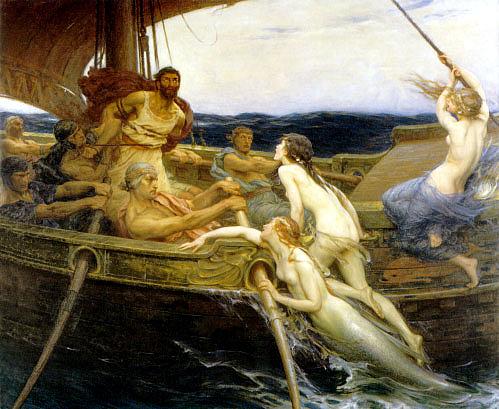
For some people, that call can be so strong that, in the end, it’s all they hear and all they care about.
[ADDENDUM: There is evidence that, at least for some people, the very first drug experience changes them physiologically, especially if it’s crack . See this:
Crack is inhaled and rapidly absorbed through the lungs, into the blood, and carried swiftly to the brain. The chances of overdosing and poisoning leading to coma, convulsions, and death are greatly increased. Crack’s rapid rush – 5 to 7 minutes of intense pleasure – quickly subsides, leading to depression that needs to be relieved by more crack. This cycle enhances the chances of addiction and dependency. Because of the brief high, users are constantly thinking about, and devising ways to get more crack. Psychologically, the drug reduces concentration, ambition, drive, and increases confusion and irritability, wreaking havoc on users’ professional and personal lives. Habitual use may lead to cocaine psychosis causing, paranoia, hallucinations, and a condition known as formication, in which insects or snakes are perceived to be crawling under the skin…
Once an individual has tried crack, they may be unable to predict or control the extent to which they will continue to use. Crack is probably the most addictive substance that has been devised so far. Crack addicts must have more and more crack to sustain their high and avoid the intense “crash” or depression that follows their binges. They become physically and psychologically dependent on crack, which is often a result of only few doses of the drug taken within a few days. This dependence can lead to addiction.
All to often, the process of crack addiction goes something like this: The “soon to be addict” takes their first hit. Upon inhalation of this powerful drug, the users body instantly begins the addiction process. The individual’s mental and emotional being is soon to follow, but for now just their body suffers from the initial stages of crack addiction. After the first few times using the drug, their mind slowly starts the addiction process. This grows stronger and stronger until, mentally, the addict believes that they cannot live without the drug. They now are entangled in a full fledged crack addiction. Shortly after this occurs, crack takes complete control over their emotions.
Once the individual’s emotions have been overridden by cocaine, they no longer feel normal without being intoxicated. When this occurs they feel the need to use more crack just to feel normal. In order to get high they have to take an immense amount of the drug. Their crack addiction has infiltrated all areas of their life. They can no longer function physically, emotionally, or mentally without crack. This cycle of addiction continues until the individual either quits using or dies…
The use of crack alters the processes of the brain by causing a change in the way neurons in the brain communicate. Nerve cells, called neurons, communicate with each other by supplying the brain with chemicals called neurotransmitters. These neurotransmitters allow information in the form of electrical impulses to be passed through the body. This process works by neurotransmitters attaching themselves to certain areas in the brain. One of the neurotransmitters affected by crack is called dopamine. Dopamine is released by neurons in the part of the brain that controls feelings of pleasure and well-being. This area is in the limbic system of the brain. Normally, once dopamine has transferred to a nerve cell’s receptors and caused a reaction in a cell, it is transferred back to the neuron that released it.
Crack cocaine causes damage to this system and blocks the process of transfer. Dopamine then builds up in the gap synapse between neurons. As a result, for crack cocaine users, dopamine keeps affecting a nerve cell after it should have stopped. That’s why someone who uses crack cocaine feels an extra sense of euphoria and pleasure. Although crack cocaine may bring on intense feelings of pleasure while it is being used, crack cocaine can damage the ability to feel pleasure in the long run. Research suggests that long-term crack cocaine use may reduce the amount of dopamine or the number of dopamine receptors in the brain. When this happens, nerve cells must have crack cocaine to communicate properly. Without crack cocaine, the brain can’t send enough dopamine to the receptors to create a feeling of pleasure.
I challenge anyone to read that site and not be almost overwhelmed by how difficult the task of quitting a drug like that must be.]