[NOTE: Every now and then I re-post a previous essay that you might have missed first time around. This is one of them (slightly edited).]
When I was a child, we were given a fair amount of homework. And although this was in what were then called “gifted” and/or “honors” classes, I wasn’t in some private school, nor even a public school in a ritzy suburb. I attended public schools from kindergarten through high school in a relatively blue collar area of New York, and from about fifth grade on I recall having between three and four hours of take-home assignments a night.
My parents, like most parents of the day, were remarkably unconcerned about this fact. Of course, they were part of a culture in which schools were generally considered to know best, when it took some great and mammoth offense for teachers’ or principals’ judgments to be questioned. I don’t even remember my parents having the habit of asking me whether I’d been assigned homework on any particular night, or whether I’d finished it, either. I suppose they figured they’d know soon enough that there was something wrong if my grades began to slip. Otherwise, my homework was primarily my own work and my own business.
Except, that is, for a particular assignment I had in sixth grade, given by a teacher we’ll call Mrs. McGuire, who had a legendary and well-earned reputation for mental cruelty. The class was doing a topic on that perennial favorite (of teachers, anyway): inventors. Each of us would have to research a famous one, write a report about him (yeah, they were all men), and deliver it to the class.
Mrs. McGuire was not a believer in choice. She selected the inventor for each student, announcing the assignments as she read off our names. Some lucky stiffs got Edison or Samuel F.B. Morse, or even old Cyrus McCormick or Eli Whitney. This meant they could write their reports by looking up the information in that trusty Mother of All References (the only one any of us could easily obtain in those days), the home encyclopedia. If students were feeling really ambitious they could, of course, supplement the encyclopedia’s pedestrian offerings with a library book or two, and take home an A or a B without much further trouble.
But when she came to my assignment, Mrs. McGuire read out the arcane name “Nicolas Francois Appert.” Nowadays, in this glorious era of instantaneous Googling and Wikipedia (of which I’ve just availed myself), one can look him up fairly easily. Even so, the information is sparse (see also this); hardly the stuff of the fifteen-to-twenty-minute oral presentation we were all supposed to deliver back then.
But in sixth grade all I could find in the encyclopedia was one terse sentence, declaring Appert to be a Frenchman who’d invented an early method of preserving food, for which he’d been awarded a prize by Napoleon. A trip to the local library revealed not a word more. And so, in a state of upset, I told my mother, and enlisted her help.
My mother was convinced that Mrs. McGuire had given me this assignment in order to humiliate me, knowing that it would be impossible to fulfill. This didn’t activate my mother to complain to the school. She knew that several generations of parents had already done so about Mrs. McGuire’s many excesses—most of them far worse than this one, by the way—to no avail. But my mother was determined to show Mrs. McGuire a thing or two.
So that Saturday we went on an expedition to the 42nd St. branch of the NY Public Library, as impressive a building then as now, perhaps even more so in my eyes.
The journey was long, and I’d never been inside before. I recall that, when we entered the gargantuan research room (“a majestic 78 feet [23.8 m] wide by 297 feet [90.5 m] long, with 52 feet [15.8 m] high ceilings—lined with thousands of reference books on open shelves along the floor level and along the balcony; lit by massive windows and grand chandeliers; furnished with sturdy wood tables, comfortable chairs, and brass lamps”)…
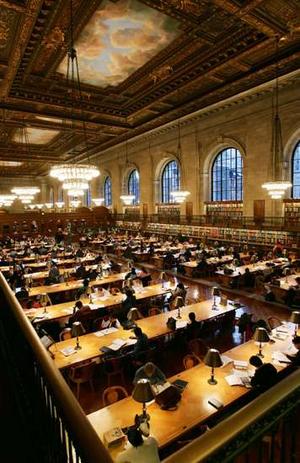
…my mother was told children were not allowed. But when she explained to the astonished librarian what my homework assignment was, I was given special permission to stay (I believe even the librarian had a few choice words to say about Mrs. McGuire).
The enormous card catalog yielded only one book on the subject. One should have been enough, but unfortunately, this one was in French, and it was by, not about, Nicolas Appert. My guess is that it was the volume described by Wikipedia as having been entitled “L’Art de conserver les substances animales et végétales” (or “The Art of Preserving Animal and Vegetable Substances for Many Years”)—an easy enough guess, since this seems to have been Appert’s only work.
We waited for the book to be delivered from the closed stacks, where its sleep had probably been undisturbed since the library’s opening in 1911. An ancient, slim volume, it turned out it held a mother lode (pun intended) of information, relatively speaking: its introduction (also in French) contained two or three pages describing Appert’s life, times, and mostly his invention.
Of course, we were not allowed to take the fragile (and decidedly rare) book home, but I sat at one of the tables and watched in awe as my mother read and translated the introduction, using whatever she remembered of her high school French, taking quick and dextrous notes (she knew shorthand, too) on a large yellow pad.
And that was it. I returned home with our prize, wrote a report, and delivered it. The kids in my class yawned (another inventor; who cares?), but Mrs. McGuire received my offering with a rather strange look on her face. I don’t know whether it was surprise, disappointment, or perhaps some combination of the two, but I didn’t much care.
What I experienced was mostly relief. My mother, however, owned up to a sense of triumph.
And the message of the whole strange episode? That you shouldn’t abandon a difficult but not impossible task, although sometimes help was needed to tackle it. That my mother could be a hero. That high school French and shorthand (neither of which I ever was to learn) might actually pay off, albeit in a somewhat strange set of circumstances. That the New York Public Library was a vast storehouse of knowledge, its mysterious underground bowels containing wondrous things.
And, I suppose, that research could be a sort of treasure hunt, an exciting adventure to uncover snippets of information heretofore unknown. Come to think of it, that latter lesson is probably responsible for some of my fascination with blogging.
And now, as I’ve completed the research (mercifully, all online) for this post, I discover that Appert’s story is still relatively hard to come by. As this source points out:
Nicholas Appert’s invention was tremendous; however, there is very little documentation on his personal and spiritual life. In this case, the invention appears to be more important than the inventor.
Tell me about it.