↓
 

The New Neo

A blog about political change, among other things

  • Home
  • Bio
  • Email
Home » Page 1222 << 1 2 … 1,220 1,221 1,222 1,223 1,224 … 1,934 1,935 >>

Post navigation

← Previous Post
Next Post→

Spain’s Ebola patient zero…

The New Neo Posted on October 7, 2014 by neoOctober 7, 2014

…is a nurse’s assistant.

Unlike the accusations that have been leveled at Thomas Duncan, no one can say she kept mum about the fact that she’d been near an Ebola patient recently. That’s because she was on the team that cared for a Spanish missionary and a Spanish priest, both of whom were shipped back to Spain after they contracted Ebola in Africa. Both of them have died.

But there is a similarity between the unnamed nurse’s disease trajectory and that of Duncan. As with him, there also was a delay in hospitalization and diagnosis. She is said to have reported her first symptom, a fever, on September 30, and yet she was only hospitalized this week. Since authorities knew in advance that she’d been exposed, why the delay, which put many more people at risk? Should they not have erred on the side of caution?

There are various possibilities. Perhaps the authorities had such faith in their isolation and protection techniques that they thought it impossible that a health worker could contract Ebola while working under state-of-the-art conditions in a Western hospital, as opposed to in Africa. Or perhaps (as I’m beginning to suspect) the diagnostic criteria for Ebola aren’t rigorous enough.

One of the first symptoms of Ebola is a fever, defined as above 101.5. But see this [emphasis mine]:

Health authorities said on Monday night that the nurse was in stable condition. She had alerted them to a slight fever on 30 September, said Antonio Alemany from the regional government of Madrid, and checked into a hospital in Alcorcé³n with a high fever on Sunday. Ebola protocol was immediately activated at the hospital and initial and secondary tests were both positive for the virus.

A “slight fever”—in other words, not high enough to be textbook Ebola. But the textbook may be wrong. Her fever didn’t become high enough to fit the criterion until five days later. The same mild fever was the case with Duncan, whose temperature was 100.1 on his first visit to the ER, when they sent him home with antibiotics (unlike the nurse, however, he already had other symptoms of Ebola). According to the woman who two days later called 9/11 for an ambulance for Duncan when he became extremely ill, his temperature even at that later stage was only 100.4 when she took it.

If both the US patient zero and Spain’s patient zero presented with mild fevers, it becomes harder to think of it as a freak occurrence. It just may be that mild fevers are more common in Ebola than previously thought, especially in the early stages. In fact, could they not be fairly common, and this fact previously missed because in Africa people don’t typically tend to get medical help until the later stages of the illness?

This is speculation on my part, of course; I’m not a doctor. But logic suggests it as a possibility, and it seems to be a potentially important issue to look into. If fever is being used as a marker for Ebola, it makes sense to make sure that fever is defined in a way that conforms to the disease’s early presentation, not just its late manifestation.

One other important question the Spanish nurse’s illness raises is how she managed to contract Ebola in the first place. There are only two possibilities, as I see it. The first is that an error (either hers or someone else’s at the hospital) was made in following the procedures for the isolation of Ebola patients. The other is that the procedures were followed but are sometimes inadequate, and more must be done to protect the people who care for Ebola patients.

This particular epidemic, as opposed to previous ones, has been marked by more medical staff contracting the disease. Is it because they have been careless? Is it because the epidemic is larger? Or is it because something has changed and made Ebola easier to contract?

These three possibilities are not mutually exclusive, either; the answer could be “all of the above.” But the most frightening one is that third one.

Posted in Health, Science | 52 Replies

The world is full of wonders: behold, the mosquito

The New Neo Posted on October 6, 2014 by neoOctober 6, 2014

I mean it: mosquitoes are astonishing.

Until recently, all I knew about mosquitoes could be summed up as: hate the little buggers. They bite, and can cause malaria.

But while researching the answer to Ymarsakar’s question the other day about mosquitoes and Ebola, I found myself in awe of the beasties. They are incredibly complex, and brilliantly engineered—like most creatures.

Where to begin? Try this:

Each species selects the situation of the water into which it lays its eggs and does so according to its own ecological adaptations. Some are generalists and are not very fussy. Some breed in lakes, some in temporary puddles. Some breed in marshes, some in salt-marshes. Among those that breed in salt water, some are equally at home in fresh and salt water up to about one-third the concentration of seawater, whereas others must acclimatize themselves to the salinity. Such differences are important because certain ecological preferences keep mosquitoes away from most humans, whereas other preferences bring them right into houses at night.

Some species of mosquitoes prefer to breed in phytotelmata (natural reservoirs on plants), such as rainwater accumulated in holes in tree trunks, or in the leaf-axils of bromeliads. Some specialize in the liquid in pitchers of particular species of pitcher plants, their larvae feeding on decaying insects that had drowned there or on the associated bacteria…

But that’s just the warmup. Here’s where I started to marvel (and forgive the length of this and what follows; believe me, I could have excerpted even more):

Typically, both male and female mosquitoes feed on nectar and plant juices, but in many species the mouthparts of the females are adapted for piercing the skin of animal hosts and sucking their blood as ectoparasites. In many species, the female needs to obtain nutrients from a blood meal before she can produce eggs, whereas in many other species, she can produce more eggs after a blood meal. The feeding preferences of mosquitos include those with type O blood, heavy breathers, those with a lot of skin bacteria, people with a lot of body heat, and the pregnant. Both plant materials and blood are useful sources of energy in the form of sugars, and blood also supplies more concentrated nutrients, such as lipids, but the most important function of blood meals is to obtain proteins as materials for egg production…

A large part of the mosquito’s sense of smell, or olfactory system, is devoted to sniffing out blood sources. Of 72 types of odor receptors on its antennae, at least 27 are tuned to detect chemicals found in perspiration…

Prior to and during blood feeding, blood-sucking mosquitoes inject saliva into the bodies of their source(s) of blood. This saliva serves as an anticoagulant; without it one might expect the female mosquito’s proboscis to become clogged with blood clots. The saliva also is the main route by which mosquito physiology offers passenger pathogens access to the hosts’ interior. Not surprisingly the salivary glands are a major target to most pathogens, whence they find their way into the host via the stream of saliva.

Mosquitoes are a veritable pharmacy of as-yet undiscovered drugs:

For the mosquito to obtain a blood meal, it must circumvent the vertebrate physiological responses. The mosquito, as with all blood-feeding arthropods, has mechanisms to effectively block the hemostasis system with their saliva, which contains a mixture of secreted proteins. Mosquito saliva negatively affects vascular constriction, blood clotting, platelet aggregation, angiogenesis and immunity, and creates inflammation. Universally, hematophagous arthropod saliva contains at least one anticlotting, one antiplatelet, and one vasodilatory substance. Mosquito saliva also contains enzymes that aid in sugar feeding and antimicrobial agents to control bacterial growth in the sugar meal. The composition of mosquito saliva is relatively simple, as it usually contains fewer than 20 dominant proteins. Despite the great strides in knowledge of these molecules and their role in bloodfeeding achieved recently, scientists still cannot ascribe functions to more than half of the molecules found in arthropod saliva. One promising application is the development of anticlotting drugs, such as clotting inhibitors and capillary dilators, that could be useful for cardiovascular disease.

It is now well recognized that feeding ticks, sandflies, and, more recently, mosquitoes, have an ability to modulate the immune response of the animals (hosts) on which they feed. The presence of this activity in vector saliva is a reflection of the inherent overlapping and interconnected nature of the host hemostatic and inflammatory/immunological responses and the intrinsic need to prevent these host defenses from disrupting successful feeding. The mechanism for mosquito saliva-induced alteration of the host immune response is unclear, but the data have become increasingly convincing that such an effect occurs. Early work described a factor in saliva that directly suppresses TNF-α release, but not antigen-induced histamine secretion, from activated mast cells… Unexpectedly, [a] shift in cytokine expression is observed in splenocytes up to 10 days after mosquito exposure, suggesting natural feeding of mosquitoes can have a profound, enduring, and systemic effect on the immune response.

Feeding is not particularly simple, either, especially for the female of the species (on the other hand, we have an answer to the burning question “What do female mosquitoes want?” The answer: blood and sugar):

Female mosquitoes use two very different food sources. They need sugar for energy, which is taken from sources such as nectar, and they need blood as a source of protein for egg development. Because biting is risky and hosts may be difficult to find, mosquitoes take as much blood as possible when they have the opportunity. This, however, creates another problem. Digesting that volume of blood takes a while, and the mosquito will require energy from sugar in the meantime.

To avoid this problem, mosquitoes have a digestive system which can store both food types, and give access to both as they are needed. When the mosquito drinks a sugar solution, it is directed to a crop. The crop can release sugar into the stomach as it is required. At the same time, the stomach never becomes full of sugar solution, which would prevent the mosquito taking a blood meal if it had the chance.

Blood is directed straight into the mosquito’s stomach. In species that feed on mammalian or avian blood, hosts whose blood pressure is high, the mosquito feeds selectively from active blood vessels, where the pressure assists in filling the gut rapidly…In the unmolested mosquito, however, the mosquito will withdraw, and as the gut fills up, the stomach lining secretes a peritrophic membrane that surrounds the blood. This membrane keeps the blood separate from anything else in the stomach. However, like certain other insects that survive on dilute, purely liquid diets, notably many of the Hemiptera, many adult mosquitoes must excrete unwanted aqueous fractions even as they feed…As long as they are not disturbed, this permits mosquitoes to continue feeding until they have accumulated a full meal of nutrient solids. As a result, a mosquito replete with blood can continue to absorb sugar, even as the blood meal is slowly digested over a period of several days.[

And that, my friends, is why mosquitoes carry neither AIDS nor Ebola (which was the original question Ymarsakar asked). Those are blood borne diseases, whereas malaria—which mosquitoes most definitely can give to their victims—is carried in the mosquito’s saliva:

[E]ven if HIV-positive individuals did circulate high levels of virus, mosquitoes could not transmit the virus by the methods that are employed in used syringes. Most people have heard that mosquitoes regurgitate saliva before they feed, but are unaware that the food canal and salivary canal are separate passageways in the mosquito. The mosquito’s feeding apparatus is an extremely complicated structure that is totally unlike the crude single-bore syringe. Unlike a syringe, the mosquito delivers salivary fluid through one passage and draws blood up another. As a result, the food canal is not flushed out like a used needle, and blood flow is always unidirectional. The mechanics involved in mosquito feeding are totally unlike the mechanisms employed by the drug user’s needles. In short, mosquitoes are not flying hypodermic needles and a mosquito that disgorges saliva into your body is not flushing out the remnants of its last blood meal.

I’m not about to cozy up to them, though. But really, what marvelous creatures!

[NOTE: I was going to add a photo of a mosquito, but they were too creepy. They still make my flesh crawl.]

Posted in Health, Nature, Science | 21 Replies

The Supreme Court punts on gay marriage

The New Neo Posted on October 6, 2014 by neoOctober 6, 2014

Which is also a decision, because the trend in the lower courts is to declare its ban unconstitutional:

Jonathan Adler writes that the Supreme Court might still take a case in the future, but I don’t see how that is realistic considering how expansive the pending cases were in terms of geography. In the states for which review was sought there will be marriages undertaken, a complicating factor if the court were to rule in the future that same-sex marriage bans were not unconstitutional.

The Court’s refusal to hear the issue was a surprise to most SCOTUS-watchers. You might call it cowardice, or you might call it lack of activism. But refusing to hear cases on which lower courts have been activist is not a lack of activism, either, it’s a lack of action.

I haven’t studied each case in depth, but it appears that they involve state appeals courts overruling anti-gay-marriage referenda passed by the people in each state, and declaring those bans invalid for constitutional reasons. That’s a troubling way for the gay marriage issue to be decided. The trend of public opinion has most definitely been for gay marriage to become more and more accepted, and one might think that as time went on more and more states would drop their bans because their populations would vote to allow gay marriage. The state courts are forcing this process, despite the fact that the arguments for the unconstitutionality of gay marriage bans is not strong.

It is somewhat akin to the history of abortion. Roe v. Wade was a stretch in the legal sense, positing a right to privacy that did not exist in the Constitution as written. And this despite the fact that the trend in the states was to allow abortion in more and more states; it had already become legal under certain circumstance in twenty states prior to the SCOTUS decision.

[NOTE: My own opinion on gay marriage can be found in this post from about a year and a half ago, particularly in the “Note” at the end of it.]

Posted in Law, Men and women; marriage and divorce and sex | 28 Replies

My political compass, three years later

The New Neo Posted on October 6, 2014 by neoOctober 6, 2014

Three years ago I took the test on the “Political Compass” site. This was the result back then, which seemed to place me correctly on the scale:

PCompass

I just took the test again. And although I certainly didn’t remember my previous answers, the results were fairly consistent. On the authoritarian scale, I scored the same, while on the left/right dimension, I had moved slightly rightward:

compass

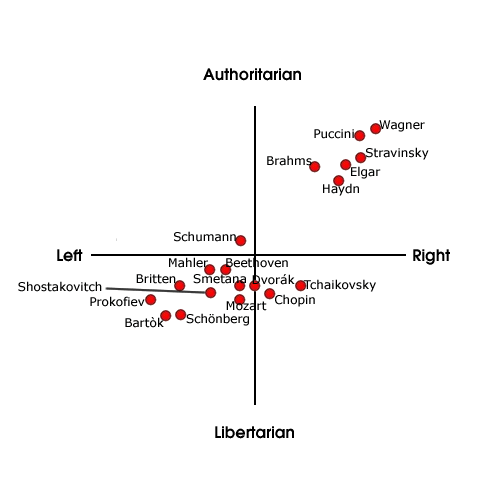
The site has a curious graph that purports to place composers on the grid. There aren’t too many composers whose politics are known (the great Bach is missing, for example, as is another favorite of mine, Handel). But when I looked at the chart, I was surprised to find where three of my absolute favorite composers—Tchaikovsky, Chopin, and Dvorak—were positioned:

composers

Does political affinity make for musical affinity?

Posted in Liberals and conservatives; left and right, Me, myself, and I, Music | 20 Replies

Testing, testing…

The New Neo Posted on October 6, 2014 by neoOctober 6, 2014

Warnings about the 9/11 hijackers: ignored.

And we’re not talking about general warnings that all too often, and yet understandably, get lost in the shuffle. We’re talking about very specific warnings about the actual 9/11 hijackers.

Posted in Terrorism and terrorists | 12 Replies

Spambot of the day

The New Neo Posted on October 4, 2014 by neoOctober 5, 2014

Hi there! This blog post could not bbe writgten much better!

Easy for you to say.

[ADDENDUM: I left comment #3 up in the comments section because I thought it very appropriate to show that some spam had successfully evaded the spam filter on this post. In fact, there were quite a few more spam comments that came through, which I deleted.

Spam is very very determined.]

Posted in Blogging and bloggers | 13 Replies

Red tribe, blue tribe

The New Neo Posted on October 4, 2014 by neoOctober 4, 2014

Here’s a wonderful post by a liberal guy who’s also a shrink, on the subject of the divide between Red and Blue America, and in particular the attitude of Blue towards Red (hat tip: commenter “carl in atlanta”):

The worst reaction I’ve ever gotten to a blog post was when I wrote about the death of Osama bin Laden. I’ve written all sorts of stuff about race and gender and politics and whatever, but that was the worst.

I didn’t come out and say I was happy he was dead. But some people interpreted it that way, and there followed a bunch of comments and emails and Facebook messages about how could I possibly be happy about the death of another human being, even if he was a bad person? Everyone, even Osama, is a human being, and we should never rejoice in the death of a fellow man…

…I genuinely believed that day that I had found some unexpected good in people ”“ that everyone I knew was so humane and compassionate that they were unable to rejoice even in the death of someone who hated them and everything they stood for.

Then a few years later, Margaret Thatcher died…

You know, you know, you know what’s coming, don’t you? And you’re right:

And on my Facebook wall ”“ made of these same “intelligent, reasoned, and thoughtful” people ”“ the most common response was to quote some portion of the song “Ding Dong, The Witch Is Dead”. Another popular response was to link the videos of British people spontaneously throwing parties in the street, with comments like “I wish I was there so I could join in”. From this exact same group of people, not a single expression of disgust or a “c’mon, guys, we’re all human beings here.”

I gently pointed this out at the time, and mostly got a bunch of “yeah, so what?”, combined with links to an article claiming that “the demand for respectful silence in the wake of a public figure’s death is not just misguided but dangerous”.

And that was when something clicked for me…

I know that “click” all too well. It’s quite an “aha” moment:

…[M]y hypothesis, stated plainly, is that if you’re part of the Blue Tribe, then your outgroup isn’t al-Qaeda, or Muslims, or blacks, or gays, or transpeople, or Jews, or atheists ”“ it’s the Red Tribe.

Well, we know that, don’t we? And I certainly know it—now. But back when I was a member of the Blue Tribe, I didn’t know it, didn’t feel it. It was a complete surprise to me when something of the sort began to happen to me at their hands. And perhaps that naivete, that surprise, that initial lack of outgroup feeling, was one of the reasons I was able to change my political affiliation when presented with certain evidence.

It’s not that, when I was a liberal, I was all warm and cozy with conservatives. I’m not even sure that I knew any. And I think I may have had some misconceptions and/or negative feelings about them. When pressed, I might have even voiced ideas like “in general they’re not as smart or well-educated as liberals,” or “they’re not very culturally sophisticated compared to liberals.” But in some basic way I just didn’t care very much. Conservatives didn’t really rile me, get my goat, set my teeth on edge. They were “other,” but not so other that I couldn’t listen to them. And when I started to listen, and realized they made more sense for the most part, in many ways, than the liberals I’d known all my life, they still remained a bit “other.”

I’m getting used to you guys, truly I am. But most of my best friends are still liberals—and it works fine as long as we don’t talk about politics. I still don’t know a lot of dyed-in-the-wool non-changer conservatives on a social level; just don’t meet many. I still live in almost (but not quite) as much of a bubble as the author of the piece. After reading it, though, it occurs to me that maybe at this point I don’t really have a political in-group. I’m outside all the groups, except maybe the changer group, which is so small as to be almost non-existent. It doesn’t bother me or feel like a betrayal of my group to criticize liberals, although for most of my life I was one of them, or at least passed as one of them. But I seem to retain enough residual otherness compared to conservatives that I feel hardly a flicker of upset when I criticize them, either. Likewise libertarians.

It’s all rather odd. Maybe the price of being a changer is to be neither fish nor fowl, and not really a member of any political group. And that’s okay with me.

Posted in Leaving the circle: political apostasy, Liberals and conservatives; left and right, Political changers | 90 Replies

Roundup on Ebola

The New Neo Posted on October 4, 2014 by neoOctober 4, 2014

There are so many articles of interest on the subject of Ebola that I think I’ll just do a roundup:

My guess is that the suspected Ebola case in DC will turn out to be a false alarm, if the information that the patient’s exposure may have occurred in Nigeria is correct. Nigeria is not one of the countries presently involved in the epidemic; it had a small outbreak this summer, but apparently no cases since then.

If you want to know why Liberian Thomas Duncan may not have gotten any special attention from the Dallas hospital, it could be because Dallas has a substantial Liberian (I keep wanting to type “Libertarian”) community, between 5,000 and 10,000 people.

J. Christian Adams at PJ on Obama’s power to stop travelers from West Africa during the epidemic. Where’s that phone and pen when you need them?

But of course, that would be RACIST!

Posted in Health, Obama, Race and racism | 37 Replies

Did Duncan know he had been exposed to Ebola…

The New Neo Posted on October 4, 2014 by neoOctober 9, 2014

…by the time he left Liberia, and did he lie about it in a form he signed on leaving the country? That’s the meme that’s been spreading, and it’s now widely believed.

I don’t buy it. I’m writing a piece on the subject that I might submit to PJ or some other publication if all goes well. But till then, I’d just like you to read this article and mull it over.

The gist of it is that the ill woman’s family was in denial of her Ebola status, and so was the village. So, why believe that Duncan was the only one of them who knew the truth? The people in the town are now angry at the dead woman’s family for supposedly lying to them and allowing their exposure to Ebola, which they apparently only realized days later was the disease Marthalene Williams must have died from, after several of her relatives had grown sick and died. By that time, Duncan was already in the US, and starting to become ill himself.

It’s a very plausible story, knowing human nature and the propensity for denial. You could say Duncan and the others should have known, but that’s different from saying he did know and lied about it. I’m not at all certain that Williams’ parents and family were lying, either; they could easily have rationalized that her symptoms were complications of pregnancy and/or malaria, especially if they were people who lacked medical sophistication.

[ADDENDUM 10/9: Several people have asked me questions about the fact that the LA Times article linked in this post mentions that the family took the pregnant woman, Marthalene Williams, to an ebola clinic that evening, along other medical facilities. I responded to that in a comment, but I thought it important enough to add as an addendum here as well.

I have read perhaps 25 or more articles describing what happened in Liberia with Duncan and the woman who died, and the articles differ somewhat on the facts, and there’s very little sourcing. However, although some of the articles cite the family (and Duncan) as having taken her to an ebola clinic, the vast majority of the articles cite “hospitals” and do not mention ebola clinics.

I referred to that LA Times article not because every word in it is gospel or completely clear (for example, it’s not clear why or how she went to an ebola clinic, since she’d actually been told at another clinic that same evening that she had malaria). I referred to it for the story of how the village reacted and what it knew, which seems consistent with the timeline and the behavior of Duncan as well.

For example (from the same article) [emphasis mine]:

A chain of confusion and denial links the Dallas apartment complex to which he moved to a dark green house about 30 yards from Duncan’s door in Liberia, where the desperate family of a dying pregnant woman treated her illness as malaria…

Duncan had ridden in a taxi with Marthalene, who was seven months pregnant and desperately ill, as they crisscrossed the Liberian capital, Monrovia, going from a clinic to two hospitals, trying to get her admitted. With them were her father, Emmanuel, and brother Sonny Boy.

From the clinic, where she was given an intravenous drip but deteriorated sharply, they were sent to an Ebola treatment unit and then another, at a time when there were no Ebola beds available in the city…

It’s unclear whether the Williamses knowingly misled people, as angry neighbors charge, or whether they were simply convinced that Marthalene didn’t have the virus, like so many other desperate families in Liberia.

And if it was unclear what the Williams family knew or didn’t know about what she actually had, it’s even MORE unclear what Duncan knew or didn’t know, since he (a) wasn’t a family member, and (b) was riding in a cab to help carry her, not in charge of any decisions and probably not even privy to the medical decisions or even the discussions between the family and the medical staff. It sounds to me as though the family went from medical facility to medical facility trying to get her a bed somewhere, because they knew she was critically ill, and so they went everywhere, and there was no room in any hospital of any type.

There there’s this:

What happened in Paynesville is common in parts of West Africa where Ebola has been spreading. When a loved one becomes ill, family members assume, or hope, that it’s something else. They buy malaria, typhoid and headache medicine from a drugstore, or from a nurse, as Marthalene did. They wash and care for the sick person, moving them and touching them and their clothing, and the infection circle widens a little further.

So, what did the family know? We don’t know. But it’s safe to assume that, whatever they family knew (and I doubt they knew all that much, although they might have suspected something), Duncan knew considerably less. The community also knew less:

According to neighbors, people in the community didn’t realize until Wednesday that Marthalene Williams had died of Ebola. That was the day that two other people died ”” her brother Sonny Boy and her close neighbor Sarah Smith ”” and news emerged of Duncan’s illness in Texas.

The neighbors—who knew she had taken ill and died, and participated in funeral rites for the her without knowing how she died—did not know she died of Ebola till others had taken sick, and Duncan was already sick by that point.

So people who read an article here and there about it, and who are confidently saying “he lied; he knew” are just not basing that on a preponderance of evidence. I see the bulk of the evidence as going against the notion that he knew—and that evidence includes (as I have said several times) the fact that if he knew, it makes no sense that he failed to inform the Dallas hospital of his exposure.

I think this man pretty much sums up the mindset that Duncan probably had. This man more or less played the same role, and had the same relationship to the Williams family, and has no apparent reason to lie:

Like Duncan, Robert Garway rents a room from the Williams family, his house one pace away from theirs. When he and his wife, Sarah Smith, heard that the landlord’s daughter was sick, he thought they should pitch in, as Duncan did. They helped move Marthalene and touched her. It was difficult to say no to the landlord.

“We thought it was a fever or some other thing. There were plenty of people who touched her, and I was among them,” Garway said, speaking on his cellphone from an Ebola unit where he is undergoing treatment.

Also this:

As a crowd gathered and the shouting grew louder, accusations flew. Some claimed that she had vomited on Duncan. Some said that she had bled from the mouth. Others said the family lied and said she’d been injured in a car accident. Few of the accusations were consistent, other than the general outrage that the family told neighbors she had died of “low blood,” or low blood pressure, and pregnancy complications.

But the Blessing Home Clinic, which examined Marthalene on Sept. 15, had diagnosed malaria, according to staffers. When she started convulsing, they told the family to take her to a hospital.

That’s all from the same article. And yet some people think that, because at one point she apparently was at an ebola clinic, the family and friends knew (including Duncan) that she had ebola? I think, on the contrary, the confusion and lack of knowledge are apparent.

In Africa, by the way, death from pregnancy-related complications or from malaria are common—probably a good deal more common than Ebola. For example, in Liberia, “According to the 2009 Health Facility Survey (prior to the ebola epidemic there), malaria accounts for 34.6% of outpatient visits and 33% of in-patient deaths.” That’s a lot of very serious cases of malaria. And the maternal mortality rate in Liberia is 770 per 100,000 live births. Compare that to the US, 18.5 per 100,000 live births. So you can see why it was very plausible that she had died of either malaria or pregnancy (and convulsions, her main symptom, are the main symptom of a pregnancy-related illness called eclampsia, which is sometimes fatal).

Putting it all together, it is far more likely he didn’t know she had ebola than that he knew. It only became clear to people after he and the others had become ill themselves.]


Posted in Health | 20 Replies

Another British aid worker beheaded by ISIS

The New Neo Posted on October 3, 2014 by neoOctober 3, 2014

The murdered man’s name is Alan Henning, and the video is what we’ve come to expect, including the threats at the end to another hostage, American aid worker Peter Kassig.

I’ve written plenty about these fanatical, bloodthirsty murderers of ISIS and their vicious, sadistic crimes. This time I’ll quote Saudi Arabia’s top Muslim cleric, Grand Mufti Sheikh Abdul Aziz al-Sheikh:

Speaking to Muslims from around the world in an address during the annual hajj pilgrimage, the mufti called on fellow Islamic leaders to “hit with an iron hand the enemies of Islam.”

…”These criminals carry out rapes, bloodshed and looting…They are tyrants,” he said, warning of “their deviant ideology.”

More about Alan Henning:

A taxi driver from near Manchester, England, Henning was part of a team of volunteers that traveled to Syria in December 2013 to deliver food and water to people affected by the Middle Eastern country’s devastating civil war.

His wife had pleaded publicly for his release, to no avail. ISIS is not only impervious to such pleas, they probably are exhilarated by them.

As for Peter Kassig:

Kassig, 26, founded the non-profit Special Emergency Response and Assistance group. At the time, the organization was providing humanitarian aid to refugees fleeing the Syrian civil war.

Kassig worked as a medic and was en route to Deir Ezzor in northern Syria for SERA when he was kidnapped on October 1, 2013, according to his family.

“I am not a doctor. I am not a nurse. But I am a guy who can clean up bandages, help clean up patients, swap out bandages, help run IVs, make people’s quality of life a little bit better,” he told CNN’s Arwa Damon during an interview in 2012.

“This is something for me that has meaning, that has purpose.”

Men such as Henning and Kassig are obviously altruistic people whose motives are nothing but good. Evil likes to attempt to destroy such people. These ISIS targets have been chosen not in spite of their goodness and innocence, but because of it. As PM David Cameron says:

The fact that [Henning] was taken hostage when trying to help others and now murdered demonstrates that there are no limits to the depravity of these ISIL terrorists.

Rest in peace, Alan Henning and all those before you.

As for the West, it had better understand the evil nature of what we are fighting here.

Posted in Terrorism and terrorists | 23 Replies

Obama’s Iraq

The New Neo Posted on October 3, 2014 by neoOctober 3, 2014

Peter Beinart’s piece in the Atlantic leads with the obligatory and customary condemnation of Bush, an attempt to make it clear that he’s not, repeat NOT, gone over to the Republican, pro-Bush dark side. Please don’t make that mistake:

Yes, the Iraq War was a disaster of historic proportions. Yes, seeing its architects return to prime time to smugly slam President Obama while taking no responsibility for their own, far greater, failures is infuriating.

His bona fides established at the outset, Beinart writes:

But sooner or later, honest liberals will have to admit that Obama’s Iraq policy has been a disaster.

Beinart then goes on to describe a few reasons why. Most of you are aware of them and more, so no need to describe them again here. Then there’s this curious statement:

Obama inherited an Iraq where better security had created an opportunity for better government. The Bush administration’s troop “surge” did not solve the country’s underlying divisions. But by retaking Sunni areas from insurgents, it gave Iraq’s politicians the chance to forge a government inclusive enough to keep the country together…

So, pray tell, how does one reconcile that statement (and the rest of the article, which describes Obama’s mistakes and their consequences) with Beinart’s initial disclaimer, where he says that the Republican architects of the Iraq War and its aftermath were responsible for “far greater, failures” than Obama? You can’t. You’re not even meant to connect statement one with statement two and see the contradiction. The first is the dogma of the party faith, with no need to prove it or back it up. The second is the tentative struggle towards the truth of what’s occurring now, and the deity (Obama) that failed.

Beinart continues:

For the Obama administration, however, tangling with Maliki meant investing time and energy in Iraq, a country it desperately wanted to pivot away from…

Under an agreement signed by George W. Bush, the U.S. was to withdraw forces from Iraq by the end of 2011. American military officials, fearful that Iraq might unravel without U.S. supervision, wanted to keep 20,000 to 25,000 troops in the country after that. Obama now claims that maintaining any residual force was impossible because Iraq’s parliament would not give U.S. soldiers immunity from prosecution. Given how unpopular America’s military presence was among ordinary Iraqis, that may well be true. But we can’t fully know because Obama””eager to tout a full withdrawal from Iraq in his reelection campaign””didn’t push hard to keep troops in the country. As a former senior White House official told Peter Baker of The New York Times, “We really didn’t want to be there and [Maliki] really didn’t want us there.”¦ [Y]ou had a president who was going to be running for re-election, and getting out of Iraq was going to be a big statement.”

In recent days, Republicans have slammed Obama for withdrawing U.S. troops from Iraq. But the real problem with America’s military withdrawal was that it exacerbated a diplomatic withdrawal that had been underway since Obama took office.

The decline of U.S. leverage in Iraq simply reinforced the attitude Obama had held since 2009: Let Maliki do whatever he wants so long as he keeps Iraq off the front page.

And this is from a liberal, in a liberal periodical.

Now, you might say that there’s a reason for this backing away from Obama. If Hillary Clinton is to run successfully in 2016, she probably needs to say she disagreed with Obama and was more hawkish on Iraq when she was Secretary of State. That may even be the truth, but if so she wasn’t very influential. At any rate, for her disclaimer to be successful in 2016 the way has to be paved by criticizing Obama now. This has the extra advantage of probably being a relief for people like Beinart, who must be tired at this point of making excuses for Obama and running the risk of looking like a fool himself, and who wants to be an “honest liberal.”

Beinart is an interesting case and not especially typical, a liberal who is a practicing Orthodox Jew and who originally supported the Iraq War. But not long afterward he recanted and toed the party line:

Beinart was a vocal supporter of the 2003 U.S.-led invasion of Iraq but by 2006 as he published his first book, he “had concluded that it had been a tragic mistake”, according to George Packer in The New Yorker. [Beinart’s] second book, The Icarus Syndrome: A History of American Hubris, published in 2010, in Packer’s words, “look[ed] back at the past hundred years of U.S. foreign policy in the baleful light of recent events [and found] the ground littered with … the remnants of large ideas and unearned confidence [as demonstrable in] a study of three needless wars”, the First World War, Vietnam, and Iraq.

Funny thing, though, though, Beinart seems to now support the leaving of some troops in Iraq post-war, and to be criticizing Obama for not doing so. And here’s an interesting dialogue of his with Bill Kristol about our involvement in Afghanistan, from a few months ago. It isn’t very consistent with his own position on Obama and Iraq today.

Posted in Iraq, Press, War and Peace | 40 Replies

More on how the Dallas hospital may have dropped the ball on the Ebola patient

The New Neo Posted on October 3, 2014 by neoOctober 3, 2014

Here’s some new information which, if true, would further implicate the Dallas hospital that sent Thomas Eric Duncan home the first time he came to the ER there. The story comes from Duncan’s nephew Joe Weeks, who seems to be acting as some sort of family spokesman (and who also is saying that Duncan is now too weak to talk to the family on the phone) [emphasis mine]:

Weeks also had concerns that the hospital wasn’t aware that Duncan may have been infected with Ebola. Weeks said that he called the hospital to report his concerns about Duncan’s condition ”“ and when he didn’t get the reaction he wanted, he called officials at the Centers for Disease Control and Prevention and the Department of Health, at which point Duncan was put in isolation.

“They had him in the ER, like any other patient, and I didn’t think that was the right procedure,” Weeks said.

“I don’t know how long it was going to take, but I wasn’t trying to wait to see how long it was going to take, so I pre-empted and called CDC and reported that there might be a possible Ebola case in Texas. But the hospital was not doing what it needed to do at that time,” he said.

Weeks sounds more on the ball than the hospital, unfortunately. Or rather, fortunately—if not for him, Duncan may have been delayed in being identified as having Ebola, and his contacts would not have been traced and isolated until more time had passed. The disease would almost certainly have gotten even more out of control than it otherwise has, and faster.

Of course, Weeks may be making some self-serving statements that are not true. But if I had to place money on it, I’d say his story is probably relatively accurate. It would be good if the CDC could weigh in on it and either deny or affirm it, but my guess is that lawyers are heavily involved at this point and are telling all the agencies to keep mum as much as possible.

[NOTE: For a review of what we already knew about the behavior of the Dallas hospital regarding Duncan, see the transcript of the news conference in this post, as well as much discussion of the issue in the comments thread there.]

Posted in Health, Law | 65 Replies

Post navigation

← Previous Post
Next Post→

Your support is appreciated through a one-time or monthly Paypal donation

Please click the link recommended books and search bar for Amazon purchases through neo. I receive a commission from all such purchases.

Archives

Recent Comments

  • Art Deco on Trump says his deportation program might have been too tough
  • Sharon W on This type of ed is special, all right
  • Barry Meislin on Open thread 11/10/2026
  • Barry Meislin on Open thread 11/10/2026
  • Barry Meislin on Open thread 11/10/2026

Recent Posts

  • The refinery issue
  • This type of ed is special, all right
  • Open thread 11/10/2026
  • Trump says his deportation program might have been too tough
  • Worldwide “anti-Zionism” – trolls and others

Categories

  • A mind is a difficult thing to change: my change story (17)
  • Academia (330)
  • Afghanistan (98)
  • Amazon orders (6)
  • Arts (8)
  • Baseball and sports (164)
  • Best of neo-neocon (91)
  • Biden (536)
  • Blogging and bloggers (599)
  • Dance (292)
  • Disaster (244)
  • Education (329)
  • Election 2012 (360)
  • Election 2016 (566)
  • Election 2018 (33)
  • Election 2020 (514)
  • Election 2022 (114)
  • Election 2024 (403)
  • Election 2026 (125)
  • Election 2028 (14)
  • Evil (130)
  • Fashion and beauty (324)
  • Finance and economics (1,054)
  • Food (319)
  • Friendship (48)
  • Gardening (18)
  • General information about neo (4)
  • Getting philosophical: life, love, the universe (737)
  • Health (1,169)
  • Health care reform (546)
  • Hillary Clinton (184)
  • Historical figures (338)
  • History (719)
  • Immigration (452)
  • Iran (467)
  • Iraq (227)
  • IRS scandal (71)
  • Israel/Palestine (836)
  • Jews (445)
  • Language and grammar (365)
  • Latin America (216)
  • Law (2,997)
  • Leaving the circle: political apostasy (125)
  • Liberals and conservatives; left and right (1,335)
  • Liberty (1,119)
  • Literary leftists (14)
  • Literature and writing (394)
  • Me, myself, and I (1,523)
  • Men and women; marriage and divorce and sex (935)
  • Middle East (385)
  • Military (327)
  • Movies (355)
  • Music (534)
  • Nature (262)
  • Neocons (32)
  • New England (185)
  • Obama (1,740)
  • Pacifism (16)
  • Painting, sculpture, photography (132)
  • Palin (93)
  • Paris and France2 trial (25)
  • People of interest (1,051)
  • Poetry (259)
  • Political changers (179)
  • Politics (2,797)
  • Pop culture (397)
  • Press (1,636)
  • Race and racism (885)
  • Religion (431)
  • Romney (164)
  • Ryan (16)
  • Science (642)
  • Terrorism and terrorists (983)
  • Theater and TV (266)
  • Therapy (71)
  • Trump (1,638)
  • Uncategorized (4,634)
  • Vietnam (109)
  • Violence (1,465)
  • War and Peace (1,035)

Blogroll

Ace (bold)
AmericanDigest (writer’s digest)
AmericanThinker (thought full)
Anchoress (first things first)
AnnAlthouse (more than law)
AugeanStables (historian’s task)
BelmontClub (deep thoughts)
Betsy’sPage (teach)
Bookworm (writingReader)
ChicagoBoyz (boyz will be)
DanielInVenezuela (liberty)
Dr.Helen (rights of man)
Dr.Sanity (shrink archives)
DreamsToLightening (Asher)
EdDriscoll (market liberal)
Fausta’sBlog (opinionated)
GayPatriot (self-explanatory)
HadEnoughTherapy? (yep)
HotAir (a roomful)
InstaPundit (the hub)
JawaReport (the doctor’s Rusty)
LegalInsurrection (law prof)
Maggie’sFarm (togetherness)
MelaniePhillips (formidable)
MerylYourish (centrist)
MichaelTotten (globetrotter)
MichaelYon (War Zones)
Michelle Malkin (clarion pen)
MichelleObama’sMirror (reflect)
NoPasaran! (bluntFrench)
NormanGeras (archives)
OneCosmos (Gagdad Bob)
Pamela Geller (Atlas Shrugs)
PJMedia (comprehensive)
PointOfNoReturn (exodus)
Powerline (foursight)
QandO (neolibertarian)
RedState (conservative)
RogerL.Simon (PJ guy)
SisterToldjah (she said)
Sisu (commentary plus cats)
Spengler (Goldman)
VictorDavisHanson (prof)
Vodkapundit (drinker-thinker)
Volokh (lawblog)
Zombie (alive)

Meta

  • Log in
  • Entries feed
  • Comments feed
  • WordPress.org
©2026 - The New Neo - Weaver Xtreme Theme Email
Web Analytics
↑