Trying to smoke out the ebola victims who might be reluctant to go to medical authorities, Sierra Leone has instituted a nationwide 3-day lockdown:
In a desperate effort to bring the outbreak under control, thousands of health care workers began going house to house in crowded urban neighborhoods and remote villages, hoping to find and isolate infected people…
Health officials said they planned to urge the sick to leave their homes and seek treatment. There was no immediate word on whether people would be forcibly removed, though authorities warned that anyone on the streets during the lockdown without an emergency pass would be subject to arrest.
Ambulances were on standby to bring any sick people to the hospital for isolation. The health care workers also planned to hand out 1.5 million bars of soap and dispense advice on Ebola.
Is soap such an unusual commodity there? Knowledge of the mechanism for the spread of disease certainly seems to be, although that’s part of the goal of the unprecedented campaign—to educate people about prevention and precautions.
Good luck. The resistance to the knowledge, and suspicion of the workers, is high:
In the latest case of violence against health care workers, six suspects have been arrested in the killings of eight people in Guinea who were on an Ebola education campaign, the Guinean government said Friday.
The victims were attacked by villagers armed with rocks and knives. The dead included three local journalists.
The entire thing is ghastly: the level of ignorance and fear, and the very real dangers of the disease compounded by that ignorance and fear.
But Mr. Salmond seemed to suggest that the campaign for a sovereign Scotland was far from over. “The position is this: We lost the referendum vote, but can still carry the political initiative,” he said. “More importantly, Scotland can still emerge as the real winner.”
His decision to step down, after earlier suggestions that he would stay on whatever the outcome of Thursday’s referendum, reflected the deep disappointment within the vocal, enthusiastic pro-independence movement on Friday.
And what of the pollsters who got it wrong? Will they resign, too? I doubt it.
It has been my experience, over the many years I’ve been following polls, that they get it right much more often than wrong—that is, if the “they” is an average. In this case, my impression before the referendum was that the “No”s would win by a few points. They won by a few more than predicted, but in the days before the vote the polls were volatile and close, causing instability in the financial markets.
But the actual vote wasn’t really close at all. Whose fault, and why, did the pollsters get it so wrong?:
And Andrew Cooper, a pollster who previously worked for Number 10 and is currently a part of the Better Together campaign, warned that intimidation by Yes activists could have skewed the polls.
Mr Cooper said: “A lot of concern among pollsters that Yes campaign thuggishness may have created a spiral of silence among No-leaners.
“Lots of anecdotes of people taking down No posters for fear of broken windows. No such anecdotes [regarding] Yes posters.”
Funny thing (and not funny ha-ha) how it’s those on the left who tend to be the intimidators, although they are usually busy accusing the right of the same.
The financial markets, which don’t like chaos and change, are happy.
David Cameron, who agreed two years ago to the vote and then watched the gap close ominously, is relieved.
The crucial factor was turnout:
…[T]he win for the “no” campaign came to down to high voter turnout in areas that tended to support staying with the U.K. At the same time, areas with higher support for independence, such as Glasgow and Dundee, had relatively low voter turnout. Turnout in Glasgow was 75%, which is low compared with other districts that saw turnout above 90%.
[NOTE: I wrote this draft a while back, but never published it. I’m in the mood for some lighter fare today; maybe you are too? So here we go—can’t get much lighter than this.]
The Emmys were on TV the other day, but I didn’t watch them. I never watch them, but afterwards I always look at the photos of the fashions.
This year they puzzled me more than ever. There were a few that were so over-the-top hideous that it’s impossible to interpret them as anything other than a purposeful effort to get attention by looking ugly. Top prize by a mile to Lena Dunham of “Girls,” who I think was going for the cotton candy look. Somehow it all went ever so wrong:
Providing Dunham with a little competition and contrast was someone named Emmy Paulson. She seems positively elegant next to Dunham, but still—double plus ungood:
The majority of the remainder of the fashions were mostly not dreadful but just not flattering, which is puzzling because for the most part these are very attractive women (although I’d never heard of most of them before), and it shouldn’t be hard for them to look lovely. But instead we get these oddities and unforced errors, close but no cigar. Perhaps merely looking elegant doesn’t get enough press to make it worthwhile.
Here’s Michelle Dockery masquerading as a semaphore flag:
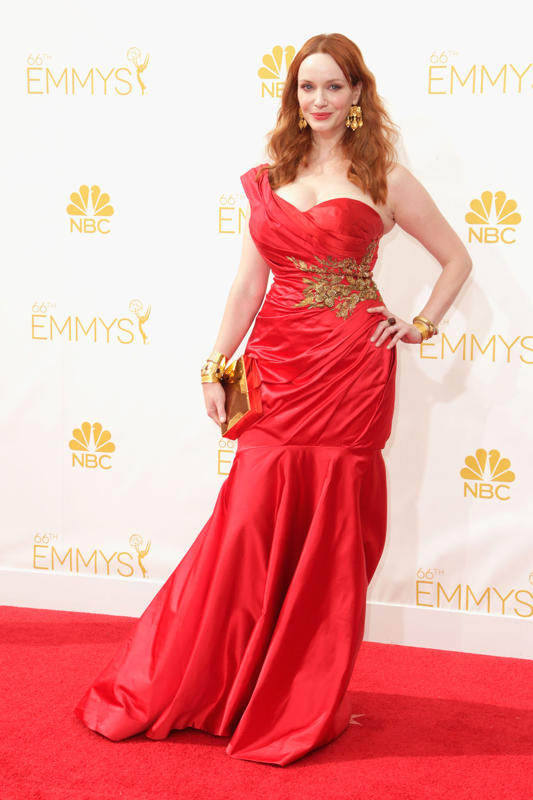
Christina Hendricks is so lush already that less would be more in the fashion sense. But instead we get a cross between first prom, Hello Dolly, and Mae West:
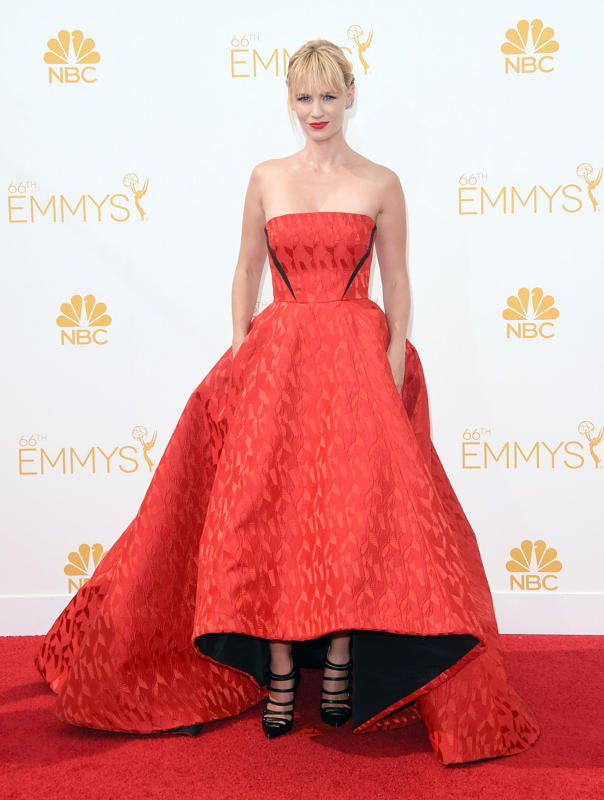
January Jones could wear anything. Then why, oh why, choose this:
I am not very tall, and I have a short waist. So I know from bitter personal experience that people who fit that description should not, I repeat not, wear dresses that cut them up into a set of horizontal segments. Laura Prepon is neither short nor especially short-waisted. But somehow, by her choice of dress, she has managed to look as though she is both. It’s a neat trick, but why bother?:
Memo to all women: canary yellow is a hard color to wear, especially in large doses. And Kate Walsh took an especially large dose:
Some people, like Kerry Washington, seem to have trouble deciding between two dresses. And so they wear both:
The fact that 16-year-olds are voting in today’s Scotland referendum was news to me, and I think of sufficient interest to warrant a post of its own.
I was surprised, but shouldn’t have been. It’s a logical extension of trends on the left that have been designed to increase their share of the vote by enfranchising more low information and easily-manipulated voters. As such, it makes perfect sense, and it’s no surprise that it is gaining favor across the pond, in countries that are even further along on the leftist path than we are.
This is apparently the first time 16-year-olds in Scotland have been able to vote, and if the outcome is tight enough they might be the ones to decide the election. The youth vote is widely perceived as favoring independence; that would make intuitive sense, since independence from their parents is generally a yearning of that age group. But no one really knows how the group will lean in the referendum, and at least one poll indicates they favor “no” to independence.
How did the 16-year-olds come to be included in the referendum? Apparently the Scottish Parliament made the decision, with the support of the more left-leaning parties and Scotland’s leader Alex Salmond, who favors independence and saw the youth vote as helpful in the fight to achieve it.
Is this what’s next for the US? Fortunately, it would require a lot more than a majority in Congress to change our voting rules at the national level and ban the prohibition of voting under 18; it requires an amendment to the Constitution. At the local level, however, the movement to extend the vote to below 18 has already begun, and has had some success.
The whole thing has a snowball effect. As more and more immature and poorly informed voters are enfranchised, they will make poorer and poorer decisions. And that, of course, is all part of the plan.
John Hinderaker reports on the withdrawal from the Obamacare market of Minnesota’s heretofore dominant Obamacare insurer, PreferredOne:
The fact that a company with 60% of the Obamacare exchange market considers the business unsustainable, even with federal subsidies, is ominous.
In Minnesota, PreferredOne’s decision will probably continue to reverberate. Individuals with PreferredOne policies purchased on the exchange will see those policies automatically renewed, unless they do something different. The catch is that, with PreferredOne no longer participating in MNSure, those people will no longer be eligible for Obamacare subsidies, so they will see premium increases”“in many cases, huge ones.
This sort of thing will keep happening for years to come. Democrats are smugly telling reporters that Obamacare is now an established fact and we should all get used to it. In reality, the law is like a series of bombs timed to go off as various deadlines kick in. Ultimately, the awful economics of the law can’t be denied. Premiums and deductibles will rise, and coverages will shrink, insofar as they are able to given the law’s expansive and sometimes irrational mandates. By 2017, when the federal government will stop reimbursing insurance companies’ losses, premiums will be far higher than when Obamacare went into effect. The Democrats apparently hope that no one will notice. To me, that seems unlikely.
Indeed, for quite some time, we’ve been treated to a series of MSM articles saying “Obamacare is here, it’s working, get used to it, the fight against it is all but lost.” I agree with Hinderaker that the law is actually a series of time bombs, cleverly staggered to go off at intervals as the public gets used to having Obamacare around.
But I am on the fence about Hinderaker’s conclusion that the Democrats are hoping no one will notice the premium rise. I think they are hoping something different: that they will be able to successfully label the premium rise as similar (and perhaps even less than) the rise that was already regularly occurring prior to Obamacare, and that in any event the people who will notice and be deeply affected by the rise will not be the majority of voters. The are counting on the fact that the majority of voters, subsidized by the others, will have become completely dependent on the largesse. As premiums rise, the subsidized voters will find the government handout even more necessary in order to obtain health insurance, not less, and therefore Obamacare would become more rather than less entrenched.
And if all else fails, there’s always single payer.
Reading a couple of articles on the referendum, I can’t find any that discuss an issue that particularly concerns me: is this a simple majority vote? Although no article I’ve found directly says so, it seems to be the case, because the vote is described as very close at a near 50-50 split.
Which brings us to my bigger question: should such a momentous decision be made by a simple majority of voters on a single day, at a single point in time? My answer would not be “yes.”
But I suppose it depends how much you believe in a pure democracy. I do not trust it overly; I fear the tyranny of the overbearing majority that Madison feared. Apparently the Scots have no such trepidation.
Conor Matchett, 19, a philosophy student at the University of Edinburgh, said he was both nervous and optimistic about the outcome after voting Yes.
“I want change. It’s as simple as that,” he said. “I believe a Yes vote is the only way to do that.”
Matchett, originally from York, in Northern England, but granted a vote in Scotland’s referendum on the grounds of his residency here, said he was voting to counter what he felt was the continuing politics of austerity from British politicians down south in Westminster.
“They are attacking the welfare state and many other things that people in Scotland hold really dear,” he said.
There is no way on earth a 19-year-old college student, attending school in Scotland but actually from York, should have a say in this matter. Hope/change; sound familiar? “Simple as that.”
And if 19-year-old college students from York can vote on whether Scotland should remain part of Great Britain, why not 16-year-olds? Where did I get that idea from? Why, from reality, that’s where:
A massive turnout of around 4.2 million Scots, about 97% of eligible voters, is expected, and residents as young as 16 have been granted permission to vote in the referendum.
The Ebola virus is spreading exponentially in Liberia, the World Health Organization said, predicting thousands of new cases there in the coming weeks.
The agency said Monday the number of new Liberian cases is moving far faster than the capacity to manage them.
Liberia already accounts for about half of all cases and deaths of Ebola in West Africa. The disease has killed more than 2,000 people, spreading from Guinea to Sierra Leone, Liberia, Nigeria and Senegal…
Obama told NBC News that U.S. military assets are needed to set up isolation units and equipment and to provide security for international health workers.
“If we don’t make that effort now, and this spreads not just through Africa but other parts of the world, there’s the prospect then that the virus mutates, it becomes more easily transmittable,” the president said.
Whether this is too alarmist or insufficiently alarmist I really don’t know. I’m not at all sure anyone does. As it is now, ebola only has traditionally spread to people in direct contact with the bodily fluids of patients, but there are worrisome signs and rumors that this could be changing. The nature of viruses is to mutate, and the possibility of airborne transmission is very real.
The whole thing puts me in mind of a pandemic from almost 100 years ago, the 1918 influenza horror if 1918-1919, which I’ve written about at some length before; one can only fervently hope that science has advanced to the point where such a conflagration will not happen this time, and that such a hope is not misplaced. I recently picked up a book on the topic of that earlier pandemic entitled The Great Influenza which, although quite long, is a good read.
That influenza epidemic has a special resonance for me because as a fairly young child I happened—in a moment of boredom—to have pulled a book called Pale Horse Pale Rider from my parents’ bookshelf and started reading the title story.
In my later, adult opinion, it is Katherine Anne Porter’s masterpiece. The subject matter, although fictionalized, was her own experience of wartime love and then near-death from the flu—although, at the age of nine or ten when I first encountered the story, I had no way to comprehend it and was extremely puzzled by what sort of terrible disease could possibly strike a young healthy person down so suddenly that way. Although the story terrified me, it fascinated me too, and I read it straight through despite the fact that it was opaque to my understanding.
The beauty of Porter’s language cast a sort of spell on me even as a child, and when I read it later as an adult and finally understood it, the story remained just as mysterious and just as beautiful. Here is an excerpt from the opening; the main character is describing a dream she’s having:
Where is that lank greenish stranger I remember hanging about the place…Now what horse shall I borrow for this journey I do not mean to take, Graylie or Miss Lucy or Fiddler who can jump ditches in the dark and knows how to get the bit between his teeth?…
Come now, Graylie, she said, taking his bridle, we must outrun Death and the Devil. You are no good for it, she told the other horses standing saddled before the stable gate, among them the horse of the stranger, gray also, with tarnished nose and ears. The stranger swung into the saddle beside her, leaned far towards her and regarded her without meaning, the blank still stare of mindless malice that makes no threats and can bide its time. She drew Graylie around sharply, urged him to run. He leaped the low rose hedge and the narrow ditch beyond, and the dust of the lane flew heavily under his beating hoofs. The stranger rode beside her, easily, lightly, his reins loose in his half-closed hand, straight and elegant in dark shabby garments that flapped upon his bones; his pale face smiled in an evil trance, he did not glance at her. Ah, I have seen this fellow before, I know this man if I could place him. He is no stranger to me.
She pulled Graylie up, rose in her stirrups and shouted, I’m not going with you this time—ride on! Without pausing or turning his head the stranger rode on. Graylie’s ribs heaved under her, her own ribs rose and fell, Oh why am I so tired, I must wake up. “But let me get a fine yawn first,” she said, opening her eyes and stretching, “a slap of cold water on my face, for I’ve been talking in my sleep again, I heard myself but what was I saying?
Slowly, unwillingly, Miranda drew herself up inch by inch out of the pit of sleep, waited in a daze for life to begin again.
I have quoted at length from the story because—well, because I like it. It still gives me the chills, and I don’t think it’s only because I know the rest of the story, all nearly-fifty pages of it. It’s partly because this is the beginning of the flu for Miranda, even though she doesn’t know it yet.
The Great Influenza, on the other hand, is a factual and scientific work, although it also happens to quote Porter’s story at one point. But here’s author Barry’s description of an outbreak towards the beginning of the epidemic, at Camp Devens in Massachusetts:
On September 24 [1918] alone, 342 men were diagnosed with pneumonia. Devens normally had twenty-five physicians. Now, as army and civilian medical staff poured into the camp, more than two hundred and fifty physicians were treating patients [two days earlier, about 20% of the camp had come down sick]…Yet on September 26 the medical staff was so overwhelmed, with doctors and nurses not only ill but dying, they decided to admit no more patients to the hospital no matter how ill…
For this was no ordinary pneumonia. Dr. Roy Grist, one of the army physicians at the hospital, wrote a colleague, “These men start out with what appears to be an ordinary attack of LaGrippe or Influenza, and when brought to the Hosp. they very rapidly develop the most vicious type of Pneumonia that has ever been seen. Two hours after admission they have the Mahogany spots over the cheek bones, and a few hours later you can begin to see the Cyanosis [blue color due to lack of oxygenation] extending from their ears and spreading all over the face, until it is hard to distinguish the coloured men from the white…
It is only a matter of hours until death comes…It is horrible. One can stand it to see one, two or twenty men die, but to see these poor devils dropping like flies…We have been averaging about 100 deaths a day…We have lost an Outrageous number of Nurses and Drs. and the little town of Ayer is a sight. It takes special trains to carry away the dead…An extra long barracks has been vacated for the use of the Morgue, and it would make any man sit up and take notice to walk down the long lines of dead soldiers all dressed and laid out in double rows…”
Barry’s book is also a history of medicine in this country, and doctors are the heroes of it for the most part. Not too many years earlier, medicine had been quite divorced from science. But by the time of the flu pandemic it was science that enabled doctors to finally figure out what was happening.
Not that it mattered much in terms of the victims; the disease had to burn itself out, and as time went on it became less virulent and finally disappeared, having run through those most susceptible in the population. In the meantime, it wreaked worldwide havoc, sowed fear, created many orphans (unlike in most flu epidemics, in that one death most often struck previously-healthy young adults), advanced our knowledge of epidemics—and helped inspire a small literary masterpiece from one of the people it nearly killed.
Roger Cohen describes the current state of affairs quite accurately, although I’m surprised to see his piece in the NY Times. However, I suppose I shouldn’t be surprised, because Cohen has been somewhat of a hawk post-9/11, and a columnist for the Times since 2006, although he obviously represents an outlier:
It was the time of unraveling. Long afterward, in the ruins, people asked: How could it happen?
It was a time of beheadings. With a left-handed sawing motion, against a desert backdrop, in bright sunlight, a Muslim with a British accent cut off the heads of two American journalists and a British aid worker…
It was a time of aggression. The leader of the largest nation on earth pronounced his country encircled, even humiliated. He annexed part of a neighboring country, the first such act in Europe since 1945, and stirred up a war on further land he coveted…
It was a time of breakup. The most successful union in history, forged on an island in the North Sea in 1707, headed toward possible dissolution ”” not because it had failed (refugees from across the seas still clamored to get into it), nor even because of new hatreds between its peoples. The northernmost citizens were bored. They were disgruntled…
It was a time of weakness. The most powerful nation on earth was tired of far-flung wars, its will and treasury depleted by absence of victory. An ungrateful world could damn well police itself. The nation had bridges to build and education systems to fix. Civil wars between Arabs could fester…
It was a time of hatred. Anti-Semitic slogans were heard in the land that invented industrialized mass murder for Europe’s Jews. Frightened European Jews removed mezuzahs from their homes…
But what really puzzles me is Cohen’s own puzzlement. He describes the dreadful situation, but keeps asking how it happened. And he provides no answer.
Now that I’ve gone back and read his column once again, though, I see that he talks about generic “people” not having the answer. Who are these “people”? His fellow journalists at the Times? The liberals he meets at cocktail parties?
I’m really not sure. But it’s certainly not conservatives, because they’ve been describing the causes of such things for many years now, and are not particularly surprised because they have long been predicting many of these events. Maybe Cohen should run in different circles.
He writes:
Nobody connected the dots or read Kipling on life’s few certainties: “The Dog returns to his Vomit and the Sow returns to her Mire / And the burnt Fool’s bandaged finger goes wabbling back to the Fire.”
Until it was too late and people could see the Great Unraveling for what it was and what it had wrought.
Nobody? I first quoted that poem on this blog in 2006, and have mentioned it time and again in the years since. And I actually was a relative newcomer to the game of quoting Kipling, at least on the conservative side.
But in a larger sense—and one perhaps unintended by Cohen—he’s right, because although the specter of the unraveling was seen looming on the horizon long before he thinks it was, it may have already been too late to effectively stop it.
When is it really “too late” to do anything about such an unraveling? I don’t think it’s absolutely and for certain too late even now, but it is extremely late indeed and the remedies would be incredibly difficult to implement and far less apt to be successful than had it been caught earlier. But how early was early enough? The 60s? The 30s? The 80s (1880s, that is)?
Or is the problem inherent in the human condition?
Supposedly the danger had been proven, and that’s why a lot of states had banned cell phone use while driving. So, the accident rate went down as the phone use declined, right?
And no one knows why. Observers notice that “visible cellphone use drops about 50 percent when a state begins its ban.” But it doesn’t seem to matter all that much. Is it because riskier people don’t stop using cell phones while driving, they just get sneaky about it? Or do they do something else for fun and driving distraction, like putting on their makeup (there’s a surprising amount of that)? Or lighting a cigarette or drinking a Coke or operating an iPod? Or maybe people have just gotten really really good at double-tasking, and when they go back to single-tasking it doesn’t make a whole lot of difference?
This isn’t just a new finding, or an outlier. Research generally shows that although texting and cell-phone use increases accidents, banning them doesn’t decrease accidents.
ISIS has done the world one favor, and one favor only.
Favor, you say? Are you mad? What sort of favor could ISIS be doing anyone?
That favor is to make more people believe that evil exists.
One would think 9/11 would have done it. And for many it did. One would have thought the beheading of Daniel Pearl would have done it. And for many it did. But something about ISIS and its atrocities and the scope of its victims, combined with its bloodthirsty reveling in its own mayhem, has silenced (for the moment; I certainly don’t think it’s permanent) a great many of those inclined to make excuses or offer rational explanations. Nor is anyone but those on the fringes denying that this is happening; the videos ISIS has released have seen to that.
Not that this realization will necessarily lead to truly effective action on the part of the West. So far it hasn’t, although it did seem to help the Yazidis on the mountain. It’s hard to imagine that the West will find its spine again, and even if it does the problem is much, much bigger than ISIS and will require a more concerted, sustained, and widespread effort than any country or group of countries seems to have the stomach for.
But the first step is recognizing evil when you see it.
World War II was an interesting case. The Nazis and the Axis powers were seen as evil, and an enormous number of countries united to fight them in an all-out war of the sort that might be mentally/emotionally impossible today. But the details of the evil regarding the Holocaust were minimized and/or even denied until after the war, when the evidence became irrefutable.* Why?
The Nazis were very different from ISIS in that they did not brag about their atrocities. They were “civilized” enough to hide them and perpetrate deceptions around them. Some of the motivation for that was to fool people, including their victims, into cooperating. But some was to lull the world into inaction. The Nazis knew that people find the worst difficult to believe, and they were counting on that. In fact, they often taunted their concentration camp victims by saying that if any happened to survive, the world would not believe their tales.
That brings me to Jan Karski. Karski was a hero of the WWII years, a Polish officer whose life had many twistings and turnings and stupendous bravery, and included action as a major figure in the Resistance. It fell to Karski (who was Catholic, but had been brought up in a heavily Jewish neighborhood in Poland) to document the Holocaust and to personally inform the Brits and FDR and other influential Americans about it as early as 1943. To say that their reaction was disappointing is to understate the matter.
Scott Johnson recently published a post at Powerline about Karski and his heroism, featuring some of Karski’s interviews. Watching them, I was struck by Karski’s demeanor. He just may be one of the most intense and yet controlled people I’ve ever seen, without being bombastic or loud. Even though he is speaking many decades after the events, he remains outraged at the responses he got.
There are videos of him discussing Roosevelt, too, but this is the one in which he talks about the reaction of Felix Frankfurter to his tale:
Frankfurter’s reaction sounded simple: “I don’t believe you.” But it was anything but. As Karski goes on to explain, “Probably he wanted to show me, yes, that the world is unprepared. This is an unprecedented problem, this is a horrible problem.” In other words, Frankfurter felt both overwhelmed and impotent, and in simultaneous denial and awareness of the horror of it all.
Was the Holocaust actually “unprecedented”? In the modern world, it seems to have been. Not that there hadn’t been problems something like it (the Armenians and Turks, to take just one example). But bad as that was, the Holocaust differed in style and especially in scope. The destruction of the Armenians was localized, but this was European-wide, and it was perpetrated by one of the most advanced, if not the most advanced, European nation on earth, a country that was simultaneously trying to conquer the Western world.
I’m not excusing Frankfurter’s reaction. But I think light can be shed on it by the following passage written by Arthur Koestler, which I’ve discussed in a previous post. Koestler was one of the people with whom Karski met (in 1943), and he joined the cause of spreading the word. Koestler wrote this passage in 1944 as part of an essay entitled “On Disbelieving Atrocities” (it appeared in the Sunday NY Times Magazine) about how difficult it was to energize others to do something about the horrors. I think that here Koestler is describing some profound truths about human nature:
There is a dream which keeps coming back to me at almost regular intervals; it is dark, and I am being murdered in some kind of thicket or brushwood; there is a busy road at no more than ten yards distance; I scream for help but nobody hears me, the crowd walks past, laughing and chatting.
I know that a great many people share, with individual variations, the same type of dream. I have quarrelled about it with analysts and I believe it to be an archtype in the Jungian sense: an expression of the individual’s ultimate loneliness when faced with death and cosmic violence; and his inability to communicate the unique horror of his experience. I further believe that it is the root of the ineffectiveness of our atrocity propaganda.
For, after all, you are the crowd who walk past laughing on the road; and there are a few of us, escaped victims or eyewitnesses of the things which happen in the thicket and who, haunted by our memories, go on screaming on the wireless, yelling at you in newspapers and in public meetings, theatres and cinemas.
Now and then we succeed in reaching your ear for a minute. I know it each time it happens by a certain dumb wonder on your faces, a faint glassy stare entering your eye, and I tell myself: now you have got them, now hold them, hold them, so that they will remain awake. But it only lasts a minute. You shake yourself like puppies who have got their fur wet; then the transparent screen descends again and you walk on, protected by the dream barrier which stifles all sound.
We, the screamers, have been at it now for about ten years. We started on the night when the epileptic van der Lubbe set fire to the German Parliament; we said that if you don’t quench those flames at once, they will spread all over the world; you thought we were maniacs. At present we have the mania of trying to tell you about the killing, by hot steam, mass-electrocution and live burial [Koestler seems to have been unaware of the gassing method that had come to be used most often by that time] of the total Jewish population of Europe.
So far three million have died. It is the greatest mass-killing in recorded history; and it goes on daily, hourly, as regularly as the ticking of your watch. I have photographs before me on the desk while I am writing this, and that accounts for my emotion and bitterness. People died to smuggle them out of Poland; they thought it was worth while. The facts have been published in pamphlets, White Books, newspapers, magazines and what not. But the other day I met one of the best-known American journalists over here. he told me that in the course of some recent public opinion survey nine out of ten average American citizens, when asked whether they believed that the Nazis commit atrocities, answered that it was all propaganda lies, and that they didn’t believe a word of it.
As to this country [Koestler was referring to Britain, where he was living at the time and writing for the war effort], I have been lecturing now for three years to the troops, and their attitude is the same. They don’t believe in concentration camps, they don’t believe in the starved children of Greece, in the shot hostages of France, in the mass-graves of Poland; they have never heard of Lidice, Treblinka or Belsen; you can convince them for an hour, they they shake themselves, their mental self-defence begins to work and in a week the shrug of incredulity has returned like a reflex temporarily weakened by a shock.
Clearly all this is becoming a mania with me and my like. Clearly we must suffer from some morbid obsession, whereas you others are healthy and normal. But the characteristic symptom of maniacs is that they lose contact with reality and live in a phantasy world. So, perhaps, it is the other way round: perhaps it is we, the screamers, who react in a sound and healthy way to the reality which surrounds us, whereas you are the neurotics who totter about in a screened phantasy world because you lack the faculty to face the facts. Were it not so, this war would have been avoided, and those murdered within sight of your day-dreaming eyes would be alive.
In that earlier post, I wrote:
Why is it so difficult to hear the screaming? Much of it is self-protective: if we paid attention to all the pain and suffering in the world, we’d be paralyzed by empathy and unable to enjoy our own lives. What’s more, there’s often a sense of powerlessness to change things.
However, despite the denial, during World War II we were already dedicated to the all-out war against the Nazis. That was the excuse FDR and others gave: that the continuance of that fight was our most effective response. Now we are not willing to commit to that sort of huge effort, despite our lack of the ability to deny the evil that is happening before our eyes. We are not powerless, and we are not in denial, but we are unwilling to unleash the power we have. And it is understandable, as long as the horror continues to stay away from our shores. I don’t think it’s any accident that the US has experienced no widespread terrorist attack in the nature of 9/11 since that date. The giant isn’t sleeping, but it’s taking a light nap, and the terrorists want to keep it that way.
*[NOTE: Some, of course, continue to deny the Holocaust to this day. But for the most part they have a very different, and far more pernicious, agenda than those who ignored or denied it during the war itself.]