The subject of H-1B visas* came up during last Wednesday’s Republican debate, most particularly regarding Rubio, who advocates an expansion of the program with some restrictions. So I decided to try to find out the truth about what’s involved and whether the program is being abused.
As with most such quests, it’s easier said than done. In fact, much easier. I could spend a few days or more doing in-depth research and maybe I would find the illumination and clarity I seek (I tend to doubt it, actually). But since I don’t have that sort of time to write this post, I’ll just show you what I found—which is the usual war of statistics being used by both sides, with the truth somewhat elusive. Perhaps it’s buried in those statistics, and those of you who have the time and inclination (and the ability to be objective, which can often be the most difficult) to tease it out, please be my guests. Meanwhile, this is what I found.
The H-1B visa program—which offers temporary visas for “specialty” occupations (often including, but not limited to, STEM jobs) is just one portion of the visa system by which foreign workers come to this country legally. The other two are H-2A (the temporary agricultural worker program) and H-2B (the same for non-agricultural workers). All of these programs require, on paper at least, that the employer show that there aren’t enough American workers to fill the need, and that the hires aren’t undercutting American workers in terms of wages (you can go to the links to read the regulations that are built into each program and supposedly guarantee that they won’t be abused, and your guess is as good as mine as to how often that happens—which may be rather often). The H1-B program has similar built-in protections of no small complexity, which are alleged to also be abused but which on paper aim to protect US workers.
You can see why this would be a book.
By the way, quite a few of Donald Trump’s companies make liberal use of the H-2B visa program (for example, a resort in Florida requesting waiters and cleaning people, mostly from Latin American countries), some use of the H-2A program (vineyard workers), and use of the H-1B program for hiring foreign models.
In another aside—just as an example of how hard it is to locate the facts on this, a search to find the actual numbers of visas issued each year in each class turned up this AFL-CIO “fact” sheet, which states that “Temporary work visa laws do not have provisions to protect guest workers or American workers.” On the contrary, they all provide such provisions, and extensive ones at that. Whether or not these regulations are properly enforced, and how often they are subject to fraud, is another question. But each program does have extensive protections in place, contrary to the assertion on that website.
As to the numbers, here’s a chart for 2012, which may be outdated but it’s what I could find:
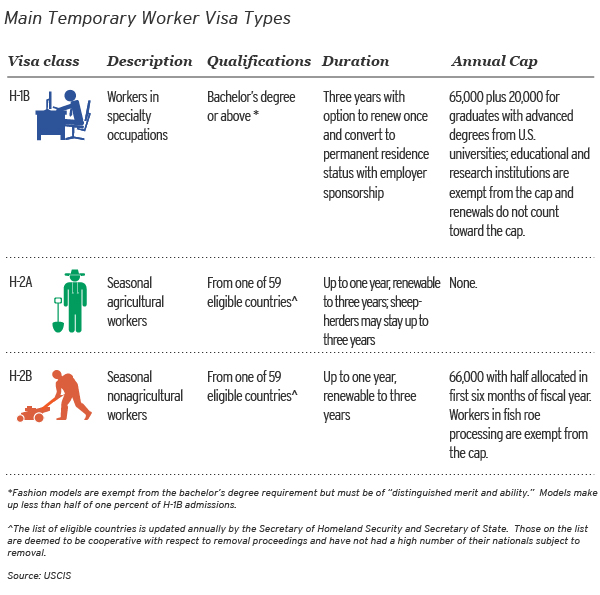
As you can see, the numbers aren’t huge. But it adds up, and to someone displaced in an industry (or someone who believes he/she has been displaced) I am sure it is infuriating.
So, what is the H-1B program doing, and what would happen if its numbers were increased, as Rubio and some others are suggesting? This US News article presents the pro-H-B1 argument:
But experts say the visa system is not damaging American salaries or their chance at getting a job in Silicon Valley. Jonathan Rothwell, a fellow at the Metropolitan Policy Program at the Brookings Institution, points out that “H1-B workers are paid at least as well as their American counterparts” and the unemployment rate for computer workers is not high relative to other occupations. Salaries for tech occupations have also increased faster than wages for other jobs during the past decade despite the use of the skilled immigrant workers, he says, citing research he completed in 2013.
“Skilled computer jobs are among the hardest to fill and the vacancies stay open for the longest period of time,” he says, adding that Rubio’s proposal for companies to wait 180 days is “an absurdly long period of time to wait to fill a skilled position.”
Indeed, a recent report from the Bureau of Labor Statistics states that the U.S. is not graduating enough students with skills in science, math and technology to meet the growing demand for tech company workers ”“ a point confirmed by data from the 2015 U.S. News/Raytheon STEM Index. The U.S. will need “approximately 1 million more STEM professionals than the U.S. will produce at the current rate over the next decade if the country is to retain its historical preeminence in science and technology,” according to the BLS report.
You can follow those links and take a look if you want to crunch the numbers. The article adds:
Data from MyVisaJobs shows that the top 25 companies sponsoring H1-B visa workers ”“ including Google, Apple and Microsoft ”“ offer foreign workers an average salary that is competitive with wages offered to Americans for tech occupations.
The article also states that most of these Silicon Valley H-1B workers are from China and India (we can assume that most of the H-2B and and H-2A workers are likely to come from Latin American countries).
Jeff Sessions makes the case against the H-1B program:
Microsoft even signed a letter urging passage of the I-Squared H-1B increase, asserting that “there are tens of thousands of unfilled jobs requiring highly skilled individuals. Four high-tech companies alone ”“ IBM, Intel, Microsoft and Oracle ”“ have combined 10,000 openings in the United States.” But consulting firm Challenger, Gray and Christmas recently noted that “employers in the computer industry saw the heaviest downsizing of the year, announcing a total of 59,528 planned layoffs. That is 69 percent more than a year ago.” Perhaps these companies, instead of lobbying for H-1B workers, should hire some of the thousands of tech workers who are being laid off?
As Microsoft’s layoffs show, there is a surplus””not a shortage””of skilled, talented, and qualified Americans seeking STEM employment. Each year, universities graduate twice as many students with STEM degrees as find STEM jobs. According to the Census Bureau, more than 11 million Americans with STEM degrees are not employed in STEM jobs””or 3 in 4 STEM degree holders. Among recent graduates, about 35 percent of science students, 55 percent of technology students, 20 percent of engineering students, and 30 percent of math students are now working in jobs that don’t require any four-year college degree””let alone their area of specialty.
The truth is that, as Professor Ron Hira testified, “the H-1B visa has become a highly lucrative business model of bringing in cheaper H-1B workers to substitute for Americans”¦ Most of the H-1B program is now being used to import cheaper foreign guestworkers, replacing American workers, and undercutting their wages.”
So, which is it: same salaries, or lower for the guest workers in the tech industries? Just try to find Ron Hira’s actual testimony and the context in which he said that, by the way; I couldn’t, at least not in a quick Googling. What I did find for Hira was this sort of thing:
There are two reasons these firms hire H-1Bs instead of Americans: 1) an H-1B worker can legally be paid less than a U.S. worker in the same occupation and locality…
Confusing, to say the least. At least on paper, the program contains protections against that sort of thing:
By signing the LCA, the employer attests that:
The employer pays H-1B non-immigrants the same wage level paid to all other individuals with similar experience and qualifications for that specific employment, or the prevailing wage for the occupation in the area of employment, whichever is higher.
The employment of H-1B non-immigrants does not adversely affect working conditions of workers similarly employed…
That’s the sort of maze one enters when trying to get at the truth. And the truth as alleged by Sessions or Rubio or Trump or Hira or as written into the law is probably something quite different from the truth as it is actually practiced. Good luck with finding statistics that can tease that out, though.
This, however, was of interest to me. It’s a summary of the report Sessions cited (or at least, it’s very similar to the report Sessions cited; Sessions did not provide a link, of course) which found that most STEM graduates aren’t employed in STEM industries.
Certain things about it leaped out at me when I took a look. The first is that it’s not limited to recent graduates; it appears to include everyone between the ages of 25 and 64 who has a degree in a STEM (science, technology, engineering, and math) discipline. The second thing that struck me is that unemployment in general in this group is low. So we can conclude that they’re employed, maybe even happily employed (the study doesn’t seem to ask that question), although not necessarily in a STEM field. The study sheds no light on what I would consider the all-important question of whether these people wanted to be in a STEM field, were looking for work in a STEM field and were denied it, once worked in a STEM field and had made a switch (for example, those older employees), or what’s actually going on with their job situations. We also don’t know from that Sessions quote whether the downsizing in the tech industry (Microsoft) involved the same or similar jobs that the H-1B workers filled, or whether there was little or no connection between the two.
You may be shocked (as I was) to learn that the STEM designation includes social sciences such as psychology, anthropology, and sociology. Although I can’t find a list of what STEM occupations the census research that Sessions quoted used, it is likely that these social sciences were included (they are on the NSF lists of STEM subjects, and they are also included in the list used by immigration, for example).
To be even remotely meaningful for the purposes of evaluating the H-1B program and how it actually works in real life, and its impact on companies and the American worker, we’d need to know a great deal more than I’ve been able to uncover by reading what Sessions wrote or that report on the census research. But the fact that a 50-year old who graduated years ago with a degree in psychology (which is a very popular degree for those who have no idea what they want to do when they get out of school, or at least it used to be) is not necessarily employed in a psychology or tech field is hardly a surprise, and hardly relevant to the subject at hand.
I was thinking of titling this post “Finding the truth: those H-1B visas and STEM employment.” But I decided to change it to “Searching for the truth: those H-1B visas and STEM employment.” I could go on and on and on with this, but I think you get the idea.
[ *NOTE: The program keeps being referred to in the media and by many politicians as H1-B, but my research indicates that all these programs follow the same form, and that it’s actually H-1B.]