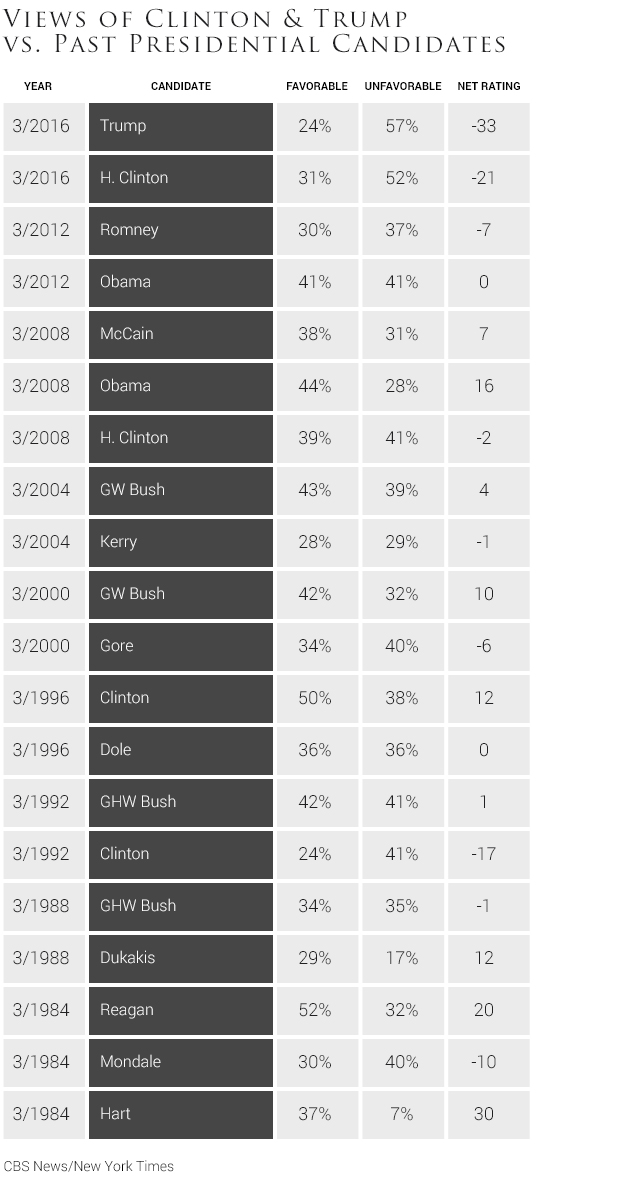
As time has gone on, Trump has become more and more unpopular with women voters, and that includes Republican women:
This month, about half (47 percent) of Republican female primary voters said they could not imagine themselves voting for Trump. (About 40 percent of male GOP primary voters said the same.)…
Trump’s favorability with women overall is a dismal 21 percent positive/ 70 (!) percent negative.
With men, it’s 28 percent positive/ 59 percent negative.
And while women traditionally vote for Democratic candidates in larger numbers than men, data shows that a Trump nomination would exacerbate the issue for Republicans.
Asked if they would prefer to see a Democratic president or a Republican president regardless of who the nominees are, 52 percent of female voters chose the Democratic option while 36 percent chose the Republican option. That’s a net advantage of 16 percentage points for the Democratic candidate.
But plug in the names “Hillary Clinton” and “Donald Trump” and the gap gets even wider.
In that hypothetical matchup, just 31 percent of women said they would chose Trump, while 58 percent said they would chose Clinton. That’s a net advantage of 27 points for Clinton.
I think this is unprecedented, although I have no proof. It’s certainly ominous for a Trump candidacy, and I don’t see it changing, except for the worse.
I’ve seen it said by a lot of blog commenters and bloggers that Trump is an alpha male, and as such he appeals to women. I’ve long been puzzled by this “alpha male” designation, because it seems to me that Trump has little in common with actual alpha males. They don’t boast and tell you how great they are and how much everyone likes them and how much money they make, or lie to make themselves sound bigger and better. Those are fake alpha males. No one who really is like that needs to brag about it.
Alpha male examples: the characters John Wayne played. Reagan. Washington. Eisenhower. Many in the military. That guy who was instrumental in stopping the French train terrorist attack recently, for example.
Fake alpha males: Charlie Sheen. Donald Trump. Most of the guys on those “I’ve got game” blogs (I forget the names of the blogs, but I’ve read a number of them on occasion).
I had written all of the above before I saw this article at American Thinker, which says essentially the same thing—including another thought I had recently (after Trump’s targeting of Heidi Cruz’s looks), which was that “Trump fights like a girl.”
Here’s the American Thinker article:
To elaborate, this tweet, and its implied message, smacks of thirteen-year-old girl cattiness. “Never talk to my boyfriend again, Suzy! He would hate you anyway, because you’re so ugly!”
Why then, to be perfectly clear, have I flipped my previous assessment of Trump’s character from thirteen-year-old boy to thirteen-year-old girl? Because thirteen-year-old boys don’t attack other boys by telling them their girlfriends are ugly. Even by that pubescent stage of development, a normal boy has learned, by hormonal intuition if not by the influence of a decent father figure, that getting at a rival by insulting his girl is just about the most unmanly thing a male of the species can do…
And how will Trump’s most boisterous supporters defend their hero’s girlish attack on Cruz’ wife? They will say, as they already are saying, “But he started it!”
That’s what I meant by calling Trump “juvenile.” And it boggles my mind that so many people seem to think this indicates strength on Trump’s part.
Now the Trump activists are touting this National Enquirer article about Ted Cruz’s supposed affairs. It won’t matter a bit to them if a shred of proof is never found ; the rumor is good enough. And it doesn’t matter a bit to them that Trump has had multiple affairs and bragged about them.
Now, I have no idea whether the Enquirer story is true or not. I tend to think not, simply because I think Cruz is too smart to run for president with that many skeletons rattling around in his closet. But as I said, I don’t know, but the point of running such a story—true or not—is to get the rumors flowing.
And it comes as no surprise whatsoever—none—to learn that the CEO of the Enquirer and Trump are great good friends and have been for quite some time (and note that the following was written back in October):
Trump and Enquirer CEO David Pecker have been friends for years. “They’re very close,” said a source close to the Enquirer…
…[Trump’s] friendship with Pecker has paid dividends. At key moments during the GOP primary the Enquirer has helped boost Trump’s campaign by attacking his rivals and fawning over him. Two weeks after Trump launched his campaign in mid-June, the Enquirer reported that Jeb Bush was “involved in the drug trade in Florida” in the ’80s and that, as governor, he was plagued by “sleazy cheating scandals ”¦ [with a] Playboy Bunny turned lawyer.” In September, the Enquirer published an unflattering photograph of Bush’s adult daughter apparently taking cigarette breaks at her office. The article hit just days after Jeb told Americans they needed to work longer hours.
Carly Fiorina has also been slimed. After the former Hewlett-Packard CEO bested Trump at the second GOP debate last month, the Enquirer ran an article headlined “Homewrecker Carly Fiorina Lied About Druggie Daughter.” The article attacked one of Fiorina’s best moments at the debate: her emotional account of her daughter’s struggle with drug addiction. “The National Enquirer has exclusively learned that Lori Ann Fiorina, who died in October 2009, was in fact Carly’s stepdaughter,” the tabloid reported. “She was brought up not by Carly but by her biological mom, Patricia Fiorina, whose marriage allegedly was wrecked by the 61-year-old White House hopeful who is determined to knock Donald Trump from his superior front-runner status!”…
Meanwhile, Trump has been exclusively celebrated in the Enquirer’s pages. As talk of a Trump candidacy heated up last winter, the tabloid published an article headlined “Trump’s the One!” that reported him leading in the polls. In September, the Enquirer published a three-part series by Trump himself under the headline “The Man Behind the Legend!”
About a month ago the Enquirer endorsed Trump enthusiastically and unequivocally, and rumor has it (see? I can play that game too) that Trump’s own dirt is strictly off-limits for the tabloid.
I’d like to add that this is the sort of thing I detest writing about. But this is the sort of thing we’ll be seeing more and more of this campaign season, I would wager.