McCarthy also points out tremendous inconsistencies in Trump’s present and past positions, inconsistencies Trump doesn’t even attempt to explain away. Trump must think the American public illogical and shallow, and he just might have a point there.
I also assume that Trump’s speech was written by speechwriters. Nothing wrong with that; politicians do it all the time. But the disconnect between Trump’s speeches and his own ability to describe the details of his positions represents a canyon-like gap.
Former House Speaker Dennis Hastert has received a fifteen-month prison sentence for the bank withdrawal charges involving the payment of hush money to one of his sexual abuse victims (which I had discussed previously here).
They can’t get him on the child molestation charges because the statute of limitations has run out. But he has confessed to those acts of molestation and apologized to the victims.
What a mess.
I am always astounded at the narcissism and/or denial that allows a person with this sort of history to go into politics. It’s the last thing I would think a person would do if that person had a history of child molestation. It shows a disconnect from reality that is profound.
I wrote “narcissism” because someone like Hastert probably feels that his fabulousness makes him immune to consequences. I wrote “denial” because some criminals (any kind of criminal, but especially those guilty of sexual crimes) are able to repress or suppress their own acknowledgment from themselves. They put the memory in a little box and place it high up on a shelf, and as the years go by and their secret is safe, it recedes further and further in their mind and they feel safer and safer that the truth will never come out.
All signs indicate that the upcoming announcement from Ted Cruz will be that he’s chosen Carly Fiorina as his running mate.
Perhaps it will help him. Perhaps not.
I’ve always liked Fiorina. But she only got a little traction back when there were 200 candidates (or however many started out), and she faded. She’s from California, and although she used to be popular with the Republicans in that state, I don’t know whether that popularity will hold or will matter.
Note I’m not making predictions here—except for the “Carly as Cruz’s running mate” one. And that’s not my prediction; it’s just about everybody’s prediction who is supposedly in the know.
Does anyone else have a strong feeling of surrealism today? I’ve known for a long time—months—that Trump is the likeliest GOP nominee. I’ve known for a long time—and still know—that his nomination is not a foregone conclusion, so I’m not giving up on other possibilities. I’ve also known—-probably ever since the fall—that the likelihood is that the Trump candidacy may have dealt a mortal blow to the GOP’s chances this year whoever is their nominee, because the rift that already existed in the party has widened and deepened. There are an enormous number of people on both sides, Cruz and Trump, who will not vote for the other one if the other one happens to end up the nominee. And although there are rifts among the Democrats too, I just don’t see those rifts as having quite the same effect in terms of damaging numbers.
So I’m not sure why today feels so surreal. Maybe it’s how the entire MSM is treating Trump as the “presumptive” (his word) nominee, and seems quite happy about it for their own reasons (ratings, a probable Hillary victory in November, and sticking it to the hated Ted). That’s not really new, though. Nor am I watching TV, but I read about it. Maybe it’s just the magnitude of the numbers in last night’s primary that are so sobering—what it says about America, and about so many GOP voters.
But the surrealistic feeling is probably just cumulative, as the chances for anything other than Trump have slowly, slowly dimmed over time, although they’re not extinguished. What’s even more galling is that the chances of Hillary Clinton’s not being elected president seem ever more distant to me, too. This was a race the GOP was positioned to win. I don’t see much, if any, chance of that now.
Trump fans do. They think their guy will trounce her, and that’s a significant part of the reason many of them have been voting for him. I see that as a delusion unsupported by any evidence whatsoever ((see this and this, as well as the NOTE* below). . I would never say it’s impossible, but I see it as highly highly unlikely. And now that that GOP civil war has gotten so heated, I think Cruz’s chances of beating her if he’s the nominee are not too much better. I think Rubio could have done it easily, but that ship sailed quite some time ago.
Oops! I guess I made some predictions there, after all.
[NOTE * In addition from the evidence of those polls from a few months ago, I’m unaware of any newer information on the subject that changes a thing. I looked at a couple of recent polls, and virtually all of them show Trump losing to Hillary, sometimes by huge margins. When I looked at the details within those polls, I couldn’t find any information about how Trump does with Democrats (or how Cruz does with Democrats, for that matter). The only relevant information was in one recent poll which compared Hillary’s ratings on a number of issues with Trump’s ratings on those same issues, in the populace as a whole (Democrats and Republicans together), and she did much better than Trump on every single measure—sometimes much much better, and that includes honesty.
Yes, yes, that could change in Trump’s favor. But in about ten months of Trump’s campaigning and building his support among GOP primary voters (a different kettle of fish than voters in the general, and his support even among GOP primary voters isn’t very high compared to most primary frontrunners at this point in a campaign), it hasn’t done so, and I don’t see it happening. Most people are very very familiar with both Hillary Clinton and Donald Trump, and I don’t see much wiggle room there.]
This is an instructive article about people who self-describe as “evangelicals”:
Thanks to data compiled by the Association of Religious Data Archives, we have a very good sense of how many people in a given locale regularly attend church. By this attendance metric, the geographic heart of American religiosity isn’t the Southeast, but the middle part of the country ”” from Texas and Oklahoma through Iowa and the Dakotas. When it comes to church participation, many parts of the South fare no better than liberal enclaves in in the Northeast…
The South Carolina election results suggest that practicing Christians in the state voted differently than their peers who attend church less regularly. Take, for instance, one of Trump’s strongholds, the area in and around Barnwell County, near the central part of the state. Trump won nearly 43 percent of Barnwell County, while Cruz collected less than 20 percent. Unsurprisingly, church-attendance rates in Barnwell lag behind those in the rest of the state. Compare that to Greenville County, which has one of the highest rates of church attendance in the state: It was one of Trump’s worst counties. The pattern generally holds across South Carolina: Cruz does well where people regularly go to church; Trump does better where they don’t…
The problem is that Cruz may depend on a group of religious voters who increasingly spurn church services and, consequently, traditional social conservatives like him.
That was written back in late February, and that’s the way things have played out, I believe. Yesterday’s primaries in southern New England and mid-Atlantic states were not in evangelical strongholds, and it’s difficult to know the characteristics of those identifying as “evangelical” there, but this is what exit polls indicated:
Barely more than four in 10 voters in the three states with exit polls were evangelical, 14 points off the average in primaries to date. And, remarkably, Trump beat Cruz by more than 25 points in this group, among his best performances among evangelicals. They split their votes between Trump and Cruz, on average, in previous contests.
My guess is that evangelicals in these states are not especially typical of evangelicals as a whole, but that’s just a guess.
At any rate, a political divide along the lines of “churchgoing vs. non-chuchgoing” makes sense to me. It would be something analogous to the political divide between observant (more conservative) Jews and secular (more liberal) Jews.
[NOTE: Here’s a previous post I wrote about Trump and his habit of questioning the sincerity of the religious beliefs of others, particularly whether Ted Cruz can really be an evangelical. I have no idea whether this accusation of Trump’s got traction, but it’s possible.]
The Harvard University survey, which polled young adults between ages 18 and 29, found that 51 percent of respondents do not support capitalism. Just 42 percent said they support it.
…Just 33 percent said they supported socialism.
It depends on what the meaning of “support” is, because I would guess—and I would place a rather large bet on this—that they “support” capitalism to the tune of buying plenty of goods and services at market prices, and having jobs with salaries that are determined by the markets and the employer (except, of course, for minimum wage). In other words, they put their money where their mouth isn’t.
But “capitalism”? That must be the province of old guys like this:
I would have loved to have seen the pollsters ask the respondents what capitalism is (could be a multiple-choice question) and see what the answers might be, because I have a feeling that a lot of them wouldn’t know. Then again, I don’t think the pollsters themselves know, if this is any indication:
John Della Volpe, the polling director at Harvard, went on to personally interview a small group of young people about their attitudes toward capitalism to try to learn more. They told him that capitalism was unfair and left people out despite their hard work.
“They’re not rejecting the concept,” Della Volpe said. “The way in which capitalism is practiced today, in the minds of young people ”” that’s what they’re rejecting.”
Della Volpe himself seems to have no idea what capitalism is, if he thinks it includes the idea of “fairness” to people “left out despite their hard work.” Left out? Does that mean they’re not receiving wages? Does that mean they’re not receiving wages that are keyed to some abstract concept of “fairness” imposed by someone-or-other (who, if not the government)? The amount of muddled thinking there is discouraging.
Here’s more:
“The word ‘capitalism’ doesn’t mean what it used to,” said Zach Lustbader, a senior at Harvard involved in conducting the poll, which was published Monday. For those who grew up during the Cold War, capitalism meant freedom from the Soviet Union and other totalitarian regimes. For those who grew up more recently, capitalism has meant a financial crisis from which the global economy still hasn’t completely recovered.
Ah, so capitalism, with everything it has given people around the world, should be immune from financial crises? I really don’t understand this insistence on some sort of ideal world where there could be a system that doesn’t involve unfairness, periodic crises, and the like. It may just be that capitalism has worked too well to cushion us against the realities of life, so well that people expect the moon of it or they fail to “support” it.
There’s no reason to limit the discussion to millennials, either, because only people in the US over 50 these days seem to “support” capitalism, according to other surveys.
But back to this most recent survey and young people’s ideas about what might be a better system, as well as what people have a “right” to and the role of government in all that:
On specific questions about how best to organize the economy, for example, young people’s views seem conflicted. Just 27 percent believe government should play a large role in regulating the economy, the Harvard poll found, and just 30 percent think the government should play a large role in reducing income inequality. Only 26 percent said government spending is an effective way to increase economic growth
Yet 48 percent agreed that “basic health insurance is a right for all people.” And 47 percent agreed with the statement that “Basic necessities, such as food and shelter, are a right that the government should provide to those unable to afford them.”
So, to summarize: they don’t like capitalism, but they’re not keen on the alternative of more government regulation, except when they are.
This will almost certainly be a very big day for Trump because of the states involved: Connecticut, Delaware, Maryland, Pennsylvania, and Rhode Island—that is, Southern New England and some mid-Atlantic states (see, I remember my grade-school geography). Trump is very popular among the Republicans in these states, which have been reliably blue in presidential elections for many cycles.
I realize that decisive Trump victories today are unlikely to change the projection regarding the delegate total at the convention, because decisive Trump victories are expected and have been factored in already. Trump has a good chance of getting to the magic number on the first ballot, but also a pretty good chance of missing it. I refuse to make predictions; I just don’t know.
Here’s a thread to discuss the primaries, or really anything else you’d like.
UPDATE 11:50 PM
Trump’s victory was huge. He may lose a few delegates, but just a few. It’s demoralizing for all Cruz supporters (at this point, that includes me), and I believe for anyone who wants Hillary Clinton to lose the election.
For me, if the GOP nominee is Trump, I’m reduced to the following hope: that if he wins the general election he shows the type of character, judgment, principles, and respect for the Constitution that he has never, never ever, even come close to displaying in his entire life.
Although “timing” has a lot to do with it. To wit, pianist Glenn Gould and the Goldberg Variations by Johann Sebastian Bach.
For a while during the mid-80s Gould was a fascination of mine. I happened upon a biography in my local library, and thought it might be of interest even though I had only a vague notion of who Gould was. So I read about Gould before I ever heard him play.
That may seem a rather odd introduction to a performing musician of great renown, but it made me extremely curious, particularly the description of Gould as irresistibly humming along to the music, a singing habit that he tried to get rid of but could not, so it had to be somewhat blocked in the final product.
The first thing I listened to was his signature piece The Goldberg Variations, in the 1955 recording which had made his name as a very young man. It is impressively fast and fluid, and quite lovely (it’s long, so if you don’t want to listen to the whole thing right now just listen to a bit):
I grew fond of it. And then I heard the 1981 version, recorded not long before Gould died at the age of 50. It’s much slower, and I immediately liked it better, although there’s a lot of difference of opinion among Gould aficionados on that issue:
To me, the first version goes by in a whirring blur. It’s impressive in terms of showing off Gould’s technique, but it’s more shallow, skitting along the surface in a mad rush, impetuously youthful. The later version has focus and depth, and you can hear each line with extraordinary clarity. No matter how slow the tempo gets, Gould manages to draw it out beautifully and meaningfully, giving it its full due.
It turns out that Gould much preferred version two, as well. I suppose that makes perfect sense; why else re-record it? Here’s an interview with Gould about the two versions:
Gould was an eccentric who was not to everyone’s taste. But he was a deeply intelligent, one-of-a-kind musician, who could explain everything he did and knew exactly what he was doing.
I know many of you on here cannot stand Trump, but I’ve felt that way about Dole, McCain, and Romney, yet I was willing to let go of my dislike and get behind these guys anyway.
K-E is not alone. I’ve read this sentiment over and over and over, on many blogs and in many comments. It makes a certain tit-for-tat sense—or at least it seems to.
But it doesn’t actually make sense to me. I pointed out why in this previous post, but it occurs to me that it might be time to reiterate the points I made there:
Many Trump supporters also write things like, “You forced me to vote for Dole, Bush, McCain, and Romney, because they were the nominees. So now you’d better vote for Trump if he’s the nominee unless you want to be called out for the hypocrite you are.” Leaving aside the fact that it’s not possible to force someone to vote for a particular candidate (short of holding a gun to the person’s head and going into the voting both with him), are there parallels here?
I don’t think so. Trump is not just a candidate with whom people differ on policy items, or think is too conservative or not conservative enough or whatever it was that people didn’t like about the aforementioned Gang of Four, he represents a hostile takeover of the Republican Party. This is no ordinary disagreement between the more moderate and more conservative wings of the party; this a difference more profound.
Here are a few reasons why Trump’s candidacy isn’t business as usual:
(1) Never having held any public office at any level, Trump has no record to look to and no experience in office-holding or governing.
(2) Trump has a history of supporting Democrats and has called himself a liberal on most issues, and if he’s a bona fide political changer he’s certainly never explained his change (unlike, for example, Reagan, who worked for conservative causes for decades after his political change, and then held office for many years at the governor level).
(3) There are multiple character issues with Trump that are well-known and dramatic and go to the heart of whether he has anything like the temperament required to be president.
(4) Trump often shows little grasp of policy issues when speaking, and is inconsistent on a host of subjects, putting out proposals and almost immediately walking them back or modifying them considerably.
(5) Trump has leveled an extremely serious charge against the previous Republican president (Bush lied!!), one that heretofore was only offered by the far left.
(6) Trump has shown a marked tendency towards strongman rule, with him as the strongman.
(7) Trump is not supported by the majority of Republican voters; he has a plurality only, and a lot of his votes seem to come in the primaries from Democrats (who may or may not actually support him in the general).
These are qualitatively different objections than the objections to previous candidates and nominees. In fact, a good argument can be made that someone as far outside a particular party as Trump is would ordinarily run Independent or third-party, and that his Republican candidacy can be likened to a hostile takeover. Whether people who think that way are alarmists is unknown, but what is certainly true is that Trump is a very, very different candidate.
I will add that Trump is the first candidate in memory who is pretty open about his disdain and dislike for the party within which he’s running, and for which he wishes to become leader and standard bearer.
Or maybe I missed the part where Dole, Romney, and McCain were trying to destroy the GOP. That stated goal is the main motivation for many of Trump’s supporters, who are often quite open about it. So some sort of equation with the candidacies of Dole, Romney, or McCain seems absurd.
Now, this doesn’t mean that if Trump is nominated, no one on the right should vote for him. I haven’t made my mind up yet what I would do, because it depends on weighing one possible/probable evil (Clinton) against another possible/probable evil (Trump), and to determine which would be worse, as well as figuring out how far you’re willing to go to compromise your own principles in the deal.
There’s nothing easy about it, at least not for me. Many days I’m at least partly with Matt Walsh on this:
We should also note the staggering hypocrisy of Trump fans insisting we vote for Trump, should he win the primary, “because you have to support the nominee.” These are the same people who’ve spent months telling us the GOP needs to be “burned down.” So the Republican Party ought to be demolished, but if Trump is its nominee, we should cancel the demolition plans and obsequiously bow to the party again? No, you can’t have it both ways, friend. You want the Republican Party reduced to rubble? Well, if Trump gets the nod, you’ll get your wish. And the rest of us will remember that it was your wish, not ours, and the next decade of Democrat rule will be on your shoulders.
I say “at least partly” because I don’t think all Trump supporters are of the “burn it down” variety. But a lot are, an awful lot. And I repeat that there’s no analogy with Dole or McCain or Romney, who may have been too moderate and “establishment” for your tastes but who were not trying to destroy their own party. The GOP is not a suicide pact, when I last checked, even though it sometimes acts like one.
David Harsanyi makes some points I’ve also been harping on for years now, about the actual record of the GOP recently versus the perception of the terrible awfulness of its record.
Here’s an excerpt from Harsanyi, but I strongly suggest you read the whole thing:
Republicans have been dreadful on plenty of fronts””the quality of their advocacy, the spine they show making arguments, and the lack of innovation and malleability in the focus of their policies, to name a very few””but resistance to Obama’s legislative agenda was definitely not one of them. If Republicans had capitulated in the way the average angry populist claims, Obama would not have needed to enact some of the most consequential abuses of executive power since World War II.
Some of this anger is propelled by false expectations and wishful thinking about how government works””which is to say, when voters don’t get what they want they assume the system has failed. On one hand, voters are under the impression that presidents should be able to craft law and policy and make everything great again; and, on the other, they are angered about the ineffectiveness of the legislative branch. It all depends on which of these corresponds with their own political affiliation.
As far expectations go, Republicans deserve blame for making promises they couldn’t possibly fulfill””including the notion that they could repeal Obamacare. Then again, overpromising is not exactly a new political trend. And it’s not as if voters flock to candidates who tell them unvarnished facts about this cruel world of ours.
Harsanyi goes on to flesh out the details. As I said, read the whole thing. He succinctly and with great clarity goes into a great many points I’ve been laboriously laying out over and over, but you know what? It probably won’t convince a single angry person, or certainly not more than a few. Because anger is an emotion and usually not subject to reason.
Unfortunately. Very unfortunately.
But I wish Harsanyi and his explanation luck. As I said, it’s lucid and thorough, and I agree with just about every word of it. It’s a finger in the dike, trying to stem the tide of an onrushing tsunami. What that tsunami would/will do to our republic if/when it breaches the dike is something I don’t have a good feeling about (an understatement, to say the least). But I plan to continue holding my own finger in that very same dike.
Political parties are organizations designed to get together as a group to further a certain point of view. They are not democracies, nor are they even republics. They are not governmental agencies or branches of government at all. They nominate people to run for office, and they make the nomination rules and can also break them—although when they do either, they take the consequences from the voters, who can either support the candidate the party selects or reject him/her.
I have no idea—none, and never have understood a single rationale for it—why there are any open primaries at all. I believe it’s done on a state-by-state basis, but why any party would allow it at any time is completely mysterious to me. If political parties decide to be more democratic and let the voters help them choose a nominee by having a say in primaries (something that seldom or never happens in Europe, as far as I know, and mostly didn’t happen here till the 1960s) why on earth would they open the process up to members of the other party, who constitute their opponents or even their enemies?
It makes no sense. It never made any sense. It allows a hostile takeover of a party.
That what is going on with Trump—it is a hostile takeover that may work. The reason Trump is close to being the nominee of the GOP and may be the nominee of the GOP is not just crossover voters in open primaries, of course; not by a longshot. But that practice certainly helped—and it will be operating in Indiana, the state that this long and grueling primary seems to be coming down to, and which features an open primary.
A party is allowed to protect itself. To protect itself, there should not be open primaries. Period. But the GOP apparently has not seen the danger, and has allowed itself to be vulnerable, and that’s its decision.
Which brings us to the wheeling and dealing that Cruz and Kasich are doing to co-operate in the various remaining states with the idea of stopping Trump. You can read about it just about anywhere, but here are some typical links. Is it smart? Will it backfire? Will it work? Has Kasich already reneged? I refuse to speculate on any of it, because I haven’t a clue and no one else does, either.
I’m writing about whether it’s okay to do this, and my answer is of course it is. And it’s smart if it works. I only wish the candidates had done it much, much earlier, but the tragedy of the commons prevented them. The GOP, conservatism, and the right are all facing an existential crisis. Yes, populists and Trump voters will probably resent the move and Trump will declare it unfair and an act of desperation, but I thought part of all of this was being clever enough to game the rules and make deals.
[NOTE: I have to say I’m very very weary of this primary season, and don’t see much hope at the moment. I hate to say that, but that’s the way it is. Talk me out of it if you can; I’d love to be convinced otherwise.
This, by the way, was the inspiration for the title of this post:
I have watched the suicide of a nation; and I know now how it happens. Venezuela is slowly, and very publically, dying; an act that has spanned more than fifteen years. To watch a country kill itself is not something that happens often. In ignorance, one presumes it would be fast and brutal and striking – like the Rwandan genocide or Vesuvius covering Pompeii…
No, national suicide is a much longer process – not product of any one moment. But instead one bad idea, upon another, upon another and another and another and another and the wheels that move the country began to grind slower and slower; rust covering their once shiny facades. Revolution – cold and angry. Hate, as a political strategy. Law, used to divide and conquer. Regulation used to punish. Elections used to cement dictatorship. Corruption bleeding out the lifeblood in drips, filling the buckets of a successive line of bureaucrats before they are destroyed, only to be replaced time and again. This is what is remarkable for me about Venezuela. In my defense – weak though it may be – I tried to fight the suicide the whole time; in one way or another. I suppose I still do, my writing as a last line of resistance. But like Dagny Taggert I found there was nothing to push against – it was all a gooey mess of resentment and excuses. “You shouldn’t do that.” I have said. And again, “That law will not work,” and “this election will bring no freedom,” while also, “what you plan will not bring prosperity – and the only equality you will find will be in the bread line.” And I was not alone; an army of people smarter than me pointed out publically in journals and discussion forums and on the televisions screens and community meetings and in political campaigns that the result would only be collective national suicide. Nobody was listening.
Gives me the willies, because although we’re not nearly there yet, we’re already way too close for comfort.
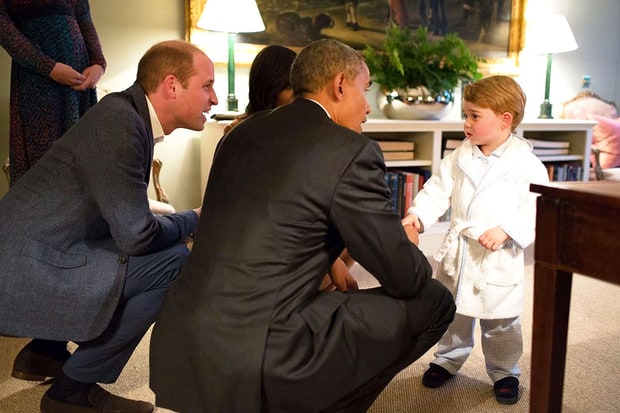
Talk about product placement! It’s a robe, folks, a white robe. In addition, it’s the sort of thing that most kids don’t wear anymore. When was the last time you saw a child in a robe?
I’ve noticed that most of Prince George’s clothes have a wonderful timeless quality. I’d call them “preppy” but that’s not quite right, either. They’re almost exactly sort of thing I remember from my long-ago childhood that were featured in the Best & Co. catalogue, conservative clothing that conveyed the possession of understated old money. The Queen has the same style-less (one might instead call it “timeless”) style that ignores style and says, “We stand for the old truths and the old ways.”
Of course, Prince George so far has little say in the matter. Come to think of it, though, he seems to tolerate his clothes quite nicely and wear them with a solemn dignity that’s also quite adorable. How many kids could pull it off as well?
[NOTE: Speaking of “pull it off,” I believe that, had I tried to put such a robe on my son when he was little, he would have pulled it off (literally). He didn’t like restraints or extra clothing, and one of the first phrases he ever used was “Too tight! Too tight!” He had particular difficulty with footed pajamas and turtlenecks, and after a short while I stopped buying either for him.]