Merkel is doing penance for her immigration policy by getting behind the banning of the full-face veil—in other words, the burqa and the niqab.
Today there’s an editorial in Bloomberg that states:
Pandering to grievances, real or imagined, rarely works. Sometimes it’s meant to soothe such feelings, as it presumably was in this case. Usually, though, it inflames them and makes matters worse.
Which grievances are being pandered to by the Bloomberg editors?
The editorial goes on to state:
Now, elections are coming up in Germany, and Merkel rightly wants to deny support to the far-right AfD party, whose anti-immigrant thinking is driven not by prudence but by outright racism. In response, Merkel’s newly hardened position is both weak on the merits and plain bad tactics.
It’s weak because the full-face veil is not much seen in Germany — and who’s actually claiming that Shariah law should overrule German law? The effect of her statement is not to encourage assimilation, but merely to convey sympathy with the anti-immigrant worldview. Hence, bad tactics: Flattering such thinking is no way to overcome it. She’s as good as conceding that the AfD has a point.
What’s wrong with this? Let me count the ways.
We can be pretty sure that some members of the “far-right” AfD party’s anti-immigrant thinking is driven by “outright racism” (although “racism” isn’t the right word, since we’re talking about a religion, Islam, rather than a race here). But how much? It’s not at all driven by “prudence”? Not even a teeny weeny little bit? Give me a break. But perhaps the authors of this editorial also were the ones that said all objection to President Obama was racist, too, and that all supporters of Donald Trump are racists.
We don’t know on what evidence the editors based their accusation about the completely racist motives of the AfD, because they are keeping mum about it. We are just supposed to take their august word for it, I guess. Here’s the AfD’s Wiki page, if you want to get up to speed. And here’s a long (confession: I only read about 2/3 of it) article in Spiegel about the party, from which I glean that its supporters very much resemble Trump’s supporters.
Of course, where Germany is concerned, extra caution makes a certain amount of sense. But this party seems, at least as far as I can ascertain, to resemble other populist and nationalist movements that are springing up in a wide variety of places in response to the present governments’ ignoring of what seems like common sense about both unchecked immigration and the preservation of cultural identity.
But let’s get back to the Bloomberg editors. The sentence “It’s weak because the full-face veil is not much seen in Germany — and who’s actually claiming that Shariah law should overrule German law?” contains two errors. If the full-face veil is “not much seen in Germany”—well, so what? Can we only ban things that are common? After all, murder is uncommon, but it is banned. To use a more relevant example, public nudity is uncommon and yet most countries have laws against indecent exposure. They are preventative, as well.
And far as the question of who is arguing for sharia law, take a look at this sort of thing. I don’t have time right now to check the study itself, but I’ve read plenty of similar findings in the past.
Now let’s look at this from the Bloomberg editors:
The effect of her statement is not to encourage assimilation, but merely to convey sympathy with the anti-immigrant worldview. Hence, bad tactics: Flattering such thinking is no way to overcome it. She’s as good as conceding that the AfD has a point.
But do they really think the AfD doesn’t have at least a point, considering what has happened with immigration in Germany? Not to mention what has happened in this country, which has been one of the main factors leading to the election of Trump. No point at all? And what has the left ever done in Germany to “encourage assimilation”? Does allowing full-body (including face) coverage in Germany “encourage assimiliation”? Hardly.
In addition, the Bloomberg editors ignore two very important things. The first is that wearing a facial veil is not dictated by Islam, it is cultural in certain countries. The second is that covering the face entirely has security consequences, and they are not good. There are anti-mask laws in various countries that have to do with people covering their faces in any manner when in places of public assembly:
In many US states and the District of Columbia, there are anti-mask laws.
Anti-mask laws date back to the mid-20th century when states and municipalities passed them as to inhibit the Ku Klux Klan, whose members typically wore hoods of white linen to conceal their identities.
I wonder whether the editors would champion the KKK’s right to cover their faces. Somehow I doubt it.
France has what is probably the most restrictive law of all in that respect:
The French ban on face covering is an act of parliament passed by the Senate of France on 14 September 2010, resulting in the ban on the wearing of face-covering headgear, including masks, helmets, balaclava, niqÄbs and other veils covering the face in public places, except under specified circumstances.
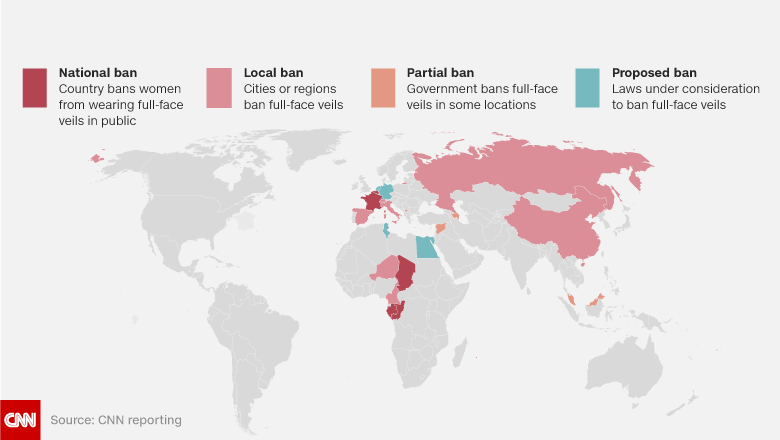
Here’s an article on the extent of bans on face-veiling, which includes this map:
Western countries—not just Germany—are struggling with issues of nationalism versus immigration. To what extent will a nation declare its own culture to be something with which immigrants must conform? What is the proper proportion of immigrants to natives in order to preserve a country’s own culture, and how many people even want to preserve that culture? What is racism and what is common sense? How far can the left go in accusing people of blanket racism before the word becomes meaningless and causes a backlash (and has that point already arrived)? What form will that backlash take (considering that Germany, for example, has a very troubling history)?
And it’s not just western countries, either. Many Muslim countries have struggled with related cultural issues. When the Shah was in power in Iran, for example, women didn’t wear the chador, but it came back with a vengeance (literally) after 1979, along with the theocracy.
And let’s not forget Turkey’s Ataturk:
The Ottoman Empire had a social system based on religious affiliation. The religious insignia extended to every social function. It was common to wear clothing that identified the person with their own particular religious grouping and accompanied headgear which distinguished rank and profession throughout the Ottoman Empire. The turbans, fezes, bonnets and head-dresses surmounting Ottoman styles showed the sex, rank, and profession (both civil and military) of the wearer…
Ataté¼rk’s Reforms defined a non-civilized (non-scientific, non-positivist) person as one who functioned within the boundaries of superstition. The ulema was not a scientific group, and it was acting according to superstitions developed throughout centuries. Their name was “Gerici”, literally means “backward”, but it was used to mean bigot. On February 25, 1925 parliament passed a law stating that religion was not to be used as a tool in politics. The question became how this law could be brought to life in a country whose scholars are dominated by the ulema. Kemalist ideology waged a war against superstition by banning the practices of the ulema and promoting the civilized way (“westernization”), with establishing lawyers, teachers, doctors. The ban on the ulema’s social existence came in the form of dress code. The strategic goal was to change the large influence of the ulema over politics by removing them from the social arena. However, there was the danger of being perceived as anti-religious…
Beginning in 1923, a series of laws progressively limited the wearing of selected items of traditional clothing. Mustafa Kemal first made the hat compulsory to the civil servants. The guidelines for the proper dressing of students and state employees (public space controlled by state) was passed during his lifetime. After most of the relatively better educated civil servants adopted the hat with their own he gradually moved further. The Hat Law of 1925 introduced the use of Western style hats instead of the fez. Legislation did not explicitly prohibit veils or headscarves and focused instead on banning fezzes and turbans for men. Another control on the dress was passed in 1934 with the law relating to the wearing of ‘Prohibited Garments’. It banned religion-based clothing, such as the veil and turban, while actively promoting western-style attire.
This is not a small topic, nor is it a simple one, although the editors of Bloomberg would like to pretend that it is. The way we dress is not the least bit arbitrary, as any wearer of the burqa could tell you. The issues are not simply religious, either—they are cultural too, and they also have security implications in a world in which Islamic terrorism is an important and dangerous phenomenon even in western nations. To say otherwise and to declare that all of this is simply a racist brouhaha is delusional.