I admire just about everything Thomas Sowell has ever written, and when first saw this I thought “Bingo, touche!” But then I started thinking about it and realized it’s not as good as I’d first imagined.
Many liberals would be likely to dismiss it, answering that greed isn’t what they’re exhibiting when they advocate income redistribution. They would say that they’re just trying to limit the greed of other people, while at the same time asking that the poor and needy receive just enough to get by.
In other words, they would claim that the rich already have “more than their share,” or “more than they need,” and that that is the definition of greed—having or wanting more then you need, whereas the poor just want to be able to live decently.
But for liberals, who defines how much is just enough and how much is way too much? For many people, the definition of “just enough but not too much” tends to be “what I want” or “what I have,” and “too much” tends to be “what the other guy has that is more than what I have.” And of course, some people who want to take some of the money of the rich aren’t greedy, because they’re already rich themselves and want to take some of their own money plus that of another rich guy, and give it to the poor one—and to compel the giving rather than let it be voluntary.
The Christian seven deadly sins are wrath, greed, sloth, pride, lust, envy, and gluttony. Wrath, sloth, pride, and lust have sort of fallen off the sin wagon these days, at least with a lot of people. But gluttony is often still considered bad (maybe worse than ever). Greed is still bad, but is usually defined as something other rich guys demonstrate. The sin of envy of the material goods that others have—that is, the covetousness forbidden by one of the Ten Commandments—is actually sometimes encouraged by liberal philosophy. And it’s certainly encouraged by society in general.
So for the most part the left retains only two of the sins, one relatively minor (gluttony) and one of enormous importance to the left: greed. The sinful nature of greed is part of their justification for wanting to take away from some people defined as greedy (the rich), in the unspoken advocacy of another formerly deadly sin: envy.
As I wrote yesterday, I think this particular deal was mostly symbolic (although not to the workers whose jobs were saved), to make a point that Trump was trying to make about being the sort of guy who was going to solve things. It’s going to be followed by policy, and the policy will affect companies in general—and the results will be either good, bad, or mixed.
In unrelated news: Hollande says he won’t be running again. I wrote about the French election last Wednesday, here.
With the announcement of Trump’s triumphant (Trumphant?) Carrier deal, the word that occurs to me—not for the first time—is “showman.”
That’s not necessarily a good thing or a bad thing, by the way. But it’s not something we’ve seen a lot of in recent years.
It’s not that previous presidents haven’t tried. Reagan was good at the speeches, as well as some sweeping gestures (“tear down this wall,” and the firing of the air controllers). Nixon, Jimmy Carter, and George Bush were abysmal; Clinton only so-so (playing the sax on TV comes to mind).
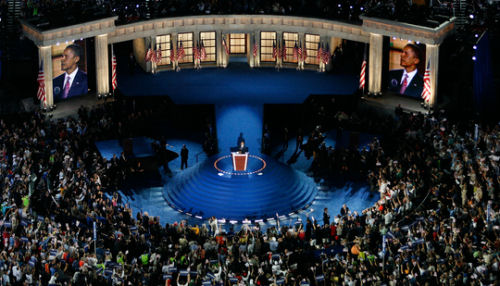
Obama tried and sometimes succeeded, particularly during his first campaign. Remember the Greek columns?
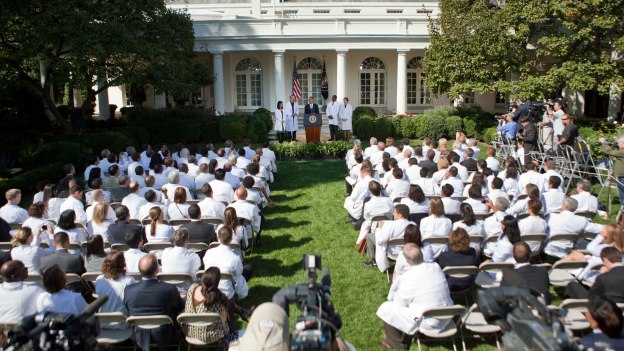
And then there were the white coats of Obamacare:
And who could forget George Bush jetting over to an aircraft carrier to give his “Mission Accomplished” speech?
But neither Obama nor Bush seemed to me to be especially accomplished at it, although Obama was better than Bush (your mileage may differ). It wasn’t exactly their natural metier, shall we say.
But this is the water in which Trump swims. This is his most comfortable place to be: the showman, in the spotlight. He’s been doing it for his entire life.
That’s one of the reasons Trump preferred enormous rallies, and was relaxed when giving lengthy speeches without a teleprompter and ad-libbing extensively. He likes the spectacle of it all and realizes the important of the gesture and the symbol. And despite his more “presidential” demeanor since his election, I doubt this aspect of his personality will fade during his presidency; au contraire. And he understands the elements of surprise, of timing.
The Trump Carrier episode has many aspects—potential problems, and potential upsides. You can read about a great many of them here. But the saving of the Carrier jobs in Indiana is symbolic, too (although it’s not the least bit symbolic to the workers themselves). Trump is trying to convey a number of things about himself, for example that he keeps his word (something he certainly has not always done in the past). That he cares about the “little people, the forgotten ones.” That he can work a deal, just as he said he could. That he’s a man of action. That he’s a man of quick and decisive and successful action.
As this article points out, the Carrier deal is the tip of the iceberg; the problem is much broader, and Trump may not be able to solve it. Nor are Trump’s solutions in the particular situation posed by Carrier magical; they probably have come from a combination of special tax incentives from the state (a common form of government favoritism) and threats from the feds.
But Trump the showman isn’t trying to show us how the sausage is made. The showman wants us to experience how good it tastes. There’s a danger in that and a value in that, and it’s a goodly part of why Trump got elected.
I am not naive about elected officials, nor about government. I don’t expect a whole lot from Trump, even if he turns out to be a much better president than I ever expected (so far, as president-elect, he’s certainly been better than I expected). I don’t expect him to be able to work miracles, or to actually solve the enormous problems we face. It would suffice if he didn’t make them worse, and if he helped create improvements in a number of situations that have been getting worse for decades. Now, that would be a show I’d like to watch.
A German intelligence officer has reportedly been arrested over a suspected Islamist plot to bomb the agency’s headquarters in Cologne…
The BfV said the man “behaved inconspicuously” prior to his arrest. He had, since April, been engaged in gathering intelligence on Islamist extremists in Germany, Der Spiegel said.
Online chats were apparently found between the suspect and other Islamists in which he attempted to recruit them to the intelligence agency to mount an attack on “non-believers”, carrying out a bomb attack on the spy HQ “in the name of Allah”.
He used several different names online and his activities were uncovered about a month ago.
The man’s family reportedly knew nothing of his conversion to Islam two years ago and subsequent radicalisation.
The suspect was thought to have pledged allegiance to of the Islamic State of Iraq and the Levant terrorist group.
First, the good news: they caught the guy.
Next, the bad news: just about everything else.
This man was a convert, and another article states that he was “of Spanish origin.” This means he could be of European ethnic origin rather than Middle Eastern or other Muslim-area origin. Or perhaps not; people are often referred to in the press by their places of birth rather than their hereditary ethnicity.
At any rate, this story appears to highlight the difficulties facing those dedicated to preventing terrorist attacks. Who to look for? This man purposely kept his Islamic identification under the radar, so—especially if he was a native European—how would one know? Continue reading →
Who? Joan Baez and Judy Collins. And they look and sound pretty good, considering. Pretty darn good.
They’re not what they were at their peak, of course. But who is, at 75 (Baez) and 77 (Collins)? The high notes are the first to go.
Yes, yes, I know; politics. But I separate art from politics.
The song’s original line was “ten years ago I bought you some cufflinks…”. Here Baez changes it to “fifty years ago.” The “you” who got the cufflinks (“they made cufflinks back then” quips Joan) was that Nobel Prize-winning author, Bob Dylan, with whom Baez had a brief but intense affair in the 60s.
And who has declined to attend the White House ceremony honoring the Nobel prizewinners.
[NOTE: And here’s my question: why would you give Bob Dylan cufflinks, even fifty years ago? Did he ever wear them, except perhaps at his Bar Mitzvah?]
[ADDENDUM: Commenter “Ann” offered a comment in which she links to a photo of Dylan wearing a shirt that looks as though it might have cufflinks.
That got me to thinking that I really hadn’t researched the cufflink angle at all. And lo and behold, when I did, I struck pay dirt.
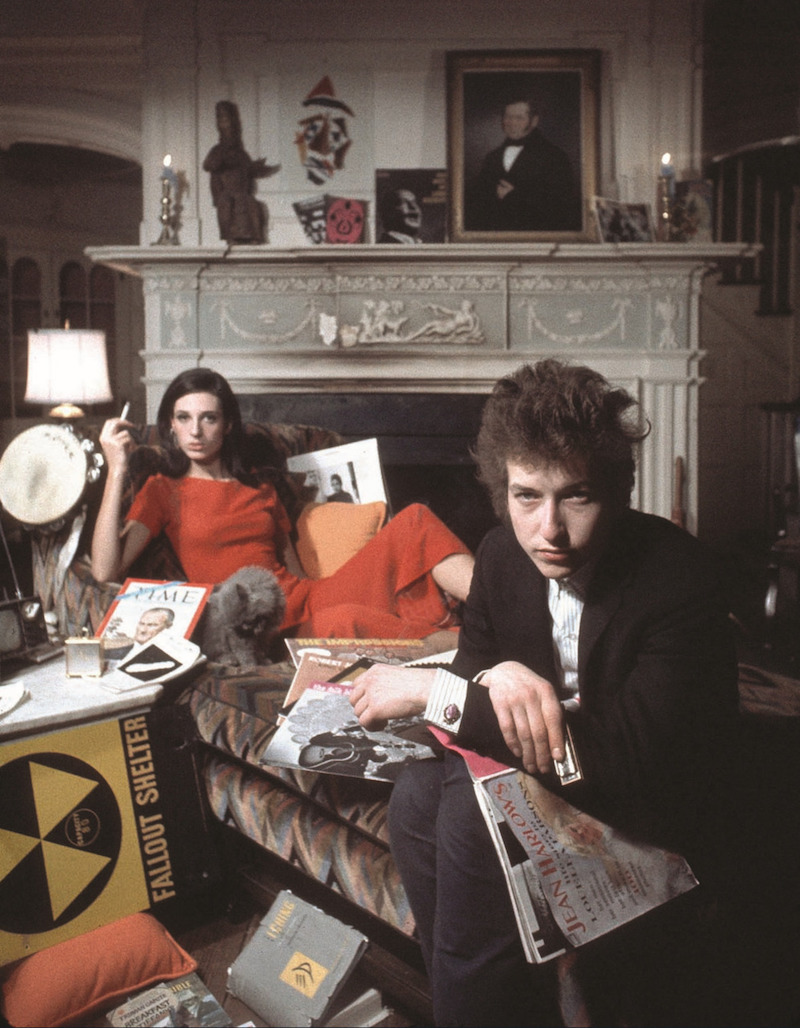
Never noticed it before, but Dylan was a regular cufflink aficionado. Here’s an extremely well-known Dylan album cover (known by me, too; “Bringing It All Back Home”). Now that I’m looking for them, the cufflinks fairly leap off the page:
What’s more, if this article is accurate, they are the cufflinks.
Joan Baez’s cufflinks, that is:
For the cover, the photographer Daniel Kramer came up with the idea of photographing Dylan in a room full of objects that would signify his influences — something that had been done in Renaissance portraiture – but with less cool stuff.
There’s a movie magazine, records by the blues singer Robert Johnson, the “beatnik” comedian Lord Buckley, the German singer Lotte Lenya (later a James Bond Villain), a R+B group called The Impressions and even Dylan’s last album “Another Side of Bob Dylan”.
The woman relining on the sofa is Sally Grossman, the wife of Dylan’s manager, Albert Grossman. On the mantle there is a poetry book by Borges (pronounced: Bor-hes) and above it a portrait of a clown that Dylan made by gluing colored glass on regular glass.
There’s a fallout shelter sign on the floor and a copy of Time Magazine featuring Lyndon Johnson as “Man of the Year” next to Sally’s side.
Dylan’s cuff links were a gift from Joan Baez and she sang about them in the song about Dylan and her, “Diamonds and Rust.”
Here’s another photo, one of the cover outtakes, that shows the cufflinks much more clearly:
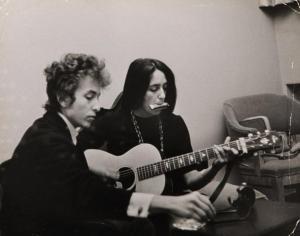
Not only that, but they were far from the only cufflinks Dylan wore (or at least that was far from the only time he wore them; this photo isn’t clear enough for me to say whether they are the exact same cufflinks or different ones):
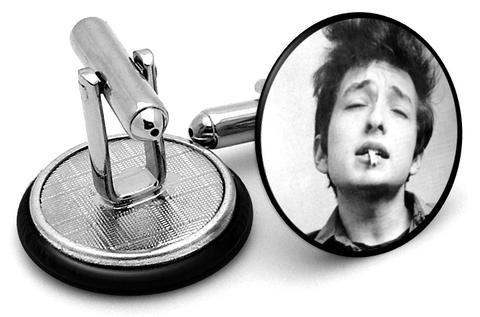
And last but far from least, you too can have your own Bob Dylan cufflinks, although they’re not from Joan Baez (people used to tell me I looked somewhat like her, though, back in the day):
And since this post is also about the passage of time, it wouldn’t be complete without an update on the woman in the photo. It’s Sally Grossman, taken “years later” (I don’t know how many, but it’s not current, because she’s in her late 70s now):
Research isn’t always this rewarding, or this much fun.]
Trump’s deal with Carrier to stay in Indiana rather than moving to Mexico is a stroke of PR brilliance. It’s also an example of exactly why Trump is now feared by the left: he is very good at this kind of visual, with populist appeal that used to be their special province.
But inquiring further, what’s it all about, Alfie? What was the quid pro quo?:
Carrier stayed because of government incentives and tax breaks. We don’t know details, but if Indianapolis and the state offered the same breaks to lots of other companies, they’d have to find other ways to raise revenue to pave streets and provide public safety. It is not, in Silicon Valley parlance, scalable.
We don’t know the details. We don’t know how this factors into the larger plan—or if there is a larger plan yet. As my mother used to say almost every time I asked her for something: we’ll see.
Pelosi got 134 votes to Ryan’s 63 ”” winning 68 percent of the votes after declaring before the election that she had the support of two-thirds of the caucus. The victory sends a message that while there’s a growing appetite for major changes in the party’s leadership structure and messaging tactics, it’s not strong enough to loosen Pelosi’s grip on a liberal-heavy group that’s rarely challenged her authority.
Ryan and his supporters had argued that the Democrats’ grim performance in this year’s elections ”” the latest in a string of cycles planting Republicans firmly in the majority ”” was a clear signal that Pelosi’s leadership strategy has failed to attract the broad coalition of voters required to return the Speaker’s gavel to the Democrats’ hands.
If the Democrats want to reward failure, that’s their business.
However, it makes perfect sense to re-elect Pelosi. She (and the majority of Democrats) sees the Democratic task in the House right now as trying to block changes that would nullify Obama’s eight years of what they consider to be achievement. Pelosi was very instrumental in getting things like Obamacare passed by strictly uniting the party to do it, and she’s the best bet for an oppositional role now. Her power is much reduced, but Pelosi isn’t likely to go wobbly on anyone or anything.
In France, [pollsters] failed to see that former prime minister Frané§ois Fillon would win the race to become the conservative party’s candidate in April’s presidential election. A social conservative with liberal economic views, Fillon scrambles our notions of Left and Right…
…Fillon tells the French that he wants “to give the country its liberty back.” He promises to cut a half-million public-sector jobs, end the 35-hour work week, and reduce France’s corpulent 3,000 pages of labor regulations to a svelte 150. This would be a revolution, of sorts…
In April 2017, Fillon, an Anglophile and practicing Catholic, could conceivably confront Marine Le Pen, the anti-Islamist leader of the National Front, in the second and conclusive round of the French presidential election. If so, the pundits will find that their old mental maps have been rendered useless in a conflict between two “conservative” candidates. That’s because the working-class vote, once claimed by the Left, has been abandoned by the French Socialists…
So according to Fred Siegel (author of that City Journal article), we have two candidates on the right—or sort-of on-the-right—fighting over what we now can call the Trump voter. Or perhaps the Trump électeur.
I fail to see what’s “liberal” about the economic views of Fillon as described there (after all, these are public sector jobs he’s cutting), although this piece in Politico also calls him economically liberal, and offers an attempt at explanation:
[Fillon] won more than 60 percent of the vote against a more moderate candidate by focusing on social values, winning the support of Catholic groups and projecting exactly who he is: an economic liberal and social conservative who, at the end of the day, is indisputably right-wing…
Hours after Fillon’s victory Sunday, Philippot went on television to assail Fillon as a cold-hearted agent of capitalism, saying his plans to lay off 500,000 civil sector workers would “bleed” France. His calls for reform of labor rules were further “austerity” directed from Brussels and embrace of the EU was proof of his “savage globalism,” Philippot said.
“The candidate of uncontrolled globalization has a name: Frané§ois Fillon,” Philippot told BFMTV. “His program is rather medieval in nature: he wants to bleed France to make it better, even though we know this doesn’t work very well.”
But Fillon’s camp argue they can siphon off Le Pen’s working-class votes. They point to exceptionally strong performances in some economically depressed areas where the National Front usually does well as proof that Le Pen does not have a lock on “Trump-like” voters.
Fillon’s Thatcherite economic policy will no doubt push France’s vast array of public-sector trade unionists””and what remains of the industrial working-class voters””into the arms of Marine Le Pen, who could merge as the de facto left-wing candidate (if such terms still have any meaning). The many millions who either work for government or are the recipient of corporatist benefits might quietly support Le Pen’s nationalism rather than risk losing their privileges.
Whoever is the victor, the ill-begotten European Union will have been handed yet another shock…
So, which is it? First Siegel says Fillon is economically liberal, and now we hear from Siegel that he’s got a “Thatcherite economic policy.” And although Politico says that Fillon is in line with the EU, Siegel says that neither candidate is.
Clear as mud, I’d say. I know that words like “liberal” mean something different in France from what they mean here, but how could a “Thatcherite” economic policy also be called “liberal”?
And since we already don’t especially trust polls at this point, I suppose we should take this with a huge grain of salt:
France’s Francois Fillon will convincingly beat National Front leader Marine Le Pen in a presidential election runoff next May, taking 66 percent of the vote, a new opinion poll showed on Wednesday.
The Elabe poll showed free-marketeer conservative Fillon, who secured his Les Republicains party nomination on Sunday, remains firmly in first position among several declared or potential candidates, including Le Pen and socialist incumbent Francois Hollande.
Both Fillon and Le Pen, head of the anti-immigrant, anti-EU, National Front, are expected to make it to a head-to-head runoff on May 7 after a first round of voting in April which will winnow out the field.
In that runoff, Fillon would likely secure 66 percent of the votes versus 34 percent for Le Pen, according to the poll, which was conducted by Internet on Sept. 28 and 29 and involved a representative sample of 941 voters.
I say it’s a long way from now to May. But it does seem as though, if we’re talking about the Trump électeur, Fillon is the more obvious choice. Both candidates are tough on immigration, by the way.
Forget the headlines about Frané§ois Fillon being a Thatcherite revolutionary or someone who will transform France into a shining neoliberal model nation. He is middle of the road, provincial middle class and if the French had a term like middle England, he would be viewed as “middle France”…
There is no doubt that he can beat Marine Le Pen ”“ and Europe will heave a sigh of relief.
She has tried to present herself as the Brexit-Trump candidate in France, but if there is one thing that does not work in French politics, it is to make an offer based on what the Americans and English do. Marine Le Pen’s endorsement by Nigel Farage is a viper’s embrace and France and Fillon will hug Germany ever closer and back more, not less, into Europe.
Well, I’ll tell you one thing I’m not going to be doing at this point: making a prediction right now based on my utter confusion about who Fillon is. Anyone who has a finger on the pulse of France can jump in here and offer one, though.
George Balanchine’s “Serenade” is one of my very favorite ballets. It’s the perfect marriage of music, choreography, costumes, mood, and lighting, casting a spell on all who watch it.
Here are two short but fascinating videos that feature some visuals while New York City Ballet dancers talk about what its like to perform in it:
And here is the complete “Serenade” performed by the New York City Ballet in 1990. It’s fuzzy, and also difficult to film because if the camera is positioned too close to the stage you don’t get the effect of all the dancers and the lovely formations, but if it’s too far away the dancers look like teeny tiny miniatures. Remember also as you watch it that ballet on video is a wonderful thing to have, but that two dimensions cannot begin to compare to three and the real thing in the flesh:
[NOTE: I’ve written about this ballet before, here.]
There’s been a lot of speculation about whether Trump is trying to humiliate Romney or whether he really wants him as his Secretary of State (see this, for example).
I’m already tired of it. I happen to think Romney would make an excellent Secretary of State. But I was surprised by Trump’s even considering him, and by Romney’s considering the post in turn. Everyone else was surprised by it, too, if they’re being honest about it. So, why would they have a clue what Trump is going to do next, since they couldn’t predict this in the first place, and since both men appear to be playing it very close to the vest?
Unpredictability was always one of the givens of a Trump administration. Trump is a wild card, and may be a loose cannon too, although let’s hope it’s more the former than the latter. Whatever else you might say about him, he is not in the mold of previous presidents. In addition, he has no track record in public office. He has changed his mind many times, and has lied many times. So why would anyone think they can predict the choice he will make?
But I do have one thing to say about it, for what it’s worth: I think that both Romney and Trump are seriously considering it, and that one of their main concerns is not so much the past bad blood between them but rather whether they are on a similar enough page regarding foreign policy that Romney could work under Trump. I think that Romney is all about service, and if he felt he could perform a service without giving up his integrity he would do it. And I think Trump is trying—at least initially—to get the best people for the job and that he actually respects Romney’s foreign policy acumen and believes he’s a straight-up trustworthy guy.
Recently I got a cryptic bill from the IRS for a small amount of money. The reason for the charges was ostensibly explained on the bill, but in a way that only dogs can hear and IRS agents or tax attorneys can understand. It wasn’t a big deal—I could have just paid it—but I thought I’d call to ask for some clarification because the bill seemed to be referring to something I already had paid.
I knew there would be a phone wait of at least an hour to talk to a human being. But that was okay with me because I could just put my phone on speaker or put my bluetooth in my ear while I worked at my computer and waited. The music was annoying, of course, but not as annoying as some while you’re on hold. It’s frustrating not to know whether it will be a half-hour wait or an hour wait or a five-hour wait or whether the line will disconnect. But after about an hour a person suddenly answered, and asked me why I was calling.
Actually, he asked me what I was calling to dispute. I started by saying that well, I wasn’t sure I was disputing anything, but I had gotten a bill about which I had a question…
And then it began. The “service representative” said—in a voice so nasty and dripping with sarcastic contempt that initially I could not believe my ears—“Excuse me; excuse me, I see you’re determined to interrupt me! Now, this time, how about listening to me? I asked you, what are you calling to dispute?”
I could have hung up right than and there, but I didn’t. More’s the pity, because that was the courteous highlight of what turned out to be about a twenty-five minute conversation that degenerated further and further on his part, although I remained scrupulously polite.
There were a number of reasons why I remained on the line and remained civil. The first was that one-hour wait. I didn’t want to repeat it, and I realized there was no guarantee the next agent would be any better. Perhaps this is the new norm at the IRS—abuse the caller and maybe he/she will never call again (by the way, I’ve spoken to the IRS about twice before to ask questions, both times over ten years ago, and the people who answered had been helpful and pleasant).
In addition, I couldn’t believe I was actually hearing what I was hearing. This person was so egregiously rude—so much like a teasing bully on the schoolyard—that it was both shocking and fascinating. How low would he go and how rude would he get? Throughout the entire conversation, I was cut off almost any time I wanted to explain anything or say anything other than what he wanted me to say (and I couldn’t glean what that might be), and then I was accused of interrupting him, or being unresponsive, or worse.
The man’s statements of supposed “explanation” were as hard to understand as the bill itself had been. It was as though his goal was not only to insult me but to keep information from me rather than reveal it, even simple information that he possessed and that could have shed light on the subject. So another reason I stayed on the line was out of sheer curiosity, to study what he was doing and see if any response of mine would change it, and also to see if I’d ever get the answers.
I could go on and try to describe the rest of the exchange, but only a recording would convey what it was like and alas, I don’t have one. I did get my answers in the end, but only because I persevered. I doubt most people would have. It was an “interesting” experience, to say the least, and one I’m not eager to repeat—which may have been part of the reason it was done that way.
It also was a demonstration of the corruption that goes with power. Power—and the IRS certainly has power—gives IRS employees the ability to vent their inner sadists because they know the people they’re dealing with are, for the most part, afraid of them. Each person one speaks to at the IRS is possessed of information that fully identifies you and makes you vulnerable, and if that person wanted to do much worse to you than merely treat you rudely, he or she probably can. It also became clear to me that the IRS either encourages this behavior on the agent’s part or at the very least could not care less about it; afterwards I looked at a bunch of discussion boards where people who’d been treated similarly had tried to complain and gotten absolutely nowhere.
The IRS is an unchecked behemoth. We already know—from its treatment of the right under Lois Lerner prior to the 2012 election, and from her subsequent behavior and that of others in the agency—what the IRS is capable of when political suppression is the goal. But now it may have come down to routine mistreatment of callers, just because they can do it. After all, who will check them and who will stop them? Nobody.
I had forgotten that when the IRS scandal first broke, even the left was upset by it. That ended after a short while, but here are some examples of the initial reaction that shows the universality of the anxiety:
MSNBC’s Rachel Maddow said: “There is a reasonable fear by all of us, by any of us, that the kind of power the IRS has could be misused,” she further said that this scrutiny of Tea Party groups was “not fair.”
Comedy Central’s Jon Stewart stated that the scandal had taken “the last arrow in your pro-governance quiver,” he further said that this threw doubt on President Obama’s “managerial competence” and had proven correct “conspiracy theorists,” moving the burden of proof onto federal authorities.
ABC News’ Terry Moran wrote that this was: “A truly Nixonian abuse of power by the Obama administration.”
Even though that sort of bipartisan outrage didn’t endure, it reflected the very real fear of the IRS that even Rachel Maddow was able to acknowledge and articulate. That’s a good reason—one of many, actually—to support the scrapping of the IRS (one of Ted Cruz’s campaign proposals, by the way) and the imposition of some completely different system that doesn’t require so much centralization of power and so much intrusiveness.
In what comes as no surprise to any human being on earth (with the possible exceptions of President Obama and Canadian Prime Minister Trudeau, and Obama would be pretending), the attacker has been identified as a recent Somali refugee and a student at Ohio State University. His name is Abdul Razak Artan, and he gave a brief interview to the school newspaper on August 25 of this year (page 5 here), in which he said he was a transfer student from Columbus State, and complained about the lack of prayer rooms at OSU and the bad press Muslims have gotten in general:
I wanted to pray in the open, but I was kind of scared with everything going on in the media,” he stated. “I’m a Muslim, it’s not what the media portrays me to be.”
I wonder what the media will portray him to be this time.
[EARLIER POST]
This is a breaking story, and as such the facts are subject to revision. But here is what we know so far:
Police confirm the suspect who drove a car into a crowd of people and began attacking them with a butcher knife on the campus of The Ohio State University is dead.
Columbus fire officials tell NBC4 nine people were transported to local hospitals, and all nine victims have non-life-threatening injuries…
OSU president Michael Drake says the sole suspect drove a car into a group of people, got out and began to cut them with a butcher knife. A police officer arrived within a minute of the attack and shot and killed the attacker.
“Within one minute”—that’s a very very speedy response, which is good. But it shows just how much damage can be done with “ordinary” weapons like a car and a knife, and how quickly.
In other, only tangentially related news, Charleston church shooter Dylan Roof is being allowed to represent himself in his trial. I am uncomfortable with this, as was the judge who decided it. This is a capital murder case, and although I have no sympathy whatsoever with Roof himself and his heinous crime, I think the bar for declaring someone able to defend him/herself in a death penalty case should be especially high, because of the extreme gravity of the outcome and the need for a fair trial.
Roof may indeed be competent to stand trial in the sense that he is able understand the charges and to assist in his or her defense by cooperating with counsel. But that’s a far cry from handling the defense himself. But perhaps once someone is declared competent, he/she is considered by law to be competent in making the decision to defend him/herself, too.