
↓
 

The New Neo

A blog about political change, among other things

  • Home
  • Bio
  • Email
Home » Page 962 << 1 2 … 960 961 962 963 964 … 1,915 1,916 >>

Post navigation

← Previous Post
Next Post→

Hey, let’s make Shelley Garland dictator

The New Neo Posted on April 15, 2017 by neoApril 15, 2017

[See UPDATE below.]

What could possibly go wrong?

When I read this HuffPo piece that Garland wrote, I kept looking for the angle. No, it wasn’t published on April Fool’s Day. No, it doesn’t seem to be satirical or a parody. It seems to be serious.

If real rather than fake, and written by an actual person (I couldn’t find anything else about Garland, so I continue to be somewhat skeptical), it’s chilling. Here’s a little excerpt, to get the flavor of it:

Some of the biggest blows to the progressive cause in the past year have often been due to the votes of white men. If white men were not allowed to vote, it is unlikely that the United Kingdom would be leaving the European Union, it is unlikely that Donald Trump would now be the President of the United States, and it is unlikely that the Democratic Alliance would now be governing four of South Africa’s biggest cities.

If white men no longer had the vote, the progressive cause would be strengthened. It would not be necessary to deny white men indefinitely ”“ the denial of the vote to white men for 20 years (just less than a generation) would go some way to seeing a decline in the influence of reactionary and neo-liberal ideology in the world. The influence of reckless white males were one of the primary reasons that led to the Great Recession which began in 2008. This would also strike a blow against toxic white masculinity, one that is long needed.

At the same time, a denial of the franchise to white men, could see a redistribution of global assets to their rightful owners. After all, white men have used the imposition of Western legal systems around the world to reinforce modern capitalism. A period of twenty years without white men in the world’s parliaments and voting booths will allow legislation to be passed which could see the world’s wealth far more equitably shared. The violence of white male wealth and income inequality will be a thing of the past.

You get the drift. All written with unapologetic pride in finding what she thinks is a really good idea that would solve all sorts of problems with a wave of her magic white-man-disenfranchising wand and make the world a better place, as Shelley Garland defines better.

Hey, why not? There’s no tyranny like progressive tyranny. Just ask Sarah Conly.

Among other things, the fact that Shelley Garland purports to be a graduate student anywhere (I believe she may be South African, although it’s hard to ascertain) is sobering. Has she ever studied history, for example? Does she have any sense of irony? Does she even understand what liberty is, much less how to protect it?

UPDATE 4/15/17 9:43 PM

I read the HuffPo article by “Shelley Garland” and wrote the draft of this post on Friday, polished it a bit later, and slapped it up there around noon on Saturday (today), and went out for the day and evening. Apparently, around the time I published it, HuffPo pulled the “Garland” piece, writing this:

We have done this because the blog submission from an individual who called herself Shelley Garland, who claimed to be an MA student at UCT, cannot be traced and appears not to exist.

We have immediately bolstered and strengthened our blogging procedures that, until now, have operated on the basis of open communication and good faith. From now on, bloggers will have to verify themselves.

We will hold discussions on putting in place even better quality controls.

Now, I don’t expect HuffPo to send a private detective to authenticate every fact about every writer they publish. But just common sense would tell them to be very, very careful about that one. It reeked of satire, and I mentioned several times my own doubt about whether it was real or some sort of satire or scam. Why didn’t they see that obviously they were going to need to check this one out with extra-special care?

Was it because they knew it was click-bait? Was it just laziness on their part? Or did the piece seem rather mainstream to them, and therefore didn’t raise any alarms at all?
Posted in Liberty, Race and racism | 33 Replies

The power of Trumpphobia

The New Neo Posted on April 15, 2017 by neoApril 15, 2017

I’m not sure how it would be spelled: “Trumpphobia,” which looks wrong but probably is correct, or “Trumphobia.” But fear of Trump has had dramatic repercussions on our southern border:

In the decades since [Gilda and Juan Francisco] opened the space [in Nogales, Mexico] to give migrants a place to shower and sleep before crossing the border, the shelter””with separate rooms full of bunkbeds for men and women””would regularly house 100 migrants per night. Sometimes, that number would hit 300 or more, and Gilda and Paco would pull out thin mattresses to fit everyone on the floor.

But today, those mattresses are neatly stacked in a closet, untouched. And the shelter is almost empty””no women travelers, and fewer than a dozen men. That’s despite the fact that April, with its mild weather, should be the busiest time of year for migrants. The place is all but dead. Gilda and Paco have never seen anything like it.

They can only think of one explanation: President Donald Trump.

The article goes on to say that Trump hasn’t really done anything so very different from his predecessor—not yet. But the prospect of what he will do has concentrated the minds of would-be illegal arrivals tremendously.

Actions matter, but perceptions matter as well. That’s true not just for people contemplating coming to this country illegally; it’s true for just about everything.

And more actual changes regarding the treatment of illegal immigrants (particularly criminal ones) and those who assist them to come here are in the works; read at the link to discover what they are. The article concludes:

Sessions is very serious about using existing federal laws to break the back of the incentives racket that attracts illegals to the United States.

Sessions has been tough on illegal immigration for a long long time. But as a senator, he had a lot less ability to influence policy than he does now. Now he gets to both influence it and implement it.

Posted in Latin America, Law | 19 Replies

Missiles on parade in North Korea…

The New Neo Posted on April 15, 2017 by neoApril 16, 2017

…but no tests, despite widespread apprehension that a nuclear test would mark the big 105th birthday celebration in North Korea.

That’s—interesting.

Some of the missiles appeared to be new types for North Korea:

Analysts were working to identify all the missiles that were shown off on Saturday, many of which appeared to have new paint jobs or be variants on known missiles.

One of the missiles looked similar to the KN-08 intercontinental ballistic missile that North Korea had included in previous parades. This missile has a theoretical range of about 7,500 miles, which is enough to reach all of the United States from North Korea, said Joshua Pollack, editor of the Nonproliferation Review.

It also put two ICBM canisters, which protect solid-fueled missiles from the effects of the environment, on the trucks that had carried the ICBMs previously. One may have been a KN-14, another missile capable of reaching the U.S. mainland, although it has a slightly shorter range.

I have to say that the first thing that occurred to me on reading that article was “how do we know these things are real?” We do know that the North Koreans have nuclear weapons, but we know that from the detonations of those weapons in tests. We don’t know it from parades.

Now, don’t get me wrong. Everything in that parade yesterday might have represented a weapon that is fully operational and ready to go. But I don’t trust that’s true, and when I Googled “How do we know the North Korean missiles in the parade are real?”, up came this article with some experts questioning the same thing. By the “same thing,” I don’t literally mean questioning whether all the missiles in the parade are real—they’re almost certainly not, because that would be a dangerous practice —but whether they truthfully represent the true nuclear capabilities of the country displaying them.

The answer is that we simply don’t know:

Under Kim Jong Un, North Korea’s off-and-on nuclear program has progressed significantly. Since he took power in 2011, Pyongyang has conducted three nuclear tests, including what it claimed to be a thermonuclear device.

Speaking to CNN last month, Euan Graham, director of international security at Australia’s Lowy Institute, cautioned against underestimating the country’s capabilities.

“I think a lot of people would have scoffed at the idea that a country of threadbare means like North Korea would be able to test (submarine-launched ballistic missiles),” he said.

But Schiller said there was still room for a great deal of skepticism.

“If you just look at what they showed on TV and in photos, it looks impressive,” he said. “But from an engineering and project management approach, a lot of mistakes have been done in the past year.”

One problem with the North Korean weapon program that’s likely to be on display at this weekend’s parade, Schiller said, is its apparently sprawling size.

Previously, mock-ups of ostensibly the same missile — such as the KN-08, which was rolled out in 2012 and 2015 — “looked very different,” Schiller said. “That would never happen if there is a frozen missile design, you know what the missile should look like.”

Whatever the exact state of its nuclear weapons program, North Korea deserves the Reaganesque term “evil empire,” and one nuclear bomb would be one too many. Under the last three presidents, the country has grown its nuclear weapons program despite our efforts to halt it. And now a fourth president gets to try. Here’s the understatement of the year [highlighted portion]:

“It should be noted that there is a personality difference between Trump and Obama,” the Global Times newspaper wrote Friday. The paper does not speak for the Chinese government on policy but often reflects a strain of thinking within the Communist Party.

“Trump is also willing to show he is different. Bombing Syria helps him to show that,” it continued, while noting that he was far from “revolutionary” because he dispatched only missiles, not troops…

Right now, Trump has some cards to play, said Kim of the Asan Institute.

“He might say: ”˜If you want one less battleship in the region, what are you going to give me?’”‰” he said ”” a reversal of the usual situation, in which North Korea asks what it can get from its adversaries in return for changing its behavior.

It had been the previous pattern that North Korea called the shots. That certainly wasn’t a productive pattern—except for North Korea.

Back in December of 2016 I wrote this about Trump:

It’s not a bad thing for the world to find a president somewhat unpredictable, as well as willing to project US strength and ability to defend itself. But too much unpredictability and too much aggressiveness can backfire and cause an equal reaction on the part of those who feel threatened.

As I’ve said before: we’ll see.

Indeed.

[NOTE: Here’s another post I wrote even earlier than that one, about the possible advantages (and disadvantages) of Trump’s unpredictability and bellicosity.

Trump is somewhat unpredictable, but he’s not crazy. The leader of North Korea is most likely both, as well as evil. Tiptoeing around him doesn’t seem to have done any good. Treating him as though he might be a somewhat rational actor amenable to pressure makes sense to me as an alternative.]

Posted in Trump, War and Peace | 17 Replies

Giving credit: Trump, China, and North Korea

The New Neo Posted on April 14, 2017 by neoApril 14, 2017

The first sentence of this WaPo article by John Pomfret caught my attention:

Something interesting is happening in China and perhaps President Trump deserves some credit.

If someone writing in the WaPo who isn’t a known conservative gives Trump any sort of credit, I not only assume that Trump might richly deserve the credit but I also assume that the person writing the article has had some sort of difficult internal struggle to get to the point of issuing that credit.

Pomfret continues:

In an editorial in the semi-official Global Times on Wednesday, Pyongyang was put on notice that it must rein in its nuclear ambitions, or else China’s oil shipments to North Korea could be “severely limited.” It is extraordinary for China to make this kind of threat. For more than a decade, as part of its strategy to prop up one of its only allies, China refused to allow the U.N. Security Council to even consider cutting oil shipments to North Korea. Beijing’s calculus was that the maintenance of the North Korean regime took precedence over everything. Now Beijing seems to be reconsidering its position.

Once in office, Trump issued a series of tweets demanding that China do more to rein in North Korea. Trump administration sources have also leaked information vowing to punish a panoply of Chinese companies that have facilitated North Korea’s busting of U.N. sanctions. (The Obama administration only sanctioned one of these firms.) Meanwhile, the U.S. military sped up its plans to deploy the Terminal High Altitude Area Defense antimissile system in South Korea, despite China’s intense opposition.

But that wasn’t all. When Secretary of State Rex Tillerson traveled to Asia in March he warned that the United States would consider a preemptive strike on the north if its nuclear program continued unabated. “The policy of strategic patience,” Tillerson announced, “has ended.” Finally, the North Korean bomb was front and center at the summit between Trump and China’s president, Xi Jinping, on April 6 and 7 at Trump’s Mar-a-Lago resort. While eating “the most beautiful piece of chocolate cake,” with Xi on the evening of April 6, Trump told the Chinese president that he had ordered U.S. forces to fire missiles at a Syrian air base, following the chemical weapons attack on Syrian civilians apparently by forces loyal to Syrian President Bashar al-Assad.

These events, culminating with Trump’s strike on Syria, appear to have concentrated Chinese minds. The strategy of backing North Korea no matter what is bumping up against the risk of an unpredictable man in the White House.

That is exactly and precisely the sort of thing that represented my best-case scenario for a Trump White House. I deeply feared a more loose-cannon and impulsive Trump, way out of his league. But at the same time I hoped for a smart, more effectively intimidating, and also slightly-unpredictable Trump, who could signal that the Obama era of accommodation is over.

At least for now, at least in the case of China’s North Korea policy, this seems to be what’s brewing.

That’s the sort of process Trump meant when he bragged that he could make better deals. Put certain pressures on, apply the law of logical consequences, and let people know you’re not afraid to follow up with action if necessary. It’s way premature to think this will be the way it will go, or the way it will stay. But at the moment, at least the signs point in that direction.

Pomfret goes on:

…[T]he recent pronouncements from Beijing show that Trump’s unpredictability can be an asset in dealing with the Chinese and that his bellicosity can serve a purpose, too.

Indeed.

[NOTE: And here’s a bit about Pomfret’s background; he seems to be an expert on China:

After two years with the AP in New York, in 1988, [Pomfret] was sent to China as a foreign correspondent, thanks to his knowledge of Mandarin and his Asian studies background. There he covered the 1989 student protests in Beijing, after which he was expelled from China because of alleged links with student ringleaders…

He later served as the editor of the Washington Post”²s weekend opinion section, Outlook.

During his career, he received several awards, including 2003’s Osborne Elliot Prize for the best coverage of Asia by the Asia Society and 2007’s Shorenstein Prize for coverage of Asia.

The experiences he had when he attended Nanjing University, and his perspective of the Chinese opening, are narrated in his 2006 book Chinese Lessons: Five Classmates and the Story of the New China.

Just two weeks ago this is what Pomfret was writing about Trump and China:

It’s totally premature to have a summit with China early next month. The Trump administration clearly has no China policy and so meeting with China’s leader, Xi Jinping, at this juncture makes no sense. In fact, it could do more harm than good to America’s relations with China…

Don’t we need to know what our priorities are first? Nothing in the zigzagging of the past few weeks gives any indication that the Trump administration actually has those priorities, much less a strategic framework within which to accomplish its goals.

Maybe Pomfret is having a slight political change, or at least a slight Trump-approval change. He wouldn’t be the only one.]

Posted in Press, Trump | 21 Replies

Using “the mother of all bombs” in Afghanistan

The New Neo Posted on April 14, 2017 by neoApril 14, 2017

[NOTE: Make sure you read the ADDENDUM below.]

I’ve never understood what the objection to one big non-nuclear bomb versus many small ones would be, if the target is well-chosen. In the case of the “mother of all bombs” recently detonated in Afghanistan, the target appears to have been quite well-chosen:

The GBU-43/B Massive Ordinance Air Blast bomb (MOAB) was dropped Thursday night on a network of fortified underground tunnels that ISIS had been using to stage attacks on government forces.

Who could object to that, except ISIS and ISIS sympathizers? Or The Society to Protect Tunnels?

Then there’s this:

The strike, in Nangarhar province near the Pakistan border, also killed 36 ISIS fighters, Afghan officials say…

The blast destroyed three underground tunnels as well as weapons and ammunition, but no civilians were hurt, Afghan and US officials have said…

Nicholson [US commander in Afghanistan] also confirmed the strike was carried out in coordination with Afghan officials, and said that the mission had conducted rigorous surveillance before, during and after the operation to prevent civilian deaths.

Hard to find any fault with that, although I suppose that someone somewhere will say that Nicholson and the officials are lying. The CNN article goes on to interview people who talk about hearing a loud noise and seeing the smoke, but so what? ISIS has already terrorized the region and caused massive civilian evacuation:

One man, who did not want to give his name for fear of ISIS retaliation, said there were no civilians left in the area the group controlled.

The region the MOAB struck butts up against the porous Pakistan border. The rocky landscape is dotted with caves and defensive tunnels, making it easy to hold and hard to attack, according to CNN International’s diplomatic editor Nic Robertson, who has previously reported from the Afghan mountains.

The point of the weapon when it was originally developed during the Iraq War (but never used until now) was to kill the enemy but also frighten them with the power of the blast. Who made the decision to use it in Afghanistan? My guess is that the generals recommended it to Trump, and he gave his approval because he trusts their judgment in the matter. It also is the start of the fulfillment of one of his campaign promises: to bomb the shit out of ISIS.

[ADDENDUM: Now, this is certainly interesting. Apparently the order to drop the bomb was entirely that of the general in command, and it was done under authority already in place during the Obama administration:

In January of 2016, President Obama approved new rules of engagement to allow U.S. commanders to launch airstrikes against ISIS in Afghanistan, because of its links to al-Qaeda.

Then in June, Obama also lifted restrictions on offensive strikes against the Taliban, which until then, the U.S. only attacked to protect Afghan forces.

Nicholson was acting under his authority as the commander of the U.S. counterterrorism mission, known as Freedom’s Sentinel, which is separate from the war between the Taliban and the Afghan government, which is under the umbrella of Operation Resolute Support.

“He had been looking at the target for months, and decided it was time to mix things up,” the official said, while admitting the U.S. military did not fully anticipate how the first use of the massive bomb would capture the imagination of the public, and be interpreted as a signal to other nations from Trump.

Well, if they didn’t “fully anticipate” it, I bet they suspected it.]

Posted in Afghanistan, Terrorism and terrorists, War and Peace | 8 Replies

One more thing about religion and law

The New Neo Posted on April 14, 2017 by neoApril 14, 2017

To yesterday’s discussion of the question of how to legally define “religion,” I want to add one thing, which is that the definition primarily relates to the privileges and protections enjoyed by religions. That is, the legal definition tells you what group can claim tax-exempt status as a religion, or the ability to be a conscientious objector (if that’s part of the religion’s dictates), or that sort of advantage.

It does not apply to the commission of crimes, which are crimes even if the perpetrator cites a religious belief in defense. To take a very obvious example, a terrorist can’t try to use a defense that he read that Islam dictates that he murder people. Nor can Muslim family members who killed a daughter because in their eyes she violated its honor claim any religious defense. We recently have the first federal prosecution of a female genital mutilation case, which is a federal crime in the US and a state crime in many states as well (FMG is both a cultural and a religious phenomenon among those who practice it, who are most commonly Muslims, many of whom believe it to be a religious prescription whether it actually is or not):

Performing FGM on anyone under the age of 18 became illegal in the U.S. in 1997 with the Federal Prohibition of Female Genital Mutilation Act. As of 2015, 24 US states have specific laws against FGM. States that do not have such laws may use other general statutes, such as assault, battery or child abuse. Supported by Equality Now, the Transport for Female Genital Mutilation Act was passed in January 2013, and prohibits knowingly transporting a girl out of the U.S. for the purpose of undergoing FGM.

The first conviction of FGM in the US occurred in 2006. Khalid Adem, an Ethiopian American, was both the first person prosecuted and first person convicted for FGM in the United States…

A doctor working at the Henry Ford Hospital in Detroit was charged in April 2017 after allegedly performing FGM in a medical clinic in Livonia, Michigan, on two girls who traveled there from Minnesota with their parents.

A Christian who murders an abortion doctor cannot use his/her religious beliefs to successfully defend him/herself legally; the murder is a murder. A Christian Scientist risks being charged with various types of abuse or negligence if the refusal to seek medical help for a child causes serious negative consequences for that child. And if Hindus in the US were still encouraging widows to jump on the funeral pyres of their husbands (which they are not; the British banned the practice in India long ago during colonial days), you best believe that they’d be paying a legal price.

In this matter it’s instructive to go back to India and the famous words of General Sir Charles James Napier:

The [Hindu] priests [in colonial India] complained to [Napier] that [suttee or sati] was a customary religious rite, and that customs of a nation should be respected. As recounted by his brother William, he replied:

“Be it so. This burning of widows is your custom; prepare the funeral pile. But my nation has also a custom. When men burn women alive we hang them, and confiscate all their property. My carpenters shall therefore erect gibbets on which to hang all concerned when the widow is consumed. Let us all act according to national customs.”

Our legal system is more than a custom, of course. But Napier was correct in that what a nation regards as illegal and what it chooses to prosecute is at least in part a result of that nation’s customs and beliefs—customs and beliefs encoded in law and enforced by the entire panoply of police, prosecutors, judges, and prisons. Pleading “but it’s my religion” does not constitute a defense against crimes, because members of all religions are subject to the laws of the nation in which they live.

Posted in Law, Religion | 12 Replies

The current Trump-describing meme…

The New Neo Posted on April 13, 2017 by neoApril 13, 2017

…is that he’s turned into a centrist (for example, see this).

But it’s hard to see how he could turn into one, when he always was a mish-mash of competing statements on many subjects. After all, it wasn’t just an objection to his personal style that caused many conservatives to oppose him during the primaries, or even after. It was statements such as his praise for the Canadian health care system, and myriad other examples of not just centrist thought but even in some cases leftist thought.

Any conservative observer of Trump factored that in long ago. Any conservative voter had to consider it during the primaries, but especially after he’d won the nomination. Voting for him constituted a leap into the unknown with a person roundly distrusted. It was only because the alternative—Hillary—was so very dreadful that most conservatives ended up holding their noses and pulling that Trump lever.

The real surprise is that Trump’s been as conservative as he has so far rather than the other way around. I’m not sure I would be surprised by anything Trump does. He is predictable in his unpredictability. But even that is unpredictable because he might suddenly turn consistent, at least for a while.

Posted in Trump | 48 Replies

In legal terms, what is a religion?

The New Neo Posted on April 13, 2017 by neoApril 13, 2017

The question of how a religion is defined has come up many times on this blog in relation to Islam and terrorism. One question sometimes asked is why can’t any group simply declare itself to be a religion and have this be legally so, no matter what the group espouses. In other words, what are the limits of the term “religion”? Are there any criteria for a belief system and its practices to be considered a bona fide religion in the legal sense, with the protection of rights that go along with that designation?

There are many reasons why there is a legal interest in defining religion, because religions get many benefits under our legal system. But the law has traditionally had quite a bit of difficulty defining the term:

Complex interests may depend on the classification of a specific belief system or practice: tax exemptions; religious practices in prison or in the military (e.g., assembly for worship services; possession and sacramental use of various religious physical objects; access to religious literature; wearing of religious garments and jewelry; availability of food required by religious tenets); specific rights of workers, etc. The application of some constitutional and federal legal rules compels courts to delineate the boundaries of the concept of religion.

Legal theorists have made serious attempts to provide an adequate definition of what religion is for First Amendment purposes, and the Supreme Court’s and other federal courts’ efforts have been manifested in a string of cases in the context of the First Amendment as well as in statutory interpretation. These efforts should not be seen as entirely fruitless, but they have not provided a generally accepted legal definition of religion.

In other words, it ain’t easy.

It’s not easy to slog through that linked article, either. But the reader who does get through it should achieve some appreciation of how difficult a task it is to create a legal definition of religion. For example:

If one makes religion a subjective phenomenon determined purely by the individual, one comes into conflict with the social experience that religion generally requires social mediating structures on account of its communal aspects. Through these social structures, religion becomes valuable for the individual and the society integrates the individual’s concerns into social activities and a whole communal experience. The natural need for this integration calls for some social, objective standards of religion beyond the individual’s assertions.

The functional definition practically diminishes the boundaries between religious and nonreligious beliefs in a traditional sense. There remains no valid test for the content of a claimed religious belief and any belief may be seen as religious if it performs the required psychic function in the individual’s life. The merging of the religious and nonreligious spheres, in Sanderson’s view, is in itself unconstitutional (Sanderson 1007). Under a functional definition, no identifiable class could be delineated as the recipient of the protection although the Constitution distinguishes a class under the word “religion” from other classes and provides special protection for that class.

So let’s turn to everybody’s favorite institution, the IRS (especially timely right now). The IRS uses these criteria to define churches (and thus, “religion”) for tax purposes, requiring the presence of some but not all of the following:

Distinct legal existence
Recognized creed and form of worship
Definite and distinct ecclesiastical government
Formal code of doctrine and discipline
Distinct religious history
Membership not associated with any other church or denomination
Organization of ordained ministers
Ordained ministers selected after completing prescribed courses of study
Literature of its own
Established places of worship
Regular congregations
Regular religious services
Sunday schools for the religious instruction of the young
Schools for the preparation of its members

The IRS generally uses a combination of these characteristics, together with other facts and circumstances, to determine whether an organization is considered a church for federal tax purposes

Not all religions meet all the criteria. For example, Quakers don’t have “ordained” ministers who have “completed prescribed courses of study.” They do have pastors, though, who have been “recorded“:

The peculiarly Quaker way of thinking about ministers comes more clearly into focus when one compares the Friends practice of ‘recording’ with the more common practice of ‘ordination.’ In many Christian denominations, one must first be ordained in order to become a minister. To be ordained, the potential minister must first meet a certain set of requirements. Usually, for example, there is a certain level of education one must attain. Some churches also exclude certain categories of people (e.g. women, divorced people, married people) from even entering the process.

As Friends, we reject the idea that some outward trait or experience could qualify someone to be a minister (remember what Fox said about Oxford and Cambridge!). Instead, we believe that anyone may be called to pastoral ministry. Rather than setting human-engineered prerequisites, Quakers have chosen simply to observe those who work as ministers. When it becomes clear that a person is indeed doing pastoral ministry, then we make an official record of what God seems to be doing. That person is “recorded” as a minister among Friends.

And yet I have little doubt that Quakers legally are considered members of a bona fide and protected religion, and their meeting houses are considered as churches in the eyes of the law.

There is something almost intuitive about the definition of a religion, and the societal and legal acceptance of that designation. It is not completely arbitrary. It is not based on just any set of beliefs. Custom and history are part of it. And although there is probably no one element that must always be present for a belief system to be defined as a religion, there are some behaviors that would result in members of a bona fide religion being excluded from protection and even prosecuted for acts that they say are in accord with their religion, but which have been designated by the legal system as criminal.

The classic example is suttee (or sati), a custom among Hindus in India that required a widow to commit suicide by throwing herself on her husband’s funeral pyre. Although initially accepted by the British occupiers, in time they came to criminalize it. Note, though, that the British didn’t declare Hinduism to not be a religion as a result; they demanded that the particular practice of suttee cease. Something similar has occurred in this country regarding Islam and female genital mutilation, a practice which is a federal crime in the US and is criminal under statutes in many states as well.

However, neither suttee nor FMG were or are basic tenets of their respective religions. Their presences in those religions may throw doubt among some people as to the definitions of Hinduism or Islam as religions or churches, but not among most people and not in the legal sense.

Posted in Liberty, Religion | 27 Replies

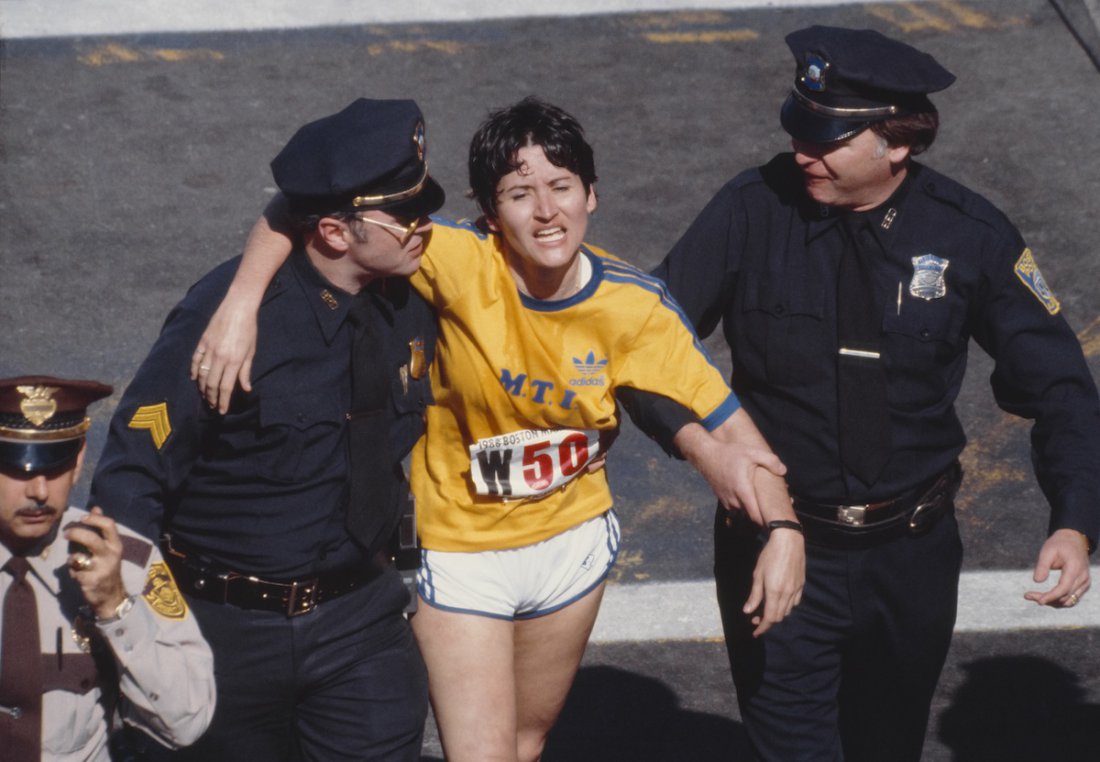
Marathon cheaters in China: shades of Rosie

The New Neo Posted on April 13, 2017 by neoApril 13, 2017

Marathon authorities in China are about to start using facial recognition techniques to foil an increasing number of cheaters:

Marathon running is booming in China, where more than 300 races were staged last year as a fitness craze sweeps the country.

But the fear of failure in the age of social media has seen some racers seek any means to ”˜achieve’ a respectable finishing time ”“ including not even taking part in the race.

Which immediately made me think of Rosie. Remember Rosie?:

On…April 21, in 1980, the 26-year-old New Yorker finished first among the marathon’s women runners in near-record time ”” just over two and a half hours…

Legendary runner Kathrine Switzer ”” the first woman ever to officially compete in the Boston Marathon ”” was instantly suspicious when she spoke to Ruiz after the race, which she was covering that day as a television commentator. Switzer asked what Ruiz’s intervals had been, per TIME; Ruiz replied, “What’s an interval?”

Oops.

More deception was revealed when New York Marathon officials looked into Ruiz’s 24th-place finish in that race and discovered that she had used a similar strategy to qualify for the Boston Marathon ”” by taking the subway instead of running most of the course. According to the New York Daily News, Ruiz explained the fact that she was wearing a marathon number by telling fellow subway riders that she had twisted her ankle and just wanted to see the end of the race.

She may not have had much training as a distance runner, but she seemed to have a great deal of practice in bending the truth. Even her application for the New York Marathon was based on a lie: An Associated Press story reveals that she submitted the form after the deadline had passed, but then got “special dispensation” by claiming she had a fatal brain tumor.

Although that article doesn’t say it, I seem to recall that Ruiz had not intended to win, just to place well (as she had in New York). But she miscalculated and won, drawing way too much attention to herself.

Posted in Baseball and sports | 8 Replies

Makeover: I don’t think she meant…

The New Neo Posted on April 12, 2017 by neoApril 12, 2017

…20 years off her life. Maybe off her face, or her age.

She also seems to have gotten a load off her mind, a weight off her chest, and a burden off her shoulders:

Posted in Fashion and beauty | 3 Replies

Predicting the behavior of the Lone Wolf

The New Neo Posted on April 12, 2017 by neoApril 12, 2017

The always-admirable Richard Fernandez has written this about the Lone Wolf terrorist:

It is a mistake to dismiss the Lone Wolves as “cowardly and depraved”. On the contrary, their tactics require a willingness to die and the intelligent use of abundant dual-use materials that is rarely if ever equaled by the political leadership of the West…

…attack [Lone Wolves] do, surprisingly yet unsurprisingly. It is Western leadership that is more deserving of criticism for turning in such a poor defensive performance despite their vast resource superiority. Obsessed with looking good, timid to the point of inactivity, determined at all costs to proclaim their own virtue, the Western elites have proved singularly incapable of combating their vastly weaker foes. The ritualistic candle-lighting, trite speeches, frightened processions and self-congratulation of the political class are completely ineffective against the laser-like menace of their foes. They haven’t noticed but the voting audience is starting to.

I agree with all of that. But in addition I would add that the West has a huge problem that’s inherent in our entire system of law and punishment. Western law is designed to balance the rights of the community—including its right to protect itself—with the rights of the individual, and we have made a conscious effort that if we must err (and being humans, we are going to err) we’d rather it be on the side of protecting the individual against government tyranny.

The prospect of predicting who will be a Lone Wolf terrorist and stopping that person in time is one that falls into that dilemma. Many Lone Wolves are citizens, born in the West, and even those who are not have certain rights if they are legal immigrants (fewer if they are illegal immigrants, but we have seen that most of these people don’t fall into that category).

Another dilemma the West faces has to do with at what point we decide an act is criminal. Ordinarily, we don’t prosecute thought-crime, and if we were to decide to do so we would have fallen pretty far down the slippery slope. Until they commit a crime, what have Lone Wolves done? Expressed a jihadi thought on Facebook, perhaps? Is that—or should that be—a crime? That’s why some jihadis are caught by using agents posing as jihadis, to be witness to the plotting of the actual crime. But Lone Wolves ordinarily have no confederates and need no confederates, so agents are less likely to be able to trap them.

And then there’s the problem of numbers. At this point, there are so many possible Lone Wolves in each Western country that monitoring them would almost certainly overwhelm the systems. How to distinguish the serious ones from the mere talkers is the question. Recent travel to a country such as Syria would be a huge clue. But you can’t lock someone up for that, you can only monitor that person more closely.

In the case of a Lone Wolf, even monitoring their communications after getting permission to do so from the proper authorities would not necessarily reveal the plotting of a crime, because Lone Wolves don’t have to coordinate with accomplices. Steal a truck, drive down a street and veer off into pedestrians, and you’ve done the deed. It’s a rather brilliant parsimony of terrorist creativity, simple and effective and capable of being executed by almost anyone should they care to do so.

Of course, one might say that so many immigrants from countries known for jihadi terrorist behavior shouldn’t have been let into the West in the first place. That is where the governments of Europe have been very slow on the uptake. But those decisions are inherently difficult, too; who is okay and who is not, and from where (as Trump found out recently with his EO and its courtroom fate so far). And many of the people involved (the parents or grandparents of today’s Lone Wolves, for example) emigrated to the West long ago. Their children and/or grandchildren are native-born citizens, or at least legal residents (European countries differ on that score).

The cat is out of the bag. Pandora’s box has been opened. The horse has left the barn. The die has been cast. Take whatever expression you want, the point is that solutions are far from easy and some of the more effective-seeming ones would compromise our entire legal system and our liberties. And even then there would be no guarantee that Lone Wolves would be caught in time.

Posted in Law, Terrorism and terrorists | 67 Replies

One thing I can say about Trump…

The New Neo Posted on April 12, 2017 by neoApril 12, 2017

…is that he’s pretty good at firing people whose performance he finds wanting.

So, is Bannon in disfavor and possibly on the way out?

I haven’t a clue. But it wouldn’t break my heart if it were to happen.

Posted in Trump | 30 Replies

Post navigation

← Previous Post
Next Post→

Your support is appreciated through a one-time or monthly Paypal donation

Please click the link recommended books and search bar for Amazon purchases through neo. I receive a commission from all such purchases.

Archives

Recent Comments

  • sdferr on Open thread 9/1/2026
  • Richard Aubrey on All the lonely people
  • Mike Plaiss on Open thread 9/1/2026
  • Hubert on “Our democracy” in Germany
  • F on Letitia James was out to get Trump

Recent Posts

  • Open thread 9/1/2026
  • Letitia James was out to get Trump
  • “Our democracy” in Germany
  • Utopias and dystopias: the twain shall meet
  • Open thread 8/31/2026

Categories

  • A mind is a difficult thing to change: my change story (17)
  • Academia (328)
  • Afghanistan (98)
  • Amazon orders (6)
  • Arts (8)
  • Baseball and sports (164)
  • Best of neo-neocon (91)
  • Biden (536)
  • Blogging and bloggers (593)
  • Dance (292)
  • Disaster (244)
  • Education (323)
  • Election 2012 (360)
  • Election 2016 (566)
  • Election 2018 (33)
  • Election 2020 (513)
  • Election 2022 (114)
  • Election 2024 (403)
  • Election 2026 (89)
  • Election 2028 (12)
  • Evil (129)
  • Fashion and beauty (324)
  • Finance and economics (1,041)
  • Food (317)
  • Friendship (48)
  • Gardening (18)
  • General information about neo (4)
  • Getting philosophical: life, love, the universe (734)
  • Health (1,160)
  • Health care reform (545)
  • Hillary Clinton (184)
  • Historical figures (337)
  • History (716)
  • Immigration (448)
  • Iran (464)
  • Iraq (227)
  • IRS scandal (71)
  • Israel/Palestine (820)
  • Jews (437)
  • Language and grammar (365)
  • Latin America (212)
  • Law (2,972)
  • Leaving the circle: political apostasy (124)
  • Liberals and conservatives; left and right (1,319)
  • Liberty (1,117)
  • Literary leftists (14)
  • Literature and writing (393)
  • Me, myself, and I (1,496)
  • Men and women; marriage and divorce and sex (929)
  • Middle East (383)
  • Military (324)
  • Movies (353)
  • Music (533)
  • Nature (261)
  • Neocons (32)
  • New England (183)
  • Obama (1,738)
  • Pacifism (16)
  • Painting, sculpture, photography (131)
  • Palin (93)
  • Paris and France2 trial (25)
  • People of interest (1,043)
  • Poetry (258)
  • Political changers (178)
  • Politics (2,793)
  • Pop culture (397)
  • Press (1,634)
  • Race and racism (881)
  • Religion (428)
  • Romney (164)
  • Ryan (16)
  • Science (639)
  • Terrorism and terrorists (971)
  • Theater and TV (266)
  • Therapy (71)
  • Trump (1,629)
  • Uncategorized (4,547)
  • Vietnam (109)
  • Violence (1,442)
  • War and Peace (1,026)

Blogroll

Ace (bold)
AmericanDigest (writer’s digest)
AmericanThinker (thought full)
Anchoress (first things first)
AnnAlthouse (more than law)
AugeanStables (historian’s task)
BelmontClub (deep thoughts)
Betsy’sPage (teach)
Bookworm (writingReader)
ChicagoBoyz (boyz will be)
DanielInVenezuela (liberty)
Dr.Helen (rights of man)
Dr.Sanity (shrink archives)
DreamsToLightening (Asher)
EdDriscoll (market liberal)
Fausta’sBlog (opinionated)
GayPatriot (self-explanatory)
HadEnoughTherapy? (yep)
HotAir (a roomful)
InstaPundit (the hub)
JawaReport (the doctor’s Rusty)
LegalInsurrection (law prof)
Maggie’sFarm (togetherness)
MelaniePhillips (formidable)
MerylYourish (centrist)
MichaelTotten (globetrotter)
MichaelYon (War Zones)
Michelle Malkin (clarion pen)
MichelleObama’sMirror (reflect)
NoPasaran! (bluntFrench)
NormanGeras (archives)
OneCosmos (Gagdad Bob)
Pamela Geller (Atlas Shrugs)
PJMedia (comprehensive)
PointOfNoReturn (exodus)
Powerline (foursight)
QandO (neolibertarian)
RedState (conservative)
RogerL.Simon (PJ guy)
SisterToldjah (she said)
Sisu (commentary plus cats)
Spengler (Goldman)
VictorDavisHanson (prof)
Vodkapundit (drinker-thinker)
Volokh (lawblog)
Zombie (alive)

Meta

  • Log in
  • Entries feed
  • Comments feed
  • WordPress.org
©2026 - The New Neo - Weaver Xtreme Theme Email
Web Analytics
↑