Actually, it’s one of the very few fossil mushrooms we have.
But all mushrooms, fossilized or otherwise, look pretty ancient to me.
Here’s the fossil:
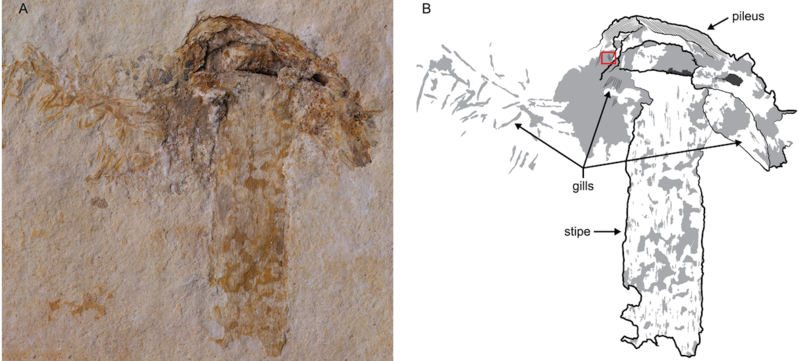

Actually, it’s one of the very few fossil mushrooms we have.
But all mushrooms, fossilized or otherwise, look pretty ancient to me.
Here’s the fossil:
Excerpt:
…[L]aw-enforcement is not supposed to subject a person to the processes of a criminal investigation absent a good faith belief that a crime may have occurred. It is abusive to interrogate people, not to uncover a reasonably suspected crime, but to create a new crime.
It is worth asking again: Why was General Flynn, the incoming national security adviser, “grilled” by FBI agents?
Department of “you would be the last person I’d tell”:
Heya! I just wanted to ask if you ever have any trouble with hackers? My last blog (wordpress) was hacked and I ended up losing months of hard work due to no back up. Do you have any methods to protect against hackers?
That bot came from a site that sells proxies for use online so that you can do stuff on your computer without anyone knowing who you are or where you originate.
Today James Comey testified before the Senate Intelligence Committee. You can see highlights here, and as well as many tweets on the subject. And you can see a large sampling of the summaries and points of view on the testimony here.
I haven’t watched, although I plan to see some excerpts. I tend not to do auditory processing very well, plus I have a very busy day with some important family matters. But I’ve certainly read recaps from both sides, and I have my own reaction.
There actually isn’t very much that’s new about the Comey testimony, because the gist of it was leaked prior to today. Of course, Comey is fleshing out the details, which will be discussed endlessly. One new fact is that Comey is backing up Trump’s assertion that he told Trump three times that he wasn’t under investigation. The press had reported this as untrue—based on its usual unimpeachable anonymous but supposedly well-informed sources—and, like so many things the press prints, that was incorrect. Trump and Comey actually more or less agree on this particular issue.
Another thing that was revealed today (IMHO) is that Comey was in an adversarial position to Trump from the start. When I say “adversarial,” I’m speaking in emotional terms, not strictly legal ones. Comey left every conversation and immediately wrote down his own recollection of what had happened, in great detail, in order to both protect himself and document the exchange.
And that documentation forms the basis for his testimony. Not only is it completely one-sided (as one might expect; after all, this is Comey telling his story), but it cannot be rebutted except in a he-said/he-said manner. This gives Comey a great deal of power to make or break a president, and everything depends on his own integrity, his freedom from bias, and his memory for a conversation in which he was not a disinterested party.
As a person who has studied human interactions and observed them based on that study, I have to say that very very few people would be capable of recording such a conversation accurately. At one point in my life I was in a situation where I worked with families and couples and each session was recorded. So I had an unusual opportunity—I was able to check out, against the actual record, my own perceptions about conversations as well as the accuracy of the recall of others about those conversations. It turns out I’m pretty good at it but certainly not perfect, and most people I saw were not particularly good at it at all.
Therefore I doubt that Comey is recreating these conversations with Trump with exact accuracy—and that’s not just him I’m talking about, that’s anyone who might be in the same position. Comey’s not a court stenographer, after all, nor is he a recording device.
Plus, Comey was “concerned” about Trump from the very start:
“And then the nature of the person [Trump]. I was honestly concerned that he might lie about the nature of our meeting, and so I thought it really important to document.”
This is what I mean by “adversarial.” Ordinarily, such an attitude doesn’t make for objective reporting, even if the person is trying very hard to be objective and even if the person honestly thinks he/she is being objective. This is a general rule of human interaction to which Comey is hardly immune. And some of the things he says that could harm Trump are in the form of Comey’s own reactions, feelings, perceptions, interpretations, and hunches, rather than “just the facts, ma’am.”
Some of it is about language, as in the case of Trump’s “honest loyalty” quote. That’s where Trump’s idiosyncratic way of expressing himself makes it unclear what he was getting at:
[Trump] then said, “I need loyalty.” I replied, “You will always get honesty from me.” He paused and then said, “That’s what I want, honest loyalty.” I paused, and then said, “You will get that from me.” As I wrote in the memo I created immediately after the dinner, it is possible we understood the phrase “honest loyalty” differently, but I decided it wouldn’t be productive to push it further. The term ”“ honest loyalty ”“ had helped end a very awkward conversation and my explanations had made clear what he should expect.
On the contrary—it could have been extremely productive to “push it further.” If Comey thought Trump’s asking for “loyalty” was a no-no, he owed it to America to “push it further.” But he did not.
I think I may know what Trump actually meant. It’s always risky to try to read someone’s mind—and Trump’s in particular—but I think Trump probably meant something like “lack of bias against me.” In other words, lack of disloyalty. That would make sense for him to wonder, in the anti-Trump atmosphere of Washington DC. Trump didn’t appoint Comey, and Trump is surrounded by previous appointees who are quite frankly against him, and I believe (without being able to prove it) that Trump sensed that Comey was suspicious of him, and wanted to be reassured that this was not the case. In that context, the term “honest loyalty” is understandable.
There’s plenty more to say about Comey’s testimony, and plenty of people have said it. You can follow the links I gave earlier, plus I would recommend this piece by Alan Dershowitz. I choose him because he’s a liberal Democrat and hardly a Trump supporter, and also a sharp guy who’s highly conversant with the law and yet does not always follow the party line. You might say that, in many instances in the past, I’ve found him to be “honestly loyal”—to the truth of the law. Here’s what he has to say about Trump and obstruction of justice:
I write this short op-ed as Comey finishes his testimony. I think it is important to put to rest the notion that there was anything criminal about the president exercising his constitutional power to fire Comey and to request ”“ “hope” ”“ that he let go the investigation of General Flynn. Just as the president would have had the constitutional power to pardon Flynn and thus end the criminal investigation of him, he certainly had the authority to request the director of the FBI to end his investigation of Flynn.
I have one more observation: Comey’s testimony is further proof that Trump’s not a lawyer, and Comey is. When I say that, I’m not just trying to be cute. What I mean is that we’ve had a lot of lawyers as presidents, including the most recent one, Obama, and a rather well-known one, Bill Clinton. Hillary would have been still another lawyer. Many Trump supporters like Trump for that very reason—he’s not a lawyer, and doesn’t talk like one. But it’s a disadvantage when he’s tussling with someone like Comey.
No, the new theme for the blog is nowhere near ready. But in response to all your comments on the previous thread on this topic, I wanted to announce that:
(1) I can’t stand nested comments either. They make a thread hard to follow, because it becomes difficult and confusing to track which are new comments and which are old. They also tend to make the discussion develop into a series of sidechats rather than a group roundtable. So, no nested comments are planned here.
(2) I’m strongly considering a drop-down menu for things like the blogroll and/or the archives.
(3) I don’t think I’ll have little photos as a regular feature. Nor will I have teasers with a “click here to continue” as a regular rule. Of course, I’ll still have photos when I think they’re appropriate, and every now and then for a very long post I’ll do what I’ve long done at times in that situation, which is to have a click-to-read-more button. But it won’t be the regular default format for posts.
At least, that’s the way I’m thinking at the moment. Any other suggestions?
The report is that there’s encouraging news on that front:
“Now I say promising, but I don’t know what it looks like legislatively ”¦ the key word is promising,” Graham said. “There better be [a vote this month], because this is not like fine wine, it does not get better with age.”
Ditto Sen. Bill Cassidy (R-La.), who has been outspoken about his concerns on the direction the party has taken, but now says he is feeling increasingly comfortable and “very encouraged” by Republicans’ plans…
At the party lunch, McConnell told his colleagues that “failure is not an option” and that the Senate has “to lead,” senators said…
“There’s a general agreement that we cannot still let a failed program stay in place,” said Sen. Thom Tillis (R-N.C.). “The key here is we have so many other things that we have to do. We’ve got tax issues to work, we’ve got infrastructure. We’ve got to continue to move forward.”
Lately the legislature has been so quiet I almost forgot they were there. Some people would consider that a feature, not a bug.
It’s hard to know what sort of bill they’re actually going to pass, if any. But it doesn’t sound like they’re considering an especially conservative solution, although it’s almost certainly more conservative than Obamacare was.
After all the Comey turmoil and brouhaha (which is not over yet), this would seem to be a fairly non-controversial pick:
President Trump on Wednesday said he intends to nominate former assistant attorney general Christopher Wray to be the next FBI director.
Wray, currently a litigation partner at King & Spalding, would replace Acting FBI Director Andrew McCabe, who took over when James Comey was fired by Trump in May…
Wray was nominated as assistant attorney general in charge of the DOJ’s criminal division in 2003 and served in that role until 2005. After he left the Justice Department, Wray returned to private practice, focusing on “white collar and internal investigations,” according to his DOJ biography.
Ah, but since nothing Trump does is considered non-controversial or conventional, is it possible this could go smoothly?
[NOTE: I haven’t read this article by Jonathan Chait, but the headline amuses me: “Trump Can Commit All the High Crimes He Wants. Republicans Aren’t Going to Impeach Him” because it is a mirror image of what the right (including me) was saying about Obama during his presidency.]
It’s a rare event in Iran. The terrorists seem to be ISIS, in a Sunni-Shi’ite struggle:
Islamic State said five of its fighters carried out the twin attacks using assault rifles, grenades, and suicide vests.
“The caliphate will not miss a chance to spill their blood,” it said, referring to Iran’s majority Shi’ite Muslim population.
A video released by its news agency Amaq included an audio track of a man saying in Arabic: “Oh God, thank you. [Gunshots]. Do you think we will leave? No! We will remain, God willing.”
Attacks are rare in Tehran and other major cities though two Sunni militant groups, Jaish al-Adl and Jundallah, have been waging a deadly insurgency, mostly in more remote areas, for almost a decade.
Iran’s Sistan and Baluchestan province, in the southeast on the borders with Pakistan and Afghanistan, is home to the Balouch minority and has long been a hotbed of Sunni insurgents fighting the Shi’ite-led republic.
Last year Iranian authorities said they had foiled a plot by Sunni militants to bomb targets in Tehran and other cities during the Muslim holy month of Ramadan.
It seems to me that both groups—the leaders of Iran and ISIS—believes that Islam should conquer the world either by force, demographics, or persuasion, or some combination of the three. But each believes that it should be the head of that Islam-dominated world.
Note that word “caliphate.” Speaking of which, Richard Landes has written an article on how the western media helps the Caliphate, a process he calls “own-goal journalism.” [Hat tip: commenter Barry Meislin.]
I’ve said before that I’ve given up on covering every little thing Trump does.
It’s wearying, and it doesn’t really affect the big picture. Then again, each incident does have some small effect, perhaps cumulative. And some of the incidents are depressing.
Such as, for example, the Trump news du jour. I’ll leave it to others to deconstruct the details—and there are plenty of articles at that link I just gave, if you care to follow it closely. But suffice to say that Trump has tweeted something about the so-called “travel ban” (currently being considered by SCOTUS for a ruling) that is designed to make his base happy, outrage and delight the opposition (“delight” because they think it will hurt his cause), and confuse and exhaust just about everyone else.
I fully expecteded the Trump presidency to be replete with incidents like this. It has been. What their ultimate effect will be I do not know. His defenders will say he’s a wily fox playing 10-dimensional chess again. His detractors will say he’s nuts, power-mad, and destructive.
The French police are armed, unlike the Brits:
French Municipal officers are armed each Municipal Police agency has different weapons meaning some Municipal Police may have revolvers while others have more modern handguns. Municipal Police also have rifles and shotguns as well for patrol needs.
So when a hammer-wielding terrorist shouting “This is for Syria” swung—and connected—with a French police officer at Notre Dame, he encountered firepower:
There were scenes of panic when two gunshots rang out at Notre-Dame, among the most visited landmarks of Paris, itself the most visited capital in the world, as hundreds of tourists were amassed outside its front entrance at around 4.30pm.
Seconds earlier, the unnamed attacker had swung his hammer at a police officer guarding the top tourist site, landing a blow. But before he could do any more damage, his colleague opened fire, hitting the assailant in the legs.
Journalist David Metreau, who said his office overlooks the square, tweeted that there were two “blasts” that sounded like shots, and posted a photo of a body lying seemingly inert on the ground.
Perhaps the terrorist was geographically confused, and thought he was in London.
[ADDENDUM: By the way, Paris has been patrolled by gun-toting officers (police or otherwise) for quite some time. Here’s a photo I took during my trip to Paris in the fall of 2006:
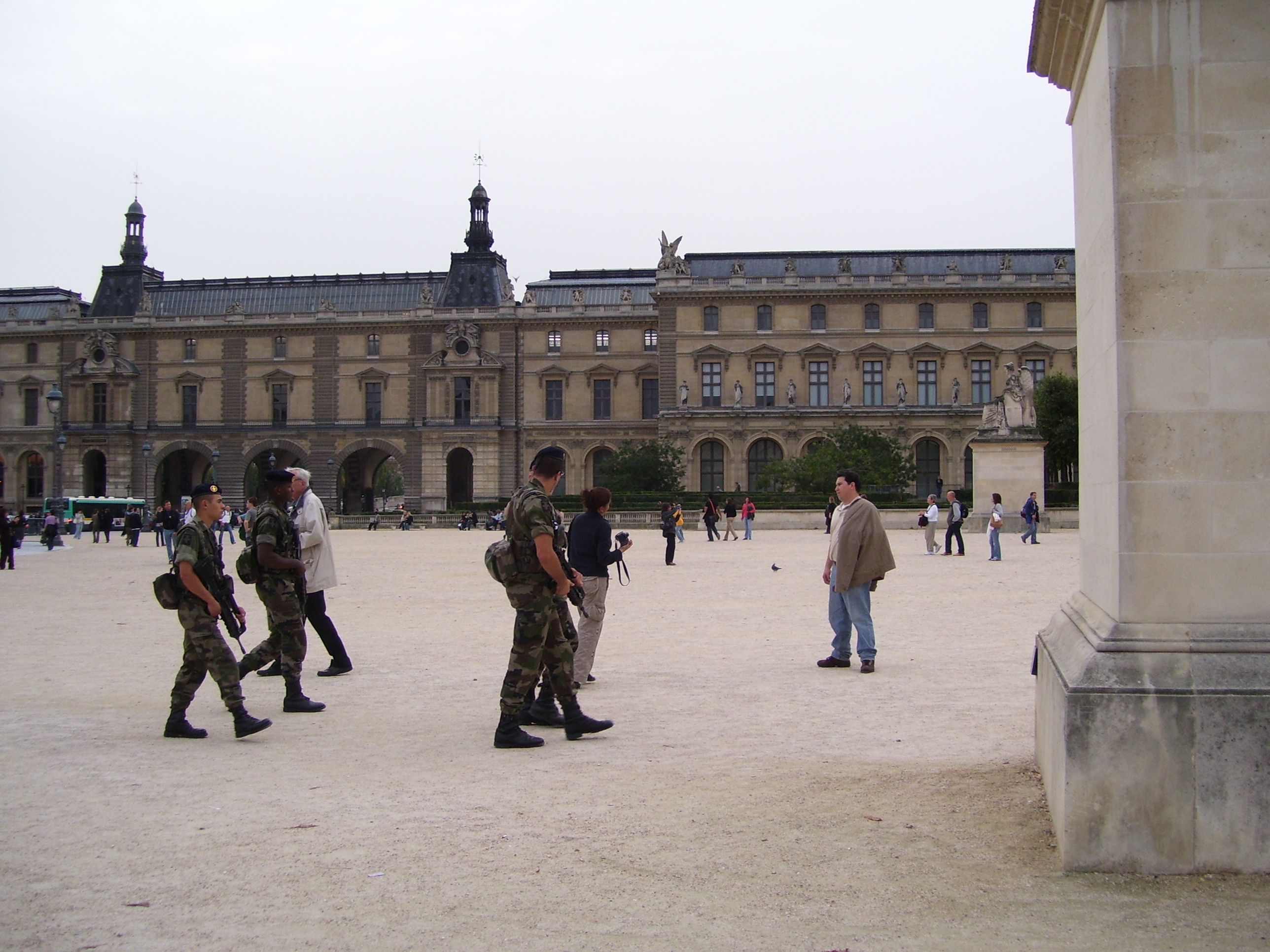
At the time I took that Paris photo, there was nothing special going on of which I was aware—no recent attacks, no particular threats. Just an ordinary day at the Louvre, if memory serves me.]
It’s long, but it’s good. Please try to ignore the things you disagree with (the guy is a “progressive,” after all) and listen closely to his descriptions of what happened at Evergreen and why.
I’m not an auditory learner and ordinarily have very little patience for long interviews, but I made it through the first hour of that one.
My first reaction is: for a ton of reasons. And even before reading this article on the subject, I thought of three reasons in particular. The first is greater lung capacity. The second is stride length, although that’s not a hard and fast rule. The third is hip configuration: wide hips make for worse runners.
You can see that latter point illustrated by the physiques of elite women runners. (I’ve written before about the athletic hip shape for women, here and here).
But if you read the article on why men excel in running, you’ll see that although hip shape and lung capacity are definitely part of the reason, there’s plenty more.
In fact, men excel in most sports. That makes perfect sense to me, and doesn’t bother me in the least. Why should it?
Even ballet—a physical and artistic endeavor in which women are generally considered the stars—acknowledges the differences between the physical skills of men and women. One of the earliest posts on this blog was about the difference:
In addition to the sheer physical thrill and the artistic satisfaction involved, partnering takes the woman back in time to an era when feminine was feminine. Now of course we have feminism, which is something else entirely.
You might say that ballet is feminist, in a way, because it gives a prominent””perhaps even a more-than-equal””role to women. You might say it’s retro, in a way, in that the role it gives tends to revolve around traditional ideas of beauty, grace, and supposed fragility masking strength.
But men and women are different, and ballet not only doesn’t ignore that difference, it celebrates it. Partnering in ballet usually involves emphasizing the difference, and as the French say (French, after all, is the language of ballet), “Vive la différence!”
Men have much greater upper-body strength, and in ballet they’re the ones who lift the women. They also have greater leg strength, which means they jump higher. Women are more flexible; their extensions (the left lifts) are higher. The line the female and male bodies create are different, even though both follow the same canons of ballet posing and movement: females more sinuous and slightly curved, males straighter and more angular. Ballet uses those differences to great advantage.