This is one of those extraordinary videos of old films, giving us a glimpse of a generation long gone:
Too bad there’s no sound.

This is one of those extraordinary videos of old films, giving us a glimpse of a generation long gone:
Too bad there’s no sound.
Even the NY Times is reporting on this (taking time off from its hobby of publishing anti-Semitic cartoons):
The conversation at a London bar in September 2016 took a strange turn when the woman sitting across from George Papadopoulos, a Trump campaign adviser, asked a direct question: Was the Trump campaign working with Russia?
The woman had set up the meeting to discuss foreign policy issues. But she was actually a government investigator posing as a research assistant, according to people familiar with the operation. The F.B.I. sent her to London as part of the counterintelligence inquiry opened that summer to better understand the Trump campaign’s links to Russia.
They’re just seeking understanding. Note the date; this was during the campaign and under Obama’s watch.
The American government’s affiliation with the woman, who said her name was Azra Turk, is one previously unreported detail of an operation that has become a political flash point in the face of accusations by President Trump and his allies that American law enforcement and intelligence officials spied on his campaign to undermine his electoral chances. Last year, he called it “Spygate.”
And he was right.
The decision to use Ms. Turk in the operation aimed at a presidential campaign official shows the level of alarm inside the F.B.I. during a frantic period when the bureau was trying to determine the scope of Russia’s attempts to disrupt the 2016 election, but could also give ammunition to Mr. Trump and his allies for their spying claims.
“Could also give ammunition to Mr. Trump and his allies for their spying claims”—Ya think? Ya think, oh ye great gray lady?
Ms. Turk went to London to help oversee the politically sensitive operation, working alongside a longtime informant, the Cambridge professor Stefan A. Halper…
A spokesman for the F.B.I. declined to comment…
[Halper’s] job was to figure out the extent of any contacts between Trump campaign advisers and Russia. Mr. Halper used his position as a respected academic to introduce himself to both Mr. Papadopoulos and Mr. Page, whom he also met with several times. He arranged a meeting with Mr. Papadopoulos in London to discuss a Mediterranean natural gas project, offering $3,000 for his time and a policy paper.
The F.B.I. also decided to send Ms. Turk to take part in the operation, people familiar with it said, and to pose as Mr. Halper’s assistant. For the F.B.I., placing such a sensitive undertaking in the hands of a trusted government investigator was essential.
British intelligence officials were also notified about the operation, the people familiar with the operation said, but it was unclear whether they provided assistance. A spokeswoman for the British government declined to comment.
Mr. Trump has repeatedly claimed that British intelligence spied on his campaign, an accusation the British government has vigorously denied.
I suppose that if a candidate really was some sort of Russian tool, it would be good to know such a thing. But, as the article quotes Bill Barr as saying:
I think spying did occur. The question is whether it was adequately predicated.
“Adequately pedicated” is legalese for there had better be a really really good reason and really really good evidence that this is going on, before resorting to such extreme and suspect methods. And there has been zero indication that was true.
I wonder whether the Times is aware that their article makes Trump look better and better—and that it makes them look worse and worse.
Case in point—this article from nearly a year ago in the Times, entitled “With ‘Spygate,’ Trump Shows How He Uses Conspiracy Theories to Erode Trust”:
Last week, President Trump promoted new, unconfirmed accusations to suit his political narrative: that a “criminal deep state” element within Mr. Obama’s government planted a spy deep inside his presidential campaign to help his rival, Hillary Clinton, win — a scheme he branded “Spygate.” It was the latest indication that a president who has for decades trafficked in conspiracy theories has brought them from the fringes of public discourse to the Oval Office.
Now that he is president, Mr. Trump’s baseless stories of secret plots by powerful interests appear to be having a distinct effect. Among critics, they have fanned fears that he is eroding public trust in institutions, undermining the idea of objective truth and sowing widespread suspicions about the government and news media that mirror his own.
Students of Mr. Trump’s life and communication style argue that the idea of conspiracies is a vital part of his strategy to avoid accountability and punch back at detractors, real or perceived, including the news media.
“He’s the blame shifter in chief,” said Gwenda Blair, a Trump biographer. “Conspiracies, by definition, are things that others do to you. You’re being duped; you’re being fooled; the world is laughing at us. It goes to this idea that you can’t believe anything that you read or see. He has sold us a whole way of accepting a narrative that has so many layers of unaccountable, unsubstantiated content that you can’t possibly peel it all back.”
The irony is so thick, with so many layers of unaccountable, unsubstantiated content in the Times, that you can’t possibly peel it all back.
Remember as you read this recent article by Andrew C. McCarthy that McCarthy worked with Mueller for many years and once deeply respected him—that is, until the last year or so.
Here’s McCarthy on Mueller’s leaked letter:
The purportedly private letter to Barr, like Mueller’s purportedly confidential report, was patently meant for public consumption, and thus leaked to the Post late yesterday. The timing is transparently strategic: the leak drops a bomb as Barr was preparing for two days of what promises to be combative congressional hearings, starting this morning; it gives maximum media exposure to Mueller’s diva routine and its Democratic chorus, while the attorney general gets minimal time to respond to asinine cries of that he should be charged with perjury, held in contempt, and – of course – impeached.
The Post’s reporters say they were permitted to “review” the letter yesterday. This phrasing implies that they were not permitted to keep a copy – i.e., no fingerprints on this leak of a close-hold document. Keep that in mind next time you read one of those hagiographies about ramrod straight Bob Mueller who never plays these Washington games, no siree…
Barr and Mueller spoke by phone the day after Mueller sent his letter. If you wade through the first 13 paragraphs of the Post’s story, you finally find the bottom line:
“When Barr pressed Mueller on whether he thought Barr’s memo to Congress was inaccurate, Mueller said he did not but felt that the media coverage of it was misinterpreting the investigation, officials said.”
So even Mueller conceded, through gritted teeth, that Barr’s letter was accurate. The diva was just worried about the media coverage.
Please read the whole thing.
I didn’t watch Barr’s testimony yesterday, but he was apparently great—but only to those predisposed to agree with him:
Mazie Hirono of Hawaii either completely trashed Barr or made a fool out of herself. Ted Cruz positively owned the Democrats. Kamala Harris, oddly, gutted Barr like a fish? I dunno. That’s what one website said…
If you only paid attention to media takeaways and social media reactions, you have no idea what happened in yesterday’s hearing. It’s almost as if, now follow me on this, but it’s almost as if nothing substantive actually happened yesterday.
Because it didn’t.
These hearings are a joke, moreso now than they’ve ever been. There is no point to these hearings because they give us no new information. Everything we know about the Mueller report, his letter to Barr, and the actual investigation into Donald Trump are things we know based solely on what’s been publicly released. We didn’t need this hearing.
So why have it? Because Congressional hearings are publicly-funded campaign ads. They give politicians a chance to show off their best material to the people who watch not to learn anything but to see someone get “owned.”
Indeed. That’s why some people refer to these things as “theater.”
I used to think—long long ago—that people could be persuaded by logic, and that when it was obvious to me that someone had the better hand in an argument, the same would be crystal clear to the majority of people listening. Ha!
You can read about it here.
Mr. Grassley said it was ironic that Mr. Trump has now been cleared of conspiracy with Russia to subvert the 2016 election, but the Clinton campaign who hired a foreign national — Mr. Steele — who relied on information that may have been planted by Russia has not faced the same scrutiny.
“That’s the definition of collusion,” Mr. Grassley said.
Mr. Barr said he doesn’t yet have conclusions, but said there is a real possibility that Russia used Mr. Steele as part of its disinformation campaign.
“That is one of the areas that I’m reviewing. I’m concerned about it, and I don’t think it’s entirely speculative,” he said.
Also see this:
During testimony on Wednesday before the Senate Judiciary Committee, Attorney General William Barr expressed his surprise that special counsel Robert Mueller did not come to a conclusion on whether or not President Trump had obstructed justice. Barr had expected a decision from Mueller, which is the norm.
Barr told the senators, “We did not understand exactly why the special counsel was not reaching a decision. We don’t conduct criminal investigations just to collect information and put it out to the public. We do so to make a decision.”
Yes, Mr. Barr, that’s how it’s usually done unless a prosecutor knows he can’t make a reasonable case against a defendant, but is interested in maintaining pressure. Particularly if the defendant is President Donald Trump, whom you hate, and you’re hoping that if the case is left open, others will pick up where you left off.
[ADDENDUM: Also see this.]
…that by claiming that Jesus was a Palestinian, she is underlining the idea that the Jews were the original inhabitants of the land now called “Palestine”? Because—and this certainly isn’t breaking news—Jesus was a Jew.
No, of course she doesn’t. Neither do her followers and admirers.
GRRRR! I am trying to decompress from dealing with some online “support” that is typical in that I suspect that, although it’s masquerading as a real live person with a real live first name, it’s actually a bot.
I sent an initial email, discussing the problem briefly and clearly, and I got a stupid boilerplate response that had little to no relation to my complaint. At the end, of course, it politely added, in the modern way of wanting feedback:
I hope you found this information helpful. Please let me know if you have any additional questions.
Best regards…
So I wrote back “No, I did NOT find the information helpful…” and then went into the problem again. This time I got a reply from a supposedly higher-up actual person who asked for some very specific additional information, which I then furnished.
Today I got a reply, which was essentially the same reply as before.
This time I responded even more clearly, with the most important points highlighted in ALL CAPS so that even a bot should be able to SEE THEM.
The modern world—the semblance of service without the actual service at all.
Have a nice day! 🙂
Russia, which often warns against anyone interfering in its “near abroad,” has no problem propping up hostile regimes in America’s back yard. “We’ll have military cooperation with whoever we want,” Maduro’s foreign minister, Jorge Arreaza, told UN reporters last week, confirming Moscow’s growing military support for his regime…
With foreigners solidifying their support for the regime, and as a political stalemate settled since January, Guaidó knew time wasn’t on his side. Sources tell me concerns that an emboldened Maduro would soon move to arrest or otherwise stop him prompted his Tuesday airbase video.
Cuba employs direct command and control over the Venezuelan military, says Stratfor’s Latin America watcher Reggie Thompson, but now units may start to switch sides. And then violence may well worsen as “security forces start to turn against each other,” Thompson warns.
Let’s face it: Venezuela was an unsustainable mess much before Tuesday. The currency is useless, food and medicine are scarce and street violence rampant. A Venezuelan friend says cartels have started distributing US currency, illegal inside the country, to ordinary citizens, so they can buy groceries. “These dollars aren’t given for nothing,” she said, indicating criminal gangs will only grow stronger.
But all that is nothing compared to what’s next. Unless either side can quickly shore up the entire military, street fighting is likely to become bloodier than ever. Heavy tanks and Russian-made air assets will come in.
And even if Maduro goes, chaos is likely to persist as Cuban-backed paramilitary gangs, known as “colectivos,” continue their violent activity.
Please read the whole thing.
Also see this:
On a day of high drama in Caracas, Secretary of State Mike Pompeo said Tuesday afternoon that Venezuela’s Nicolás Maduro was believed to have been ready to leave the country hours earlier, but had been persuaded by the Russians not to go.
“It’s been a long time since anyone has seen Maduro,” he told CNN. “They had an airplane on the tarmac. He was ready to leave this morning as we understand it. And the Russians indicated he should stay.”
Pompeo said Maduro had been intending to fly to Cuba.
Ah, but Trump is Putin’s puppet, don’t you see?
It is outrageous that so many people angry for so long about Trump’s supposed collusion with Russia (remember that?) also support Bernie Sanders, who refuses to say Maduro must go, praises socialist Latin American regimes, and spent his 1988 honeymoon on a Burlington sister city trip to the waning Soviet Union.
[NOTE: This is a repeat of a previous post.]
Today is Mayday.
As a child I was confused by the wildly differing associations the word conjures up. It’s a distress signal, for example, apparently derived from the French for “come to my aid.”
That was the first meaning of the word I ever learned, from watching the World War II movies that were so ubiquitous on TV when I was a tiny child. The pilot would yell it into the radio as the fiery plane spiraled down after being hit, or as the stalling engine coughed and sputtered. On the ship the guy in uniform would tap it out in code and repeat it (always three times in a row, as is the convention) when the torpedo hit and the ship filled with water.
But on a far more personal level, it was the time of the May Féte (boy, does that sound archaic) in my elementary school, when each class had to learn a dance and perform it in the gymnasium in front of the entire student body’s proud/bored parents. The afternoon was capped by the eighth-graders, who were assigned the only activity of the day that seemed like fun—weaving multicolored ribbons around the maypole.
Ah, the maypole. As children, who knew it was a phallic symbol? Or that maypoles were once considered so risque that they were banned in parts of England by certain Protestant groups bent on discouraging the mixed-gender dancing and drunkenness that seemed to go along with them (not in my elementary school, however; only girls were allowed to wind the maypole ribbons, and the mixed-gender dancing the rest of us had to do was decidedly devoid of frivolity)?
The other meaning of Mayday was/is the Communist festival of labor, or International Workers Day. In my youth the big bad Soviets used to have huge parades that featured their frightening weaponry. Back in the 20s and 30s the Mayday parades in New York City were fairly large. I know this because I own a curious artifact of those times—a home movie of a Mayday parade from the mid-1920s. I’m not sure who in my family had such an early and prescient interest in movies, but the film features my paternal grandparents on their way to such a celebration.
They’d come to this country from pre-revolutionary Russia in the early years of the century. Like many such immigrants, my grandfather became a Soviet supporter who thought the Communists had a chance of making things better than they’d been in the Russia he’d left behind. Since he died rather young, only a few years after the film was made in the 1920s, I don’t know whether time and further revelations of the mess the Soviet Union became would have changed his point of view. In the film, however, the family goes to view the Manhattan Mayday parade, which looks to be a very well-attended event with hopeful Communist banners held high and nary a maypole nor a Morris dancer in sight.
The footage of the parade seemed archaic even back when I saw it as a young girl, although it was fascinating to see the grandfather and grandmother I’d never known (not to mention my father as a handsome seventeen-year old). But the most puzzling sight of all was the attention paid to the Woolworth building. Whoever took the movie was fascinated by it; there were two slow pans up and down its length.
Why the Woolworth Building? Opened in 1913, it was a cool fifty-seven stories high, the tallest building in the world until 1930. It had an elaborate Gothic facade and was considered a monument to capitalism—the “Cathedral of Commerce,” although the Communist-sympathizing photographer of my Mayday movie didn’t seem to let those two offending words (cathedral, commerce) get in the way of his awe for the building.
I never noticed the Woolworth building myself until the day I visited the site of the World Trade Center a few months after 9/11. There were still huge crowds coming to pay homage, and so we had to wait in a long line that snaked around the nearby blocks.
That’s how I found myself in front of a familiar sight, the Woolworth Building, still Gothic after all these years, and still standing (although it had lost electricity and telephone service for a few weeks after 9/11, the building itself sustained no damage). No longer dwarfed by the enormous towers of its successor—that new Cathedral of Commerce, the World Trade Center—the Woolworth Building even commanded a bit of its former dominance.
Although it’s still dwarfed from this angle:
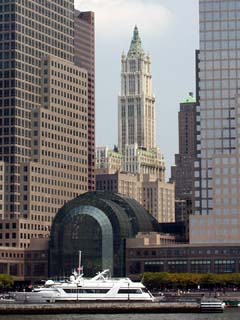
And to bring this hodgepodge of a post round full circle, there exists a book of photos of 9/11 with the title Mayday, Mayday, Mayday!: The Day the Towers Fell, a reference to the myriad distress calls phoned in by firefighters on that terrible day.
Meet Monique, the chicken that went to sea:
I said to myself, ‘If she annoys me, I can always eat her.’ It feels weird to say that now! We formed a real bond.
What the well-dressed chicken will wear in Greenland:

And there’s already a kids’ book out.
“Decline” doesn’t seem to be a strong enough word for what’s been happening in Venezuela. It’s horrendous there, and somewhat unclear at the moment. It seems an attempted coup is underway, but whether it will gain any more traction than before is unknown:
Despite images showing some military members in support of Guaidó, Venezuela’s president Nicolás Maduro said he had spoken with military leaders that showed “total loyalty.” Maduro had not been seen in public as of Tuesday afternoon and its unclear where he is located at the moment.
Guaidó, meanwhile, addressed crowds in different parts of Caracas, rallying citizens to take to the streets. “Today it is clear to us that the Armed Forces are with the people and not with the dictator,” Guaidó told a crowd in Altamira.
Historically, in situations such as this, the support of the armed forces is always key. Dictators rely on force, and if that force turns on them, they’re generally finished.
From John Bolton:
We see this now is a potentially dispositive moment in the efforts of the Venezuelan people to regain their freedom which we fully support..We think it’s still very important for key figures in the regime who have been talking to the opposition over these last three months to make good on their commitments to achieve the peaceful transfer of power from the Maduro clique to interim President Juan Guiado.
And there’s this:
MSNBC reporter Kerry Sanders unwittingly made the American case for the Second Amendment during a report Tuesday on the political upheaval in Venezuela.
Anchor Andrea Mitchell introduced Sanders for his report by commenting on the surprising ability of Venezuelan dictator Nicolás Maduro to stay in power, despite the pressure on him to step down.
“Not only hanging on but he appears to still control the military,” Sanders said. “You have to understand, in Venezuela gun ownership is not something that’s open to everybody. So if the military have the guns, they have the power and as long as Nicolás Maduro controls the military, he controls the country.”
As long as Maduro controls the military, the people have little power.
Here’s an article that goes into why economic engineering such as that of Venezuela is not going to have good outcomes:
So many people enamored with long-debunked theories had high hopes that for Venezuela — despite the enormous historical and empirical evidence to the contrary — the promise of socialism would work and would not lead to the loss of liberties or drive the once-prosperous nation into poverty. Looking back on the 20th century, we should turn to some of the most prominent thinkers who lived under similar conditions and dissected their experiences for us to learn from. Venezuela’s crisis is a good example of harsh lessons learned by one generation but forgotten by the next.
In 1944, Friedrich Hayek warned in The Road to Serfdom that tyranny inevitably results when a government exercises complete control of the economy through central planning. Over half a century later, beginning with Hugo Chávez’s revolution, Venezuela began its own road to serfdom by expropriating thousands of businesses and even entire industries. The more fortunate companies left before it was too late, while the businesses that remained were handed over to the Venezuelan military, under whose oversight they were neglected into ruins. In a typical demonstration of class warfare, the government publicly vilified these business owners as unpatriotic, greedy lackeys of American interests, claiming that Venezuela’s poverty had been a direct result of their existence.
Chavismo created an atmosphere of distrust in which no one felt safe enough to invest in Venezuela. More important, the courts were no longer the place to get redress. Since 1999, the Venezuelan judiciary had been systematically stacked with judges loyal to the executive. Twenty years after socialism took hold of the country, Venezuela has hit rock bottom on every possible development index. Today, 90 percent of Venezuelans are living below the poverty line and inflation rates exceed 1 million percent. Record numbers of children are dying from malnutrition, and nearly all of the country’s hospitals are either inoperative or in critical need of basic medical supplies. Frequent nationwide power outages have left, at times, up to 70 percent of Venezuela in darkness. Chávez’s socialist agenda purported to be in service of the entire nation, but as Hayek reminds us, “the pursuit of some of [the] most cherished ideals . . . [produces] results utterly different from those which we expected.”
Has anyone noticed whether those celebrities and politicians touting the wonders of Venezuela’s Chavez and then Maduro have commented on recent developments there?
Does it seem as though the NY Times has had special difficulties lately in terms of blows to its lofty goal of being the unassailable paper of record?
The Netanyahu/Trump anti-Semitic cartoon, and then another anti-Semitic cartoon, both of which were noticed and to which enough people objected that the Times had to make some mild mea culpas. And now this (hat tip: commenter Barry Meislin):
The New York Times, which apologized yesterday for running “anti-Semitic propaganda” against Israeli Prime Minister Benjamin Netanyahu and President Trump, issued a correction about an article alleging Jesus was Palestinian and not Jewish.
The op-ed, titled “As a Black Child in Los Angeles, I Couldn’t Understand Why Jesus Had Blue Eyes,” read: “Jesus, born in Bethlehem, was most likely a Palestinian man with dark skin.” The New York Times issued the correction one week after it ran the story and received a barrage of criticism…
It was changed to: “But Jesus, a Jew born in Bethlehem, presumably had the complexion of a Middle Eastern man.”
What is “the complexion of a Middle Eastern man”? Well, I have “the complexion of a Middle Eastern woman,” more or less, which is about the same as the complexion of a Greek or Italian woman. Big deal.
I can’t say I care about Jesus’ skin color, but some people apparently do, and if you’re interested, here’s a big discussion of what Jesus probably looked like. It concludes that he probably didn’t have blue eyes, by the way.
And have you noticed a certain theme in many of the NY Times’ recent egg-on-face moments? They all involve insults to Jews, and one also involves an insult to Christians (a twofer, as it were).
Yesterday in the comments of this blog there was a big discussion of the supposed Jewish ownership of the Times. That used to be true, but it’s not true any more. Until 2018, this guy had been in charge for over twenty years:
Sulzberger’s mother was of mostly English and Scottish origin and his father was of Jewish origin (both Ashkenazic and Sephardic). His parents divorced when he was five years old. Sulzberger was raised in his mother’s Episcopalian faith; however, he no longer observes any religion.
So not Jewish at all in the religious sense, not Jewish in the group sense (passed down through mother, not father), and half-Jewish in the genetic sense. No Jewish identity, nor did he ever have one.
Since 2018 the owner is his son:
Sulzberger was born in Washington, DC, on August 5, 1980, to Gail Gregg and Arthur Ochs Sulzberger Jr. Through his father, he is a grandson of Arthur Ochs “Punch” Sulzberger Sr., great-grandson of Arthur Hays Sulzberger, and great-great-grandson of Adolph Ochs. His paternal grandfather was Jewish, and the rest of his family is of Christian background (Episcopalian and Congregationalist).
Not. Jewish.
Why this matters I know not, but people seem quite intent on figuring it out, so I’m providing the answer.
I also can’t help but notice a trend the last few days: a lot of posts here about Jews and Jewish concerns, be it anti-Semitism or Israel or vaccines. But that’s what’s been in the air. A lot of it has to do with press coverage of Jews, and how biased it is.
But that’s nothing new, either. Yesterday I pointed out how anti-Semitic cartoons have been winning prizes in Europe for decades, for example. And groups such as CAMERA have been grinding away at the incredibly mendacious anti-Israel reporting of the Times in particular for decades, too. In fact, in 2012 they wrote a book entitled “Indicting Israel: New York Times Coverage of the Palestinian-Israeli Conflict.
The bias of the Times used to be more subtle, and harder for the naive reader to detect. The paper seems to have slipped lately—just as the Democratic Party candidates have—into showing their hand more clearly.