I came across these charts the other day, and I’ve been trying very hard to figure out certain things about them. The charts are an attempt to compare the projected need for ventilators, hospital beds, and ICU beds with the actual supplies of those things, and calculate what will be needed versus what will be available at peak (a date calculated to be April 15 – a date few of us were inordinately fond of before, and this new association is not likely to further endear it).
Here are my questions; so far I haven’t been able to find the answers – although the answers may be there; I just haven’t been able to find them at this point.
Did the modelers take into account the fact that elective surgeries have been stopped?
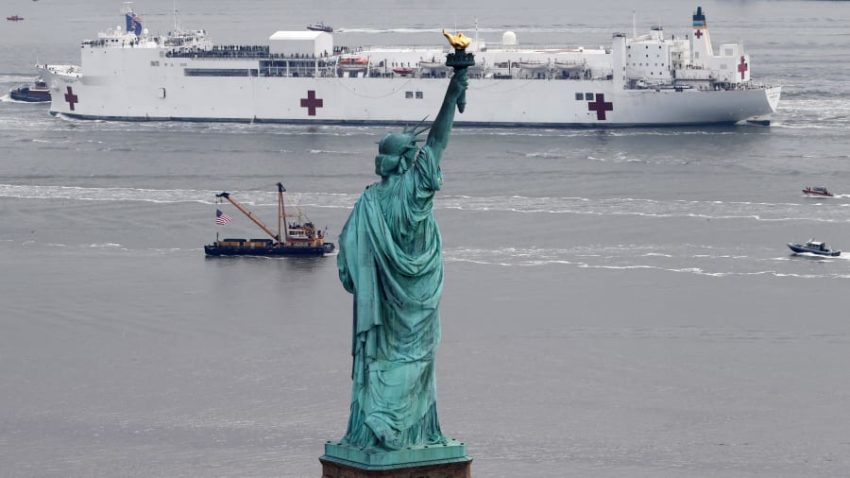
Did they take into account the tent hospitals that are being built, or the ships that are being sent to various coastal cities that need them, or the medical personnel who are being recruited (from the military, retirees, etc) by the government?
Do they assume this peak of April 15 will be reached all over the US all at once? That seems unlikely to be the case.
Also, I see (for example) that on their graph of predictions for ICU bed needs (go here and click on the “ICU beds” tab to see the chart), it says that for Mar 31 (yesterday) 21,569 ICU beds would be needed. But on the chart for the USA at Worldometers (which may or may not be accurate, although it’s what everyone seems to use) it says the number of cases in the US that are serious or critical is presently 5004, and that yesterday it was 4576. That’s a huge disparity between the model and what’s actually being reported. And I’m not at all sure that all serious cases go to the ICU rather than regular hospital beds, so the disparity may even be greater than it seems.
Now, it may well be that 4576 and 5004 are too low and perhaps way too low, since 912 people died yesterday in the US. Did about a fifth of all the ICU cases in the US die in a single day? Seems unlikely, although I have no figures on whether it’s possible I can’t really tell who’s right and who’s wrong, and how many people are actually in ICUs in the US right now.
However, let’s look at what the chart predicts for ICU beds and need. It says that at peak we will need 38,849 beds and at that point we will be 18,905 beds short. By my calculations, that means that they are saying that the most ICU beds we’ll ever have available for COVID patients would be 19,944 (that’s 18905, the shortfall at peak, subtracted from 38849, the need at peak).
But they are also saying (if I’m reading their graph correctly) that on March 31, yesterday, there was a need for 21,569 ICU beds. If that is correct and that actually was the need for ICU beds yesterday, it would mean that we’re already short about 1.5 thousand ICU beds as of yesterday. But I have read nothing about that. And in fact, most states have no problem at all right now. New York is stressed, but that’s where a huge number of all the cases are right now and even they apparently have not run out of ICU beds, although the press is loaded with predictions that they soon will (here’s just one example of the many articles like that).
And that is not the whole country; that is New York, which at the moment has something like 1/3 of all US cases and about 2/5 of the deaths so far. I’m not saying they won’t run out of ICU beds there – in fact, I would be surprised it they didn’t – but it’s the model I’m talking about at the moment, and its projections don’t even seem to fit what’s actually happening right now.
Am I doing the math wrong? I’m tired of the number crunching and checking and re-checking, so I may be getting careless and making errors. But I just can’t make head or tail of that ICU bed chart compared to reality – not that reality is easy to get figures for, either. For example, that last article I linked contains this interesting passage about New York City’s resources and needs:
Yet [NY Mayor] de Blasio has refused to publicly share how many beds or ICU beds remain available at city public and private hospitals. Instead, he has said he’ll keep updating the public about how much longer the city’s resources can last given the available beds and ventilators needed to keep the sickest patients alive.
That makes it impossible to know whether the city’s ICU bed availability has gone below 300 at any point — or whether the numbers have since been boosted and by how much.
Do they just not know? That wouldn’t surprise me. Or are they hiding something? That would not surprise me either. Are they very close to running out for real, and don’t want to further panic people? That would not surprise me. Or are they okay for now, and want to make things seem even worse than they are (as if they’re not bad enough) to keep people in line as well as get more resources from the feds? Wouldn’t surprise me either.