
I’m home!
The Biden administration’s…
…Department of Homeland Security plans to create a Minitrue:
Homeland Security Secretary Alejandro Mayorkas testified Wednesday before a House committee that the Department of Homeland Security (DHS) is creating a “Disinformation Governance Board” to combat disinformation and ‘misinformation’ ahead of the 2022 midterms.
What could possibly go wrong?
[NOTE: In case you’re not familiar with Orwell’s Minitrue, please see this.]
The story of my left eye – so far: Part III
[Part I can be found here.
Part II can be found here.]
“It’s very possible we won’t be able to remove your cataract,” the renowned cataract surgeon at Mass Eye and Ear repeated, and went on for many minutes in that same vein. This was no standard disclaimer of the type that all surgeons mention, in which unforeseen and unusual bad outcomes can happen but are highly unlikely. This was his emphasis, and he kept repeating how difficult my case was.
I felt very alone in that room. Was I hearing him right? I wished I had someone in there with me, or was at least recording what he was saying, because it was so shocking I was starting to wonder if I was perceiving it correctly. I asked him whether he could tell me my chances of success – give me some sort of percentage of likely success.
“No, I cannot possibly do that,” he answered.
This was unique in my experience. I’d had other tricky surgery consults for my back and arm injuries, and doctors had always answered that question. So I asked him again, saying that maybe he could just give me a rough idea.
He refused again. He could not and would not do it.
He barely spoke about the usual things like what kind of lens I might get implanted. It sounded to me as though he had given up before he even began. This was especially awful because I was under the distinct impression that he was someone who supposedly saw tough cases and plenty of them. If he couldn’t fix it, who could?
I felt lost and almost terrified. I had not expected this.
I asked him another question: could the synechiae (adhesions) have occurred because of my iridotomy? “Absolutely, ” he answered.
That at least seemed like the right answer to me, although it contradicted what the previous doctor had told me.
This Mass Eye surgeon added that if the cataract surgery failed, than I would need more eye surgery or perhaps several more eye surgeries of a more complex nature. But don’t worry, he would refer me to other surgeons for that, and Mass Eye had plenty of good eye surgeons.
Here we were, talking about the repair surgery for a surgery that hadn’t even happened yet.
I didn’t know what else to do, so I made an appointment for cataract surgery with him in about two months. At the very end he tried to reassure me by saying that at Mass Eye they usually were successful. After hearing for about twenty minutes how unsuccessful he expected my surgery to be, I didn’t feel the least bit confident.
I wanted to give myself a little time to think. But as time passed, the fear I had of that surgery never abated. In fact, the fear became worse as the surgery date – the first week of March – approached. I couldn’t picture letting this surgeon perform the surgery, but although I did searches for doctors specializing in complex cataract surgery, I couldn’t figure out where to go to find someone to trust. Mass Eye and Ear was supposed to set the standard for eye surgery in New England, and if they didn’t think they could fix it I felt lost and depressed and didn’t know where to turn.
I spoke to my brother and he mentioned he had an eye surgeon friend who might be willing to talk to me and give advice. She was very nice, but told me that most eye doctors didn’t see much of this condition, and that my local eye doctor who’d said he saw one or two a year was fairly typical. She’d try to find out who might be more experienced, and asked me if I was willing to travel to other parts of New England. I said I certainly was, and that I’d be more than willing to travel to New York. I probably should have said I’d be willing to travel anywhere, but I figured that New England and New York – the places she knew best – ought to have enough eye surgeons for her to be able to find one for me. But she didn’t seem to be able to find what I was looking for.
About a week before the scheduled surgery I called the Mass Eye doctor and we talked again. I had to make sure I had heard him right and that I wasn’t letting my imagination and fear run wild. He reiterated the entire message and even explained further. He said again that my case was unusual and especially difficult. My left eye hadn’t dilated at all in his office, and now instead of adhesions in about a quarter of my iris’ circumference – which had been the case six months earlier – now my lens and iris were stuck together for 180 degrees of the lens’ circumference. There also was some sort of extra membrane there.
I asked him whether I was the most difficult synechiae case he’d ever seen. He said “I won’t answer that.” Was that an answer of a sort?
And why on earth had the adhesions, which had involved about a quarter of the circumference of my eye for the previous seven years or so, suddenly doubled in size and scope in six months? I didn’t even bother to ask him that one; I was pretty sure there was no answer to be had.
At the end of the conversation, I told him that to be honest I was thinking of canceling the surgery. He said that I’d better cancel soon if I was going to cancel at all, so that they could schedule someone else for that time. I said I’d let him know within the next twenty-four hours.
You can imagine what those twenty-four hours were like. For the rest of the day and that night I felt sick to my stomach. I couldn’t see myself having the surgery with him – I really didn’t want him to go near me – but my vision in that eye was so poor and only slightly correctable with eyeglasses, and I felt I had to do something about it. But I had no idea where to go.
The tension mounted and I felt more and more ill. Talk about gut feelings! Around 1 AM, I did a search on my computer – the same one I’d done before I’d ever seen this doctor – for “synechiae and cataract surgery,” and this article popped up. I’d read it before, but that was before my appointment, when I’d still thought that Mass Eye and Ear would solve my problems and I wasn’t really looking for another doctor.
Now I read it again. The title was, “Synechiae can be managed during cataract surgery.” After having heard so much about how mine probably couldn’t be managed, I felt an immediate sense of relief on just reading that title. It was so calm and so positive. Can be managed.
And then it occurred to me to find the location of the doctor who’d written it. After all, he apparently had enough of an interest in the problem of synechiae and cataracts to have written on the topic. I discovered that his office was in Los Angeles, and that fact instantly gave me a good feeling as well. My ex-husband’s family lived there and I know LA very well. In fact, I’d had my arm surgery in LA when no one on the east coast had been willing to take a chance on me. My son had had his shoulder surgery there, and my husband his knee surgery.
The doctor’s name was Uday Devgan, and his website had hundreds of stories from satisfied patients and from other eye doctors. I realize these things can be bogus, but they were so detailed and so heartfelt that I felt buoyed up. Here’s just one example:
At 67 years of age, I had cataract surgery in Rancho Mirage, California. The surgeon botched one of my eyes, resulting in the loss of practically all eyesight in that eye. I consulted SEVEN ophthalmologists to learn the answers to three simple questions: 1) what was the problem, 2) how did it develop, and 3) what could I do about it.
NONE of these doctors could answer any of these questions, and I didn’t want to sue anyone. I just wanted to fix my eyesight. Most of the responses were shoulder shrugs, and a few were downright insulting, for example, one supposedly famous doctor said, “It’s academic at this point.”…
Finally, the last of the seven docs said, “I’m a pretty good surgeon, but I’m not good enough for your problem. If I had your problem, there is only one doctor I’d go to in Southern California. His name is Uday Devgan. Don’t let anyone else touch your eye.”
We beat a path to Dr. Devgan’s door. Low and behold, not only did he have the most and more up to date equipment than any surgeon we had visited, but within five minutes, he had answered ALL my questions. My cataract surgeon had made too large of an incision in my eye that was too close to the center, causing extreme astigmatism.
Dr. Devgan did three important things for me. First, he explained the entire problem and how he could resolve it. Second, his manner and the expertise that shined through gave me hope. And finally, after a year of healing from my botched cataract surgery, Dr. Devgan performed a PRK laser operation on my harmed eye that reshaped it and gave me 20/20 vision two months later in that eye.
I decided then and there at about 3:00 AM, that I would call Dr. Devgan’s office the next morning.
[To be continued….]
Reagan interlude
Yesterday I happened to be in the neighborhood of the Reagan Library, and so I visited it.
I’m not a fan of presidential libraries, although I’ve been to three now. I find them a bit boring, sorry to say. The Reagan Library has the advantage of being in a pleasant setting with views of the surrounding hills and low mountains, but it still seems to mostly rehash things I already know – and I’m not unusually knowledgeable about Reagan, although I’m certainly aware of the major events of his presidency (I was a young mother at the time, very busy and quite exhausted).
To me, the most interesting part of the Library – in addition to the view – was Reagan’s Air Force One. It looked colossal in a hanger-like setting, even though it’s really not all that large for an airplane. The inside was surprisingly Spartan: no beds (just some futon-like couches) and no showers. It had the unusual ability – unusual for the 1980s, that is – to be able to communicate from the air with any place on earth.

I found the experience of being at the Library to be sharply poignant and almost painful, because of the contrast between Reagan and who’s running the country today. Reagan’s idealism, his ability to express himself, and the faith he had in America seemed to be a relic of a very bygone age. Was it only forty-ish years ago that he was elected? It doesn’t seem as though forty years should have been long enough to have this country sink as far as it has, and yet that’s what’s happened. His message was faith in the possibility, or maybe even the probability, of America’s renewal, so I’ll try to believe in that.
I was so taken with certain quotes I found in the Library that I photographed a few. I hadn’t heard this one before; it’s quite early in Reagan’s career:

This one is from Thomas Jefferson:
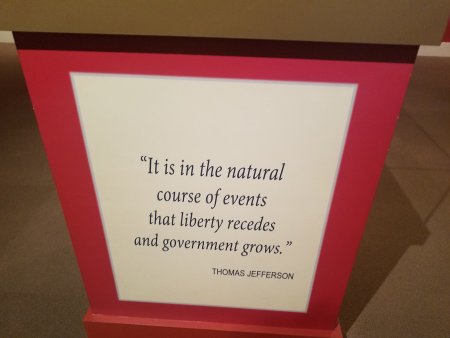
They knew.
Open thread 4/28/22
Whatever happened to the Iran Deal?
Is it possible that it’s dead in the water for now? Dare we hope?
The US is moving toward ending its efforts to return to the 2015 nuclear deal with Iran, as Tehran continues to make demands without showing a willingness to consider concessions, Israeli diplomatic sources said on Tuesday.
National Security Adviser Eyal Hulata met with his American counterpart, Jake Sullivan, in Washington this week to discuss alternative ways to stop Iran from obtaining a nuclear weapon in the event – which Jerusalem views as likely – that the Iran deal is not revived.
Multiple diplomatic sources in Jerusalem shared the assessment that the US is close to abandoning the revival of the 2015 Joint Comprehensive Plan of Action nuclear deal in light of Iran’s demand that Washington removes the Islamic Revolutionary Guard Corps from its list of Foreign Terrorist Organizations (FTO) and its refusal to take reciprocal steps.
The chances of the US and Iran returning to the JCPOA are “slim to none,” a senior diplomatic source said, adding that as time passes, the less the likelihood of sealing a deal.
If this is true – and I’m starting to think it is – what accounts for it? I don’t for a moment buy the assertion that the Biden administration really wouldn’t have removed the Islamic Revolutionary Guard Corps from its list of Foreign Terrorist Organizations, and that this was the reason for the deal’s collapse. However, I think it was an indirect cause, in that political opposition to the deal and that part of it as well as general objections to the deal – very significant Congressional bipartisan objections – were the real reason. Congress actually seemed serious about blocking the deal in any way possible, and the administration would have had egg on its face if that had happened and even Democrats supported the block.
The administration has enough egg on its face as it is, and midterms are coming up. Could be that they are waiting till after November to conclude the Deal, but it also could be that it really is over for the life of the Biden administration.
My other question is why Iran would continue to insist on that part of the deal if it really was a sticking point. After all – if leaks are true – Iran was getting so much else out of the deal that it seems to me that they could have dropped that part and still scored an enormous win. That solidifies my notion that the deal didn’t really collapse over just the terrorist part of it, and that the signal from Congress may have been that the deal itself as a whole was opposed by enough Democrats that continuing to push it would represent a big embarrassment for the administration.
NOTE: Not long ago I wrote this piece on why the deal seemed stalled. It includes information on what has been happening in Congress. There’s also been this sort of bipartisan action going on for a while.
On our changing nuclear weapon and defense policy
Here’s a fascinating article about the history of our nuclear weapons policy. It’s way outside of my field of expertise, but I think it offers much food for thought.
An excerpt:
[I]n the 1960s and ’70s, U.S. planners understood that NATO lacked the conventional forces necessary to defeat a Soviet conventional attack. But, they reasoned, the Soviets would realize that we could respond by threatening to escalate the conflict by employing tactical, theater, or even strategic nuclear weapons. Deterrence would work because we possessed an advantage at that level, which the Soviets would surely recognize.
But such optimistic assumptions began to go awry in the late 1970s. A watershed 1977 Commentary article by Richard Pipes, “Why the Soviet Union Thinks It Could Fight and Win a Nuclear War,” laid out the unpleasant truth. The Soviets had begun to deploy theater nuclear weapons and, most critically, to develop powerful counterforce strategic nuclear capabilities, such as the SS-18, that erased U.S. escalation dominance. A U.S. threat to escalate to a nuclear exchange as it was losing a conventional war in Europe now rang hollow.
Beginning in the late 1970s and into the Reagan Administration, the United States responded at the strategic, theater, and conventional nuclear level. At the strategic nuclear level, the United States deployed a whole array of new accurate delivery systems such as the land-based Minuteman III and MX intercontinental ballistic missiles (ICBMs) and the Trident submarine-launched ballistic missile (SLBM), the B2 stealth bomber, and the first components of a strategic missile defense. At the theater nuclear level, we deployed the Pershing II intermediate ballistic missile in Europe. But perhaps most importantly, at the conventional level, we responded by developing true warfighting and war-winning operational doctrines. For the U.S. Army and Air Force it was the “AirLand Battle/Operations,” and, for the naval services, the “Maritime Strategy,” designed to bring naval aviation to bear against NATO’s northern flank and in the Pacific. Some of the capabilities these concepts employed were technological, but the most important changes were doctrinal.
These developments represented a true integration of conventional and nuclear strategy and force structure. This was reflected in U.S. professional military education…
Much more at the link.
Libs of TikTok experiences the Streisand Effect
What’s the Streisand Effect?:
The Streisand effect is a phenomenon that occurs when an attempt to hide, remove, or censor information has the unintended consequence of increasing awareness of that information, often via the Internet. It is named after American singer Barbra Streisand, whose attempt to suppress the California Coastal Records Project’s photograph of her residence in Malibu, California, taken to document California coastal erosion, inadvertently drew greater attention to the photograph in 2003…
The Streisand effect is an example of psychological reactance, wherein once people are aware that some information is being kept from them, they are significantly more motivated to access and spread that information.
And so we have Libs of TikTok’s follower increase:
The Libs of TikTok Twitter account is approaching one million followers after Washington Post reporter Taylor Lorenz exposed her identity in a hit piece…
Libs of TikTok has become wildly popular for simply acting as a mirror for leftist insanity. The account shares videos, tweets and other documents of anything from liberals naming their cat after Dr. Anthony Fauci to sexual content being taught to kindergartners…
The attempt from the Washington Post to silence the account now appears to have backfired spectacularly, as Libs of TikTok has gained over 300,000 followers since the Lorenz hit piece was released. It is now just 60,000 followers short of one million.
Ron Coleman, who is giving legal counsel to the account creator, has aggressively pushed back on falsehoods spread about the account creator in the aftermath of the story. After a fake tweet falsely attributed to Libs of TikTok was circulated by left-wing influencer account, Coleman threatened legal action if it was not removed. The tweet, which falsely accused the creator of defending pedophilia, was promptly deleted by all sizable accounts who had posted it.
Twitter is of course in a state of flux now that it’s been acquired by Elon Musk. Perhaps it will improve, but I’m not counting on it. I don’t use Twitter and seldom read it; I think it’s basically pernicious and have briefly explained why in this previous post.
[NOTE: See also this.]
Open thread 4/27/22
The story of my left eye – so far: Part II
[Part I, which dealt with my iridotomies about fifteen or so years ago, can be found here.]
When I left off my story in Part I, about fifteen or so years ago, I’d recently had two iridotomies. The one in the left eye was unusually large and let in extra light, although I got fairly used to it over time. But every now and then I’ve sometimes had eye technicians or eye doctors exclaim on seeing it, “Wow, that’s an incredibly large iridotomy!”
Then about seven years ago I was told I had the faint beginnings of cataracts in both eyes. It wasn’t a problem yet, except that when I looked at the moon at night the image was somewhat doubled. Same with glowing numbers in the dark, such as on my clock-radio. Nothing much to get excited or disturbed about, though.
Then a little later, one day when I’d been to the eye doctor for my annual checkup and come home, I looked in the mirror with my eyes dilated and saw an odd thing about the pupil in my left eye: about a quarter of the pupil’s circumference hadn’t dilated along with the rest. My left pupil looked like someone had taken a noticeable bite out of the circle.
How odd, I thought. That had never happened before. But the eye doctor, who must have seen it, hadn’t mentioned it to me as a cause for concern, so I pretty much forgot about it.
Then one day about four years ago I was in a store dressing room trying on some clothes and suddenly I saw something that looked like a lightning bolt in the outer periphery of my right eye. It kept happening, particularly when I turned my head to the right, and I quickly realized I might be having an eye emergency called a retinal detachment.
My regular eye doctor had retired two years earlier and I hadn’t been to an eye doctor for those two years, but I called the office and they set me up with someone else who had impeccable academic credentials. She saw me pronto, that day, and assured me that it wasn’t a retinal detachment I was experiencing but merely something called a posterior vitreous detachment, quite common in older people and usually innocuous except for an increase in floaters and those lightening flashes for a while.
While there I was asked to read the eye chart before my eyes were dilated. With my right eye I could see as well as ever, which was pretty darn well. But when I closed my right eye and looked with only my left eye, I discovered that I could barely read the top letter on the eye chart. Everything below that first line looked like Chinese characters, and very blurry ones at that.
I was so shocked that I almost fell over. My mouth went dry and my hands went cold. What on earth had happened to me? And I was almost as shocked and upset that I hadn’t even noticed it until that moment; apparently the vision in my right eye had grown almost totally dominant over the left. I managed to tell the eye doctor that in the last two years my left eye had apparently gone from almost 20/20 vision to being almost unable to read the eye chart, and I hadn’t even realized it. Why had that happened? How had that happened? When had that happened?
The doctor didn’t seem to know and what’s more she didn’t seem to care. I asked whether it could have been from my cataract, but she was adamant that my cataract wasn’t bad enough to account for it. Then I asked her another question: what about that area of my pupil that didn’t dilate along with the rest of the pupil? What was that all about? No one had ever explained it.
“Oh, you just have some scar tissue there,” she answered. This was profoundly disturbing to me as well. Scar tissue? How on earth did I get scar tissue? “You must have had some inflammation at some point in the past,” she answered. When I asked how I could have had inflammation serious enough to cause scar tissue and not even realize it, she shrugged again. Our session was over.
I made a mental note to find an eye doctor who was more interested in these things than she seemed to be. The posterior vitreous detachment in my right eye seemed to resolve uneventfully, though, and then about a year later I found myself in another eye doctor’s office for my checkup. This time I was told that the cataract in my left eye was indeed bad enough to have caused my precipitous vision loss. But about the scar tissue no one had a clue. Must have been some inflammation, but for no seeming reason and outside of my awareness, which made no sense to me. But no one seemed to think that the scar tissue represented any particular problem.
By this time I knew I had to have cataract surgery, probably in both eyes. The vision in my right eye had become worse by this time as well, although nowhere near as bad as in my left. I thought maybe I’d have the surgery in the spring, but then COVID hit and elective surgery was out of the question. Meanwhile, both eyes got worse and couldn’t be corrected much if at all with eyeglasses. I started having more trouble driving, reading street or traffic signs, finding things in the supermarket, and even some difficulty on the computer although my near vision continued to be rather good in my left eye, which was so much worse at distance vision than my right. The only plus – if you can call it that – was that the halos around street lights were very beautiful, like enormous crystalline snowflake patterns made of hundreds of tiny diamond shapes, with each of the tiny diamond shapes having borders in the form of tiny rainbows.
Because of COVID I waited until the summer of 2021 and then went to the best cataract surgeon in my local area. He did a workup and said that sure, he’d do my cataract surgery. But my case would be more difficult than the typical one because of the scar tissue.
No eye doctor had ever mentioned this as a potential problem before; they’d all acted as though the scar tissue was a small and unimportant feature of my left eye. But this doctor was saying that the adhesions I had that were stopping the pupil in my left eye from fully dilating – adhesions which are called posterior synechiae – meant that my lens in that eye was somewhat stuck to my iris. And it’s the lens the surgeon must remove when cataract surgery is performed.
I asked him whether this scar tissue was from my iridotomy (I had looked online and read that scar tissue was more common in people who had previously had iridotomies). He said no, certainly not.
“Your cataract removal will take a little longer than usual,” he told me. “And your recovery will take longer, too.” Again, I felt an increase in fear.
I asked him whether he had seen this sort of thing in patients before. “Oh, sure,” he said. I asked him how often. “One or two times a year,” he answered.
One or two a year didn’t sound like very often to me. This condition was obviously not very common, and at that moment I resolved to go to Mass Eye and Ear in Boston, one of the most famous and highly respected eye hospitals in the country, for a second opinion and surgery there.
Unfortunately – partly because of backup from all the postponed surgery because of COVID – I had to wait six months for that appointment, which was this past January. The appointment was with a doctor there who specialized in complex cataract surgery rather than run-of-the-mill situations. I had great confidence that he would tell me that he was experienced at this sort of thing and that despite the difficulties of my case he had full confidence that my surgery would be successful.
When the day of my appointment at Mass Eye and Ear came, my workup with technician after technician was long. But I felt that at last I’d come to the right place. Then in came the doctor – actually, two of them. They examined me briefly and then spent some time softly discussing my case right in front of me, although not yet addressing me. Something in their tones made me feel uneasy, although I couldn’t understand exactly what they were saying.
Then my doctor turned to me and said, “Your case is a very difficult one and your surgery will be very hard to do. There’s a very good chance it won’t succeed.”
This was not what I had expected to hear and certainly not what I wanted to hear. I felt suddenly sick to my stomach as well as shaky.
[To be continued in Part III…]
What’s Musk got in store for Twitter?
Why care about Ukraine?
About a month ago, commenter “BrianB” had this to say. I think it represents one not uncommon point of view on the right:
On the personal and emotional level I sympathize with Ukraine. But personal emotions are how our “leaders” manipulate us and they are nothing to base a foreign policy on.
For 30 years we have had “leaders” of both parties jerking us one way then another over humanitarian and democratic appeals for why we should spend trillions and kill thousands and all it has done is spend trillions and kill thousands for no purpose other than to strengthen our “leaders” and weaken the US.
Russia is corrupt and concerned with its near abroad and is no particular threat to me. Ukraine is corrupt and is also no threat to me.
The Dems and and the GOPe and the progs and the globalists and Soros and Schwab are all mortal and immediate threats to me and America. Realpolitik is cold blooded but we have seen what sentimentality and nation building has gotten us so which school is truly cold blooded?
The question realpolitik demands is what is in our, America’s, interests; a sentimental, underdog Ukraine win or a Russian one? A Ukraine win strengthens our true enemies and will launch them on ever more meddling and nation building and adventurism. It also strengthens them politically at home. A Russian win damages the neocon/neolib/globalist project.
I believe this view is incorrect, although somewhat understandable.
As Russia takes on more territory – Ukraine in particular, with all its resources – it acquires more sources of income and more influence. Russia also has made Europe dependent on it, and that’s worrisome and has (until the recent war, anyway) greatly affected Europe’s decisions on foreign policy and trade. That and Russia’s alliances with China and other third-world countries have the goal of creating a countervailing power to the West. They’re playing for big stakes (the article is from a few weeks before the Ukraine invasion):
The two leading authoritarians of our time have declared unprecedented common cause, perhaps even a de facto security alliance, with aspirations of shaping a new world order to replace the one fashioned by the United States and its partners after World War II.
So, they publicly released the entirety of their audacious, 5,300-word joint statement in English this weekend, declaring that “a trend has emerged towards redistribution of power in the world” – namely toward them and away from the U.S. and its democratic partners and allies.
There’s a lot in the statement worth reading and digesting, but here’s my rough executive summary: Russia and China are throwing in their lot in a gesture of cooperation that exceeds even Stalin’s partnership with Mao, in each other’s regions and around the world. For the first time, Beijing has joined Moscow in opposing NATO enlargement and embracing Putin’s vision for a new European security order. Russia returned the favor by opposing the new Australia-U.S.-U.K. security agreement, endorsing its One China Policy, embracing the Russia-India-China cooperation format, and blessing its Arctic role.
In addition, there is evidence that Putin has been influenced by the work of Aleksandr Dugin, something I wrote about in this previous post. Here’s an excerpt in which I quoted this article:
Dugin gave Putin the ideology he needed to reject the tainted European strain of Soviet communism while rehabilitating it as a great patriotic people’s movement, including the rehabilitation of Stalin in his role as wartime champion against Hitler. This ideology also enabled Putin to make what is to him a coherent argument that, while the Soviet communist regime will never be restored, the Slavophilic populism that was its true lifeblood can be—a national tribalism extending to all Slavic peoples including Ukraine, Poland, and the Balkans, who must be gathered back into the Russian fold.
And here’s a description of a book on Dugin’s philosophy, written in 2014:
A new ideology—Eurasianism—is being advanced by those who dream of a new empire and revenge on the Western powers which brought about the collapse of the Soviet empire. Aleksandr Dugin, the father of Eurasianism, was recently described by Foreign Affairs as “Putin’s Brain.” For Dugin, the battle between Russia and the West is an epic struggle to fulfill ancient myths: a battle between the mystical forces of the mythical land of ‘Arctogaia’ and a decadent, materialistic America. “The American Empire should be destroyed,” Dugin declares, “And at one point, it will be.”
Russia’s performance in Ukraine so far doesn’t make achievement of this goal seem likely through military means. But it still appears to be a goal – and Russia has been more successful in undermining the US and the West through non-military strategies. BrianB expresses the idea that “A Russian win damages the neocon/neolib/globalist project,” but I disagree. Russia wants the West to be as weak as possible, and it sees that so-called “neocon/neolib/globalist project” as a mechanism further encouraging Western weakness. To that purpose, Russia has encouraged some aspects of it rather than discouraging it – but only for the West, not for Russia. There is no reason whatsoever to believe that a Russian victory in Ukraine would reduce that strategy; rather, there is every reason to believe Russia would continue it.
To take one example, Russia has been instrumental in spreading and supporting climate change and Green propaganda in the US, in particular opposition to fracking and drilling for fossil fuels in this country:
In 2014 – the same year Russia annexed Crimea – then-North Atlantic Treaty Organization (NATO) Secretary-General Anders Fogh Rasmussen warned that Russia was covertly working to undermine European and U.S. fossil fuel production.
Three years later, in 2017, Reps. Lamar Smith (R-Texas) and Randy Weber (R-Texas) sent a lengthy letter to then-Treasury Secretary Steven Mnuchin making a similar accusation. Importantly, their letter connected some of the dots highlighting Russia’s covert efforts to fund various environmental organizations that were trying to limit or end U.S. hydraulic fracturing, or fracking, for shale gas and oil…
In 2014 – the same year Russia annexed Crimea – then-North Atlantic Treaty Organization (NATO) Secretary-General Anders Fogh Rasmussen warned that Russia was covertly working to undermine European and U.S. fossil fuel production.
Three years later, in 2017, Reps. Lamar Smith (R-Texas) and Randy Weber (R-Texas) sent a lengthy letter to then-Treasury Secretary Steven Mnuchin making a similar accusation. Importantly, their letter connected some of the dots highlighting Russia’s covert efforts to fund various environmental organizations that were trying to limit or end U.S. hydraulic fracturing, or fracking, for shale gas and oil.
The media and Democrats mostly shrugged their collective shoulders at these allegations. They were far too busy trying to prove the now-discredited Russian-Trump election collusion to be bothered with a more plausible Russian-environmental activist collusion….
In hindsight, it is increasingly apparent that Putin has been preparing for his Ukrainian invasion for years. Dominating the global energy market by covertly working to limit U.S. production would have been a huge coup — in more ways than one.
So it seems to me to be a good idea to rethink that business about who a Russian win benefits and who it hurts. The Russian interest is in sowing chaos and division in the US through propaganda, and handicapping our economy (especially in the energy field but also in every respect), and I think it can count some successes there.
In addition, there is the more general principle of not looking the other way when an imperialistic country invades another country with the purpose of annexing all or part of it, such as Russia did with Ukraine. If successful, Putin would not be likely to stop at Ukraine. The only thing that will stop him from going forward into other countries is exhaustion and depletion of military resources, and that depletion can only occur if we continue to help Ukraine by supplying armaments to fight Russia. What’s more, a Russian victory in Ukraine might embolden other countries to do the same around the world. Does anyone think that wouldn’t affect the US, at least economically, and probably in many other ways?