I’ve got a busy day today–further posting is planned some time this evening.
[ADDENDUM 10:30 PM: Well, everything took much longer than I thought it would–not an unusual situation for me. So, posting will resume tomorrow.]

I’ve got a busy day today–further posting is planned some time this evening.
[ADDENDUM 10:30 PM: Well, everything took much longer than I thought it would–not an unusual situation for me. So, posting will resume tomorrow.]
In my recent post about chocolate and its supposed health benefits, reader Ben-David has this to say:
I think your [inability to eat chocolate] can be seen as a spur to creativity. So many unimaginative menus conclude with a chocolate dessert, instead of something that draws on seasonal or exotic flavors.
Yes I like chocolate. But I also like halvah and anything with sesame, and I love lemon-flavored desserts (especially after a heavy meal).
You can’t always wear a little black dress…
Well, if I kept eating chocolate and all those other wonderful desserts you mention, I probably wouldn’t ever be able to wear a little black dress. It would have to be a great big one.
But seriously, Ben-David (and this is a serious matter, this matter of chocolate deprivation), I appreciate your concern. Rest easy–I have no problem finding other desserts to enjoy.
But, you know what? I still miss chocolate–there’s something uniquely delectable about it.
I’ve thought about what that thing might be–and so have scientists. This article features a few of their theories. I do indeed love some of the very things you suggest: anything with lemon is great, fruit pastry and pies, sorbet, and I have a special fondness for caramel sauce over vanilla ice cream (although these days it’s hard to find a high quality caramel that isn’t just corn syrup and artificial flavorings). But since I’ve been off chocolate (several years now), I’ve discovered that these other sweets are somehow sweeter than chocolate. Often, they’re just too sweet, even cloying.
So I’ve concluded that chocolate’s wonderfulness lies partly in the fact that there’s something about the bitterness and depth of the chocolate taste itself that grounds the sugar in it. The taste is complex, and simply magnificent.
So, although I greatly appreciate your attempt to comfort me and expand my horizons (and my waistline), it ain’t gonna work. There’s nothing like chocolate.
When events such as the mosque bombing and the subsequent unrest and violence in Iraq happen, I turn–as I’ve done so many times before–to Iraq the Model for some inside information.
I’ve written this previous post about Iraq the Model, a tribute to its authors and the fine job they’ve done over the years since the official Iraq War ended. I’ve been reading the blog for all that time, and you know what? Omar and Mohammed, the Baghdad-based Iraqi brothers who write the blog, have never disappointed.
That’s not to say they’ve never had negative things to say–they certainly have. But, in retrospect, I can’t recall a time when they turned out to be seriously incorrect about anything important that was happening in their country. Unlike some even in our own beloved MSM, their reports and predictions on Iraq have withstood the test of time.
A few days ago, right after the bombing, Omar seemed shaken by the turn of events. Usually calm and level-headed, he displayed uncharacteristic anxiety:
As if we didn’t have enough problems already!
The quality of the target and the timing of the attack were chosen in a way that can possibly bring very serious consequences over the country….
Things look scary here in Baghdad and I hope there won’t be more updates to report as I can’t see a positive thing coming out of this.
What are the brothers saying now? They seem to have found quite a few positives, although the difficulties of the situation are far from over.
Life is coming back to normal in Baghdad and marketplaces and offices are open again after being shut for 4 days…
However, it seems there are also some positive outcomes from this incident and its aftermath; the first one in my opinion was the performance of the Iraqi army which had a good role in restoring order in many places. Actually the past few days showed that our new army is more competent than we were thinking.
But the latest events have also showed the brittle structure of the interior ministry and its forces that retreated before the march of the angry mobs (if not joined them in some cases) and I think the statements that came from the meetings of our politicians pointed this out so clearly when Sunni politicians said they wanted the army to replace the police and police commandos in their regions and this indicates growing trust between the people and the army.
The other positive side is represented by the line we’ve seen drawn between clerics and politicians.
In spite of the attempts of clerics to look like as if they were the defenders of national unity with all their meetings, joint prayers and hugs, the political leaderships got a sense of their growing danger and the meeting at Jafari’s home (which al-Hakeem didn’t attend) showed that the government is keen to keep the country intact and the government systems as functional as possible to contain the crisis. This meeting indicates that politicians have realized that those clerics whether Sunni or Shia are the origin of the problem and are ready to coup on even their political allies which made the politicians more aware of the danger imposed by clerics on the project of building a state ruled by the law.
It’s worth reading the whole thing. As I said, I’ve grown to trust the brothers’ analysis and insight more than I trust that of the media. It appears that the bombing has created an opportunity, at least. We’ll see whether the government can capitalize on that opportunity in order to form a more unified state.
Unity, in traditionally fragmented Iraq, a country cobbled together post-WWI, and with the additional legacy of decades of Saddam and his Sunni Baathists persecuting the Shi’ites and Kurds? Gateway Pundit has a roundup of stories, photos, and posts that seem to indicate there is more desire for unity among Iraq’s people than many think.
Perhaps some of this unity comes from the recent adversity that the Iraqi people have shared. There’s an old Bedouin saying that you’ve probably heard:
I against my brother I and my brother against our cousin, my brother and our cousin against the neighbors all of us against the foreigner.
The saying has been invoked many times to illustrate why Iraqis will rise up against any US occupation. But as I read Omar and Mohammed’s posts, it seems that the Iraqis may actually be in the process of becoming more united against a different foreigner (or, rather, foreigners) influencing events in their country lately: Syria and Iran.
[ADDENDUM: The NY Times is reporting that the Sunnis have returned to participate in discussions for a new government. The talk, at least, is of unity:
The Sunni negotiator, Mahmoud al-Mashhadany, said Sunni politicians now recognize the need to form a widely inclusive government as quickly as possible to succeed the current interim government, dominated by religious Shiites and Kurds.
“We’ve canceled our withdrawal from the talks,” Mr. Mashhadany said in a telephone interview. “We should hurry up and form a national unity government, to change this hopeless government. In the new government, everyone will handle responsibility.”…
But he [Mashhadany] generally struck a conciliatory tone, saying “there’s a desire to accelerate the formation of the cabinet” and adding, “This is from the leadership of all the groups ”” the Sunnis, the Shia and the Kurds.”
Doesn’t sound exactly like civil war to me. We’ll see.]
No fair, no fair!!
In the continuing and ongoing revision of health directives by medical science, today’s bulletin is that chocolate has been found to be non-hazardous to your health.
In a study conducted in–where else?–the chocolate-loving chocolate-producing Netherlands, it was found that older men who ate a third of a bar of chocolate a day had lowered blood pressure and a decreased risk of death.
You’d think this was good news–and for most people (especially older men in the Netherlands), it is. But not for me. Because, as I wrote here, I can’t eat chocolate. And that’s really sad, because I love it.
But to the rest of you: enjoy. Don’t mind me, sitting in the corner, watching you all, tears slowly rolling down my face.
And maybe it’s time to rename this dessert.
Not too long after 9/11, I read an interview with Mohammad Atta’s father in which he said his son could not possibly have committed the attack.
I would have written this off as the typical and understandable reaction of a grieving and distraught father–after all, who wouldn’t be in denial, under similar circumstances?–if it hadn’t been accompanied by a curious charge about who had done it: the Mossad. The Jews.
So preposterous did this assertion seem to me at the time that I came up with an alternate theory: Atta’s father was somewhat out of touch with reality. Whether he’d already been this way before 9/11, or whether he’d been driven off the deep end by the event, I didn’t know. But he was clearly a crackpot, with some unusual ideas.
That was then; this is now. In the years that followed I learned to consider people such as Papa Atta almost mainstream–especially in the Arab world, although also not so unusual elsewhere, including the US and certainly Western Europe. I’ve become all too aware that conspiracy theories and theorists are everywhere (lurking under the bed, no doubt).
Just Google “mohammed atta father jews 9/11,” or any similar combination of words, and a long listing will spring up of websites dedicated to the proposition that some combination of the Jews, Bush, and Israel engineered 9/11 and framed the loveable Atta Junior–and the authors of said websites have far less reason to want to exonerate Atta than his own father had. So, what’s their excuse? And, if such a proliferation of “evidence” can be proffered even in the face of the facts of 9/11, how much more easily can conspiracy theories take root to “explain” events that are less well-documented?
Conspiracies are very appealing. They appeal to simplicity (one or two linked and evil groups are responsible for the horrors and turmoil of the world, rather than many groups and a complex sequence of events that we understand only poorly). They appeal to the need to know (rather than the acknowledgement that some things are mysterious). They appeal to a sense of order (rather than chaos). They appeal to predictability (rather than the unknown). They appeal to scapegoating and displacement and denial of one’s own culpability. They appeal. They appeal. (Some of the reasons for their widespread appeal are discussed in psychological terms in Dr. Sanity’s fine essay on defense mechanisms).
And the granddaddy of all conspiracy theories, of course, is anti-Semitism (although anti-Americanism is now breathing down its neck in the “anti” sweepstakes). There is little doubt in my mind that the need to believe in conspiracies is one of the main reasons for anti-Semitism, rather than any other single factor related to Jews, who are merely a convenient target. It’s the conspiracy part of anti-Semitism that gives the phenomenon its punch and its “legs.”
But there is never any lack of targets, I’m afraid. If the Jews didn’t exist we’d have to invent them–or find somebody else to take the rap.
The need to find conspirators certainly has not let up recently, and shows no sign of doing so–au contraire. According to Big Pharaoh, our Egyptian informant, US/Israel conspiracy theories continue to be overwhelmingly dominant in the Egyptian (and, by extrapolation, perhaps much of the Arab) world in explaining the recent mosque bombing in Iraq.
And, of course, Iran has wasted no time getting into the blame act.
Here’s a BBC article on reactions around the Arab world (plus Iran) to the mosque bombing (hat tip: Roger Simon). Note the unanimity of conspiracy theories coming from Iran, and their absence in the Iraqi press.
I find it exceptionally interesting that–at least as far as their media goes–the Iraqis, the ones facing the real danger in this particular case, don’t seem to be in denial about who’s doing what. At least in the quoted excerpts, there’s no blaming of either the Jews or the Americans for the bombing (although I have little doubt there’s a contingent in Iraq who heartily blame both).
The relative strength of conspiracy theories in the Arab and Iranian world, serving to deflect blame from other Arabs/Iranians/Moslems and onto the usual suspects, protect that world from looking in the mirror and facing its own need to change, and the rot within. Because the mosque bombing is an affront to the Islamic faith as a whole, to believe that fellow-Arabs or fellow-Moslems did it is tantamount to admitting a truth that many cannot, and will not, acknowledge. To do so would be too shattering.
But conspiracy theories are hardly the sole province of the Arab/Islamic world; not by a longshot. They may indeed be more common there (I seem to recall some post-9/11 polls that indicated the vast majority of Egyptians agreed with Atta’s father about who was responsible for 9/11, for example). But one only has to tune into Coast to Coast on almost any night, or surf the web–or, of course, go to the websites of David Irving‘s rabid supporters (I refuse to show the links, but you can find them easily enough yourself) to see the universality of the theme that some group–Jews or Illuminati or Bush’s Minions or Aliens–is Behind It All, pulling the strings of the world’s puppets.
[NOTE: Jeff Goldstein’s post about evaluating the situation in Iraq mentions that one of the ways to counter the ascendance of conspiracy theories would be a much stronger effort to publicize the truth–in other words, propaganda, as I’ve defined it here.]
A companion piece to the previous essay: Paul Simon’s “Kodachrome.”
[ADDENDUM: Another companion piece, this one by blogger Ed Driscoll in TCS daily, describes some of the newest technology in recording and communicating, and how they might affect the blogosphere through videoblogging.]
The other day I happened to be catch part of the Powerball winners’ interview on TV.
I missed the beginning, so I didn’t hear all them speak. But I thought those I did hear were very impressive. There were eight winners, co-workers from a meat-processing plant in heartland flyover country, Nebraska.
Three are immigrants, two from Vietnam and one from central Africa. One of the Vietnamese immigrants said simply, when asked about his motives for emigrating, “I came here to be free.”
Several of the winners had habitually worked about seventy hours a week in the plant; no doubt, that will change (some had already quit by the time of the interview). Working in a meat packing plant for seventy hours a week sounds like a punishing job, although many spoke of liking their fellow-workers. I listened to about five of the interviews, and the winners I heard sounded remarkably relaxed–so much so that they drew gales of laughter for their humor–as well as articulate, poised, and very levelheaded, especially considering their about-to-be transformed lives.
It’s one of those stories that seems to be a combination of the human dream and the American dream, and somehow it’s not just about money. It’s about hardworking people getting lucky, and trying to keep their heads on straight. I get the impression that these particular people will do just fine; I certainly hope so.
But another thing that struck me (and which has nothing to do with the lottery) is how comfortable people have become in front of a camera. One day you’re a worker on the assembly line in a meat-packing plant, the next day you’re at a full-court-press press conference in front of America and the world? No sweat–just open up your mouth and talk.
It wasn’t always that way. When I was a kid, the older generation didn’t even feel comfortable talking on the telephone, especially long distance. Terse and tense, their conversations were the equivalent of Civil War era photos in which the people posed, stiff and rigid. Long distance calls cost a lot of money back then, not just in relative terms but in absolute terms–at least twenty-five cents a minute, and often a great deal more. So a long-distance phone call was usually just a way to hear a person’s voice; and then, over and out.
When my boyfriend went to Vietnam back in the late 60s, letters were pretty much the only means of communications, and delivery was sporadic and chancy. No e-mail of course, but even no telephones. For a year–his entire dangerous tour of duty, when he was in the thick of things–I only spoke to him once, and that was when he called me unexpectedly from Australia, where he’d gone for his R&R. Our one-hour conversation may have cost him a hundred dollars or so, to the best of my recollection (not that he much cared; what difference did it make at that point?). Expensive thought it was, it seemed nothing short of miraculous to be able to have a telephone conversation with someone halfway round the world.
Do you remember the first home telephone answering machines? There was a time when they were rare. Then they became common, but it still took a while for people to get used to them. At the beginning, I tended to freeze whenever I encountered one, nervously trying to frame my message, unaccustomed to being recorded. Now the words usually flow in a relaxed little monologue, including quips and conversational asides.
In the audio/visual realm, first there were home movies (already quite well-established in my childhood, but rare, expensive, and short). Then sound came into the picture, and then home videos. At first, people would pose for home movies as though for the still camera, especially older people–they had to be reminded to move around, that this was a move-ie– and then, later, to speak.
Then there was the first time I saw and heard myself on videotape. It was on TV, of all things, on a show entitled “It’s Academic,” a sort of College Bowl-type quiz show for New York City high school students. I was the only girl on the show that day, and I wore a red suit and heels (we used to dress up back then). I was the literature expert on my high school’s team, and I fulfilled the purpose for which I was chosen: I got all the lit questions right, although we ended up losing. And then I got to go home and watch myself a week or two later–but only once, and in black-and-white. There were no video recorders back then, so it was all ephemeral, and I didn’t really identify with the person on the screen, who seemed a stranger.
About seven years passed before I saw myself on video again. This time I was in graduate school, taking a course in interviewing techniques. Bulky and elaborate videotape equipment had been set up by the professor in a special room, and we had to team up with a partner from the class and then go to the room and interview each other while we were recorded. The video session lasted about a half hour, and my friend and I got so into our conversation that after a few minutes we forgot that the camera was running and acted fairly natural.
So for the very first time I got to see myself as others see me–at least, somewhat, although in two dimensions only. I was surprised to find I seemed a bit different that what I’d always pictured in my mind’s eye–friendlier, more relaxed, not displaying whatever tension I felt inside.
Home videos came much later. At first they were a novelty, then we all got used to them. Then they became a bore, much too much of a good thing. The cute kids–subject of most of the videos–grew up, and after that no one was all that eager to document the advance of wrinkles and sag in the parents.
But the permanent legacy of it all is that virtually everyone seems comfortable in front of a camera now. Still another legacy is that we’re much more acutely aware of the aging process. That’s a function of the ubiquity of cameras (digitals make it ever easier to take more and more photos, and to distribute them to more and more people, who seem to care less and less about seeing them).
I imagine the days when there were no cameras, and the only way to chart the process of age in oneself was through memory. Did recollection accentuate the gap–“oh, I used to be so beautiful, and now look at me”? Or did it smooth things over–“I still don’t look half bad, even though I’m older; I really haven’t changed that much”?
Either way, however, there was no need–and no way–to confront the actual evidence of what one’s younger self had looked like, as we now can do so easily through the mechanism of photos. Painted portraits were only for the few back then, and the more wealthy, and of course they lied. Photos lie also, but ordinarily much less (for example, the snapshots we’ve saved from our youth are the more flattering ones, and so the gap between past and present becomes even wider).
Our current obsession with looks and youth is partly a human constant; most societies value such things, although standards of what is beautiful may differ. But in modern life, it’s been exacerbated by all the ways we can remind ourselves of what used to be. Narcissus, after all, had only a pool of water in which to see his reflection, but still it drove him mad and led to his death. Crossing the river Styx, his shade bent down to try to glimpse its reflection in the waters. I wonder what it saw there.
I’ve written before, here, about how hard it is for me to write short posts.
But now I’ve learned that I’m in very good company. This NY Times piece on the demise of the Western Union Telegram (RIP, telegrams!) describes how Mark Twain dealt with the same problem:
Mark Twain, like most writers, found it easier to write long than short. He received this telegram from a publisher:
NEED 2-PAGE SHORT STORY TWO DAYS.
Twain replied:
NO CAN DO 2 PAGES TWO DAYS. CAN DO 30 PAGES 2 DAYS. NEED 30 DAYS TO DO 2 PAGES.
But just to prove I can write short–there. That’s it.
Yesterday’s post about the mosque bombing and the general topic of making political decisions drew forth a host of interesting comments. I gave a very brief response here, but I think a few more words are in order because the issues raised are quite important and the answers are not intuitively obvious.
First, let me say that anyone who wonders what “neocon” actually means, and why I had the temerity (or the stupidity) to name my blog thusly, should look here for a brief discussion and a good link to further information. It has become clear to me that the name “neocon” functions at times as a sort of red flag waving in front of the bulls who’ve decided–for whatever reasons–that neocons are the scourge of the world. As I put it in that linked “Why neo-neocon?” post:
Neocon” is used by critics as a code word for a lot of things, among them: imperialist, unrealistic dreamer, and scheming puppeteer (along with its subset, scheming evil Jewish puppeteer).
The comments on the thread about the mosque bombing display the three charges to a greater or lesser extent. I think, however, that the accent there was on the “unrealistic naive and stupid dreamer” part.
The question raised in the comments that especially interested me (and the one that I plan to try to answer in this post) is this:
Purely as an exercise. If 9/11 was the trigger event to “make you a neo-con”. What kind of event would make you give up this credo?
Is there an outcome in Iraq that would suffice for this event?
The questioner is probably a new reader here, and therefore may have missed my previous statements about how 9/11 was the trigger for my change only in the sense of starting a process that took several years to complete. I tried to make that clear in my “About me” section, and I took several thousand words to explain it, here. Please read them.
But suffice to say it actually wasn’t a single event that changed anything for me. And I doubt a single event would change me back.
What would? The brief and quick answer I offered last night was this one:
What would it take for me to stop believing that, as Churchill said, “Democracy is the worst form of government, except for all the others”? Perhaps nothing, short of seeing another form of government that is superior, in action. I have yet to see that. What would it take to get me to believe that someone like Saddam shouldn’t have been overthrown? Perhaps nothing, short of a demonstration that leaving him in would have been better (and I can’t quite imagine how that would be demonstrated).
If the neocon agenda were to guide foreign policy for the next couple of decades (highly unlikely, by the way), and if in that time the world erupts in an enormous conflagration of some sort, it will be clear that the neocon agenda did not prevent very very bad things from happening. I always knew that was a distinct possibility. But if I managed to survive such a conflagration, I still would never know what the alternatives might have brought–the same, worse, or better?
All I can do–all anyone can ever do–is evaluate the situation on the basis of my reading, my thoughts, and my observations. I do quite a bit of all three, and I have seen no other policy that seems as though it would have been a better way to have handled the world we have faced during the last four and a half years. I’m not talking about the details–clearly, there’s room for improvement there–but about the big picture.
I’d like to expand a bit on that answer of mine. To do so, I want to refer to another comment from the previous thread (boy, that thread is the gift that keeps on giving). This comment contains the heart of one of the main serious criticisms of the Iraq war and the hand that the neocons had in it: the writer calls the war an “elective military adventure” that “aggravat[ed]…existing problems.”
I think that the quoted commenter, and many others who would state something similar, are quite sincere in their belief that the Iraq war was elective. Part of that belief system is based on the “no WMD” argument, the one that’s been repeated ad infinitum and ad nauseum on this and other blogs, so I’m not going to rehash that part of it.
The idea that this war was elective has some possible corollaries. The first is that it was waged for dark and nefarious purposes by an evil administration (oil, racism, love of slaughter). I think these arguments have been disposed of so many times that I’m not going to address them further here; those who believe them at this point are beyond the reach of any argument I could muster. The second is the “neocons are naive fools” contention, which is the one that’s relevant to today’s topic. The idea behind this assertion is that those who started us on this “adventure” (note the word choice: they are silly boys who had no idea that war is not a scouting trip) were stupid and shortsighted, having no notion and taking no thought of possible and/or probable consequences before they blundered in to break a lot of eggs.
So, in summary, the criticism goes as follows: neocons naively and stupidly, and for no good reason, electively embarked on a war they saw as an easy (“slam dunk”) adventure. Now we all reap the consequences, including the long-suffering people of Iraq.
I’ve previously written a post that deals with the issue of whether neocons, or Bush, or Rumsfeld, actually thought the postwar reconstruction would be a “cakewalk”, here.
The short answer: they did not. The longer answer: they underestimated the problem of the aftermath, and made some mistakes in going about the reconstruction.
But this in no way invalidates the decision, in my opinion. And this is not a simple failure to admit error on my part–I think this entire blog has proven that I can admit making mistakes, and that I can change my mind. But I’ve seen no reason to do so in this case. Why? One reason is that I did not consider (and still do not consider) this war to have been elective.
Oh, it was elective in the sense that the land mass of the continental US hadn’t been invaded by an enemy force of millions of soldiers bent on our destruction. It was elective in that no country had vaporized our cities with nuclear weapons, or the like. But it was not elective in the following ways:
The evidence or lack thereof of actual WMDs aside, there was (and still is) strong and incontrovertible evidence that Saddam was planning to reconstitute his WMD program as soon as possible. And, combined with the postwar evidence of French and Russian collaboration with Saddam to lift sanctions, that “as soon as possible” would have come sooner rather than later. Nothing would have stopped it short of war, and the UN was complicit in the whole thing. Saddams’s defiance of the UN and weapons inspectors set a terrible precedent that had to be stopped, and the UN was completely uninterested in doing so.
This is not just neocon rhetoric. It is the conclusion of the Duelfer report (not a neocon document). The new Saddam tapes only solidify the idea, and the Oil for Food scandal is part of the picture. The humanitarian plusses in deposing Saddam are also clear; and, although these benefits were most assuredly not the main reason the war was waged, they are a strong side benefit.
And what of the negatives, which are very real and quite serious? The fact that this endeavor was not perfectly executed–well, that was simply inevitable, I’m afraid. I take issue with some of the decisions that were made, but that does not mean I think the whole thing should not have been attempted.
How is it that I can still say this? Well, for one thing, we have no idea whether civil war will actually occur or not; the jury is still out on that. But, for the sake of argument, let’s say it does. What then?
My answer is that it was always a possibility, a risk inherent in the toppling of Saddam. If you remove one threat it does not mean another less-than-desirable outcome will not take its place, not in the real world vs. the world of wishful thinking. And those who accuse the neocons of the latter are guilty of it themselves, I’m afraid, if they ignore the dangers inherent in all the possible choices we faced, including that of inaction.
Because the truth is that the forces leading to unrest in the Middle East are not necessarily stoppable, but the creation of a functioning democracy, if successful, would constitute a counterforce of some magnitude.
If the democracy/human rights experiment in Iraq falls into civil war and chaos, does that mean that doing nothing would have been better? Allowing Saddam to laugh at the sanctions and the UN inspections, and later to rearm himself with WMDs? Would this have been a good outcome? I don’t think so; just a different bad one.
The forces of hatred and destruction have been building up all over the Middle East and Iran for quite some time now. It is very possible they cannot be stopped; that is Wretchard’s Three Conjectures, required reading for all who might desire to understand some of the deeper reasons behind the launching of the Iraq war, and what it hoped to possibly avert.
In fact, civil war in Iraq is not an artifact of American intervention via the invasion of Iraq. It is a manifestation of forces that have been brewing for centuries and especially since the division of the Ottomon Empire after WWI. Saddam controlled and manipulated these forces in his own way, which was to orchestrate his own Sunni-dominated war against the Shi’ites, a type of civil war waged by dictator. Taking Saddam away does not create the problem; it simply changes it in a way that at least gives the Iraqi people a chance of ending up with a better result.
Because the truth is that Moslem-on-Moslem violence is hardly a new thing, or a small thing, or a US-generated thing, much as the anti-neocon faction would like to pretend it is. As Wretchard writes in Three Conjectures:
Revenge bombings between rival groups and wars between different Islamic factions are the recurring theme of history. Long before 3,000 New Yorkers died on September 11, Iraq and Iran killed 500,000 Muslims between them. The greatest threat to Muslims is radical Islam; and the greatest threat of all is a radical Islam armed with weapons of mass destruction.
And Saddam, who did not directly represent radical Islam, was more than willing to arm himself with WMDs and to use them against his own enemies, and/or to support factions of radical Islam with WMDs and use them to revenge himself against his enemies. Does anyone honestly doubt that, had Saddam re-developed his weapons program as he planned, he would have hesitated to use nuclear-armed terrorists to get back at his arch-enemy the US, or his other enemies, both internal and external?
The Iraq war always was a gamble, and it still is. But doing nothing (as well as all the other proposed alternatives) was at least as great a gamble. Perhaps greater. And I believe that those who fail to see that are the naive ones.
See an excellent roundup of differing views on the current post-mosque bombing crisis in Iraq, here.
And the latest from Iraq the Model, who’s on the scene in Baghdad.
Belmont Club writes:
The good news is that there are enough cools heads on both sides to try to keep the lid on. That fact alone attests to the accomplishment of those who have tried to build a unitary Iraq. The bad news is that the pressures — stoked by parties unknown, though Iraq the Model suggests they are “foreign terror groups” — may be too much to handle.
Bottom line–no one really has a clue, or too much more than a clue.
The doom-and-gloomers who cried “civil war” at the very outset of any discord in Iraq are now practically salivating with glee (I’m sorry, but that’s how I see it) at being able to say–like the hypochondriac who wrote “I told you so!” on his tombstone–“See, civil war! Here it is, at last!”
As for me, I cannot see the future. But my experience of the past tells me that neither extreme pessimism nor extreme optimism is warranted right now. I know that the goal of those who have done this is to spark a civil war, and I know that the goal of those who hate President Bush and the entire Iraqi war is to have it sparked, and to be able to say “We told you so.”
Is my motivation for wanting things to turn out well to be able to say, myself, “I told you so?” I certainly don’t think it is. I want things to turn out well for the sake of–well, for the sake of things turning out well for the Iraqi people, the US, and the world.
But I never was naive enough to believe this would be at all easy, or that it was necessarily going to turn out well, or that it was a “slam dunk.” And the kneejerk characterization of the neocon endeavor as being composed of people who think that way–that bringing democracy plus human rights to the Arab world, or any part of the world that doesn’t already have that tradition–will be easy is, I think, mischaracterizing the movement.
I’ve already written a long post on the whole meme that neocons thought the Iraq war would be a “cakewalk,” which I think is a misrepresentation of the basic neocon position. The
post is here for anyone who wants to review it; I see no need for me to rewrite it.
I would summarize my position as follows: all alternatives in these situations (prewar Iraq, for example) are fraught with danger and possible chaos. But we must nevertheless choose the course that looks best given all the knowledge we have at the time, knowing that it might lead to failure. That’s the risk one must take.
In fact, it’s impossible not to take a risk. Because don’t think you can avoid making a decision by simply choosing to do nothing. That has consequences, too, although they are easier to deny. And, since we don’t have a variety of worlds in which we can try out all the different actions as a sort of scientific experiment, we have to make all decisions with very imperfect knowledge, making it up as we go along, never quite knowing whether we were correct or not–even ex post facto.
That’s history (and life) as it’s lived, I’m afraid. Which is not to say that we shouldn’t try to evaluate decisions, of course. We must, in order to try to learn to make better ones. I think we can now safely say, for example, that securing the Iraqi borders very early on would have been a very good thing to do–if indeed a way could have been found to do so. But I certainly don’t think we can rightly say that the war itself was an error, looking at the situation as a whole so far–although, of course, some say it, will say it, and have been saying it from the moment the very first difficulties began.
I wrote a previous post on this subject of evaluating decisions that affect history. It was based on the writing of one of my favorite authors, Milan Kundera. I’ll repeat some of his words here:
Several days later, [Tomas] was struck by another thought, which I record here as an addendum to the preceding chapter: Somewhere out in space there was a planet where all people would be born again. They would be fully aware of the life they had spent on earth and of all the experience they had amassed here.
And perhaps there was still another planet, where we would all be born a third time with the experience of our first two lives,
And perhaps there were yet more and more planets, where mankind would be born one degree (one life) more mature.
That was Tomas’s version of eternal return.
Of course we are here on earth (planet number one, the planet of inexperience) can only fabricate vague fantasies of what will happen to man on those other planets. Will he be wiser? Is maturity within man’s power? Can he attain it through repetition?
Only from the perspective of such a utopia is it possible to use the concepts of pessimism and optimism with full justification: an optimist is someone who thinks that on planet number five the history of mankind will be less bloody. A pessimist is one who thinks otherwise.
And this is what Kundera (a Czech) wrote about the history of his people:
There is only one history of the Czechs. One day it will come to an end, as surely as Tomas’s life, never to be repeated.
In 1618, the Czech estates took courage and vented their ire on the emperor reigning in Vienna by pitching two of his high officials out of a window in the Prague Castle. Their defiance led to the Thirty Years War, which in turn led to the almost complete destruction of the Czech nation. Should the Czechs have shown more caution than courage? The answer may seem simple; it is not.
Three hundred and twenty years later, after the Munich Conference of 1938, the entire world decided to sacrifice the Czech’s country to Hitler. Should the Czechs have tried to stand up to a power eight times their size? In contrast to 1618, they opted for caution. Their capitulation led to the Second World War, which in turn led to the forfeit of their nation’s freedom for many decades or even centuries. What should they have done?
If Czech history could be repeated, we should of course find it desirable to check the other possibility each time and compare the results. Without such an experiment, all considerations of this kind remain a game of hypotheses…
The history of the Czechs will not be repeated, nor will the history of all of Europe. The history of the Czechs and of Europe are a pair of sketches from the pen of mankind’s fateful inexperience.
“Mankind’s fateful inexperience” is always operating on this, the planet of inexperience.
And so the inexperienced pundits pronounce, predict, and pontificate–while the caravan moves on.
[NOTE: I’m not sure why this post has so much blank space in it. It has something to do with the text I copied to display the results. I can’t seem to fix it, so just scroll down a bit.]
I got this from Callimachus. I’m not usually all that great on geography, but maybe blogging and reading so much in order to blog has helped (or maybe the test isn’t that all-fired difficult after all).
At any rate, I’m not as good as Mr.-Done-With-Mirrors-Smarty-Pants. But I did pretty well.
|
Geography Genius
You scored 91% knowledge, and 0% confusion |
| Excellent! This is the highest score. You are very knowledgeable about the world. You didn’t answer any (or many) of the questions with seriously incorrect answers. Great work. You are now ready to write your own Geography Knowledge test. Don’t forget to vote on this test! |

|
|
Test is found here. |
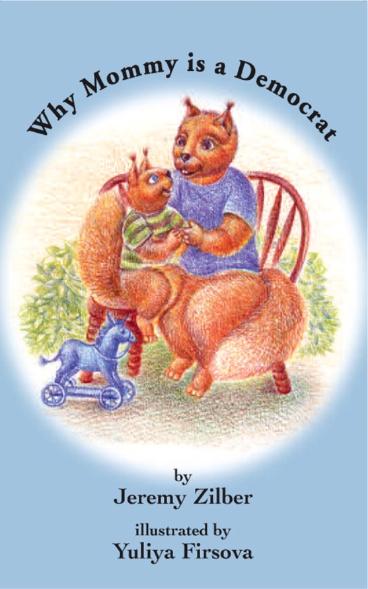
Gerard Van der Leun has called our attention to a children’s book that has to be seen to be believed. Actually, scratch that; this book cannot be believed, even after being seen.
Take a look. Take a long look. Then come back and agree with me that Why Mommy Is a Democrat simply must be parody; it is so perfectly simpleminded that it could be nothing else. Spawn of the Onion, perhaps, or Mad magazine–something, anything but an actual serious effort at writing a children’s book.
After giving the post at American Digest some serious in-depth study, and Googling around (including a visit to the book’s website), I can only conclude that Why Mommy Is a Democrat is on the up and up after all, as serious as serious can be.
In the book, the words “Democrat” and “good person” seem to be used synonymously and interchangeably, and the illustrations–oh! the illustrations!–featuring what I can only conclude are meant to be squirrels (although they look more like antennaed aliens to me)–are quite stupendously hideous in a sentimental and strangely retro Dick-and-Jane-y way.
I can’t quite fathom having the concept of writing such a book in the first place, the need to explain the ordinary everyday political affiliation of a parent to a very young child. I just don’t think it’s an issue that’s uppermost in a child’s mind, or even something about which a child would care at all. But I suppose that, even though this is a children’s book, it’s really wasn’t written with the child in mind.
And it turns out the book is not alone. Research is my thing, and careful research has turned up a host of similar items, children’s books about Mommy and politics. So I now present them for your edification (by the way, all these books are quite real, although my interpretations of them might be just a tad suspect):
Sometimes My Mommy Gets Angry: this one’s easy; Mommy must be an evil Republican.
Mommy Hugs: here Mommy’s clearly a loving Democrat–although that elephant illustration on the cover must be in error; the characters should be donkeys.
Mommy CEO: 5 Golden Rules: obviously a Republican again, and a dirty capitalist to boot.
Mommy Diagnostics: The Naturally Healthy Family’s Guide to Herbs and Whole Foods for Health: a Democrat, what else? Lives in northern California, perhaps Marin county.
Mommy Knows Worst: Highlights from the Golden Age of Bad Parenting Advice: not only Republican all the way, but note the nefarious author: blogger James Lileks! Need I say more?
Mommy and Daddy Are Fighting: we obviously have a mixed marriage here: a Democrat has married a Republican (was this book by any chance written by the offspring of James Carville and Mary Matalin?)
Mommy is Missing: apolitical and unaffiliated, Mommy probably doesn’t even bother to vote; she’s a shirker
I Saw Mommy Kicking Santa Claus : The Ultimate Holiday Survival Guide: Mommy is a liberal/leftist secular Democrat who is gamely fighting all the trappings of Christmas
Mommy You’re My Hero: a military Mommy, more likely than not a Republican, although she certainly could be a Democrat instead
Mommy Poisoned Our House Guest: can there be any doubt? Mommy’s a Republican all the way.
The DIY Guide to Mommy Sanity: clearly, this is about our very own Republican Dr. Sanity
Mommy Under Cover: CIA Mommy.
Dear Mommy and Daddy When I Grow Up I Don’t Want To Be BROKE: written by the budding Republican child of Democrat parents, an ungrateful turncoat
Mommy And The Policeman Next Door: don’t ask, don’t tell; you don’t want to know
And, by the way, my mommy really was a Democrat. Still is, actually.
All kidding aside, children are nearly always indoctrinated by their parents in their initial political affiliation, and most of the time this affiliation lasts for life. In fact, one of the very first posts in my “A mind is a difficult thing to change” series talks about that at great length, here. But Why Mommy Is a Democrat is an unusually overt–not to say heavy-handed and preposterous–example of politicizing directed towards children.
Somehow, it reminds me ever so slightly of this:
“Elementary Class Consciousness, did you say? Let’s have it repeated a little louder by the trumpet.”
At the end of the room a loud speaker projected from the wall. The Director walked up to it and pressed a switch.
“”¦ all wear green,” said a soft but very distinct voice, beginning in the middle of a sentence, “and Delta Children wear khaki. Oh no, I don’t want to play with Delta children. And Epsilons are still worse. They’re too stupid to be able to read or write. Besides they wear black, which is such a beastly colour. I’m so glad I’m a Beta.”
There was a pause; then the voice began again.
“Alpha children wear grey They work much harder than we do, because they’re so frightfully clever. I’m really awfuly glad I’m a Beta, because I don’t work so hard. And then we are much better than the Gammas and Deltas. Gammas are stupid. They all wear green, and Delta children wear khaki. Oh no, I don’t want to play with Delta children. And Epsilons are still worse. They’re too stupid to be able ”¦”
The Director pushed back the switch. The voice was silent. Only its thin ghost continued to mutter from beneath the eighty pillows.