[Part I can be found here.]
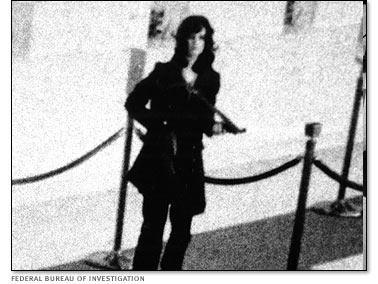
About a month after being photographed with a gun at the Hibernia bank robbery and then coming out as the chic revolutionary “Tania,” Patty Hearst participated in still another crime. This time she covered for shoplifting SLA members Bill and Emily Harris at a sporting goods store, spraying gunfire from a car outside, allowing them to escape as Patty screamed obscenities. Witnesses said her cooperation was full and she did not seem to be coerced—and, in fact, there were indeed moments when the Harrises were in the store committing the robbery that Patty was alone in the car and had an opportunity to escape, an opportunity she did not take. It seemed that her conversion was for real.
The next day, the majority of the members of the SLA died in a shootout and fire in Los Angeles. It was thought at the time that Patty was among them. But forensic evidence proved otherwise; she had not been there, and was now on the lam.
Another tape—which I believe proved to be her last—was issued, in which she said:
I died in the fire on 54th Street, but out of the ashes I was reborn. I know what I have to do.
A little over a year later an emaciated Patty Hearst was taken into custody, and a few months after that she was put on trial and found guilty despite—or perhaps because of?—her defense by celebrity attorney F. Lee Bailey:
What really hurt her case, in Patty’s estimation, was Bailey’s closing argument. As he grabbed his notes, she could see that his hands were shaking and his face was flushed. She had the impression that he’d been drinking. His comments to the jury were rambling and irrelevant. Then he knocked a glass of water off the podium and the water hit his crotch. For the rest of his closing, it appeared that he’d wet his pants. Later Patty was to write about how jury members giggled: “It was, to say the least, distracting.” To make matters worse, he had flown each evening to Las Vegas to conduct a seminar, and had then flown back for the trial. It was the feeling of many that Bailey’s inability to make a forceful statement, whether he was exhausted or inebriated, decided Patty’s fate.
There were other irregularities in the trial, in which Patty was sentenced to twenty-five years (later shortened to seven). The brainwashing defense was poorly presented and poorly understood, and most of America didn’t buy it.
But brainwashing is by far the best explanation of Patty’s behavior, despite the verdict. Here are some of the many ways in which Patty’s treatment by the SLA greatly resembled brainwashing (from a Saturday Evening Post article around the time of the trial; the events in parentheses represent what actually happened to Patty):
1. Confinement under inhuman conditions to lower resistance (such as being kept blindfolded in a closet for 57 days).
2. The insistence on confession of past misdeeds (such as being raised in a privileged family).
3. Manipulating confessions into the context of the ideology (Patty had it all while many people are starving). The confession becomes self-criticism.
4. Telling the person that his former society had turned against him (Patty was told that her parents would not meet the ransom demands).
5. “Undeserved” liberties are granted commensurate with the person’s conversion, which makes the person grateful to his captors. (She denounced her family on tape.)
6. The person’s weakened physical state and feeling of shame and inferiority merge into a bond with the captor. (Patty joined the SLA in their criminal activities.)
7. Captors prove their sincerity by using the same tactics on their fellow prisoners. (Patty took part in a bank robbery and helped two members elude arrest.)
8. Even upon returning to society, the person will experience confusion and doubt. (She exhibited this behavior.)}…In addition, Patty had some clear disadvantages. She had no training in these tactics, she was young and vulnerable, she’d been protected most of her life, and she lived among college students who articulated anti-establishment values. There’s no reason to doubt that she had been under duress sufficiently traumatic and manipulative to produce the shocking behavior for which she was on trial.
The list leaves out another important method of humiliation and manipulation used on Patty after her kidnapping: she was repeatedly sexually abused by her captors.
Patty’s sentence was commuted by President Carter after she had served twenty-one months (and President Clinton later pardoned her). Shortly after leaving prison, she married her bodyguard and went on to live a rather conservative—and security-conscious—life as wife and mother in Connecticut, as well performing as sometime actress in a few small movie roles.
Patty—now Patricia—also authored a book about her case. Those who believed her to be guilty thought it a self-serving apologia, but those more inclined to believe the brainwashing theory (such as me) found it mostly convincing and coherent. Among other interesting points I recall from her book was the fact that, early on, she knew she was guilty of bank robbery from the initial Hibernia heist, which was documented by camera. So had she tried to turn herself in at any later time, she was convinced that her innocence would not have been believed, but that she would have been convicted of the crime. Still later, when the fatal fireshoot and fire occurred, she realized that the police in fact had not been interested in protecting her, since they had assumed she had been in the house that had burned. She was not only fully brainwashed by then, but she felt that there was no turning back even if she had wanted to; if she did, she would most likely be found guilty and imprisoned. And later events certainly supported that perception.
There are some similarities and also huge differences between the Hearst case and that of Jill Carroll. Carroll is a young woman, but she’s a good deal older than Hearst was at the time. But, more importantly, Carroll’s situation seems to represent a case of simple coercion by political kidnappers who threatened her in order to make a political point, and to create a set of videos that could be successfully used as propaganda. Hearst’s kidnappers were far more ambitious in their aims: theirs was a purposeful, systematic, and remarkably successful program to brainwash Patty Hearst and to use her both as propaganda and as an actual accomplice in their cause.
These days Patricia Hearst Shaw seems both straightforward and insightful in interviews that describe both her particular state of mind long ago and the general attitudes and experiences of victims of brainwashing. As such, she still has important things to tell us.
Here is Patricia describing her mental and emotional changes during that first tumultuous year after the kidnapping (from a 2002 Larry King interview):
KING: A brain-washed person doesn’t know from time element when they’re being brainwashed, do they? They don’t wake up one day and say, I have been brainwashed?
HEARST: No. No, they don’t. They — I know for me, I thought that I was kind of fooling them for awhile, and the point when I knew that I was completely gone, I’m quite convinced, was at the Mel Sporting Goods Store when I reflectively did exactly what I had been trained to do that day instead of what any sensible person would have done or person still in control of their senses and their responses, which would be the minute the Harrises had left the van to have just run off and called the police.
At that point, you know, looking back, I can say that I was gone. I was so far gone I had no clue how bad it was.
Patty is well aware that many still think she’s guilty, and that her brainwashing claim is a transparent excuse. And she thinks she understands why they might feel that way:
CALLER: Hey, Ms. Hearst, I would like to know, have you ever felt guilty being a part of the SLA and how do you handle the fact that so many others think you are just as guilty?
HEARST: You know, when I first was arrested and first going through the therapy with the psychiatrist because I did feel really horrible. And I — it was the kind of guilt that was — a lot of it stemmed from feeling so horrible that my mind could be controlled by anybody, that I was so fragile that this could happen to me.
And because really we all think we’re pretty strong and that nobody can make us do something if we don’t want to do it. That’s true until somebody locks you up in a closet and tortures you and finally makes you so weak that you completely break and will do anything they say. And there was the feeling of guilt and self- loathing and despair and pain that was just overwhelming.
And in terms of people still thinking that I’m guilty, you know, the government spent an awful lot of time trying to convince people of that. So how can I blame them?…
Jill Carroll’s case is not the only recent one that has brought Patty Hearst to some people’s minds. In the same interview with Larry King, Patricia Hearst Shaw was asked to compare her case to that of the American Taliban, John Walker, who some saw as resembling her. She herself saw a different resemblance:
KING: Do you have some sympathy for John Walker?
HEARST: I had to think for a second. The…
KING: The American Taliban.
HEARST: OK, well, frankly, I mean, I think you have another case of someone who went looking for trouble, who politicized themselves, wasn’t finding enough trouble where they were and went looking for it. I have heard people say it reminds me of the Patty Hearst case and I think it reminds me of my kidnappers. That’s what it reminds me of.
And here is a portion of the interview that has some relevance to Jill Carroll’s (coerced) remarks about how she had been treated while a captive:
KING: Were any of these people [the SLA], to you, likable?
HEARST: You know, yes, sure. It gets to degrees of who’s likable when you’re with people who are causing mayhem and placing bombs and doing robberies. There are always some people that are more likable than others. It’s hard to say. You know how when people have been held hostage, one of the first questions they get asked is, how were you treated? And the answer is almost always I was treated, you know, pretty well. And by that, they usually mean they weren’t killed.
Patricia Hearst Shaw seems remarkably stable today, and exhibits rare insight and perspective into the state of mind of the brainwashed kidnap victim, although some reject that explanation of her acts even to this day. I think it’s quite clear, however, that she didn’t choose that unconventional and horrific period of her life; it was thrust upon her, and she appears to have ultimately adapted rather well to her re-entry to “normal” existence—although her life would never again be really normal.
My guess is that her husband (and former bodyguard) represents a figure of great stability and support to her, a person who bridges her former trauma and her present calm. It’s no accident she married her bodyguard, I would guess; he may have represented the one person able to protect her.
Because, when one actually thinks about it, no one else who should have protected her was able to do so: not her parents, not her boyfriend at the time, not the police, not the court system, not the expert witnesses, and not her lawyer (the best money could buy). In the end, she had to learn the hard lessons herself—and one of those lessons was that many will never forgive her for what she did. But I think she’s at peace even with that.