
Estrich finds out the hard way…
…what it means to question anything about the Obama campaign.
Obama’s paper trail in Illinois
For many years Obama has carefully cultivated his history to assure that he remains a blank screen on which people can project whatever they want to see. For example, he is unique in being a Harvard Law Review President and later a University of Chicago law professor whose published works number exactly zero (see this and this). His record in the US Senate is so scant as to be nearly nonexistent.
But Stanley Kurtz has done some fine work for the Weekly Standard, delving into what he calls Obama’s “lost years”—the job he held the longest of any in his life so far, Illinois State Senator. Kurtz unearths a surprising amount of information that belies Obama’s new post-racial, nonliberal incarnation. Continue reading →
Stop me before I change my mind!

Here’s another story of political change (second part here).
It’s of interest to me not only because writer/changer Lissa cites me as inspiration, but because of the description of her reaction when she first realized she was going in the direction of Left-to-Right political change:
At this point I was severely uncomfortable. As I’ve mentioned before and can’t emphasize enough, my family is very left-leaning. (As I’ve also mentioned before, they are also intelligent, loving and caring, so think twice if you’re planning on dissing them in the comments.) What if, God forbid, I became a conservative? That would be unconscionable. I’d gotten into enough passionate arguments over whether the United States had the *right* to invade Iraq; I could only imagine the difficulty it would create if I started advocating gun rights and the like.
I sent out a cry for help. I emailed my liberal, politics-following friends (good, intelligent people all) and asked for assistance. I explained that I was starting to lean toward the conservative side and asked for blogs, articles, arguments ”” anything that would help keep me firmly in the liberal camp. I received back a few variations of “Bush is an idiot” and “Bush is a horse’s ass.”
Lissa was asking for the equivalent of an intervention to “save” her. Continue reading →
You can’t make this stuff up
The Onion could. But it doesn’t need to. Obama obliges by saying it himself. The subject matter is his recent trip abroad:
I was puzzled by this notion that somehow what we were doing was in any way different from what Sen. McCain or a lot of presidential candidates have done in the past,” Obama said Sunday, speaking about his trip at a conference of minority journalists. “Now, I admit we did it really well. But that shouldn’t be a strike against me.”
The man is tone deaf. In the first sentence, he doesn’t get the difference between a rock star tour and a fact-finding trip. In the second, he doesn’t understand how arrogant he sounds. And in the third, he whines.
Who ever said…
…Obama’s not consistent? He certainly has been on this issue.
Let’s see if I’ve got this right
The Obama “dollar bill” remark wasn’t about race before it was about race.
Getting dizzy, anyone?
Olmert vows/promises to quit
Israel prepares to say a heartfelt buh-bye to Olmert, and don’t let the door hit you on the way out. He was a weak leader who arguably made the country’s position worse.
The next steps for Israel are unclear. There will be an election in September for leader of Olmert’s party, but if no new name emerges Olmert could linger on quite a while. If a national election were to be called, Netanyahu is the current frontrunner.
The odd trio: McCain and Britney and Obama
Racial paranoia—or strategic accusations of racism, take your pick—has gotten out of hand in the Democratic Party. Now McCain has been accused of racism in his new ad for juxtaposing video of Obama speaking in Berlin with photos of young blond white women Britney Spears and Paris Hilton as examples of celebrities for celebrity sake.
The accusations would be funny if they weren’t so sad. Continue reading →
Obama and the dollar bill guys: not just playing the race card—he’s playing the preemptive race card
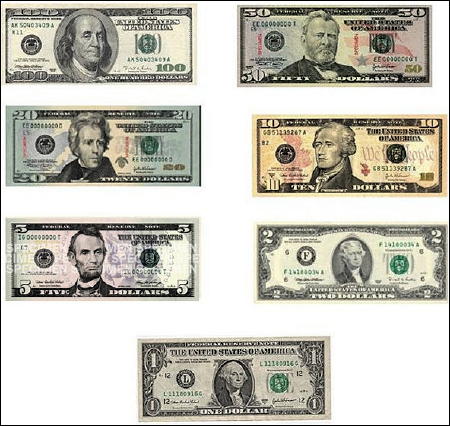
The Obama camp says the McCain campaign is wrong to accuse him of playing the race card in the following remarks Obama made while addressing a crowd in Missouri yesterday:
Nobody thinks that Bush and McCain have a real answer to the challenges we face. So what they’re going to try to do is make you scared of me. You know, ‘he’s not patriotic enough, he’s got a funny name,’ you know, ‘he doesn’t look like all those other presidents on the dollar bills.’
Yeah. You know. Continue reading →
On acting Presidential (or kingly)
In recent decades, as the Presidential races have become more like advertising campaigns and less like contests about the issues, there’s been a great deal of attention paid to “acting Presidential.” Some of it is reasonable, an attempt to size up a candidate’s character in order to understand what sort of President he/she would make. But much of it has become cosmetic: how firm the jaw, how vibrant the voice, how tall and erect the stance.
Perhaps it started with television and the Nixon-Kennedy debates, when those who listened on radio tended to judge Nixon the victor while those who watched on TV favored the upstart Kennedy. Just as Kennedy was more telegenic than Nixon, there’s no question Obama has it all over the opposition on looks and the projection of whatever is superficially “Presidential.”
But now Obama has taken “acting Presidential” to new heights—or depths, depending on how you look at it. He has started to act as though he were already President. Continue reading →
The times they have a’changed: Obama on state visits abroad
Here’s Barack Obama a while back on the subject of state visits:
“When Sen. Clinton brags, ‘I’ve met leaders from eighty countries—I know what those trips are like! I’ve been on them. You go from the airport to the embassy. There’s a group of children who do native dance. You meet with the CIA station chief and the embassy and they give you a briefing. You go take a tour of a plant that [with] the assistance of USAID has started something. And then—you go.
“You do that in eighty countries–you don’t know those eighty countries,” he said. “So when I speak about having lived in Indonesia for four years, having family that is impoverished in small villages in Africa—knowing the leaders is not important—what I know is the people. . I traveled to Pakistan when I was in college—I knew what Sunni and Shia was [sic] before I joined the Senate Foreign Relations Committee. .
Ah, but photo-ops are different. Continue reading →