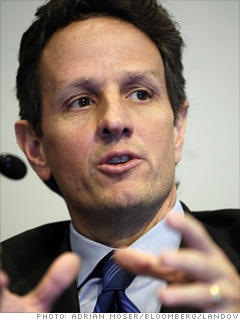
Say what you will about Tim Geithner, he’s a good-looking man.
But he also reminds me of somebody.
Here’s our guy Tim:
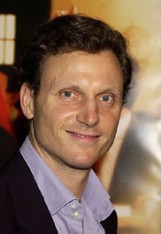
And here’s actor Tony Goldwyn:
In case you can’t immediately place Goldwyn, he’s not only Sam Goldwyn’s grandson, he was extraordinarily impressive as the creepy white-collar villain Carl Bruner in the movie “Ghost.”
The friend is Chris Dodd, and the story is that, in order to protect Geithner and Obama, the administration threw Chris Dodd under that enormous bus that has come to shelter so many.
The basic facts are fairly well known at this point, after several initially conflicting stories: Dodd’s original bill had a clause that banned the AIG bonuses, and Geithner pressured him to eliminate the restriction, which he did. Congress passed it and Obama then signed the bill.
The only real question at this point is what did Obama know and when did he know it? Whether Geithner acted on his own (somewhat unlikely, IMHO, although the White House would prefer that you think so) or with Obama’s knowledge, there is no doubt that the impetus came not from Dodd but from the administration, and that Dodd is being sacrificed.
It couldn’t happen to a nicer guy. But whether or not I think highly of Dodd (I most decidedly do not), the point is that he’s been a big supporter of Obama and that he’s taking the fall right now.
The thought has surely crossed Chris Dodd’s mind more than once these past few days: is this how Barack Obama treats his friends?
But if Dodd had been paying even a particle of attention to Obama’s behavior (or, to be fair, to the dirty game of politics itself), he would have known the answer to be a resounding “yes.” I’m starting to get redundant here, but I keep going back to the earliest days of Obama’s political career (think “Alice Palmer”).
Besdies, would else you expect from an Alinsky disciple and instructor? Anyone—anyone—who believed Obama’s lofty pre-election rhetoric of change and transparency and morality was simply not paying attention to the actual behavior he had exhibited during his entire political career, as well as during the campaign itself.
I keep harping on the Alice Palmer story. Please read the whole thing if you’re not familiar with it, but here’s a quick summary:
The day after New Year’s 1996, operatives for Barack Obama filed into a barren hearing room of the Chicago Board of Election Commissioners.
There they began the tedious process of challenging hundreds of signatures on the nominating petitions of state Sen. Alice Palmer, the longtime progressive activist from the city’s South Side. And they kept challenging petitions until every one of Obama’s four Democratic primary rivals was forced off the ballot.
Fresh from his work as a civil rights lawyer and head of a voter registration project that expanded access to the ballot box, Obama launched his first campaign for the Illinois Senate saying he wanted to empower disenfranchised citizens.
But in that initial bid for political office, Obama quickly mastered the bare-knuckle arts of Chicago electoral politics. His overwhelming legal onslaught signaled his impatience to gain office, even if that meant elbowing aside an elder [African-American] stateswoman [and Obama mentor] like Palmer.
A close examination of Obama’s first campaign clouds the image he has cultivated throughout his political career: The man now running for president on a message of giving a voice to the voiceless first entered public office not by leveling the playing field, but by clearing it.
The article appeared in the Chicago Tribune in April of 2007. But it remained a largely local story. Somehow, most people—even those who follow politics rather closely—have never heard of it. Why was this not heavily publicized during the campaign? (Yeah, I know; rhetorical question.) Can you imagine what the MSM would have done with it if this incident had been in George Bush’s or John McCain’s past, ? (Yeah, I know; obvious observation).
Obama’s ruthlessness towards Palmer and all the other Democrats attempting to run against him in the primary of his very first election was a warning to all opponents: don’t mess with me, or I’ll screw you, and it doesn’t matter whether you’re friend or foe.
Except for the fact that it didn’t involve actual blood, Obama’s methods remind me of nothing so much as the way ambitious mobsters in “The Godfather” let everyone know at the outset what stuff they’re made of. But Mafia dons don’t ordinarily run for president.
Le Figaro reports…that Obama sent the former leader of France [Chirac] a “very nice” letter, which included this idiotic comment: “I am certain that we will be able to work together, in the coming four years, in a spirit of peace and friendship to build a safer world.”
Whatever is happening to Obama? No matter what his agenda might be, socialist or otherwise, what possible reason could he have for reaching out to Chirac and drawing the ire of Sarkozy?
And, more to the point, whatever is happening to Obama’s aides and advisers? Don’t presidents have the equivalent of fact-checkers or spell-checkers or briefers or protocol experts or something like that to call on to keep them from making incredibly egregious errors such as this?
Either Obama is getting some very bad advice, or he’s ignoring some good advice, or he’s getting no advice. None of these options is especially reassuring.
[NOTE: I am more than willing to retract this post if it turns out to be some sort of joke—in fact I’d be relieved and happy to do so. I must say I thought at first that it had to be a spoof, but I could find nothing to contradict it, and the source seems to be the French press.
Come to think of it, that’s a bit suspect in and of itself. Stay turned.
If anyone can shed light on the truth or falsehood of the Obama letter to Chirac, please post the evidence in the comments section.]
[ADDENDUM: The multi-talented Fausta has provided some requested light. Please read what she has to say.]
It’s no secret that I’ve been critical of Barack Obama for much of his candidacy, and even more so during his presidency. But I honestly believe that, even back in my liberal Democrat days, I would not have drunk the Obama Kool-Aid.
I probably would have voted for him. But I very much doubt that I would have exhibited the starry-eyed worship I see in so many (although I’m seeing it less and less these days).
I like to think I would have remained unaffected because I am so perceptive and smart and could penetrate his mask of disguise. In truth, though, it might have been because once I reached adulthood, I would not have been susceptible to the transformative content of his message either. Only in early childhood could I ever have believed that any mortal could change Washington or “heal the world” in one fell swoop.
Idealism vs. realism is at the heart of it, and I think I lost much of my idealism (some would call it naivete) early on. Idealists have their place and their pluses. But they are dangerous as well because they are very susceptible to demagogues, con men, and manipulation.
It is my observation that the ranks of garden-variety liberals are composed in large part of sketchily-informed idealists. The ranks of radicals on the Left (which is a very different thing) are composed of some idealists mixed with a goodly proportion of manipulative, angry, ruthless, power-hungry tyrants. All of this is in the service of a better world, of course.
I’ve written previously about the message of the Nicholas Gage book Eleni. It tells the sobering tale of what can—and often does—-happen when political idealists meet up with the roadblocks of reality and yet remain stubbornly dedicated to their plans rather than abandoning them. Those mushy idealists can turn into manipulative, angry, ruthless, power-hungry tyrants quite easily, and do so with depressing regularity:
The book delineates, step by careful step, how over the course of time these people compromised and hardened until they were all but unrecognizable, their dreams soured and their cause utterly transformed into something they wouldn’t have recognized (or supported) at the outset.
Will we see such a thing happen here? I believe in American exceptionalism, but it has its limits. I hope we have not reached them.
[NOTE: Is Obama himself an example of this phenomenon? Perhaps. It partly depends on whether you think he is primarily a naive and idealistic idealogue or a cold-blooded egomaniacal narcissist, or some combination of the two. In any case, it’s not clear yet just how far Obama has gone, or is willing to go in the future, along the road to tyranny.
But even if he is an idealist, I think some of the hardening of which I speak happened to him quite early in his political life. Consider the evidence of his ruthlessness in the Alice Palmer incident, which occurred the very first time Obama ran for public office.]
[ADDENDUM: David Warren has a theory on Obama. He thinks he’s a well-meaning idealist who’s been so steeped in liberal surroundings all his life that he’s lost sight of where the middle is.]
President Obama’s Teleprompter dependence has become so extreme that the little gadget has decided to enter the blogosphere with its own tell-all story.
Yes, it’s good for a joke or two. But more serious discussion of the Teleprompter reliance of our new Orator-in-Chief mostly focuses on the irony and apparent contradiction that a president known for being an articulate graduate of Harvard Law School, and for the soaring rhetoric of his inspiring oratory, appears remarkably tongue-tied and awkward without his trusty Telly.
Of course it’s always been known that speechmaking, in contrast with the more spontaneous give-and-take of debate or press conferences, is a very different beast. For example, John McCain (remember him?) was far better at the latter than the former—that is, until he became candidate McCain in 2008, at which point he started resembling his predecessor George Bush and was rather mediocre at both. It was also clear from the Obama campaign that we knew only a tiny bit about his off-the-cuff speaking, because almost all of his interviews were softball puffery.
But what we did know was troubling; many on the Right pointed out that Obama stammered and hesitated, and seemed to be almost a different person, without his script.
Obama himself seems to be aware of the disparity. His attempt to deal with it has been this over-reliance on the Teleprompter to help overcome his disfluency when speaking extemporaneously. It makes sense; after all, why stammer and stumble when you can sound smooth?
The late great Dean Barnett was one of the first to not only notice this but to understand what it might signify besides a simple desire for fluency. Writing in February 2008 about a speech Obama had made a few days earlier, Barnett shrewdly observed [emphasis mine]:
As he strode to the podium, Obama clutched in his hands a pile of 3 by 5 index cards. The index cards meant only one thing–no Teleprompter.
Shorn of his Teleprompter, we saw a different Obama. His delivery was halting and unsure. He looked down at his obviously copious notes every few seconds throughout the speech. Unlike the typical Obama oration where the words flow with unparalleled fluidity, he stumbled over his phrasing repeatedly.
The prepared text for his remarks, as released on his website, sounded a lot like a typical Obama speech….The prepared text reached out to all Americans, including (gasp!) Republicans. It also evidenced Obama’s signature lack of anger…[and] loftier tone…
But…[w]ith no Teleprompter signaling the prepared text, Obama failed to deliver the speech in his characteristically flawless fashion. He had to rely on notes. And his memory. And he improvised…
Virtually every time Obama deviated from the text, he expressed the partisan anger that has so poisoned the Democratic party. His spontaneous comments eschewed the conciliatory and optimistic tone that has made the Obama campaign such a phenomenon…[T]his different Obama was a far less attractive one…
Barnett noticed—as many had, even at the time—the enormous difference in articulateness between Teleprompter-Obama and Obama unplugged (the latter is the title of Barnett’s article). That was the easy part. The more discriminating observation Barnett made was between the message of Teleprompter Obama and the message of ad-lib Obama. The two were not just different in degree—they were profoundly opposite in tone and essence. Ad-lib Obama was far more angry and more radical—indeed, although Barnett doesn’t mention it, this Obama resembled the angrier and more radical Michelle Obama, in her earlier campaign remarks that drew so much controversy.
Obama is addicted to his Teleprompter not only because he knows he sounds better—smoother and smarter—with it than without. The deeper reason for his reliance on it may just be that he differs so profoundly from the persona he wishes to convey that he quite literally cannot trust himself to speak without it. Shorn of the Teleprompter, he not only runs the risk of revealing a disfluency that could rival (or even exceed?) that of his reviled predecessor George Bush—he may reveal who he truly is, an angry man with a profoundly radical agenda for America.
That agenda (although not the anger) emerged just a bit when he was being questioned by Joe the Plumber during the campaign (the anger came later, when Obama mocked Joe). Obama’s “spread the wealth” remark to Joe was a tiny slip of the careful campaign mask, a moment when just a dab of Obama’s far Left leanings oozed out through an unguarded crack. Now that Obama is president, he has revealed more of those inclinations, but he is doing so in a calibrated and orchestrated manner that is calculated (he hopes) to soothe any alarm most Americans might feel.
All leaders rehearse and prepare their speeches. Churchill, as I recall from the wonderful William Manchester biographies of him (one of which appears in the photo at the top of my blog page), prepared his public addresses down to the tone and gestures, even writing notes to himself as to when to seem to hesitate and when to stammer. But that was theater, designed to accentuate who and what he already was and had been known to be for decades. Churchill’s private and public selves were congruent, as well as his brilliance in both scripted and extemporaneous speaking and debate.
I’m not expecting Obama to be Churchill. But Obama’s oratorical hyper-control, unlike Churchill’s, is in the service of hiding rather than revealing the essential self. All really good orators know how to milk a crowd, and even to use suggestive gestures that border on mass hypnosis. But Obama’s exercise of such things is extreme, and he just may be offering us the fewest non-scripted public utterances of any leader in America’s modern history.
The reason for this is not merely his attempt to appear more articulate than he actually is. In his endeavor to exercise such tight control over his words, Obama seems to be presenting the most studied and manipulative (in the sense of saying one thing and intending another, and/or using doublespeak, as I outlined in yesterday’s post) message of any president in our history. This is profoundly disturbing.
I’d hardly gotten through lamenting the fact that Obama is a champion blamer of others—no “The Buck Stops Here” sign on his desk—when what do you know, right on cue, he comes out with “I’ll take responsibility. I’m the President.”
Sounds good, doesn’t it? Until you stop and think about it for a moment—which he’s counting on most Americans to fail to do.
Let’s take a closer look at what Obama said concerning the AIG bonuses:
“Washington is all in a tizzy and everybody is pointing fingers at each other and saying it’s their fault, the Democrats’ fault, the Republicans’ fault,” [Obama] said at a town hall meeting Wednesday. “Listen, I’ll take responsibility. I’m the President.”
He also makes clear that it isn’t really his fault. “We didn’t grant these contracts,” he said.
But he added: “So for everybody in Washington who’s busy scrambling, trying to figure out how to blame somebody else, just go ahead and talk to me, because it’s my job to make sure that we fix these messes, even if I don’t make them.”
Note that nowhere does he admit any wrongdoing or culpability. The clues are in the little details of language; do not think for a moment that they are accidental. Obama’s ability to craft his balancing act is so precise that it has me in awe. Almost every word he utters is there for a careful strategic reason, to induce a particular psychological effect in the listener.
First we have “Washington is all in a tizzy.” That is a favorite ploy of Obama’s—to ridicule and trivialize criticism (last April, for example, I wrote about his tendency to use the word “silly” to describe his opposition).
Note also it is Washington that’s in this tizzy of blame, not the American people. That’s because Obama knows that “Washington” isn’t very popular right now (or perhaps ever), so it makes a good target. And Obama, of course, isn’t “Washington,” although he happens to reside there.
He doesn’t even consider the possibility that anyone in “Washington” (except, of course, for Obama, who’s not really “in” Washington) might be sincerely trying to discover who is actually responsible for the problem. No, they are merely eager to deflect the responsibility onto others. The fact that this is actually a pretty good description of the motivation of so many members of Congress only adds to Obama’s believability, so one might be pardoned for forgetting that Obama has been doing the very same thing—pointing the finger at others and saying it’s their fault, not his—ever since he came to office.
Next we have the phrase “saying it’s their fault, the Democrats’ fault, the Republicans’ fault…” Notice what Obama leaves out here—the phrase “saying it’s my fault,” or even the more distant third-person “saying it’s the President’s fault.” He refuses to add those words because he doesn’t even want to admit it as a possibility. He doesn’t want to leave that image in people’s minds even for a moment.
Then Obama says, “I’ll take responsibility.” Not “I am responsible.” Just that he’ll “take” responsibility. He’ll wrap the mantle of responsibility around his shoulders whether it fits or not. That’s just how noble he is. And not because he’s done anything wrong, of course. It’s because presidents are supposed to be big boys and do that sort of thing.
Obama drives this thought home by immediately adding “I’m the President.” He wants to remind us of the dignity of his office, and the fact that he holds it and wields power right now.
But Obama saves the best for last. It’s astounding how he manages to pack so much into one sentence. He repeats his earlier ridicule of Washington for emphasis: “everybody in Washington who’s busy scrambling, trying to figure out how to blame somebody else.” Once again we have an image of a pack of clowns or Keystone cops, a comedy routine of fools, refusing to take the responsibility that is rightly theirs and saying “he did it; she did it; not me!”
Everyone, that is, but the righteous Obama. In contrast he says, “just go ahead and talk to me, because it’s my job to make sure that we fix these messes, even if I don’t make them.” So once again we have the contrast of the silly Washington blamers (whom he is blaming for being blamers), followed immediately by a reminder of his high office (“it’s my job to fix”) and then the kicker, a disclaimer of wrongdoing: “even if I don’t make them.” That last is slipped in so smoothly that the audience might easily miss the fact that he just negated the responsibility he had claimed to be taking only a moment before.
But in actuality he is just appearing to negate that responsibility that he claimed to be taking a moment earlier. I know that’s a bit complex and convoluted (Obama is nothing if not complex and convoluted), but please bear with me. The tipoff is his use of the word “if.” He is careful not to say whether he made this mess or didn’t, or whether he had any role in its genesis at all. He is saying that, whether he did or did not make this mess (and who knows which it might be?), he is going to take responsibility for it anyway—a responsibility which he has just subtly deflected.
I wrote this analysis without having seen a video of his remarks. But when I watched them just now, the visuals made even clearer what he was doing.
The remarks in question begin at minute 4:46:
Note his gestures and affect. When he says the bits about “tizzy” and “scrambling” the intent to mock is obvious; he waves his arms in a flapping motion both times. Then, when he is making the contrasting remarks that follow, about his own position of power and gravitas as the President, his aspect grows more serious and responsible, and he underscores the effect by placing his hand solemnly on his chest each time, just in case we missed it, indicating: “I am the President. Me. Me.”
[NOTE: Lest you think any of this “now I say it now I don’t” language was an accident, Obama uttered similar although not identical double talk while answering press questions prior to the Town Hall meeting. When asked whether he wished he’d learned about the AIG bonuses sooner so he could have done something about them, he dodges the question and instead says:
Well, look, rather than going into sort of the details of finding it out, ultimately I’m responsible, I’m the President of the United States. We’ve got a big mess that we’re having to clean up. Nobody here drafted those contracts. Nobody here was responsible for supervising AIG and allowing themselves to put the economy at risk by some of the outrageous behavior that they were engaged in. We are responsible, though. The buck stops with me. And my goal is to make sure that we never put ourselves in this kind of position again.
See also my April 2008 dissection of Obama’s non-apologetic apologies.]
I was fiddling around at You Tube the other night, and came across these classics.
They reminded me how very much I’d enjoyed Mandy Patinkin’s performance in “The Princess Bride.” It was a good movie with an excellent script. But it was Patinkin’s humor crossed with intensity as the determined and relentless Montoya that really made the film for me. In a part that might have been ludicrous in anyone else’s hands, he was fanciful and believable, lovable and obsessed, all at the same time
I am worried because I thought partisan reconciliation was an animating force of Obama’s candidacy, a big reason why he thought he—rather than one of the 306 million other Americans—should be President. I am worried that, amidst a credit crisis, two wars, and a lack of confidence in our nation’s institutions, we have installed as President a man apparently willing to abandon a foundational premise of his candidacy not three months into his tenure.
We should all be worried.
But where was Cost when Obama abandoned one of the fundamental premises of his candidacy when he was still a candidate? I’m talking about his broken campaign financing pledge way back in June of 2008. It exposed Obama not only as a hypocrite, but as a pass-the-buck hypocrite as well.
…Obama’s been running as the business-as-unusual candidate, not just another hypocritical, lying pol who, as Obama’s former mentor the Rev. Wright said, “does what politicians do.” And yet as soon as Obama saw that the money flowing his way was far beyond what he could get if he adhered to his agreement, he reneged.
It’s not just that he reneged, either”“it’s how he reneged. Who’s to blame, according to Obama? Why, John McCain and the nasty Republicans, that’s who. James Joyner writes that this charge of Obama’s does take “a bit of gall.” I’d say it takes substantially more than a bit, as well as a heavy dose of the whining, blaming, audacity in which the holier-than-thou Obama tends to specialize…
This move, more than any other, was the tipoff as to what sort of politician Obama was and is. Many American voters ignored the facts that were staring them in the face, hoping against audacious hope that Obama’s words were what he really meant, rather than his acts. But it doesn’t usually work that way, does it?
Oh, and should anyone on earth be surprised that this flagrant violation of bipartisanship is being considered in a move to force Obama’s energy and health initiatives down the already-engorged throats of the American people?