
Only I’ll make Hillary do it.
Obamamites say: bounces off me and sticks to you
Obama and his supporters have milked, squeezed, massaged, and wrung out the old meme “It’s all Bush’s fault.” Sensing the public is getting a bit sick of the refrain, another has come to the forefront.
It’s not exactly new, but suddenly I see it everywhere in comments sections in the blogosphere. It goes like this: “McCain would have been worse.” And then there’s its only slightly milder variant: “McCain would have done the same.”
McCain is no genius. But there is no question that his policies, whether domestic or international, would have been markedly different from Obama’s—and, unless a person happens to be on the far Left, he/she ought to agree (unless blinded by the irrational need to defend Obama no matter what) that McCain would have done better.
Would McCain have proposed the enormous stimulus bill that he voted against? Would he have pushed a radical overhaul of health care insurance in the middle of the crisis, especially a government option? Would he have cut missile defense funding? Would he have been in favor of cap and trade? Card check? Would he be trying his hardest to put Chavez’s lackey Zelaya back in power? Would he have failed to offer strong support for Iran’s demonstrators? Would he have given Moscow what it wanted and cut our ability to respond to international crises in order to gain—well, basically nothing?
Any thinking person knows the answers.
In fact, the only things McCain would have done that would have been the same as Obama are the cases in which Obama echoed Bush’s policies on terrorists, such as indefinite detention and warrantless wiretaps. Oh, and McCain probably would have banned waterboarding (which had ended de facto in 2003 anyway) just as Obama did.
I could list more differences, but why bother? The charge isn’t really a serious one to begin with. Like so many others on the Left it is merely a juvenile attempt at distraction, a sort of “and so’s your old man,” or “bounces off me and sticks to you,” a meaningless schoolyard taunt.
But that’s the way it is these days.
Dr. Sanity opts for sanity
My friend, Sanity Squad colleague, and blogger extraordinaire Dr. Sanity is taking a long and perhaps permanent break from blogging. Please stop by, smell the virtual roses, and wish her well!
Obligatory Palin thread of the day
This’ll be short: reading about the Palin interview today, it strikes me that Palin really is a maverick.
I work and I work and I work…
…writing posts full of research and facts and critical thinking and well-reasoned discourse. At least, I try to.
So where have a ton of hits come from today, according to my sitemeter? A search on Bing for images of “muffin top.”
In case you missed it first time round, here’s the post.
More on Palin-hate? [continued…and continued…]
I never expected to be writing so much about Sarah Palin at this point.
You’d think the subject had been more or less exhausted, but the hate goes on (and if you’ve missed my previous thoughts on the matter, and happen to want to read them, just go to the category “Palin” on the right sidebar and start clicking).
But this post at a feminist blog on the Left, defending Palin (yes, you read that right: defending Palin) is well worth reading, including its comments section, even if you think you’re getting sick of the subject. It offers a very different take.
Pseudonymous blogger and feminist Violet Socks isn’t in agreement with Palin on much of anything political. But she is outraged by the venom unleashed almost from the start in Palin’s direction, especially that spit out by women, and in particular feminist women (something I noticed and remarked on here and here).
Violet tries to explain it, and makes a valiant and impressive effort to do not only that, but to sort out the vicious lies from the truth (hint: it’s mostly the former that constitutes the bulk of the rumors about Palin). I’m always gratified to see someone on the other side try to be fair to Palin (or anybody, for that matter), and I think Violet gets a lot of it right. I won’t try to summarize what she says; read the whole thing to get the flavor of it. But her best (and already much-quoted line) is:
These people don’t hate Palin because of the lies; the lies exist to justify the hate.
Bingo.
If Violet ends up saying she still can’t really explain it all, and is feeling somewhat stumped by the phenomenon, I think that’s because Palin-hatred has a highly emotional and irrational aspect. This element was best summed up by comment #237 in the thread, which struck a big chord with me by comparing the process to the famous Shirley Jackson short story “The Lottery,” which describes but does not explain the ritual stoning of a woman by villagers.
Palin-hatred has mysterious irrational aspects, but it also has explicable and indentifiable ones. And although no single one of them is sufficient to account for the phenomenon, together they have a powerful synergistic effect. You might say that Palin-hated represents the perfect storm, the confluence of flashpoints regarding class, education, beauty, sexuality, Christianity (don’t discount the latter; it’s important to the hatred and comes with a whole set of assumptions, some of which Violet discusses at some length), and female ambition.
In a particular irony, Palin is indeed a feminist (as Violet also points out). She’s just not their kind of feminist, according to the predominantly Leftist and liberal feminist establishment. So she is especially infuriating to them, a sort of feminist Uncle Tom, who receives the sort of ire ordinarily reserved for people like Clarence Thomas, considered a traitor to his race for being a conservative Republican.
One thing I found especially interesting on reading the comments section at Violet’s post is that, as many of the liberal feminists there have observed with dismay the Palin hatred and the lies that fueled it, it seems to have stirred up a process of doubting and wondering for some of them. Their unease concerns the Left in general: they are wondering if they can continue to trust that it’s telling the truth about other things. Do I detect, perhaps, the beginning of a political change process?
[ADDENDUM: It has occurred to me that, although very different in perspective, focus, and scope, Palin-hatred is similar to anti-Semitism in its virulent irrationality, as well as the fact that “These people don’t hate Jews because of the lies; the lies exist to justify the hate.”]
Robert McNamara: he fought a war of attrition
The news comes today that Robert McNamara, famous as Kennedy and then Johnson’s Secretary of Defense during the Vietnam War, has died at the age of 93.
Those of us who are of a certain age remember him well, as one of those responsible for what I have since termed “the first act” (that is, the poorly run, poorly conceived, Johnson portion) of the Vietnam War. McNamara lived to later repudiate the war and his part in it, in a series of mea culpas that made the once-reviled man somewhat more popular among the antiwar Left, at least as an object lesson in repentance.
McNamara’s public life was defined by his failure on the war. But if he’d never been connected with Vietnam, he probably would have been considered a resounding success. He certainly was effective in his early years as a businessman with Ford; would that he’d stayed there. But Kennedy promoted him to the Cabinet (he was also offered Treasury—a post for which he’d have been far better suited—but unfortunately he turned that down) and he was kept on as Johnson’s Defense Secretary after the Kennedy assassination.
McNamara had served in World War II and done statistical analysis of bombers’ effectiveness, but his major expertise was in business. He used that business acumen to implement general changes in defense policy and weapons and organizational matters in the armed forces. But, faced with Vietnam, he met his match (or rather, mismatch), coming up with the idea of a deadly and misguided numbers game:
McNamara put in place a statistical strategy for victory in Vietnam. He concluded that there were a limited number of Viet Cong fighters in Vietnam and that a war of attrition would destroy them. He applied metrics (body counts) to determine how close to success his plan was.
I’m no military expert, and hindsight is 20/20, but on the face of it this makes no sense, when faced with a tenacious enemy motivated by an extreme and deeply held ideology and the support and largesse of Communist China. Quite early on, McNamara became convinced that the war was unwinnable, and he left office in 1968. Despite the fact that under Westmoreland’s successor General Creighton Abrams, the “second act” of Vietnam (see this and this) reversed some of McNamara’s errors, the attitude of the public and especially the press was set: it was McNamara’s war, and it could not be won.
The career of McNamara is a cautionary tale, wherein a man of great achievement and intelligence applied that brainpower to an area he did not sufficiently understand, and to which he was temperamentally unsuited. He spent much of the rest of his life trying to make up for it. I hope he’s found his peace at last.
Honduras in crisis
Will the rule of law and the constitution of Honduras win out against its enemies—which seem to include our current president, Barack Obama?
No need for me to write a post on this, as so many others have covered it well. Here are the links:
A hard-hitting article in the WSJ criticizes not only Obama re Honduras, but the Bush administration for its soft line on Chavez in 2004. However, it doesn’t mention 2002, when Bush was criticized for probably undercover tacit support of a short-lived coup against Chavez. Interesting comments to the WSJ article, as well.
More from Fausta, who continues, through her knowledge of Spanish and Latin American sources, to have her finger on the pulse of Honduras. She reminds us that the party working against Zelaya’s return is his own party, which is still in power there.
Query: how many people in America are aware of what’s happening in Honduras? How many believe Obamaspeak that it’s an ordinary military coup, and that reinstating Zelaya would be following the rule of law?
Miscarriage of justice? You be the judge
I usually write about injustices on the macro level, but there are smaller ones as well: injustices to a single person.
Hardly small, though, if you’re that person, or that person’s family. And abuses within the justice system itself—whether by police, prosecutor, judge, or jury—affect us all, because we need to be able to trust in the rule of law and its appointed agents and/or enforcers.
I was watching television yesterday and happened across an episode of “Hard Evidence” on TLC. It featured the case of a young man named Ryan Ferguson, who was convicted in December 2005 of the brutal November 2001 murder of Kent Heitholt, sports editor of the Columbia Missouri newspaper.
Something about the show caught my attention, and so I watched till the end. By the time it was over I was not only convinced that Ferguson was innocent, I was shocked at the process that brought him to the point of ever being tried for the crime in the first place.
The facts of the case are long and involved, but the salient points are these:
(1) There is no physical evidence of any sort linking Ferguson to the murder. All the relevant physical evidence that does exist (such as some hair in the victim’s hand) exonerates him.
(2) There are no eyewitnesses to place him there. All the eyewitnesses who saw a man or men with the victim shortly before the murder have said the man could not be identified as Ferguson.
(3) The entire case rests on one thing alone: the confession of supposed accomplice Chuck Erickson, who received a reduced sentence for his pointing the finger at Ferguson. But Erickson’s confession only came two years after the highly publicized murder, and after he’d read much information in the newspaper and dreamed (yes, you read that right: dreamed) that he’d done it. What’s more, when he came to police to tell them about his dream, he knew no facts of the case other than what he’d read in the paper, and told them as much. They proceeded to fill him in on the facts so he could flesh out his “confession”—the opposite of what good police work should be, which is to hold back salient facts to make sure they’re got the right person, who can then supply the missing details.
Fortunately (although not fortunately enough for Ferguson, who was convicted by a jury that didn’t believe in the well-documented phenomenon of false confessions), the police interrogations of both Erickson and Ferguson were taped.
Here are some excerpts from Erickson’s initial police questioning:
And here are excerpts from the initial police interrogation of Ferguson, which lasted nine hours:
Positively outrageous.
[NOTE: Much more information can be found here. For example, this is a good page to look at.]
And North Korea…
…sends Obama a Happy Fourth of July message, complete with fireworks.
Happy Fourth of July: to liberty!
[This is a repeat of an previous post. I thought it especially relevant today because I see our liberties as newly-threatened. In addition, there’s the news that the crown of the Statue of Liberty has been reopened today to visitors for the first time since 9/11.]
I’ve been visiting New York City, the place where I grew up. I decide to take a walk to the Promenade in Brooklyn Heights, never having been there before.
When you approach the Promenade you can’t really see what’s in store. You walk down a normal-looking street, spot a bit of blue at the end of the block, make a right turn–and, then, suddenly, there is New York:
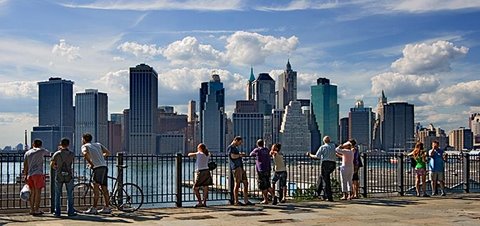
And so it is for me. I take a turn, and catch my breath: downtown Manhattan rises to my left, seemingly close enough to touch, across the narrow East River. I see skyscrapers, piers, the orange-gold Staten Island ferry. In front of me, there are the graceful gothic arches of the Brooklyn Bridge. To my right, the back of some brownstones, and a well-tended and charming garden that goes on for a third of a mile.
I walk down the promenade looking first left and then right, not knowing which vista I prefer, but liking them both, especially in combination, because they complement each other so well.
All around me are people, relaxing. Lovers walking hand in hand, mothers pushing babies in strollers, fathers pushing babies in strollers, nannies pushing babies in strollers. People walking their dogs (a preponderance of pugs, for some reason), pigeons strutting and courting, tourists taking photos of themselves with the skyline as background, every other person speaking a foreign language.
The garden is more advanced from what it must be at my house, reminding me that New York is really a southern city compared to New England. Daffodils, the startling blue of grape hyacinths, tulips in a rainbow of soft colors, those light-purple azaleas that are always the first of their kind, flowering pink magnolia and airy white dogwood and other blooming trees I don’t know the names of.
In the view to my left, of course, there’s something missing. Something very large. Two things, actually: the World Trade Center towers. Just the day before, we had driven past that sprawling wound, with its mostly-unfilled acreage where the WTC had once stood, now surrounded by fencing. Driving by it is like passing a war memorial and graveyard combined; the urge is to bow one’s head.
As I look at the skyline from the Promenade, I know that those towers are missing, but I don’t really register the loss visually. I left New York in 1965, never to live there again, returning thereafter only as occasional visitor. The World Trade Center was built in the early seventies, so I never managed to incorporate it into that personal New York skyline of memory that I hold in my mind’s eye, even though I saw the towers on every visit. So, what I now see resembles nothing more than the skyline of my youth, restored, a fact which seems paradoxical to me. But I feel the loss, even though I don’t see it. Viewing the skyline always has a tinge of sadness now, which it never had before 9/11.
I come to the end of the walkway and turn myself around to set off on the return trip. And, suddenly, the view changes. Now, of course, the garden is to my left and the city to my right; and the Brooklyn Bridge, which was ahead of me, is now behind me and out of sight. But now I can see for the first time, ahead of me and to the right, something that was behind me before. In the middle of the harbor, the pale-green Statue of Liberty stands firmly on its concrete foundation, arm raised high, torch in hand.
The sight is intensely familiar to me—I used to see it almost every day when I was growing up. But I’ve never seen it from this angle before. She seems both small and gigantic at the same time: dwarfed by the skyscrapers near me that threaten to overwhelm her, but towering over the water that surrounds her on all sides. The eye is drawn to her distant, heroic figure. She’s been holding that torch up for so long, she must be tired. But still she stands, resolute, her arm extended.
Palin: it’s the education, stupid
Back in September I wrote that some of the Palin-hatred we’ve seen represents a class war. What I’m going to write about today is somewhat related to that, but not completely.
Yes, class is part of Palin-hatred for sure, but (especially in America) class can be mitigated by education. Look no further than Presidents Clinton and Obama for evidence of this; neither were aristocrats to begin with, but they became the equivalent of American aristocrats (or at least earned respect for their intellectual capacities) through their Ivy League degrees and their adoption of that all-important manner of aristocrats here: the speech patterns of the highly educated.
It’s true that Sarah Palin has been to college. But these days so much of the population goes to college that the mere fact of a college degree is nothing special in most peoples’ minds. And Palin most definitely went to the wrong school—or schools plural, which is even worse. What’s more, in her speech patterns, her cadence and rhythm and accent, she has stubbornly refused to adopt the bland and homogenized manner of the educated elite.
This is part of the reason for the idea that Palin is dumb—even though it’s clear she’s not. But she “reads” dumb to many people, because she’s working and/or middle class and doesn’t cover that fact up with erudite academic-speak. If she doesn’t, it must mean she can’t, in many people’s eyes; it can’t possibly be a proud and strategic choice, right? It’s as though Eliza Doolittle tried to go to Ascot without the benefit of Henry Higgins’s tutoring: how dare she! And why would she?
It’s exactly the sort of thing I believe that commenter “nyomythus” was referring to when he wrote yesterday (except for the fact that he doesn’t blame her; most people who say this sort of thing fully blame her):
…[I]t’s not [Sarah Palin’s] fault it’s the people that put faith in her and give her a false confidence. Her ilk is not fit to govern—stew potatos and pluck chickens ya, have a position of governance in the USA na.
Note the injection of the “ya…na” speech patterns, reminiscent of Palin and those odd folks in the movie “Fargo,” the kind of proletarian of the north country accent for which Palin has been mocked.
Liberals like to think of themselves as friends of the downtrodden masses, the uneducated and the working classes. But they prefer this to be a form of noblesse oblige—they are the enlightened ones reaching down in their great magnanimity to help the unfortunates, who will then be ever-grateful for the largesse. It’s okay, too, if a minority person pulls him or herself up from squalor and becomes a leader—preferably with the help of a nice Ivy League education, but even without it if the minority in question is seen as having being oppressed enough.
Sarah Palin shatters those rules. Her true bottom-up (as opposed to fake top-down) populist appeal, her whiteness, and her rejection of the veneer of academic elitism that she could take on if only she changed her speech patterns, have driven them wild from the start. It’s only been compounded by the fact that she is a member of a certain group usually seen as oppressed: women. But this small point in her favor has been easily overcome by all the other points against her: she not their kind of woman, and maybe not even a woman at all.
I experienced this phenomenon first hand, the very day after the Palin nomination was announced by John McCain, when I happened to be attending a party where most of the guests were highly educated ultra liberal women. They were discussing Palin, and even then—not twenty-four hours after she had first burst on the scene—-their attitude towards her was set and unanimous, and they hadn’t gotten it from the media or checked it out with each other yet; it was developing as I watched (silently).
To sum up their reaction: they were laughing at her. They didn’t bother to disguise their contempt; they thought her a stupid joke. It was something akin to the attitude they might have had back in high school if the head of the pom-pom girls (who also happened to be the class slut) wanted to apply to Radcliffe and be designated valedictorian as well.
Even back when I was a liberal I didn’t share this attitude towards the value of an Ivy League degree (or even a degree at all). I’ve never confused erudition with smartness, or the trappings of an Ivy League education with intelligence, or either of them with something as unrelated as an accent or speech patterns or even fluidity of speech (this was one of the reasons that I didn’t turn on Bush as stupid even when I was a Democratic and disagreed with his policies).
Of course, education and intelligence are hardly mutually exclusive; they sometimes coincide. But I know full well that they don’t invariably do so, and I knew that from early in life. I grew up as the child of highly educated professionals but we lived in a blue-collar community, and my parents had a varied group of friends. Some had graduate degrees (my father was both a lawyer and CPA) and yet some had never finished high school. Some were rich, and some lived in small apartments above stores; some spoke with the accents of the educated and some did not.
Because both my parents had grown up in the same community in which I was also being raised, and had known most of these people their whole lives, they knew the back-story, as it were. My mother, who loved to talk, would tell me the history of this person and that person: he had wanted to be a gym teacher, but had to drop out of high school during the Depression to support his parents and ended up pushing racks though the streets of the garment district and then driving a truck. She had been pulled out of school after eighth grade by a tyrant father who insisted she earn her keep, and then married her off to a man she didn’t love. She spoke of them with sympathy rather than condescension.
My parents loved to entertain, and they would invite these people over often. Everyone would sit around a large table with cake and coffee, talking and talking and talking about everything under the sun, including politics. I was an observer and a sometime participant, and I never remember thinking that the ones with the big degrees had anything more or less worthwhile to say than those without them.
Later on I got my own big degrees, several of them, from a few highfalutin schools to boot. But I encountered a surprisingly wide variety there in terms of brainpower. There was book learning and then there was smart, and the one didn’t always have that much to do with the other, although sometimes it did. I also found myself thinking that the highly educated could be dangerous in their hubris if their schooling wasn’t accompanied by a deep thoughtfulness, because it could instead be accompanied by arrogance and the idea that because they had that elite education they knew far more than they really did.
Perhaps that’s why I was predisposed to listen to politicians in a different way, to not be swayed by a surface glibness or academic-speak. Palin is not my favorite candidate, and I never was at all sure that she could run and win in 2012, but I have always seen her as intelligent and courageous, and I’m awaiting her next move, which I imagine will be interesting. She’s been consistent in showing a remarkable ability to surprise people—whether they be her supporters or her enemies. And she’s doing so now.