
Busy day—will post more later.
So Obama, how’s that dialogue thing going?
Obama is annoyed that his magic touch has failed to instantly fix a 60-year-old problem area of the world, Israel and Palestine. Oh, those silly children! Why can’t they all just get along?:
Bristling with impatience, President Barack Obama sternly prodded Israeli and Palestinian leaders to relaunch Mideast peace negotiations Tuesday, grasping a newly personal role in their historic standoff. He won an awkward, stone-faced handshake but no other apparent progress beyond a promise to talk about more talks.
But, after all, isn’t talking about more talking what Obama does best?
Message from a 74-year-old bodybuilder
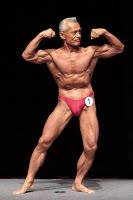
Seventy-four-year-old Japanese champion bodybuilder Tosaka says “anyone can stay young and healthy if they exercise from time to time.”
Sure. The voiceover then goes on to say, without missing a beat, [emphasis mine] “Tosaka spends most of his time working out at a small gym in Tokyo…”
He also probably spends most of his meals eating raw fish, because there’s not an ounce of fat on him. Nevertheless, you have to admit the guy looks extraordinary (video here).
Is the Iranian regime toast?
It very well could be, if (and it’s a big “if”) Michael Ledeen is correct in his assessment of the situation there [emphasis mine]:
When a tyrannical regime dies, you can see the symptoms in the little things. Late Friday afternoon, after millions (yes, millions”“this according to Le Monde, France 2, and L’Express, with the BBC saying that the demonstrations were bigger than those at the time of the Revolution) of Greens mobbed the streets and squares of more than thirty towns and cities to call for the end of the regime, there was a soccer game in Azadi Stadium in Tehran. It holds about a hundred thousand fans, and it was full of men wearing green and carrying green balloons. When state-run tv saw what was happening, the color was drained from the broadcast, and viewers saw the game in black and white. And when the fans began to chant “Death to the Dictator,” “Death to Russia,” and “Death to Putin, Chavez and Nasrallah, enemies of Iran,” the sound was shut off. So the game turned into a silent movie.
But the censors forgot about the radio, and the microphones stayed open, so that millions of listeners could hear the sounds of the revolution. And in Azadi Stadium, as in most parts of the country, the security officers either walked away or joined the party…
Look at what didn’t happen in the streets last Friday. Not a shot was fired at the millions of demonstrators in Tehran. There are YouTubes of police fraternizing with the Greens. There are stories of Revolutionary Guardsmen helping the demonstrators, and even the Basij didn’t dare to attack or arrest, with a handful of exceptions (one of which is notable: in Tabriz, if I remember correctly, they started to round up some people, and the crowd turned on them, freed the would-be victims, and beat the Basijis to death).
One cannot overestimate the importance of the occurrences I’ve highlighted in bold, because they represent an absolute necessity if the Iranian people are ever to cause a change in government in their country. Last June, when the anti-regime demonstrations got going and were then suppressed, I wrote the following, and I see no reason to change my mind:
However, the real questions are (1) how far the demonstrators are willing to go, and how much violence against them are they willing to absorb; (2) how far the mullahs are willing to go, and how much violence they are willing to perpetrate; and (3) will the police, the Guards, and other forces called in by the mullahs to quell the crowds be willing to fire on them, or will they stay their hands?
That last question may be the most important of all. Like all tyrants, the mullahs can do little without the help of the vast numbers of henchmen they employ, and without the exercise of fear. Sometimes there is a great deal of opposition and unrest under the radar screen even within the groups assisting tyrants, and once dissatisfaction as a whole reaches a critical mass and events transpire to release it, there can be a sudden change and a refusal to defend the regime.
And then there’s this, from a post I wrote three years ago:
When hatred of a ruler or rulers is so widespread that it has become rampant among those who would protect those rulers or enforce their edicts, then those rulers may be in big trouble, no matter how repressive and brutal they are willing to be to suppress dissent. Because they cannot do it alone; they must have a cooperative armed apparatus in place to enforce their will.
Michael Ledeen has been focusing a great deal of his considerable energy on Iran for many years. He is the originator of the phrase “Faster, please!,” a sort of modern-day “Carthago delenda est” which Ledeen has featured in many of his articles on the subject, although he is also on record as having been against a US invasion or airstrikes against the country.
Instead, his approach to Iranian regime change has been to encourage the Iranian people to dissent against its own government, forcing more and more pressure until it collapses for want of popular support. The situation Ledeen describes in Iran right now would, if true, be the vindication of his campaign and the fulfillment of his long-held desires for that country. For these reasons, it’s possible Ledeen is just a victim of his own wishful thinking. I don’t pretend to know whether this is true or not.
But Ledeen has shown prescience and insight before on the topic of Iran; for example, in 1979, when most people failed to see what was brewing, he correctly predicted the direction the Khomeini revolution would take:
In 1979, Ledeen was one of the first Western writers to argue that Ayatollah Ruhollah Khomeini was a “clerical fascist”, and that while it was legitimate to criticize the Shah’s regime, if Khomeini seized power in Iran the Iranian people would suffer an even greater loss of freedom and women would be deprived of political and social rights.
Ledeen is virtually the only person reporting right now on the current Iranian demonstrations. That doesn’t make him wrong, but it certainly makes it hard to know much about what’s really happening and whether he’s right. The lack of coverage is partly because the Iranian regime has made it very difficult if not impossible for journalists to visit that country to report on events there. Ledeen seems to have Iranian informants, but are they telling him the truth, or are they telling him what they think he wants to hear?
If Ledeen is right, however, it could be one of the best pieces of news to come along in a long while. And if the regime does fall (and something better replaces it; be careful what you wish for), will President Obama put himself on the wrong side of history again?
Obama: confused about Afghanistan?
I don’t think he is (at least not in the way you’d imagine). But Leslie Gelb does:
I’m lost on President Barack Obama’s Afghanistan policy””along with most of Congress and the U.S. military. Not quite eight months ago, Mr. Obama pledged to “defeat” al Qaeda in Afghanistan by transforming that country’s political and economic infrastructure, training Afghan forces and adding 21,000 U.S. forces for starters…And a mere three weeks ago, he punctuated his commitments by proclaiming that Afghanistan is a “war of necessity,” not one of choice. White House spokesmen reinforced this by promising that the president would “fully resource” the war.
Yet less than one week ago, Mr. Obama said the following about troop increases: “I’m going to take a very deliberate process in making those decisions. There is no immediate decision pending on resources, because one of the things that I’m absolutely clear about is you have to get the strategy right and then make a determination about resources.” He repeated that on Sunday’s talk shows.
Are we now to understand that he made all those previous declarations and decisions without a strategy he was committed to?
The answer is: it depends on what the meaning of “strategy” is. Gelb is confused because he still thinks of Obama in conventional terms, of “strategy” as an effort to win the war, and of previous Obama statements as rationally connected in the ordinary way to new ones.
I see it differently. I think Obama committed to Afghanistan as a strategy to look tough in the election, and is now looking for a way out that doesn’t make him look weak. In the meantime, he’s stalling.
He would have liked victory to be easy there because it would have been a feather in his cap and a defense against those who say he isn’t interested in fighting terrorism. But since it’s not, he has no desire to stay the course, and he couldn’t care less about the geopolitical repercussions for America.
And I’d be happy to be proven wrong about this.
Interim Honduran President Micheletti speaks
Read his piece in today’s WaPo. Hope he can stay the course against the thugs in DC and elsewhere:
We are, of course, disappointed with the position of the United States and the European Union, both longtime friends. We look forward to continuing dialogue with the United States, the European Union and the rest of the international community to prove our commitment to democracy and the Honduran people’s love of freedom. Coercive action directed at our nation will only harm less fortunate Hondurans, whose hospitals, schools, roads and other institutions rely greatly on our friends’ generous assistance, for which all of our citizens are immensely grateful.
I have said from the moment I was sworn in as president of Honduras that I do not intend to remain in office one second more than what our constitution mandates. On Jan. 27 I will hand over leadership responsibilities to the ninth president of our 27-year-old democracy. Such actions are in keeping with the desire of the majority of our people: the strengthening of our democracy.
Zelaya is in Honduras…
…taking refuge in the Brazilian Embassy.
Keep checking Fausta’s blog for information and updates.
[Hat tip: Baklava.]
Solving the Obama conundrum
I’ve figured something out about Obama, and that is this: nearly everybody’s trying to figure Obama out.
That’s one of the few things that unites America at the moment. Left and Right alike, people are busy asking the question “Who is Obama, what is he?”
I cannot recall another president about whom this question could be asked so often and with such great urgency. To be sure, some of them gave us unpredictable moments, or favored policies that surprised us (think Nixon and China). Some of them changed while in office, such as the pre-9/11 vs. the post-9/11 George Bush.
But in some essential way, we knew who each president was and what he stood for, even if we might heartily disagree with every bit of his agenda or even dislike him personally. Obama is the first president we’ve ever had about whom many of us are beginning to suspect he has been lying not just about this or that topic, but about his very essence: who he is and what he wants for America.
Obama’s obfuscating and lawyerly language, his deliberate vagueness, and his propensity to lie without blinking, coupled with his affable personality and the unprecedented protection afforded by the press, constitute a carefully constructed screen. But his actions are troubling, even to the Left, who continue to make excuses for his ineptitude; and to the middle (take a look at this by Mickey Kaus, for example) who want to think he’s a thoughtful moderate but see little evidence for it any more. The Right (and I include myself here) thinks it knows that Obama is a man of the far Left, but we argue and wonder about just how far he wants to go, and how successful he will be.
One of the reasons Obama has been a relative cipher compared to past presidents is at least partly because each of them had a longer track record in the public eye than Obama did. It is also partly because they were more forthcoming about their pasts (a good example is the release of academic records). But it is also because they were basically upfront about who they were and what they intended, and/or the press was still doing at least some of its homework back then.
For example, we knew Clinton was a womanizer. How far this would go in the White House was unknown, but we all knew the basic fact of it, which even supporters had to admit. Plus, his womanizing was an issue which, although it spoke to important questions of character and honesty, did not involve a matter of state but instead involved a personal arena.
With each of these previous presidents, if most Americans (not the fringe on either side, of course) had heard some preposterous rumor about him, we could say with some conviction: “No, of course he won’t do that!” But many of us have come to think of Obama, “Yes, he could. Or, could he?” We wonder, ex-post-facto, whether the meaning of Obama’s campaign slogan: “Yes, we can!” was, “I can do anything I want to; just try and stop me.”
Case in point for today [emphasis mine]:
Barack Obama has demanded the Pentagon conduct a radical review of US nuclear weapons doctrine to prepare the way for deep cuts in the country’s arsenal, the Guardian can reveal.
Obama has rejected the Pentagon’s first draft of the “nuclear posture review” as being too timid, and has called for a range of more far-reaching options consistent with his goal of eventually abolishing nuclear weapons altogether, according to European officials…
The review [of ways to reduce our nuclear arsenal] is due to be completed by the end of this year, and European officials say the outcome is not yet clear. But one official said: “Obama is now driving this process. He is saying these are the president’s weapons, and he wants to look again at the doctrine and their role.”
False? True? Rumor? Fact? Will it all be revealed in the fullness of time? And most importantly, what are Obama’s motivations here? We somehow felt that in the past—even with a President such as Jimmy Carter, whose foreign policies were somewhat similar to Obama’s—that each man was driven by a sincere desire to protect America, even if he might be mistaken in the way he went about it. Most of us who didn’t like Carter saw him as dangerous, but misguided and naive. But Obama’s disarmament plans are embedded in a host of other signals we get from him that make us doubt not only his judgment, but whether even his basic motivations are good ones.
Richard Fernandez notes the Obama pattern that is emerging:
Here’s the thing: if you have to read between the lines too much then the text becomes more of a puzzle than a narrative and a President can’t be like an onion without creating problems. He sends a variety of signals to his supporters, to his enemies, to the ordinary citizens of the country. And every leader ”” even Stalin and Hitler to use extreme examples ”” had an implicit duty to be consistent. Consistently bad, maybe, but consistent. So supporters and enemies could know which end was up.
Suppose he were as Leftist as say ”¦ Bill Ayers. If he were consistently that you could calculate what he would do. You might not like what he would do, but you know what it would be. If you didn’t know you are in one of those Who-dunnit Agatha Christie rooms where nothing is known for sure until Inspector Poirot figures out the one angle from which all makes sense. I think Klein is truly perplexed. He doesn’t know what Obama did, so he’s guessing.
It’s like being confronted with an optimization program whose objective function is secret. It’s like being in front of a giant Krell machine and not knowing what it does. Maybe I’m making too much of it, and it is just my personal opinion, but I’ve always felt there was something that I wasn’t quite getting about the President. It’s there, just on the edge of vision. And then it’s gone. One day I’ll see it clearly, but it’s an elusive thing.
A unified field theory of Obama would explain all his moves. I think that the idea that he is a covert far Leftist and statist up to no good does exactly that. But saying that aloud is still unconscionable to most people (not to mention racist!). And the difference between Bill Ayers and Obama is that, although Ayers may not be the most straightforward guy in the universe, he’s honesty itself compared to Obama. The reason for Obama’s stealth is clear, however: a person as far to the Left as Obama could not be elected President of the US while being clear and upfront about his agenda, so dissemblance about the essential self and its goals is required.
But there’s something else in that elusive “something” to which Fernandez refers, and it has to do with Obama’s personality. It’s that certain “something” that really good con men (and sociopaths) have, an indefinable thing and people can’t quite read. But its a good part of what makes them successful. Do you think that you could always spot a good con man? Think again; despite a certain offness, the whole point of a con is that enough people fall for it. Obama knows that full well, and he counts on it, as do most good con men.
However, over time people often become aware of the con, because of subtle cues: things just don’t add up, the affect doesn’t match the words, the actions are suspicious. This is beginning to happen with the American people and Obama.
Here’s a quote from commenter Leo Linbeck III, who gets it. He has the interesting approach of separating Obama the Man from Obama the President:
I have to admit that Barack Obama qua Barack Obama is an enigma to me. I’ve read all of the various theories ”“ psychological and political ”“ that attempt to explain his behavior. I’ve played close attention for months, and I can confidently say I have no idea what he truly believes in his heart. (Of course, that is true of most of us.)
However, President Obama is not mysterious in the least. He is a man who found himself thrust into the Presidency on the strength of his symbolic power and the electoral collapse of the opposing party. He has risen to the top of the political world, and now “in charge.” He has virtually no executive experience, and very little in his background would lead you to believe he would arrive at this job, at this time. So he is completely unprepared for the task.
And over his head. Way over his head.
I agree. But along with this commenter, I agree that this isn’t really the point, because Obama the President has certain beliefs by which he is operating, and will continue to operate, to wit:
1. He believes government is a force for good in society, so more government is better.
2. He believes the government must intervene to solve social problems, and most problems are social problems.
3. He believes that everyone’s (and every nation’s) point of view is equally valid, but that historic oppressors have a special responsibility to be accommodating to the historically oppressed.
4. He believes that profit is a bad thing, the result of exploitation, and that the government has the responsibility to protect the public from profiteers.
5. He believes that wisdom is a function of knowledge and education, and knowledge comes from education.[I’m not sure I agree about this one, but that’s a minor point]
6. He believes he can tell people what they want to hear and they will support him, regardless what the facts may be, or what he has told others.
In other words, despite all of the rhetoric of outreach, reconciliation, listening, and the rejection of “false choices,” President Obama is a classic [sic] collectivist liberal…The last 90 days have been President Obama’s coming-out.
Yes, indeed. The evidence is there for those who are willing to face it. It is still possible to speculate on what drives Obama the Man—as one can do endlessly about most people with character disorders, or con men or sociopaths. But it’s a losing game, and not necessary.
We may never know much about Obama the Man, but I believe we now know enough about Obama the President, despite his efforts to hide: he is a statist of the far Left, who wants to implement a statist Leftist agenda for America both domestically and in foreign affairs, and he will do everything he can to achieve these goals.
The Kennedy assassinations: exhibits in the art of rewriting history by the Left
Here’s a link sent by an astute reader, featuring quotes from some prominent media liberals about the JFK (and in one case the RFK) assassination[s]:
Exhibit A – Liberal talk radio host Mike Malloy, August 27: …I remember feeling that way in 1963 and in 1968-when [Ted Kennedy’s] two brothers were murdered by the right wing in this country…
Exhibit B – Novelist Lorenzo Carcaterra, September 13:…In the summer months of 1963, the voices of the right were tossing hate bombs at another young President…messages of hate, threats and warnings.
One such warning was for President John F. Kennedy to stay out of Texas.
To stay out of Dallas…
Exhibit C – Eric Boehlert, Media Matters for America, September 18:…A President was killed the last time right-wing hatred ran wild like this
That being John F. Kennedy, who was gunned down in Dallas, of course…But I’ve been thinking about Dallas in 1963 because I’ve been recalling the history and how that city stood as an outpost for the radical right, which never tried to hide its contempt for the New England Democrat.
In addition, Chris Matthews said that Right-wing anger at JFK was responsible for creating the climate of hatred that led Leftist assassin Oswald to kill him.
Let’s set the record straight here, because they never will. President Kennedy was killed by a committed Leftist, although part of the purpose of the continuing conspiracy theories that have gripped America ever since is to obscure this fact and blame it on the Right. That’s not the only reason for the conspiracy theories, of course—they naturally arise from an event so traumatic and so initially mysterious, and the truth (that Oswald did it alone) is so frightening, because it means a mouse can lay low a king.
But there is no question that the Left has pushed the theory that the assassins were shadowy figures on the Right and that Oswald was the patsy, just as he said he was. I could link to tons of sites alleging just this, but I’m not interested in giving them traffic so you’ll have to find them yourself; it’s not difficult. And of course we have Leftist movie director Oliver Stone mightily rewriting history in films such as the abominable “JFK.”
As for Robert Kennedy, he was killed by Sirhan Sirhan, a Palestinian whose motivation was clearly anger that RFK was a supporter of Israel. Unless you turn yourself into a pretzel, it’s impossible to see Sirhan as a man of the Right responding to criticism of RFK emanating from the Right.
As for the contention by Matthews and many others that the assassins may have been from the Left, but that it was the Right’s verbal hatred sparked the Left’s assassinations—that’s quite a stretch, isn’t it? But since Matthews isn’t so far down the rabbit hole that he sees Oswald as a figure on the Right, or believes Oliver Stone’s wild conspiracy theories, he must come up with the next best thing: the devil (i.e. the Right) made him do it. Even if that makes zero sense.
Rewriting history can be difficult. But practice makes perfect. And the Left has had over forty years to shape and polish this particular gem of a rewrite.
I guess I can’t call President Obama a liar on this, because it would be racist of me…
…but I’m going to do it anyway: liar, liar, pants on fire!
I’m referring to this Obama interview with George Stephanopoulos (video available at the link), which features what seems to me to be one of the most egregious lies Obama has ever told. And that’s saying something.
But then again, maybe it’s just that Obama is as profoundly ignorant as Charles Gibson (although at least Obama admits to having heard of the ACORN scandal itself, which is more than Gibson managed to do). But I vote for mendacious over ignorant.
Here’s the exchange between Obama and Stephanopoulos:
STEPHANOPOULOS: How about the funding for ACORN?
OBAMA: You know, if — frankly, it’s not really something I’ve followed closely. I didn’t even know that ACORN was getting a whole lot of federal money.
STEPHANOPOULOS: Both the Senate and the House have voted to cut it off.
OBAMA: You know, what I know is, is that what I saw on that video was certainly inappropriate and deserves to be investigated.
STEPHANOPOULOS: So you’re not committing to — to cut off the federal funding?
OBAMA: George, this is not the biggest issue facing the country. It’s not something I’m paying a lot of attention to.
National false memory syndrome
I’m taking the above phrase from David Horowitz’s article on Sixties Black Panther Eldridge Cleaver and his many subsequent conversions:
[Cleaver’s] Panther comrades David Hilliard, Bobby Seale, and Elaine Brown were busily taking advantage of a national false memory syndrome which recalled the Panthers not as the street thugs they were but as heroes of a civil-rights struggle they had openly despised. (In their heyday, Panther leaders liked to outrage their white supporters by referring to its leader as “Martin Luther Coon.”) On campus lecture tours, in Hollywood films, and in a series of well-hyped books celebrated by institutions like the New York Times and the Washington Post, they rewrote their own past to fit the legend.
It struck me that we could extend the concept and say that we are suffering from a generalized national false memory syndrome about our history and the history of the world, aided and abetted by the press and academia. After all, these two institutions are tremendously instrumental in giving us the bulk of our information as to what’s happening as it occurs (the so-called “first draft of history”), and then in further filtering, explaining, analyzing, and therefore shaping and ultimately defining our memories of historic events, even events that we ourselves have lived though. And these two institutions have in recent decades been ever more strongly taken over by liberals and the Left.
Orwell knew full well how this sort of thing works, as did the Communists and the Left. As they still do.
[NOTE: “False memory syndrome” is a controversial term that refers to the idea that a certain unknown percentage of people reporting childhood abuse, especially sexual abuse at the hands of parents, are not relating the objective truth of what actually occurred but are relating false memories that have either surfaced through the power of therapist suggestion, or in dreams. It’s one of the most contentious areas of psychology, and I’m not about to get into a discussion of it here. Suffice to say that I believe the syndrome exists, although the extent of it is presently unknown and it’s often very difficult to determine when it is operating.]
RIP Irving Kristol: founder of neoconservatism
Once again, we have the news that a well-known person has died. But this time it’s neither a movie star nor a singer, but the man who was widely known as the father of neoconservatism (and the actual father of Bill Kristol): Irving Kristol.
Here’s an idea of the huge influence Kristol the elder had on conservative thought in America:
A Trotskyist in the 1930s, Kristol would soon sour on socialism, break from liberalism after the rise of the New Left in the 1960s and in the 1970s commit the unthinkable ”” support the Republican Party, once as “foreign to me as attending a Catholic mass.”
He was a New York intellectual who left home, first politically, then physically, moving to Washington in 1988. He was a liberal “mugged by reality,” his turn to the right joined by countless others, including such future GOP Cabinet officials as Jeane Kirkpatrick and William Bennett and another neo-conservative founder, Norman Podhoretz.
He was a flagship in the network of think tanks, media outlets and corporations that helped make conservatism a reigning ideology for at least two decades, the “vast right-wing conspiracy” that Hillary Rodham Clinton would claim was out to get her husband.
“More than anyone alive, perhaps, Irving Kristol can take the credit for reversing the direction of American political culture,” liberal commentator Eric Alterman wrote in 1999.
Kristol’s history encompasses many of the characteristics of neoconservatism, a persuasion that’s gotten a lot of bad press in recent years. But bad press and controversy has been part of neoconservatism from the beginning; the Left doesn’t take kindly to apostates, especially ones as intelligent and vocal as Kristol was. As I wrote in my own early post on why I decided to call myself neo-neocon:
“Neocon” is used by critics as a code word for a lot of things, among them: imperialist, unrealistic dreamer, and scheming puppeteer (along with its subset, scheming evil Jewish puppeteer).
This tendency has only gotten more pronounced in the years since I wrote those words. But here, in some of his own words, is what Kristol (and most neocons), actually stood (and stand) for:
[from 1972] It seems to me that the politics of liberal reform, in recent years, shows many of the same characteristics as amateur poetry. It has been more concerned with the kind of symbolic action that gratifies the passions of the reformer rather than with the efficacy of the reforms themselves. Indeed, the outstanding characteristic of what we call “the New Politics” is precisely its insistence on the overwhelming importance of revealing, in the public realm, one’s intense feelings””we must “care,” we must “be concerned,” we must be “committed.” Unsurprisingly, this goes along with an immense indifference to consequences, to positive results or the lack thereof.
[from 1975] If the United States is to gain the respect of world opinion, it first has to demonstrate that it respects itself””its own institutions, its own way of life, the political and social philosophy that is the basis of its institutions and its way of life. Such a sense of self-respect and self-affirmation seems to be a missing element in our foreign policy.
[from 1980] The foreign policy of the United States ought to have as its central purpose a world order that has been shaped, to the largest degree possible, in accord with our national interests as a great power that is free, democratic and capitalist.
[from 1980] Our economic problems are not intractable…On the other hand, once the idea gets around that we are in a profound crisis and that only “drastic action” by Washington can save us””then it will be time to head for the storm cellars.
[from 1997] The world has yet to see a successful version of “trickle-up economics,” an egalitarian society in which the state ensures that the fruits of economic growth are universally and equally shared. The trouble with this idea””it is, of course, the socialist ideal””is that it does not produce those fruits in the first place. Economic growth is promoted by entrepreneurs and innovators, whose ambitions, when realized, create inequality. No one with any knowledge of human nature can expect such people not to want to be relatively rich, and if they are too long frustrated they will cease to be productive. Nor can the state substitute for them, because the state simply cannot engage in the “creative destruction” that is an essential aspect of innovation. The state cannot and should not be a risk-taking institution, since it is politically impossible for any state to cope with the inevitable bankruptcies associated with economic risk taking.
RIP, Irving Kristol, and condolences to his family.