Act One [of Obama’s plan] is over. The stimulus, Obamacare, financial reform have exhausted his first-term mandate. It will bear no more heavy lifting. And the Democrats will pay the price for ideological overreaching by losing one or both houses, whether de facto or de jure. The rest of the first term will be spent consolidating these gains (writing the regulations, for example) and preparing for Act Two.
The next burst of ideological energy — massive regulation of the energy economy, federalizing higher education and “comprehensive” immigration reform (i.e., amnesty) — will require a second mandate, meaning reelection in 2012.
That’s why there’s so much tension between Obama and congressional Democrats. For Obama, 2010 matters little. If Democrats lose control of one or both houses, Obama will probably have an easier time in 2012, just as Bill Clinton used Newt Gingrich and the Republicans as the foil for his 1996 reelection campaign.
Obama is down, but it’s very early in the play. Like Reagan, he came here to do things. And he’s done much in his first 500 days. What he has left to do he knows must await his next 500 days — those that come after reelection.
The real prize is 2012. Obama sees far, farther than even his own partisans. Republicans underestimate him at their peril.
So Krauthammer comes down firmly in the “knave” camp of the “Obama, knave or fool?” debate. I tend to agree with him, and with his warning about the perils of underestimating Obama, especially now when he seems down and out.
But one thing puzzles me, and in this respect I’m more optimistic than Krauthammer: even if Obama is re-elected in 2012 (perish the thought), if Congress has also gone Republican—which it is likely to do—would he not be stymied in enacting his legislative agenda? He can’t do everything by executive order—although I wouldn’t put it past him to try.
[ADDENDUM: Bookworm has a related post about whether it’s time to despair.]
Here we go again: another 2000-plus-page bill that is a pastiche of disparate elements that no one quite understands. It doesn’t do much to change the things that contributed most to the financial debacle in the first place (including both Frank and Dodd themselves), and its biggest effect will be to create a larger federal bureaucracy to administer it:
Dodd-Frank no doubt contains some useful provisions–inevitably, in a 2,319-page bill. Overall, however, this law is like being invited to dinner and served pictures of food…
Far from streamlining regulations, mandating greater transparency, and reducing uncertainty, Dodd-Frank provides government bureaucrats with unrestricted hunting licenses. Only one of the roughly 115 federal and state agencies currently involved in financial regulation has been consolidated. At the same time, the new law creates 12 new regulatory bodies and gives them vast amounts of rule-making discretion. In the next two years these and other financial regulators will hold an estimated 243 new rule-making procedures.
At this point, the American public seems so shell-shocked by it all that there isn’t really much reaction. But that’s part of the plan, isn’t it?
If Obama weakens more and more, and his unpopularity rises even with Democrats, quitting at that point could make [Hillary Clinton] a heroine and position her for a primary challenge against him in 2012, as well as allowing her to claim experience in foreign affairs from her stint as Secretary. But if that’s her intent, before that moment comes she will have to swallow more and more pride and do more and more of Obama’s distasteful bidding, which will further weaken her.
I beg to differ with those who wax enthusiastic about a Clinton candidacy, however. She might be a marginally better president than Obama (particular in the foreign realm, where I think she’d show more toughness and do less bowing), but only marginally. Otherwise, same old same old, although she might also have the smarts to go more slowly in moving to the left, so that the frog in the pot (the American public, that is) wouldn’t feel it so much as the water surrounding it inexorably rises to the boiling point.
One point the Anchoress makes in her piece is that Hillary has been waiting all her life to become president, having been told since her college years that she’s got the chops to become the first female POTUS. It strikes me that the same could be said of Barack Obama, with the substitution of the words “first black” for “first female.” And it also strikes me that this is a personal history of which to beware as a qualification for a president. In fact, it is a contraindication, and a very bad sign in a candidate.
The late, great British dancer Stanley Holden was a dance teacher of mine. One doesn’t ordinarily think of comedy in connection with ballet dancers, but Holden was a master of it, best known for originating the en travesti character Widow Simone, choreographed on him by Frederic Ashton in 1960 as part of the ballet “La Fille Mal Gardee” with the Royal Ballet.
Holden is said to have performed the role—and its most famous number, the clog dance—with far more humor than anyone has ever managed to bring to it since. But alas, there is no video of him that I can find online, and so the following pallid substitute will have to do, featuring a different (and highly inferior) dancer:
Holden was a latecomer to ballet and much shorter (and more short-legged) than the usual danseur. Perfect technique was never really the main point for him. But fortunately, he had other attributes. Here is a bit of the early history that molded him, and gave him the unique qualities he brought to his roles:
Born to a poor family in London’s East End, Holden yearned to be a tap dancer in the mode of Fred Astaire. At nine he began lessons that cost a shilling a week, and several years later, to advance his skills as a tapper even further, ballet study was recommended. He put on the despised tights, took the dreaded classes, and lo and behold, a new direction beckoned. At sixteen he passed his advanced R.A.D. (Royal Academy of Dancing) examination and within weeks became a member of the Sadler’s Wells (later the Royal) Ballet. Some have felt that, in an earlier time, none of this would have transpired, that he would have headed for the music halls. As it turned out, there was a niche made to order for this outsized personality: character dance. At his peak, Holden stood out as ballet’s only true comic in the Chaplin tradition.
I lived in Los Angeles for a year back in the 70s (that’s when I did my “silent bit” in the movie “The Turning Point”). While there, I usually took a daily morning class from Holden at his large—and, mercifully, air-conditioned—studio.
Holden didn’t look like a ballet dancer at all; more like a jockey. He exuded a tremendous amount of energy and an unforced cheeriness that was both unusual and infectious. He never yelled or was even cross, unlike so many temperamental dance teachers.
Ballet classes follow a certain pre-determined pattern (which I’ve described in some detail here). Holden excelled at giving the class what are called “combinations,” those little pieces of choreography that make a dance class interesting rather than a mere repetition of the same steps every day. A good teacher puts movements together in a way that flows musically, and yet challenges the dancers—strengthening a particular part of the body one day and another the next, or focusing on a certain type of coordination or timing.
Holden was especially good at offering combinations that were varied and fun. He kept them coming at us rapid-fire. Whether he planned these combinations ahead of time or made them up on the spot, or whether he had a secret book with lists of them that he’d memorized, I have no idea. But I do know that—especially towards the end of class, when the combinations featured large jumps and other big movements across the diagonal of his huge studio (a space that, unlike most dance classrooms, was constructed without any obstructive pillars or columns)—the feeling most of us had, along with exhaustion, was sheer joy.
“I want to die teaching” Holden said in an interview in 1997. “That’s my life. I love it.” He managed to convey that love not in any conventionally schmaltzy (or balletic) way, but through his own exuberance. And the article goes on to say that, although ill at the end, he managed to teach class until a few weeks before he died. I’m glad of that.
Of all the many online tributes to Mr. Holden that I’ve read, this one, written in 1995, best captures Holden’s rare quality of buoyant but at the same time understated good humor. The following is precisely as I remember him when I was in attendance in the 70s:
It’s near the end of his class and Stanley Holden calls out, “Bye, sweetheart,” to the girl retrieving her bag from the corner and now heading for the door. The same little scene repeats itself several more times as the ballet master, an imp of a ruddy-cheeked man, dispenses cheery and nonchalant farewells to others making their exits. Without ever dropping a beat and while demonstrating the combination at hand, he offers an explanation: “You see, I’ve just given them the bag step. It’s my name for the hard one that makes everyone run for their bag.”
He didn’t usually dance combinations full out, but his demonstrations still had more joie di vivre than all of us youngsters in the class put together could muster. Here’s more on that:
Taking just a moment to formulate the next combination, he launches into the phrase—his arms held endearingly aloft in Fifth Position, his upper back leaning into the arc, his head cradled within it. The class follows. No one, however, quite gets the feeling. No one defines it as an act of love except Holden. If the thrust of dancing lies in its communicative or emotive value, only one person here seems acquainted with the idea.
Next comes an infectious comic galop from the pianist, and the ballet master quickly sets it in steps that suggest saucy fun. Again the class follows. But no one wears a smile. “They won’t listen to what the music tells them,” he says. “Whenever I encourage them to imagine they’re dancing for an audience, they say, “We’re concentrating on our technique.'”
Why are there no videos of Holden on the internet? Movies certainly exist, so it wouldn’t be impossible to post a segment from one on You Tube. Anyone out there who could oblige?
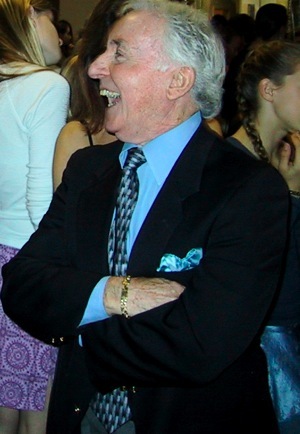
Here’s a photo of Holden at his 75th birthday party in 2003. Greatly enjoying himself, as usual, and looking scarcely a day older and just a mite grayer than when I’d known him some thirty years earlier:
Readers of this blog may have noticed I haven’t given a lot of space to the soap opera trials and tribulations of the Palin family. But it’s hard to ignore the news that daughter Bristol and her erstwhile swain Levi Johnston are engaged to be married.
For now. Forgive the cynicism, but I wouldn’t bet a lot of money on this marriage even occurring, much less being successful. The groom-to-be has revealed himself to be a low-life, although this recent news explains the origins of his recantation and apology to formidable mother-in-law-elect Sarah Palin. The latter must be hopping mad at the development, but has issued the following official statement, “Bristol believes in redemption and forgiveness to a degree most of us struggle to put in practice in our daily lives.” Translation: if she can forgive this scumbag, she can forgive anyone. I can’t. But I’ll suck it up for the sake of the grandkid.
Of course, couples with even less auspicious beginnings have worked out all right. So I’ll say no more except to wish them well. They’ll need it.
In a way, the first Tuesday of November 2010 can’t come fast enough for me. But in a way I’m dreading it, because so much is riding on it.
I think it’s the most important election—undoubtedly the most important midterm election—of my lifetime. There are pivot points in history when things can go in one direction or another, and this seems to be the best time (perhaps the last time?) to stop the leftist agenda of President Obama and the current Congressional leaders from getting a firm grip and creating changes that might be exceptionally difficult to reverse later on.
I’m fairly confident that there will be gains by Republicans. But will the results be enough to throw effective roadblocks in the way of Obamacare (by defunding, for example) and other unpopular bills this Congress has passed—including the ones I believe they are determined to pass in the lame duck session between November and the January swearing-in?
It’s far from clear. But one thing that does seem clear—crystal clear—is that when Obama is stumping for Democrats running for re-election in 2010, we’re not going to be hearing a word about the phony “bipartisanship” that he so loved to natter on about during the 2008 election campaign:
Barack Obama has decided that fiery self defense and withering mockery of Republicans are the best modes of attack as he tries to save Democrats from a drubbing in November’s mid-term elections.
No more Mr. Nice Guy; we know who Obama is now, so he doesn’t have to pretend any more.
Remember how much fun it was to taste a bit of the raw batter during the making of cakes or cookies when you were a child? Well, that simple joy ended years ago, when raw eggs were nixed because they carried salmonella. Off limits, too, became the many wonderful recipes featuring raw egg whites, such as this favorite, unless one wanted to live especially dangerously.
And have you tried ordering a medium rare hamburger lately in a restaurant? Faggetaboutit. Oh, they’ll ask you how you’d like your burger cooked, all right. But if you answer with a request for anything less well-done than “medium,” they’ll sigh and say they just can’t do it. E.coli, you know.
And now we have warnings about two foods that heretofore seemed especially innocuous, salsa and guacamole:
The dishes were blamed for one in 25 identified outbreaks of food poisoning at restaurants between 1998 and 2008””more than twice the rate of the previous decade, the CDC said. Often, the outbreaks were traced to raw hot peppers, tomatoes and cilantro””common ingredients in salsa and guacamole.
The worst thing I’d ever previously thought salsa and guacomole could do to me was to taste so yummy with taco chips that I’d eat too much of them and gain weight. So could the food police please just stay away for a change and leave us to enjoy our simple pleasures, unmolested? Thank you; much obliged.
I watched the World Cup finals yesterday with a bunch of people who care a great deal more about soccer than I do (not difficult, since I care scarcely more about soccer than I do about curling).
The world disagrees with me, of course; soccer is the most popular sport on earth. And so the term “world” in “World Cup” is a great deal more apropos than it is in other similar titles such as “World Series.”
As I joined a gazillion others in viewing the proceedings yesterday, I could not help but think the following:
(1) BOR-ing! Perhaps if I understood the finer points I would find the game hyper-exciting, but then again perhaps soccer is just a defensive, repetitive, low-scoring snore.
(2) Come to think of it, though, there are those muscular legs in those shorts. Very attractive indeed—although am I correct in noting that the shorts have gotten a bit longer over the years? Not a good trend, IMHO.
(3) There’s a lot of pretending to be injured in order to penalize the other team, complete with writhing around on the ground in seeming agony while grabbing the knee, and then bounding up pretty quickly after the umpire makes the call.
(4) Spanish guys are smaller and slighter than guys from the Netherlands.