And in completely unrelated news, this feat is astounding, especially to us non-runners. I’m glad it worked out well; seems potentially risky, though. I wouldn’t recommend it for most people. But then, most people wouldn’t try to do it in the first place.
No surprise here, except perhaps in the early timing.
Christie and Romney are the type of Republicans many call RINOs. They are somewhat moderate compared to conservative voters, some of whom don’t trust them to be unwavering enough in their support of conservative principles, especially on social issues.
I think that both Cristie and Romney are fiscally conservative, which is the most important thing at the moment (yes, I know about Romneycare; a longer post on that is coming one of these days). And although Christie and Romney are very different in style—and I prefer Christie’s blunt straight-shooter attitude and his sense of humor to Romney’s smoothness—one experience they share above all is being (or having been, in the case of Romney) Republican governors in Democratic states. That’s a special circumstance; probably only Ronald Reagan emerged from it with his conservative bona fides intact.
And sometimes I wonder whether some conservatives might even consider Reagan to be a RINO by today’s stricter standards.
In today’s WaPo Marc Thiessen lists and describes the errors Attorney General Eric Holder has made since joining the Obama administration. It makes for sobering reading; “Fast and Furious” is only the most recent in a lengthy accounting. And yet:
President Obama says that he has “complete confidence” in Attorney General Eric Holder. That’s good news for Republicans. Pick almost any unnecessary, losing battle in Obama’s first term, and his hapless attorney general is at the center of it.
If not for the fact that so many of Holder’s decisions harm national security, he would be a political dream come true for the GOP ”“ delivering up reliably disastrous controversies for the president every few months.
Of course, with Obama’s proclivity for doing an about-face, he could abandon Holder at any moment, as would appear to be politically prudent. But there’s been speculation that that will happen for years, and it has not yet occurred.
Why not? My answer is not substantially different than it was back in February of 2010 when I wrote a post entitled “Is Holder about to be tossed?” (sound familiar?), in which I refer to Holder as a “proxy” for Obama and then add:
…[M]y gut senses a close identification between Obama and Holder, an almost-Vulcan-mind-meld between them on the legal issues involved…This is not a compliment to either man; I think both are sadly misguided.
Holder serves a purpose for Obama. If there is an issue on which the President is somewhat loathe to express his opinion fully, perhaps because he knows it will be unpopular or controversial, I believe that Obama purposely uses Holder as cover, to draw the opposition’s criticism and deflect it from himself.
Perhaps the proper word for the relationship might be “surrogate” or “mouthpiece.” This is not to say that Holder does not have opinions of his own. I am not claiming he is a puppet. But his opinions are so closely in sync with Obama’s on these issues that for all intents and purposes they are one.
For this reason, I disagree strongly with those who think Holder is about to go. I suppose Obama might sacrifice him if it becomes necessary for strategic reasons (after all, he’s been known to do such a thing). If the decisions they both support because so unpopular Obama feels the need to disassociate himself from Holder and use him as scapegoat, it will happen. But this would only occur in the most extreme of situations, because Obama is so wedded to these views himself, and they are completely integral to his own attitude about the legal status and treatment of terrorists.
Holder is also no ordinary Cabinet appointee for Obama. They have known each other since 2004, the year Obama first achieved a national profile. The two met at “a dinner party hosted by former White House aide Anne Walker Marchange, niece of Clinton friend Vernon Jordan.” Very soon after declaring himself a candidate in early 2007, Obama requested that Holder be part of his campaign, and “Holder served as a legal adviser and strategist and led Obama’s vice presidential search committee.”
Holder is a trusted adviser and member of Obama’s inner circle. It probably doesn’t hurt, either, that Holder is a graduate of Columbia and a former basketball player, much like Obama. But it’s their common attitude towards law that creates the strongest bond between the men. As Holder says, “We are on the same page.”
And I don’t think Obama is eager to turn that page.
What about that piece would I change if I were writing it today? Not a whole lot, really. Holder is a relative newcomer compared with Valerie Jarrett, who was Obama’s (and wife Michelle’s) mentor in matters both political and social in Chicago beginning 20 years ago, but he is highly important nevertheless, and not just as an appointee.
If Obama is the loner people say he is, then old and trusted friends—especially ones that predate his presidency—become even more important. If he jettisons them, who is left?
You may notice that I haven’t written a word so far about the Wall Street protests, although plenty of others have. That’s because I don’t think these demonstrations are going to end up being especially important in the larger political scheme of things. I don’t envision the protests growing a whole lot bigger, for example, although of course I could be wrong about this.
But for now the protests seem to exist mainly as a conduit for those on the left who dearly wish the glory days of the 60s would return, when demonstrations were large and actually seemed to influence public policy. It would give them something so many aging boomers now have: the chance to look back with the warm glow of nostalgia and pride in their declining years at their fiery and politically meaningful youth.
The main impulses driving the Occupy Wall Street protests seem to be a combination of leftist class politics, anger at diminishing opportunities for money spent (often in the form of student loans), and the desire to vent (as well as, in a few cases, financial rewards for joining up). But I think one significant thing about these protests is that they are the first ones I’m aware of in this country that channel a supposedly anti-establishment rebellion that is nevertheless basically in league with a current administration rather than against it.
Think about it; isn’t it usually the current government that’s being raged against? I haven’t done an exhaustive search, but it appears that there’s a paucity of anti-Obama signs and sentiments among those camping out in Zuccotti Park. That’s not to say that the protesters aren’t frustrated with Obama in many ways, but he is not their focus but their cheerleader, having long employed divisive rhetoric to stir up anger against those titans of finance who have now become the targets of the protesters’ rage.
And this despite the fact that Obama himself benefited greatly from Wall Street, from which he drew supporters, contributors, and advisers. At the same time, however, his rhetoric has excoriated them, a neat trick that perhaps only Obama would have the audacity to try to perform.
It’s not that Obama has created the rage against Wall Street through his rhetoric. But he has fed it and encouraged it and has supported it, as part of his effort to become the most intentionally divisive president in memory. Peter Wehner writes:
It was Obama, after all, who ”“ more than any political figure in our lifetime ”“ promised to heal the breach. That was at the very core of his message, and his appeal, during the last presidential election.
For example, in his announcement speech on February 10, 2007, it was Obama who complained, “We’re distracted from our real failures and told to blame the other party”¦” He would not sink to such depths, he promised us.
The Occupy Wall Street protesters have probably forgotten that message, if they ever listened to it (or believed it) in the first place, and so hypocrisy on that score is probably not one of the things that frustrates them about Obama. If anything, they probably think he hasn’t been divisive enough—or at least not clever enough about his divisiveness. Now it’s time to up the ante, and if Obama won’t do it, they’re going to have to do it themselves.
It’s an idea whose time has come, so we’ve got another article to match yesterday’s, where Obama is again described as increasingly isolated and confused:
The gist is this: President Obama has become a lone wolf, a stranger to his own government. He talks mostly, and sometimes only, to friend and adviser Valerie Jarrett and to David Axelrod, his political strategist.
Everybody else, including members of his Cabinet, have little face time with him except for brief meetings that serve as photo ops. Secretary of State Hillary Rodham Clinton and Treasury Secretary Tim Geithner both have complained, according to people who have talked to them, that they are shut out of important decisions.
A number of people on this blog have speculated, beginning quite some time ago, that Obama might end up having some sort of breakdown. I don’t think that’s what happening, although of course it can’t be ruled out. I think his psyche is a lot more well-defended than that.
But when there’s stress—and Obama is undoubtedly undergoing stress, and possible threats to his long-held assumptions about himself and his own competence—people tend to fall back on the defense mechanisms they know. If these articles are true, Obama’s method appears to be to pull back from feedback, especially of the negative variety; keep his own counsel; and blame others for what’s gone wrong.
The title of the new article is “Aimless Obama Walks Alone.” So this could be his theme song:
The CNN headline screams “Cain: Racism not holding anyone back.” Inflammatory words, although Cain—as a black man himself—is probably one of the few people who wouldn’t be immediately disqualified from office for saying them.
But did he say them? Nope:
“I don’t believe racism in this country today holds anybody back in a big way,” Cain said on CNN’s “State of the Union.” “Are there some elements of racism? Yes. It gets back to if we don’t grow this economy, that is a ripple effect for every economic level, and because blacks are more disproportionately unemployed, they get hit the worst when economic policies don’t work. That’s where it starts.”
The gist of the rest of Cain’s remarks is that although there’s a residual amount of racism, it’s not a big factor for most people, who sometimes use it as an excuse for their failure to achieve. And that lack of education and concentration in economically distressed cities such as Detroit are other factors.
As a child I don’t think I was unusually susceptible to the power of advertising. I wasn’t especially into acquiring goods, either.
But there were a couple of things I craved because I’d seen them on TV. They seemed magical, and I thought I needed them in my child version of the pursuit of happiness.
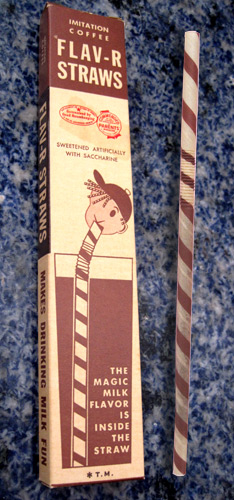
The first was Flavor Straws (or rather, “Flav-r Straws”:
The straws promised to alleviate the bad taste of the dread milk, turning it magically into chocolate or strawberry milk simply by sipping through them. Why this was so very much better than mixing in the Hershey’s syrup by hand I don’t really know. But hey, that’s the power of advertising.
The straws themselves failed to deliver the goods; they didn’t flavor the milk much. And when, in my frenzy to help things along, I tore one open and tasted the pellet of flavoring inside, it was dreadful, bitter and artificial and really quite ghastly. So the Flavor Straw died a fairly quick death, at least in my house.
Tiny Tears was another thing altogether. She was a baby doll with a gimmick: you could fill her with a bit of water, press on her belly, and she cried “real” tears out of two little ducts next to her eyes. Not only that, but she came with a nicely fitted layette, and a little pipe though which she could blow bubbles.
Even better, Tiny (at least the version I saw most advertised on TV, and the one I eventually received in response to my pleas) looked a bit like me, because she had short dark curly hair. Don’t go by the illustration at her Wiki entry, which denotes a later version. The one I had looked like this:
My mother must have given her away in due time. I could replace her now to the tune of many hundreds of dollars; she’s a collectible. Although I think I’ll pass on that, there was something about that particular doll that stirs a depth of memory. Doing the research for this post, and looking at the photos, it all comes back to me: the ads, the excitement, the longing, the opening of the doll box, the experimenting to try to get the tears to work—like the Flavor Straw, not always successful, but on the whole far more satisfying.
It’s becoming clearer and clearer that Obama, unlike many presidents, is not a people person. He not only doesn’t have many friends but he doesn’t have many advisers, and those he has retained are the ones he’s had for many years. The portrait is of the man most of us have already seen: tight, distrustful, and cold.
Wilson quotes the White House as often saying during the administration’s first two years, “Good policy makes for good politics.” That may be at least partly true, although if you alienate enough powerful people you might have trouble pushing your policy even if it’s very good. The trouble with Obama’s policy is that it’s not good, as even liberals are starting to agree. Unlike conservatives, they may find it not radical (or steadfast) enough, but the common denominator is that Obama is lacking in both arenas, policy and people skills.
Wilson’s article is pretty easy on Obama; he seems to be an admirer who thinks Obama has a few flaws that might doom his campaign for a second term. But he correctly locates the moment when Obama really went wrong as when he abandoned any pretense of working on jobs for the unpopular push for Obamacare. Wilson never quite explains why Obama did this, if he’s so all-fired smart. But this wistful quote nicely illuminates the condescending know-it-all quality of this administration towards the little people:
“What if we proposed something that was actually popular?” one senior adviser who was not part of the campaign said a year into the administration. “There’s only so much spinach people are going to eat.”
But what if Obamacare isn’t spinach, it’s horse manure? What if the people can smell it a mile away? Maybe “popular” isn’t always “bad.” Maybe the people knew what the president’s priorities should have been, and maybe being responsive to them would have been both good policy and good politics.
I’ve been amazed at the scope and depth of the reaction to the death of Apple’s Steve Jobs. It goes beyond the fact that he was relatively young and very prominent and influential. We’re seeing what looks like deep grief and personal loss on the part of people who didn’t even know him.
I was sad to hear he’d died, as I’d be sad to hear of the death of almost anyone relatively young, with four children and a wife and a lot of life in him, and more innovative work he could have done. But I’m not a Mac aficionado nor am I a techie, and I hadn’t followed the career or life of Jobs in anything except the most cursory way.
So I don’t share that intensely personal reaction of others, and at first I didn’t understand their grief. But on reflection I think I get it. Jobs was one of those people who really did “follow his bliss.” He seems to have been a unique and powerful mind almost from the start, with strengths in various areas: technical innovation combined with an esthetic sense, knowing what people would want even before they did, and organizing and managing things and people to produce the products that would profitably fulfill those wants and create more.
In doing this he rubbed a lot of people the wrong way. Those who worked for him often found him abrasive and difficult. But most of us didn’t work for him; we only got to look in from the outside, and to use his products for work or play. And that’s part of the secret to the strong emotional reaction to his death: we may not have known Jobs personally, but Jobs as innovator affected us in extremely personal ways—by changing the methods and technology by which we learn, work, and entertain ourselves.
The other thing about Jobs’s death that I believe struck people is the more conventional one: the relatively early death of a guy who seemed to have it all but who couldn’t stave off fate. The memento mori proves the truth of the poet’s words, that death is also a universal and an equalizer:
The boast of heraldry, the pomp of power,
And all that beauty, all that wealth e’er gave,
Awaits alike th’ inevitable hour:-
The paths of glory lead but to the grave.
I’ve been trying to think of someone who else whose life and death has affected people similarly. I can’t. The closest I can come is a combination of Thomas Edison (can’t find much about the reaction to his death, but I doubt it was anything like the grief over Jobs) and Walt Disney.
It’s the latter, strangely enough, whom I think Job resembles more than the former. Disney was an innovator who affected people in terms of entertainment, creating a huge empire that began with cartoons but expanded into amusement parks of unprecedented scope.
It seems I’m hardly the first person to make the Jobs/Disney comparison, although it occurred to me independently; I hadn’t read articles like this one when it came to me. But even Jobs’s associate Steve Wozniak seems to think it’s Disney whom Jobs most resembled, not Edison (the relevant passage begins at minute 4:15—and my guess is that Wozniak thinks that Wozniak resembles Edison more than Jobs did):
The comparison is even more clear than that, because one of Jobs’s lesser-known business interests was acquiring Pixar and developing the film “Toy Story,” an extension of the computer into the cartoon world. The connection between Jobs and Disney later became even more direct, as you may be surprised to discover:
The bulk of [Jobs’s] wealth came from his 7.4 percent stake in The Walt Disney Co. — 138 million shares — worth $4.4 billion. Jobs acquired Pixar in 1986 and Disney bought the computer animation studio in 2006, placing Jobs on Disney’s board of directors. According to Bloomberg, Jobs’ Disney stock paid him at least $242 million in dividends before taxes since 2006. Jobs was the single largest shareholder in Disney, the parent company of ABC News.
Jobs was a very rich man, and he probably enjoyed that wealth. But he seems to have been driven by something else:
In 1993, Jobs told the Wall Street Journal: “Being the richest man in the cemetery doesn’t matter to me”¦Going to bed at night saying we’ve done something wonderful”¦that’s what matters to me.”
Much of the world seems to agree that Steve Jobs did something wonderful.
[ADDENDUM: And here, right on schedule, is a comparison of the grief at the death of Edison to the death of Jobs.]
In some ways the news that the U.S. Preventive Services Task Force has stopped recommending routine prostate cancer screening through the mechanism of the PSA blood test mirrors the same group’s finding in 2009 that routine mammograms for women between 40-50 should no longer be suggested.
The problems the panel faces are very similar to those it was grappling with in the mammogram situation: a simple and relatively inexpensive screening test for a fairly common but extraordinarily nasty disease, confusing and difficult-to-evaluate statistics about whether or not the test really decreases mortality, and a treatment that has its own negatives in terms of pain and suffering (both physical and emotional). Now as then, the task force will be accused by some of cutting back on a benefit in order to save the money that would otherwise be spent to cover the test and its results. The doctors will be seen as hard-hearted and/or scientifically incompetent or simply wrong in their conclusions.
But although the two situations (mammograms and PSA tests) are somewhat similar they are not identical, with the mammogram decision actually being somewhat easier. As I wrote in November of 2009, when I disagreed somewhat with the panel’s recommendations:
The listed harms of extra mammograms seem minor although more frequent [than the harms of not doing them], the benefits admittedly less frequent but rather more major””life vs. death, for example. And deaths in the age group specified””women in their forties””involve a population of young mothers. We’re not talking about death squads for grandma here; we’re talking about mommy.
Prostate cancer is a related but somewhat different disease with even more confusing demographics and more serious (and common) side effects of treatment, presenting doctors with a host of conundrums [emphasis mine]:
Prostate cancer is the second-leading cause of cancer death among men, after lung cancer. In 2009, it was diagnosed in approximately 192,000 men. A small number of tumors are very aggressive, but the majority of prostate tumors are not likely to cause death. They grow very slowly, and only a fraction break out of the prostate, seed new tumors in other parts of the body and kill the patient. The current thinking is that about 30 percent of men in their 40s have prostate cancer, 40 percent of men in their 50s and so on, right up to 70 percent of men in their 80s. Yet only 3 percent of all men die from the disease. In other words, far more men die with prostate cancer than from it, and only a tiny fraction of prostate cancers ever cause symptoms, much less death.
But here is the tricky part: Unless there are symptoms or a finding on a physical exam, doctors generally cannot accurately predict which cancers are destined to be indolent, to sit around for years growing slowly, if at all, and those that will ultimately prove lethal.
You can see the dilemma, and it’s far worse than that facing doctors advising women about mammograms, because breast cancer—although common—is both less frequent than prostate cancer and far more reliably lethal if left untreated. What’s more, the interventions for prostate cancer are especially troubling and common in their possible side effects:
About half of men who undergo radiation or surgery [for prostate cancer] will have permanent side effects like impotence and incontinence. Up to 1 in 200 men die within 30 days from complications related to the surgery.
Those who advocate routine screening say it’s worth it in lives saved. But opponents point to studies that show no difference in mortality between the screened and the unscreened.
Until we know more, the best solution is probably (as the article concludes) to inform men of the risks and benefits of screening before they take the PSA test and let them decide whether they want to roll those iffy dice. This follows a recent trend in medicine in which patients are more and more often being asked to take responsibility for decisions that used to be the province of doctors. This is either good or bad depending on how much you want to depend on your doctor.
[NOTE: And, of course, the entire issue has insurance consequences: will PSA tests now be removed from routine coverage?]
[ADDENDUM: On a lighter note, those of a certain age may get the reference in the title and first line of this post. But for the others, here’s some help:
Word is that Harry Reid has invoked the so-called nuclear option, although to me it seems different (and less comprehensive in effect) than my previous understanding of how a nuclear option would work.
Allahpundit takes a stab at explaining; Reid’s move appears to be aimed at restricting a minority party’s attempt to offer amendments after cloture has already occurred. That’s what Philip Klein says, too.
So although everybody seems to be calling Reid’s gambit “shocking,” I’m not so very shocked. After all, Reid had originally planned to do far worse at the beginning of this Congress. The recent move is along the lines he’d promised but far less dramatic in its effects. That said, it still sets a bad precedent for minority party rights in the Senate—a precedent that could backfire on Reid and the Democrats if they lose control of the Senate after 2012. That’s why both parties have so far refrained form this type of action before; it can come back to haunt them later when the pendulum swings.