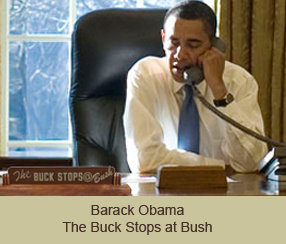
I know that there are plenty of braggarts and liars in politics, especially among so-called “surrogates”–i.e. advisors, campaign managers, official advertisements, PAC advertisements, supporters, and the like. And vice-presidents; perhaps especially vice presidents.
But I’ve never seen—or at least cannot remember—a sitting president sinking quite as low as Obama regularly does these days while campaigning (which is what seems to occupy an enormous amount of his time and energy). And he doesn’t need surrogates; he does it himself, bragging on his exploits and lying—usually in a very subtle manner, by innuendo rather than direct accusation—about his opponents.
What’s got me going this time? The “Mitt-Romney-wouldn’t-have-killed-Bin-Laden-like-I-did” meme that the Obama campaign’s been spouting off on lately.
The first problem is that it’s hypocritical, because Obama has criticized opponents for using this sort of thing for campaign purposes:
This is the same President who once criticized Hillary Clinton for invoking bin Laden ”˜to score political points.’
This is the same President who said, after bin Laden was dead, that we shouldn’t ”˜spike the ball’ after the touchdown. And now Barack Obama is not only trying to score political points by invoking Osama bin Laden, he is doing a shameless end-zone dance to help himself get reelected.
So, what did Obama actually say yesterday? Try this on for size; it was the president’s answer to a press conference question in which a reporter specifically asked about the controversy, mentioning Romney by name:
“I’d just recommend that everybody take a look at people’s previous statements in terms of whether they thought it was appropriate to go into Pakistan and take out Bin Laden.”
“I assume that people meant what they said when they said it. That’s been at least my practice,” Obama said from the East Room of the White House, during a joint news conference with Japan’s prime minister. “I said that I’d go after Bin Laden if we had a clear shot at him, and I did. If there are others who have said one thing and now suggest they’d do something else, then I’d go ahead and let them explain it.”
A particular pet peeve of mine is the use the weasel word “people” when the speaker actually means someone quite specific. In this case it’s undoubtedly Romney to whom Obama is referring, as is clear from the context. Here’s the video for that:
Obama knows that Romney will try to “go ahead and explain it,” but that most people won’t be listening to him. But here, for those who are paying attention, is what Romney said. He’s done plenty of ‘splaining already:
If you missed the origin of this controversy, it comes from an Obama campaign commercial that heaps credit on Obama for Seal Team Six’s raid on Obama’s house, and suggests that Romney wouldn’t have authorized the mission. The Romney quote is, “It’s not worth moving heaven and Earth, spending billions of dollars just trying to catch one person.” Of course, Romney didn’t say what Obama now claims he did”“that, if we knew bin Laden’s whereabouts and were prepared to kill him, Romney would decline to authorize the mission. Within a few days after the speech from which the quoted sentence came, Romney was asked about it in a presidential debate:
Romney: Thank you. Of course we get Osama bin Laden and track him wherever he has to go, and make sure he pays for the outrage he exacted upon America.
Moderator: Can we move heaven and earth to do it?
Romney: We’ll move everything to get him. But I don’t want to buy into the Democratic pitch that this is all about one person ”” Osama bin Laden ”” because after we get him, there’s going to be another and another.
This is about Shia and Sunni. This is about Hezbollah and Hamas and Al Qaida and the Muslim Brotherhood. This is a worldwide jihadist effort to try and cause the collapse of all moderate Islamic governments and replace them with a caliphate.
They ultimately want to bring down the United States of America.
This is a global effort we’re going to have to lead to overcome this jihadist effort. It’s more than Osama bin Laden.
But he is going to pay, and he will die.
I’m not sure why this particular episode has galled me so much. It isn’t just that Obama engages in this sort of thing—which, after all, is hardly unheard-of in campaigns—but that with so many people his reputation for honesty and uprightness and integrity remains unbesmirched. How does he pull that one off?