
Burger King tells Mayor Bloomberg…
Meanwhile, in North Carolina…
…Obama is losing significant support among African-Americans, not unlike what’s been happening among Jewish voters.
It may be enough to swing North Carolina into Romney’s column.
Note that I wrote that Obama is losing support. But I suppose it’s at least theoretically possible that Romney is gaining support.
After all, just a couple of weeks ago in late May, there was a sprinkling of articles like this one in the WaPo entitled, “Romney campaign begins quiet push for African American voters.” The article’s thrust was that Romney was not going to win over any of these voters—and in fact his very presence offended some, such as 78-old-old Philadelphian Madaline G. Dunn, quoted in the piece as graciously saying, “It is absolutely denigrating for him to come in here and speak his garbage.” But others, such as Bill Galston of the Brookings Institute, emphasized that appealing to black voters would be likely to help Romney seem tolerant in the eyes of white voters, which would enhance his electability with them, at least.
But Tara Wall, a communications adviser of Romney’s, in charge of outreach to African Americans and the most senior African-American on Romney’s team, insists he’s sincere:
…[W[e can’t go in with the mind-set that we aren’t going to win any people over to our side…From a messaging standpoint, we need to be able to communicate and relate to these communities about how they are being impacted by Obama’s policies. It’s the right thing to do, and it’s an important part of the process. It’s not a ploy, it’s not a tactic, it’s part of who we are. We have to show up.
Well, I’ve heard it said that the first thing you need to do is show up.
In the comments section of the WaPo article, I noticed a suggestion that Republicans adopt the following slogan to appeal to black voters: “Come back home.” Of course, people who have no idea what the relative histories of the Republican vs. the Democratic parties were during the days of the Civil War, Reconstruction, and Civil Rights up to Lyndon Johnson’s day would scratch their heads in puzzlement at that catchphrase. But a little history lesson about the history of the Republican Party and civil rights wouldn’t be a bad idea.
Obama’s bad week: losing his turns
There have been a lot of articles lately about Obama’s terrible, horrible, no good, very bad week.
The “private sector is doing fine” remark seems to have been a catalyst, but there have been a host of other indications lately that the president’s campaign is beginning to unravel. I submit, however, that it’s not time to crow, although it is time to be optimistic. But it’s still a long five months to November, with many many many events that can happen to change things before then.
However, there does seem to have been a snowball effect. I think one of the things that’s occurred is that Obama has lost his turns. Whatever am I talking about? A dance analogy may be an odd one, but it’s the one that occurs to me:
Likewise with dancers. You can see them practicing their turns after class, over and over and over, looking in the ever-present mirror to see if they can detect that elusive flaw that’s spoiling their turns. Because when turns go, it’s not a pretty sight. Balance is a thing that’s either on or off; a person who could once do four flawless revolutions from a single push-off preparation will now have trouble getting around twice””perhaps even hopping to complete the revolutions or, (for a female) falling off pointe, which can involve an ignominious and dangerous pratfall.
Virtually all dancers know that losing one’s turns is a possibility every time they take the preparation for a turn (usually a momentary pause in fourth or fifth position with the knee bend known as a demi-plie, eyes fixed on something ahead for the “spotting,” arms poised to whip and then close in for a bit of added impetus. It’s a leap””well, not exactly a leap””of faith, a push into the unknown. Will the turn hold? The dancer has to have the confidence that it will, and relax into it, bringing together all his/her technique and knowledge without really thinking about it. It’s part of the dancer’s body memory, and trust has to enter into it.
Obama has long been an extremely confident man. Arrogant, even. That’s part of the problem for some of us, and part of his charm for others. But his confidence contributes to his—confidence. It’s a trait that feeds on itself, and when it’s lost, it’s hard to recover—even for a narcissist, who may cling ever more tightly to the illusion of confidence and yet find him/herself increasingly awkward and error-prone.
More on Bloomberg’s drink ban, and liberty
I suggest you read the whole thing—but here’s what I take away from this article on NYC Mayor Bloomberg’s efforts to ban large sugary drinks, as well as previous health efforts to protect the Big Apple’s citizens from their own rapacious appetites:
There is little available data showing the cost of the programs, the number of participants or the results.
It’s taken as a matter of faith that this sort of thing works, though. Some of the people interviewed for the article seem to know better, such as Bronx borough president Ruben Diaz Jr.:
“Ultimately people need to be responsible for their own actions,” Mr. Diaz said, explaining that “if they’re of a certain mind-set, they’re going to continue to have poor eating habits, and we’re still going to have the same problem.”
But in the following quotes, we have an academic at Yale, and Bloomberg himself, perfectly elucidating the liberal mindset—it’s health vs. liberty in opposition to each other, with the former taking priority over the latter:
Kelly D. Brownell, the director of the Rudd Center for Food Policy and Obesity at Yale University, said that while education and incentives were popular with the public, those programs tended to reach relatively small numbers because of their limited funds. He said he supported the use of regulations like the city’s proposed ban on large sodas as a necessary step toward curbing obesity.
“It completely makes more sense to make the environment healthier rather than to just do pure education,” he said.
In defending his proposal, Mr. Bloomberg said at Montefiore that the ban was not intended to tread on anyone’s rights, and he noted that more than individual liberties were at stake. “We are absolutely committed to doing everything in our power to help you get on track and stay on track to maintain a healthy lifestyle,” he said. “Because this isn’t your crisis alone ”” it is a crisis for our city and our entire country.”
And yet, even if you forget about the compromise to liberty—which is a huge and vitally important issue—there is no evidence that such programs work. We really know very little about how to successfully and permanently control obesity even in well-motivated people, and we also know little about the health effects of being slightly overweight, the most common type of problem.
And before some of you tell me in the comments section that I’m missing the point, because for far leftists the compromise of liberty is the point—a feature, not a bug—I’m not talking about them. I’m talking about the more numerous well-meaning (oh, save us from the well-meaning!) liberals who think sacrificing their liberty to buy a supersized Coke is a very small price to pay for increased health, and don’t see the dangerous slippery slope they’re on—and don’t much care until they found we’ve slid quite a bit further down that hill.
I know it’s exceedingly trivial, but…
…here’s the question of the day: what do you think of Sarah Palin’s new eyeglasses?
When I first saw them, I was shocked that I was shocked to see that her eyeglass frames were new. It’s odd how a person’s eyeglasses can become such a familiar part of his/her face that the viewer experiences any change as a jarring jolt.
Palin had signature thin rims and now she’s got thick ones, a much stronger eyeglass statement. Did she want to look more authoritative? More of a mental heavyweight? DId she succeed? Or was she just tired of the old look?
I like them. But of course, Palin would look good in almost anything.
Jews cooling on Obama—sort of
Jewish support for Obama has declined 10% from 2008.
That’s a not insignificant amount, although it may seem small. But it only seems small if you don’t realize how deeply ingrained Jewish Democratic affiliation is. Also, compared to Obama’s drop among other groups that support him, this exceeds the average decline.
It was sociographer and Commentary writer Milton Himmelfarb who famously said “Jews earn like Episcopalians, and vote like Puerto Ricans.” That was back in the non-PC 1950s, when you could get away with saying something like that without offending Puerto Ricans too deeply (no one cares about offending Episcopalians). But it turns out that these days Jews vote more like Puerto Ricans used to than Puerto Ricans do today.
Why? Norman Podhoretz tackled it in 2009, here:
…Mr. Obama beat Mr. McCain among Jewish voters by a staggering 57 points. Except for African Americans, who gave him 95% of their vote, Mr. Obama did far better with Jews than with any other ethnic or religious group. Thus the Jewish vote for him was 25 points higher than the 53% he scored with the electorate as a whole; 35 points higher than the 43% he scored with whites; 11 points higher than the 67% he scored with Hispanics; 33 points higher than the 45% he scored with Protestants; and 24 points higher than the 54% he scored with Catholics…
Most American Jews sincerely believe that their liberalism, together with their commitment to the Democratic Party as its main political vehicle, stems from the teachings of Judaism and reflects the heritage of “Jewish values.” But if this theory were valid, the Orthodox would be the most liberal sector of the Jewish community. After all, it is they who are most familiar with the Jewish religious tradition and who shape their lives around its commandments.
Yet the Orthodox enclaves are the only Jewish neighborhoods where Republican candidates get any votes to speak of…The upshot is that in virtually every instance of a clash between Jewish law and contemporary liberalism, it is the liberal creed that prevails for most American Jews. Which is to say that for them, liberalism has become more than a political outlook. It has for all practical purposes superseded Judaism and become a religion in its own right. And to the dogmas and commandments of this religion they give the kind of steadfast devotion their forefathers gave to the religion of the Hebrew Bible. For many, moving to the right is invested with much the same horror their forefathers felt about conversion to Christianity.
All this applies most fully to Jews who are Jewish only in an ethnic sense. Indeed, many such secular Jews, when asked how they would define “a good Jew,” reply that it is equivalent to being a good liberal.
But avowed secularists are not the only Jews who confuse Judaism with liberalism; so do many non-Orthodox Jews who practice this or that traditional observance. It is not for nothing that a cruel wag has described the Reform movement””the largest of the religious denominations within the American Jewish community””as “the Democratic Party with holidays thrown in,” and the services in a Reform temple as “the Democratic Party at prayer.”
I haven’t yet read this book by Podhoretz, a longer treatment of the same question. But it’s on my “to-do” list.
The most shocking divorce story of all
For many more years than most people have been alive, they tried hard to make it work. And at least as far as all outside observers could tell, they succeeded.
No arguments, although neither was exactly the talkative sort. Companionate and tranquil would be two good words to describe this marriage. They didn’t move in the fast lane, but in the great race of life they got the job done.
But now, now—well let’s just say that this is not a a story that will warm the cockles of your heart. Although no one’s certain why the falling out occurred—and the two main protagonists aren’t telling—it’s bad, and it’s public:
“We get the feeling they can’t stand the sight of each other any more,” Zoo boss Helga Happ said.
Bibi and Poldi have happily rubbed along at the Austrian zoo in Klagenfurt for 36 years, having moved together from Basel zoo in Switzerland.
Both 115 years old, the pair grew up together – and eventually became an item.
However, you men may not be surprised to hear that the first overt act of aggression was initiated by the female tortoise—although who knows what terrible and secret provocation on the part of Poldi may have caused her to initiate such a desperate act?:
Staff at the zoo realised all was not well when Bibi attacked Poldi, biting off a chunk of his shell. She launched further attacks on her partner until he was moved to a different location.
Of course, at the ripe old age of 115, it could be senility.
Read it and weep.
Obama: the private sector is “doing fine”
I’ve been trying to figure this one out ever since it happened.
At first I assumed Obama’s remark that the private sector is “doing fine” was a truncated quote. But no, he really did say that, even in context. This video gives the entire statement, which was an ad lib answer to a reporter’s question rather than a scripted remark. Ad libs tend to be either careless errors, or especially revealing, or sometimes both:
So it becomes a matter of what he meant. Now, even if he meant something perfectly reasonable and yet said the above, it counts—as Romney said—as an “extraordinary miscalculation,” if only in the political sense, although it’s probably one in the mathematical and economic sense as well (which I believe is what Romney meant by using the phrase, although we can’t be too sure of that, either.) Some of the numbers are crunched here.
When I watch the video of Obama, I get the impression that he was first and foremost being strategic—that is, he was focused on the last part of his statement rather than the first, racing ahead in his mind to get to the “let’s blame the Republicans” part. And Wisconsin loomed large in his mind. So he didn’t stop to think what that first part sounded like to most Americans, in his rush to get out a message to undo the Wisconsin results and focus on how much we need to take care of public sector employees.
I think Powerline’s John Hinderaker has it just about right*, as well:
…I think there is more going on here then merely another instance of Obama’s cluelessness. Rather, I think the belief that the private sector is rich and the public sector is poor, so that transfers of wealth from private sector to public sector are endlessly justified, is embedded deeply in Obama’s ideology.
Another thing that’s very deeply embedded is that public sector employees and especially their unions are Obama’s natural constituency compared to private sector employees. Of course, exceptions to that rule are massive, but there’s nevertheless a strong tendency in that direction. Right now Obama is all about his own re-election and shoring up his base as well as appealing to those in the middle, which gives us another reason for his seemingly clueless remark: he’s trying to spin his record and say it’s not really so bad, and he hasn’t caught onto the fact that most Americans simply don’t and won’t believe him.
Defenses have come fast and furious from Obama supporters. They range from Andrew Sullivan’s predictable “he was taken out of context” (no, he wasn’t), to more convoluted responses such as this, which seem to rely on essentially ignoring the private sector remark and focusing on how it is that the mean old Republicans are stiffing the public sector.
Even Obama got into the defensive act this time, rather than just relying on surrogates, which showed that he’s at least aware that he may have wounded himself with his earlier remarks:
It is absolutely clear that the economy is not doing fine,” Obama said in his correction. “That’s the reason I had a press conference.
Fair enough. He never said the economy as a whole was doing fine. He continued:
I think if you look at what I said this morning and what I’ve been saying consistently over the last year, we’ve actually seen some good momentum in the private sector. There’s been 4.3 million jobs created, 800,000 this year alone, record corporate profits. And so that has not been the biggest drag on the economy.
That may have been what he meant, but it’s not what he said. He didn’t say that even though the private sector is still hurting, it’s doing a bit better than the public sector. He still it was doing fine. So it’s not that he was misunderstood. He was disagreed with: it depends what the meaning of fine is.
And it also depends on whether you’re looking at this chart. You can see that the private sector has taken an upswing lately compared to the relative flatness of the public sector line. But you can also see that the private sector is not doing fine compared to the public sector:
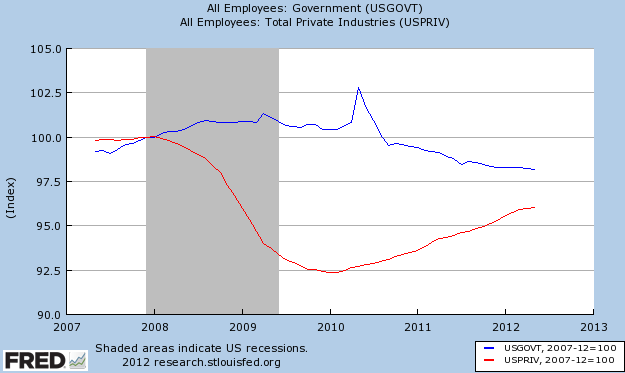
“Tone deaf” doesn’t even begin to describe it.
*I said Hinderaker had it right when he wrote that Obama’s remark rested on principles embedded in Obama’s philosophy. We can see that Obama is hardly not alone in this, as the following video of Harry Reid from October of 2011 attests:
Back then, Reid’s remarks got some press, although nothing like Obama’s recent coverage. There was even some discussion of what Reid meant, and an attempt at ascertaining the facts:
Republican staff from the Senate Finance Committee also said it would be difficult for Reid “to be more wrong” since as a percentage, more jobs have been lost in the private sector than in government since the start of the recession in December 2007.
“Bottom line: Private sector jobs have been greater both in absolute terms and as a proportion of the pre-recession base than government sector jobs,” the aides said.
Asked about the senator’s statement, Reid’s spokesman defended it as accurate.
“All he was doing was pointing out that most job losses in recent months have been coming from the public sector,” said Reid spokesman Adam Jentleson, noting that the president’s jobs bill “contains tons of provisions to encourage private sector hiring,” including tax credits for small businesses and write-offs for expenses.
“The bill currently on the floor is about cops and firefighters, and that was what he was talking about. (Reid), of course, thinks we need to spur hiring in the private sector,” Jentleson added.
It’s not usually a great idea to take a leaf out of Harry Reid’s book. But I think Obama arrived at the formulation independently, and for the same reasons and reflecting the same mindset. It’s sort of like the simultaneous development of the theory of evolution by Darwin and Wallace—only not quite so smart.
[ADDENDUM: John Podhoretz has a good analysis in the NY Post.]
More on the press and that photo of Kim Phuc
Yesterday’s PJ article and its comments yielded a couple of further thoughts. One was this comment at PJ, which I think succinctly sums up some of the problems in inherent in the presentation of war photos or indeed any other emotionally explosive news:
Pictures like this serve two purposes: One is to tell people that it’s OK to stop thinking about a complex matter…Another is to reinforce the idea that America…is always the bad guy.
And further, I think that “not thinking about a complex matter” is endemic to the press. As I wrote here, before I saw the comment above that I’ve highlighted:
Sometimes the facts were reported wrong regarding the photo. But sometimes they were merely omitted, or important parts omitted. Sometimes (I would guess) that omission was done purposely and strategically, but sometimes it was done ignorantly and without even realizing the importance of the deeper context.
So some members of the press report correctly, given their space limitations. But some press members knowingly mislead, either through actual lies or strategic omissions. And sometimes it’s the members of the press who are thinking too simply about a complex issue, and don’t even understand what it is that they’ve left out.
Day of blogger silence
Today is a National Day of Blogger Silence (a sort of oxymoron?). The purpose is explained in this post by Ace, and Michelle Malkin has much more to say here, including contact information (Malkin is nothing if not thorough):
Free speech is under fire. Online thugs are targeting bloggers (mostly conservative, but not all) who have dared to expose a convicted bomber and perjuring vexatious litigant now enjoying a comfy life as a liberally-subsidized social justice operative. Where do your elected representatives stand on this threat to our founding principles?
And if you follow this link, you’ll find what a lot of other bloggers have written on the matter.
Fortunately, I’ve written a piece for PJ that appears today, so you even have something of mine to read and comment on, despite the (relative) silence.
Blogging is an alternative and complement to the MSM that’s come to mean a great deal to a lot of people. It certainly does to me. I bet it does to most of you, too.
Forty years later: Kim Phuc, the girl in the photo
It’s been forty years since this photo shocked Americans:

Do you know the story behind the photo? I tell it in this article at PJ. Some of what you read may surprise you.
[NOTE: I’ve written about the photo before, in a different context. See this and this.]