…Depot.
[Hat tip: BenK at Ace’s.]
[ADDENDUM: I sincerely hope the couple had been acquainted beforehand.
And let me point out that this occurred at 8:40 AM, and that it gives new meaning to the term “shacking up.”]

…Depot.
[Hat tip: BenK at Ace’s.]
[ADDENDUM: I sincerely hope the couple had been acquainted beforehand.
And let me point out that this occurred at 8:40 AM, and that it gives new meaning to the term “shacking up.”]
Caroline Glick’s article on Obama and Syria seems to sum up the situation quite nicely—although “nicely” is hardly the proper word, because it makes for very sobering reading indeed:
It is important to note that despite the moral depravity of the regime’s use of chemical weapons, none of America’s vital interests is impacted by their use within Syria. Obama’s pledge last year to view the use of chemical weapons as a tripwire that would automatically cause the US to intervene militarily in the war in Syria was made without relation to any specific US interest.
But once Obama made his pledge, other US interests became inextricably linked to US retaliation for such a strike. The interests now on the line are America’s deterrent power and strategic credibility. If Obama responds in a credible way to Syria’s use of chemical weapons, those interests will be advanced. If he does not, US deterrent power will become a laughing stock and US credibility will be destroyed.
Unfortunately, the US doesn’t have many options for responding to Assad’s use of chemical weapons. If it targets the regime in a serious way, Assad could fall, and al-Qaida would then win the war. Conversely, if the US strike is sufficient to cause strategic harm to the regime’s survivability, Iran could order the Syrians or Hezbollah or Hamas, or all of them, to attack Israel. Such an attack would raise the prospect of regional war significantly.
Please read the whole thing.
The only part with which I’d disagree—and it’s not all that huge a disagreement, really—is that I think that US deterrent power has already become a laughing stock and US credibility been destroyed. The Obama administration has certainly accentuated and underlined and solidified this impression around the world, but it actually had already begun to occur in the final years of the Bush administration.
Obama’s 2008 election was a symptom of this change rather than an initial cause. It had already become clear, as the aftermath of the Iraq war and the American presence in that country wore on, and the MSM and many politicians in both the US and Britain and western Europe (including Senator Barack Obama) relentlessly pressed the liberal/left line against that war (featuring exaggerations and outright lies in addition to valid criticism in order to get the desired narrative across), that public opinion in the Western world had turned against the efforts in Iraq, and against further intervention and engagement of a similar nature.
Obama’s present waffling, red-line braggadocio, lack of focus on US interests and goals, and abandonment of allies is just icing on a cake that has been a long time in the mixing and baking. I suppose that doesn’t mean things couldn’t change at some future point, especially after Obama is out of office (after all, look at what happened in England during the buildup to World War II—first appeasement, and then Churchill’s resolve energizing the will of the people). But it doesn’t look likely, and even if it occurred it would take a long time to rebuild the trust that has been destroyed.
That does not mean that Obama is absolved of responsibility. On the contrary; he’s been working at this goal of disappointing allies, decreasing the influence and credibility of the US, and appeasing terrorists and Iran for a long time now, long before he became president. And he’s been helped by most of the Democrats in Congress and the majority of journalists.
[ADDENDUM: Also please read Richard Fernandez’s analysis of Parliament’s “no” vote.]
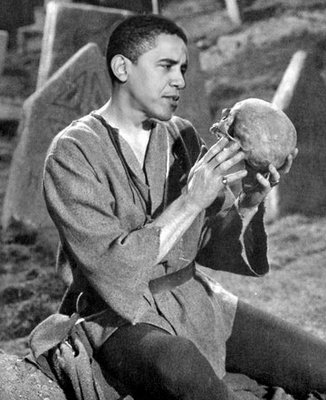
I’ve likened President Obama to Hamlet before.
Once more, it seems he’s made up his mind about what to do but then again perhaps he’s not made up his mind at all.
Maybe it’s all a clever strategic head-fake on his part. I doubt it, however; Obama’s slowness to come to a decision in military matters has become legendary.
The whole thing is also an opportunity for me to revisit my earlier rewrite of Hamlet’s famous “To be or not to be” soliloquy on procrastination and the perils of decision-making and gear it to Obama’s predicament. As before, I really needed to change very little to make it fit:
To strike, or not to strike: that is the question:
Whether ’tis nobler in the mind to suffer
The slings and arrows of outrageous Assad,
Or to take arms against a sea of troubles,
And by opposing end them? To attack: to dither
No more; and by attack to say we end
The heart-ache and the thousand natural shocks
That Syria is heir to, ’tis a consummation
Devoutly to be wish’d. To act, to attack;
To attack: perchance to depose: ay, there’s the rub;
For in its wake what next may come
Whether or not Assad shuffles off this worldwide stage,
Should give us pause: there’s the respect
That makes calamity of intervention;
For who would bear the whips and scorns of time,
The oppressor’s wrong, the proud man’s contumely,
The pangs of chemical war, the law’s delay,
The insolence of office and the spurns
That patient merit of the unworthy takes,
When he himself might his mark make
With a bare missile? who would tyrants bear,
To defy the red lines that he drew?
But that the dread of something afterward,
The unknown consequences in whose grip
A legacy might founder, puzzles the will
And makes us rather bear those ills we have
Than fly to others that we know not of?
Thus conscience does make cowards of us all;
And thus the native hue of resolution
Is sicklied o’er with the pale cast of thought,
And enterprises of great pith and moment
With this regard their currents turn awry,
And lose the name of action.–Soft you now!
The fair MSM! Sycophants, in thy orisons
Be all my sins forgotten.
This observation by Robert Frost has long been one of my favorite descriptions of a liberal:
A liberal is a man too broadminded to take his own side in a quarrel.
Of course, that’s only true when the quarrel is with a member of a protected group. A liberal has no such reluctance when quarreling with a conservative.
Looking for a site with the Frost quote led me here, where I found some others worthy of contemplation, such as this from William F. Buckley Jr.:
Liberals claim to want to give a hearing to other views, but then are shocked and offended to discover that there are other views.
I would add that liberals have a tendency to ascribe those views, when found and heard, to prejudice and/or malevolence.
Here’s Niall Ferguson:
So much of liberalism in its classical sense is taken for granted in the west today and even disrespected. We take freedom for granted, and because of this we don’t understand how incredibly vulnerable it is.
We’re learning fast, but not fast enough to stop the process, it seems.
”•
”•
…in the FBI and the military, no less.
We already knew that Nidal Nassan, the Fort Hood shooter, had given plenty of notice of his impending act of violence and that it was ignored, apparently for PC reasons. But the details are still shocking.
We have officially entered bizarro world. Or maybe we’ve been there for quite some time.
[NOTE: By the way, the phrase “run amok,” which I used in the title without really thinking all that much about it, has some interesting origins.]
Thirteen senior Army officers have sentenced Maj. Nidal Hasan to death for carrying out the horrific 2009 shooting rampage at Fort Hood Army base.
The panel’s recommendation will now go to a convening authority, the general responsible for assembling the capital court-martial, for review and approval. The convening authority can approve or reduce the sentence.
On Friday, Hasan was unanimously convicted on 13 charges of premeditated murder and convicted of 32 charges of attempted premeditated murder. His conviction carries a mandatory minimum sentence of life in prison and the panel was authorized to consider the death penalty.
This is no surprise. I think it is probably what Hassan wants, as well, although here’s what the prosecution had to say about that:
The government argued against the idea that a death sentence would result in martyrdom for Hasan. “He will never be a martyr because he has nothing to give. Do not be misled. Do not be fooled. He is not giving his life. We are taking his life. This is not his gift to God; this is his debt to society. This is not a charitable act. He is not now and never will be a martyr. He is a cold-blooded murderer,” argued prosecutor Col. Michael Mulligan.
It will take quite a bit of time to go through the appeals (no military executions have taken place since 1961, despite 16 military death penalty convictions since 1984), and I make no predictions as to whether the sentence will hold. But if it is overturned, it will probably be because Hassan had inadequate counsel: himself.
…one of these some day?
There’s something very wonderful about such an invention, as well as something very spooky.
[Hat tip: Instapundit.]
This article about the inadequacy of the NSA’s security check of Edward Snowden is behind a WSJ firewall, but here’s a discussion of what it said:
A federal review revealed that the U.S. government bungled NSA leaker Edward Snowden’s most recent background check…
Investigators missed key information in Snowden’s last background check, including a security violation and his employment with the Central Intelligence Agency. Furthermore, background checkers did not collect significant information from anyone other than Snowden’s mother and girlfriend.
It’s not that there was any huge red flag that was missed. But the check was cursory and incomplete on the face of it.
And these are the people tasked with gathering intelligence vital to our national security?
One of the odd things about Obama’s intentions on Syria is that the general plan has been leaked to the press. And unless it turns out be be a case of releasing incorrect information with the deliberate purpose of misleading Assad, it’s hard to figure out exactly why the administration would leak like this.
Obama’s defenders, such as Max Fisher, seem to think it’s a wise and well-thought-out move on the part of the administration:
Actually, publicly revealing when, how and where the United States (and some allies) will likely strike makes sense, given what Obama wants to accomplish. If his goal were to fully enter the Syrian civil war and decisively end it, then, yes, secrecy would be the way to go. But the administration has been very clear that it has a much more modest goal: to punish Syrian leader Bashar al-Assad for his suspected use of chemical weapons so that he, and future military leaders, won’t do it again.
What’s about to happen, if the United States and allies do go through with the strikes, is less of a war and more of a ritual. This isn’t about defeating Assad, it’s about punishing him. And that calls for being really precise about how much punishment the United States imposes…
…[W]hat the Obama administration appears to want is a limited, finite series of strikes that will be carefully calibrated to send a message and cause the just-right amount of pain. It wants to set Assad back but it doesn’t want to cause death and mayhem. So the most likely option is probably to destroy a bunch of government or military infrastructure ”” much of which will probably be empty.
Aside from the fact that it is probably a fantasy that we could ever read Assad’s mind to that extent and calibrate our strikes so precisely, there is the mystery as to why telegraphing the scope and intent of the attack in advance would be necessary for the success of the plan as described. Fisher indicates that letting Assad know how limited the strikes will be is likely to keep him from escalating and would also deter him from future chemical (or other) attacks, but as Bruce McQuain points out at Hot Air:
Since it is a limited strike and it is going to be against specific units, Syria has the option of dispersing them, an option I’m sure they’ll take. They’ll also likely disperse them in to highly populated urban areas where they can…
Since they have thousands of artillery pieces capable of firing chemical shells, it is unlikely a limited strike is going to even seriously dent that capability. Moving artillery into the cities would likely deter the US more than the US would deter Syria. Helicopters can be moved as well. They don’t need long runways. Other aircraft will be dispersed And finally, command and control are easily moved and dispersed.
McQuain goes on to add that Assad is likely to use chemical weapons again afterwards, just to prove he can and that he is undeterred by the likes of Obama. And, as the WSJ editors point out:
…[T]he attacks are primarily about making a political statement, and vindicating President Obama’s ill-considered promise of “consequences,” rather than materially degrading Assad’s ability to continue to wage war against his own people.
It should go without saying that the principal purpose of a military strike is to have a military effect. Political statements can always be delivered politically, and U.S. airmen should not be put in harm’s way to deliver what amounts to an extremely loud diplomatic demarche. That’s especially so with a “do something” strike that is, in fact, deliberately calibrated to do very little.
Even then, I’m not sure why an advance announcement would be necessary. Perhaps the intent is just to accentuate what a brave and intimidating guy Obama is, and how he keeps his word when he talks about red lines? I think this move might be another subset of Obama’s well-known propensity to overvalue his own rhetoric, and to think that words can substitute for works, and bluster can serve as well as brawn.
[ADDENDUM: Ace takes us for a stroll down memory lane, to that long-ago time when Bush was president and Senator Barack Obama had these ringing words to say about the possibility of Bush’s launching strikes on Iran:
The President does not have power under the Constitution to unilaterally authorize a military attack in a situation that does not involve stopping an actual or imminent threat to the nation.
That was then. This is now.]
Is there a solution to nagging? Just stop doing it, says Taffy Brodesser-Akner (that’s quite a moniker, by the way).
For most people, easier said than not-done.
But of course, I wouldn’t know. I never, never ever nag; I merely offer the occasional exceedingly helpful suggestion, the timely reminder, or the insightful non-directive open-ended question.
But enough about me (please!). The larger question I’m interested in is this: what is nagging? And why is it something men tend to accuse women of, but seldom vice versa? Is it just a question of labeling, or do women actually do more of it? Or is it that men are just more bothered by it, because they perceive it as being given orders rather than receiving requests?
Nagging tends to occur when the members of a couple have different standards about what’s desirable, often in terms of neatness or other tasks. Chore reminders are a classic source of marital nagging, and they can be highly annoying, leading the man to feel he’s married to either his mother or a schoolmarm or some combination of the two. A real turnoff.
But what’s a wife to do when her husband has agreed to do a certain chore and keeps neglecting, avoiding, or forgetting it, over and over and over? She can ignore the fact that he’s ignored it, but that can lead to a lot of pent-up anger and frustration on her part. She can vent that anger and yell at him and insult him—but good luck with that, because it can only escalate the problem and even ultimately destroy the relationship. Or she can nag very politely, making “I” statements and being careful not to order him around, which can sometimes still trigger his annoyance at the fact that she’s peck, peck, pecking away at him.
Some of these problems start when the woman makes a request and the guy says he’ll do it. Maybe at the time he says that he really does intend to do it, but it’s just not as important to him as it is to her, and later it slips his mind. Or maybe he never intended to comply in the first place, and was hoping she’d forget. Or is he showing her he can’t be pushed around? Or is it some combination of those things, plus embarrassment when his failure to do the task is pointed out to him, resulting in anger and counter-accusation (you’re a nag!)?
And by the way, these vicious cycles are usually a lot easier to avoid when you don’t live with someone. It’s also a great deal easier when there are no kids around to stress both parties out. So women who never nagged before can suddenly start doing it after living together a while, or after having children.
So, do men ever nag? And if and when they do, what’s it called?
[NOTE: Without really thinking too hard about it, I’d always assumed that the dual meanings of the word “nag”—to annoy by constant urging and chiding, and an old worn-out horse—were related in their origins. Surprisingly, however, they’re not.]