I’ll believe this when I see it.
But that’s what they need to do.

I’ll believe this when I see it.
But that’s what they need to do.
…are also stupid. But this Millennial says they’re not, and that’s why they’re not signing up for Obamacare in the requisite numbers. He especially points out how downright offensive and insulting the Obamacare ads pitched at the young have been.
Everyone noticed that right from the start. It’s especially puzzling because one thing you can say about Obama is that, in the past, he hired PR people who were geniuses at reaching the young. The young voted for him in droves and are actually responsible for the fact that he’s president. And although many on the right were puzzled by the appeal of ad campaigns such as the Julia one and the Lena Dunham one, the Obama team was pitch-perfect about this demographic and what would appeal to it. His team also managed to use the internet to carefully and precisely focus on their young targets with all sorts of appeals almost perfectly crafted to get them in exactly the right spot.
So what went wrong with the Obamacare messaging? Perhaps the problem was that what they were trying to sell wasn’t so much a dream of dependency or sexiness (the Julia and Lena ads) that would have no cost but only benefit, but a much more muddled message that involved the young person actually paying money, and in fact more money than before. Part of it may be just as simple as that.
But the rest was just a flat-footedness that even us fuddy-duddy conservatives could tell was off-key. What happened? I assume the same people who did Obama’s campaign were not in charge of publicity for Obamacare. But who were the folks doing Obamacare ads—Republican moles? Could Republicans be that savvy?
Fireworks exploded and Russian flags fluttered above jubilant crowds Sunday after residents in Crimea voted overwhelmingly to secede from Ukraine and join Russia. The United States and Europe condemned the ballot as illegal and destabilizing and were expected to slap sanctions against Russia for it.
Ukraine’s new government in Kiev called the referendum a “circus” directed at gunpoint by Moscow ”” referring to the thousands of Russian troops now in the strategic Black Sea peninsula after seizing it two weeks ago.
But after the polls closed late Sunday, crowds of ethnic Russians in the regional Crimean capital of Simferopol erupted with jubilant chants in the main square, overjoyed at the prospect of once again becoming part of Russia.
The Crimea referendum offered voters the choice of seeking annexation by Russia or remaining in Ukraine with greater autonomy. After 50 percent of the ballots were counted, Mikhail Malishev, head of the referendum committee, said more than 95 percent of voters had approved splitting off and joining Russia.
I have no doubt some people in Crimea are overjoyed. Maybe more than half. But 95%? No fair vote is 95%. And there’s no reason to think this was a fair vote:
Ethnic Ukrainians interviewed outside the Ukrainian Orthodox cathedral of Vladimir and Olga said they refused to take part in the referendum, calling it an illegal charade stage-managed by Moscow. Some said they were scared of the potential for widespread harassment.
There was never any question the vote would be for secession; no other result would have been allowed.
As for what the US, NATO, and Europe will do, I predict sanctions that will have little effect. And the eastern Ukraine, which is similar in Russian-leaning tendencies to Crimea, may be chomping at the bit to follow Crimea. It’s western Ukraine that wants greater ties to the west.
Oh, and by the way, let’s look at a little history in the area:
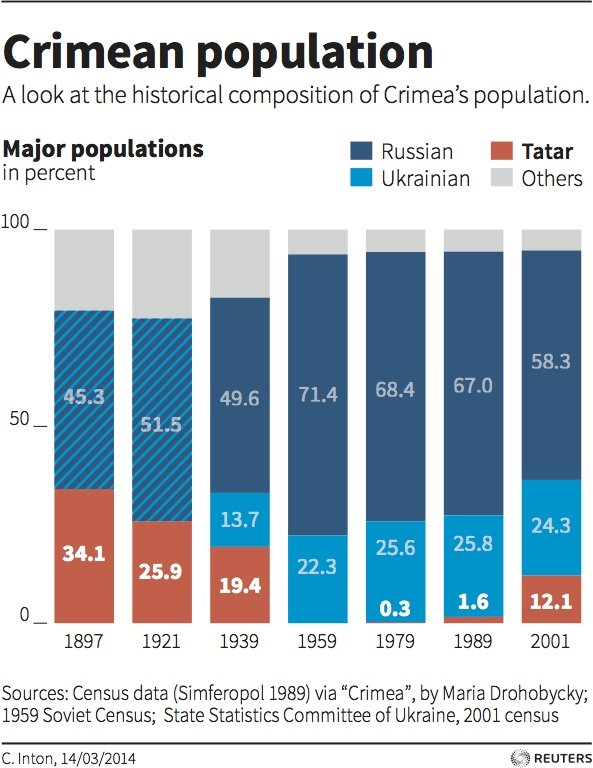
Crimea may have a majority Russian population today, but it hasn’t always been that way.
The peninsula’s dark history of ethnic cleansing is visible in the following chart from Reuters.
The chart shows a collapse in the population of native Crimean Tatars from 34.1% in 1897 to zero in 1959, marking brutal harassment leading up to Soviet leader Joseph Stalin’s forcible deportation of the entire population in 1944, with nearly half dying in the process. It took decades for the population to climb back to 12% by 2001.
While the population of Ukrainians and especially Russians rose, the percentage of the population falling into an unlisted category also fell from more than 20% in 1921 to around 5% in 1959. This was a consequence of the deportation of Armenians, Bulgarians, Greeks, and other groups.
Here’s the chart:
Stalin paved the way.
…probably should not venture into the world of Yiddish.
Oy, vey! It will only give her tsuris instead of nachas.
Note to MoDo: not all “kve” words are alike.
And it will get a lot thicker before this is through.
Captain Zaharie is now stepping to the forefront of authorities’ suspicions:
Captian Shah [Zaharie] was an ”˜obsessive’ supporter of Ibrahim. And hours before the doomed flight left Kuala Lumpur it is understood 53-year-old Shah attended a controversial trial in which Ibrahim was jailed for five years.
Campaigners say the politician, the key challenger to Malaysia’s ruling party, was the victim of a long-running smear campaign and had faced trumped-up charges.
Police sources have confirmed that Shah was a vocal political activist ”“ and fear that the court decision left him profoundly upset. It was against this background that, seven hours later, he took control of a Boeing 777-200 bound for Beijing and carrying 238 passengers and crew.
Ibrahim (also known as Anwar) seems like a relative good guy here, at least as best I can tell (and I can’t tell much, I freely admit). That certainly doesn’t mean all his supporters are.
This might explain the relative closed-mouthedness of the Malaysian government about the plane’s course and fate. However, if it was a political protest, it’s an extraordinarily extreme one for a pilot of all those years with a good record. And wouldn’t you think we’d have heard something from him by now about it? Protests only work if people know what’s being protested.
Of course, if Zaharie and the passengers are dead, we wouldn’t be hearing from him, except indirectly.
It was also announced that the plane may have sent a last ping while on the ground, and that Zaharie and his wife are either separated or divorced. And then there’s this: Zaharie or the co-pilot (or someone acting as pilot) seems to have spoken to ground control after one of the systems was turned off, and reported nothing awry.
I am relatively certain that there’s a lot more that authorities know that they’re not announcing.
[NOTE: Malaysian names turn out to be confusing, even to the newspapers. Sometimes people are referred to by one name, sometimes by another.
Here’s information about Ibrahim’s sodomy trials. This is a long-running tale in Malaysia, which sounds like quite a country—twenty-year imprisonment possible even for consensual sodomy, and a person can be convicted of sexual crimes on the testimony of one man or two woman. Sharia law.]
…to screw in a lightbulb?
No, I mean—to get cozy?
I’ve seen a couple of these Princess Cruise ads on TV, and they really drew my attention. I think they’re brilliant, actually.
In a rut? The ads sell the company’s cruises as a way to get out of that rut, not by visiting new places in the usual travel sense, but through a more internal journey that involves renewing relationships in a relaxing and luxurious atmosphere. It’s the theme and variations rather than the symphony.
That some of the ads may be quite obnoxious is of little import. The husbands or wives of a certain age, archly studying their long-term spouses in the shipboard light as though they were prize heifers and deciding they’re not so tedious after all, might strike the viewer as repugnant. But the demographic that might be expected to go on cruises may feel otherwise, and the idea of interpersonal renewal may be a good part of the reason.
Princess Cruises is certainly counting on it being part of the reason, and willing to spend quite a bit of money to prove it. It’s a new twist on the idea of a shipboard romance—this time, you’ll be having a romance with the person you’re already with, who’ll seem like a new person.
One who knows how to order wine, for example. This particular ad rubs me the wrong way for all the stated reasons and probably a few more besides, but I continue to think it’s masterful:
Here’s a similar ad with the sexes reversed:
Similar, and yet different, and not just because the couple is younger in the second ad. The woman in the first ad is admiring her slightly-graying guy because of his behavior—he’s such a sophisticate with the wine! The man in the second is admiring the way his wife looks rather than something she does, and that ad might appeal to women because it indicates that on a cruise he won’t be so mad at them for taking too long to get ready.
Brilliant, as I said.
[NOTE: My parents used to cruise every year before tax time, a way for my father (who was a CPA) to relax in winter before the big big crunch that had him burning the midnight oil. They went with at least three other couples and often more, all good friends, and they had a whopping good time.
I don’t think there was a lot of contemplative re-evaluation of the marriage. It was more about interacting with other people and experiencing some warm weather, usually the Caribbean. When I was fourteen they took my brother and me on a Christmas Caribbean cruise. I’ve never been on a cruise as an adult, but I remember that one well, especially the all-you-can-eat food. I gained about five pounds in ten days, and stayed in a room with my brother. The ship was the Mauretania, which was scrapped not long after my cruise. It seemed archaic even then; the cabin I shared with my brother was tiny and dark, without windows of any sort, which meant we could sleep late because there was no sense of time. There was a shared dorm-like bathroom down the hall. Not exactly the lap of luxury, but it was fun nevertheless.]
Well, this certainly narrows it down, doesn’t it? What an “interesting” neighborhood:
[Malaysian Prime Minister] Razak said countries located in the flight corridors that are now the focus of the search have been contacted so they can share radar data and “all relevant information” with the investigative teams, which include the Federal Aviation Administration and National Transportation Safety Board.
That northern corridor runs through Afghanistan, Pakistan, India, Bangladesh and Burma.
There is a southern corridor too, but it goes mainly to the west of Australia over the Indian Ocean.
The Prime Minister added that “the flight was still communicating with satellites until 8:11 a.m. ”” seven and a half hours after takeoff, and more than 90 minutes after it was due in Beijing,” at which point it would have been close to running out of fuel.
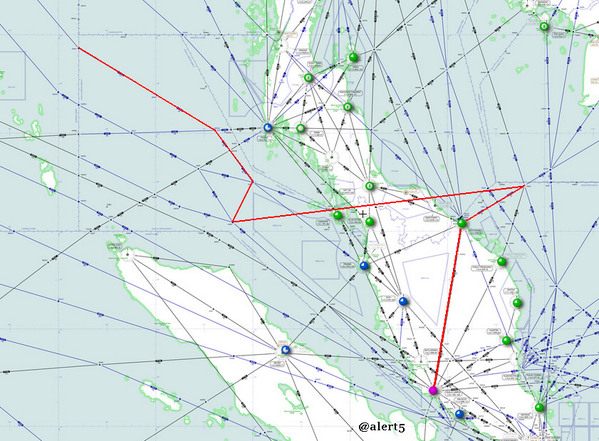
Here is all that’s known (or at least, reported to be known) of the earlier path of the plane:
This is a strong statement:
[An unnamed Malaysian] official said a deliberate takeover of the plane was no longer a theory. “It is conclusive,” he said, indicating that investigators were ruling out mechanical failure or pilot error in the disappearance…
The Malaysian official said only a skilled aviator could navigate the plane the way it was flown after its last confirmed location over the South China Sea.
The possibilities are almost endless, and some of this will be pieced together through military radar from a host of countries. I would imagine most people (and here I’d include myself) would have assumed that a rogue plane would have been detected by radar whether it had its transponder on or not, and would be considered at least potentially hostile in this post-9/11 world. And yet this one was hardly noticed, and if it was it seems to have elicited a yawn—even though a Malaysian plane was already reported to be missing! The implications are staggering.
The sad and mind-boggling truth is that we don’t know what human agent was responsible for this, where the plane was taken, if it crashed or landed safely, and if the passengers and crew are alive or dead. That’s a lot of unknowns, although I believe we are not being told everything the authorities know.
[NOTE: I’ve also noticed many people in the comments sections of various articles keep asking why none of the passengers managed to call on their cellphones. But at very high altitudes and far from any cellphone towers, no calls could be made successfully. Some of the 9/11 passengers managed to do it because those planes were flying relatively low at times, and what is especially important is that they were always over land that tended to be generously equipped with cellphone towers (here’s a very lengthy discussion; even at fairly high altitude cellphones can sometimes work if over towers). In addition, many of the 9/11 calls were on special airphones, installed in planes and designed to be used while flying.]
New information on Flight 370:
Radar signals recorded by the Malaysian military appear to show the missing airliner climbing to 45,000 feet, above the approved altitude limit for a Boeing 777-200, soon after it disappeared from civilian radar and made a sharp turn to the west, according to a preliminary assessment by a person familiar with the data.
The radar track, which the Malaysian government has not released but says it has provided to the United States and China, then shows the plane descending unevenly to 23,000 feet, below normal cruising levels, as it approached the densely populated island of Penang, one of the country’s largest. There, the plane turned from a southwest-bound course, climbed to a higher altitude and flew northwest over the Strait of Malacca toward the Indian Ocean.
This is being treated as very big news. But I’m not sure it adds a whole lot, except that it’s very consistent with the current theory that the plane was hijacked by a passenger or diverted by one of the regular pilots. I’m a bit suspicious of the article, though, because it also refers to the data transmitted from the plane’s Rolls-Royce engines, whereas most people seem to be saying that no such data was transmitted.
But confusion is the standard in this story ever since it began.
I find the following quite intriguing and disturbing (the latter a word I’ve been using over and over for the Flight 370 story):
The erratic movements of the aircraft after it diverted course and flew over the country also raise questions about why the military did not respond to the flight emergency. Malaysian officials have acknowledged that military radar may have detected the plane, but have said they took no action because it did not appear hostile.
I am confused as to how a plane could “appear hostile” on radar. It’s not as though radar can read its mind. I assume it would be through the plane’s suspicious behavior/actions/movements. But it’s hard to understand why going up and down precipitously like this, and turning off one’s transponder, wouldn’t be considered at least potentially hostile, and rouse some sort of response such as scrambling.
At least, not yet.
I hope that someday we’ll learn enough to make sense of it. But I’m beginning to wonder if that day will ever happen. Or if we’ll ever get a straight story on it from the authorities.
In the meantime, we weave speculative tales about it in an effort, probably vain, to make as much sense of it as we possibly can with the limited amount of information we have so far.
I’ve been writing about this story on a daily basis because it’s unusually gripping, with all the elements of a Tom Clancy novel except the author’s explication, or the pleasure of knowing it’s just a story. This is a story, but not just a story; it’s reality, unfortunately for the passengers, their families, and the rest of us. Just as 9/11 was a revelation about what was possible with a bunch of determined and planful terrorists, so Flight 370 is a revelation about how a flight can go missing in real time without a whole lot known about it, if certain human agents (which it appears were responsible) want it to disappear.
Here’s my best theory of the moment. It goes almost without saying that this is pure speculation, but it’s speculation based on the “facts” as best we know them:
I don’t think the cockpit was breached by a stranger, although that is certainly possible. It would help to know whether the 777 had a locked cockpit door; I haven’t seen that information offered anywhere. I think that one of the pilots (most likely the younger one, who was only 27) caught the other completely off-guard and disabled or killed him. But whether it was one of the actual pilots or an outsider, it would have to have been someone who was very familiar with this type of plane and how to turn off its feedback systems.
Once alone, the pilot was able to act as he wished without being observed. He proceeded to turn off the transponder and other systems and fly the plane according to a preconceived plan, which probably did not involve crashing it. The passengers would have been, quite literally, in the dark. Especially with a locked door, they would have noticed nothing. It was night, after all, and most were probably sleeping. They were flying over a relatively unsettled area with few lights, so why would anyone have noticed a diversion, even if it went on for many hours? When they looked out the windows, they would have seen darkness either way.
Whether the perpetrator succeeded in his plan I do not know, nor do I know what the ultimate goal was, although you can be fairly sure it was a bad one, and probably involved other people on the ground. Was his destination a country, or a remote landing strip? Did it involve further weaponizing the plane, holding the passengers hostage, or something else?
If he succeeded, we will probably learn in time, although what we learn will be even more disturbing than what we already know. Possibly even catastrophic. Alternatively, he crashed (most likely by accident) and we may or may not ever recover the plane’s wreckage, the finding of which could give us many more clues as to what happened.
A week ago I would have considered the above a wild fantasy, and I probably would not have entertained it. Things have changed, and truth may have become even stranger than fiction.
[ADDENDUM: Newer information here. The gist of it is that the plane’s new flight path was ” a commonly used navigational route.” That indicates a non-rogue pilot to me. Of course, the actual pilot might have been placed under duress by a highjacker.]
Basically, what they’re reading is a lot of what used to be called porn. And I don’t mean sneaking around to get it, or looking at it online. I mean that the young adult book market—books written expressively for young teenagers—has a certain segment that has become highly sexualized.
The idea of innocence, naivete, protecting children (or those just emerging from childhood) from matters that used to be considered adult seems to have fallen by the wayside. It wasn’t so very long ago that the relatively sedate Lady Chatterly’s Lover was still banned in the UK even for adults; the unexpurgated version couldn’t be published there till 1960.
And Lucy and Desi slept in those twin beds, at least in their TV lives. But oh, how far we’ve come since then!

…you can…well, it’s complicated.
You were too stupid to be told this before.