I’ve written quite exhaustively about the Obamacare narrow network problem, which I know is especially serious in California, because I spent a goodly portion of my spare time last winter researching Obamacare in California for a relative. It was tooth-grindingly, mind-numbingly frustrating and time-consuming to try to get any reliable information at all, but the gist of what I gleaned was bad, if a person wants to have the ability to choose or keep (quaint idea—wherever have we hard it?) his/her doctor.
The LA Times now tells us that the situation will be no better in 2015. In fact, it seems that it will be even worse, if possible, in most areas of California.
This was completely and totally predictable, like much of Obamacare’s bad news.
But did you know that Americans don’t really care about choosing their doctors? To say that, one must ignore evidence to the contrary, which says that Americans do care despite the efforts of health care insurance pundits to tell them they shouldn’t care because it doesn’t matter and all doctors are somehow the same:
Yet survey after survey has found that patients in HMOs (like Kaiser) are perfectly satisfied with their health care, and the doctors they have access to. We have a magical tendency to believe, if a doctor has done something good for us, that he or she was the only medical provider in the world who could have done that good. It’s not true.
First of all—and that’s just first of all—many people in Kaiser (at least in the past) were/are there because they chose Kaiser, which is an HMO where your choices of doctors are limited to those employed by Kaiser. Therefore these consumers are not a random sample of people; they are people who might be expected to be among those who care least about doctor choice.
Second of all, other polls indicate that many people—in fact, a majority—do care about choice for the most part.
I am most definitely one of those other people who care. My guess is that those like me, who have had a number of somewhat obscure health problems, value choice even more than most people do, because we’ve learned the value of it from personal experience.
My injuries were such that, if I had not had the capacity, through my health insurance (which for many decades I selected and paid more for in order to retain that choice), to go anywhere in the country for treatment for the nerve injuries in my arms, I would almost certainly have remained so overwhelmed, consumed, and distracted by chronic pain that I would hardly be functioning at all, if indeed I’d managed to survive (I’ve told the story here).
And I’ve seen this happen to many other people, too. Once you’ve had the experience you don’t forget it.
My guess is that many of the people who don’t care about doctor choice are young and healthy, and fortunate enough not to have needed much care, so for them any doctor will do. In fact, they probably almost never even go to a doctor. But someday they will. And most people who are older and/or sicker understand the enormous value of a doctor you like, trust, and have chosen.
Of course, choice costs money. That’s the problem. But one of Obamacare’s greatest flaws is that it not only restricts choice for those with subsidized health insurance, it standardizes all individual policies and restricts choice even for those who pay their own way (socialism is fair because it makes all people equally miserable).
All of this is why a number of states have passed or are considering what are known as “any willing provider” laws:
If approved, South Dakota would be added to the list of states with a so-called “any willing provider” laws that requires broader inclusion in health insurance networks. The health insurance industry opposes these laws, arguing that the laws hurt their ability to negotiate with physicians and hospitals and to drive efficient care ”” which, the industry says, translates to higher costs for patients…
Twenty-seven states in all have some form of any willing provider law but they vary significantly, according to the National Conference of State Legislatures. Many of these states have had these laws on the books since the 1980s, and the laws can be broad, covering most of a state’s doctors and hospitals, while others much narrower in scope apply to just pharmacies or certain provider types.
These laws reflects people’s dissatisfaction with narrow networks, a dissatisfaction Obamacare advocates are busy denying. How bad is the narrow network problem? This bad:
About 70 percent of health plans sold on the ACA’s health insurance marketplaces this past year had narrow or ultra-narrow networks, according to McKinsey and Co., which defined “narrow” as excluding at least 30 percent of an area’s largest hospitals. Narrow networks were increasingly being used before the ACA, but they’ve become more prevalent under the law…
Yes, this was already a trend. But there were a lot more choices available before Obamacare. After the passage of the Act, narrow networks made a Great Leap Forward:
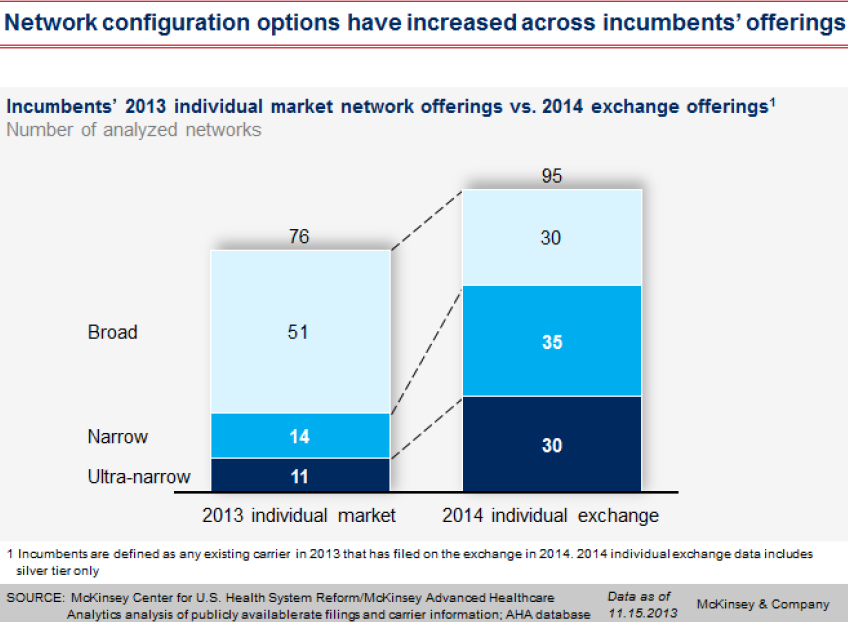
It’s not a pretty picture.